18 Egyptian Recipes: Koshari, Molokhia & Cairo Home Cooking
Egypt's legume-and-bread kitchen, from the koshari cart to the molokhia pot — 18 recipes, the six-ingredient pantry, and a 4-night rotation that costs $22 in protein.
Egyptian home cooking runs on legumes, long-simmered greens, and bread — koshari, ful medames, molokhia, and ta'ameya are the four dishes that define it, and all four are cheap, mostly vegetarian, and built for feeding a crowd. Below are 18 recipes from the AislePrompt catalog organized the way an Egyptian kitchen actually works: street food, home stews, grilled proteins, mezze, and two desserts.
Get a free week of easy dinners
Seven weeknight dinners with the shopping list already totalled, sent Sunday. No account needed, unsubscribe in one click.
No spam, unsubscribe in one click. Recipes, shopping lists and Instacart carts all work without an account either way.
Egypt is the most populous country in the Arab world and the origin point of both falafel and koshari, but it's badly underrepresented on US recipe sites compared to Lebanese or Moroccan food. That's a shame, because the cuisine is unusually well-suited to how people cook now: heavy on lentils and fava beans, light on expensive protein, and forgiving of long unattended cooking.
If you already cook Middle Eastern or Moroccan food, you have 80% of the pantry already.
Introduction: the Egyptian pantry
Six ingredients carry most of the flavor in this list. Stock these and the rest is produce.
Cumin. The dominant spice in Egyptian cooking, used far more heavily than in Levantine food. Buy whole seeds and toast them — pre-ground cumin loses most of its aromatics inside six months.
Coriander seed. Ground coriander is the partner to cumin in the taqliya (garlic-coriander sizzle) that finishes molokhia and lentil soup.
Dried mint. Not fresh. Dried mint is a distinct ingredient in Egyptian cooking with a deeper, almost tea-like flavor, and it's non-substitutable in molokhia and in the tomato sauce for koshari.
Ghee (samna). Clarified butter, used for frying rice and for the taqliya. It has a higher smoke point than butter and a nuttier flavor than neutral oil.
Molokhia leaves. Jute mallow — sold frozen and finely chopped in Middle Eastern groceries, or dried in bags. Frozen is much better than dried. There is no substitute; spinach is not molokhia.
Dried fava beans and brown lentils. The two legumes the cuisine is built on. Fava for ful medames and ta'ameya, lentils for koshari and shorbet ads.
Add rice, short pasta, vermicelli, tahini, lemons, garlic, tomato paste, and pita and you can cook every recipe below.
Equipment
Nothing exotic. A heavy-bottomed pot for the lentil-and-rice work, a wide skillet for the taqliya and for frying ta'ameya, and a sharp knife for the volume of onion this cuisine demands — koshari alone needs three large onions sliced paper-thin for the crispy topping. Browse cookware for a 5-quart Dutch oven and knives for something that will make thin, even onion slices without a fight. A food processor from small appliances is genuinely useful here: ta'ameya batter is a processor job, not a mortar job, unless you're feeling romantic about it.
Street food classics: koshari, ful medames, taameya (5 recipes)
These four dishes are what Egyptians actually eat, sold from carts and hole-in-the-wall shops from Alexandria to Aswan. All of them are vegetarian except the hawawshi.
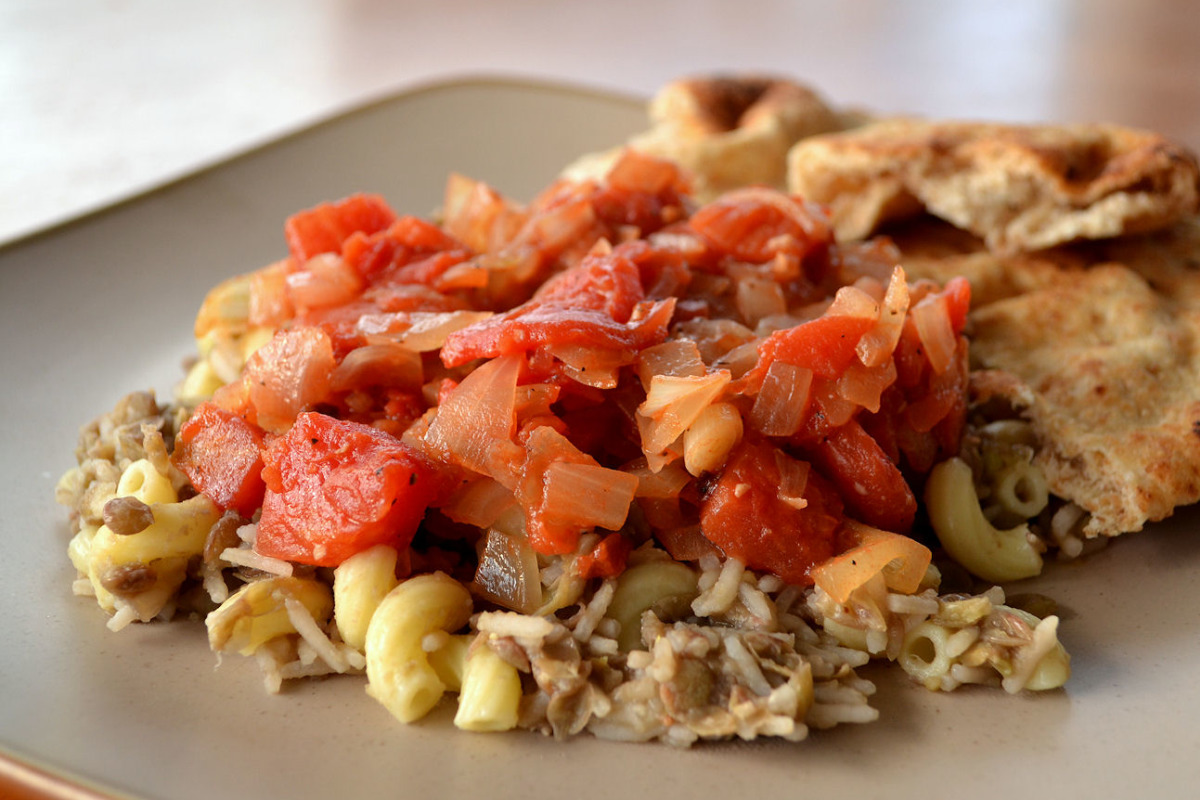
1. Koshari with Tomato Sauce and Crispy Onions — Egypt's national dish and the archetype of carb-on-carb: rice, brown lentils, and short pasta layered together, topped with a spiced tomato sauce, a garlic-vinegar daqqa, chickpeas, and a mountain of fried onions. Roughly $1.40 a serving. Make the crispy onions first and drain them well; soggy onions ruin it. Wikipedia's kushari entry traces its likely 19th-century origin to a collision of Indian khichri, Italian pasta, and Egyptian lentils.
2. Pyramid-Inspired Egyptian Koshari with Tangy Tomato Sauce — a sharper, more vinegar-forward take on the same dish. Worth making if the first version tasted flat to you; the acid is usually what's missing.
3. Slow-Simmered Egyptian Ful Medames with Garlic and Lemon — stewed fava beans mashed with olive oil, lemon, garlic, and cumin. This is the Egyptian breakfast, eaten with pita, and one of the oldest continuously prepared dishes on earth — ful medames shows up in the archaeological record well before the Islamic period. Dried favas need an overnight soak and 2–3 hours of simmering; canned favas cut it to 15 minutes with a real but acceptable quality loss.
4. Pan-Fried Egyptian Ta'ameya (Falafel) with Fresh Herb Salad — the Egyptian original, made from split fava beans rather than chickpeas, which makes it greener inside, lighter, and creamier than the Levantine version. The falafel entry covers the fava-vs-chickpea split. Do not use canned beans — the batter will disintegrate in the oil. Soaked-and-drained dried favas, never cooked, is the only way this works.
5. Baked Egyptian Hawawshi with Spiced Ground Beef Filling — spiced ground beef with onion, parsley, and chili baked inside pita until the bread crisps and the fat soaks into it. Egyptian street food's answer to a stuffed flatbread. Baked at 450°F rather than fried, which is both easier and better.
Molokhia & Cairo home stews (4 recipes)
This is what gets cooked at home on a weeknight, and molokhia in particular is the dish Egyptians abroad miss most.
6. Molokhia Stew with Chicken and Garlic — finely minced jute mallow simmered in chicken broth until it thickens to a distinctive, deliberately viscous texture, then finished with a taqliya of garlic and ground coriander fried in ghee and poured in while sizzling. Molokhia is genuinely polarizing on texture — it's mucilaginous, like okra. Serve over rice with a squeeze of lemon.
The taqliya is the step people skip and shouldn't. Fry 6–8 minced garlic cloves and a tablespoon of ground coriander in 3 tablespoons of ghee until the garlic is deep gold — 60–90 seconds, and it goes from gold to burnt in about 15 — then pour it into the pot while it's still audibly sizzling.
7. Slow-Simmered Egyptian Lentil and Tomato Stew — the everyday lentil pot. Cumin-forward, thickened with tomato, eaten with bread.
8. One-Pot Lentil and Pasta Bowl with Tomato Sauce — a weeknight koshari that skips the separate rice pot and the fried onions. 35 minutes, one pan, and about 80% of the flavor.
9. Vegetable-Infused Lentil Rice and Pasta with Tahini-Tomato Sauce — a tahini-enriched variant. The sesame changes the dish substantially and makes it richer than street koshari.
Real numbers: cost and time per dish
| Dish | Active time | Total time | Cost/serving (4) | Vegetarian |
|---|---|---|---|---|
| Koshari | 40 min | 75 min | $1.40 | Yes |
| Ful medames (dried favas) | 15 min | 3 hr + soak | $0.85 | Yes |
| Ta'ameya | 30 min | 45 min + soak | $1.10 | Yes |
| Molokhia with chicken | 25 min | 60 min | $3.20 | No |
| Hawawshi | 20 min | 40 min | $2.60 | No |
| Kofta (lamb) | 20 min | 35 min | $4.40 | No |
Costs are US national-average grocery prices as of August 2026.
Grilled proteins: kofta, kebab, samak mashwi (4 recipes)
Meat is the smaller half of Egyptian cooking, and when it appears it's usually ground, spiced, and grilled.
10. Fatimid Spice-Rubbed Chicken — a warm-spice rub (cumin, coriander, cinnamon, paprika) on chicken, roasted. The simplest entry point to the flavor profile.
11. Sheet Pan Egyptian Chicken with Sweet Potatoes and Pomegranate — the weeknight version: one pan, 45 minutes, pomegranate molasses for the sweet-sour finish.
12. Phoenician Lamb Kofta with Tahini Yogurt Sauce — ground lamb with onion, parsley, cumin, and coriander, shaped onto skewers. The critical technique: work the meat until it's slightly tacky, then chill for 30 minutes before shaping, or it slides off the skewer on the grill.
13. Lebanese-Inspired Lamb Kofta Meatballs with Tzatziki Dip — the same spice logic in meatball form, which is easier on a weeknight and better for kids.
Rice, bread & mezze (3 sides)
14. Koshari-Inspired Lentil and Rice Bowl with Tomato Garlic Sauce — this doubles as a side and as a light main. Egyptian rice is usually short- or medium-grain, toasted in ghee with broken vermicelli before the liquid goes in.
15. Roasted Eggplant Baba Ganoush with Tahini and Pomegranate — char the eggplant directly over a gas flame or under a broiler until the skin is black and collapsing. Smoke is the whole point; a gently roasted eggplant makes a bland dip.
16. Steamed Grape Leaves Stuffed with Spiced Long-Grain Rice — mahshi wara' enab. Stuffed vegetables are a whole category in Egyptian cooking; the mahshi tradition covers cabbage, zucchini, peppers, and eggplant with the same rice-and-herb filling.
Sweet finishers (2 recipes)
17. Rosewater and Cardamom Semolina Cake with Pistachio Syrup — the closest catalog analogue to basbousa, the semolina cake soaked in sugar syrup that ends most Egyptian celebration meals. The rule that makes or breaks it: hot cake, cool syrup, or the reverse — never both hot, or the cake goes soggy instead of absorbing evenly. Basbousa is shared across the eastern Mediterranean under a dozen names.
18. Orange-Cardamom Semolina Cake with Rosewater Syrup — a citrus-forward version. Less floral, better for people who find rosewater soapy, which is a real and common reaction.
Meal plan: a 4-night Egyptian dinner rotation
The rotation is designed so Monday's cooking feeds Tuesday and the legume soak windows line up.
| Night | Main | Side | Prep the night before |
|---|---|---|---|
| Sunday | — | — | Soak dried favas for Monday's ful |
| Monday | Ful medames | Pita, tomato-cucumber salad | Soak split favas for Tuesday's ta'ameya; par-cook lentils |
| Tuesday | Ta'ameya | Baba ganoush, pita | Fry the koshari onions (they keep 3 days) |
| Wednesday | Koshari | Pickled turnips | Thaw molokhia |
| Thursday | Molokhia with chicken | Egyptian rice | — |
Total protein spend for four nights, family of four: about $22. Three of the four mains are vegetarian.
To swap any of these or scale to six, build it at /meal-plan — the planner rebuilds the shopping list around whatever you keep. If you need a substitution for molokhia or fava beans, the chat assistant will rework a recipe around what your grocery store actually stocks.
Kitchen essentials for Egyptian cooking
- A 5-quart heavy pot. Koshari needs a pot that won't scorch rice on the bottom. See cookware.
- A wide, shallow skillet for the taqliya and for shallow-frying ta'ameya in an inch of oil.
- A very sharp knife. Three onions sliced paper-thin for koshari is the single most knife-dependent task in this list — a dull blade turns it into a fifteen-minute crying session. Knives and cutting, and our knife set guide if you're buying.
- A food processor for ta'ameya batter and for mincing herbs in the volume this cuisine wants. Small appliances.
- A spider or slotted skimmer for pulling ta'ameya and fried onions out of oil. Utensils and tools.
- A spice grinder for whole cumin and coriander. See kitchen gadgets.
Technique: the three things that separate Egyptian from Levantine cooking
If you already cook Lebanese or Syrian food, three habits change.
Cumin volume. Egyptian cooking uses roughly two to three times the cumin of Levantine cooking. A pot of Egyptian lentil soup takes a full tablespoon of ground cumin for four servings; the same pot cooked Lebanese-style takes a teaspoon. If your version tastes like it's missing something, it's almost always cumin.
The taqliya finish. Levantine soups get finished with lemon and olive oil. Egyptian soups and stews get finished with garlic and coriander bloomed in hot fat and poured in at the last second. It's a heat-and-timing technique, not an ingredient list, and it's why restaurant molokhia tastes different from yours.
Bread as a utensil. Aish baladi — the whole-wheat pita that puffs into a hollow round — is not a side, it's the fork. Ful, ta'ameya, and baba ganoush are all eaten by tearing and scooping. Egyptian bread covers the baladi/shami distinction; the word aish literally means "life." If your grocery only stocks thin Greek-style pita, look for a whole-wheat pocket pita — the thicker bread holds up to scooping where a thin one tears.
Toasting whole spices: the 90-second version
Whole cumin and coriander seed lose potency slowly; pre-ground loses it in months. Toast whole seeds in a dry skillet over medium heat, shaking constantly, for 60–90 seconds until they smell like a spice market and the cumin darkens a shade. Cool completely before grinding — grinding warm seeds turns them to paste in the grinder. A tablespoon of freshly toasted, freshly ground cumin has roughly the aromatic punch of three tablespoons of the jar you opened last winter.
Regional differences: Cairo, Alexandria, and Upper Egypt
Egypt is not one kitchen, and knowing the split helps you understand why two recipes for the same dish look nothing alike.
| Region | Signature | What changes |
|---|---|---|
| Cairo / Delta | Koshari, molokhia with rabbit or chicken | The street-food canon; heavier on tomato and vinegar |
| Alexandria | Seafood, samak mashwi, sayadeya rice | Grilled fish over spiced rice; more garlic, less cumin |
| Upper Egypt (Saeidi) | Firm ghee, fatta, slow-cooked lamb | Richer, more meat, more clarified butter |
| Sinai / Bedouin | Pit-cooked lamb, flatbread on a saj | Sparse spicing, smoke-forward |
The recipes in this list lean Cairo and Delta, because that's the version most people mean when they say "Egyptian food," and it's the one built from pantry legumes rather than a whole lamb.
Fatta — the dish worth knowing about
Fatta deserves a mention even though the catalog doesn't have a direct match yet: layers of toasted bread, rice, and simmered meat, drenched in a garlic-vinegar-tomato sauce and served at Eid and at celebrations. It's the clearest expression of the Egyptian instinct to layer starches and then cut through them with acid — the same logic that produces koshari. If you like koshari, fatta is the next thing to look for.
Common pitfalls: 5 ways Egyptian recipes go wrong
1. Canned favas in ta'ameya. Cooked beans have no structure. The batter falls apart in the oil and you get greasy fragments. Dried split favas, soaked 12–24 hours, never cooked.
2. Burning the taqliya. Garlic goes from gold to acrid in about fifteen seconds in hot ghee. Pull the pan the moment the garlic is deep gold — carryover heat finishes it.
3. Skipping the daqqa on koshari. The garlic-vinegar sauce is not optional garnish; it's the acid that keeps three starches from tasting like paste. Make it, and make it sharp.
4. Under-frying the koshari onions. They should be deep brown and shatteringly crisp, which takes 20–25 minutes over medium heat, not 8. Pull them when they're a shade lighter than you want and drain on paper — they darken as they cool.
5. Substituting spinach for molokhia. It isn't a texture approximation, it's a different dish. If you can't find frozen molokhia, cook something else that week.
When Egyptian cooking isn't the right call
- You're low-carb. Koshari is rice, pasta, and lentils in one bowl. The cuisine's core is starch, and stripping it out leaves very little.
- You need dinner in 20 minutes. Ful and ta'ameya need overnight soaks; koshari needs three components cooked separately. The sheet-pan chicken is the only genuinely fast entry here.
- Your grocery store has no Middle Eastern section. Molokhia and dried split favas are the two hard-to-source items. Everything else is supermarket-standard.
- Texture is a dealbreaker. Molokhia's viscosity is not something you get used to on the second try. Know that going in.
FAQ
The five questions we hear most about cooking Egyptian food at home, answered below.
Sources
- Egyptian cuisine — dishes, history, and regional variation
- Kushari — origin and composition of Egypt's national dish
- Molokhia — the plant, the dish, and its regional spread
- Ful medames — the oldest dish in the list
- Falafel — the fava-vs-chickpea split
- TasteAtlas — Egypt — regional dish index
Related reading
- 22 Middle Eastern Dinners: Shawarma, Kebabs & Hummus Bowls
- 20 Moroccan Recipes: Tagines, Couscous & Harissa
- 20 Lebanese Recipes: Hummus, Tabbouleh, Kibbeh & Mezze
- 22 Greek Recipes: Moussaka, Souvlaki & Spanakopita
- 22 Chickpea Recipes: Plant-Based Weeknight Dinners
Frequently asked questions
What is koshari and why is it Egypt's national dish?
Where can I find molokhia leaves outside Egypt?
Is Egyptian falafel (taameya) the same as Lebanese falafel?
Which Egyptian recipes are vegan or vegetarian?
How spicy is Egyptian food compared to Moroccan or Levantine cuisine?
Sources
- en.wikipedia.org
- en.wikipedia.org
- en.wikipedia.org
- en.wikipedia.org
- en.wikipedia.org
- en.wikipedia.org
- en.wikipedia.org
- en.wikipedia.org
- tasteatlas.com
Plan a week of meals in two minutes.
Tell our AI what you have and what you like — it builds your plan, shopping list, and Instacart cart. No account needed.
Try free →