18 Sri Lankan Recipes: Coconut Curries, Kottu Roti & Hopper Breakfasts
Temper the curry leaves first, add the coconut milk last, and roast your own curry powder — the three habits that separate Sri Lankan cooking from its neighbors.
Sri Lankan home cooking comes down to three moves: a hot tempering of curry leaves and mustard seed to start, dark-roasted curry powder instead of the pale yellow supermarket kind, and coconut milk stirred in at the end rather than the beginning. Get those three right and a chicken curry, a dhal, a sambol and a pot of rice becomes a complete Sri Lankan table in about an hour.
Get a free week of easy dinners
Seven weeknight dinners with the shopping list already totalled, sent Sunday. No account needed, unsubscribe in one click.
No spam, unsubscribe in one click. Recipes, shopping lists and Instacart carts all work without an account either way.
Introduction: Sri Lankan spice logic and the tempered curry
Sri Lankan cuisine gets filed under "Indian food" by most American grocery stores and most American search results, and that is a genuine loss. The island sits 20 miles off the southern tip of India, but its cooking runs on a different engine: coconut in three forms rather than dairy, dark-roasted spice rather than raw ground spice, and sour notes from tamarind and goraka rather than yogurt or tomato.
The structural unit is not "a curry" — it is rice and curry, a platter of one starch and four to six small dishes eaten together in one sitting. That is why every recipe below is small. A Sri Lankan chicken curry serves four as one component of a meal, not four as the entire meal.
Almost every dish starts the same way, with the temper (thel dala): oil at medium-high heat, then mustard seeds until they pop, then a sprig of fresh curry leaves and a strip of pandan, then sliced onion, garlic and green chili. That sequence takes 90 seconds and it is the reason a Sri Lankan dhal tastes nothing like a north Indian one. Skip it and you have made a generic coconut stew.
Three heat levels are worth knowing before you start. Traditional home curries land around 6-8 out of 10 on a Western scale. The recipes in this roundup sit at 4-6 as written, and every one of them scales down by halving the chili powder and seeding the fresh chilies. The flavor lives in the tempering, not the burn.
The 6 pantry cornerstones (curry leaves, pandan, coconut, Ceylon cinnamon, roasted curry powder, Maldive fish)
Six ingredients carry roughly 80% of the flavor identity. Buy these and almost any Sri Lankan recipe becomes reachable; substitute your way around them and you will end up cooking something else.
| Ingredient | Sinhala name | What it does | Substitute | Where to find |
|---|---|---|---|---|
| Fresh curry leaves | karapincha | Citrus-camphor top note in the temper | None that works — freeze extras | South Asian grocer, $2-3/bunch |
| Pandan leaf | rampe | Grassy, vanilla-adjacent background | Omit; do not use pandan extract | Frozen at Asian grocers |
| Coconut milk + fresh coconut | pol kiri / pol | Body, sweetness, sambol texture | Full-fat canned; frozen grated coconut | Any supermarket, $2/can |
| Ceylon cinnamon | kurundu | Delicate, floral warmth | Cassia works but is 3x harsher | Spice shops, $6-10 |
| Roasted curry powder | thuna paha | The dark, toasty base note | Make it — see below | Home-toasted |
| Maldive fish | umbalakada | Dry umami and salt in sambols | Bonito flakes, or anchovy paste | Sri Lankan grocer |
Two of those deserve detail.
Ceylon cinnamon is not a snob preference here — it is the actual species, Cinnamomum verum, and Sri Lanka produces the overwhelming majority of the world's supply. It is pale, brittle, layered like a cigar, and tastes floral where cassia (the hard, single-curl bark sold as "cinnamon" in most US stores) tastes hot and candy-like. In a curry that uses a 2-inch piece, the difference is obvious.
Roasted curry powder is a 12-minute job you do once a month. Toast 3 tablespoons coriander seed, 1 tablespoon cumin seed and 2 teaspoons fennel seed in a dry pan over medium heat until they are genuinely dark brown — well past the point that feels safe, roughly 8-10 minutes with constant movement. Add 10 dried curry leaves, a 2-inch Ceylon cinnamon stick, 4 cloves and 3 cardamom pods for the last 60 seconds. Cool completely, then grind. It keeps 3 months in a sealed jar and it is the single biggest upgrade available to a Western cook attempting this cuisine.
You will also want a heavy pan that holds heat for the tempering step and a spice grinder; the cookware and kitchen gadgets categories cover both.
6 signature curries (chicken curry, dhal, jackfruit polos, cashew curry, kiri hodi, fish ambul thiyal)
These six are the working core of the cuisine. Cook two of them plus rice and a sambol and you have a legitimate Sri Lankan dinner.
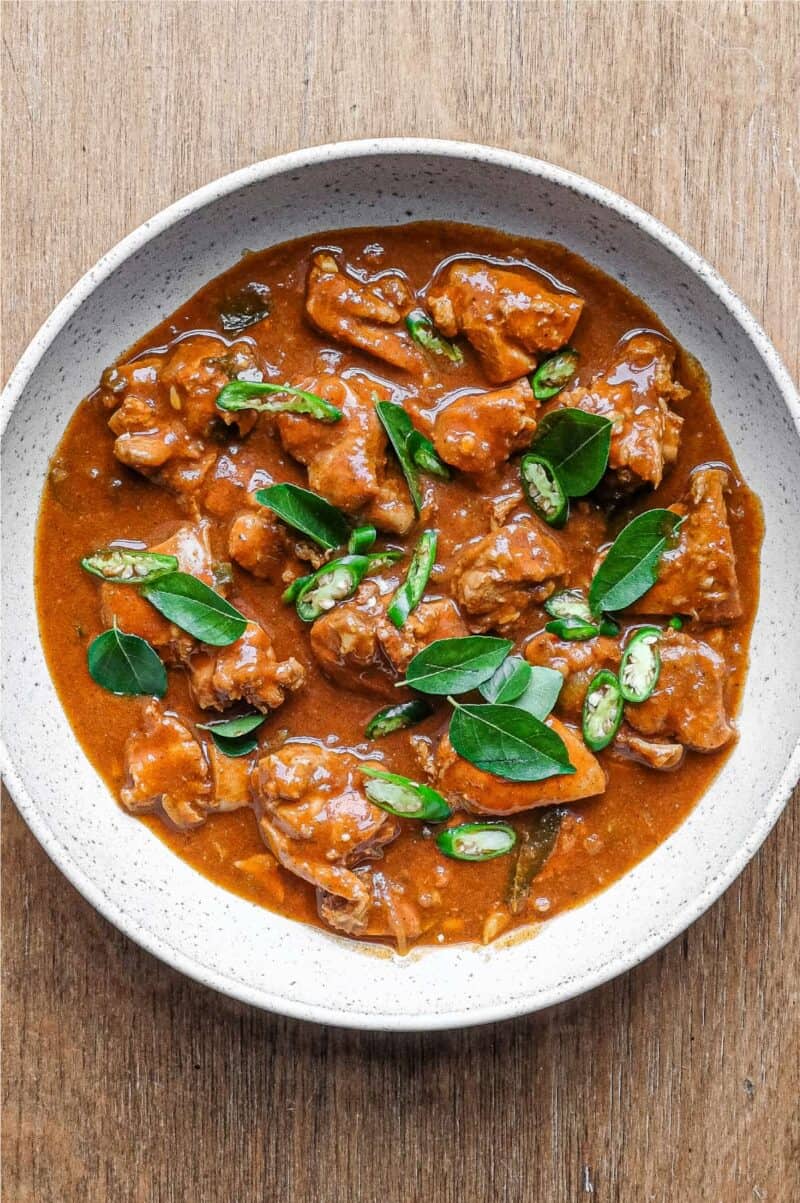
Slow-Simmered Sri Lankan Chicken Curry with Roasted Curry Leaves is the anchor dish — bone-in thighs, roasted curry powder, and coconut milk added only in the last 10 minutes so it never breaks. Bone-in matters: the collagen gives the gravy body that boneless breast cannot.
Red Lentil Parippu Curry with Coconut and Mustard Seeds is parippu, the dish that appears on virtually every Sri Lankan plate. Red lentils collapse in 15 minutes with no soaking, and the whole thing is a 25-minute weeknight proposition. The Sri Lankan Red Lentil and Spinach Curry is the same idea with greens folded in for a one-pot vegetarian dinner.
Golden Chickpea and Cashew Coconut Curry with Turmeric stands in for kaju maluwa, the cashew curry served at celebrations. Real cashew curry uses raw cashews soaked for several hours until they turn tender and almost custardy — if you make it that way, soak overnight and keep the simmer gentle, because a hard boil turns them chalky.
Coconut Tamarind Fish Curry with Fresh Herbs is the closest catalog analogue to ambul thiyal, the southern sour fish curry. Authentic ambul thiyal uses goraka (Garcinia gummi-gutta), a dried sour fruit that acts as both acid and preservative — it is what allowed fishing villages to keep fish edible for days without refrigeration. Tamarind is the accessible substitute; use about 2 tablespoons of concentrate per pound of fish.
Sri Lankan-Style Fish Curry with Curry Leaves and Slow-Simmered Sri Lankan Coconut Fish Curry cover the milder coconut-forward end. Use a firm fish — kingfish traditionally, but swordfish, mahi-mahi or halibut all hold together through a 12-minute simmer where cod will fall apart.
Slow-Cooked Black Pork Curry with Roasted Coconut Sambol is the island's darkest, most intense curry — the black comes from curry powder toasted nearly to charcoal plus a long, low simmer. Budget 2.5 hours and do not rush the browning.
For kiri hodi, the thin coconut-milk gravy poured over rice, there is no shortcut worth writing: simmer one can of coconut milk with sliced onion, green chili, turmeric, a pandan strip, curry leaves and a squeeze of lime for 8 minutes, never letting it boil. It is the mildest thing on the table and it exists to cool the rest of it down.
4 rice, roti and street food (kottu roti, lamprais, milk rice kiribath, godhamba roti)
Kottu roti is the national street food and the loudest dish in South Asia — shredded godhamba roti chopped on a griddle with egg, vegetables, curry and two metal blades, in a rhythm you can hear a block away. At home, use a flat griddle or your widest skillet, two sturdy metal spatulas, and day-old roti or flour tortillas cut into ribbons. The technique that matters: cook the egg and vegetables first, add the roti ribbons last, and chop rather than stir so the bread absorbs curry without going to mush. Total time is under 15 minutes and it is the best use of leftover curry there is.
Godhamba roti is the paper-thin stretched flatbread underneath kottu. The dough is high-hydration and rested for at least an hour, then slapped and stretched translucent on an oiled surface — much closer to Malaysian roti canai than to Indian chapati.
Lamprais is the Dutch-Burgher contribution: rice cooked in stock, a mixed meat curry, a fried ash-plantain cutlet, a boiled egg, seeni sambol and a blachan, all wrapped in banana leaf and baked. It is a weekend project, and it is the single most distinctive thing on the island's menu.
Kiribath — milk rice — is short-grain rice cooked in coconut milk until sticky, pressed flat, and cut into diamonds. It marks new beginnings: New Year, the first of the month, a new house. Serve it with seeni sambol or lunu miris. The closest catalog match for the technique is Coconut Milk-Infused Jasmine Rice with Lemongrass; use short-grain rice and a 1:1 coconut milk-to-water ratio to get the sliceable texture.
4 breakfast dishes (hoppers appa, string hoppers, egg hoppers, pol sambol)
Sri Lankan breakfast is the meal that converts people.
Hoppers (appa) are fermented rice-flour and coconut-milk pancakes cooked in a small bowl-shaped pan, swirled so the batter climbs the sides. The result is a bowl with a lace-crisp rim and a soft, slightly sour, custardy center. The batter ferments 8-12 hours at room temperature — overnight is the practical schedule. A hopper pan runs $15-25 and nothing in a Western kitchen genuinely replicates it; a small wok is the least-bad substitute.
Egg hoppers are the same batter with an egg cracked into the center as it sets, covered for 3 minutes. This is the breakfast to make on a Saturday for people who have never eaten Sri Lankan food.
String hoppers (idiyappam) are steamed nests of pressed rice-flour noodles, eaten with kiri hodi and pol sambol. They need a string-hopper press and about 20 minutes of assembly, and they hold better than hoppers do.
Pol sambol rides along with all three — see the next section.
4 salads, sambols and sides (pol sambol, seeni sambol, gotu kola mallum, mango achcharu)
Sambols are the condiment class that makes the whole platter work: small, sharp, and eaten in the same bite as the mild things.
Pol sambol is freshly grated coconut, chili powder, red onion, lime, salt and Maldive fish, worked together by hand until the coconut turns pink. Frozen grated coconut works; desiccated coconut does not unless you rehydrate it in 2 tablespoons of warm water first. It takes five minutes and it goes on everything.
Seeni Sambol with Caramelized Onions and Spices is the sweet-hot opposite: onions cooked down 40 minutes with tamarind, sugar, chili and cinnamon until they turn jammy and near-black. It keeps two weeks refrigerated and improves for the first three days.
Mallum is the shredded-greens side, traditionally gotu kola — grated coconut, lime, chili and greens, barely cooked so it stays green. Stir-Fried Mixed Vegetables with Coconut and Curry Leaves is the same technique with supermarket vegetables; kale or collards stand in for gotu kola with 60 seconds of heat, no more.
Achcharu is the pickle end of the table. Eggplant Moju Pickle with Tamarind and Mustard Seeds is the classic wambatu moju — eggplant fried until collapsed, then pickled sweet-sour with mustard and tamarind. Crisp-Fried Eggplant with Coconut and Tamarind Stir-Fry is the faster weeknight version.
Round out a platter with Tamarind-Infused Chickpea Curry with Coconut Milk, Fenugreek-Tempered Pumpkin Curry (the analogue of wattakka kalu pol), Stir-Fried Okra with Cashews and Coconut Milk (bandakka), Slow-Cooked Potato Curry with Mustard Oil and Curry Leaves (ala hodi), Coconut and Tamarind Lentil Curry with Mustard Seeds, and Eggplant and Fenugreek Leaves Curry. For a snack or a starter, Spicy Sri Lankan Chicken 65 with Curry Leaf and Green Chili is the fried-chicken end of the island's Indian-influenced repertoire.
Setting up a Sri Lankan rice-and-curry platter
Rice and curry is a balance problem, not a recipe. The plate needs one mild thing, one rich thing, one sour thing, one sharp thing and one crunchy thing around a mound of rice. Here is a workable Saturday build for four people:
| Component | Dish | Active time | Make ahead? |
|---|---|---|---|
| Rice | Plain basmati or red rice | 5 min | No |
| Main curry | Sri Lankan chicken curry | 25 min | Yes, 3 days |
| Dhal | Red lentil parippu | 10 min | Yes, 4 days |
| Vegetable | Pumpkin or okra curry | 15 min | Yes, 2 days |
| Mild gravy | Kiri hodi | 10 min | Same day only |
| Sambol | Pol sambol | 5 min | Same day only |
| Pickle | Eggplant moju | 30 min | Yes, 2 weeks |
Total active time is about 100 minutes, but only 25 of those fall on the day if you cook the curries ahead — every coconut-based curry on this list is better on day two, once the roasted spice has bled fully into the gravy.
Five mistakes that spoil a Sri Lankan meal:
- Boiling coconut milk. It splits into oil and grainy solids. Add it off the boil, at the end, and keep the pot at a bare shiver afterward.
- Skipping the temper. Dumping ground spices into liquid gives you a flat, dusty curry. The 90-second oil bloom is the whole flavor.
- Using pale supermarket curry powder. Un-roasted powder in a Sri Lankan recipe reads as thin and slightly raw. Toast your own.
- Dried curry leaves. They contribute almost nothing. Buy fresh, use what you need, freeze the rest in a bag — they temper straight from frozen.
- Making one curry and calling it dinner. The cuisine is built on contrast between four or five small dishes. Two curries plus rice and a sambol is the realistic minimum.
For storing the make-ahead half of the platter, flat stackable containers beat round tubs — see the storage and containers category, and the utensils category for the microplane and heavy spatulas the sambols need.
Frequently asked questions
How is Sri Lankan curry different from Indian curry?
Sri Lankan curries lean more heavily on coconut milk and roasted curry powder (kalu thuna paha), and use curry leaves, pandan, and rampe as tempering aromatics rather than cumin-coriander bases. The heat profile is higher than most Indian regional cuisines because black pepper and Ceylon cinnamon add background warmth on top of chili. Sri Lankan meals also center a shared platter (rice + 4-6 small curries) rather than one main dish.
Do I really need a hopper pan to make hoppers?
Yes — a hopper pan (a small round bowl-shaped pan) creates the signature crisp lace edge and soft custardy center. A mini wok or a wok-shaped small nonstick pan is a workable substitute. Hoppers are one of very few Sri Lankan dishes that don't translate to standard Western cookware. Hopper pans cost $15-25 online and last a lifetime with basic care.
Can I substitute regular curry powder for Sri Lankan roasted curry powder?
Not really — the roasted version has a fundamentally deeper, more toasty flavor because the whole spices are dry-toasted to nearly black before grinding. Make your own by toasting equal parts coriander, cumin, and fennel seeds until very dark, then blending with dried curry leaves, chili, cardamom, cloves, and Ceylon cinnamon. Store in a sealed jar for up to 3 months.
What is Maldive fish and can I substitute it?
Maldive fish (umbalakada) is dried, cured skipjack tuna shaved into flakes — it adds umami and salt to sambols and dhal without adding wetness. Bonito flakes are the closest substitute, followed by a mix of anchovy paste and fish sauce (use a quarter teaspoon of each per tablespoon of Maldive fish called for). Vegans can skip it and add a pinch of MSG or mushroom powder instead.
How spicy are Sri Lankan curries, and how do I dial the heat down?
Genuinely spicy — a home Sri Lankan chicken curry runs 6-8 out of 10 on the Western scale. Dial down by cutting the chili powder by half, removing seeds from the fresh chilies, and finishing with extra coconut milk. The tempering step (curry leaves, mustard seeds, garlic in hot oil) is non-negotiable; that's where the flavor lives, not just the heat.
Sources
- Sri Lankan cuisine — regional overview, dish taxonomy and colonial influences
- Rice and curry — the structure of the shared platter
- Appam (hoppers) and idiyappam (string hoppers) — batter, fermentation and pan technique
- Kottu — the street-food dish and its griddle method
- Cinnamomum verum — why Ceylon cinnamon is a different species from cassia
Where to go next
For the neighboring cuisine and its overlaps, 25 easy Indian dinner recipes covers the curries most Americans already know. 25 Thai recipes and 22 Malaysian and Indonesian recipes work the same coconut-and-chili territory from the other side of the Bay of Bengal.
Frequently asked questions
How is Sri Lankan curry different from Indian curry?
Do I really need a hopper pan to make hoppers?
Can I substitute regular curry powder for Sri Lankan roasted curry powder?
What is Maldive fish and can I substitute it?
How spicy are Sri Lankan curries, and how do I dial the heat down?
Sources
- en.wikipedia.org
- en.wikipedia.org
- en.wikipedia.org
- en.wikipedia.org
- en.wikipedia.org
- en.wikipedia.org
- en.wikipedia.org
Plan a week of meals in two minutes.
Tell our AI what you have and what you like — it builds your plan, shopping list, and Instacart cart. No account needed.
Try free →