Brazilian Recipes: 46 Authentic Dishes from Feijoada to Brigadeiro
A cook's map of Brazil's five regional kitchens — Bahia's coconut and dendê, the churrasco South, the pork and black beans of Minas — plus the salgados and sweets that fill the table between meals.
Brazilian cooking travels further per ingredient than almost any other cuisine — the same bottle of dendê oil takes you from moqueca in Bahia to shrimp bobó in Rio to a pot of coconut-stewed black beans in Minas. This guide covers 46 authentic Brazilian recipes: the weekend feijoada, the coastal stews, churrasco at the home grill, the salgados that fill a party table, and the brigadeiros that end it — with the sourcing and technique notes that make each one taste right.
Get a free cookout plan for a crowd
Mains, sides and quantities scaled to your headcount, with one Instacart cart instead of a spreadsheet.
No spam, unsubscribe in one click. Recipes, shopping lists and Instacart carts all work without an account either way.
Brazil's five regional kitchens, mapped
Brazilian cooking isn't one cuisine — it's roughly five. Bahia in the northeast is coconut, dendê palm oil, and dried shrimp; Minas Gerais is pork, black beans, and slow-simmered comfort food; the South is churrasco and gaúcho grill culture; the North is Amazonian fish and tucupi; and Rio and São Paulo blend all of them plus Portuguese, Italian, Japanese, and Middle Eastern immigrant influence. What ties them together is the meal shape: a protein (grilled, stewed, or fried), rice and beans, a starchy toasted crumb (farofa), and something raw and acidic (vinagrete or vegetable salad). Build a plate to that formula and it reads unmistakably Brazilian even if you've swapped every ingredient.
What follows is organized the way a Brazilian table actually fills up: the long-simmer stews first, then the coastal coconut dishes, the grill, the everyday rice and beans, the salgados that show up between meals, and the sweets. The good news for weeknight cooks: about 60% of the recipes below are naturally gluten-free (tapioca and cassava do most of the starch work), and most take under 45 minutes once you've made one Sunday cook — feijoada, picanha roast, or a big pot of arroz e feijão — that carries three subsequent dinners.
The Brazilian pantry: dendê, farofa, cachaça, malagueta
Six ingredients unlock most of the recipes below. All are shelf-stable or refrigerator-durable and worth a single Latin-market run to acquire:
| Ingredient | What it is | How you use it |
|---|---|---|
| Dendê (red palm oil) | Deep-orange oil from Bahia | 1–2 Tbsp at the end of moqueca, bobó, or acarajé for color and smoky depth |
| Farofa flour | Toasted cassava (yuca) meal | Toast in butter with onion, garnish everything |
| Cachaça | Distilled sugarcane spirit | Caipirinhas + a splash into moqueca broth |
| Malagueta or bird's-eye chili | Tiny fresh red chilies | 1–2 in stews; base of every table hot sauce |
| Coco leite (unsweetened coconut milk) | Full-fat, 400 mL cans | Moquecas, bobós, coconut rice |
| Tapioca flour (polvilho azedo) | Sour cassava starch | Pão de queijo, brigadeiro thickener |
A tin of dendê goes rancid in six months even sealed, so buy the smallest bottle you can find (100–250 mL) and refrigerate it after opening. Yellow farofa flour, tapioca starch, and coconut milk keep basically forever. Chili you'll grow on a windowsill or replace with any small hot red chili.
If you're new to the cuisine, Feijoada Carioca Black Bean and Pork Stew is the flagship cook and Traditional Brazilian Cheese and Cassava Bread (Pão de Queijo) is the easiest first bake — same pantry serves both.
Feijoada & long-simmer stews (5 recipes)
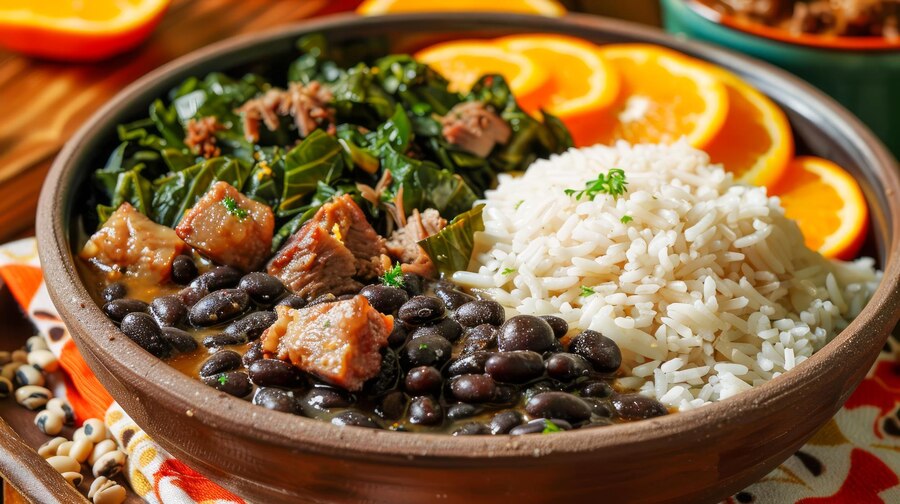
Feijoada is the Brazilian Sunday cook: black beans slow-simmered with a menagerie of smoked and cured pork parts (ribs, sausage, trotter, ear, tail in the full traditional version — pick any three for a home cook's version), served with white rice, sautéed collard greens, farofa, and oranges. The oranges aren't optional; they cut the pork richness so you can eat a full plate. The dish's history — and the long-debunked myth that it was invented in slave quarters from scraps — is laid out at Wikipedia — Feijoada; it descends from Portuguese and wider European bean-and-meat stews.
Feijoada carioca — the Rio version, the one most Americans have eaten. Overnight-soak two pounds of black beans, then simmer in a heavy pot with smoked pork ribs, a good linguiça calabresa or Portuguese chorizo, a smoked ham hock, garlic, bay, and enough water to cover by two inches. Simmer three hours until the beans have collapsed into a dark, glossy broth. Season aggressively with salt, sweat two chopped onions in bacon fat and stir them in, and finish with a splash of white vinegar. The Feijoada Carioca Black Bean and Pork Stew is a full, home-scale recipe with the exact meat ratios.
Weeknight feijoada. Same idea, scaled down and short-cut: canned black beans (drained), one small package of pre-cooked linguiça, a handful of diced smoked ham, and everything simmered for 45 minutes so the beans still have their soul. Not tradition; it is dinner on a Tuesday.
Feijão tropeiro — the pioneer's ancestor of feijoada from Minas Gerais. Cooked black beans (drained, not saucy) tossed with sautéed bacon, sausage, garlic, farofa, and a scramble of eggs, finished with collards. It's a one-pan skillet meal in 30 minutes; see Feijão Tropeiro with Collard Greens and Farofa for the exact assembly order (farofa and eggs go in last so nothing gets soggy).
Slow-simmered pork-and-bean feijoada — the middle-path recipe, split-timed. Brown two pounds of pork shoulder cubes, add to a pot of black beans with smoked paprika, garlic, and bay. Simmer three hours. See Slow-Simmered Black Bean Feijoada with Pork and Beef for the beef-and-pork ratio.
Baked feijoada casserole — bake instead of simmer. See Baked Feijoada-Style Black Bean Casserole with Pork for a variation that finishes in the oven while you set the table.
For a sausage-forward version that skips the harder-to-source cuts entirely, Slow-Cooked Brazilian Feijoada with Smoked Sausage leans on linguiça and smoked ham you can buy at any supermarket.
For any long-simmer stew, invest one time in a Le Creuset Enameled Cast Iron Dutch Oven, 6.5 qt. The heavy walls hold temperature perfectly across three hours of low simmer, and the tight lid keeps evaporation predictable so your beans stay soupy rather than reducing to paste.
Moqueca & coastal fish stews (4 recipes)
Moqueca is Brazil's most famous fish stew, and it's actually two different dishes depending on where in Brazil you ate the last one. Baiana (from Bahia) is built on coconut milk and dendê palm oil, cooked in a clay pot, and finished with cilantro and lime. Capixaba (from Espírito Santo) skips the coconut and dendê and uses annatto oil and tomato instead. Both are outstanding; Baiana is the version most home cooks meet first, and Wikipedia — Moqueca traces how the two diverged along the coast.
Classic moqueca de peixe. Firm white fish (grouper, snapper, cod, or halibut) marinated 20 minutes in lime, garlic, and cumin, then layered in a heavy pot over sautéed onion, tomato, and bell pepper, simmered in coconut milk with dendê oil added at the very end. Time in the pot: 12 minutes total. The Moqueca de Peixe (Coconut Fish Stew) is the canonical version, sized for four.
Moqueca-style Brazilian fish stew. A less-strict version that uses annatto oil instead of dendê if you can't source the palm oil — see Moqueca-Style Brazilian Fish Stew with Coconut and Palm Oil for the substitution ratios.
Moqueca de camarão. Shrimp instead of fish, cooked the same way. Two pounds of medium shrimp go in the last five minutes; anything longer and they turn to erasers. Cook this in a wide, shallow pot so the shrimp cook in a single layer. Try the Moqueca de Camarão with Coconut Milk and Dendê Oil recipe — 30 minutes total.
Clay-pot moqueca baiana. If you have a clay pot (panela de barro) or any heavy earthenware, the traditional version cooks in it because the clay holds heat gently for the slow flavor build. See Clay Pot Moqueca Baiana with Coconut and Dendê Oil for pot substitutes if you don't own clay.
Serve moqueca ladled over white rice with a small mound of farofa on the side and a wedge of lime. Nothing else needed.
Bahia's coconut-and-dendê table: bobó, vatapá and shrimp in coconut milk (4 recipes)
Moqueca gets the attention, but Bahia's real signature is a family of thick, orange, coconut-and-palm-oil stews built on the same base and separated by what thickens them. Learn the base once — onion, garlic, tomato, bell pepper, cilantro, coconut milk, dendê at the end — and four dishes come off it.
Bobó de camarão is moqueca thickened with puréed cassava (yuca). Boil a pound of peeled cassava until fork-tender, blend it smooth with a cup of the cooking water and a can of coconut milk, then fold that purée into the sautéed aromatics and add shrimp for the last five minutes. The texture lands somewhere between a bisque and a curry, and it eats over rice like nothing else in the Brazilian repertoire. Start with Bobó de Camarão with Coconut and Cassava, which gives the cassava-to-coconut ratio explicitly — get that wrong and you either get soup or wallpaper paste.
Slow-cooked shrimp bobó takes the same dish into a Dutch oven or slow cooker for a hands-off weekend version. See Slow-Cooked Brazilian Shrimp Bobó with Coconut Milk. Add the shrimp only in the final 10 minutes regardless of what the total cook time is; they overcook on any timeline.
Vatapá is the same stew thickened with stale bread, ground peanuts, and cashews instead of cassava, blended into something closer to a savory porridge. It is the classic filling inside acarajé (black-eyed-pea fritters) and is excellent on its own over rice. Vatapá Coconut Shrimp Stew with Dende Oil is the home-scale version; the nuts do the work, so toast them before grinding.
Camarão no leite de coco is the unthickened cousin — shrimp simmered straight in coconut milk with dendê and lime, no purée at all. Fastest of the four at about 25 minutes. See Camarão no Leite de Coco with Dende Oil.
If you want the fuller Bahian seafood spread, Moqueca Baiana-Style Seafood Stew with Dende Oil mixes fish, shrimp, and shellfish in one pot — the version served at a Salvador beach barraca. Bahia's kitchen is distinct enough that Wikipedia's Cuisine of Bahia entry tracks its West African roots separately from the rest of Brazilian cooking, and the dendê-plus-coconut base is exactly where that lineage shows.
| Bahian stew | Thickener | Active time | Serve with |
|---|---|---|---|
| Moqueca | none (reduces) | 30 min | White rice, farofa, lime |
| Bobó de camarão | Puréed cassava | 45 min | White rice only |
| Vatapá | Bread + peanuts + cashews | 40 min | Rice, or as acarajé filling |
| Camarão no leite de coco | none | 25 min | Rice, sliced chili |
Churrasco: grilled Brazilian meats at home (5 recipes)
Churrasco is not American barbecue. American barbecue is low-and-slow smoking with sauces and rubs; churrasco is high-heat direct grilling seasoned only with coarse salt (or salt and lime), the goal being a deep sear on the outside and pink-to-red inside. It works because Brazilian cuts (picanha especially) have a fat cap that renders into the meat as it cooks.
Picanha. The signature cut — top sirloin cap, ideally in a whole 2.5-lb triangular roast with the fat cap on. Two ways to cook it: skewered in half-moons over hard charcoal (traditional) or roasted whole with the fat cap scored (weeknight). The Pan-Seared Picanha Steak with Garlic and Rosemary is the stovetop version — a cast-iron sear that gets 80% of the char without needing a grill. Follow the fat-cap-down step; that's what renders enough beef fat to baste the muscle underneath.
Grilled picanha with chimichurri. Charcoal-grilled picanha with an Argentine chimichurri that also works on Brazilian tables. Try the Charcoal Pit-Grilled Picanha with Chimichurri Sauce if you have live-fire access.
Beef churrasco skewers. Cube any tender beef (sirloin, ribeye tips, tri-tip), thread on metal skewers with quarter-inch of space between cubes for airflow, salt heavily, grill over high direct heat 3 minutes a side. See Churrasco-Style Fire-Roasted Beef Skewers with Chimichurri for the exact skewer-loading and grill choreography.
Chicken churrasco. Boneless skinless thighs marinated in garlic, lime, and olive oil for 30 minutes, then grilled hard. Simple, fast, and the leftover thighs make excellent chopped-chicken-and-rice bowls for lunch the next day. See Skewered Garlic-Lime Brazilian Chicken Churrasco.
Whole picanha, oven-and-sear. No grill at all: score the fat cap in a crosshatch, salt heavily, roast fat-side up at 400°F until the center reads 125°F, then sear the cap in a ripping-hot skillet for two minutes to crisp it. See Authentic Brazilian Picanha Steak. The cut itself is worth understanding before you buy — US butchers often break the sirloin cap down into rump or coulotte steaks, and Wikipedia's Picanha entry maps the Brazilian cut onto American butchery names so you can ask for the right thing. Churrasco technique more broadly is covered at Wikipedia — Churrasco.
Doneness math for churrasco (all with a 5-minute rest):
| Cut | Target internal | Total time on high direct heat |
|---|---|---|
| Picanha, whole roast | 130°F for medium-rare | 8 min per side over hot coals + 10-min rest |
| Picanha, skewered half-moons | 125°F pulled | 3 min per side, 3 sides |
| Beef churrasco cubes | 130°F | 3 min per side |
| Chicken thighs, boneless | 165°F | 4 min per side |
Buy a decent instant-read thermometer if you plan to cook picanha more than once. The fat cap makes the meat feel done long before it is, and a probe removes the guesswork.
Rice-and-beans weeknight bowls (6 recipes)
Every Brazilian dinner is a rice-and-beans dinner underneath its top note. Once you have a pot of each in the fridge, weeknight assembly takes 15 minutes.
Classic arroz e feijão. White rice cooked with garlic and onion in oil; separately, black or red beans simmered with garlic, bay, and a strip of bacon. Portion each onto a plate; add the day's protein (grilled chicken, sautéed shrimp, leftover picanha) and a small salad. This is dinner five nights a week in most Brazilian homes.
Slow-cooked beef picadinho. Cubed beef stewed with tomato, onion, garlic, and a splash of white wine until fork-tender, spooned over rice with fried egg on top. See Slow-Cooked Beef Picadinho with Brazilian Spices for the sauce build.
Feijoada bowl. Leftover feijoada beans (thinned with a splash of stock) over rice, farofa on top, a slice of orange on the plate. Sunday's feijoada becomes Tuesday's five-minute lunch.
Spicy sausage-and-bean skillet. Sliced linguiça browned in a hot pan, cooked black beans added, splash of stock, simmered until reduced. Try Spicy Brazilian Pork and Beef Sausage with Cilantro Chimichurri for the seasoning path.
Galinhada. Brazil's chicken-and-rice one-pot, cooked together so the rice absorbs the chicken fat and turmeric or saffron colors the whole pan gold. It is the single best entry point to Brazilian cooking for anyone nervous about unfamiliar ingredients — nothing in it needs a special trip. See Galinhada Chicken and Rice Simmered with Fresh Herbs.
Strogonoff. Brazil adopted stroganoff from Russia by way of France and rebuilt it with tomato paste, cream, and a shower of crisp potato sticks (batata palha) on top, served over white rice. It is on the weeknight rotation in most Brazilian households and tastes nothing like the mushroom-and-sour-cream version Americans know. Try Chicken Stroganoff Brazilian Style with Creamy Tomato Sauce.
For the rice base, keep a good 8-inch chef's knife on the counter — Brazilian rice starts with finely minced onion and garlic cooked in oil for two minutes before the rice hits the pan, and dull knives make that step tedious.
Sides that make it Brazilian: farofa, vinaigrette, pão de queijo
Three sides earn their place on nearly every Brazilian dinner table:
Farofa. Cassava flour toasted in butter with sautéed onion, sometimes bacon and green onion, cooked until the flour is deep golden and sandy. It's the Brazilian equivalent of croutons plus stuffing — you scoop it over feijoada, sprinkle on rice, or serve as a starchy foil to grilled meat. Start with Farofa with Brazilian Toasted Cassava Flour and Bacon as your baseline; adapt from there.
Vinagrete. The Brazilian pico de gallo: finely diced tomato, red onion, green pepper, cilantro, tossed with white vinegar, olive oil, and salt. Serve alongside churrasco and grilled fish. It brightens the whole plate. See Citrus Vinagrete Salad with Tomatoes and Onions.
Pão de queijo. Chewy, cheese-stuffed tapioca rolls, gluten-free by nature, warm from the oven. Two pans a week is normal in Brazilian households — they're breakfast, a side at dinner, and the appetizer everyone reaches for at parties. The Traditional Brazilian Cheese and Cassava Bread (Pão de Queijo) is the canonical version with just enough guidance about tapioca-flour temperature.
For a stuffed variant with a molten cheese center, Cheese-Stuffed Pão de Queijo (Brazilian Cheese Bread) is the party-table upgrade. The roll's origins in Minas Gerais and its all-tapioca construction are covered at Wikipedia — Pão de queijo.
Salgados: Brazilian street food and party snacks (6 recipes)
Salgados — literally "salties" — are the fried and baked savory snacks sold at every Brazilian bakery, bus station, and birthday party. They are not dinner, but they are half of why people love Brazilian food, and most of them freeze raw and fry from frozen, which makes them genuinely practical for entertaining.
Coxinha is the flagship: shredded chicken bound with cream cheese or Catupiry, wrapped in a dough made from chicken-broth-cooked wheat flour, shaped into a teardrop meant to mimic a chicken drumstick, breaded and deep-fried. The dough is essentially a savory choux — you cook the flour into the hot broth until it pulls away from the pan, then knead it warm. Plan an afternoon the first time; the shaping is the whole skill. Fried Coxinha Chicken Croquettes is the standard version, and Coxinha-Shaped Chicken Croquettes with Creamy Catupiry Filling adds the Catupiry cheese that most Brazilians consider mandatory. Fry at 340°F, not hotter — the dough browns before the center heats if you push it.
Tapioca crepes (beiju) are the gluten-free counterweight: hydrated tapioca starch pressed into a dry non-stick pan where it fuses into a soft, pliable disc in about 90 seconds a side, then folded over cheese, coconut, or ham. No batter, no eggs, no flour. Cheese-Stuffed Tapioca Crepes with Coconut Milk covers the hydration step, which is the only part that goes wrong — the starch must be moistened and sieved to a damp sand texture, never a batter.
Pão de queijo, party format. The dinner-table version is a roll; the party version is bite-sized. Cheese-Filled Brazilian Pão de Queijo Bites bakes in a mini-muffin tin so each one gets a crisp shell and a molten middle, and Moist Brazilian Cheese Bread (Pão de Queijo) Baked in Mini Muffin Tin is the batter-style variant you pour rather than roll — thirty seconds of prep against fifteen minutes of hand-shaping. A cheap 24-cup mini tin from bakeware is the one piece of equipment that makes the batter version worth doing.
Fried cassava (mandioca frita) is Brazil's answer to the french fry, and better: boil cassava chunks until tender, cool, then deep-fry until the outside shatters. Fluffier interior than potato, and it holds heat longer. See Fried Cassava Cakes with Spicy Brazilian Pepper Sauce — the malagueta sauce alongside is the point.
Romeu e Julieta — a slab of guava paste (goiabada) against fresh white cheese — is the sweet-savory snack Brazilians eat at every hour. Sweetened Guava Paste and Cheese Toast with Brazil Nut Crumble turns it into a toast you can serve at brunch or after dinner.
| Salgado | Gluten-free? | Fry or bake | Freezes raw? |
|---|---|---|---|
| Coxinha | No (wheat dough) | Deep-fry 340°F | Yes, 3 months |
| Pão de queijo | Yes (tapioca) | Bake 400°F then 350°F | Yes, bake from frozen |
| Tapioca crepe (beiju) | Yes (tapioca) | Dry pan, 90 sec/side | No, make to order |
| Mandioca frita | Yes (cassava) | Boil then deep-fry | Yes, after the boil |
| Romeu e Julieta | Yes | Assemble or toast | No |
Brazilian sweets: brigadeiro, beijinho, quindim and cassava cake (6 recipes)
Brazilian desserts run on three ingredients — sweetened condensed milk, coconut, and egg yolks — and almost all of them are naturally gluten-free. They are also, by American standards, aggressively sweet on purpose; these are festa foods, and the sugar is doing structural work, not just flavoring.
Brigadeiro is the national dessert: condensed milk, cocoa powder, and butter cooked in a saucepan until the mixture pulls cleanly away from the pan when you drag a spoon through it, then cooled, rolled into balls, and coated in chocolate sprinkles. That "pulls away" moment is the whole recipe — stop early and you get sauce, go long and you get candy. It takes 10 to 12 minutes over medium-low heat, stirring constantly. Brigadeiro Brazilian Chocolate Truffles is the canonical version. For a fruit-forward variation, Toasted Coconut and Guava Brigadeiros swaps in guava paste and toasted coconut.
Beijinho ("little kiss") is the white sibling — same condensed-milk base, coconut instead of cocoa, rolled in more coconut with a single clove pressed into the top. Sweeter and more fragrant than brigadeiro. Cassava Flour Beijinho Coconut Truffles uses cassava flour to firm the mixture, which makes them easier to roll on a warm day.
Quindim is the outlier and, to a lot of people, the best of them: a bright-yellow baked custard of egg yolks, sugar, and grated coconut that sets into a glossy, dense round with a coconut layer on the bottom and a mirror top. Baked in a bain-marie in individual ramekins for about 40 minutes. It is rich rather than merely sweet, and it is the one Brazilian dessert that reads as grown-up to an American palate. See Quindim (Coconut and Egg Yolk Custard) — the highest-rated Brazilian sweet in our catalog. Its Portuguese-convent ancestry is documented on Wikipedia's Quindim page, which explains the egg-yolk-heavy formula: convent bakers had yolks left over after using whites to starch habits.
Bolo de mandioca (cassava cake) is a dense, chewy, custard-textured cake made from grated fresh cassava, coconut milk, and eggs — closer to a baked pudding than a sponge, and gluten-free without any substitution. Baked Cassava Cake with Coconut and Brown Sugar Glaze is the version to start on; Pan-Fried Cassava Cakes with Coconut and Cinnamon makes individual cakes on the stovetop in a fraction of the time.
Tapioca pudding. Large pearl tapioca steamed with coconut milk and rapadura (unrefined cane sugar) — the Brazilian answer to rice pudding, with a cleaner sweetness. See Coconut-Steamed Tapioca Pudding with Brazilian Palm Sugar.
A note on sugar: every recipe here tolerates a 20–30% sugar reduction without breaking. Brigadeiro is the exception where texture depends on it — reduce the sugar there and cook it two minutes longer to compensate.
Drinks: caipirinha, açaí and the non-alcoholic table (3 recipes)
Caipirinha is Brazil's national cocktail and one of the simplest drinks in existence: half a lime cut into wedges, two teaspoons of sugar, muddled directly in the glass until the sugar has scrubbed the oil out of the peel, then filled with crushed ice and two ounces of cachaça. The muddling is not optional and it is not gentle — you are extracting peel oil, not juicing. Use cachaça, not rum; cachaça is distilled from fresh sugarcane juice while rum is made from molasses, and the grassy note is the entire character of the drink. Muddled Mint Cachaça Caipirinha adds mint for a longer, cooler version, and Tropical Passionfruit Caipirinha is the maracujá variation you will find at every beach kiosk in Rio.
Açaí bowls are a genuinely Brazilian export that Americans have thoroughly reinvented. In Brazil, açaí is served frozen and unsweetened or lightly sweetened with guaraná syrup, topped with granola and banana, and eaten as a meal — often after the beach, often savory-adjacent in the north where it is served with fish and farofa rather than fruit. Sweetened Açaí Bowl with Granola and Tropical Fruits is the Rio-style version.
For non-drinkers, the standard Brazilian table offer is suco — fresh fruit juice blended with water and a little sugar, made from whatever is in season. Passionfruit, guava, cashew fruit, and lime are the classics, and any of them work in a caipirinha glass without the cachaça (a caipifruta sem álcool).
Sunday feijoada, weeknight scaled version
The two dinners that anchor a Brazilian home cook's week:
Sunday feijoada for eight. Two pounds of black beans, two pounds of assorted smoked pork parts, one hour of active work, three hours of simmering, one enormous pot of comfort food that lasts three lunches and a dinner. Serve with rice, sautéed collards with garlic, farofa, orange slices, and a spoon of hot sauce.
Weeknight rice-and-beans-and-something. A pot of rice, a pot of beans, and whatever protein cooks in 20 minutes (a picanha steak, a chicken thigh, a piece of white fish poached in coconut milk). Assemble on a plate with a spoon of vinagrete on the side. Total time: 30 minutes if the rice is pre-cooked.
Round out the week with grilled sausage, a moqueca on Friday when you want to feel like the weekend has started, and a Brazilian dinner party for eight (see FAQ below).
Where to source malagueta, cassava flour and dendê (plus gluten-free swaps)
Four ingredients decide whether these recipes taste Brazilian or merely tropical. Here is where each one actually comes from and what to do when you cannot find it.
Dendê (red palm oil). Brazilian brands Yoki and Zomi sell 500 mL bottles for roughly $8–12 at Latin markets and on Amazon; Whole Foods stocks unrefined red palm oil under other labels in the cooking-oil aisle. Buy the smallest bottle available — palm oil is high in carotenoids that degrade with light and heat, and an opened bottle loses its aroma within about six months even refrigerated. Substitute: three parts coconut oil to one part annatto (achiote) oil for color, plus a pinch of smoked paprika. It is not the same — you lose the fruity, faintly funky finish — but it gets the color and body right.
Cassava flour, three ways. This is where most American cooks go wrong, because "tapioca flour" on a US label can mean three different products:
| Brazilian name | US label | Use it for | Do NOT substitute |
|---|---|---|---|
| Polvilho azedo | Sour/fermented tapioca starch | Pão de queijo (the puff comes from here) | Corn starch, sweet tapioca alone |
| Polvilho doce | Sweet tapioca starch | Beiju/tapioca crepes, thickening | Wheat flour |
| Farinha de mandioca | Cassava/yuca flour, toasted meal | Farofa | Tapioca starch (wrong texture entirely) |
Farofa needs the coarse toasted meal, not the fine white starch. If a bag looks like powdered sugar it is starch; if it looks like coarse cornmeal it is farinha. Bob's Red Mill cassava flour is fine for baking but is too fine for good farofa. Full context on the two families of product is on Wikipedia's Tapioca and Cassava entries — the same root, processed two entirely different ways.
Malagueta chili. Fresh malagueta is hard to find in the US outside Brazilian markets. Bottled malagueta in vinegar (Yoki, Hemmer) is widely sold online and is what most Brazilian households keep on the table anyway. Substitute: fresh bird's-eye (Thai) chilies are the closest match in heat and size; piri-piri is a near-relative. Two bird's-eyes replace three malaguetas in any stew here. Try Slow-Cooked Beef Stew with Brazilian Malagueta Peppers or Coconut-Stewed Black Beans with Malagueta Pepper once you have a jar.
Catupiry. The Brazilian requeijão cream cheese inside a proper coxinha. Imported tubs appear in Brazilian groceries; otherwise blend 8 oz full-fat cream cheese with 2 Tbsp heavy cream and a pinch of salt until pourable. Close enough that nobody at the party will call it.
Gluten-free notes. Most of this article is already safe: feijoada, moqueca, bobó, vatapá (check the bread thickener — use gluten-free bread or lean on the nuts), churrasco, farofa, pão de queijo, beiju, mandioca frita, and every dessert above are wheat-free by construction. The two exceptions are coxinha and empadão, both built on wheat dough. Coxinha dough can be made with a 50/50 blend of sweet tapioca starch and rice flour, though it fries darker and needs a gentler hand when shaping. The Celiac Disease Foundation's gluten-free food guide covers cross-contamination rules that matter here, since shared fryer oil is the usual failure point at Brazilian bakeries rather than the recipes themselves.
Browse Dutch ovens for the heavy pot these stews want — or the wider cookware shelf — plus spatulas and turners for something that survives twelve minutes of constant brigadeiro stirring, utensils for the rest of the drawer, and grocery for the shelf-stable coconut milk and cassava products worth keeping in the pantry year-round.
Real-world numbers: shopping list for a Brazilian dinner party for 8
| Item | Qty | Approx cost (US, 2026) |
|---|---|---|
| Picanha roast (whole cap) | 3 lb | $45 |
| Black beans (dried) | 2 lb | $4 |
| Smoked linguiça or chorizo | 1 lb | $9 |
| Smoked ham hock | 1 | $6 |
| Coconut milk (400 mL cans) | 3 | $8 |
| Dendê palm oil | 100 mL bottle | $10 |
| Tapioca flour | 1 lb | $5 |
| Fresh cilantro, parsley, green onion | bunches ×3 | $6 |
| Roma tomatoes, bell peppers, red onions, garlic | assorted | $12 |
| Cachaça (750 mL) | 1 | $22 |
| Limes | 8–10 | $4 |
| Oranges (for feijoada) | 6 | $6 |
Total roughly $137 for a full spread that feeds 8 with leftovers. Add a $10 bag of good white rice and $8 for chicken thighs if you're serving both mains. It's cheaper per head than nearly any equivalent dinner party.
Common pitfalls
1. Adding dendê too early. Palm oil is fragile; the flavor evaporates if you cook it more than two minutes. Add at the end of moqueca off heat, or drizzle over the finished plate.
2. Boiling beans hard. Feijoada wants a bare simmer. Rolling boil breaks the beans open and turns the pot into paste before the meat is tender.
3. Skipping the acid on picanha. A finish of lime juice, salt flake, and coarse pepper — even after seasoning during cooking — is what makes churrasco taste bright rather than heavy.
4. Using pre-cooked cassava flour for farofa. Buy raw or slightly toasted (farinha crua or farinha de mandioca torrada) and toast it yourself. Pre-toasted "farofa mix" is often stale.
5. Not squeezing the shrimp before moqueca. Wet shrimp release a puddle into the coconut sauce; pat them bone-dry and season 10 minutes before they hit the pot.
6. Using the wrong tapioca for pão de queijo. Sour polvilho (polvilho azedo) is what puffs. Sweet polvilho alone gives you a flat, gummy roll, and corn starch labeled "tapioca" gives you nothing at all.
7. Frying coxinha too hot. At 375°F the breadcrumb shell browns in ninety seconds while the center is still cold. Hold the oil at 340°F and give them four minutes.
8. Pulling brigadeiro off the heat early. The mixture is done when a spoon dragged across the pan leaves a clean line that holds for a full second. Short of that it will not roll, no matter how long you chill it.
The full 46-recipe index
Every recipe linked above, grouped by where it lands on the table. All 46 are live in the AislePrompt catalog with scalable servings and a one-tap shopping list.
Feijoada & long-simmer stews
Moqueca & coastal fish stews
Bahian coconut-and-dendê stews
| # | Recipe |
|---|---|
| 1 | Bobó de Camarão with Coconut and Cassava |
| 2 | Slow-Cooked Brazilian Shrimp Bobó with Coconut Milk |
| 3 | Vatapá Coconut Shrimp Stew with Dende Oil |
| 4 | Camarão no Leite de Coco with Dende Oil |
Churrasco & grilled meats
Rice, beans & weeknight bowls
Sides & staples
Salgados & street food
Sweets
Drinks
| # | Recipe |
|---|---|
| 1 | Muddled Mint Cachaça Caipirinha |
| 2 | Tropical Passionfruit Caipirinha |
| 3 | Sweetened Açaí Bowl with Granola and Tropical Fruits |
FAQ
Where do I buy Brazilian ingredients like dendê oil and farofa flour?
Latin American grocery stores stock both, and many chain supermarkets now carry red palm oil and cassava flour in the international aisle. Online, the Brazilian brands most cooks trust are Yoki, Zomi, and Hemmer. Dendê is not shelf-stable indefinitely, so buy the smallest bottle you can find and refrigerate it after opening. Coarse toasted farinha de mandioca for farofa keeps up to a year sealed.
What is dendê oil and can I substitute it?
Dendê is unrefined red palm oil from Bahia, deep orange from carotenoids, with a fruity and faintly savory finish that gives moqueca baiana and bobó their signature color. In a true baiana it is not optional. The closest workable substitute is three parts coconut oil to one part annatto oil for color, plus a pinch of smoked paprika. Expect the right color and body but a noticeably cleaner, less funky flavor.
How long does feijoada actually take to make?
About an hour of active work and three hours of simmering, and you can split it across two days without penalty. Soak the black beans overnight, simmer the stew for two to three hours the next morning, rest it in the fridge, then reheat with fresh orange and sautéed collards at dinner. Restaurant versions stew far longer; a heavy Dutch oven at a bare simmer for two and a half hours gets you most of the depth.
Why won't my pão de queijo puff up?
Almost always the flour. You need polvilho azedo, the sour fermented tapioca starch, or a fifty-fifty blend of sour and sweet polvilho — not corn starch and not fine cassava baking flour. The other common culprit is oven temperature: these need about 400°F for the first ten minutes to inflate, then 350°F for another twelve to set. Pre-shredded cheese contains anti-caking cellulose and yields dense, squat rolls.
Can I make feijoada without pork?
Yes. A chicken-and-beef version uses smoked chicken thighs and beef chuck with a smoked turkey wing for depth, and a fully vegetarian pot leans on smoked paprika, mushrooms, and a little liquid smoke for the umami base. The soul of feijoada is the slow reduction plus the orange, greens, and farofa on the side; the specific meats matter less than most recipes claim. Cook time drops to about two hours without pork bones.
What's the difference between churrasco and American barbecue?
Churrasco is high-heat direct grilling on skewers over open flame, seasoned only with coarse salt, aiming for a deeply crusted exterior and a rare-to-medium interior sliced into ribbons. American barbecue is low-and-slow smoking with rubs and sauces. Picanha, the top sirloin cap, is the signature cut, grilled skewered in half-moons so every slice picks up both crust and juice. A charcoal grill or a screaming cast-iron pan both work at home.
What sides go with churrasco picanha?
Farofa, a sharp vinagrete of tomato, onion, and parsley, garlic rice, black beans, and grilled pineapple. Brazilian steakhouse tables also carry warm pão de queijo and a green salad with hearts of palm. Skip heavy potato dishes — the picanha fat cap is already supplying the richness, so the sides should be acidic, crunchy, and starch-light to keep a full plate eatable.
Is Brazilian food naturally gluten-free?
A large share of it is. Feijoada, moqueca, bobó, churrasco, farofa, pão de queijo, tapioca crepes, fried cassava, rice and beans, and nearly every dessert in this guide are wheat-free by construction, because tapioca and cassava do the starch work rather than flour. The main exceptions are coxinha and empadão, both wheat-dough salgados, and vatapá when it is thickened with bread rather than nuts.
Are Brazilian desserts always this sweet?
Brigadeiro and beijinho are dialed-up sweet on purpose — they are birthday-party foods, not everyday desserts. Most home cooks scale the sugar back twenty to thirty percent without breaking the texture, though brigadeiro needs two extra minutes on the heat to compensate. For a less-sweet option, quindim and cassava cake balance sugar against real egg-yolk and coconut richness and satisfy in much smaller portions.
How do I plan a Brazilian dinner party for 8 people?
Anchor with picanha or a big moqueca, since both scale to eight without extra work. Put rice, black beans, farofa, and vinagrete on the side because they hold at room temperature and let guests build their own plates. Serve warm pão de queijo as people arrive and brigadeiros at the end. The full shopping list runs about twenty-two ingredients and roughly $137 at 2026 US prices.
Sources
- Wikipedia — Brazilian cuisine
- Wikipedia — Cuisine of Bahia
- Wikipedia — Feijoada
- Wikipedia — Moqueca
- Wikipedia — Churrasco
- Wikipedia — Picanha
- Wikipedia — Pão de queijo
- Wikipedia — Brigadeiro
- Wikipedia — Quindim
- Wikipedia — Tapioca
- Wikipedia — Cassava
- Wikipedia — Palm oil
- Celiac Disease Foundation — gluten-free foods
Frequently asked questions
Where do I buy Brazilian ingredients like dendê oil and farofa flour?
What is dendê oil and can I substitute it?
How long does feijoada actually take to make?
Why won't my pão de queijo puff up?
Can I make feijoada without pork?
What's the difference between churrasco and American barbecue?
What sides go with churrasco picanha?
Is Brazilian food naturally gluten-free?
Are Brazilian desserts always this sweet?
How do I plan a Brazilian dinner party for 8 people?
Sources
- en.wikipedia.org
- en.wikipedia.org
- en.wikipedia.org
- en.wikipedia.org
- en.wikipedia.org
- en.wikipedia.org
- en.wikipedia.org
- en.wikipedia.org
- en.wikipedia.org
- en.wikipedia.org
- en.wikipedia.org
- en.wikipedia.org
- celiac.org
Plan the whole cookout in one go.
Ask our AI for mains, sides and quantities for your headcount — one Instacart cart, no spreadsheet.
Plan my cookout →