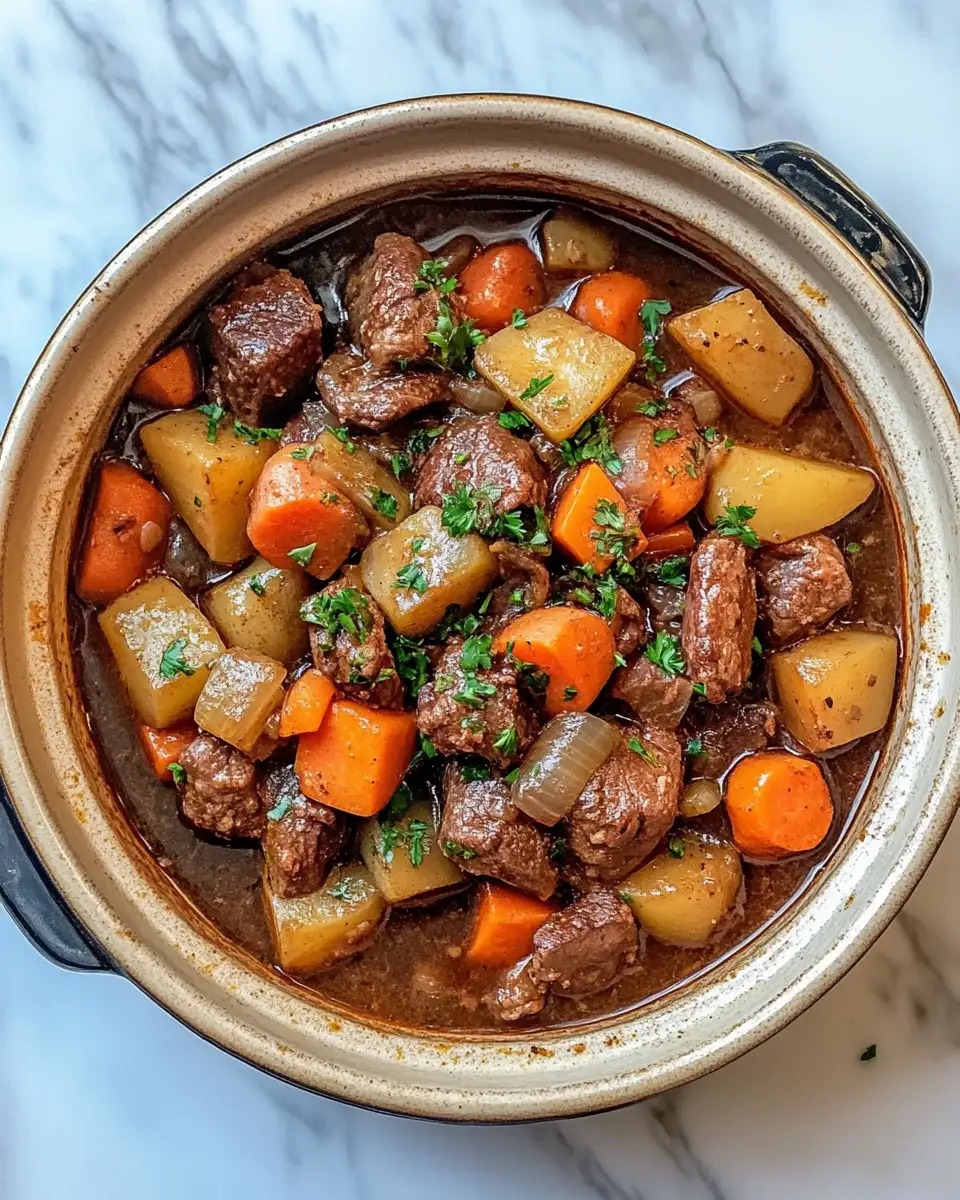
20 Dutch Oven Dinners: One-Pot Braises, Stews & Weeknight Roasts
The pot that sears, simmers, and bakes without a single transfer — and 20 dinners that prove it, from stew to bread.
The easiest Dutch oven dinners are one-pot braises, stews, and roasts: sear a protein, add aromatics and roughly two cups of liquid, clamp the lid on, and let a 300–325°F oven do the rest. Below are 20 of them — beef stew, coq au vin, pot roast, jambalaya, cassoulet, even no-knead bread — that need one pot, one lid, and almost no attention once the oven door closes. Most take under 20 minutes of hands-on work.
Get a free week of one-pan dinners
Seven one-pan and sheet-pan dinners, one shopping list, one Instacart cart. Sent Sunday, no account needed.
No spam, unsubscribe in one click. Recipes, shopping lists and Instacart carts all work without an account either way.
Introduction — why the Dutch oven is the most versatile pot in your kitchen
A Dutch oven is a heavy lidded pot, usually cast iron, that goes from a stovetop burner into the oven. That single trait is the whole argument. A skillet sears but can't hold two quarts of liquid. A stockpot holds liquid but has thin walls that scorch a fond. A slow cooker simmers but never browns anything. The Dutch oven does all three jobs in sequence without a single transfer, which is why it survives every kitchen-gadget purge.
The physics are boring and reliable. Cast iron weighs roughly 5 to 7 pounds per empty 5-quart pot, and that mass is thermal ballast: when you drop a pound of cold chuck into a preheated pot, the surface temperature sags maybe 40–60°F instead of 150°F, so the meat browns instead of steams. That browning is the Maillard reaction, and it's the difference between beef stew that tastes like beef and beef stew that tastes like wet vegetables. The lid then traps steam, keeping the liquid at a lazy 180–200°F for hours — the exact window where collagen in tough cuts converts to gelatin and a $9/lb chuck roast turns silkier than a $28/lb tenderloin.
That's braising in one sentence, and it's what fall and winter cooking is built on. Searches for Dutch oven recipes climb from September through February every year, and the reason is practical rather than sentimental: it's the season of cheap collagen-rich cuts, root vegetables that hold up to two hours of heat, and a household that doesn't mind the oven running.
If you already own a cast-iron skillet, the Dutch oven is the second and last piece of cast iron you need. If you're building a fall rotation, pair this list with our early-fall soup and stew roundup and the pumpkin and butternut squash dinners — same pot, same season, no overlap.
What You Need: enameled cast iron vs bare cast iron, size sweet spots
There are two families, and the choice is genuinely about what you cook, not about price.
Enameled cast iron is bare iron with a fused glass coating — vitreous enamel. It's non-reactive, so tomato, wine, vinegar, and citrus braises won't strip anything or pick up a metallic edge. The light-colored interior lets you read fond color at a glance, which matters more than people admit when you're deglazing. It's also the only sane option if you don't want to think about seasoning maintenance. The Le Creuset 5.5 qt Signature Round in Flame is the reference pot at about $312 as of 2026, and it is the size most households actually use; Le Creuset's full Dutch oven range runs from 2 to 13.25 quarts if you need something outside that. If you cook for six or more, the Staub 7 qt Round Dutch Oven at roughly $298 buys you the extra quart and a half for less money than the equivalent Le Creuset.
You do not need to spend that. The Crock-Pot Artisan 3-quart enameled Dutch oven runs about $50 and handles a two-person braise fine. America's Test Kitchen has repeatedly found that inexpensive Dutch ovens perform close to the premium ones on everything except long-term enamel durability and handle ergonomics; their full Dutch oven review is the most useful third-party read before you buy.
Bare cast iron is cheaper per quart, takes higher heat without risking enamel chips, and is the better bread pot because you can preheat it empty to 500°F without a second thought. The Lodge 6-quart pre-seasoned camp Dutch oven is about $80, and the Lodge Cast Iron Combo Cooker at roughly $60 is a 3.2-quart pot whose lid is a 10.25-inch skillet — two pans for one price. The tradeoff is that acidic braises will dull the seasoning over time, so a weekly tomato-heavy rotation argues for enamel. Cast-iron cookware basics haven't changed in a century.
A third shape worth knowing: the braiser, a wide shallow pot like the Le Creuset Signature Braiser 5 qt. More surface area means better browning and faster reduction; less depth means it's wrong for stock, bread, or anything you want to submerge.
Size sweet spots
| Capacity | Feeds | Best for | Empty weight | Typical 2026 price |
|---|---|---|---|---|
| 3–3.5 qt | 1–2 | Weeknight braise, side dishes, small bread | 8–10 lb | $50–$260 |
| 4.5 qt | 2–4 | Chicken thighs, chili, pasta one-pots | 11–12 lb | $330–$400 |
| 5.5 qt | 4–6 | The default: stew, pot roast, whole 4 lb chicken | 12–13 lb | $310–$435 |
| 6.75–7.25 qt | 6–8 | Short ribs for a crowd, cassoulet, double batches | 14–16 lb | $365–$480 |
| 9 qt+ | 8–12 | Stock, party chili, holiday cooking | 17+ lb | $440+ |
If you buy exactly one, buy 5.5 quarts. It roasts a 4-pound chicken with room for vegetables, holds a full batch of stew, and still bakes a 900-gram bread loaf. Round beats oval for heat evenness and burner fit; oval only wins if you routinely roast something long.
Three accessories actually matter. Locking 16-inch tongs at about $21 let you turn short ribs without leaning your forearm over 400°F iron. A Thermapen ONE instant-read thermometer at roughly $125 ends the guesswork on when a pot roast is done — 203°F, not "three hours." And a wooden spoon set around $16 keeps metal off the enamel. Browse the rest in cookware and utensils and tools.
The Braise: chicken, pork shoulder, short ribs
Braising is the Dutch oven's home turf. The template never changes: pat the meat dry, sear hard in two batches, remove it, soften aromatics in the rendered fat, deglaze with wine or beer or stock while scraping the fond, return the meat, add liquid to come one-half to two-thirds up the sides — never covering it — and go into a 300–325°F oven with the lid on.
Short ribs are the cut that converts skeptics. Short ribs are about 25% connective tissue by weight, so they need 2.5–3 hours at 300°F to reach the 200–205°F internal temperature where they slump. Spiced Red Wine-Braised Beef Short Ribs is the classic French treatment; Slow-Braised Short Ribs with Tomato Deglaze swaps wine for tomato and shaves the cost; and Spicy Korean-Style Braised Beef Short Ribs with Gochujang proves the technique isn't French-owned.
Chicken thighs are the weeknight version — 45 to 60 minutes, not three hours, because thigh meat carries far less collagen. Red Wine-Braised Chicken Thighs with Pancetta and Mushrooms is essentially a fast coq au vin. Italian Herb-Braised Chicken Thighs with White Wine and Rosemary goes lighter, and Low-Temperature Braised Chicken Thighs with Lemon and Thyme drops the oven to 275°F for a forgiving, unattended hour. Leave the skin up and above the liquid line and it stays crisp; submerge it and it turns to rubber.
Pork shoulder is the cheapest path to a full pot of shreddable meat, usually $3–$5 per pound. It wants 3–4 hours and an internal temperature near 195–205°F. Slow-Braised Pork Shoulder with Bitter Herb Gremolata finishes with a raw-herb hit that cuts the fat. Half-Pint Lager-Braised Pork Shoulder with Onions uses beer instead of stock, and Vinegar-Braised Pork Shoulder with Mustard Greens cooks the greens right in the braising liquid.
Two canonical braises belong here as well. French Oven-Braised Coq au Vin with Pearl Onions is the dish the pot was arguably designed for — coq au vin predates the modern enameled pot by centuries. French Slow-Cooked Beef Bourguignon with Mushrooms is its beef counterpart; beef bourguignon is the recipe Julia Child used to teach Americans that chuck outperforms sirloin in a wet pot. Round it out with Classic Chicken Cacciatore and Craft Beer-Braised Beef Brisket with Caramelized Onions.
The Stew: beef, chicken, vegetable, fish
A stew is a braise with more liquid and the meat cut smaller. Everything is submerged, the pieces are bite-sized, and the cooking time drops because you've multiplied the surface area.
Beef. Dutch Oven Beef Stew with Root Vegetables is the baseline: chuck cut into 1.5-inch cubes, seared in three batches, then two hours at 325°F. Cut smaller than that and the cubes shred into the broth before the collagen finishes. Braised Viennese Beef Goulash with Paprika and Onions uses a near-1:1 onion-to-beef ratio — the onions dissolve and thicken the sauce with no flour at all, which is the point of goulash.
Chicken. Dutch Oven Chicken and Potato Stew and Campfire Dutch Oven Chicken and Vegetable Stew both land in about 60 minutes. Chicken Paprikash with Sour Cream needs one piece of care: temper the sour cream with hot broth off the heat, or it breaks. Real Chicken and Dumplings drops dough onto the simmering surface with the lid on for the last 15 minutes — the trapped steam is what sets the dumplings, so don't peek. Slow-Simmered Cajun Chicken and Andouille Gumbo starts with a 30–40 minute roux, which the pot's mass makes far harder to scorch; gumbo is unforgiving in a thin pan.
Vegetable and legume. These are 40-minute weeknight stews with no searing step at all. Authentic Tuscan White Bean and Sausage Stew and Chickpea and Kale Stew with Smoked Paprika both come in under $2.50 per serving. Smoky Mushroom and Lentil Stew with Roasted Root Vegetables gets its depth from a hard mushroom sear before the liquid goes in — skip that and it tastes flat.
Lamb. Slow-Cooked Lamb and Root Vegetable Stew is the Irish template. Slow Simmered Moroccan-Spiced Lamb Tagine works in a Dutch oven despite the name — the conical tagine recirculates condensation, and a heavy domed lid does approximately the same job.
Fish. Seafood stews are the fastest thing in this article and the most commonly ruined. Build the broth for 25 minutes, then add fish and shellfish for the last 6–10 minutes only. San Francisco Cioppino Seafood Stew is the American version; Provence-Style Bouillabaisse with Saffron-Infused Bread is the ancestor. Bouillabaisse traditionally uses whatever the boat didn't sell, which is still the right way to shop for it.
The Roast: whole chicken, pork loin, beef roasts
Roasting in a Dutch oven is a two-phase move: lid on to steam and cook through, lid off to brown and reduce. Skipping the second phase is why covered roasts sometimes come out pale.
Whole chicken. A 4-pound bird fits a 5.5-quart round pot. Sear breast-side down for 5 minutes, flip, add aromatics, cover, and roast at 400°F until the thigh reads 165°F — about 60–70 minutes — then uncover for a final 10–15 minutes. One-Pan Roast Chicken with Garlic and Rosemary is the minimalist version. Tuscan Lemon and Rosemary Roast Chicken with Garlic Smashed Potatoes cooks the potatoes in the drippings, and Springfield-Style Herb Roasted Chicken with Root Vegetables turns the whole thing into one pot for four people.
Beef. Pot roast is a braise wearing a roast's name, and the target is 203°F internal — the same number barbecue people use for brisket, for the same collagen reason. Slow-Roasted Beef Pot Roast with Root Vegetables runs 3–3.5 hours at 300°F. Slow Braised Midwest Beef Pot Roast with Root Vegetables adds the root vegetables in the final 60 minutes so they don't disintegrate — a detail most recipes get wrong.
Pork loin. The opposite problem: loin is lean, so it's a 145°F cut with a 10-minute rest, and 20 extra minutes turns it to sawdust. Rosemary-Roasted Pork Loin with Carrots and Parsnips and Honey-Dijon Roasted Pork Loin with Maple-Glazed Root Vegetables both roast uncovered at 375°F, using the pot purely as a heat-stable roasting vessel. This is the one section where the thermometer isn't optional.
Sunday Sauce & Pasta One-Pots
Ragù is what a Dutch oven does while you do something else. Sunday Ragù alla Bolognese wants 3+ hours at a bare simmer with the lid cracked so it reduces; the pot's mass keeps the bottom from scorching at heat settings where a thin saucepan would need constant stirring. Italian Slow-Cooked Beef Ragu with San Marzano Tomatoes uses whole cuts you shred at the end instead of ground meat.
True one-pot pastas cook the noodles in the sauce, so the starch thickens everything and you wash one pot. One-Pot Chicken and Tomato Basil Pasta and One-Pot Tomato White Bean Pasta are both 30-minute weeknight meals. One-Pan Sausage and Mushroom Risotto exploits the even heat — you can stir every few minutes instead of continuously, because the pot doesn't develop hot spots.
Two big-format one-pots close the section. One-Pot Spiced Chicken and Regional Sausage Jambalaya is rice cooked in the same pot as the andouille and the trinity — jambalaya is a one-vessel dish by definition. And Cassoulet with Sausage, Pork Shoulder, and Herb-Infused Beans is the weekend project: cassoulet traditionally involves breaking and re-forming the bean crust several times over 3 hours, and a 7.25-quart pot is the right size for a batch that feeds eight.
Bread & Sides in the Same Pot
The Dutch oven's second career is as a home bread oven. Preheat the empty covered pot to 450–500°F for 30 minutes, drop the dough in, bake covered for 30 minutes, then uncovered for 15–20. The lid traps the loaf's own steam, which is what commercial steam-injection ovens do and what your home oven cannot. No-knead bread exists in its current form because of this trick; King Arthur's no-knead crusty white bread is the clearest write-up of the method.
Two catalog versions: No-Knead Artisan Crusty Bread and No-Knead Artisan Crusty White Bread. Both are overnight doughs — 12 to 18 hours at room temperature, about 10 minutes of hands-on work. Bare cast iron is the better choice here — repeated empty preheats above 450°F are exactly the abuse that crazes enamel over years.
Sides work too. Vinegar-Braised Cabbage with Apples and Caraway is the standard partner for any pork braise. One-Pot Budget Minestrone Soup feeds six for pocket change. And Rustic Appalachian Bean and Cornbread Casserole bakes the cornbread directly on top of the beans — a genuine one-pot dinner-and-bread.
20 Weeknight-to-Weekend Dutch Oven Dinners (recipe list)
Sorted by total time, so the top half is weeknight-viable and the bottom half is a Sunday.
Ten more worth your rotation once you've run the list above: Slow-Braised Short Ribs with Tomato Deglaze, Spicy Korean-Style Braised Beef Short Ribs with Gochujang, Red Wine-Braised Chicken Thighs with Pancetta and Mushrooms, Low-Temperature Braised Chicken Thighs with Lemon and Thyme, Slow-Braised Pork Shoulder with Bitter Herb Gremolata, Half-Pint Lager-Braised Pork Shoulder with Onions, Vinegar-Braised Pork Shoulder with Mustard Greens, French Slow-Cooked Beef Bourguignon with Mushrooms, Classic Chicken Cacciatore, and Craft Beer-Braised Beef Brisket with Caramelized Onions.
Real-world numbers: doneness targets and timing
Every number below is an internal temperature, measured at the thickest point away from bone. This is the single table worth taping inside a cabinet door.
| Cut | Target internal temp | Typical time at 300–325°F | Why |
|---|---|---|---|
| Beef short ribs | 200–205°F | 2.5–3 hr | Collagen-heavy; falls off bone only above 200°F |
| Beef chuck (stew, 1.5" cubes) | 200–205°F | 2–2.5 hr | Same collagen window, smaller pieces |
| Beef pot roast (3–4 lb) | 203°F | 3–3.5 hr | Whole cut, slower heat penetration |
| Pork shoulder | 195–205°F | 3–4 hr | Fat and collagen both need the long hold |
| Chicken thighs (braised) | 175–185°F | 45–60 min | Safe at 165°F, but texture improves past 175°F |
| Whole chicken (roast) | 165°F thigh | 60–70 min at 400°F | Breast dries out if you push past this |
| Pork loin | 145°F + 10 min rest | 45–60 min at 375°F | Lean; overshoot is unrecoverable |
| No-knead bread | 205–210°F crumb | 45–50 min at 450–500°F | Below 205°F the center is still gummy |
Two timing rules follow from the table. First, tough cuts are done by temperature, not by clock — a 3-pound chuck roast that reads 185°F at three hours simply needs another 40 minutes, and nothing bad happens while it waits. Second, lean cuts are done by clock and thermometer, because the window between 145°F and dry is roughly 10 minutes.
Common Pitfalls
Five failure modes account for nearly every disappointing Dutch oven dinner.
Crowding the sear. Two pounds of beef dumped in at once drops the pot below the browning threshold and the meat releases water into the pan. You get gray cubes and a thin, sour braise. Sear in three batches with a minute between them so the pot recovers, and accept that this takes 15 minutes.
Too much liquid. A braise is not a soup. Liquid should reach one-half to two-thirds up the meat, no higher. Covering the meat entirely means the exposed top never concentrates and the finished sauce needs 20 minutes of hard reduction to taste like anything.
Boiling instead of simmering. If the liquid is rolling, the oven is too hot — cast iron holds far more heat than the recipe author's thin pot assumed. Drop 25°F. A hard boil at 212°F tightens muscle fiber faster than collagen converts, which is exactly how you get stew meat that is both overcooked and tough.
Adding vegetables too early. Carrots, potatoes, and parsnips turn to mush in three hours. Add them in the final 45–60 minutes unless the recipe explicitly wants them dissolved into the sauce.
Thermal shock. Never take a screaming-hot pot to a cold sink, and never pour cold liquid into a dry hot pot. Enamel crazes and, rarely, bare iron cracks. Le Creuset's care guidance and Lodge's enameled cast iron page both put this first for a reason.
When a Dutch oven is the wrong pot
Being honest about this saves you a bad dinner. Reach for something else when:
- You're deep-frying more than a quart of oil. The pot holds temperature beautifully, but 15 pounds of hot iron plus hot oil is a genuine handling hazard, and a lighter pot with a clip-on thermometer is safer.
- You want a hard crust on a thin cut. Steaks, pork chops, and fish fillets belong in a skillet — the Dutch oven's high walls trap steam and prevent the dry-surface browning you're after.
- You need speed. A pressure cooker gets chuck to 203°F in 45 minutes. If your weeknight has 45 minutes and not 2.5 hours, that's the correct tool; braise on the weekend instead.
- You're cooking for one. A 5.5-quart pot with one chicken thigh in it is mostly empty air, and the sauce reduces to nothing. Use a small braiser or a 3-quart pot.
- The recipe wants induction-free portability. Cast iron is magnetic and works on induction, but a loaded 7.25-quart pot at 15+ pounds is a two-hand, oven-mitt lift. Plan the transfer before you start.
Care & Cleaning Tips
Enameled pots: let the pot cool for 15 minutes before it hits water, then soak with warm soapy water for 20 minutes and use a plastic scraper or nylon brush. For the brown film that builds on light interiors, simmer a tablespoon of baking soda in two inches of water for 10 minutes and it lifts. Bar Keepers Friend works on stubborn stains but is mildly abrasive — save it for quarterly, not weekly. Never use metal utensils or steel wool, and never take an empty enameled pot above 500°F.
Bare cast iron: hot water and a stiff brush, no long soak, dry immediately on a warm burner, then wipe a thin film of neutral oil across the interior. If food is stuck, boil an inch of water in the pot for 3 minutes and it releases. Rust means the seasoning failed, not that the pot died — scrub it back, oil it, and bake it upside down at 450°F for an hour.
Both types: store with the lid slightly ajar or with a paper towel between lid and rim. A sealed lid traps residual moisture, which stains enamel and rusts bare iron. Knob check — older Le Creuset phenolic knobs are rated to about 375–400°F while the stainless replacements handle 500°F, so if you're baking bread at 500°F, confirm what's on your lid.
How to build a make-ahead Dutch oven meal plan (cook Sunday, eat Monday–Thursday)
The honest objection to everything above is time. A three-hour braise is not a Tuesday. But that framing is wrong: the Dutch oven is a batch tool, and a braise is the rare dinner that is measurably better on day three than on day one. Cook once on Sunday, eat four times.
The mechanism is simple. Collagen keeps converting to gelatin while the pot cools, fat solidifies on top and can be lifted off cleanly the next morning, and the aromatics finish diffusing into the liquid overnight. A pot roast pulled at 203°F on Sunday afternoon and refrigerated is a better pot roast on Monday than it was twenty minutes out of the oven.
The 7-quart Sunday, four weeknight dinners
One 6- to 7-quart braise yields roughly 8 to 10 portions. Here is the rotation that gets the most distance out of a single Sunday session:
| Day | What you eat | Work tonight | Active time |
|---|---|---|---|
| Sunday | Slow-Braised Midwest Beef Pot Roast, fresh from the pot | Sear, braise, rest | 35 min active / 3.5 hr total |
| Monday | Same pot roast, degreased and reheated | Reheat covered at 325°F | 10 min |
| Tuesday | Shredded beef over polenta or in tacos | Shred, warm the liquid down to a sauce | 15 min |
| Wednesday | One-Pot Tomato White Bean Pasta with leftover braising liquid as the base | One pot, start to finish | 30 min |
| Thursday | Authentic Tuscan White Bean and Sausage Stew built on the last of the liquid | One pot | 40 min |
The braising liquid is the asset, not the leftover. Two cups of strained pot-roast liquid turns a weeknight bean pasta into something that tastes like it took all day, because it did — just not today.
Storage and reheating numbers that matter
- Cool it fast. Get the pot from 140°F down to 70°F within two hours, and from 70°F to below 40°F within four more. A full Dutch oven left on the stovetop overnight sits in the danger zone for six hours. Decant into shallow containers instead of refrigerating the whole pot — 4 quarts of hot braise in one vessel takes most of a night to reach 40°F.
- Refrigerated life: 3 to 4 days. That is the Monday-through-Thursday window, and it is why the plan above ends on Thursday.
- Reheat to 165°F throughout, not "until warm." Covered at 325°F for 25 to 35 minutes is gentler than the stovetop and will not tighten the meat the way a hard simmer does.
- Freeze at the 4-day line, not after. Braises freeze cleanly for about 3 months. Freeze the meat submerged in its liquid; anything exposed to air dries out and goes grey within weeks.
- Skip freezing the starch. Pasta and rice one-pots turn to paste. Freeze the braise, cook the starch fresh — it is 10 minutes.
Which dishes batch well, and which don't
Braises and stews with connective-tissue cuts are the whole point: Italian Slow-Cooked Beef Ragù, Slow-Braised Pork Shoulder with Gremolata, and Dutch Oven Beef Stew with Root Vegetables all improve for three days. Bean stews like Chickpea and Kale Stew with Smoked Paprika hold even better and cost a fraction as much per portion.
What does not batch: anything with a crust or a crisp skin. A roast chicken is a Sunday dinner, not a Wednesday one — reheated skin is soft skin. Risotto and one-pot pastas are 30-minute dishes made to order. And bread is its own schedule; the overnight dough means you start Saturday night for a Sunday loaf. Store it cut-side down on a board, not in plastic, and it stays good for two days in a bakeware drawer or a paper bag.
If you would rather not plan the rotation by hand, AislePrompt's chat will build a week around a single Sunday braise — it reads the recipes above, scales the pot to your household size, and hands back a consolidated shopping list. The meal plan builder does the same thing on a fixed weekly grid.
Frequently asked questions
What size Dutch oven do I need for these recipes?
Do I really need an enameled Dutch oven, or will bare cast iron work?
Can I use a Dutch oven on an induction cooktop?
How do I keep food from sticking to my Dutch oven?
Can I make these dinners on the stovetop only, without an oven step?
Sources
- americastestkitchen.com
- americastestkitchen.com
- lecreuset.com
- lecreuset.com
- lodgecastiron.com
- kingarthurbaking.com
- en.wikipedia.org
- en.wikipedia.org
- en.wikipedia.org
- en.wikipedia.org
- en.wikipedia.org
- en.wikipedia.org
- en.wikipedia.org
- en.wikipedia.org
- en.wikipedia.org
- en.wikipedia.org
- en.wikipedia.org
- en.wikipedia.org
- en.wikipedia.org
- en.wikipedia.org
- en.wikipedia.org
- en.wikipedia.org
- en.wikipedia.org
- en.wikipedia.org
- en.wikipedia.org
- en.wikipedia.org
One pan, one shopping list, one tap.
Ask our AI for one-pan weeknight dinners — it totals the ingredients and sends the cart to Instacart.
Get one-pan dinners →