20 Israeli Recipes: Shakshuka, Sabich & Modern Middle Eastern Dinners
Israeli cooking is Mizrahi, Ashkenazi, and Levantine kitchens in one pan — mostly vegetables, mostly 25 to 40 minutes, all built on tahini and lemon.
Modern Israeli cooking is Mizrahi, Ashkenazi, and Levantine food colliding in one kitchen: a tomato-and-egg shakshuka that arrived from North Africa, an eggplant-and-egg sabich from Iraq, and a tahini technique borrowed from Palestinian and Lebanese kitchens. Most of it is one pan, 25–40 minutes, and heavily plant-forward.
Get a free week of easy dinners
Seven weeknight dinners with the shopping list already totalled, sent Sunday. No account needed, unsubscribe in one click.
No spam, unsubscribe in one click. Recipes, shopping lists and Instacart carts all work without an account either way.
Israeli cooking as a fusion, not a cuisine
There is no single Israeli culinary tradition, and that is the point. In three generations, cooks from Morocco, Yemen, Iraq, Iran, Poland, Ukraine, Ethiopia, and Tunisia landed in the same small country and started eating each other's food. What emerged is less a cuisine than a shared grammar — heavy on olive oil, tahini, lemon, cumin, and charred vegetables, light on dairy-and-meat combinations, and built around a table covered in small plates rather than a single center-of-plate protein.
Three streams feed it:
Mizrahi and Sephardi — the North African and Middle Eastern Jewish kitchens. This is where shakshuka comes from (Tunisia and Libya), where the Yemenite breads jachnun and kubaneh come from, where chraime — fish poached in a fierce red pepper sauce — comes from, and where most of the spice vocabulary originates: cumin, caraway, turmeric, harissa, hawaij.
Ashkenazi — the Central and Eastern European Jewish kitchen. Less visible in modern restaurant cooking but still the backbone of holiday tables: challah, brisket, kugel, gefilte fish, and the entire pickling repertoire.
Levantine — the shared regional food of Palestinians, Lebanese, Syrians, and Jordanians. Hummus, falafel, tabbouleh, baba ghanoush, labneh, and za'atar are regional, not national. Any honest guide to Israeli food says so plainly.
The Ottolenghi effect, since roughly 2008, is what pushed this into English-language home kitchens: vegetables treated as the main event, aggressive use of lemon and pomegranate molasses, and the insistence that a table of six salads is dinner. Nearly every recipe below reflects that.
A note on the calendar. Israeli food is largely dairy-or-meat, rarely both. That is not a flavor decision, it is kashrut, and it explains why the tahini-based sauces exist at all: they deliver creaminess to a meat meal where yogurt cannot go. Once you notice it, half the cuisine's technique makes sense.
The Israeli meal decision framework
| Time of day | Style | Protein | Total time | Start here |
|---|---|---|---|---|
| Breakfast / brunch | One pan, eggs | Eggs, feta | 17–50 min | Shakshuka |
| Lunch | Mezze spread | Chickpeas, dairy | 5–35 min | Hummus + labneh + salads |
| Weeknight dinner | Sheet pan or skillet | Chicken, fish | 20–45 min | Za'atar grilled chicken |
| Friday / weekend | Slow-roasted | Lamb, whole chicken | 90–320 min | Slow-roasted lamb shoulder |
| Dessert / drinks | Cold, make-ahead | — | 5–55 min | Halva parfait |
The plant-forward default. Aim for a 2:1 vegetable-to-meat ratio by volume. A typical Israeli dinner is one protein and four vegetable plates, not the reverse. This is the single easiest change to make if you're adapting an existing weeknight rotation.
The make-ahead rule. Nearly every mezze improves after 24 hours in the fridge. Hummus, matbucha, roasted eggplant, chickpea salads, and pickles all hold 3–4 days. A Thursday afternoon of cooking covers Friday dinner, Saturday lunch, and Sunday's leftovers.
The one-pan rule. Shakshuka, chraime, and most of the sheet-pan chicken dishes below are single-vessel. If your weeknight problem is cleanup, this cuisine is unusually forgiving.
20 Israeli recipes, grouped by category
Breakfasts and brunches (5)
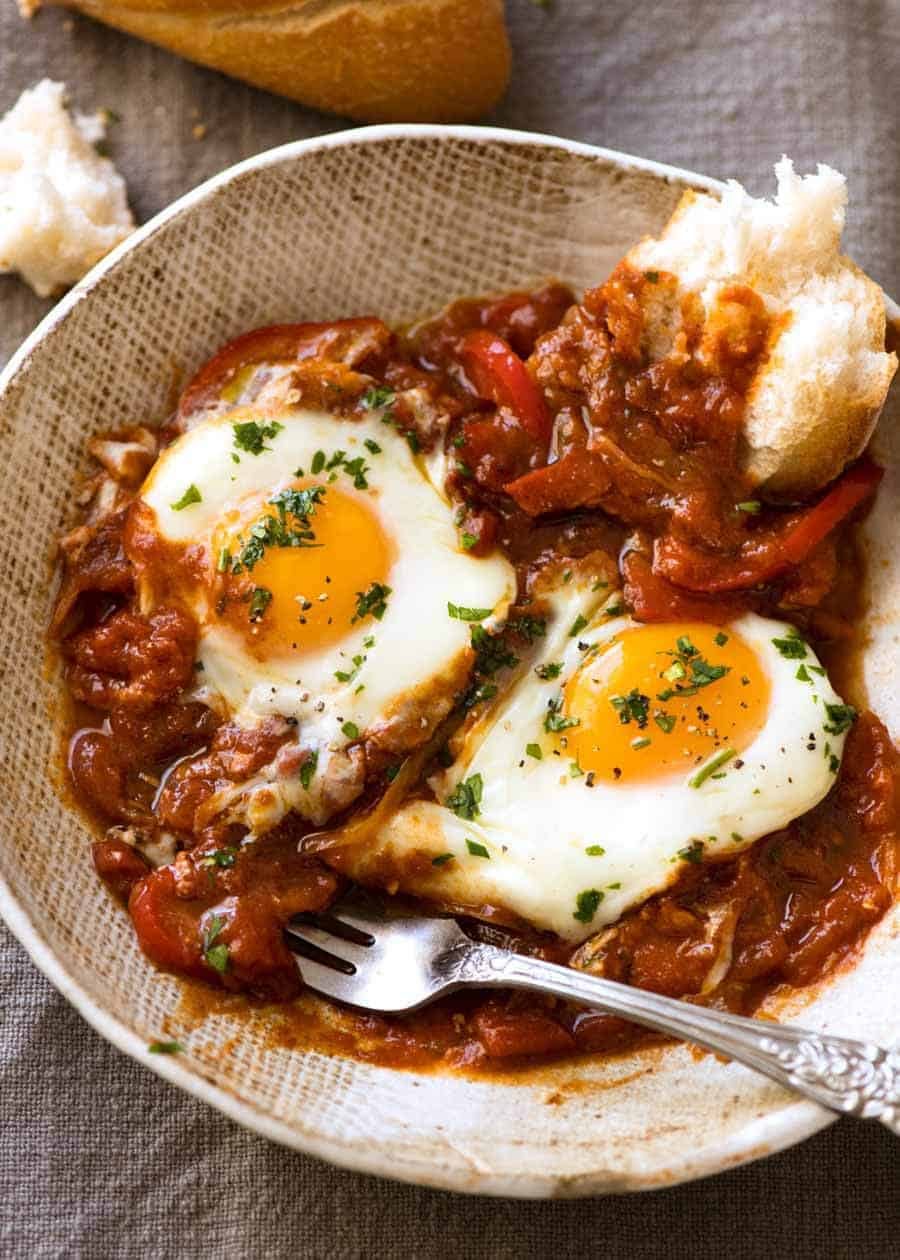
1. New York-Style Jazz Brunch Shakshuka with Feta — 30 minutes, serves 4, 320 calories. The canonical version: tomatoes and peppers cooked down to a jam, eggs cracked into wells, feta over the top.
2. Impromptu Soulful Jazz Brunch Shakshuka — 35 minutes, serves 4, 270 calories. A slightly lighter sauce and the version to make when you want it to feed four with bread rather than three without.
3. Sautéed Spinach and Cilantro Shakshuka with Feta Crumbles — 17 minutes, serves 2, 220 calories. Shakshuka yerukah — green shakshuka. No tomato at all; the base is wilted greens, garlic, and cumin. The fastest recipe on this page.
4. Cabbage and Spinach Shakshuka with Cilantro — 30 minutes, serves 4, 260 calories. A heartier green version that stretches a bunch of greens into a full dinner for four.
5. Authentic Moroccan Shakshuka — 50 minutes, serves 4, 380 calories. The North African original the Israeli version descends from — deeper spicing, longer reduction, more harissa.
Mezze and salads (6)
6. Authentic Lebanese Hummus with Pita and Grilled Vegetables — 30 minutes, serves 4, 380 calories. The Levantine base recipe. Get this one right and the rest of the mezze table follows.
7. Labneh with Za'atar and Olive Oil Drizzle — 5 minutes, serves 4, 180 calories. Strained yogurt, a pool of good olive oil, a heavy dusting of za'atar. Five minutes and it anchors a whole board.
8. Za'atar Roasted Eggplant with Tahini Drizzle — 35 minutes, serves 4, 180 calories. Roast the halves cut-side down at 425°F until fully collapsed. Undercooked eggplant is the most common failure in this cuisine.
9. Sumac-Roasted Cauliflower with Tahini Drizzle — 30 minutes, serves 4, 180 calories. The dish that arguably started the modern Israeli vegetable movement in Western restaurants.
10. Chilled Israeli Couscous and Three-Bean Summer Salad — 25 minutes, serves 4, 320 calories. Ptitim — a toasted pasta invented in 1950s Israel as a rice substitute, not a traditional grain at all.
11. Roasted Chickpea and Za'atar Salad with Pomegranate Seeds — 35 minutes, serves 4, 220 calories. Roast the chickpeas dry until they rattle in the pan; that texture is the whole dish.
Mains (6)
12. Za'atar Grilled Chicken with Sumac Onions and Pomegranate — 30 minutes, serves 4, 420 calories. The best weeknight-to-effort ratio here.
13. Za'atar Roasted Chicken with Sumac and Lemon — 90 minutes, serves 6, 420 calories. A whole bird, 90 minutes, feeds six. The Friday-night default.
14. Pan-Seared Lamb Kofta with Za'atar Yogurt Sauce — 25 minutes, serves 4, 350 calories. Grind-and-sear in under half an hour.
15. Crispy Air Fryer Falafel with Tahini Lemon Sauce — 27 minutes, serves 4, 280 calories. Use dried soaked chickpeas, never canned — canned chickpeas turn to paste and the patties fall apart. The oven-baked version takes 45 minutes and needs no appliance.
16. Pan-Seared Sea Bass with Za'atar and Lemon Yogurt Sauce — 20 minutes, serves 4, 320 calories. The closest thing here to chraime's fish-in-sauce logic, in a fraction of the time.
17. Slow-Roasted Lamb Shoulder with Israeli Couscous and Labne — 320 minutes, serves 6, 620 calories. Five and a half hours, almost entirely unattended. This is the holiday centerpiece.
Sweets and drinks (3)
18. Half-Sweet Halva Parfait — 15 minutes, serves 4, 340 calories. Tahini's dessert form, layered with yogurt. Genuinely the fastest impressive dessert in this cuisine.
19. Orange-Cardamom Semolina Cake with Rosewater Syrup — 55 minutes, serves 8, 320 calories. Pour the syrup over the cake while the cake is hot and the syrup is cool — that temperature gap is what makes it soak instead of pool.
20. Citrus-Mint Lemonade Refresher — 5 minutes, 110 calories. Limonana, the frozen mint lemonade sold from every kiosk in Tel Aviv in summer.
Worth adding once the basics are down: Grilled Eggplant and Labneh Flatbread with Za'atar (25 minutes), Za'atar-Spiced Chicken Shawarma Wraps with Pickled Turnips (25 minutes), Sumac-Spiced Lamb Chops with Za'atar Roasted Veggies (35 minutes), and Slow-Simmered Iraqi Lamb Stew with Sumac and Pomegranate Molasses (140 minutes) for the Mizrahi braise tradition.
Building the Israeli pantry
Seven items. Five are at a normal supermarket in 2026; two need a specialty grocer or a two-day shipment.
| Ingredient | Where | Typical price | Notes |
|---|---|---|---|
| Tahini | Most supermarkets | $8–14 / 16 oz | Soom and Al Arz are the benchmark brands; single-origin Ethiopian humera seed |
| Za'atar | Whole Foods, Trader Joe's, international aisle | $6–10 | Should be green and fragrant, not brown and dusty |
| Sumac | International aisle, spice shops | $5–8 | Tart, deep red; it is the lemon you sprinkle |
| Harissa | Most supermarkets | $5–9 | Tube keeps 6 months open; jar keeps 3 weeks |
| Pomegranate molasses | International aisle, Middle Eastern grocer | $5–8 | One bottle lasts a year |
| Silan (date syrup) | Middle Eastern grocer, online | $8–12 | Sweetener and glaze; no direct substitute |
| Preserved lemon | Middle Eastern grocer, online | $8–12 | Use the rind, discard the pulp |
Tahini is the one to spend on. Cheap tahini is bitter, chalky, and seizes when you add water. Good tahini pours like heavy cream at room temperature and tastes nutty rather than acrid. The price difference between a $5 jar and a $12 jar is roughly $0.40 per serving and it is the difference between hummus you'd serve guests and hummus you wouldn't.
Za'atar goes stale fast. It contains sesame and dried herbs, both of which oxidize. Buy small, store dark and airtight, and replace it annually. If it smells like nothing when you open the jar, it will taste like nothing on the food.
What to buy for Israeli cooking
A 10- or 12-inch cast-iron skillet. Every shakshuka on this page lives in one. Cast iron holds even heat, goes under the broiler to set the egg whites without overcooking the yolks, and doubles as the serving vessel — Israeli shakshuka arrives at the table in the pan, always. Skip nonstick here: you want the fond that builds when tomato hits hot iron, and the sauce is meaningfully better for it. Browse Cookware for oven-safe skillets rated to 500°F.
A food processor or a mortar and pestle. Hummus, matbucha, harissa, and every tahini sauce are emulsions. A processor does it in 90 seconds; a mortar and pestle does it better and takes 10 minutes. Either works, nothing else does — a blender pulls in too much air and a whisk won't break the chickpeas down. See Small Appliances and Utensils & Tools.
A half-sheet pan. The sheet-pan chicken and every roasted-vegetable mezze want a rimmed 18×13 pan with room for things to sit in a single layer. Two pans are better than one crowded pan — crowded vegetables steam instead of caramelizing, and caramelization is the entire flavor argument of this cuisine. See Bakeware.
A sharp knife. Israeli salad — the finely diced cucumber-tomato-onion that accompanies almost everything — is ⅛-inch dice. A dull knife crushes tomatoes into water. See Knives & Cutting.
A mezze dinner for six: the actual plan
The most common question about this food is not "how do I make hummus" — it is "what does a whole meal look like." Here is a spread that has worked repeatedly, with real quantities and real timing.
| Dish | Amount for 6 | Make when | Hands-on time |
|---|---|---|---|
| Hummus | 3 cups | Up to 3 days ahead | 20 min |
| Labneh with za'atar | 2 cups | Up to 4 days ahead | 5 min |
| Roasted eggplant with tahini | 3 large eggplants | Day before | 10 min + 35 roast |
| Sumac-roasted cauliflower | 2 heads | Day of, serve warm | 10 min + 30 roast |
| Chickpea and za'atar salad | 6 cups | 2 hours ahead | 15 min |
| Za'atar grilled chicken | 3 lb thighs | Day of | 15 min + 30 cook |
| Pita or laffa | 12 rounds | Bought; warm day-of | 2 min at 400°F |
| Halva parfait | 6 glasses | Morning of | 15 min |
Total hands-on time: about 95 minutes, spread across three days. Total cost at 2026 US supermarket prices runs roughly $55–70 for six, or about $10 a head — most of it in the chicken and the tahini.
The order of operations. Thursday: hummus and labneh. Friday morning: eggplant, chickpea salad, parfaits. Friday evening, in the last 45 minutes: cauliflower into a 425°F oven, chicken onto the grill or into a skillet, pita warmed in the last two minutes while everything else comes to the table.
Plating. Everything goes out at once, on the table, in the vessels it was cooked in where possible. Spread the dips into shallow bowls with the back of a spoon and pool olive oil in the well — that swirl is not decoration, it keeps the surface from drying out. Warm bread goes in a towel-lined basket so it steams itself soft.
Leftovers. This spread reliably produces a second full lunch. Hummus, labneh, chickpea salad, and eggplant all hold three more days; the chicken gets chopped into a pita with tahini sauce and pickles. Nothing here is worse on day two, which is the strongest practical argument for cooking this way at all.
The technique most people skip: emulsifying tahini properly
Raw tahini plus water looks like it should thin out. It does the opposite: add water and it seizes into a stiff, grainy paste that appears broken. Most people panic here, add oil, and end up with something greasy.
The order matters, and so does the temperature.
1. Start with tahini in a bowl. Add the lemon juice and crushed garlic first, before any water. Whisk. It will thicken and look wrong. This is correct.
2. Add ice-cold water, a tablespoon at a time, whisking hard between additions. It will keep seizing, then abruptly loosen and turn pale ivory. That flip usually happens somewhere around the fourth or fifth tablespoon.
3. Keep going past the flip until it pours in a ribbon. Season with salt and cumin at the end.
The chemistry: tahini is roughly 55% oil suspended in ground sesame solids. Adding water forces a phase inversion from oil-continuous to water-continuous. Cold water keeps the oil viscous enough to break into fine droplets rather than pooling; warm water lets it separate. Adding acid first gives the emulsion something to stabilize against.
The visual test: finished tahini sauce should be the color of heavy cream and coat a spoon, sliding off in a sheet rather than dripping. If it's beige and grainy, it needs more cold water and more whisking. If it's thin and separated, you went too fast.
This one technique unlocks hummus, falafel sauce, roasted-cauliflower drizzle, sabich, and the sauce for every grilled meat here. It is worth practicing on a small batch.
Common mistakes
- Canned chickpeas in falafel. They're cooked, so they turn to paste. Dried chickpeas soaked 12–24 hours and never boiled are the only correct input.
- Under-roasting eggplant. It should collapse completely. Firm eggplant is spongy and bitter; there is no middle ground.
- Warm water in tahini sauce. See above. Ice water, always.
- Crowding the sheet pan. Two pans, single layer, 425°F. Steamed vegetables taste like nothing.
- Treating shakshuka sauce as a quick step. The tomatoes and peppers need 15–20 minutes to reduce to a jam before the eggs go in. Crack them into a watery sauce and the whites spread everywhere.
- Buying pre-ground sumac in bulk. It fades within months. Small jars, replaced often.
Sources
- NYT Cooking — Israeli cuisine for the broader recipe canon and the Mizrahi/Ashkenazi split described above.
- Serious Eats — Shakshuka for the sauce-reduction timing and egg-setting method used across the five shakshukas here.
- Bon Appétit — Modern Israeli cooking for context on the Ottolenghi-era shift toward vegetable-forward plates.
Where to go next
This cuisine sits inside a bigger regional cluster and reads best alongside its neighbors. 20 Israeli & Levantine recipes goes deeper on the Yemenite breads and malawach. 20 Lebanese recipes covers the shared Levantine mezze repertoire in detail, 22 Greek recipes picks up the Eastern Mediterranean thread, and 22 Persian recipes covers the rice-and-herb tradition that shaped the Iranian-Jewish side of the table.
Frequently asked questions
What's the difference between Israeli and Middle Eastern cuisine?
Where can I buy Israeli ingredients like za'atar and silan?
Is shakshuka a breakfast, brunch, or dinner dish?
What's the best pan for cooking shakshuka?
Can I make Israeli mezze dinners ahead of time?
Sources
Cook Israeli at home this week.
Ask our AI for a week of Israeli dinners — it writes the recipes, builds the shopping list, and sends the cart to Instacart. No account needed.
Plan my Israeli week →