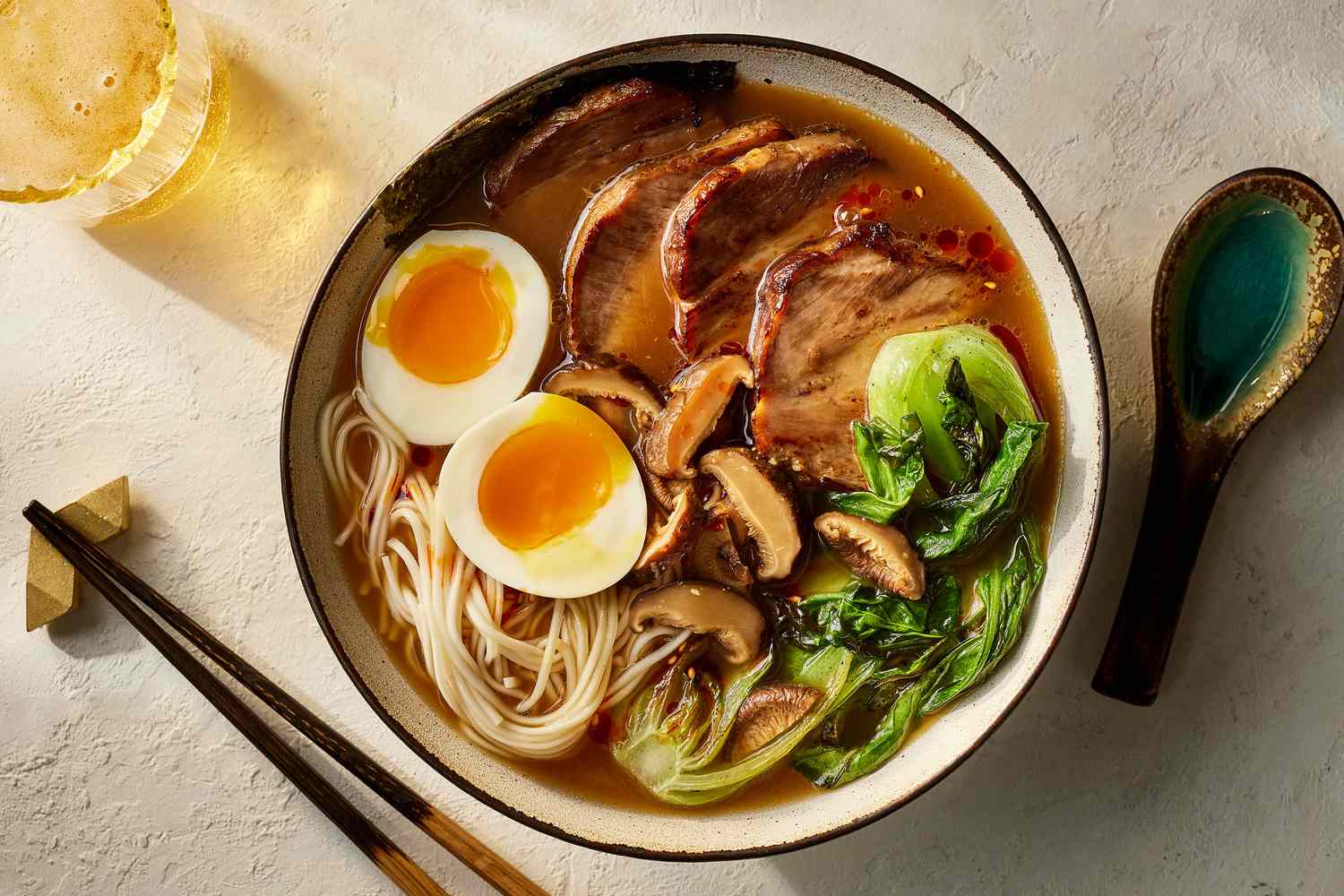
22 One-Bowl Asian Noodle Recipes: Ramen, Pho, Pad Thai and More
The four regional traditions inside Asian noodles — Japanese, Vietnamese, Chinese, Thai — and the 22 recipes that cover the canon.
A bowl of noodles is a complete meal in every Asian cuisine — protein, starch, broth or sauce, aromatics, and a garnish in one vessel. The 22 recipes below cover the four regional traditions inside "Asian noodles": Japanese ramen and udon, Vietnamese pho, Chinese stir-fried noodles, and Thai noodle bowls. Each dish is a real recipe you can put on the table in 20 to 45 minutes with the right pantry stock. Every one links to the full instruction sheet in the AislePrompt catalog.
Get a free week of easy dinners
Seven weeknight dinners with the shopping list already totalled, sent Sunday. No account needed, unsubscribe in one click.
No spam, unsubscribe in one click. Recipes, shopping lists and Instacart carts all work without an account either way.
Introduction: The four regional traditions inside 'Asian noodles'
"Asian noodles" is a marketing category. Nobody in Tokyo, Hanoi, Bangkok, or Guangzhou would tell you they eat "Asian noodles" — they'd tell you they eat ramen, or pho, or pad Thai, or lo mein. The techniques behind each tradition don't cross over well, and the noodles themselves are engineered for specific cuisines.
The four traditions in this article:
- Japanese. Broth-based bowls (ramen, udon soup), cold noodle dips (soba, somen), and stir-fries (yakisoba, yaki udon). The broths are the point — hours of simmering, layered dashi bases, precise soy or miso tare seasoning.
- Vietnamese. Pho (beef or chicken broth over rice noodles), bun bo hue (spicy version), bun (cold rice-vermicelli bowls). Bright herbs and lime finish every bowl.
- Chinese regional. Sichuan (dan dan noodles, mala broths), Cantonese (chow mein, lo mein, wonton noodle soup), Northwestern (biang biang, hand-pulled noodles). Wok technique defines the stir-fries — wok hei is the goal.
- Thai and Southeast Asian. Pad Thai, pad see ew, drunken noodles, coconut curry noodles. Fish sauce, tamarind, palm sugar, chile — the balance of sweet, sour, salty, hot.
Serious Eats' Asian noodle coverage is a good primer if you want a deeper survey; this article is the practitioner's shortcut — the technique and the recipes to make tonight.
For equipment: the cookware category has the woks and heavy skillets that produce proper wok hei; the knives category has the vegetable knives that make aromatic prep fast; the utensils category has the long chopsticks and spider skimmers that make noodle work smooth.
Noodle glossary: rice, wheat, egg, buckwheat, glass, udon, ramen
Getting the noodle right matters more than getting the sauce right — the wrong noodle in a good sauce cooks wrong, absorbs wrong, and eats wrong. Nine noodle types cover the ground.
Ramen noodles. Thin, springy wheat noodles made with alkaline salt (kansui) that gives them their yellow color and chew. Fresh from a Japanese market is best; dried instant packets are a distant second (and the seasoning packet should be thrown out — make your own tare). Cook time: 90 seconds to 3 minutes depending on thickness.
Udon. Thick, soft, chewy wheat noodles served in dashi broth or stir-fried. Frozen udon (the vacuum-sealed refrigerated kind) is what Japanese cooks buy — dried udon has never quite matched the texture. Cook time: reheat 60 seconds in boiling water for frozen; 8 minutes for dried.
Soba. Thin, earthy noodles made from buckwheat flour, served hot in broth or cold with a dipping sauce. 100% buckwheat soba is the connoisseur's version — a wheat-buckwheat blend is easier to work with and more common. Cook time: 4 minutes; rinse in cold water immediately.
Rice noodles. Come in three widths — fine (vermicelli, for cold bowls), medium (5mm, the pad Thai size), and wide (14mm, for pad see ew). Soak in warm water 30 minutes before cooking; don't boil ahead.
Egg noodles (Chinese). Yellow, springy, chewy — used in chow mein, lo mein, wonton soup. Fresh from a Chinese grocery is the target; dried is fine for stir-fry, less good for soup.
Wheat noodles (Chinese). White, unadorned, used in Sichuan dishes (dan dan noodles, mala tang) and Northwestern hand-pulled preparations. Biang biang noodles are the belt-wide wheat variant from Xi'an.
Glass noodles / cellophane. Made from mung bean or sweet potato starch. Translucent when cooked. Used in Korean japchae and Vietnamese salad rolls. Soak in hot water 5-10 minutes to soften.
Somen. Very fine wheat noodles served cold in the summer. Cook 90 seconds and rinse thoroughly in cold water; the residual starch is aggressive.
Ramyeon (Korean). Instant-style thick wheat noodles used in kimchi noodle soups and buldak preparations. Chewier than Japanese instant ramen.
Noodle-per-serving reference
| Noodle | Dry weight per serving | Cooked yield | Cook time (fresh / dried) |
|---|---|---|---|
| Ramen | 80 g | 220 g | 90 s / 3 min |
| Udon | 200 g fresh, 90 g dried | 300 g | 60 s / 8 min |
| Soba | 90 g | 240 g | — / 4 min |
| Rice medium (5mm) | 80 g | 200 g | Soak 30 min, then 90 s in wok |
| Chinese egg | 90 g | 240 g | 60 s / 4 min |
| Glass | 60 g | 180 g | Soak 8 min in hot water |
The core builds: broth-based, stir-fry, cold noodle, curry
Four core techniques cover 90% of Asian noodle cookery. Each is a distinct skill set.
Broth-based bowls. The broth is 80% of the dish. For ramen, this means either an authentic tonkotsu (12-18 hours of hard-boiling pork bones for collagen extraction) or a weeknight shoyu shortcut (chicken broth + dashi + soy + mirin + garlic in 25 minutes). Pho uses a similar long-simmer approach — beef bones with charred onion and ginger, cinnamon, star anise, cloves, coriander for 3 hours. The noodles cook separately and get placed in a warm bowl; broth is ladled over hot.
Weeknight ramen: not authentic tonkotsu, which needs 12-18 hours of hard-boiling pork bones to extract collagen. But a fast weeknight shoyu ramen using chicken broth, dashi, soy sauce, mirin, and garlic hits the table in 25 minutes and satisfies 80% of the craving. AislePrompt's quick ramen recipes all use this shortcut structure and note where the deep authenticity gap is. Pressure-Cooked Tonkotsu Shoyu Ramen with Slow-Simmered Pork Broth uses a pressure cooker to shortcut the 18-hour bone boil to 3 hours with 80% of the collagen extraction. Hokkaido-Style Tonkotsu Ramen with Char Siu is the full-effort version for a weekend project.
Stir-fry noodles. Chinese, Thai, and Japanese wok-tossed noodles all share technique: extremely high heat, dry ingredients added first, sauce added last, everything moving constantly. The right noodle for stir-fry is drier than the noodle for soup — hydrated but not soft. Chinese chow mein uses fresh egg noodles blanched briefly and dried on a rack; Thai pad see ew uses wide rice noodles soaked but not cooked; Japanese yaki udon uses frozen udon reheated in the wok. Cantonese Stir-Fried Chow Mein with Char Siu Pork shows the classic Cantonese technique.
Cold noodle bowls. Cook, rinse in cold water, drain aggressively, dress with a dipping sauce or a tossed dressing. The rinse is critical — residual starch produces a gummy bowl. Hand-Pulled Soba Noodles with Matcha-Infused Dipping Sauce is a Japanese summer classic. Korean bibim guksu (spicy cold noodles) uses somen tossed in gochujang.
Curry noodles. Coconut milk-based Thai and Malaysian noodle curries (khao soi, laksa) sit between broth and sauce — thicker than pho, thinner than pad Thai. Cooking method: build the curry paste in oil, add coconut milk, simmer 5 minutes, add proteins, ladle over precooked noodles. Thai-Style Coconut Curry Noodles with Shrimp and Bok Choy is the entry point.
How to slurp: technique matters more than you think
The Japanese approach to noodles isn't polite Western table manners — it's an efficient consumption strategy. Slurping does three things: it cools the noodles as they enter your mouth (broth-based bowls arrive at 190°F), it aerates the noodles and broth for more flavor perception, and it makes the meal go faster (a properly-hot bowl of ramen is best eaten in 8 minutes before the noodles overcook).
The mechanics: pick up a small bundle of noodles with chopsticks (five or six strands), lift toward your mouth, inhale as the strands enter. Sip broth from the bowl (Japanese ramen bowls are engineered for this — the rim is thin and holds the mouth well) or with a spoon (Chinese and Vietnamese soup service). Don't cut noodles with your teeth halfway through a bite — the strand falls back into the bowl and splashes.
In Japan the sound is expected. In China, less so — silent consumption is the norm. In Vietnam, chopsticks-and-spoon simultaneously (chopsticks for noodles, spoon for broth) is standard. Match the tradition to the dish.
22 curated one-bowl noodle recipes
The full lineup organized by tradition:
Japanese ramen and udon (5)
- Hokkaido-Style Tonkotsu Ramen with Char Siu — advanced
- Pressure-Cooked Tonkotsu Shoyu Ramen with Slow-Simmered Pork Broth — intermediate
- Spicy Miso Peanut Ramen Bowl with Tofu and Vegetables — beginner
- Japanese Teppanyaki-Style Lobster and Snow Tuna Grill — intermediate
- Hand-Pulled Soba Noodles with Matcha-Infused Dipping Sauce — intermediate
Vietnamese pho (2)
- Vietnamese Pho-Inspired Chicken Soup with Star Anise and Ginger — intermediate
- Vietnamese pho bo (traditional beef pho — recipe coming to the catalog)
Chinese regional (7)
- Sichuan Mushroom Dan Dan Noodles with Chili Oil — intermediate
- Cantonese Stir-Fried Chow Mein with Char Siu Pork — intermediate
- Singapore Mei Fun with Shrimp and Pork — intermediate
- Speedy Asian Fusion Stir-Fried Noodles with Crispy Vegetables — beginner
- Stir-Fried Egg Lo Mein with Chicken and Mixed Vegetables — beginner
- Biang biang noodles (hand-pulled Xi'an style — recipe coming)
- Zucchini Noodles Stir-Fry with Garlic Butter Shrimp — beginner (low-carb variant)
Thai and Southeast Asian (6)
- Quick Shrimp Pad Thai with Tamarind and Peanuts — intermediate
- Pad See Ew Stir-Fried Noodles with Chinese Broccoli and Beef — intermediate
- Stir-Fried Spicy Drunken Noodles with Thai Basil — intermediate
- Thai-Style Coconut Curry Noodles with Shrimp and Bok Choy — beginner
- Spicy Thai Peanut Noodles with Tofu — beginner
- Bibim guksu (Korean cold spicy noodles — recipe coming)
Korean (2)
- Hot and Tangy Kimchi Udon Noodle Soup — beginner
- Korean japchae (sweet-potato glass noodles with beef and vegetables — recipe coming)
Pantry stock: what to keep for a noodle bowl in 20 minutes
The pantry that enables 20-minute noodle bowls is small and shelf-stable:
- Dried noodles. One package each of ramen, udon, soba, rice vermicelli, wide rice noodles, and Chinese egg noodles. Total pantry footprint: one shelf.
- Broth base. Instant dashi granules (Hondashi is the Japanese standard), boxed chicken broth (Swanson unsalted), a jar of miso paste (white or red), a bottle of soy sauce (light and dark), a bottle of fish sauce (Red Boat or Three Crabs).
- Aromatics. Fresh garlic, fresh ginger, scallions, cilantro — refresh weekly.
- Umami boosters. Dried shiitake mushrooms, kombu, dried shrimp (small pack from a Chinese grocery), Chinese black vinegar (Chinkiang), Shaoxing wine.
- Chile heat. Sichuan chile crisp (Lao Gan Ma or Fly by Jing), Thai chile-garlic paste, Korean gochujang, dried red chiles for Thai and Sichuan dishes.
- Fats. Toasted sesame oil (Kadoya is the standard), neutral oil for stir-fry (peanut, canola, or grapeseed).
- Sweeteners and sours. Rice vinegar, tamarind paste, palm sugar (or brown sugar), lime.
With this pantry, a 20-minute noodle bowl becomes a decision, not a shopping trip. Miso ramen from scratch: boil water, dissolve miso and dashi, add a handful of frozen udon, add wilted spinach and a sliced boiled egg, done in 8 minutes.
For meal-planning around it, AislePrompt's meal-plan tool will build a week around noodle-bowl anchors and generate the pantry-refresh shopping list.
Kitchen tools: wok, deep bowl, chopsticks
Six pieces of equipment cover almost every Asian noodle recipe:
- Carbon steel wok, 14-inch. The wok is preferable but not required. A carbon steel wok gives the smoky wok hei char that defines proper stir-fried noodles because of its high heat and sloped sides. A 12-inch cast-iron skillet is the best substitute — get it screaming hot, work in small batches, and don't overcrowd. Stainless steel works but produces less browning; nonstick is the wrong tool for this.
- Deep noodle bowls. 24 oz minimum capacity for ramen or pho. The rim should be thin — thick rims hurt your mouth on the sipping side.
- Long chopsticks (菜箸). 12-14 inch cooking chopsticks for handling noodles in a hot wok. Regular eating chopsticks are too short and put your knuckles at risk.
- Spider skimmer. For lifting noodles out of boiling water without losing broth. The wire-mesh version drains better than the perforated stainless one.
- Fine-mesh strainer. For skimming pho broth and straining dashi.
- Ladle with a deep bowl. For serving broth cleanly.
Common pitfalls to avoid
- Overcooking rice noodles. They keep cooking in hot sauce or broth after you plate. Pull them at 60% doneness.
- Boiling instant ramen for too long. Instant ramen is engineered to cook in 90 seconds. Two minutes turns it to mush.
- Rinsing noodles that go into hot broth. Rinsing strips residual heat and starch — noodles that go directly into hot pho or ramen should not be rinsed. Rinsing is for cold bowls only.
- Skipping the aromatic bloom. Sichuan and Thai recipes call for blooming aromatics (garlic, ginger, chile) in hot oil before adding liquid. Skipping this produces a flat one-note dish.
- Substituting sesame oil for cooking oil. Toasted sesame oil is a finishing oil — its flavor breaks at high heat. Cook in a neutral oil, finish with a drizzle of sesame oil at the end.
How to fix noodles that stick together
Two fixes. First, rinse cooked noodles under cold water to stop the starch from setting them into a brick. Second, toss the rinsed noodles with a teaspoon of neutral oil before adding to the pan or bowl. If they've already stuck, break them apart in warm broth or under running warm water for 30 seconds — never microwave a noodle brick.
FAQ
What's the difference between ramen, udon, and soba noodles?
Ramen are thin, springy wheat noodles made with alkaline salt (kansui) that gives them their yellow color and chew. Udon are thick, soft, chewy wheat noodles served in dashi broth or stir-fried. Soba are thin, earthy noodles made from buckwheat flour, served hot in broth or cold with a dipping sauce. Each has a texture and traditional pairing that doesn't cross over well.
Can I make ramen broth in under an hour?
Not authentic tonkotsu, which needs 12-18 hours of hard-boiling pork bones to extract collagen. But a fast weeknight shoyu ramen using chicken broth, dashi, soy sauce, mirin, and garlic hits the table in 25 minutes and satisfies 80% of the craving. AislePrompt's quick ramen recipes all use this shortcut structure and note where the deep authenticity gap is.
What noodles do I use for pad Thai?
Flat rice noodles, size 5mm (labeled as 'pad Thai noodles' or 'banh pho' in Asian markets). Soak them in warm water for 30 minutes until pliable but still firm — don't boil them ahead of time or they'll turn to paste in the wok. Add them dry-ish to the wok with the sauce and they finish cooking in 90 seconds while absorbing the flavor.
Do I need a wok for Asian noodle dishes?
Preferable but not required. A carbon steel wok gives the smoky wok hei char that defines proper stir-fried noodles because of its high heat and sloped sides. A 12-inch cast-iron skillet is the best substitute — get it screaming hot, work in small batches, and don't overcrowd. Stainless steel works but produces less browning; nonstick is the wrong tool for this.
How do I fix noodles that stick together?
Two fixes. First, rinse cooked noodles under cold water to stop the starch from setting them into a brick. Second, toss the rinsed noodles with a teaspoon of neutral oil before adding to the pan or bowl. If they've already stuck, break them apart in warm broth or under running warm water for 30 seconds — never microwave a noodle brick.
Sources
Frequently asked questions
What's the difference between ramen, udon, and soba noodles?
Can I make ramen broth in under an hour?
What noodles do I use for pad Thai?
Do I need a wok for Asian noodle dishes?
How do I fix noodles that stick together?
Sources
Plan a week of meals in two minutes.
Tell our AI what you have and what you like — it builds your plan, shopping list, and Instacart cart. No account needed.
Try free →