Best Immersion Blenders for 2026: Stick Blenders for Soups, Sauces & Smoothies
Blade geometry and grip beat wattage every time. Five picks from budget to premium, plus the jobs a countertop blender genuinely does better.
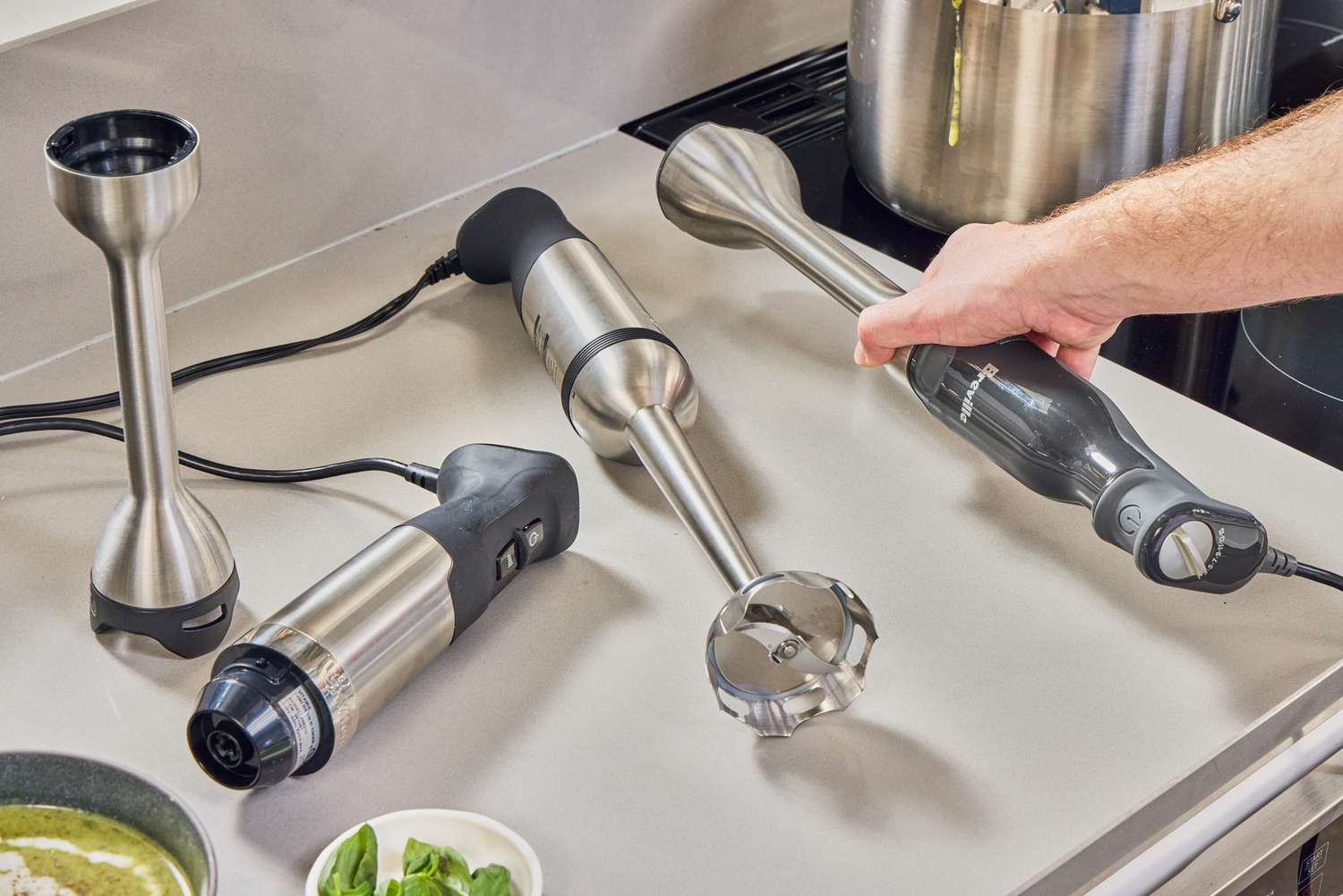
The best immersion blender for soups in 2026 is the Breville BSB510XL Control Grip: 280 watts, a bell-shaped guard that stops suction against the pot bottom, and a trigger-style Control Grip handle designed to reduce hand strain.
Where to buy these picks
Affiliate links: we may earn a commission on qualifying Amazon purchases. Policy. Prices show only when checked in the last 24 hours.
- Best Overall: Breville BSB510XL Control Grip $147.97 at Amazon, Check price on Amazon →
- Best Value: KitchenAid Variable Speed Corded Hand Blender KHBV53Check price on Amazon →
- Best for Beginners: Braun MQ50001M Vario Hand Blender $69.47 at Amazon, Check price on Amazon →
- Best Cordless: KitchenAid Go Cordless Hand Blender KHBRV71 $109.95 at Amazon, Check price on Amazon →
- Best Compact / Budget: Immersion Blender Handheld by turelar $18.88 at Amazon, Check price on Amazon →
Which immersion blender fits you
| Your situation | Buy | Why | Buy link |
|---|---|---|---|
| Doing long purées, or tired of a blender that suctions to the pot | Breville BSB510XL Control Grip $147.97 | 280 W, 15 speeds; bell guard with cutouts, trigger under the fingers, dishwasher-safe shaft | Amazon → |
| Soup a couple of times a month | KitchenAid Variable Speed Corded Hand Blender KHBV53 | Variable-pressure trigger, removable stainless shaft; KitchenAid sells replacement parts | Amazon → |
| First stick blender, worried about splashing | Braun MQ50001M Vario Hand Blender $69.47 | 500 W, 21 speeds for a slow start; SplashControl bell directs flow down, away from the shaft | Amazon → |
| A cord would drape across the burners | KitchenAid Go Cordless Hand Blender KHBRV71 $109.95 | Removable 12V battery, up to 30 min run time; variable-speed trigger, removable pan guard | Amazon → |
| Soup a few times a year, smallest budget | Immersion Blender Handheld by turelar $18.88 | Two speeds, stainless blades, nothing else; the simplest blender in the guide | Amazon → |
Quick answer
Which immersion blender fits a different budget or kitchen?
The best value is the KitchenAid Variable Speed Corded Hand Blender KHBV53, with a variable-pressure trigger, a removable stainless shaft and replacement parts sold by KitchenAid; it suits soup a couple of times a month. For beginners, the Braun MQ50001M Vario pairs 500 watts and 21 speeds for a slow start with a SplashControl bell that directs flow down, away from the shaft. The KitchenAid Go Cordless Hand Blender KHBRV71 is the cordless pick, with a removable 12V battery rated for up to 30 minutes of blending and a variable-speed trigger, and the turelar Immersion Blender is the compact budget pick: two speeds and stainless blades, enough for soup a few times a year.
An immersion blender's real advantage isn't power. It's that it goes to the soup instead of the soup going to it — no ladling 3 litres of 90°C liquid into a countertop jar in batches, no exploded lid, no second thing to wash.
What you'll use with it
A stick blender purées soup in the pot it simmered in. The Dutch oven guide picks that pot, from Le Creuset down to budget enameled cast iron from Tramontina. Read the Dutch oven guide →
Dutch oven guide’s top pick: Le Creuset Signature Round Dutch Oven, 5.5 qt $363.95 at Amazon, Check price on Amazon →
Introduction: why an immersion blender does jobs a countertop blender can't
Three jobs where the stick wins outright:
- Hot soup in the pot. A sealed countertop blender full of hot liquid builds steam pressure and can blow the lid off (nutribullet's blender user guide warns that hot liquid "can be ejected out of the appliance due to sudden steaming"). You're supposed to vent it and work in batches. An immersion blender skips the whole problem.
- Small volumes. A countertop blender needs enough volume to reach the blade — usually 500 ml minimum. A stick blender emulsifies a single egg yolk into mayonnaise in a narrow beaker in 20 seconds.
- Partial blending. Chunky-smooth soups, where you want half the pot puréed and half left in pieces. A countertop blender is all-or-nothing.
Where the countertop blender still wins: frozen drinks, nut butters, tough fibrous things like kale stems, and anything needing genuinely silky texture — a Vitamix 5200 measured about 28,500 RPM at top speed in Joy of Blending's tachometer test (the often-quoted 37,000 RPM is the bare motor's rating), against a stick blender's 12,000-15,000.
Our Top 5 Picks
#1 Best Overall: Breville BSB510XL Control Grip
Verdict: The ergonomics and the anti-suction bell are worth the premium.
Two design decisions justify the Breville's price. First, the trigger sits under your fingers instead of under your thumb, a grip designed to ease hand strain over a long purée. Second, the blade guard is a bell with cutouts rather than a flat skirt — it doesn't suction to the bottom of the pot, which is the single most annoying failure mode of cheap stick blenders. Breville's product page credits the bell-shaped base and its internal ribbing with reducing suction.
280 watts is modest on paper and plenty in practice for soup; wattage matters far less than blade geometry at these speeds. 15 speeds, and the shaft detaches for the dishwasher.
#2 Best Value: KitchenAid Variable Speed Corded Hand Blender KHBV53
Verdict: The one to buy if you make soup a couple of times a month.
The KHBV53 has a genuinely variable trigger — squeeze harder, blend faster — rather than fixed speed steps, which makes it easy to start slow and avoid the splash. Removable stainless shaft, and KitchenAid sells replacement parts for it, which is not true of most budget appliances. Also available in white.
Want the attachments too? The KHBV83 bundle adds a pitcher, whisk, and chopper.
#3 Best for Beginners: Braun MQ50001M Vario Hand Blender
Verdict: Braun designed SplashControl to direct flow downward, away from the shaft.
Splashing is the thing that puts beginners off stick blenders — you plunge it in, hit the trigger, and repaint the kitchen in tomato soup. The Braun MQ50001M's bell geometry directs flow downward and sideways rather than up the shaft, and 500W with 21 speeds gives you a genuinely slow start. The MQ5000 is the 400W sibling.
#4 Best Cordless: KitchenAid Go Cordless Hand Blender KHBRV71
Verdict: No cord dragging through the soup.
Cords are a real annoyance at the stove — they drape across burners and pull the blender off balance. The KitchenAid Go runs on a removable 12V MAX battery instead, which KitchenAid rates at up to 30 minutes of continuous run time — about ten pots of soup at three minutes each. It has a variable-speed trigger like the corded KHBV53, a removable 7-inch blending arm, and a removable pan guard that keeps the blade off the bottom of a nonstick pot. A 3-cup blending jar with a lid comes in the box. The battery is included with this model, and it fits the other KitchenAid Go cordless appliances.
#5 Best Compact / Budget: Immersion Blender Handheld by turelar
Verdict: The no-frills pick, and it purées soup.
The turelar is two speeds, stainless blades, and nothing else. For soup a few times a year it is entirely sufficient, and it is the simplest blender in this guide. The KOIOS 3-in-1 adds a whisk and frother.
Premium alternative: Vitamix 5-Speed (corded)
Not cordless, and not part of the Top 5 on price: if money is no object and you want maximum power, the Vitamix 5-Speed Immersion Blender bundle pairs a 625W motor with a whisk and storage case — the only stick blender here that genuinely approaches countertop smoothness. The Vitamix 2-Speed is the cheaper 350W version.
What to look for
| Spec | Why it matters | Target |
|---|---|---|
| Motor wattage | Matters for dense purées, not thin soups | 200-300W enough; 500W+ for hummus/nut work |
| Blade guard shape | Flat skirts suction to the pot bottom | Bell with side cutouts |
| Speed control | Fixed high speed = splashed kitchen | Variable trigger, or 5+ steps |
| Shaft length | Must reach past the liquid line of your stockpot | 20 cm+ for a 6 qt pot |
| Bowl clearance | Short shafts drown the motor housing | Measure your deepest pot |
| Detachable shaft | Otherwise you're washing a motor | Twist-off, dishwasher safe |
| Cord length | Stove-to-outlet distance is real | 1.5 m minimum |
| Battery life (cordless) | A pot of soup is ~3 minutes of run time | 20+ min per charge |
On wattage specifically: manufacturers advertise it because it's a big number, but a 1000W stick blender and a 280W one purée cooked squash identically. Wattage only shows up when the load resists — hummus, nut butter, raw fibrous vegetables. Buy for blade design and ergonomics, not watts.
Immersion vs countertop blender
| Task | Immersion | Countertop | Winner |
|---|---|---|---|
| Hot soup in the pot | Direct, no transfer | Batches, steam risk | Immersion |
| Silky-smooth bisque | Good | Excellent | Countertop |
| Mayonnaise / aioli | 20 seconds in a beaker | Needs volume | Immersion |
| Smoothies with ice | Struggles | Easy | Countertop |
| Small sauce (1 cup) | Easy | Below blade line | Immersion |
| Nut butter | No | Yes | Countertop |
| Cleanup | Rinse the shaft | Full jar + lid + gasket | Immersion |
| Storage | A drawer | Counter real estate | Immersion |
Most kitchens want both eventually. If you can only own one and you cook soup, buy the stick.
The 3 attachments that expand what a stick blender can do
1. The whisk. Whips cream in about 90 seconds and beats eggs for custard without dragging out a hand mixer. This is the attachment people actually use.
2. The chopper bowl. Handles onions, herbs, nuts, and breadcrumbs in small volumes where a full food processor is overkill. Not a food-processor replacement — it can't do a large batch — but it earns its drawer space.
3. The potato masher / mashing foot. Available on some Braun and Vitamix models. Genuinely better than a blade for potatoes, because blades develop the starch and turn mash gluey within seconds.
Skip the milk-frother attachment. It works, and an inexpensive standalone frother works better.
How this powers soup and hidden-veggie recipes
An immersion blender turns almost any vegetable and stock into a soup in under 30 minutes. These are the ones that show off what it does:
- Squash and root purées: Creamy Roasted Butternut Squash Soup, The Best One-Pot Butternut Squash Soup, and Quick Butternut Squash Soup with Coconut Milk.
- Tomato and pepper: Creamy Tomato Basil Soup and Half-and-Half Tomato and Roasted Red Pepper Soup.
- The starch trap: Velvety Potato Leek Soup — blend this one briefly. Over-blended potato goes gluey in about 15 seconds because the blade ruptures starch granules. Ten short pulses, not a continuous minute.
- Cauliflower, the low-carb workhorse: Roasted Cauliflower Soup with Thyme, Velvety Cauliflower Soup with Parmesan, and Creamy Coconut-Cauliflower Soup with Ginger.
- Hidden-veggie sauces for picky eaters: Hidden Veggie Spaghetti with Roasted Red Pepper Sauce, One-Pot Cheesy Macaroni and Hidden Veggie Sauce, and Hidden Veggie Turkey Meatballs with Tomato-Basil Sauce. Our 25 Hidden Veggie Recipes roundup has more.
Browse small appliances for the blenders themselves, cookware for a heavy-bottomed soup pot that won't scorch, and gadgets for the beakers and scrapers around them.
Real-world numbers: time and yield
| Task | Stick blender | Countertop (batched) | Notes |
|---|---|---|---|
| 3 L pot of squash soup | 90 sec | 6-8 min | Two or three transfers |
| 1 cup mayonnaise | 20 sec | Won't emulsify at that volume | Narrow beaker required |
| Whipped cream, 250 ml | 90 sec (whisk) | n/a | Chill the bowl first |
| Potato leek, 2 L | 10 pulses | 3 min | Over-blending ruins it either way |
| Cleanup | 30 sec rinse | 3 min | The real daily difference |
A worked example: butternut squash soup, start to finish
0:00 — prep. Peel and cube 1 kg of butternut squash, roughly chop an onion, smash three garlic cloves. Cubes want to be about 2.5 cm; smaller and they collapse before the onion softens, larger and they take twice as long.
0:10 — sweat. Onion into a heavy 6-quart pot with butter or oil over medium heat, salted, for eight minutes until translucent but not browned. Garlic in for the last minute. Browning the onion here changes the soup's character entirely — sweeter and deeper, but no longer clean and squash-forward. Choose deliberately.
0:20 — simmer. Squash in, then stock to about 2 cm below the top of the vegetables, not covering them. This is the mistake most home cooks make: too much liquid produces a thin soup you can't fix without reducing for another 20 minutes. You can always thin at the end; you can't easily thicken.
0:40 — check. A knife should slide through a cube with no resistance. Undercooked squash blends grainy no matter how long you run the blender.
0:42 — blend. Pot off the heat, wait two minutes so it drops off the boil. Submerge the bell fully, start on the lowest speed, and work it slowly around the pot in a figure-eight so everything passes the blade. Ninety seconds gets you smooth. Release the trigger before you lift the head.
0:45 — finish. Cream or coconut milk off the heat, taste, adjust salt, and add acid — a squeeze of lemon or a splash of cider vinegar. Squash soup without acid tastes flat and vaguely sweet, and almost every recipe under-specifies it.
Total: 45 minutes, one pot, one blender shaft to rinse. The same soup made in a countertop blender adds three transfers, a hot jar, a lid, and a gasket to wash, and carries a real risk of a steam-driven eruption on the first batch.
How the picks compare head to head
| Model | Watts | Speeds | Attachments | Best for |
|---|---|---|---|---|
| Breville Control Grip | 280 | 15 | Whisk, chopper | Frequent soup makers |
| KitchenAid KHBV53 | 180 | Variable | Optional | Most people |
| Braun MQ50001M | 500 | 21 | EasyClick system | Splash-averse beginners |
| KitchenAid Go KHBRV71 | Cordless, 12V | Variable | Pan guard, 3-cup jar | Cord-free stovetop work |
| Vitamix 5-Speed | 625 | 5 | Whisk, case | Dense purées, hummus |
| turelar Handheld | ~300 | 2 | None | Occasional use |
Common pitfalls
- Lifting the head above the liquid while running. That's how you paint the ceiling. Keep the bell fully submerged, start on low, and release the trigger before you lift.
- Blending starchy soups too long. Potato, and to a lesser extent parsnip, turns to glue. Short pulses.
- Running it in a nonstick pot without a guard. Metal blades score the coating. Use a model with a pan-protecting ring, or purée in a separate bowl.
- Leaving the motor unit under the tap. The shaft detaches for a reason. Water in the housing kills the unit.
- Buying on wattage alone. Covered above — blade geometry and ergonomics decide how it feels to use.
- Blending boiling liquid. Let the pot drop off the boil for two minutes first. Superheated liquid can erupt when agitated.
When NOT to buy an immersion blender
If you already own a good countertop blender and you make soup three times a year, skip it — the transfer hassle isn't worth the money at that frequency. If you want silky restaurant-grade bisque with no texture at all, no stick blender gets there; you want a high-speed countertop jar and a fine chinois. And if your only use case is smoothies, this is entirely the wrong tool — buy a countertop blender or a personal bullet blender instead.
Sources
Motor, blade-geometry, and technique claims cross-checked against Serious Eats — Immersion Blender Reviews, Wikipedia — Immersion blender for the design history, and America's Test Kitchen equipment reviews for comparative testing methodology. Hot-liquid safety follows nutribullet's blender user guide, the Vitamix speed comes from Joy of Blending's measured test, and the Breville's anti-suction design from Breville's BSB510 product page.
Frequently asked questions
What wattage do I need in an immersion blender?
Can an immersion blender replace my countertop blender?
Is cordless worth the extra 40 to 60 dollars?
How do I use an immersion blender without splattering hot soup everywhere?
What can I make with the whisk and chopper attachments?
How we picked
This guide is researched, not bench-tested. We shortlisted products from the AislePrompt kitchen catalog and compared them on published manufacturer specifications (such as materials, size and capacity), on what owners report in published reviews, and on any third-party sources linked in this guide. The guide was drafted with AI assistance. We did not run lab or hands-on tests of these products, so any measurement quoted here comes from the manufacturer or a cited source. Prices change often: use the “Check price on Amazon” buttons for today’s price.
Recipes to try with the blender
Put your gear to work — save any recipe to My Recipes (no account needed) and send its ingredients to Instacart in one tap.



Shop small appliances on AislePrompt →Browse the full kitchen shop →