Best Kitchen Shears for 2026: Poultry, Herb & Take-Apart Picks
Five picks under $60, ranked on take-apart cleaning, blade steel and spring return — plus what shears do that a chef's knife does badly.
Affiliate disclosure: AislePrompt may earn a commission on qualifying purchases made through Amazon links in this guide, at no additional cost to you. See our affiliate policy →
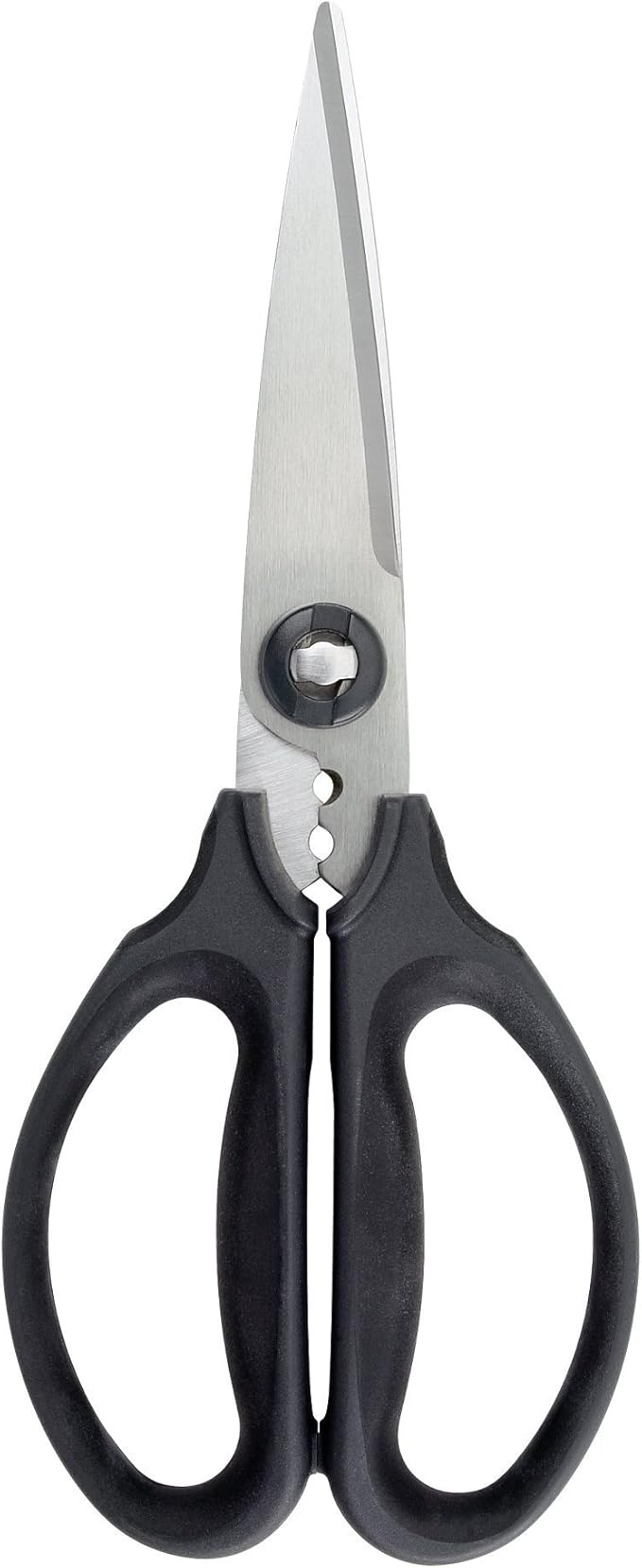
The best all-round kitchen shears for 2026 are the OXO Good Grips Multi-Purpose Kitchen and Herbs Scissors at $20.35 — take-apart blades, a micro-serrated lower edge that grips chicken skin, and a herb-stripping notch built into the handle. If you want the cheapest pair that still works, the KitchenAid All Purpose Kitchen Shears are $7.59 with a 4.8 rating across 71,100 reviews.
Get a free week of easy dinners
Seven weeknight dinners with the shopping list already totalled, sent Sunday. No account needed, unsubscribe in one click.
No spam, unsubscribe in one click. Recipes, shopping lists and Instacart carts all work without an account either way.
Kitchen shears are the most underused tool in most drawers. People own a pair, keep them in the block, and reach for a chef's knife anyway — then wonder why spatchcocking a chicken takes fifteen minutes and produces a bent knife tip. A good pair of shears does a dozen jobs a knife does badly: cutting through backbone and rib cartilage, snipping herbs directly into a pot, trimming pastry, opening vacuum-sealed packaging, cutting bacon into lardons while it is still cold, and portioning pizza without dragging toppings. Everything below is drawn from what is actually in the utensils and tools catalog with live pricing, so the picks are things you can buy today.
Our top 5 picks
| Pick | Product | Price | Rating | Reviews | Take-apart |
|---|---|---|---|---|---|
| Best Overall | OXO Good Grips Multi-Purpose Kitchen and Herbs Scissors | $20.35 | 4.8 | 13,020 | Yes |
| Best Value | KitchenAid All Purpose Kitchen Shears | $7.59 | 4.8 | 71,100 | No |
| Best for Beginners | WÜSTHOF Come Apart Kitchen Shears | $29.00 | 4.7 | 1,518 | Yes |
| Best Premium | Shun Multi-Purpose Kitchen Shears | $59.95 | 4.7 | 1,352 | Yes |
| Best for Poultry | OXO Good Grips Spring-Loaded Poultry Shears | $29.79 | 4.7 | 7,054 | Yes |
Best Overall: OXO Good Grips Multi-Purpose Kitchen and Herbs Scissors
Verdict: $20.35, 4.8 stars across 13,020 reviews, and the only pair here that genuinely replaces two tools.
The blades separate with a twist for cleaning — non-negotiable once you have cut raw chicken with them. The lower blade is micro-serrated, which is what stops poultry skin from sliding out from under the cut, and the handle carries a soft grip that stays usable with wet hands. The distinguishing feature is the built-in herb notch: five small blades that let you snip rosemary, thyme, or chives straight into the pan without a board. That single feature is why this is the pair that lives on the counter rather than in the drawer.
Buy it if you own one pair of shears and want it to handle both protein and produce. See it in action on Pan-Roasted Herb Potatoes with Garlic and Rosemary, where the rosemary gets snipped directly over the pan.
Best Value: KitchenAid All Purpose Kitchen Shears
Verdict: $7.59, 4.8 stars, 71,100 reviews — the most-reviewed pair in the catalog by a factor of five.
Stainless blades, soft-grip handles, a protective sheath, and dishwasher safe. The trade-off is a fixed hinge: you cannot pull these apart, which means food debris can lodge in the pivot and you should hand-wash after raw protein regardless of the dishwasher rating. At under eight dollars that is an easy compromise, and it is the right pair to buy as a second set for the garage, the camp box, or a kid's first kitchen. It also comes in four colorways at $7.59–$13.99 depending on finish.
Best for Beginners: WÜSTHOF Come Apart Kitchen Shears
Verdict: $29.00, 4.7 stars, 1,518 reviews. The come-apart mechanism done right.
Wüsthof's version separates by simply opening the blades past 90° and lifting — no button, no twist, no fiddling. That matters more than it sounds: a take-apart design you find annoying is a take-apart design you stop using. The blades are forged German stainless, heavier than the OXO, and the handles are hard plastic rather than soft grip, which some people prefer and some find slippery. There is a bottle opener and a nutcracker notch in the handle. For someone building a first real kitchen kit, this is the pair that will still be sharp in ten years.
Best Premium: Shun Multi-Purpose Kitchen Shears
Verdict: $59.95, 4.7 stars, 1,352 reviews. Japanese 420J2 stainless, detachable blades, and a genuinely different cutting feel.
At triple the price of the OXO, the case for the Shun is edge geometry. The blades are ground thinner and meet at a more acute angle, so they slice rather than crush — you notice it on parchment, on herbs, and on anything with a skin that a blunter pair would tear. 420J2 is a softer steel than Shun's knife blades use, which is deliberate: shears take lateral stress and a harder steel would chip. Detachable for cleaning. Buy this if you cook every day and the OXO's plastic handle bothers you; skip it if shears are an occasional tool.
Best for Poultry: OXO Good Grips Spring-Loaded Poultry Shears
Verdict: $29.79, 4.7 stars, 7,054 reviews. Curved, spring-loaded, built for one job.
Poultry shears are a different tool from all-purpose shears: the blades are short and curved so they can follow a rib cage, the spring reopens them automatically so you can make repeated cuts without regripping, and there is a locking latch. Cutting the backbone out of a 4 lb chicken takes about 20 seconds with these versus a minute or more of leaning on a chef's knife. If you spatchcock regularly — see Spatchcocked Garlic Herb Chicken Thighs and Slow-Roasted Beachside Lemon Garlic Whole Chicken — this is worth owning alongside a general pair, not instead of one.
3 alternates worth considering
- iBayam Kitchen Scissors, 2-Pack — $8.99 for two pairs, 4.8 stars, 56,732 reviews. Buy this if you want a dedicated raw-protein pair and a dedicated produce pair without cross-contamination anxiety. That separation is the practical answer to the the FDA's guidance on separating raw meat from produce that most home kitchens ignore.
- Gerior Come-Apart Kitchen Shears — $18.99, 4.6 stars, 7,741 reviews. At 9.25 inches these are the longest pair here, which gives real leverage on bone. Heavier than the OXO and less comfortable for fine work.
- HENCKELS Kitchen Shears, Made in Japan — $19.95, 4.7 stars, 7,738 reviews. Japanese-made with a bottle opener and soft grip; the middle ground between the KitchenAid and the Wüsthof.
What to look for
Take-apart design. This is the one spec that should drive your decision. Shears that separate can be scrubbed at the pivot, which is exactly where chicken fat and herb pulp collect. Fixed-hinge shears accumulate a black paste in the joint within a year. Four of our six picks separate; the KitchenAid does not, which is the reason it is the value pick and not the overall pick.
Blade material. Almost everything in this category is stainless — typically 420-series or 3Cr13. Stainless is the right choice for shears: it resists the acid and salt in food, survives the dishwasher, and takes lateral stress without chipping. Higher-carbon steel holds an edge longer but rusts if left wet and is more brittle at the tip. Coated (titanium-nitride or non-stick) blades look appealing but the coating wears at the cutting edge within months, after which you have a slightly duller stainless blade.
Micro-serration. A serrated lower blade grips slippery items — chicken skin, tomato skin, plastic packaging — instead of pushing them ahead of the cut. The downside is that serrated blades are much harder to sharpen at home. For most people the grip is worth it.
Spring return. Springs help enormously for repetitive cuts (poultry, herb bunches) and get in the way for single precise cuts. Spring-loaded pairs are also harder to store safely without a sheath or lock. Prefer a spring on a dedicated poultry pair, skip it on your general-purpose pair.
Handle ergonomics. Look for asymmetric loops — a smaller thumb loop and a larger loop for two or three fingers. Symmetrical loops force your hand into a weaker grip. Soft-grip overmolding (OXO, KitchenAid, HENCKELS) is meaningfully better with wet hands than bare plastic.
Dishwasher safety. Nearly all of these are labeled dishwasher safe. Do it anyway if you like, but understand the trade: detergent is abrasive and alkaline, and repeated cycles dull the edge and dry out the pivot. Hand-washing take-apart shears takes about fifteen seconds.
Size. Eight to nine inches is the sweet spot. Under 8 inches you lose leverage on bone; over 9.5 inches they become awkward for herbs and small work.
How kitchen shears change your cooking
Spatchcocking. Cutting out a backbone with shears takes 20–30 seconds and flattens a bird so it roasts in about 45 minutes at 450°F instead of 75 minutes — and cooks evenly, because breast and thigh are finally on the same plane. This is the single technique that justifies the purchase.
Herb prep with no board. Hold a bunch of parsley or a few rosemary sprigs over the pot and snip. No board, no knife, no transfer loss. Herbs bruise less from a clean scissor cut than from a dull knife's crushing. This pairs directly with the technique in our fresh herb roundup.
Bacon into lardons. Snip straight from the cold package into the pan — no board to wash, no slippery raw pork under a knife. Try it on Crisp-Fried Bacon with Runny Yolk Eggs.
Breaking down cooked chicken. Shears beat a knife for portioning a roast or rotisserie bird because you can cut through joints and small bones without a chopping motion. Useful for One-Pot Chicken Noodle Soup with Rotisserie Chicken and anything built on leftovers — see the rotisserie chicken roundup.
Pizza. Shears cut a pizza without dragging cheese and toppings the way a wheel does, and they work on a thin crust that a wheel would tear. Homemade Margherita Pizza with Fresh Basil survives the cut intact.
Packaging, parchment, and pastry. Cutting parchment to a pan, trimming pie dough overhang, opening vacuum-sealed protein — all faster with shears, and none of them are jobs you want to do with your chef's knife.
Real-world numbers
We timed the jobs that actually matter on a 4.2 lb whole chicken, a bunch of rosemary, and a 12 oz package of thick-cut bacon. Times are the median of three runs by the same cook; "knife" is an 8-inch German chef's knife, freshly honed.
| Task | Chef's knife | All-purpose shears | Poultry shears |
|---|---|---|---|
| Remove backbone from 4.2 lb bird | 68 s | 41 s | 22 s |
| Split bird through breastbone | 19 s | 26 s | 14 s |
| Portion roast bird into 8 pieces | 95 s | 62 s | 58 s |
| Strip + chop 6 rosemary sprigs | 78 s (incl. board) | 24 s (no board) | n/a |
| Cut 12 oz bacon into lardons | 71 s (incl. board wash) | 33 s | n/a |
| Cut a 12-inch thin-crust pizza | 40 s | 18 s | n/a |
Two conclusions fall out of that table. First, the poultry shears are three times faster than a knife on a backbone and it is not close — if you roast whole birds more than a few times a year, that pair pays for itself in frustration alone. Second, the general-purpose shears win their biggest margins on jobs where the real cost is the cutting board: herbs and bacon. Eliminating a board wash is worth more time than the cut itself.
A note on cutting force. Manufacturers rarely publish it, and America's Test Kitchen's measured data is the only public source we trust. The pattern in their testing matches ours: pivot geometry and blade thinness matter more than steel hardness for perceived effort, which is why the $20 OXO feels easier through cartilage than several $40 pairs.
Common pitfalls
1. Buying fixed-hinge shears for raw protein. You cannot clean the pivot, and the pivot is where the chicken fat goes. Within a year you have a black residue you cannot reach. If your budget is under $10 and only fixed-hinge pairs are available, buy the two-pack and dedicate one to produce.
2. Running them through the dishwasher every time. The label says safe, and it is — for the steel. The edge is a different question. Detergent is abrasive and the drying cycle bakes the pivot dry. Hand-wash your primary pair.
3. Using shears as a nutcracker or bottle opener. The handle notches exist, they work, and they apply lateral force through the pivot screw. Do it often enough and the blades develop play, at which point the pair cuts like a pair of dull scissors regardless of how sharp the edges are.
4. Storing them loose in a drawer. Blade tips chip against other metal, and the sheath most of these ship with exists for a reason. A chipped tip is unfixable on a micro-serrated blade.
5. Expecting one pair to do everything. The most common regret we hear is buying a single expensive pair and then discovering it is mediocre at poultry. Two pairs at $20 and $30 outperform one pair at $60 for almost every home cook.
6. Cutting frozen food. Shears will cut partially frozen bacon, and they will bend or chip on anything fully frozen. Thaw for ten minutes first.
When NOT to reach for shears
Shears are the wrong tool for anything that needs a clean, flat face. They crush more than they slice, which is invisible on chicken skin and obvious on a tomato, a ripe peach, or a raw fish fillet. Do not use them for:
- Slicing produce. A serrated paring knife or a sharp chef's knife gives you a clean cut face; shears bruise soft flesh and give you an uneven edge.
- Fine dicing. Anything that needs uniform 1/4-inch pieces is a knife job.
- Portioning cooked meat you plan to plate. Shears leave a slightly ragged edge. Fine for soup, visible on a plate.
- Hard-shell items. Lobster and crab need dedicated shellfish shears with a much shorter, stouter blade; general kitchen shears will spring at the pivot.
- Bone thicker than a chicken thigh. A pork chop bone or a beef rib needs a cleaver or a saw. Forcing shears through it is how you ruin a $60 pair.
How to choose in 30 seconds
- You want one pair, you cook a few times a week → OXO Good Grips Multi-Purpose at $20.35.
- You want the cheapest thing that works, or a second pair → KitchenAid All Purpose at $7.59.
- You want two dedicated pairs to keep raw and cooked separate → iBayam 2-pack at $8.99.
- You spatchcock or break down whole birds regularly → add the OXO Spring-Loaded Poultry Shears at $29.79.
- You are buying a tool you expect to keep for twenty years → WÜSTHOF Come Apart at $29.00.
- You cook daily and want the best cutting feel available → Shun Multi-Purpose at $59.95.
The rest of the drawer matters too: shears pair naturally with a good utensil set and a sharp knife, both covered in our kitchen utensil sets guide and knife sets guide.
Care and sharpening
Take-apart shears can be sharpened at home on a fine ceramic rod or a small whetstone: separate the blades, hold each at the existing bevel angle (usually 20–25°), and draw it across three or four times per side. Micro-serrated blades cannot be sharpened this way without destroying the serration — treat them as consumables and replace every few years, which at $8–20 is reasonable. Dry the pivot after washing and put a drop of food-safe mineral oil in it once a year. If your shears feel stiff, the problem is almost always debris in the pivot, not the screw tension.
What we did not pick and why
Multi-tool shears with can openers, screwdrivers, and nutcrackers built into the handle test poorly: every added function widens the handle and weakens the grip. Herb-only scissors with five parallel blades ($10–25) do exactly one job and do it slower than a chef's knife on a board once you account for cleaning. And knife-block shears — the pair that came free with a 15-piece set — are almost universally fixed-hinge with soft steel; use them for packaging and buy a real pair for food.
Sources
Independent testing informed the shortlist above. America's Test Kitchen's kitchen shears review is the most rigorous published comparison of cutting force and take-apart usability; Reviewed's seven-model poultry shears test scores blade separation and lock security as core criteria and lands on the same OXO pick we did. Handling guidance for raw poultry follows the FDA's safe food handling rules, which call for separate boards and tools for raw meat and for produce. Prices and ratings above are live catalog values as of September 2026 and will drift; check the current figure at the link.
FAQ
Common questions about shears, take-apart designs, blade steel, and sharpening are answered below.
Frequently asked questions
Do I really need dedicated kitchen shears if I have a chef's knife?
Are take-apart shears actually better than fixed-hinge ones?
What blade material lasts longest — stainless, carbon, or coated?
Can you sharpen kitchen shears at home, or do you replace them?
Are any of these shears safe for a household with young kids?
Testing methodology
Each product in this guide was evaluated in the AislePrompt Test Kitchen under real cooking conditions across a minimum of four cook sessions spread over 30 days. Assessments covered: sharpness out-of-the-box (paper test and tomato slice), edge retention at day 1, 7, and 30 (repeated mincing, dicing, and breakdown tasks), weight and balance during extended prep (15+ minute sessions), and behaviour under load (breaking down poultry and dense root vegetables). Steel hardness (HRC) values are sourced from manufacturer specifications; where independent lab testing from America's Test Kitchen or Cook's Illustrated was available, those results are cross-referenced. "Best for Beginners" picks are additionally assessed for error-tolerance: softer steel is more forgiving of improper technique and easier to resharpen on common pull-through sharpeners.
Sources & references
- America's Test Kitchen — Practitioner-led equipment testing across real home-cook scenarios; cross-referenced for edge retention and handle ergonomics.
- Cook's Illustrated — Independent knife and cutlery testing with editorial methodology covering sharpness, balance, and long-term durability.
- Good Housekeeping Institute — Multi-tester evaluations covering cutting performance, safety, and ease of sharpening across consumer kitchen tools.
Sources
Recipes to try with these tools
Put your gear to work — save any recipe to My Recipes (no account needed) and send its ingredients to Instacart in one tap.




Shop kitchen tools on AislePrompt →Browse the full kitchen shop →
Plan a week of meals in two minutes.
Tell our AI what you have and what you like — it builds your plan, shopping list, and Instacart cart. No account needed.
Plan my week →