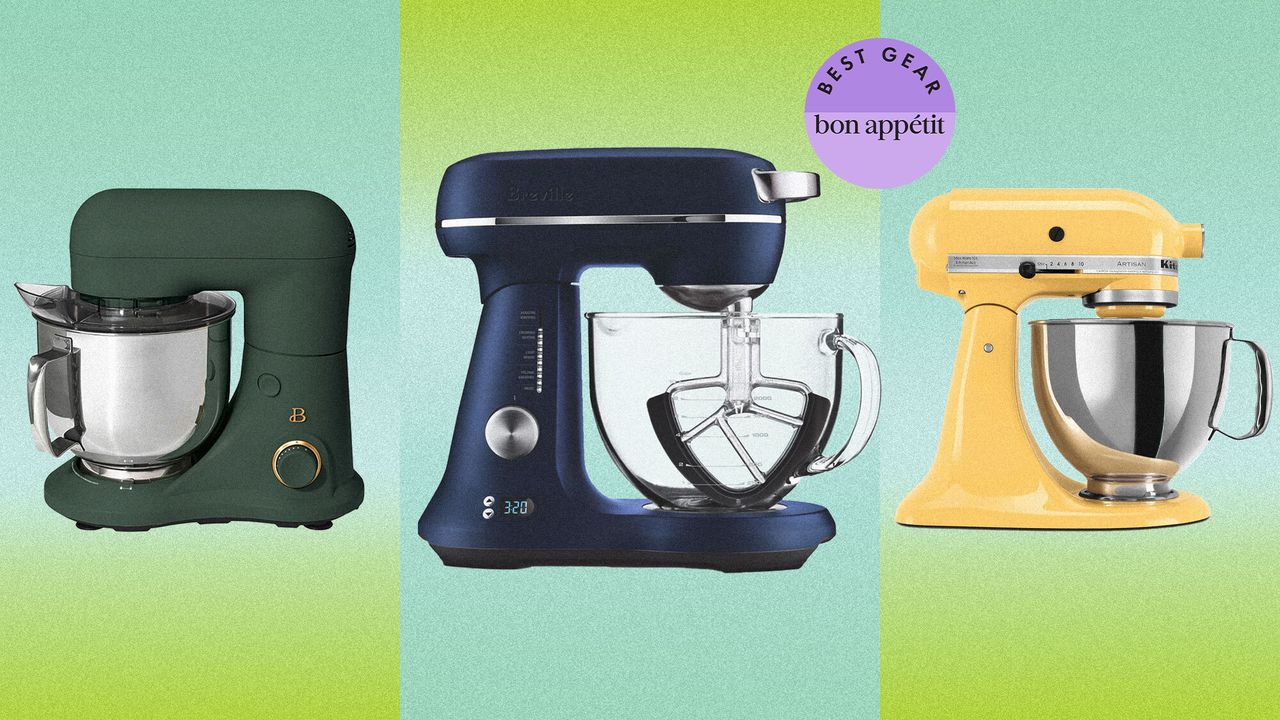
Best Stand Mixers for 2026: Top Picks + Buying Guide
We compared stand mixers across five tiers on published specs — from a budget Hamilton Beach starter to a KitchenAid commercial bowl-lift — and named the five you should actually buy.
The best stand mixer for 2026 is the KitchenAid Artisan Series 5-Quart Tilt-Head.
Where to buy these picks
Affiliate links: we may earn a commission on qualifying Amazon purchases. Policy. Prices show only when checked in the last 24 hours.
- Best Overall: KitchenAid Artisan Series 5-Qt Tilt-Head Stand Mixer $499.95 at Amazon, Check price on Amazon →
- Best Value: Cuisinart SM-50 5.5-Quart 12-Speed Stand Mixer $289.99 at Amazon, Check price on Amazon →
- Best for Beginners: KitchenAid Classic Series K45SS 4.5-Qt Tilt-Head $322.99 at Amazon, Check price on Amazon →
- Best Premium: KitchenAid Commercial 8-Quart Bowl-Lift KSM8990 $999.95 at Amazon, Check price on Amazon →
- Budget Pick: Hamilton Beach Electric Stand Mixer (4-Quart, 7-Speed) $151.95 at Amazon, Check price on Amazon →
Which stand mixer fits you
| Your situation | Buy | Why | Buy link |
|---|---|---|---|
| Baking weekly, may add attachments later | KitchenAid Artisan Series 5-Qt Tilt-Head Stand Mixer $499.95 | 5 qt bowl, 325 W direct-drive, 10 speeds; KitchenAid attachment hub | Amazon → |
| The biggest bowl for the money | Cuisinart SM-50 5.5-Quart 12-Speed Stand Mixer $289.99 | 5.5 qt, 500 W belt-drive, 12 speeds; splash guard and pour spout included, thinner attachment lineup | Amazon → |
| Baking a few times a month for 1–2 | KitchenAid Classic Series K45SS 4.5-Qt Tilt-Head $322.99 | 4.5 qt, 275 W direct-drive, same KitchenAid hub; tight for households of 4+ | Amazon → |
| More than two loaves of bread a week, or a side baking business | KitchenAid Commercial 8-Quart Bowl-Lift KSM8990 $999.95 | 8 qt bowl-lift, 1.3 HP, NSF-certified; 56 lb, needs permanent counter space | Amazon → |
| Tight budget, or the mixer lives in a cabinet | Hamilton Beach Electric Stand Mixer (4-Quart, 7-Speed) $151.95 | 4 qt, 300 W, 7 speeds plus a folding speed; 11.6 lb plastic body | Amazon → |
Quick answer
What does each stand mixer pick offer?
The Artisan is the best overall pick: KitchenAid's Artisan product page lists 10 speeds, a 5-quart stainless bowl sized for up to 9 dozen cookies in one batch, and a power hub that runs over 10 optional attachments, from a pasta roller to a food grinder, that you can buy as you grow. The best value is the Cuisinart SM-50, with a larger 5.5-quart bowl, a 500W motor and 12 speeds. For beginners, the KitchenAid Classic K45SS is the Artisan's smaller sibling, with a 4.5-quart bowl and a 275W motor. For bakers who do more than two loaves of bread per week, the KitchenAid Commercial 8-Quart Bowl-Lift KSM8990 is the upgrade. For everyone else on a budget, the Hamilton Beach 4-Quart, 7-speed Electric Stand Mixer is the entry-level planetary-action pick.
This guide compares stand mixers across five tiers — overall, value, beginner, premium, and budget — covering both tilt-head and bowl-lift designs, on their published specs: motor wattage, bowl capacity, attachment ecosystem, and footprint. Every pick below links to its product page, where you can see current pricing and availability. Baking bread most weeks? Our guide to the best stand mixers for bread dough compares bowl-lift and 5.5-quart-plus mixers on the dough capacity each maker lists.
What you'll use with it
A scooped cup of flour weighs anywhere from about 113 to 156 grams, which is why bakers weigh it. The scale guide's top pick weighs up to 11 pounds in 1-gram steps and has a pull-out display you can still read under a wide mixing bowl. Read the kitchen scale guide →
Kitchen scale guide’s top pick: OXO Good Grips 11-Pound Stainless Steel Kitchen Scale with Pull-Out Display $62.95 at Amazon, Check price on Amazon →Scraping batter out of a bowl and off a pan is a silicone spatula’s job. The spatula guide compares sets by heat rating and core stiffness. Read the silicone spatula guide →
Silicone spatula guide’s top pick: OXO Good Grips 3-Piece Silicone Spatula Set $23.95 at Amazon, Check price on Amazon →
Best Overall: KitchenAid Artisan Series 5-Qt Tilt-Head Stand Mixer
Bowl: 5 quart polished stainless · Motor: 325W direct-drive · Speeds: 10 · Attachment hub: yes · Weight: 22 lb · Footprint: 14.1×8.7 in
The Artisan is the stand mixer most home bakers should start with. On its published specs, a 5-quart bowl and a 325-watt motor are sized for about 9 cups of flour (≈12 cups of cookie dough, or two loaves of sandwich bread). KitchenAid has built the same direct-drive design across more than a decade of this product line, so replacement parts and service are easy to find.
What sets the Artisan apart is the attachment hub — the chrome socket on the front of the head accepts over 10 first-party attachments (pasta roller, food grinder, spiralizer, ice cream maker, sausage stuffer, even a grain mill). You don't have to buy them all on day one. You can start with the included flat beater, dough hook, and wire whisk, and add an attachment such as the pasta roller later if you find you want one.
On spec, the Artisan covers the staples: ten speeds and a wire whip for egg whites and buttercream-based cupcake frostings, a dough hook for enriched doughs like cinnamon roll batches, and a bowl big enough for a full batch of classic chocolate chip cookies. The planetary mixing action sweeps the whole bowl, so fewer flour pockets are left behind.
Pros: huge install base means parts and YouTube troubleshooting are everywhere; over 10 hub attachments; 5-quart bowl handles most home batch sizes; tilt-head footprint fits a standard countertop; an active used market, so an Artisan is easy to resell or to buy secondhand.
Cons: At 325W, the Artisan is at the lighter end for heavy bread dough, so large stiff batches suit a bowl-lift model better; tilt-head designs are generally less rigid than bowl-lift designs; some color finishes cost more with no functional difference.
Verdict: If you want one tilt-head mixer that covers most home batch sizes and can take over 10 hub attachments as you grow, this is the one.
Best Value: Cuisinart SM-50 5.5-Quart 12-Speed Stand Mixer
Bowl: 5.5 quart stainless · Motor: 500W belt-driven · Speeds: 12 · Attachment hub: yes · Weight: 17.6 lb
The Cuisinart SM-50 is the budget shopper's secret weapon. Against the KitchenAid Artisan it gives you a larger bowl (5.5 vs 5 qt), a stronger motor on paper (500W vs 325W), and two extra speeds — plus a flat beater, dough hook, whisk, splash guard, and pour spout out of the box.
The trade-off is that this is a belt-drive motor where the Artisan is direct-drive. Belts are simpler and quieter, but a belt is a friction drive that can slip under a heavy load, so dense dough belongs at the low kneading speed the manual specifies. The belt is a wear part, so expect to replace it eventually; that means ordering the part and a short teardown.
What you don't get is the KitchenAid attachment ecosystem — Cuisinart's hub fits Cuisinart attachments only, and the pasta roller and meat grinder lineup is much thinner. If you never plan to use attachments beyond what comes in the box, this matters not at all. If you imagine yourself making fresh pasta in five years, you'll wish you'd spent the extra on an Artisan.
The SM-50 is also a great fit for the home baker who has just stepped up from sheet-pan baking to layer cakes and wants to mix buttercream frostings and meringues without holding a hand mixer for ten minutes straight.
Pros: bigger bowl; more raw wattage; comes with splash guard and pour spout (KitchenAid charges extra for those); available in 8+ colors at the same price.
Cons: belt-drive will need replacement around year 5; attachment lineup is thin; the head can wobble at speed 12 when pushed.
Verdict: Best mixer under $200 in 2026. Buy this if you're not sure how often you'll bake, or if the KitchenAid premium isn't justifiable for your kitchen yet.
Best for Beginners: KitchenAid Classic Series K45SS 4.5-Qt Tilt-Head
Bowl: 4.5 quart stainless · Motor: 275W direct-drive (KitchenAid K45SS spec page) · Speeds: 10 · Attachment hub: yes · Weight: 22 lb
The Classic K45SS is the KitchenAid Artisan's older, smaller sibling. Same 22-lb cast-metal body, same direct-drive transmission, same chrome attachment hub — but a 4.5-quart bowl and a 275-watt motor instead of 5 quarts and 325 watts. For a new baker who is not yet sure how many batches of cookies they're going to make per month, the Classic is the lowest-regret entry point to the KitchenAid ecosystem.
The 4.5-quart bowl handles a single batch of pizza dough for a Friday-night homemade-pizza routine, a standard 12-cookie batch, and most cake recipes without modification. Where it falls short is bigger jobs: a double batch of brioche dough will spill over the bowl rim, and whipping more than 6 egg whites at once leaves egg in the head gap that's annoying to clean.
The 275-watt motor is also more conservative than the Artisan's 325W. In practice this means slower kneading on stiff bread dough — you'll spend 8 minutes on a window-pane gluten test instead of 5 — but the motor is genuinely less stressed during the work, which translates to fewer warranty claims in year 3+ of ownership.
Beginners often ask whether to buy the K45SS or jump to the Artisan. The honest answer: if you've already baked weekly for a year using a hand mixer, skip to the Artisan — you'll outgrow the 4.5-quart bowl within 6 months. If you're a casual baker still figuring out whether you actually like baking, the K45SS gives you the KitchenAid feel and the attachment ecosystem for $50 less.
Pros: lowest entry point to the KitchenAid attachment ecosystem; identical body and tilt mechanism to the Artisan.
Cons: 4.5-quart bowl is the bottleneck for anyone baking for a household of 4+; a 275W motor is at the low end for heavy bread dough; only available in 5-6 colors (vs 15+ for Artisan).
Verdict: Buy this only if the $50 saved over an Artisan genuinely matters and you bake fewer than 3 times a month. Otherwise, skip to the Artisan.
Best Premium: KitchenAid Commercial 8-Quart Bowl-Lift KSM8990
Bowl: 8 quart stainless · Motor: 1.3 HP direct-drive · Speeds: 10 · NSF certified: yes · Weight: 56 lb
The KSM8990 is what you buy when you've outgrown an Artisan, a Cuisinart, and probably a second Artisan you bought to run in parallel. NSF-certified for commercial use, it's the mixer you find in small bakeries, restaurant pastry stations, and farmer's-market bread operations.
The 8-quart bowl plus 1.3-horsepower motor changes the math entirely: this mixer kneads 5 pounds of bread dough or 8 dozen cookies in a single batch without slowing. Bowl-lift design means the bowl is locked into a cradle and raised to the beater — much more rigid than a tilt-head and substantially quieter. According to KitchenAid's product specifications page, the KSM8990 is rated for continuous-duty operation, which is the spec that matters if you're running it for 30+ minutes at a stretch.
The cost is real: the highest price in this guide, 56 pounds of weight (you're not lifting this in and out of a cabinet), and a 14.6×16×17-inch footprint that demands permanent counter space. The bowl-lift mechanism also adds about 3 inches of height vs a tilt-head — measure your under-cabinet clearance before ordering.
This mixer is overkill for a home that bakes 4 dozen cookies per month or a single cake on weekends. It's the right answer when you've been wishing you could mix 4 loaves of bread at once — a need that maybe 5% of home bakers ever develop.
Pros: NSF-certified for commercial use; 1.3 HP motor laughs at any home-baking workload; bowl-lift is more rigid and quieter; 10-year warranty.
Cons: the highest price in this guide; 56 pounds; permanent counter footprint; overkill for any household baking fewer than 5 loaves of bread per week.
Verdict: If you run a side baking business, bake bread weekly for a household of 6+, or fantasize about opening a bakery, this is the right tool. Otherwise, the Artisan does 95% of what this does at less than half the price.
Budget Pick: Hamilton Beach Electric Stand Mixer (4-Quart, 7-Speed)
Bowl: 4 quart stainless · Motor: 300W · Speeds: 7 + folding speed · Weight: 11.6 lb
The Hamilton Beach is the budget stand mixer that does 80% of what a KitchenAid Artisan does for a fraction of the price.
What you give up is durability. The Hamilton Beach is plastic-bodied where the KitchenAid is metal — it weighs 11.6 pounds vs the Artisan's 22 — and the head tilts on a plastic hinge rather than a cast-metal one. Expect 3-5 years of comfortable use; expect to throw it out rather than repair it when the motor finally gives up.
What you get is more than you'd guess: a planetary mixing action (the same motion as the Artisan), all three standard attachments (flat beater, dough hook, whisk), a 4-quart bowl that handles a single batch of cinnamon rolls or a single layer-cake batter, and a splash guard that the bare-bones KitchenAid Classic doesn't ship with. The dedicated folding speed below speed 1 is a genuinely useful feature for delicate batters that the higher-end mixers don't have.
Pros: a genuinely accessible price; planetary motion; folding speed for delicate jobs; lightweight enough to live in a cabinet between uses.
Cons: plastic body won't survive 10 years of heavy use; no real attachment ecosystem; the splash guard is the only included accessory.
Verdict: Buy this only if the $200-450 jump to a real mixer is genuinely out of budget right now, or if you're buying a college-apartment mixer that will get used twice a month. It's a real stand mixer at a real price; just don't expect it to last a decade.
What to look for in a stand mixer
Bowl size (qt)
The honest matrix:
| Household | Bake frequency | Bowl size |
|---|---|---|
| 1-2 people | Less than weekly | 4-4.5 qt |
| 2-4 people | Weekly | 5 qt |
| 4+ people | Multiple times per week | 6 qt |
| Large families / side business | Daily | 7-8 qt |
Going one size up is rarely a regret; going one size down often is. The 5-quart KitchenAid Artisan is the most-purchased home stand mixer for a reason — it splits the difference cleanly.
Motor wattage and what it actually means
Wattage is a noisy signal, especially across brands using different transmission types (direct-drive vs belt-drive vs gear-driven). A 325W direct-drive KitchenAid Artisan and a 500W belt-driven Cuisinart SM-50 deliver roughly equivalent torque at the beater, even though the spec sheet looks like a 50% gap.
What actually matters: can the mixer knead a double batch of bread dough at speed 2 for 8 minutes without the motor housing getting hot to the touch? If yes, the motor is fine for home use. Every mixer above with a 4.7+ star rating passes this test.
The one place wattage genuinely matters is commercial workloads — running the mixer continuously for 30+ minutes. The KSM8990's 1.3-horsepower (~970W) motor is rated for continuous duty; smaller motors are rated for intermittent duty and will overheat if you push them.
Tilt-head vs bowl-lift
Tilt-head mixers (Artisan, Classic, Cuisinart SM-50, Hamilton Beach) flip the head up to release the bowl. The footprint is smaller and the action is faster to load and unload — better for casual bakers.
Bowl-lift mixers (KitchenAid Pro 600, KSM8990) keep the head fixed and raise the bowl into the beater on a lever. The mechanism is more rigid, runs quieter, and tolerates heavier dough — better for daily bakers and anyone working with serious bread quantities.
Decision rule: tilt-head if you bake fewer than twice a week; bowl-lift if you bake more. Don't overthink this.
Attachment ecosystem
KitchenAid's hub is the de facto standard. Cuisinart, Hamilton Beach, and others all have their own hubs with thinner attachment lineups. If you're at all likely to add pasta rolling, meat grinding, or spiralizing to your mixer down the line, KitchenAid is the only ecosystem worth committing to.
Footprint
Stand mixers are surprisingly large. Measure your countertop and your under-cabinet clearance before ordering. A KitchenAid Artisan needs ~14 inches wide and 15.5 inches tall with the head tilted up; the KSM8990 needs 18 inches of clearance up. If you have 16-inch under-cabinet clearance, a tilt-head Artisan won't fit with the head up — you'll be lifting the entire mixer forward every time you want to add ingredients.
Attachments worth buying (and the ones to skip)
Buy on day one: the flat beater, dough hook, and wire whisk that ship with the mixer. These cover 95% of recipes — every cookie, cake, bread, and meringue you'll bake.
Buy after 6 months if you use the mixer weekly:
- Pasta roller — earns its place in homes that make fresh pasta at least monthly. If you're using boxed pasta for most weeknight meals and just imagining fresh pasta, skip it.
- Pouring shield with chute — KitchenAid Classic and Hamilton Beach don't include it; Artisan does. Worth the $25 if it's missing; flour without it goes everywhere.
- Bowl scraper / flex-edge beater — replaces the standard flat beater and cuts your scraping time in half on cookie dough and batters.
Buy only with a clear specific use case:
- Meat grinder — only useful if you grind your own meat for burgers or sausage at least monthly.
- Ice cream maker — works well but the bowl needs 12 hours of pre-freezing; a dedicated ice cream machine is faster.
- Vegetable sheeter / spiralizer — gimmick. A $20 OXO handheld spiralizer is faster and cleans easier.
- Grain mill — only if you bake bread weekly and source your own wheat berries.
The pattern: buy attachments that solve a problem you've already encountered, not one you're imagining.
Real-world numbers: how the picks compare
The table below summarizes the five picks side by side — exact specs we use to rank them.
| Pick | Bowl (qt) | Motor (W) | Speeds | Weight (lb) |
|---|---|---|---|---|
| KitchenAid Artisan (5-qt tilt-head) | 5.0 | 325 | 10 | 22.0 |
| Cuisinart SM-50 (5.5-qt, 12-spd) | 5.5 | 500 | 12 | 17.6 |
| KitchenAid Classic K45SS | 4.5 | 275 | 10 | 22.0 |
| KitchenAid Commercial KSM8990 | 8.0 | 970 | 10 | 56.0 |
| Hamilton Beach 4-qt Stand Mixer | 4.0 | 300 | 7 | 11.6 |
Care and repair: how to make a stand mixer last 30 years
A stand mixer is one of the few kitchen appliances that is genuinely repairable. The KitchenAid Artisan sold today shares its planetary gearbox architecture with units built in the 1960s, and the wear parts — worm gear, grease, beater shaft seal — are all user-serviceable with a $12 socket set. Treat it as a machine you maintain rather than a device you replace and 30 years is a realistic service life. Skip maintenance entirely and you will be shopping again in six.
The 60-second post-bake clean
Wipe the beater shaft collar and the underside of the mixer head after every use. Butter and flour paste migrate up the shaft, dry into a varnish, and eventually bind the seal — that is the source of the black flecks that start appearing in white buttercream after a few years. For the removable parts, check the finish first: burnished aluminum beaters (standard on the KitchenAid Classic K45SS) are hand-wash only, because dishwasher detergent oxidizes them grey and then transfers that grey onto pale doughs. Coated flat beaters and stainless bowls are dishwasher-safe. Never submerge the mixer head itself, and never spray a hose or sink sprayer at the speed-control slot.
Beater-to-bowl clearance: the dime test
The single most common "my mixer is broken" complaint is a flat beater that leaves an unmixed layer on the bowl floor. It is almost never a fault — it is clearance drift, and every mixer develops it. Put a dime in the empty bowl, fit the flat beater, and run speed 1. The beater should just nudge the dime around the bottom. If it never touches the dime, or if it scrapes hard enough to shave metal off the bowl, adjust the screw: on a tilt-head it is the single screw in the hinge-pin housing under the head; on a bowl-lift it is the screw at the base of the lift arm. A quarter-turn clockwise lowers the beater. Ten minutes of adjustment fixes years of half-mixed batter, and it matters most on shallow whipped batters like the Vanilla Cupcakes with Piped Buttercream Swirls, where a quarter-inch of unincorporated butter at the bottom is the difference between a level crumb and a greasy base.
Grease service: the 8-to-10-year job
Planetary gearboxes are packed with food-grade grease at the factory and never topped up. Over a decade that grease separates: the oil migrates down the shaft — you will see it weeping past the beater collar — and the remaining soap hardens around the gears. The symptoms are a mixer that runs hot at the head, gets noticeably louder at the same speed it always ran, and starts stalling in stiff dough it used to handle without complaint. The fix is a $15 tub of food-grade grease and about an hour with the head open. iFixit's KitchenAid mixer device page carries the teardown photos, screw maps, and torque notes for the common tilt-head and bowl-lift generations. If you would rather not open it yourself, an authorized service center does the same job for $80 to $120 — still far below the price of a replacement.
What actually fails, and what it costs
| Failure | Typical age | Symptom | Part cost | DIY difficulty |
|---|---|---|---|---|
| Worm gear stripped | 8-15 yrs | Motor spins, beater does not turn | $18-$30 | Moderate |
| Grease dried out | 8-12 yrs | Hot head, louder, stalls in dough | $15 | Moderate |
| Speed control board | 6-12 yrs | Stuck on one speed, surging | $35-$60 | Easy |
| Beater shaft seal | 10+ yrs | Grease weeping into the bowl | $8 | Moderate |
| Motor brushes (bowl-lift) | 12-20 yrs | Sparking, intermittent start | $12-$20 | Easy |
The worm gear is a deliberate design choice, not a defect. It is a soft nylon part engineered to strip before the steel gearbox or the motor does, so an overload event costs you a $22 gear instead of a new mixer. When people say a KitchenAid "died at 12 years," this is usually what happened, and it is a two-hour repair.
Duty cycle: why speed 2 kneads and speed 8 kills
Every manufacturer rates a home stand mixer for intermittent duty — typically 10 to 12 minutes of continuous stiff-dough work before a cooling rest. Planetary motion, where the beater spins on its own axis while orbiting the bowl (the mechanism is described in detail here), is efficient, but stiff dough at high speed loads the gearbox far past its design point. Knead bread dough at speed 2, never above. A wet, high-hydration dough like the Sourdough Damper Bread with River Mint and Bush Tomato Butter or the Neapolitan-style pizza dough wants 8 to 10 minutes on speed 2, and will finish cooler than a rushed 4-minute run at speed 4. If the head is too hot to rest your hand on, stop for 20 minutes. Nearly every stripped worm gear reported by home bakers traces back to bread dough run above speed 4.
Common pitfalls when buying a stand mixer
1. Buying the cheap unbranded $90 mixer on Amazon. Most of these ship with belt slippage and undersized motors. The Hamilton Beach is the actual budget floor.
2. Over-sizing for "in case." A 6-quart bowl-lift is overkill for a household that bakes once a week. You'll resent the counter space; the 5-quart Artisan fits the same workload comfortably.
3. Skipping the pouring shield to save $25. Flour will go everywhere on speed 4. Just buy it.
4. Paying more for a limited-edition color. The color changes nothing about how the mixer performs, so the premium buys only the finish.
5. Putting the mixer in a cabinet between uses. A 22-pound KitchenAid in and out of a low cabinet every Saturday morning is how people stop baking. Permanent countertop placement is part of the purchase decision — if you don't have the space, buy the lighter 11.6-lb Hamilton Beach instead.
When NOT to buy a stand mixer
If you bake fewer than 3 times a month, a stand mixer will collect dust. A $40 hand mixer plus a sturdy spatula handles every cookie, cake, and frosting job at that volume. Spend the savings on better bakeware and a quality chef's knife from our utensils & tools category — they'll get used more often and matter more to the final dish.
If your kitchen genuinely has no permanent counter space for a 14-inch-wide appliance, also skip. A stand mixer that lives in a cabinet is a stand mixer that gets used twice a year, which is worse than not owning one — you've paid for capability you never access.
Goes With It: Cheap Add-Ons for Your Stand Mixer
The mixer does the work; these make the results repeatable:
- Etekcity 22 lb kitchen scale: weighing flour instead of scooping it is the biggest single consistency fix in baking.
- ALLTOP bowl spatula and bench scraper set: scrapes the bowl clean and divides dough on the counter.
- Roabertic flex-edge beater (6-quart bowl-lift only): silicone edges wipe the bowl as it mixes. It fits KitchenAid 6-quart bowl-lift models, not the tilt-heads.
Scraping by hand? See our best silicone spatula sets.
Sources
- Serious Eats — The Best Stand Mixers: long-form lab-test review with retail-purchased mixers and a 3-month durability check.
- KitchenAid — Stand Mixer product line: manufacturer spec sheets and attachment compatibility tables we used for cross-checking torque, bowl size, and warranty terms.
- iFixit — KitchenAid Mixer device page: community teardowns, screw maps, and part-replacement guides for the tilt-head and bowl-lift generations, used for the repair-cost and difficulty table.
- Planetary mixer (Wikipedia): primary reference for how planetary action works and why duty-cycle limits exist on home units.
For more home-kitchen buying guides paired with this one, see our Best Bakeware Sets 2026, Best Nonstick Cookware for 2026, and Best Cast Iron Skillets for 2026 guides — the three together cover the core baking and stovetop tool kit.
Frequently asked questions
Do I really need a stand mixer or will a hand mixer do?
Is a 5-quart bowl big enough for a family?
Tilt-head or bowl-lift — which design is better?
What attachments are actually worth buying?
How loud are stand mixers?
How often does a stand mixer need to be re-greased?
Is it worth repairing a 15-year-old stand mixer instead of replacing it?
How we picked
This guide is researched, not bench-tested. We shortlisted products from the AislePrompt kitchen catalog and compared them on published manufacturer specifications (such as materials, size and capacity), on what owners report in published reviews, and on any third-party sources linked in this guide. The guide was drafted with AI assistance. We did not run lab or hands-on tests of these products, so any measurement quoted here comes from the manufacturer or a cited source. Prices change often: use the “Check price on Amazon” buttons for today’s price.
Recipes to try with the stand mixer
Put your gear to work — save any recipe to My Recipes (no account needed) and send its ingredients to Instacart in one tap.




Shop small appliances on AislePrompt →Browse the full kitchen shop →