Best Waffle Makers for 2026: Belgian, Classic and Mini Picks + Buying Guide
Flip or stationary, Belgian or classic, budget or premium — the spec that actually decides your pick is how many waffles have to hit the table at once.
Where to buy these picks
Affiliate links: we may earn a commission on qualifying Amazon purchases. Policy. Prices show only when checked in the last 24 hours.
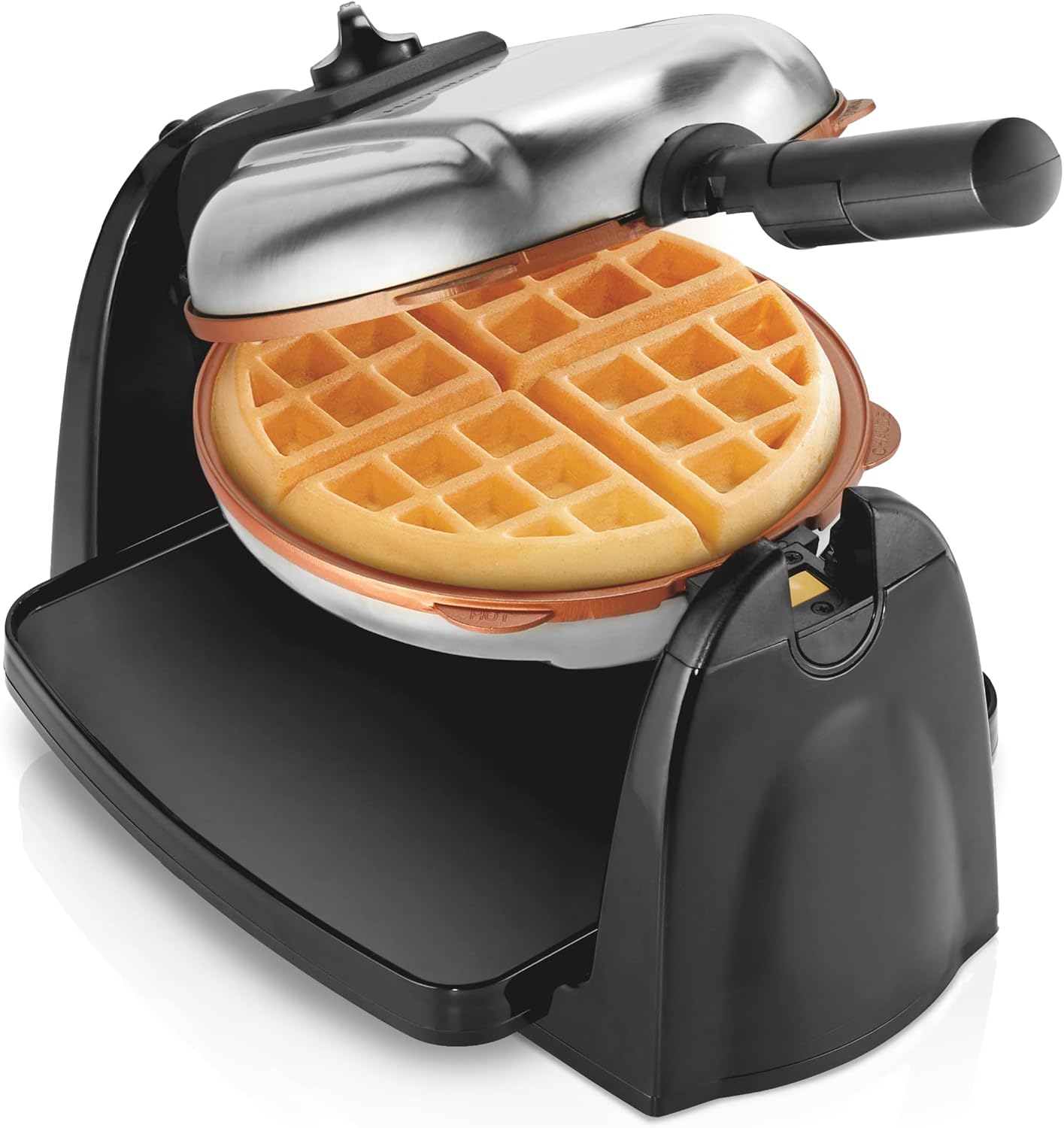
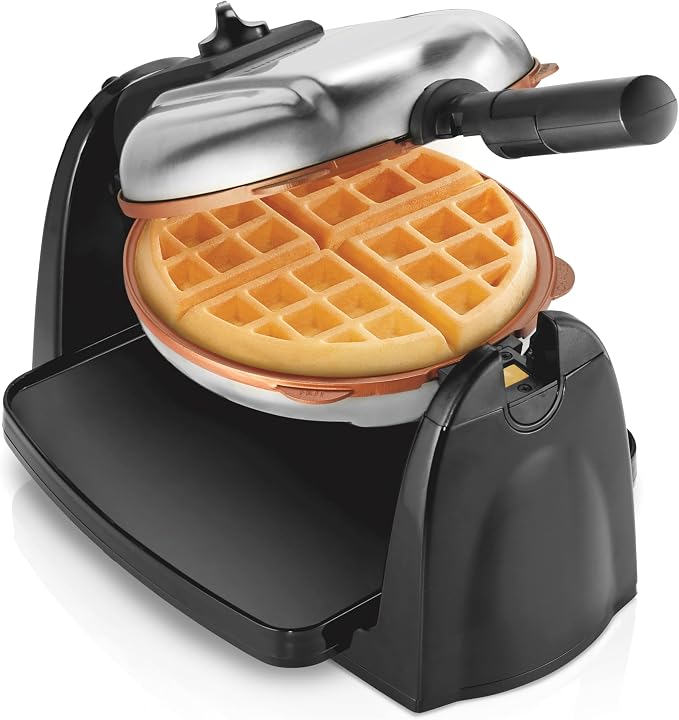
- Best overall: Hamilton Beach Belgian Waffle Maker, Easy Flip (26031)Check price on Amazon →
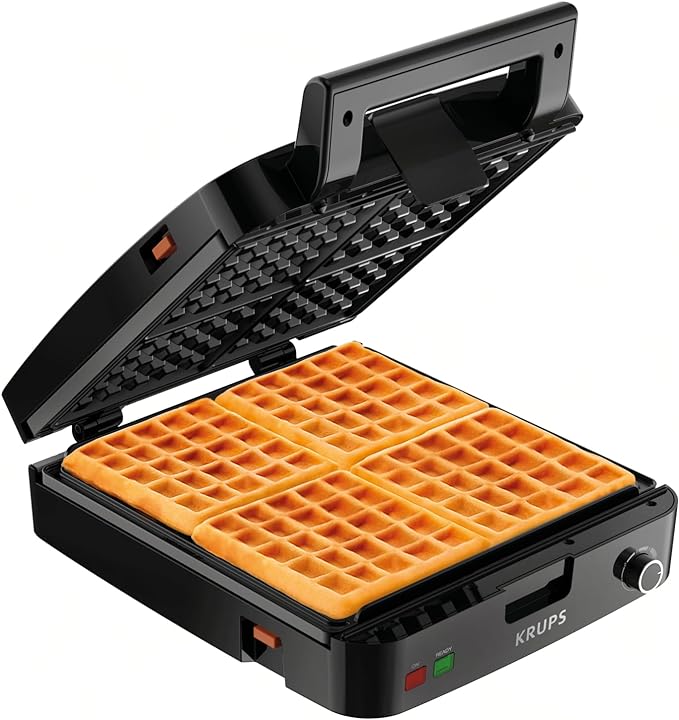
- Best for families: KRUPS 4-Slice Belgian Waffle MakerCheck price on Amazon →
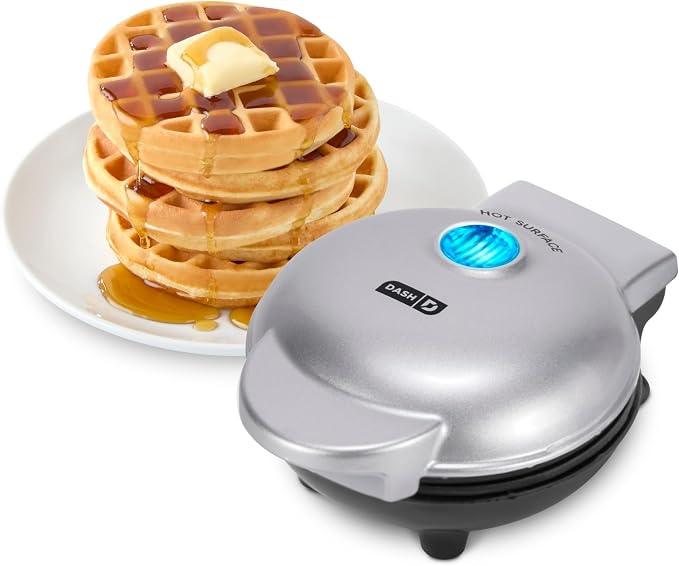
- Best for beginners and small households: Dash Mini Waffle MakerCheck price on Amazon →
- Best premium: All-Clad Stainless Steel Waffle Maker, 4 SectionCheck price on Amazon →
- Best classic (and best budget): Cuisinart WMR-CAP2 Round ClassicCheck price on Amazon →
The best waffle maker for most homes in 2026 is the Hamilton Beach Belgian Waffle Maker with removable Durathon plates at about $84 — it flips, the PFAS-free ceramic plates lift out for the dishwasher. Feeding four? The KRUPS 4-Slice Belgian at $90 cooks four at once. Cooking for one? The $13 Dash Mini is all you need.
Get a free week of easy dinners
Seven weeknight dinners with the shopping list already totalled, sent Sunday. No account needed, unsubscribe in one click.
No spam, unsubscribe in one click. Recipes, shopping lists and Instacart carts all work without an account either way.
Why waffle maker choice is really a household-size decision
Every waffle maker buying guide wants to sell you on plate depth and browning dials. Those matter, but they are second-order. The first question — the one that decides whether the appliance lives on your counter or dies in a cabinet — is how many waffles you need to put on the table before the first one goes cold.
Waffles have a brutal serving-window problem that pancakes do not. A pancake off a griddle is fine five minutes later. A waffle is crisp for about ninety seconds, then the steam trapped in the pockets migrates outward and softens the crust. If your machine makes one 7-inch waffle every four minutes and you have four people eating, the first person finishes before the last waffle is poured, and three of the four waffles were served soft. That is not a recipe problem. That is a throughput problem, and the only fix is buying the right capacity up front.
Run the math for your own table. A single-waffle maker produces roughly 15 waffles an hour. A double or 4-slice model produces 30 to 60. A mini produces about 20, but each one is a 4-inch single serving rather than a shareable round. Households of one or two are fine anywhere on that scale. Households of four or more need a double, a 4-slice, or a plan — hold finished waffles in a 200°F oven directly on the rack, never stacked on a plate, which keeps them crisp for about 20 minutes.
The second-order question is whether you want Belgian pockets or classic squares, and that is genuinely a taste decision rather than a quality one. We will get to it below, after the picks.
This guide pairs with our 20 best American breakfast recipes for lazy weekend mornings and our bulk breakfast meal prep guide — waffles freeze better than almost any other breakfast, which changes the value calculation on a machine you might only use on Saturdays.
Top picks
Every pick below is a live, in-stock model in our small appliances catalog, with the price and rating as of September 2026. Prices on waffle makers swing hard around Black Friday and Mother's Day; the ranking does not change much when they do.
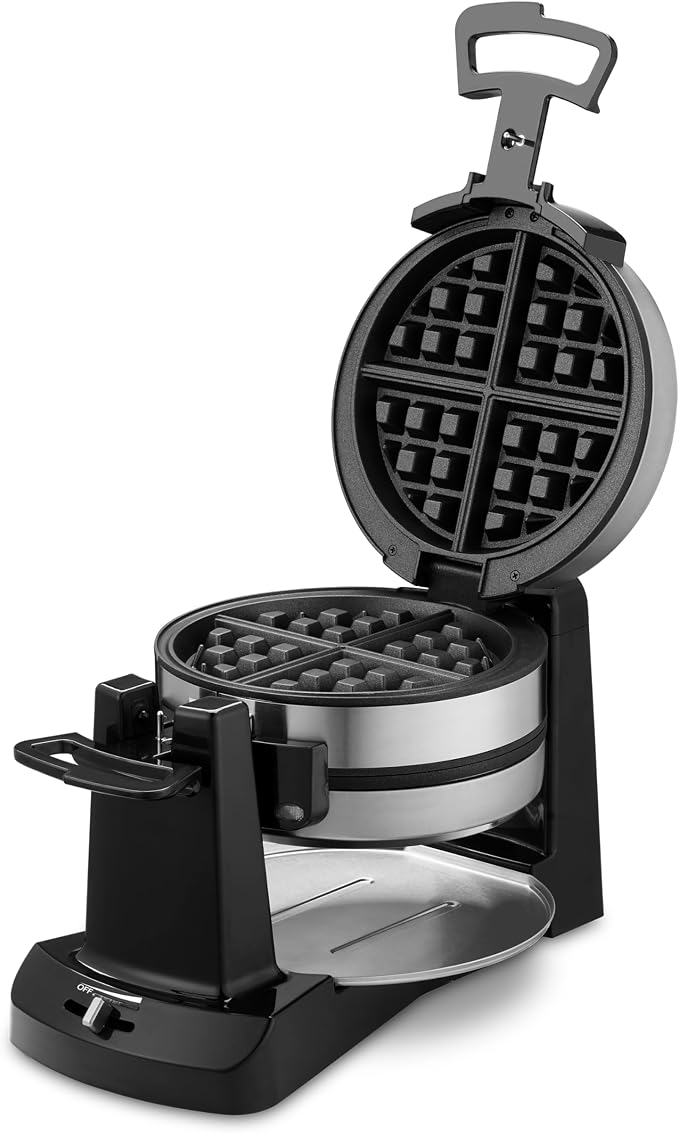
#1 Best overall: Hamilton Beach Belgian Waffle Maker, Easy Flip (26031)
Verdict: flip mechanism · removable PFAS-free Durathon ceramic plates
This is the machine that solves the two problems that actually ruin home waffles. First, the raw center: a stationary iron cooks the batter from below faster than from above, so a thick Belgian pour sets its bottom crust while the top is still wet. Flipping the plates 180° partway through redistributes the batter through gravity, which is why diners and hotel breakfast bars have used rotating irons for decades. Second, cleanup: the Hamilton Beach 26031 plates lift out and go in the dishwasher, which is the difference between a machine you use twice a month and one you use every weekend.
The Durathon ceramic coating is PFAS-free, which matters if you have been following the regulatory story around per- and polyfluoroalkyl substances — see the EPA's PFAS explainer for the actual chemistry rather than the marketing. Ceramic coatings trade a little release performance for that, so brush the plates with melted butter or neutral oil before the first pour of each session. After that, they release cleanly.
Buy it if: you want restaurant-style deep Belgian waffles without spending $150+, and you will not hand-wash plates.
Skip it if: you need more than one waffle at a time. This is a single-round machine.
Pair it with the Waffles with Belgian Buttercream and Fresh Berries — a batter thick enough to fill 1-inch pockets is exactly what a flip iron is built for.
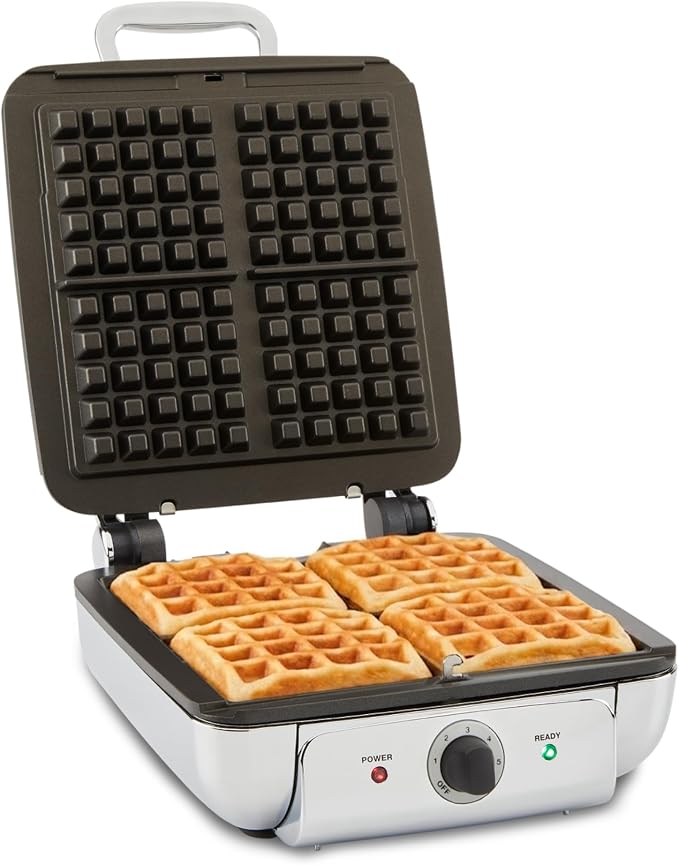
#2 Best for families: KRUPS 4-Slice Belgian Waffle Maker
Verdict: 1,200W · four waffles per cycle · removable plates · audible ready beep
Four waffles at once changes breakfast from a relay race into a single service. The KRUPS 4-slice runs 1,200 watts across a plate area roughly four times a single-round iron's, so a full cycle takes longer than a single machine's — call it five to six minutes versus three to four — but you finish four servings in the time a single iron finishes one. For a household of four, that is the entire ballgame.
The audible ready beep sounds gimmicky and is not. Waffle irons signal doneness by steam volume dropping off, which is a skill you learn and then lose over six months of not making waffles. A beep set against a browning level you dialed in once removes the guesswork permanently.
It does not flip. At six minutes on a 1-inch Belgian plate that is less of a problem than it sounds, but do not overfill: an overfilled stationary iron is the single most common cause of a gummy center.
Buy it if: three or more people eat waffles at the same time.
Skip it if: you live alone. It is a large, heavy appliance to heat four plates for one person.
#3 Best for beginners and small households: Dash Mini Waffle Maker
Verdict: 4-inch waffle · one button, no dial
There is no serious argument against owning a Dash Mini at $13. It heats in about three minutes, cooks a 4-inch waffle in three to four, wipes clean in fifteen seconds with a damp towel, and fits in a drawer.
What it actually is, is a single-serving hot-plate press. That makes it the best machine on this list for the things that are not waffles — chaffles, hash-brown patties, brownie rounds, biscuit-dough pockets. A 4-inch plate cooks those faster and more evenly than a 7-inch plate does, because the heating element is closer to every square inch of the surface.
The PTFE coating is standard non-stick — durable if you never touch it with metal, ruined in one afternoon if you do. See the PTFE entry for what the coating actually is and its thermal limits.
Buy it if: you cook for one or two, or want a second machine for weekday mornings.
Skip it if: you want waffles you can cut into quarters and share.
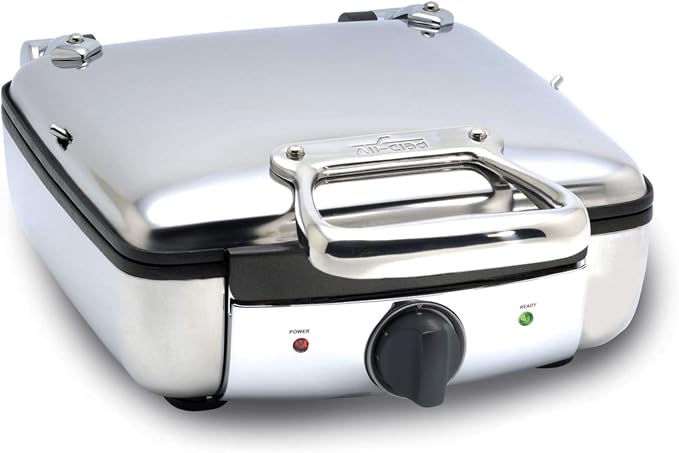
#4 Best premium: All-Clad Stainless Steel Waffle Maker, 4 Section
Verdict: 1,600W · six browning levels · upright storage · dishwasher-safe
Sixteen hundred watts is the number that justifies the price. Wattage per square inch of plate is the closest thing this category has to a quality spec, because recovery time — how fast the plates return to temperature after cold batter hits them — is what determines whether waffle number three is as crisp as waffle number one. The All-Clad 4-section has the highest wattage in this guide and it shows on batch three onward.
Upright storage is the other underrated feature. A waffle maker stored flat needs 11 by 13 inches of shelf; stored on its end it needs about 5 by 13. In a normal kitchen that is the difference between an appliance in the cabinet and one permanently colonizing the counter.
Six browning levels is more granularity than most people use. Find your setting once — usually 4 or 5 for a buttermilk batter, 3 for anything with sugar or honey in it — and never touch the dial again.
Buy it if: you make waffles most weekends and want a machine that will still be doing it in ten years.
Skip it if: $180 for a once-a-month appliance is hard to justify. The Hamilton Beach at $84 makes a very good waffle.
If you want the full All-Clad statement piece, the 99010GT 4-square Belgian is the premium option, with seven browning settings. It is a better-looking machine. It is not a meaningfully better waffle.
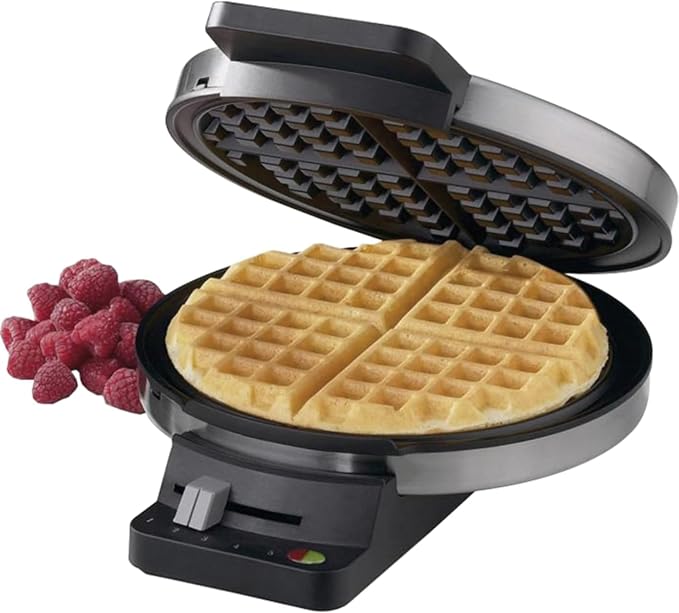
#5 Best classic (and best budget): Cuisinart WMR-CAP2 Round Classic
Verdict: 1,250W · 5 browning settings · classic (shallow) grid
Not everyone wants Belgian. Classic waffles — shallower grid, denser crumb, thinner cross-section — stack better, freeze better, toast back to crisp better, and hold a fried egg without the yolk disappearing into a pocket. The Cuisinart WMR-CAP2 is the default classic iron for a reason: 1,250 watts into a small shallow plate means fast recovery, and $31 means it is the cheapest genuinely good appliance in this guide.
Classic grids are also the right choice for savory waffles, where you are usually putting something wet on top. Try the Savory Breakfast Waffle with Maple Butter and Fresh Berries or go all the way to Buttermilk-Brined Fried Chicken with Waffle and Maple Butter — chicken and waffles works far better on a classic grid than on a deep Belgian one, because the waffle needs to act like bread, not like a bowl.
Buy it if: you want thin, crisp, stackable waffles, or you meal-prep and freeze.
Skip it if: the deep pocket full of melted butter is the whole reason you want a waffle maker.
Belgian vs classic vs mini: plate depth, batter volume, and which suits your household
The three formats are not tiers. They are different products that happen to share a hinge.
| Format | Grid depth | Waffle size | Batter per waffle | Cook time | Best for |
|---|---|---|---|---|---|
| Belgian | ~1 inch | 7 in round or 4-square | ~1 cup | 4–6 min | Dessert-style waffles, syrup and butter, weekend service |
| Classic | ~1/4 to 1/2 inch | 6.5–7 in round | ~1/2 cup | 3–4 min | Stacking, freezing, savory toppings, chicken and waffles |
| Mini | ~1/4 inch | 4 in round | ~3 tbsp | 3–4 min | One or two people, chaffles, hash browns, kids |
Where to buy the picks in this guide
Prices are shown only when checked in the last 24 hours; otherwise check the current price on Amazon.
Depth drives everything downstream. A 1-inch Belgian pocket holds roughly twice the batter of a classic grid of the same diameter, which means twice the interior to cook through, which is why Belgian batters traditionally use yeast or whipped egg whites — the extra lift opens the crumb so heat penetrates. Pour a standard baking-powder pancake batter into a deep Belgian iron and you get the raw-center failure that sends people back to the store. See the waffle iron entry for how the depth conventions diverged between American and Belgian irons in the first place.
Classic grids are more forgiving precisely because there is less to cook. They also produce more crust per gram of waffle, which is the actual thing people like about waffles — the Maillard reaction between the batter's sugars and proteins happens on the surface, and a shallow grid is nearly all surface.
Mini plates take that further. A 4-inch mini is almost entirely crust, which is why chaffles and hash-brown waffles work so well in one and so poorly in a deep Belgian iron.
Household-size mapping, bluntly:
- One or two people, weekdays included: mini, $13. Buy a second one later if you like it.
- Two people, weekends only: single Belgian flip, $84, or classic, $31.
- Three to five people: 4-slice, $90, or a double flip.
- You host brunch: 4-slice plus a mini for the kids, roughly $103 total.
What to look for
Flip vs stationary. Flipping redistributes batter by gravity partway through the cook, which evens out top-to-bottom browning and is the cheapest insurance against a gummy center. It costs roughly $30 to $60 over an equivalent stationary model and takes about 6 inches more counter depth for the rotation. Worth it on deep Belgian plates; largely unnecessary on shallow classic plates, where there is not enough batter depth for the problem to appear.
Plate coating: ceramic vs PTFE. PTFE (the classic non-stick) releases better and costs less. Ceramic coatings are PFAS-free and generally handle higher temperatures, but they lose release performance faster with use and need a light oiling before each session. Neither survives metal utensils. If you are choosing on chemistry, ceramic; if you are choosing on ten-year release performance, PTFE with a silicone spatula and no scrubbing.
Removable plates. The single biggest predictor of whether a waffle maker gets used. Fixed-plate machines require wiping a hot, awkward, hinged surface by hand. Removable-plate machines go in the dishwasher. If a model has this feature and you are on the fence, take it — the Hamilton Beach and KRUPS picks above both have it.
Browning dial. Three settings is enough; five is plenty; seven is marketing. What matters is that the dial is repeatable — you set it once for your standard batter and forget it. Dial-free minis compensate by cooking a thin enough waffle that timing is the only variable.
Indicator lights and beeps. Two lights (power, ready) is the minimum useful configuration. A single light that does double duty is genuinely annoying, because you cannot tell "heating" from "done." An audible beep is better than any light.
Cord storage and upright storage. Sounds trivial, reads trivial, matters enormously in a small kitchen. A machine that stores on its end takes about 55% less shelf area than one that stores flat.
Wattage. 1,000W is the floor for a full-size iron; 1,200–1,400W is the sweet spot; 1,600W buys you batch-three consistency. Minis run 350–600W and do not need more.
Also worth knowing
Five more machines that did not make the top five but are the right answer for specific situations.
| Model | Price | Why you'd pick it |
|---|---|---|
| Cuisinart Double Flip Belgian, 1400W | Check price | Two flip waffles per cycle — the throughput of a 4-slice with the evenness of a flip |
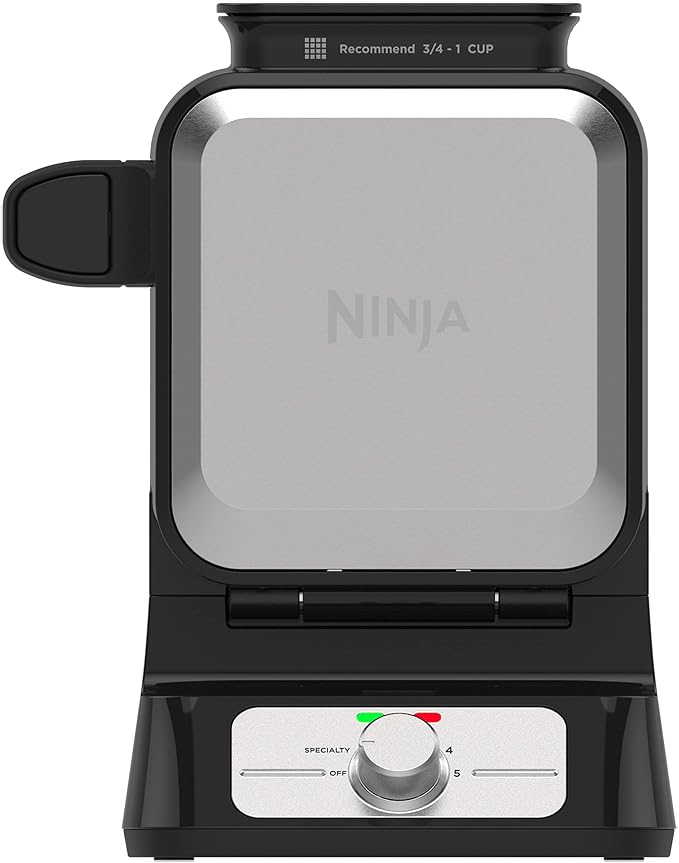
| Ninja Belgian Waffle Maker Pro (BW1001) | Check price | Highest-rated machine in the $100 bracket; 5 shade settings |
| Breville BWM520XL No-Mess | Check price | Integrated moat catches overflow — the fix if you consistently over-pour |
| Hamilton Beach Belgian Mini, makes 2 (26009) | Check price | Two minis at once with a shade dial; the keto-chaffle machine |
| Dash Multi Mini, makes 4 | Check price | Four 4-inch waffles at once — family throughput without family-size storage |
| BELLA Flip-n-Store, ceramic | Check price | Cheapest flip model with ceramic plates and upright storage |
Beyond breakfast: hash browns, cornbread, brownies and chaffles
A waffle maker used only for waffles is an appliance you run twenty times a year. Used as a press, it is one you run weekly, and that is how a $13 mini or an $84 flip iron actually earns its counter space.
Hash-brown waffles are the killer app. Squeeze shredded potato dry in a towel — genuinely dry, this is the whole trick — season it, bind it with one beaten egg per two cups, press it into a greased iron for six to eight minutes. You get a rösti with twice the crust surface of a pan version, and no flipping a disintegrating potato cake in a skillet. Our Skillet Hash Browns with Caramelized Onions and Cheddar adapts to a waffle iron directly; use the same mixture and skip the skillet step.
Chaffles — cheese and egg, no flour — cook in about four minutes and come out like a savory crisp. They are the reason the mini category exploded. Start with Cheese and Spinach Chaffles with Garlic Aioli or the simpler Bacon and Avocado Chaffle. Grease the plates properly for these; melted cheese against bare non-stick is the one mixture that will make you regret a ceramic coating.
Cornbread waffles turn a side dish into a plate. A standard cornbread batter, slightly loosened with extra buttermilk, cooks in four minutes and holds sauce far better than a baked square does. Use the batter from Stone-Ground Cornbread with Maple Syrup and Pecans, then build a Waffle Sandwich with Fried Chicken and Maple Hot Sauce on top of it.
Brownie waffles cook in three minutes versus thirty in an oven, and the deep grid gives you eight crisp edges per serving instead of two. Reduce the flour slightly; brownie batter in a Belgian pocket is dense.
Vegetable waffles for people avoiding grain: Cauliflower Flaxseed Waffles with Avocado Slices press well in any iron and hold their structure better than cauliflower pancakes do.
And when you want the traditional article — yeasted, pearl-sugar, caramelized — the Flemish Waffle with Honey and Candied Walnuts is the European template. Note that sugar-heavy Liège-style batters caramelize onto plates; see the waffle entry for the regional distinction, and brush the plates before each pour.
If you are weighing a waffle maker against other breakfast hardware, our griddle buying guide covers the pancake-and-bacon side of the same decision, and the toaster oven guide covers reheating frozen batches.
Common pitfalls
Overfilling. The number one cause of bad home waffles, and it produces two failures at once: batter escapes the seam and burns on the hinge, and the excess depth leaves a raw center. Start with two-thirds of what looks right, close the lid, and note the fill level that just reaches the edges. That is your measure forever.
Opening too early. A waffle that tears when you lift the lid is not stuck — it is underdone. The crust has not set enough to release. Close it and give it another 60 to 90 seconds. Steam volume dropping off is the reliable doneness signal on machines without a beep.
Stacking finished waffles. Two waffles stacked on a plate trap steam between them and both go soft within a minute. Hold them directly on an oven rack at 200°F, in a single layer.
Cold batter into a hot iron. Batter straight from the refrigerator drops plate temperature far enough that the first waffle browns unevenly. Let batter sit out 15 minutes, or accept that the first one is the cook's waffle.
Over-mixing. Waffle batter with developed gluten comes out tough and chewy rather than crisp. Mix until the flour just disappears; lumps are fine and will hydrate on the counter.
Washing plates while hot. Thermal shock crazes ceramic coatings and warps thin aluminum plates. Unplug, wait five minutes, then wipe warm.
Metal utensils. One pass with a fork ends a non-stick coating's life. Silicone or wood only, forever.
Care and cleaning: keeping non-stick intact
Unplug the machine and wait about five minutes, until the plates are warm rather than hot. Residual heat is doing the work here — a damp paper towel across warm plates lifts most batter with no scrubbing at all. Wipe, close the lid, done. Ninety seconds total.
For batter that has set hard in the grid, lay a wet paper towel across the plates while they are still warm, close the lid, and leave it two minutes. The trapped steam softens everything; wipe it out afterward with a soft brush for the corners of the squares.
Never submerge the base of any waffle maker. On removable-plate models — the Hamilton Beach 26031 and the KRUPS above — the plates themselves are dishwasher-safe on the top rack, but the housing is not and never will be.
Re-season occasionally. A light film of neutral oil wiped across cool plates, then a single empty heat cycle, restores release on both PTFE and ceramic surfaces after heavy use. Do this every ten sessions or so and coatings last years longer.
Store upright if the design allows, with the cord wrapped. Flat storage in a crowded cabinet is how plates get scratched by whatever gets shoved in next to them.
When not to buy a waffle maker
Be honest about frequency. If you make waffles twice a year, a $13 mini is the correct purchase and a $180 machine is a mistake. If you never make waffles but want to press hash browns and chaffles, buy the mini for that and ignore the entire Belgian category.
Skip it entirely if your counter space is already contested and you own a griddle — pancakes from a griddle solve 80% of the same breakfast problem with an appliance you already use for eggs, bacon and grilled cheese. Compare with Nostalgic Buttermilk Pancakes with Maple Glaze before you commit shelf space.
And skip the 4-slice family machines if your household is two people who occasionally have guests. Heating four plates for two waffles wastes eight minutes and a meaningful amount of electricity every single time. Buy the single, and hold waffles in the oven on the rare occasion you are feeding six. Our quick school-morning breakfast guide has faster weekday options that need no new hardware at all.
Frequently asked questions
Belgian waffle maker or classic — which should I buy?
Belgian if you want deep pockets that hold syrup and butter — roughly a 1-inch grid, crisp outside, custardy inside. Classic if you want thinner, denser waffles that stack well for meal prep and freeze without going soggy. Belgian batters use yeast or beaten egg whites for lift and eat like a dessert; classic batters are quick baking-powder mixes that behave more like bread, which is why chicken and waffles is nearly always served on a classic grid.
Are mini waffle makers actually worth it?
Yes if you cook for one or two, and yes as a second appliance if you already own a full-size iron for weekends. Minis heat in about three minutes, cook a 4-inch waffle in three to four, wipe clean in fifteen seconds, and store in a drawer — the friction is low enough that people actually use them on weekday mornings. The $13 Dash Mini also handles hash-brown patties, chaffles and brownie rounds, so it earns its counter space several ways.
Do I need a flip waffle maker?
A flip model rotates the plates partway through the cook so gravity redistributes batter through every square, which evens out top-to-bottom browning. That is the cheapest fix for the raw-center problem that ruins deep Belgian waffles. On a shallow classic grid there is not enough batter depth for the problem to appear, so flipping buys you little. Worth the extra $30 to $60 if you are cooking 1-inch Belgian waffles most weekends; skip it otherwise.
Can you make things other than waffles in a waffle maker?
Yes — hash-brown waffles are the killer app that turns the machine into a weekday workhorse. Squeeze shredded potato genuinely dry, bind it with egg, and press it for six to eight minutes. Cornbread waffles hold sauce for fried-chicken sandwiches, brownie waffles cook in three minutes instead of thirty, and chaffles (cheese plus egg) need no flour at all. Grease the plates first for anything sugary or cheesy, since both caramelize onto non-stick.
How do I clean a waffle maker without ruining the non-stick?
Unplug it and wait about five minutes until the plates are warm rather than hot, then wipe them with a damp paper towel — the residual heat lifts most batter with no scrubbing. Never submerge the base and never touch the plates with metal; both end a coating's life. For set-on batter, lay a wet paper towel across the warm plates, close the lid for two minutes, then wipe. Removable-plate models go on the dishwasher's top rack.
For more breakfast planning, see our lazy weekend breakfast roundup.
Sources
- Waffle iron — Wikipedia — construction, plate-depth conventions, and the history of the rotating iron
- Waffle — Wikipedia — regional formats, including the Brussels/Liège distinction behind "Belgian"
- Maillard reaction — Wikipedia — why surface area and browning level drive waffle flavor
- Polytetrafluoroethylene — Wikipedia — what PTFE non-stick coatings are and their thermal limits
- PFAS Explained — US EPA — the regulatory context behind PFAS-free ceramic plates
Frequently asked questions
Belgian waffle maker or classic — which should I buy?
Are mini waffle makers actually worth it?
Do I need a flip waffle maker?
Can you make things other than waffles in a waffle maker?
How do I clean a waffle maker without ruining the non-stick?
How we picked
This guide is researched, not bench-tested. We shortlisted products from the AislePrompt kitchen catalog and compared them on published manufacturer specifications (materials, size, capacity, warranty), on what owners report in published reviews, and on any third-party sources linked in this guide. The guide was drafted with AI assistance. We did not run lab or hands-on tests of these products, so any measurement quoted here comes from the manufacturer or a cited source. Prices change often: use the “Check price on Amazon” buttons for today’s price.
Sources
Recipes to try with your small appliances
Put your gear to work — save any recipe to My Recipes (no account needed) and send its ingredients to Instacart in one tap.

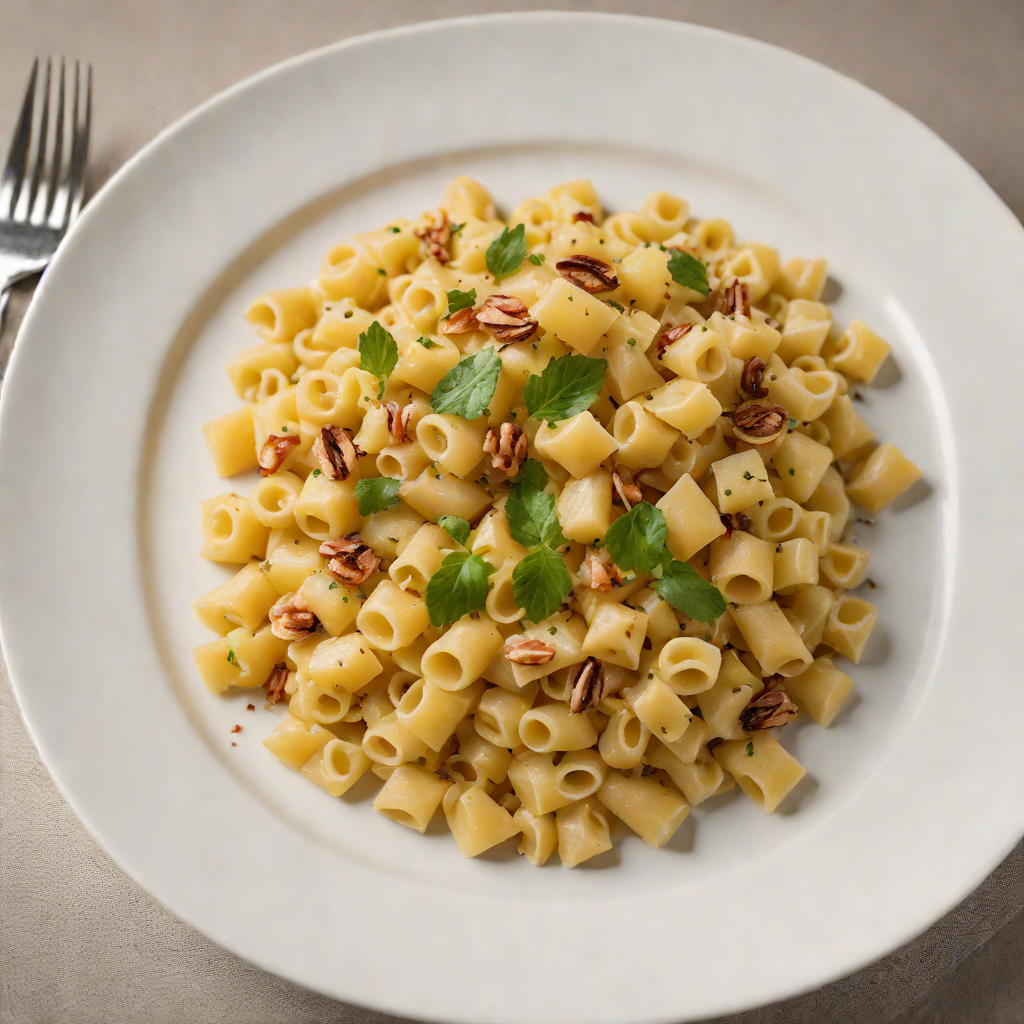
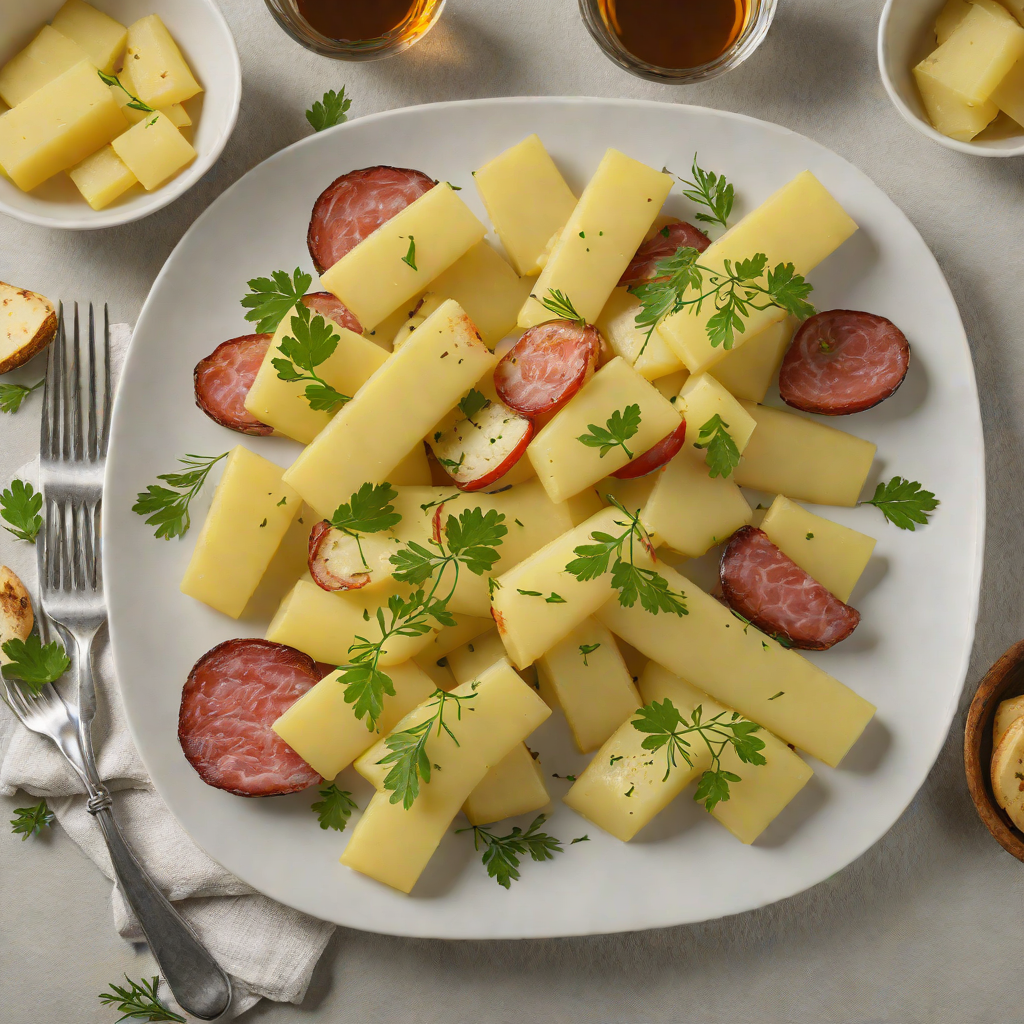
Shop small appliances on AislePrompt →Browse the full kitchen shop →
Plan a week of meals in two minutes.
Tell our AI what you have and what you like — it builds your plan, shopping list, and Instacart cart. No account needed.
Plan my week →