Bulk Breakfast Meal Prep: 15 Make-Ahead Recipes for Busy Mornings
Two hours on Sunday, four formats, and fifteen recipes that turn weekday breakfast into a 60-second job.
Affiliate disclosure: AislePrompt may earn a commission on qualifying purchases made through Amazon and Instacart links in this article, at no additional cost to you. See our affiliate policy →
Bulk breakfast meal prep means cooking one or two breakfast formats in a single 90-to-120-minute session — usually Sunday — and portioning them into 10 to 15 grab-and-eat servings. Two hours of work covers a full work week for a household of two to four, at roughly $1.20 to $2.40 per portion, and drops weekday morning effort to under 60 seconds.
That is the whole promise, and it is the most reliable one in meal preparation. Dinner prep fails because dinner is where the day's stress lands and takeout is one tap away. Breakfast prep succeeds because breakfast is a small, repeatable, low-variance meal you eat half-asleep, at the same time, in the same place, five days in a row. Repetition is the enemy of dinner and the friend of breakfast.
Why breakfast is the highest-ROI meal to batch
Three reasons, in order of how much they actually matter.
The decision is worth more than the food. Weekday breakfast is decided in a five-minute window while you are underslept and getting other people out the door. Every morning you have to decide and cook, you lose 10 to 15 minutes and usually default to whatever is fastest — which in practice is a breakfast cereal bowl or nothing. Prepping removes the decision, not just the labor.
The unit economics are unusually good. Breakfast ingredients are cheap in bulk and stable in storage: rolled oats, eggs, frozen fruit, flour tortillas, yogurt. A dozen eggs, a bag of oats, and a bag of frozen berries — call it $14 to $18 at an average US supermarket in August 2026 — is 15 to 20 portions. A single drive-through breakfast sandwich is $5 to $7. Bulk breakfast prep is the rare habit where the healthier option is also the cheaper one by a factor of three or four. The USDA Economic Research Service Food Price Outlook tracks how these staple categories move if you want to sanity-check your own numbers against national averages.
Batch sizes are naturally right. A standard 12-cup muffin tin makes 12 egg muffins. A half sheet pan makes 12 pancake squares. A 9x13 dish makes 8 to 9 casserole portions. The hardware already batches in week-shaped quantities, which is not true of, say, a skillet.
The one thing bulk breakfast prep is not is a nutrition strategy on its own. Prepping a week of pastry is still a week of pastry. What prep does is make it trivially easy to eat the thing you already decided you wanted to eat — which is why the sections below skew toward formats that carry real protein and dietary fiber rather than sugar.
The four breakfast prep formats
Almost every make-ahead breakfast falls into one of four buckets. Pick two — never one, never four — and you have a week.
| Format | Prep time | Fridge life | Freezer life | Morning effort | Best for |
|---|---|---|---|---|---|
| Overnight (soak, no cook) | 10-15 min for 5 | 5 days | Not recommended | 0 sec, eat cold | Zero-cook households, hot weather |
| Freezer (cook, wrap, freeze) | 60-90 min for 12 | 3 days | 3 months | 90-150 sec microwave | Big appetites, long horizons |
| Grab-and-go (bake, portion) | 30-45 min for 12 | 4-5 days | 1-2 months | 0-45 sec | Commuters, kids, desk breakfasts |
| Batch-cook (one dish, slice) | 45-70 min for 8 | 4 days | 2 months | 60-90 sec | Households eating the same thing |
The reason to pick two formats is burnout. Overnight oats every weekday for three weeks is how people quit. Two formats in rotation — say jars Monday, Wednesday, Friday and egg muffins Tuesday, Thursday — makes the same total prep effort feel like variety. The reason not to pick four is that four formats means four cleanups and four shopping sub-lists, and the session stops fitting in a Sunday afternoon.
Format 1 — Overnight oats: one base ratio, six flavors
Overnight oats are a cold-soaked descendant of muesli, and they are the cheapest entry point into breakfast prep because there is no cooking step at all. Rolled oats hydrate in liquid over 6 to 8 hours in the fridge; the beta-glucan soluble fiber in oats does the thickening.
The base ratio, memorized once, used forever:
½ cup rolled oats : ½ cup liquid : 1 tbsp chia seeds : pinch of salt
Scale by jar. Five jars = 2½ cups oats, 2½ cups liquid, 5 tbsp chia. Add sweetener and flavor per jar, not to the batch, or every jar tastes the same by Thursday.
Use rolled oats, not instant and not steel-cut. Instant turns to paste by day two. Steel-cut never fully softens cold — it needs heat. Liquid can be dairy milk, plant milk, or kefir; if you want the jar to carry real protein, swap half the liquid for strained (Greek) yogurt or cottage cheese blended smooth. That single swap takes a jar from about 8 g of protein to 18-20 g.
The chia seeds are not optional if you want the texture to hold five days — they absorb roughly 10 times their weight in liquid and keep the oats from weeping. Salvia hispanica is the plant; a tablespoon adds about 4 g of fiber.
Six flavors that hold up through a Friday, all built on the same base:
| Flavor | Add per jar | Approx. protein | Recipe |
|---|---|---|---|
| Peanut butter banana | 1 tbsp peanut butter, ½ mashed banana | 10-15 g | No-Bake Peanut Butter Banana Overnight Oats |
| Chocolate cherry | 1 tbsp cocoa, ¼ cup cherries, almond butter swirl | 9 g | Chocolate-Cherry Overnight Oats with Almond Butter Swirl |
| Apple cinnamon pecan | ½ diced apple, ¼ tsp cinnamon, 1 tbsp pecans | 15 g | Cinnamon-Spiced Apple and Pecan Overnight Oats |
| Berry almond | ¼ cup blueberries, 1 tbsp sliced almonds | 10 g | Hidden Forest Berry and Almond Overnight Oats |
| Tahini date | 1 tbsp tahini, 2 chopped dates, sesame | 8 g | Tahini and Date Overnight Oats with Toasted Sesame |
| Vanilla berry chia | 1 tsp vanilla, extra chia, mixed berries | 8 g | Vanilla Chia Overnight Oats with Fresh Berries |
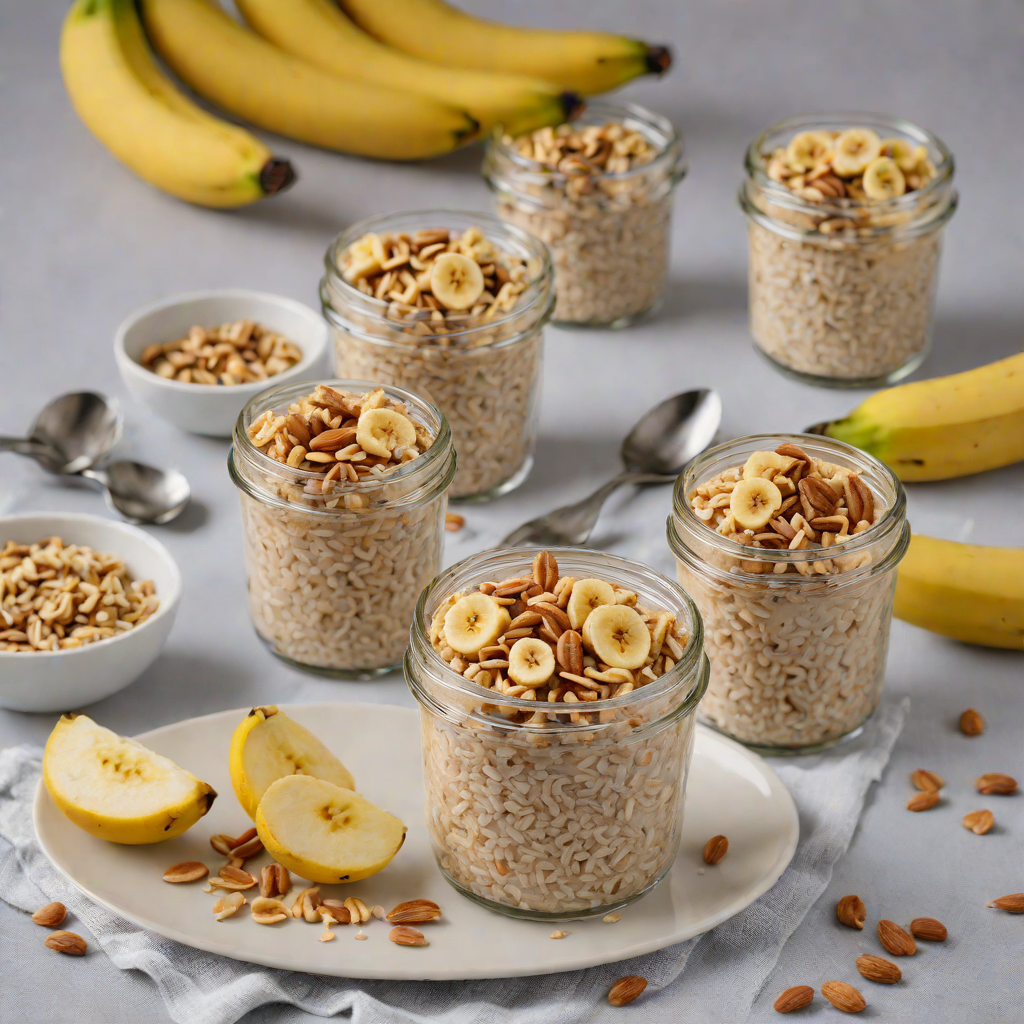
Two more worth knowing: Chocolate Almond Overnight Oats with Chia Seeds is the lowest-effort version on the list at 5 minutes of prep, and No-Bake Peanut Butter Chocolate Overnight Oats is the one that reads as dessert and gets kids to eat oats at all. If you want the jar-forward presentation — the version that looks like the photo at the top of this page — Overnight Oat Breakfast Jars with Banana and Peanut Butter is built for wide-mouth mason jars and scales cleanly to five.
Chia pudding is the same idea with the oats removed. 3 tbsp chia to 1 cup liquid, whisked twice in the first 20 minutes so it does not clump. It keeps a day longer than oats and is naturally gluten-free: Coffee-Spiced Chocolate Chia Pudding, Chocolate Cardamom Chia Pudding with Toasted Almonds, and No-Bake Chia Pudding with Mango and Coconut all use it. No-Bake Mango Coconut Chia Parfait layers it, which buys visual variety for zero extra work.
Format 2 — Egg muffins, egg bites, and frittata slabs
This is the protein workhorse and the format most likely to survive the Thursday-burnout test, because savory food does not fatigue the palate the way sweet food does.
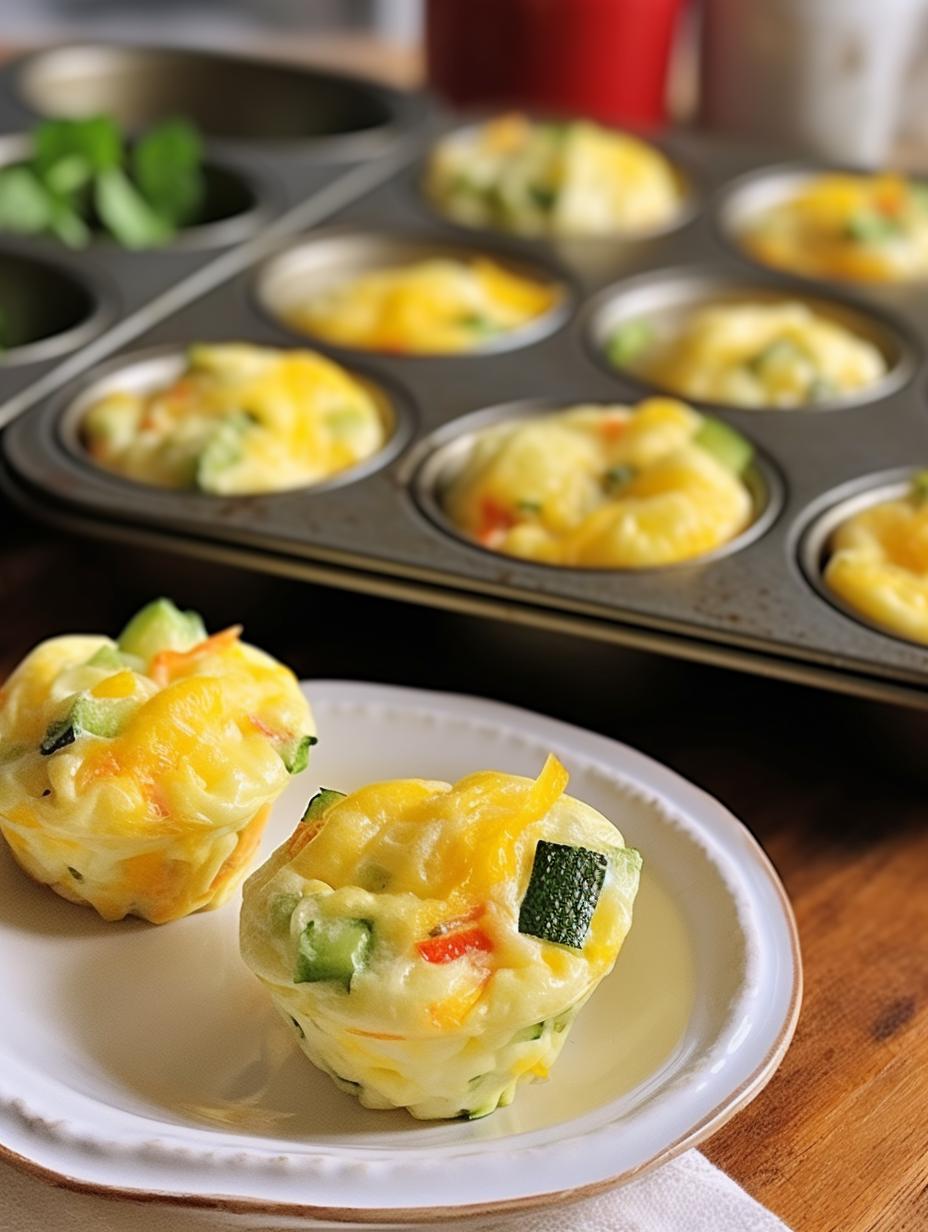
Egg muffins are a frittata baked in a muffin tin. The formula is 8 eggs to 1 cup of add-ins to ½ cup of cheese, which fills a 12-cup tin. Bake 20 minutes at 350°F. The USDA's shell egg guidance puts the safe internal temperature for egg dishes at 160°F — a thin-probe thermometer in the center cup is the only reliable check, since the edge cups always finish first.
Pick by what is in your fridge:
- Vegetable-Packed Egg Muffins — 100 kcal each, the lowest-calorie option on the list
- Baked Savory Egg Muffins with Spinach and Feta — spinach and feta, 12 g protein
- Broccoli and Cheddar Egg Muffins — the kid-safe cheddar version
- Cheddar and Herb Egg Muffins with Sausage — 15 g protein, the most filling
- Bacon and Egg Muffin Cups with Cheddar and Chives
- Oven-Baked Egg Muffins with Spinach and Feta
- Egg and Spinach Muffin Cups with Feta and Sun-Dried Tomatoes
- Egg and Cheese Cauliflower Breakfast Muffins — lowest-carb of the set
- Cheesy Veggie Frittata Muffins — makes 12, at 85 kcal each
The deflation problem is real and has one fix. Egg muffins puff in the oven and sink as they cool — that is steam leaving, not a mistake. What you can prevent is the wet sink, where the muffin collapses into a soggy disc. Pre-cook every watery add-in. Raw spinach, mushrooms, zucchini, and tomatoes all release liquid into the custard. Sauté them first, drain, and cool before they go in the batter.
Egg bites are the sous vide-style version — blended, silkier, usually baked in a water bath. Herb-Scented Egg Bites with Spinach and Feta carries 14 g protein per serving, Spiced Sausage and Egg Bites hits 18 g, and Cheesy Chive Egg Bites with Sun-Dried Tomatoes is the 80-kcal option.
Frittata slabs are the same custard baked flat in a 9x13 and cut into squares. Fewer pans, faster portioning, better freezer geometry — flat squares stack; domed muffins do not. Whole30 Veggie Frittata with Chive Cream fits a Whole30 week, Sausage and Vegetable Frittata is the 25 g protein high-water mark, and Spinach and Roasted Red Pepper Frittata with Tex-Mex Flair is the one worth making when you want leftovers you actually look forward to. Mini Vegetable Frittatas with Spinach and Cherry Tomatoes and Nonstick Pan Mushroom and Spinach Frittata round out the set.
Format 3 — Breakfast burritos: wrap twelve at once
The breakfast burrito is the highest-calorie-density, longest-shelf-life format in this article, and it is the only one that genuinely survives three months in a freezer without turning to mush.
The assembly-line method. Do not build burritos one at a time. Cook every component first, lay 12 tortillas out on the counter, and fill in one pass:
1. Scramble 12 eggs low and slow, pulling them 30 seconds underdone — they will finish cooking during the reheat.
2. Brown 1 lb of sausage or chorizo; drain thoroughly. Fat is what makes a thawed burrito greasy.
3. Roast 1½ lb of diced potatoes or sweet potato at 425°F for 25 minutes. Cool completely.
4. Shred 8 oz cheese. Do not use pre-shredded — the anti-caking starch goes gritty after a freeze-thaw.
5. Cool everything to room temperature before wrapping. Wrapping warm filling steams the tortilla and produces a gummy burrito on reheat. This is the single most common failure in this format.
6. Roll tight, wrap each in aluminium foil, then bag all 12 in one freezer zip bag. Foil blocks freezer burn; the bag blocks the freezer's ambient smell.
The one recipe explicitly engineered for this is Make-Ahead Breakfast Burritos with Scrambled Eggs and Veggies — 320 kcal and 20 g protein per burrito, and the quantities already scale to a batch. For heavier variants: Scrambled Egg and Sausage Breakfast Burrito with Pico de Gallo at 30 g protein, Denver-Style Breakfast Burrito with Scrambled Eggs and Chorizo with chorizo, Tex-Mex Breakfast Burrito with Spiced Potatoes and Cheese, and Denver-Style Smothered Breakfast Burrito with Sausage and Potatoes. The lightest is Spinach and Salsa Breakfast Burrito with Scrambled Eggs at 350 kcal with 22 g protein.
Reheat, in order of quality: oven or convection/air fryer at 375°F for 18-22 minutes from frozen (best texture, crisp exterior); microwave 2 minutes wrapped in a damp paper towel, flip at 60 seconds (fastest, softest); or thaw overnight in the fridge and microwave 90 seconds (the compromise most people land on). Never microwave in the foil.
Ingredients that do not freeze: fresh avocado (turns brown-grey and watery), raw tomato and lettuce (cell walls rupture), sour cream and crema (they split). Add those at eating time, not wrapping time.
Format 4 — Smoothie freezer packs
A smoothie freezer pack is a zip bag or jar holding every solid ingredient, pre-portioned. In the morning you dump the bag into a blender, add liquid, and blend for 45 seconds. Ten packs take about 20 minutes to build.
The per-pack formula: 1 cup frozen fruit + 1 cup greens + ¼ cup protein (Greek yogurt, cottage cheese, or a scoop of whey) + 1 tbsp fat (nut butter, flax, hemp, or pumpkin seed). Add 1 to 1¼ cups liquid at blend time.
Two rules that separate a good pack from a bad one. First, freeze the greens — spinach frozen flat in a bag blends smoother than fresh and does not wilt into slime in the fridge by Wednesday. Second, do not put liquid in the pack. Frozen liquid means a 4-minute thaw before the blades will even turn, which destroys the entire time saving.
Working starting points: Green Power Smoothie, Glacial Blueberry and Mint Smoothie Bowl at 12 g protein, Blended Tropical Mango-Pineapple Smoothie Bowl, Citrus-Spiced Ginger Turmeric Smoothie, and Sugar-Free 'Reset' Green Smoothie. If your morning problem is coffee and breakfast, Iced Cappuccino Protein Smoothie with Espresso and Cinnamon collapses both into one 20 g-protein glass.
Sheet-pan pancakes and the French toast bake
These are the weekend-flavor formats that make prep feel less like discipline. Both convert a griddle-bound dish into a single-pan bake.
Sheet-pan pancakes are ordinary pancake batter poured onto a parchment-lined half sheet pan and baked at 425°F for 15 to 18 minutes, then cut into 12 squares. No flipping, no standing at the stove, and the whole batch finishes at once. Northern-Style Apple and Cinnamon Sheet Pan Pancakes serves 6 and Funfetti Sheet Pan Pancakes serves 8 — the second one exists to bribe children and is unapologetic about it. Freeze squares flat on a tray for an hour before bagging, or they weld into a brick. Reheat in a toaster straight from frozen.
For traditional pancakes that still batch well, Gluten-Free Buttermilk Pancakes with Maple Pecan Syrup covers a gluten-free household and Spinach and Banana Pancakes with Oat Flour is 150 kcal a serving with vegetables hidden in plain sight.
The French toast bake is structurally a savory-turned-sweet bread pudding: cubed day-old bread, an egg-and-milk custard poured over, rested overnight, baked 40 minutes. Stale bread is required — fresh bread has no capacity left to absorb custard and goes to mush. Baked Sourdough French Toast with Fresh Berries and Maple Syrup uses sourdough, which holds its structure better than anything else; Baked Cinnamon Roll French Toast Casserole serves 8 and is the holiday-morning version. For lunchboxes, Child-Friendly Honey Cinnamon French Toast Sticks freeze and toast individually. Real maple syrup matters more here than in almost any other application, because there is nothing else carrying the flavor.
Baked Oatmeal Squares with Mixed Berries and Walnuts belongs in this group too — 9 portions from one pan, sturdier than any pancake, and the only sweet format on this list that carries meaningful fiber.
Overnight casseroles and crustless quiche
The batch-cook format at its most literal: one dish, eight portions, zero assembly.
Overnight Sausage and Cheese Breakfast Casserole is assembled the night before and baked in the morning — 8 servings at 22 g protein, and the highest-yield single dish in this article. Sausage, Egg, and Chive Breakfast Casserole and Cheesy Cauliflower Breakfast Casserole with Bacon and Spinach are the same idea at 4 and 6 servings, the second one low-carb enough for a ketogenic week.
Crustless quiche is the leaner cousin — no pastry means no soggy bottom after refrigeration, which is exactly why it preps better than the classic. Spinach and Egg Crustless Quiche with Dill is 180 kcal a slice, Baked Crustless Spinach Mushroom Quiche carries 15 g protein, and Apple and Cheddar Crustless Quiche is the sweet-savory outlier worth trying once.
Two more one-pan options that reheat unusually well: One-Pan Spicy Tomato and Chickpea Shakshuka and Authentic Moroccan Shakshuka. Prep the shakshuka tomato base in bulk and freeze it flat; crack fresh eggs into a reheated portion in about four minutes. That is the general trick for any egg-topped dish — prep the base, never the egg.
Vegan households get the same structure from Smoky Nutritional Yeast Tofu Scramble at 22 g protein and Quick Scrambled Tofu Breakfast Bowl with Spinach and Avocado. Pressed, crumbled tofu reheats better than scrambled eggs do — it does not go rubbery.
Grab-and-go: parfait jars, breakfast cookies, energy bites
The formats you eat with one hand, standing up, or at a desk 40 minutes after leaving the house.
Parfait jars are 20 minutes for four and the fastest protein-per-minute in this article. No-Bake Yogurt and Berry Parfait with Honey and Granola carries 18 g protein; Black Hills Honey Yogurt Parfait with Mixed Berries and Granola makes 4 at 15 g each. No-Bake Greek Yogurt and Berry Parfaits with Honey and Pistachios and No-Bake Strawberry Yogurt Parfait with Granola Layers round it out. The granola goes on in the morning, never on Sunday — layered granola is soggy within 12 hours. Keep a small jar of it beside the parfaits and top at eating time. Make your own in the same session: Wattleseed and Macadamia Nut Granola and Macadamia and Davidson's Plum Breakfast Granola both keep two weeks airtight, and macadamias hold their crunch better than softer nuts.
Breakfast cookies are oat-and-banana bound, not butter-and-sugar bound, which is what makes them breakfast rather than dessert: Soft Banana and Oat Breakfast Cookies makes 12 at 90 kcal, Smooth Banana Oat Breakfast Cookies makes 6, and No-Bake Banana Oat Breakfast Cookies with Peanut Butter skips the oven entirely.
Energy bites are the smallest unit and the best glovebox food: No-Bake Oat and Almond Butter Energy Bites makes 16, No-Bake Peanut Butter Energy Balls makes 12, and No-Bake Nut Butter Energy Bites with Oats and Honey is the neutral base to riff on.
Three more single-serve builds worth prepping components for: Brioche Breakfast Sandwich with Bacon and Cheddar (assemble 4, wrap, freeze), Skillet Ham and Folded Egg Breakfast Sandwich at 28 g protein, and Fried Egg and Avocado Breakfast Sandwich on English Muffin — English muffins freeze better than any other bread here. And the zero-recipe option: a dozen boiled eggs in the fridge, which is the backbone of Hard-Boiled Egg and Avocado Breakfast Bowl with Smoked Paprika.
Storage windows and reheat times, by format
Everything below sits inside standard US cold-storage guidance. The controlling rule is the danger zone: 40°F to 140°F is where bacteria multiply fastest, and cooked food should not sit in it more than two hours total — one hour if the kitchen is above 90°F. The USDA's general ceiling for cooked leftovers is 3 to 4 days refrigerated, and the FoodSafety.gov cold food storage charts give the per-category detail.
| Format | Fridge | Freezer | Reheat | Note |
|---|---|---|---|---|
| Overnight oats | 5 days | Not advised | None — eat cold | Texture peaks day 2-3 |
| Chia pudding | 5 days | Not advised | None | Whisk twice while setting |
| Egg muffins | 4 days | 2 months | 30-45 sec microwave | Cool fully before bagging |
| Egg bites | 4 days | 2 months | 30 sec microwave | Water-bath bake = silkier |
| Frittata slab | 4 days | 2 months | 45-60 sec microwave | Cut before freezing |
| Breakfast burritos | 3 days | 3 months | 2 min microwave / 20 min oven | Foil, then bag |
| Smoothie packs | n/a | 3 months | Blend 45 sec | No liquid in the bag |
| Sheet-pan pancakes | 4 days | 2 months | Toaster, from frozen | Freeze flat first |
| French toast bake | 4 days | 1 month | 60 sec covered | Custard rests overnight |
| Breakfast casserole | 4 days | 2 months | 60-90 sec microwave | Portion before freezing |
| Parfait jars | 3 days | Not advised | None | Granola morning-of |
| Breakfast cookies | 5 days | 3 months | None or 15 sec | Airtight, room temp OK |
| Energy bites | 2 weeks | 3 months | None | Fridge, not counter |
Two operational notes worth more than the table. Freeze flat, then consolidate. Anything that will be eaten individually — burritos, pancake squares, casserole portions — goes on a tray in a single layer for 60 minutes first, then into a bag. Skip that and you get one frozen block and a knife-and-hot-water problem on Tuesday. Buy a fridge thermometer. The FDA's guidance is that the fridge should hold at or below 40°F and the freezer at 0°F; a lot of home fridges run several degrees warm, and every storage window above assumes they do not. A $7 thermometer is the difference between the table being accurate and being optimistic. If you need the deeper freezer-specific rules, the USDA's Freezing and Food Safety page is the primary source.
Real-world numbers: what two hours of Sunday prep buys
Times below are what a reasonably practiced home cook hits in a normal kitchen with one oven and one burner, measured start-to-cleanup. They are estimates to plan against, not laboratory figures — your knife speed and your oven's recovery time will move them.
| Session | Active time | Total elapsed | Portions | Approx. cost/portion |
|---|---|---|---|---|
| 5 overnight oat jars | 12 min | 12 min | 5 | $0.85 - $1.20 |
| 12 egg muffins | 20 min | 45 min | 12 | $0.70 - $1.10 |
| 12 breakfast burritos | 55 min | 85 min | 12 | $1.60 - $2.40 |
| 10 smoothie packs | 20 min | 20 min | 10 | $1.30 - $1.90 |
| 1 sheet-pan pancake tray | 15 min | 35 min | 12 | $0.40 - $0.65 |
| 1 breakfast casserole | 20 min | 70 min | 8 | $1.10 - $1.70 |
Cost figures are approximate US supermarket prices as of August 2026 and assume bulk staples rather than single-serve packaging. Nutrition figures throughout this article come from each linked recipe's own listing; the USDA's FoodData Central is the reference database if you want to compute your own.
The stacking is what matters. Egg muffins and a sheet-pan pancake tray share the oven — one preheats while the other bakes — so 24 portions cost about 35 minutes of active time and 80 minutes of elapsed time. That is the real answer to "how long does bulk breakfast prep take": not two hours of standing at the counter, but two hours of elapsed time containing about 40 minutes of actual work.
Protein per portion, for anyone building around a target:
| Portion | Protein | Calories |
|---|---|---|
| Sausage frittata square | 25 g | 320 |
| Sausage burrito | 30 g | 480 |
| Coffee protein smoothie | 20 g | 250 |
| Yogurt parfait jar | 18 g | 280 |
| Sausage egg bite | 18 g | 200 |
| Cheddar-sausage egg muffin | 15 g | 220 |
| Greek-yogurt overnight oats | 15 g | 350 |
| Plain overnight oats | 8-10 g | 320-350 |
If you want every portion above 40 g, that is a different playbook — see High-Protein Meal Prep: A 5-Day Plan at 40g Per Meal.
The two-hour Sunday timeline
A worked example. Two formats, 24 portions, one oven.
| Clock | Action |
|---|---|
| 0:00 | Oven to 350°F. Dice vegetables for egg muffins; brown sausage. |
| 0:12 | Whisk 8 eggs with cheese and cooled add-ins; fill muffin tin. |
| 0:18 | Muffins into the oven (20 min). Start the oats. |
| 0:20 | Build 5 oat jars — oats, liquid, chia, salt, then flavor per jar. |
| 0:32 | Muffins out. Oven to 425°F. Mix pancake batter. |
| 0:40 | Batter onto the parchment-lined sheet pan; into the oven (16 min). |
| 0:45 | Wash the mixing bowls while the pan bakes. |
| 0:56 | Pancakes out. Cool on a rack — do not stack warm. |
| 1:10 | Cut pancakes into 12; egg muffins now cool enough to bag. |
| 1:20 | Portion, label with the date, refrigerate or freeze. |
| 1:35 | Final cleanup. Done. |
Label everything with the date, not the day of the week. "Wed" is meaningless three weeks later in a freezer; "8/24" is not. A roll of masking tape and a marker is the entire system.
15 breakfast recipes to prep this Sunday
If you want a ready-made list rather than a framework, prep these. They cover all four formats, and no two of them taste alike.
1. Overnight Oat Breakfast Jars with Banana and Peanut Butter — the anchor jar, scales to 5
2. Cinnamon-Spiced Apple and Pecan Overnight Oats — 15 g protein, autumn-leaning
3. Chocolate-Cherry Overnight Oats with Almond Butter Swirl — the dessert-feeling one
4. Vegetable-Packed Egg Muffins — 100 kcal, 12 from one tin
5. Cheddar and Herb Egg Muffins with Sausage — the filling savory option
6. Spiced Sausage and Egg Bites — 18 g protein in a two-bite package
7. Sausage and Vegetable Frittata — 25 g protein, cuts into squares
8. Make-Ahead Breakfast Burritos with Scrambled Eggs and Veggies — freeze 12
9. Scrambled Egg and Sausage Breakfast Burrito with Pico de Gallo — 30 g protein
10. Northern-Style Apple and Cinnamon Sheet Pan Pancakes — no flipping, 12 squares
11. Baked Oatmeal Squares with Mixed Berries and Walnuts — 9 portions, real fiber
12. Overnight Sausage and Cheese Breakfast Casserole — 8 servings from one dish
13. No-Bake Yogurt and Berry Parfait with Honey and Granola — 18 g protein, 5 minutes
14. Coffee-Spiced Chocolate Chia Pudding — gluten-free, keeps 5 days
15. No-Bake Oat and Almond Butter Energy Bites — 16 bites, the gap-filler
Build the shopping list for whichever subset you pick with the Shopping List tool, check what you already have against your Pantry, and if you want a dietary swap on any of them — vegan, gluten-free, nut-free, lower-carb — AislePrompt's chat will rebuild the format around the constraint without you having to find a different recipe.
What to buy
Breakfast prep is not equipment-heavy. Five things cover every format above.
Wide-mouth glass jars, 16 oz, a dozen. Overnight oats, chia pudding, parfaits, and smoothie packs all live in these. Wide-mouth matters: a spoon has to reach the bottom. Borosilicate or standard canning glass both work. See Storage & Containers for tested sets.
Glass meal-prep containers with locking lids, 8 to 16 oz. For egg muffins, frittata squares, and casserole portions. Glass over plastic here for one specific reason: you reheat in these, and glass does not stain, absorb egg-and-cheese smell, or raise BPA-adjacent questions on repeated heating. Also in Storage & Containers.
A 12-cup non-stick muffin tin, plus silicone liners. The liners are the actual purchase. Egg muffins weld themselves to bare metal no matter how much you grease it; silicone liners pop them out intact and go in the dishwasher. Bakeware covers tins and liners.
A half sheet pan (18x13) with parchment. Sheet-pan pancakes, roasted burrito potatoes, and flat-freezing everything else. One good pan replaces three mediocre ones. Bakeware again, and Cookware if you want a non-stick skillet for the scramble step.
A blender that survives frozen fruit. The failure mode of a cheap blender is not that it is slow — it is that ice and frozen berries stall the motor and it dies in month four. Anything rated for crushing ice will do. Small Appliances has the picks.
Two optional but genuinely useful: a fridge/freezer thermometer (see the storage section above for why) and a thin-probe instant-read thermometer for checking the 160°F center on egg bakes. Both are in Kitchen Gadgets. A Utensils & Tools rack of good silicone spatulas is what actually gets custard out of a bowl, and staples like bulk oats, chia, and frozen fruit sit under Grocery & Pantry. If you want the long-form comparison, Best Meal Prep Containers 2026 tests the container sets specifically.
Common pitfalls
Five failure modes account for nearly every abandoned breakfast-prep habit.
Prepping one format for five days. This is the number-one cause of quitting, and it usually happens in week two. The food is fine; the palate is bored. Two formats in rotation solves it completely and costs almost no extra time, because the second format is usually cooking while the first one cools.
Wrapping or sealing warm food. Warm food in a sealed container generates condensation, and condensation is what makes a reheated burrito gummy, an egg muffin slimy, and a pancake square soggy. It also parks the food in the danger zone longer than it should be. Cool on a rack, uncovered, until room temperature — 30 to 45 minutes for most of these — then seal.
Adding wet ingredients too early. Granola on Sunday is soggy by Monday. Avocado frozen in a burrito is grey and watery. Fresh berries stirred into oats on Sunday bleed and go mushy by Wednesday. The rule: anything crunchy, anything fatty-and-fresh, and anything dairy-cultured goes on at eating time, in a small separate container.
Under-seasoning. Cold food tastes flatter than hot food, and refrigeration mutes salt and acid further over several days. Season egg mixes and oat bases about 20 percent more aggressively than you would if you were eating them immediately. This is the single easiest fix on the list and almost nobody does it.
Not labeling. By Wednesday every foil-wrapped cylinder in the freezer looks identical, and the one from three weeks ago looks exactly like the one from Sunday. Masking tape, marker, actual date. It takes 90 seconds for the whole batch.
A sixth, less common but worth naming: ignoring the two-hour rule during the prep session itself. A big prep session means food sitting out cooling for long stretches. Cooked eggs, sausage, and potatoes should not spend more than two cumulative hours between 40°F and 140°F, and foodborne illness risk is the reason the window exists. Stage your cooling — get the first component into the fridge while the second one is still in the oven.
When bulk breakfast prep is the wrong call
It is not universally correct, and pretending otherwise is how people feel bad about a system that was never going to fit them.
If you do not eat breakfast, do not prep breakfast. Prepping food you will not eat is a guaranteed loss of both money and Sunday. Intermittent-fasting schedules, shift work with rotating wake times, and people who genuinely are not hungry before 11 a.m. are all better served prepping a portable lunch — see Mason Jar Salad Meal Prep — than forcing a breakfast habit.
If your household eats on five different schedules with five different diets, the shared-batch math stops working. You end up prepping five separate single portions, which is just cooking five breakfasts on Sunday instead of five breakfasts across the week — no time saved. Prep the components instead: a tub of boiled eggs, a tub of roasted potatoes, cut fruit, and let people assemble.
If you have no freezer space, half the formats above are off the table and your storage windows collapse to 3 to 5 days. That is still workable — overnight oats, egg muffins, and parfaits are all fridge-only formats — but skip burritos and smoothie packs entirely rather than cramming them into a full freezer, where they will thaw partially and refreeze with ice crystals.
If breakfast is your one enjoyable slow ritual of the day, protect it. A Saturday of unhurried omelettes, hash browns, and a poached egg on a bagel is worth more than the 12 minutes it saves. Prep weekdays, cook weekends. That is the whole balance, and it is also why 20 Best American Breakfast Recipes for Lazy Weekend Mornings exists as its own thing.
Where to go next
- Sunday Meal Prep: 20 Make-Ahead Recipes — the same discipline applied to lunch and dinner
- High-Protein Meal Prep: 5-Day Plan at 40g Per Meal — when every portion has to hit a number
- Freezer-Friendly Meal Prep: 20 Batch-Cook Recipes — the deep dive on the freezer format
- Budget Meal Prep Under $5 Per Portion — cost-first planning
- 20 Quick School-Morning Breakfasts — the kids-and-a-bus-schedule version
- College Meal Prep on a Budget — one burner, one mini fridge
- 22 Whole30 Breakfast Recipes — compliant breakfast without the egg-scramble rut
- Vegetarian Meal Prep: 10 Plant-Based Bowls — plant-forward across the week
- Weekly Meal Plan — build the whole week, breakfast included
- Browse all recipes — 150,000+ recipes, filterable by time, diet, and cuisine
Sources
Storage windows and temperature rules in this article follow US federal food-safety guidance: the FoodSafety.gov cold food storage charts, the USDA FSIS pages on Leftovers and Food Safety, the Danger Zone (40°F–140°F), Freezing and Food Safety, and Shell Eggs from Farm to Table, plus the FDA's Refrigerator Thermometers: Cold Facts about Food Safety.
Nutrition context draws on the USDA's FoodData Central and MyPlate, the Harvard T.H. Chan School of Public Health Nutrition Source entries on oats and protein, the American Heart Association on whole grains and dietary fiber, and the NIH Office of Dietary Supplements iron fact sheet. Price context comes from the USDA Economic Research Service Food Price Outlook.
Cost and time figures are approximate US supermarket prices and home-kitchen timings as of August 2026, and are given to plan against rather than as measured laboratory results. Per-recipe nutrition figures come from each linked recipe's own listing.
Frequently asked questions
How long does bulk breakfast prep actually save me each morning?
How long do prepped breakfasts stay fresh?
What containers work best for breakfast meal prep?
Can I meal-prep breakfast if I'm gluten-free, vegan, or low-carb?
How do I avoid breakfast burnout by Thursday?
Meal-prep recipes from the catalog
Save any of these to My Recipes — no account needed — and send the ingredients to Instacart in one tap.