Mason Jar Salad Meal Prep: 15 Recipes That Stay Fresh All Week
Dressing on the bottom, greens at the top, five days of crisp lunches -- the layering method plus the 15 jars that actually hold.
To make mason jar salads that last the week, layer in this order: dressing on the bottom, then hard vegetables, then grains or beans, then protein and cheese, then tender vegetables, then greens packed loosely at the top. Seal a wide-mouth 32-oz jar and refrigerate. The dressing never touches the greens until you invert the jar to serve — that's the whole trick, and it buys you five days instead of one.
Get a free Sunday meal-prep plan
One batch cook, five lunches that still hold on Thursday, and a single consolidated Instacart cart. Sent Saturday.
No spam, unsubscribe in one click. Recipes, shopping lists and Instacart carts all work without an account either way.
Introduction: The physics of a mason jar salad that lasts 5 days
A dressed salad wilts because the acid and oil in the vinaigrette break down the cell walls of leafy greens through osmosis. Salt in the dressing pulls water out of the leaf; the leaf goes limp within about two hours at room temperature and within a day in the refrigerator. Nothing about that is avoidable — if dressing touches greens, the clock starts.
The mason jar method doesn't slow the chemistry down. It just prevents contact. Two to three tablespoons of dressing sit at the bottom of a narrow glass column, and directly above them sits a layer of dense, non-absorbent vegetables — cucumber rounds, chickpeas, shredded carrot, cherry tomatoes — that acts as a physical dam. The greens sit six inches up, dry and untouched, in an environment that's cold, dark, and nearly airtight. Five days later you shake the jar, dump it into a bowl, and it dresses itself on the way out.
Two additional details matter and both get skipped. First, the jar must be genuinely full — air is what oxidizes cut lettuce edges brown. Pack the greens to the shoulder of the jar. Second, wet greens rot. Spin or towel-dry every leaf before it goes in, because surface water is what turns spinach to slime on day three.
As of 2026, a set of twelve wide-mouth quart jars runs about $18-$24, which works out to under $2 per jar against a $10-$15 restaurant salad. This guide covers the layering formula, the 15 recipes from the AislePrompt catalog that work best in jar format, a 45-minute Sunday timeline, and the shopping list for a full week.
The layering formula: dressing, hard, soft, tender, greens
Every jar in this guide uses the same five-layer stack. The order is not stylistic — each layer exists to protect the one above it.
Layer 1 — Dressing (2-3 tbsp). Vinaigrettes hold better than creamy dressings across five days because there's no dairy to separate. If you want a creamy dressing, tahini and Greek yogurt bases hold about four days; mayonnaise-based dressings hold two.
Layer 2 — Hard vegetables (¾ cup). Cucumber, carrot, radish, bell pepper, red onion, celery, cherry tomatoes. These are the dam. They sit in dressing all week and improve — the acid lightly pickles them.
Layer 3 — Grains, beans, or pasta (½-1 cup). Quinoa, farro, brown rice, chickpeas, black beans, orzo. This layer absorbs any dressing that wicks upward and turns it into flavor rather than sogginess. Cool the grain completely before layering; warm grain steams the layers above it.
Layer 4 — Protein and cheese (3-4 oz). Grilled chicken, hard-boiled egg, canned tuna, feta, edamame, cubed tofu, salmon. This layer should be dry-ish. Pat cooked chicken with a paper towel before it goes in.
Layer 5 — Greens (2 cups, packed to the rim). Romaine, kale, spinach, arugula, cabbage. Sturdy greens outlast tender ones: kale and cabbage hold seven days, romaine five, spinach four, arugula and spring mix three.
Optional layer 6 — anything that must stay crisp until the last second (nuts, croutons, tortilla strips, avocado) goes in a small separate container or a snack bag tucked in the lid. Avocado in particular should never go in the jar; it browns by day two regardless of layering.
The right jars, lids, and tools for salad prep
Jar size. Wide-mouth 32-oz (quart) for a full lunch salad; wide-mouth 16-oz (pint) for a side salad. The wide mouth is not optional — a regular-mouth jar's neck is too narrow to pack greens without bruising them, and too narrow to shake the salad into the dressing. Wikipedia's mason jar entry covers the two-piece lid design and why the reusable one-piece plastic lids sold separately are the better buy for non-canning use.
Lids. Skip the two-piece canning lids that come in the box. One-piece plastic storage lids are easier to open with cold hands and don't rust in the dishwasher. Budget $8 for a 12-pack.
Tools. A salad spinner is the highest-ROI tool in jar prep — it's the difference between four days and five. A sharp chef's knife and a large cutting board make the 45-minute Sunday timeline realistic. A 4-oz squeeze bottle for dressing lets you portion 2 tbsp per jar in about eight seconds each.
Jars, lids, and dressing bottles all live in the storage and containers section of the AislePrompt shop; knives and boards are in the utensils and tools section. If you want a fuller comparison of glass versus plastic prep vessels, our best meal prep containers guide covers seal quality and freezer performance in more depth.
5 grain-bowl mason jars (quinoa, farro, brown rice)
Grain jars are the most filling of the three categories and the best value per portion — a cup of cooked quinoa costs about $0.45.
Mason Jar Chicken & Quinoa Salad for Meal Prep — 15 min, 4 servings, 310 cal, 21g protein. The reference build. If you make one jar to learn the format, make this one.
Mason Jar Layered Vegetable and Quinoa Salad — no cook time at all if you use pre-cooked quinoa, 4 servings, 300 cal. The fastest jar in the guide.
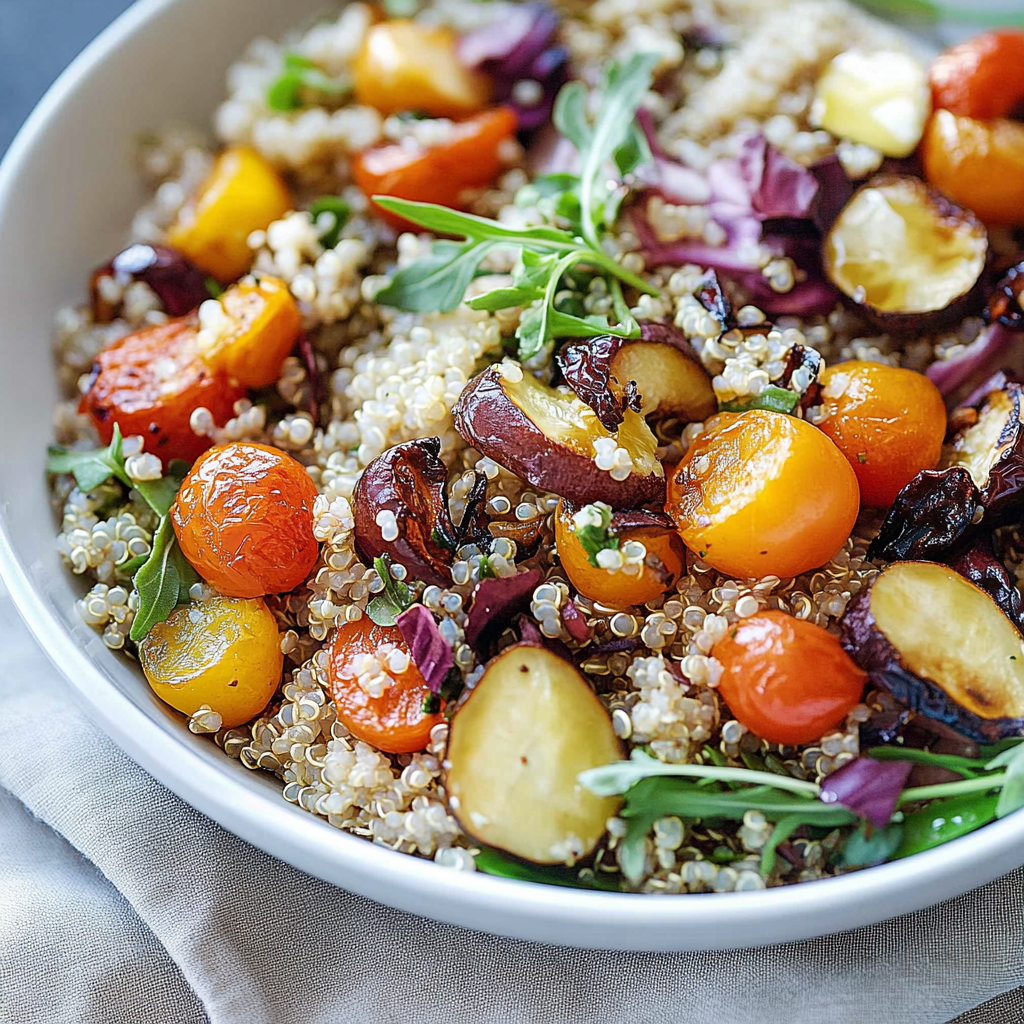
Mason Jar Quinoa and Roasted Veggie Salads — 20 min, 4 servings, 350 cal. Roasting the vegetables first drives off water, which is why this one holds a full five days rather than four.
Roasted Farro & Roasted Vegetable Grain Bowl with Tahini Dressing — 35 min, 4 servings, 480 cal. Farro is the sturdiest grain for jars; it doesn't turn to paste the way quinoa can by day five.
Lemon-Herb Roasted Chickpea & Farro Bowl — 50 min, 4 servings, 480 cal, 18g protein. The longest prep here, but the roasted chickpeas stay crunchy for three days if you keep them out of the dressing layer.
5 protein-forward mason jars (chicken, tuna, chickpea, tofu, salmon)
Protein jars are what make a salad actually hold you until dinner. The target is 20g+ per jar; below that you're hungry by 2 PM.
Buffalo Cauliflower and Chicken Salad with Avocado Dressing — 25 min, 4 servings, 380 cal, 40g protein. Highest-protein jar in the guide. Keep the avocado dressing in a separate 2-oz container and add it at the table.
The Best Avocado Cobb Salad with Crispy Bacon — 10 min, 4 servings, 390 cal. Layer the bacon with the protein, not the greens, and skip the avocado until serving.
Mini Tuna Salad Pasta Salad — 10 min, 4 servings, 265 cal, 13g protein. Pantry-staples jar: canned tuna, small pasta, and whatever hard vegetable is in the crisper. Holds three days, not five, because of the mayo.
Seared Tofu and Quinoa Salad with Ginger-Sesame Dressing — 10 min, 2 servings, 450 cal, 35g protein. Press the tofu 20 minutes before searing; unpressed tofu weeps into the grain layer.
Genuine Sushi-Style Salmon Poke Bowl — 5 min, 2 servings, 580 cal, 32g protein. The one hard limit in this guide: raw fish holds two days maximum, not five. Build these on Sunday for Monday and Tuesday only.
5 international-flavor mason jars (Greek, Thai, Mexican, Italian, Vietnamese)
Flavor rotation is what stops week-three meal-prep fatigue. Same technique, five different dressings.
Chickpea and Cucumber Greek Salad with Feta and Dill — no cook, 4 servings, 280 cal, 12g protein. Feta holds beautifully in dressing; it lightly cures over five days.
Refreshing Cucumber and Tomato Greek Salad with Feta — no cook, 4 servings, 180 cal. The lightest jar in the roundup — pair it with a grain jar rather than eating it alone.
Cold Thai Mango Noodle Salad with Spicy Peanut Dressing — 5 min, 4 servings, 420 cal. Peanut dressing thickens in the fridge; thin it with a teaspoon of warm water when you shake the jar.
Lime-Cumin Quinoa Salad with Black Beans and Corn — 15 min, 4 servings, 350 cal. The Mexican-flavor entry, and the cheapest per portion at roughly $1.60.
Antipasto Salad with Italian Meats and Provolone — no cook, 4 servings, 380 cal, 22g protein. Cured meats and hard cheese are shelf-stable enough that this jar is arguably better on day four.
Vietnamese-Inspired Rice Noodle Salad with Lemongrass and Fresh Herbs — 5 min, 4 servings, 280 cal. Fresh herbs go in the greens layer, not the vegetable layer, or they bruise.
Two more worth keeping in rotation: the Mediterranean Quinoa Salad (15 min, 340 cal) and the Mediterranean Chickpea & Cucumber Salad with Lemon-Tahini Dressing (no cook, 320 cal) — both are five-day holders and both scale to eight jars without extra work.
Sunday prep in 45 minutes: the timeline
| Time | Task |
|---|---|
| 0:00-0:05 | Set a pot of water on for quinoa or farro; preheat oven to 425°F for roasted vegetables |
| 0:05-0:15 | Wash and spin all greens; spread on a towel to finish drying |
| 0:15-0:25 | Chop hard vegetables — cucumber, carrot, pepper, red onion — into one big bowl each |
| 0:25-0:32 | Mix 3 dressings in squeeze bottles; drain and rinse beans |
| 0:32-0:38 | Portion dressing into 5 jars, then hard vegetables, then grains |
| 0:38-0:43 | Add protein and cheese layers; pack greens to the rim |
| 0:43-0:45 | Lid, label with the day, refrigerate upright |
Two rules that keep this at 45 minutes: cook the grain and roast the vegetables while you chop, and build all five jars assembly-line style — all five dressings, then all five vegetable layers — rather than finishing one jar at a time. Assembly-line is roughly 40% faster.
Shopping list for a full week of 5 jars
| Category | Items | Approx. cost |
|---|---|---|
| Greens | 1 head romaine, 5-oz box spinach, 1 bunch kale | $8 |
| Hard vegetables | 2 cucumbers, 3 carrots, 2 bell peppers, 1 red onion, 1 pint cherry tomatoes | $9 |
| Grains and beans | 1 cup dry quinoa, 1 can chickpeas, 1 can black beans | $6 |
| Protein | 1 lb chicken breast, 6 eggs, 4 oz feta | $12 |
| Dressing | Olive oil, red wine vinegar, lemon, tahini, peanut butter (pantry staples) | $4 |
| Total | 5 jars, roughly $8 per jar equivalent | ~$39 |
That's about $7.80 per lunch against $12-$15 for a comparable bought salad — roughly $30/week saved, or $1,500 over a work year. The jars themselves pay for themselves in the first week and a half.
Real-world numbers: how long each component actually holds
The five-day claim is an average. In practice the jar's shelf life is set by whichever component fails first, so it's worth knowing the individual numbers.
| Component | Holds (refrigerated at 40°F) | Failure mode |
|---|---|---|
| Kale, shredded cabbage | 7 days | Slight limpness, still edible |
| Romaine, iceberg | 5 days | Rust-brown cut edges |
| Spinach | 4 days | Slime at leaf contact points |
| Arugula, spring mix | 3 days | Yellowing, bitter flavor |
| Cooked quinoa, farro, rice | 5 days | Texture pastes out past day 5 |
| Chickpeas, black beans (canned) | 5 days | None within window |
| Grilled chicken breast | 4 days | Dries, goes stringy |
| Hard-boiled egg (peeled) | 4 days | Rubbery white |
| Canned tuna, plain | 4 days | Fishy odor concentrates |
| Tuna or chicken salad (mayo) | 2 days | Food-safety limit |
| Raw fish (poke) | 2 days | Food-safety limit |
| Feta, provolone, hard cheese | 7 days | None within window |
| Cherry tomatoes, cucumber | 5 days | Softening in dressing |
| Avocado (in jar) | 1 day | Browns |
| Nuts, croutons (in jar) | 1 day | Goes soft |
Practical reading of that table: build Monday-through-Wednesday jars with whatever protein you like, and reserve Thursday and Friday for the durable combinations — chickpeas or feta on kale or cabbage. That single scheduling change is what takes a prep session from "three good lunches and two disappointing ones" to five good ones.
Common pitfalls: 5 ways jar salads go wrong
1. Wet greens. The single most common failure. Surface water on spinach turns it to slime by day three. Spin dry, then towel-blot.
2. Warm ingredients. Layering warm quinoa or just-cooked chicken creates condensation inside a sealed jar, which drips down onto the greens. Cool everything completely first — 20 minutes spread on a sheet pan.
3. Over-dressing. Two to three tablespoons is the whole allowance. More than that and the dressing rises past the dam layer as the jar settles.
4. Regular-mouth jars. Greens get crushed going in and won't come out cleanly. Wide-mouth only.
5. Ignoring the protein clock. Not all proteins hold five days. Raw fish is two; mayo-based salads are two; cooked ground meat is three; grilled chicken, hard-boiled egg, canned tuna, beans, and firm cheese are four to five. The FoodSafety.gov cold food storage charts are the authority here — refrigerate at or below 40°F and follow the stated windows rather than the smell test.
When NOT to use a mason jar salad
Jar salads are the wrong format when the salad's appeal is warm-and-crisp — a fried chicken salad or a warm grain bowl with a runny egg loses everything in the jar. They're also poor for anything built on avocado, fresh croutons, or delicate herbs as the main event, all of which degrade faster than the greens do. And if you don't have refrigeration at work, a jar salad is a food-safety problem rather than a lunch: the USDA's MyPlate vegetables guidance is worth reading alongside the storage charts, but the short version is that two hours above 40°F is the limit. Pack an ice pack or pick a shelf-stable lunch instead.
FAQ
The five questions we hear most about jar-salad prep, answered below.
Sources
Storage windows and safe refrigeration temperatures follow the FoodSafety.gov cold food storage charts. Vegetable serving guidance comes from USDA MyPlate, nutrition figures cross-reference USDA FoodData Central, and background on jar hardware and lid designs is from Wikipedia's mason jar entry. For the broader batch-cooking context, Wikipedia's meal preparation entry is a reasonable primer.
Related reading
- Sunday Meal Prep: 20 Make-Ahead Recipes for the Week
- Vegetarian Meal Prep: 10 Plant-Based Bowls for the Week (30-50g Protein Each)
- Back-to-School Lunchbox Meal Prep: 20 Make-Ahead Recipes for the Week
- Budget Meal Prep Under $5 Per Portion: 20 Cheap Bulk Recipes
- Turn any five of these into one aisle-sorted grocery list with the AislePrompt meal plan.
Frequently asked questions
Why do mason jar salads last 5 days when regular salads wilt in 1?
What size mason jar do I need?
Can I use a plastic container instead of glass?
How much do 5 jars of mason jar salads cost per week?
What proteins hold up best in a mason jar salad?
Sources
One Sunday, one week of lunches.
Ask our AI to plan the batch-cook — components, quantities, and a single Instacart cart.
Plan my prep day →