18 West African Recipes: Jollof, Egusi, Suya & Nigerian Classics
Four pantry items and one non-negotiable technique — frying the pepper base until the oil separates — carry the whole cuisine.
West African home cooking runs on four things: red palm oil, ground dried chile, ginger and garlic in quantity, and time. Nigerian jollof, egusi soup, suya skewers, and a pot of pepper soup are all built from the same short pantry, and none of them are hard — they're just unfamiliar. Here are 18 recipes with the technique notes that actually decide whether they work.
Get a free week of easy dinners
Seven weeknight dinners with the shopping list already totalled, sent Sunday. No account needed, unsubscribe in one click.
No spam, unsubscribe in one click. Recipes, shopping lists and Instacart carts all work without an account either way.
The flavor pillars: palm oil, chile, ginger, long braises
Red palm oil is the ingredient that makes West African food look and taste West African. It's unrefined, deep orange-red, and tastes faintly of carrot and earth. It is not interchangeable with refined "palm oil" (which is bleached and flavorless), and it is not coconut oil. In a pot of egusi or a red stew, palm oil is 30% of the flavor.
The second pillar is heat, and it comes from scotch bonnet — a habanero-family pepper running 100,000–350,000 Scoville units, roughly 12–40 times a jalapeño. In traditional cooking, one whole scotch bonnet in a four-serving stew is standard. Every recipe below scales: one pepper is medium by Nigerian standards, half is mild by anyone's, and two is what your Nigerian friend actually eats.
Third is the aromatic base. Nigerian cooking blends raw onion, red bell pepper, tomato, and scotch bonnet into a purée — the obe ata base — and then fries that purée in oil for 15–25 minutes until it darkens and the oil separates back out. That fry is not optional. An unfried base tastes raw and sour; a properly fried one tastes sweet and deep. It is the single most-skipped step by new cooks and the most common reason a first attempt disappoints.
Fourth is patience. Egusi, ogbono, and the red stews want 45–90 minutes at a bare simmer. The BBC's West African cuisine overview is a decent map of the regional differences if you want the wider context before you start cooking.
The pantry: what to buy and where
| Item | What it is | Where | Substitute |
|---|---|---|---|
| Red palm oil | Unrefined, orange-red | African grocer, online | 3:1 neutral oil + unrefined coconut + paprika (approximate) |
| Egusi | Ground melon seed | African grocer, online | Raw pumpkin seed, ground (close) |
| Scotch bonnet | Habanero-family chile | Latin/Caribbean/African grocer | Habanero, 1:1 |
| Dried crayfish | Ground, intensely savory | African grocer | Dried shrimp powder |
| Suya spice (yaji) | Peanut, chile, ginger, spices | African grocer, or make it | See below |
| Stockfish / dried fish | Air-dried cod or similar | African grocer | Omit; add fish sauce |
| Long-grain parboiled rice | Firm, separate grains | Any supermarket | Not basmati, not jasmine |
| Bouillon cubes | Maggi or Knorr | Any supermarket | Salt + stock concentrate |
Nearly every metro area has at least one African grocery store; searching "African grocery" plus your ZIP is usually enough. Failing that, palm oil, egusi, and dried crayfish are all reliably available online year-round; scotch bonnets are seasonal in US supermarkets but habaneros substitute exactly.
Make your own suya spice (yaji): 1/2 cup roasted peanuts ground to a coarse powder and blotted of oil, 2 tbsp cayenne, 1 tbsp smoked paprika, 2 tsp ground ginger, 1 tsp garlic powder, 1 tsp onion powder, 1 tsp bouillon powder. Keeps 3 months in a jar.
Rice mains
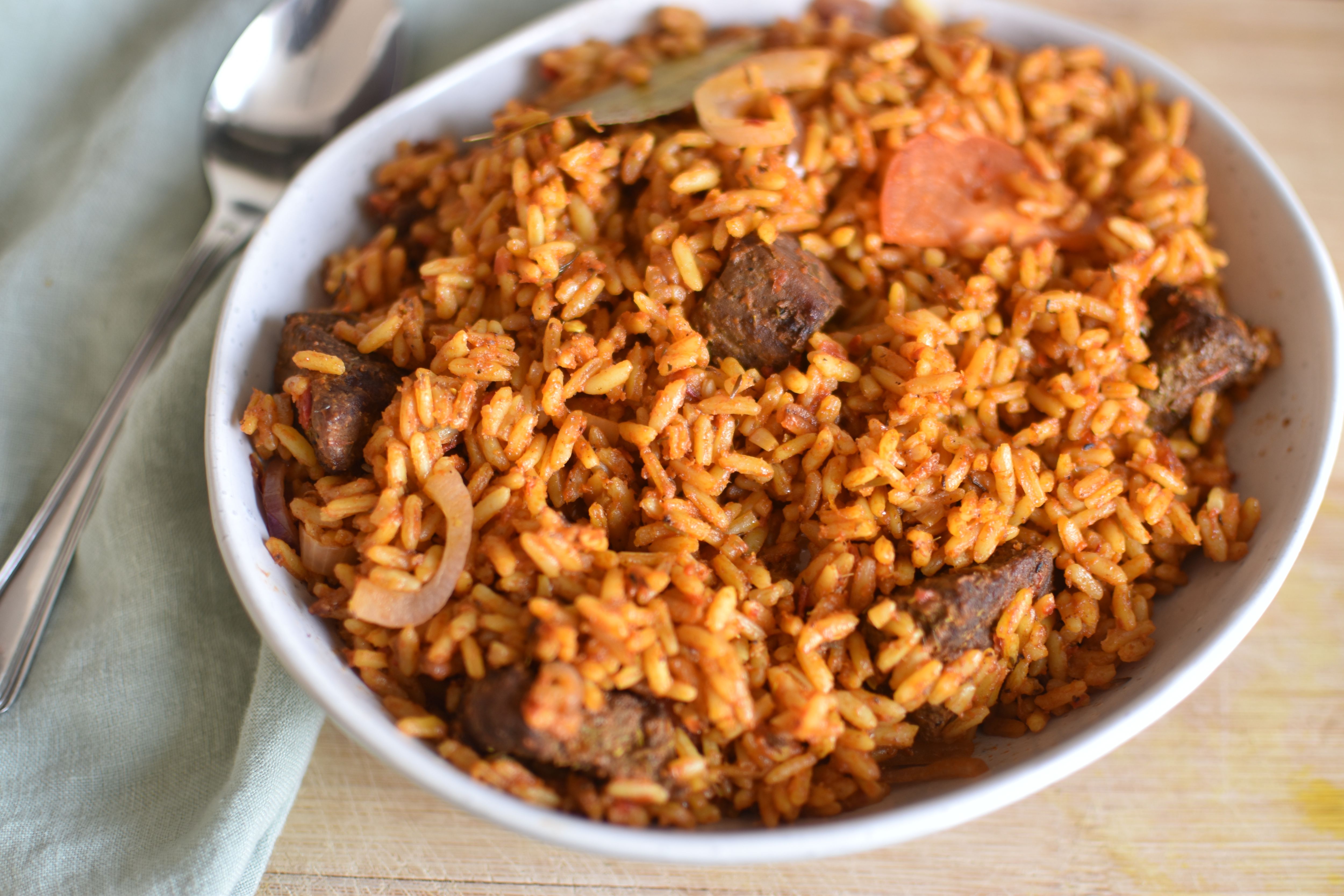
Jollof is the center of gravity. It's parboiled long-grain rice cooked in a fried tomato-pepper base until the grains absorb the sauce and the bottom of the pot picks up a smoky crust.
- Classic Nigerian Jollof Rice — start here. The base gets fried until the oil separates, then the rice goes in with just enough stock, and the pot cooks on the lowest possible heat under foil for 25 minutes without stirring.
- Authentic West African Jollof Rice with Chicken & Peppers — a one-pot version where the chicken cooks in the same rice, which is the way most weeknight Nigerian kitchens actually do it.
- Chicken and Plantain Jollof Rice — the plantain is not a garnish; the sweetness is a structural counterweight to the chile.
Getting the crust (party jollof): the smoky bottom that defines party jollof comes from letting the pot's base scorch slightly at the end. Uncover for the last 4–5 minutes over medium heat and don't stir. If you're nervous, a piece of foil pressed directly onto the rice surface before the lid traps steam and gives you a wider margin.
Rice choice is not negotiable. Long-grain parboiled rice only. Basmati and jasmine are too soft and turn to porridge in the volume of sauce jollof requires.
Soups and stews
In Nigerian usage, "soup" means a thick stew eaten with a starch — it's the main course, not a starter.
- Stewed Nigerian Egusi Soup with Leafy Greens — ground melon seed thickens into something between a stew and a crumble. The technique note: mix the egusi with a little water into a paste, drop it into the hot oil in lumps, and let the lumps set for 10 minutes before stirring. Stirring immediately gives you a grainy sludge.
- Slow-Cooked Nigerian Egusi Soup with Spinach and Beef — the same dish with a longer, gentler braise.
- Slow-Cooked Nigerian Ogbono Soup with Tender Beef — ogbono (wild mango seed) makes the famously stretchy, glossy soup. Bloom the powder in hot oil for 60 seconds before adding liquid or it clumps.
- Nigerian Okra Soup with Spinach & Peppers — fast, 30 minutes, and the most approachable of the four.
- Punch-Flavored Nigerian Groundnut Stew and Groundnut Soup with Chicken and Spinach — peanut-based, rich, and the easiest entry point for someone new to the cuisine.
- West African Peanut Stew — the pan-regional version, sweet-potato-forward and naturally vegan if you skip the stock.
- Spicy Nigerian Pepper Soup with Chicken & Plantains — thin, aromatic, and medicinal in the way chicken soup is. This is what gets made when someone in the house is sick.
- Nigerian Palm Nut Soup with Chicken — palm fruit concentrate, not palm oil; richer and fruitier.
- Slow Cooker Nigerian Beef Stew with Sweet Potatoes — the red stew adapted to an 8-hour unattended cook.
- Slow-Simmered Ghanaian Red Red Bean Stew — black-eyed peas in palm oil with fried plantain, and one of the best cheap meals in the whole region at roughly $1.10 a serving.
Grilled and skewered
- Spiced Beef Suya Skewers with Peanut Sauce — the definitive street food. Slice the beef thin — 1/8 inch, against the grain — coat in yaji, and grill hot and fast. Thick suya is chewy suya.
- Suya Spiced Chicken Skewers with Peanuts — same spice, faster cook, more forgiving.
- Yassa Chicken with Onions and Lemon — Senegalese, and the outlier on this list: the heat is low and the flavor is a mountain of onions cooked down in lemon juice and mustard.
- Braised Senegalese Chicken Yassa with Caramelized Onions — the oven version; grill the chicken first for char, then braise.
Suya timing: thin slices need 90 seconds a side over direct high heat. The peanut in the yaji burns fast, so any longer and the coating goes bitter before the meat is done.
Plantain, starch, and small bites
- Crispy Fried Plantains — dodo. Use plantains that are mostly black, not yellow; the sugar is what caramelizes.
- Fried Plantain Kelewele with Spicy Ginger and Garlic Marinade — Ghanaian, and the best thing on this list to eat standing over the stove.
- Fried Akara Bean Cakes with Spicy Tomato Sauce — black-eyed pea fritters, whipped until the batter is genuinely airy. Under-whipped batter fries dense.
- Fried Senegalese Akara Black-Eyed Pea Fritters — the Senegalese take, usually eaten for breakfast.
- Cassava-Plantain Fufu with Light Tomato Soup — the swallow that goes with every soup in Section 2. Instant fufu flour from an African grocer is what most home cooks in Lagos use too; there is no purity points to be won here.
The jollof primer — Nigerian vs Ghanaian vs Senegalese
The jollof rivalry is real, loud, and mostly good-natured. The differences are actual technique differences:
| Version | Rice | Base | Signature |
|---|---|---|---|
| Nigerian | Long-grain parboiled | Tomato + red bell + scotch bonnet, fried hard | Smoky scorched bottom, drier grain |
| Ghanaian | Basmati or jasmine | Tomato base + aromatic spice (bay, ginger, nutmeg) | Perfumed, softer, more separate |
| Senegalese (thieboudienne) | Broken rice | Fish, tamarind, vegetables | The original; fish-forward, one-pot with vegetables |
Thieboudienne is the ancestor of all three — a Senegalese one-pot of broken rice, fish, and vegetables that traveled along the coast and simplified as it went. If you're cooking one to understand the family, cook the Senegalese one.
If this is your entry point into African cooking, 18 Ethiopian recipes and 20 Moroccan recipes cover the other two traditions with the deepest recipe coverage on the site.
Real-world numbers
| Dish | Serves | Ingredient cost (Aug 2026) | Active time | Total time |
|---|---|---|---|---|
| Jollof rice with chicken | 6 | $16 | 35 min | 1 hr 15 min |
| Egusi soup + fufu | 6 | $22 | 30 min | 1 hr 30 min |
| Beef suya (2 lb) | 8 | $19 | 25 min | 45 min + marinade |
| Red red bean stew | 6 | $7 | 20 min | 55 min |
| Pepper soup | 4 | $11 | 15 min | 45 min |
Two of those are under $1.20 a serving. West African cooking is, among other things, extremely good value — the expense is front-loaded in the pantry (palm oil, egusi, crayfish are $25–35 all in) and then amortized across months of cooking.
Common pitfalls
- Not frying the pepper base long enough. 15–25 minutes, until the oil separates and floats. This is the whole dish.
- Using refined palm oil. It's bleached and flavorless. You want the unrefined red kind.
- Basmati in jollof. Long-grain parboiled only.
- Stirring egusi too early. Let the lumps set for 10 minutes.
- Slicing suya thick. 1/8 inch against the grain, or it's chewy.
- Yellow plantains for dodo. Wait for mostly-black skin.
- Adding scotch bonnet whole and then leaving it. A pepper simmering for an hour releases far more heat than one added in the last 15 minutes. Choose deliberately.
When to cook something else
These aren't 30-minute weeknight dishes, with two exceptions (okra soup and pepper soup). Egusi, ogbono, and a proper jollof want 75–90 minutes and a cook who's in the kitchen for the first half of it. Don't start one at 6:30pm on a Tuesday. Cook a double batch on a Sunday instead — every soup on this list freezes for three months and reheats better than it started.
Kitchen tools for West African cooking
Two tools do most of the work: a heavy Dutch oven or thick-bottomed pot — jollof lives or dies on even bottom heat, and a thin pot scorches unevenly instead of crusting — and a powerful blender for the pepper base, which needs to be genuinely smooth rather than chunky. Beyond that, a sturdy wooden spoon set for stirring thick soups, and a cast-iron grill pan or skillet for suya when the weather rules out the grill.
FAQ
What makes jollof rice specifically Nigerian?
Nigerian jollof uses long-grain parboiled rice and a base of tomato, red bell pepper, and scotch bonnet fried hard until the oil separates. Its signature is the smoky scorched bottom — party jollof — that comes from finishing uncovered over higher heat. Ghanaian jollof uses basmati and a more aromatic spice profile (bay, nutmeg, ginger), producing a softer, perfumed rice with separate grains rather than a crusted pot.
Where do I buy palm oil, egusi, and scotch bonnet peppers?
African grocery stores are the reliable source, and most US metro areas have at least one — searching "African grocery" plus your ZIP code usually finds it. Otherwise, unrefined red palm oil and dried egusi seed are available online year-round from West African importers. Scotch bonnets are seasonal in US supermarkets, but habaneros are the same species and substitute one-for-one with no adjustment.
How spicy are Nigerian recipes, really?
Traditional recipes run hot. One whole scotch bonnet in a four-serving stew is standard, and scotch bonnets measure 100,000–350,000 Scoville units against a jalapeño's 2,500–8,000 — call it 12 to 40 times hotter. Every recipe here scales down cleanly: half a pepper is mild, one is medium by Nigerian standards, two is what the dish is actually supposed to taste like. Add it late for less heat.
What's a good substitute for palm oil?
There isn't a perfect one — the fruity, red-orange character of unrefined palm oil is specific and structural. As a starter approximation, blend three parts neutral oil with one part unrefined coconut oil and a heaping teaspoon of sweet paprika per half cup, which gets you the color and some of the richness. Never use refined palm oil; it's bleached and deodorized and contributes nothing but fat.
Can I make jollof rice in a rice cooker or Instant Pot?
You can make a decent jollof in either, but you'll lose the scorched bottom crust that defines party jollof. If you use an Instant Pot, fry the pepper base on Sauté for the full 15–20 minutes first — skipping that is the mistake — then pressure-cook the rice for 6 minutes with a 10-minute natural release. Finish under a broiler for 3 minutes to approximate the crust.
Sources
Last verified: August 2026.
Frequently asked questions
What makes jollof rice specifically Nigerian?
Where do I buy palm oil, egusi, and scotch bonnet peppers?
How spicy are Nigerian recipes, really?
What's a good substitute for palm oil?
Can I make jollof rice in a rice cooker or Instant Pot?
Sources
Plan a week of meals in two minutes.
Tell our AI what you have and what you like — it builds your plan, shopping list, and Instacart cart. No account needed.
Try free →