18 Ethiopian Recipes: Injera, Doro Wat & Berbere-Spiced Stews for a Communal Feast
One platter, no plates, no cutlery — two stews and three vegetable sides feed eight for about $28, and there's a 24-hour shortcut for the injera.
Affiliate disclosure: AislePrompt may earn a commission on qualifying purchases made through Amazon and Instacart links in this article, at no additional cost to you. See our affiliate policy →
Ethiopian food is the easiest cuisine in the world to serve family-style: everything goes on one giant sourdough flatbread, nobody gets a plate, and there is no cutlery. Cook two stews and three vegetable sides and you have a spread that feeds eight for about $28. The only hard part is injera, and there is a legitimate 24-hour shortcut.
What you'll use with it
The onion base and the wats here want a wide, heavy 5–7 quart pot. The Dutch oven guide picks that pot, from Le Creuset down to budget enameled cast iron from Tramontina. Read the Dutch oven guide →
Dutch oven guide’s top pick: Le Creuset Signature Round Dutch Oven, 5.5 qt $363.95 at Amazon, Check price on Amazon →Dutch oven guide’s Best Value pick: Tramontina Bestow Enameled Cast Iron 5.5 qt $69.99 at Amazon, Check price on Amazon →Dutch oven guide’s Best for Beginners (Bare Cast Iron) pick: Lodge 5 qt Pre-Seasoned Camp Dutch Oven $74.90 at Amazon, Check price on Amazon →The vegetable wat in this roundup takes 12 minutes under pressure, where doro wat runs close to two hours on the stove. The Instant Pot guide’s top pick is the 6-quart Duo. Read the Instant Pot guide →
Instant Pot guide’s top pick: Instant Pot Duo 7-in-1 (6-Quart) $79.00 at Amazon, Check price on Amazon →
Why one platter changes the meal
Ethiopian cuisine is built around gursha — the practice of feeding someone else by hand from the shared platter. That's not a garnish on the tradition; it's the structure. Stews (wat) are spooned in mounds onto a bed of injera, the spongy fermented flatbread, and everyone tears pieces from the edge and scoops.
Practically, this means: no plating, no timing individual portions, and no side that has to come out hot at the exact same moment. It's the least stressful dinner party format there is, and it's naturally vegan-friendly — Ethiopian Orthodox fasting days (roughly 180 a year) mean the cuisine has a genuinely deep vegan repertoire rather than an afterthought.
The pantry: five things, three of them cheap
| Item | What it is | Where to buy | US price (2026) |
|---|---|---|---|
| Berbere | Chili-forward spice blend, 12–20 components | Ethiopian market, Whole Foods, Amazon | $8–14 / 8 oz |
| Niter kibbeh | Clarified butter infused with spices | Make it, or Ethiopian market | $4 to make / $12 to buy |
| Teff flour | Tiny ancient grain, injera base | Ethiopian market, Bob's Red Mill, Amazon | $8–12 / lb |
| Mitmita | Hotter, brighter chili blend for kitfo/tibs | Ethiopian market, online | $8–12 / 4 oz |
| Cardamom, fenugreek, ajwain | Berbere from scratch | Any grocer / Indian market | $3–6 each |
Berbere is the spine of the cuisine. It's chili powder plus fenugreek, cardamom, coriander, korarima, ajwain, nigella, ginger, garlic, rue, and more — often 15 to 20 ingredients toasted and ground. Store-bought is fine to start. Homemade is noticeably better and costs about $6 for a batch that lasts three months.
Niter kibbeh is the other half. Melt a pound of butter over low heat with sliced onion, garlic, ginger, cardamom pods, fenugreek, cinnamon, and a bay leaf; simmer 30 minutes; strain. It keeps three months refrigerated and it is the reason a doro wat tastes Ethiopian rather than merely spicy. Do not skip it and substitute plain butter — this is the highest-return 30 minutes in the whole cuisine.
Berbere from scratch
Toast whole and grind: 2 tbsp coriander seed, 1 tbsp fenugreek, 1 tbsp cardamom seed, 1 tsp ajwain, 1 tsp nigella, 1 tsp black peppercorn, 4 whole cloves, 1 tsp allspice berries. Combine with ½ cup mild chili powder (Kashmiri or New Mexico), 2 tbsp sweet paprika, 1 tbsp ground ginger, 1 tbsp onion powder, 1 tbsp garlic powder, 1 tsp cinnamon, 1 tsp ground nutmeg, 2 tsp salt.
That's about 1¼ cups, enough for 12–15 dinners, at roughly $6 in bulk spices versus $10–14 for an 8-oz commercial jar that's mostly paprika.
Wats: the stews that carry the platter
Wat (or wot) is the general word for stew. Every one of them begins the same way — a mountain of finely diced red onion, dry-cooked with no fat at all for 15 to 20 minutes until it collapses and its sugars concentrate. Only then does the niter kibbeh go in, then the berbere, then the protein. That dry-onion step is the technique that separates a real wat from a curry with berbere in it.
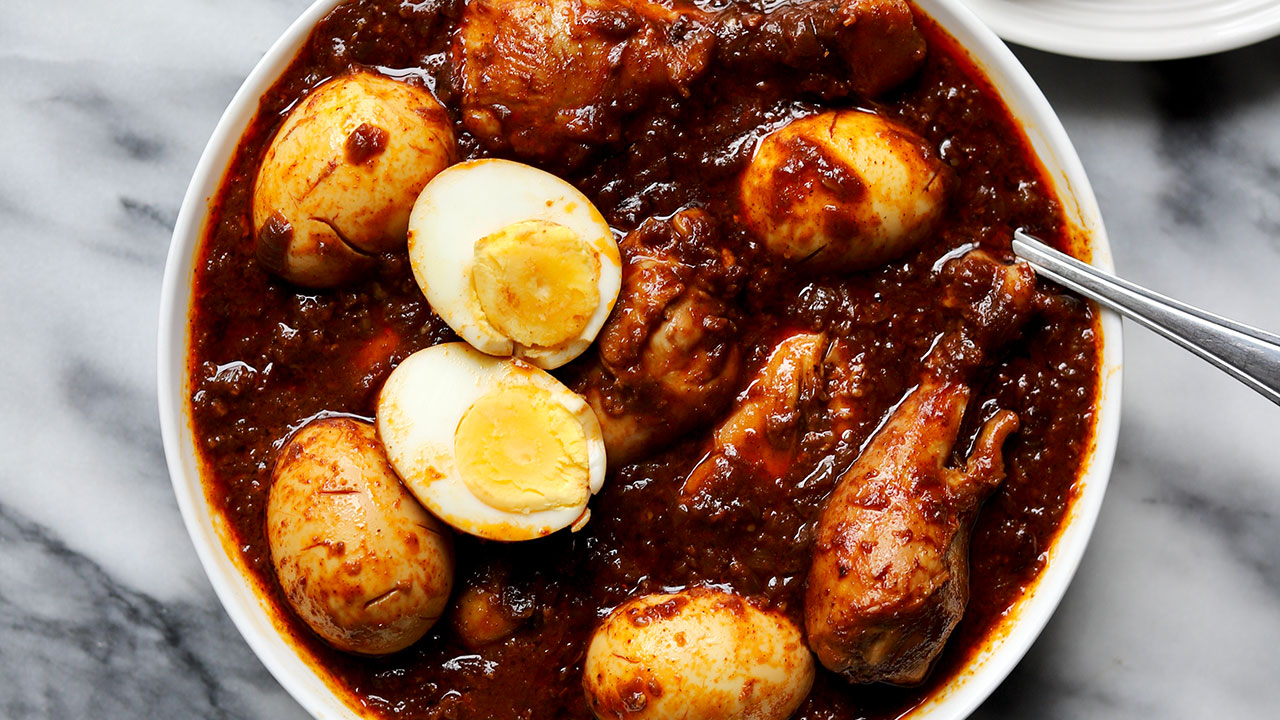
Doro wat is the national dish — chicken legs and hard-boiled eggs braised in a deep red berbere sauce, traditionally served at holidays and weddings. Six pounds of onion for one chicken is not a typo in the classic version.
- Doro Wat: Slow-Simmered Chicken Stew with Hard-Boiled Eggs — the reference version
- Spiced Doro Wat Braised Chicken with Hard-Boiled Eggs
- Slow-Simmered Doro Wat Ethiopian Chicken Stew
- Spiced Chicken & Berbere Stew with Slow-Cooked Onions — the one that treats the onion step properly
- Chicken Stew with Spiced Berbere — simplest entry point
- Berbere Chicken Thighs with Lemon-Ginger Rice — weeknight, over rice, 40 minutes
Misir wat is red lentil stew and it is the single best dish to cook first. It's vegan, costs about $4 for six servings, takes 40 minutes, and tastes like it took three hours.
- Spiced Misir Wat Red Lentil Stew
- Slow-Cooked Misir Wat Lentil Stew with Berbere
- Slow-Simmered Lentil Misir Wot with Niter Kibbeh
- Lentil & Berbere Slow-Simmered Stew
- Sun-Roasted Red Lentil Stew with Turmeric — the alicha (mild, turmeric-yellow, no berbere) register
Shiro wat is powdered-chickpea stew — thick, nutty, and the fastest thing in the cuisine at about 20 minutes.
Lentil stews carry most of the vegan side of the platter, and red lentils are the right variety — they break down completely, which is what you want here.
Tibs: the 15-minute one
Tibs is the fast, dry counterpart to the slow wats: cubed beef or lamb seared hard with onion, jalapeño, and rosemary, finished with niter kibbeh. Restaurant versions arrive on a clay brazier still sizzling.
- Beef Tibs with Green Pepper and Lime
- Awaze Beef Tibs with Spiced Chili Sauce — awaze is berbere thinned with wine, the standard dipping sauce
- Tibs Stir-Fry with Rosemary and Garlic
Rosemary in an Ethiopian dish surprises people. It's genuine — rosemary grows wild across the highlands and it's the signature aromatic in tibs.
For the raw-beef end of the menu, Spiced Ethiopian Kitfo with Gomen and Ayib is Ethiopia's steak tartare: minced raw beef warmed in mitmita-spiked niter kibbeh, served with fresh cheese and greens. Ask your butcher to grind a whole piece of top round to order if you're making it.
Vegetable sides for the platter
A proper platter carries three to five vegetable dishes. All of these are vegan, all cost under $3 a batch, and all keep four days.
- Gomen Wat Ethiopian Collard Greens with Garlic and Ginger — the standard greens
- Gomen Braised Collard Greens
- Sautéed Ethiopian Spiced Cabbage and Potatoes — tikil gomen, the mild yellow cabbage-carrot-potato dish
- Stewed Cabbage with Carrot and Ethiopian Spices
- Instant Pot Ethiopian Vegetable Wat with Cabbage and Potatoes — 12 minutes under pressure
- Slow-Simmered Spiced Fava Beans with Lemon Zest — ful, the breakfast dish
Add a timatim salata — diced tomato, red onion, jalapeño, lime, a spoon of berbere — as the raw, acidic counterpoint. It takes four minutes and it's what keeps a platter of stews from feeling heavy.
The injera problem
This is where most home cooks stall, so here's the honest breakdown.
Real injera is 100% teff flour and water, fermented three to five days at room temperature until it smells sharply sour, then poured onto a hot clay mitad and steamed under a lid. The fermentation produces the characteristic tang and the injera eyes — thousands of tiny holes on the surface. Teff is a genuinely ancient grain, gluten-free, and unusually high in iron and calcium for a cereal.
| Approach | Time | Difficulty | Result |
|---|---|---|---|
| Full teff, 3–5 day ferment | 4 days | Hard | Authentic; tricky to pour without a mitad |
| 50/50 teff + all-purpose, 24 h | 1 day | Medium | Very close; more forgiving |
| Teff + buttermilk + baking soda | 90 min | Easy | Right texture, missing the sour |
| Buy it frozen | 0 | None | Genuinely good; $6–9 per 10-pack |
Recommendation: buy it the first time. Any Ethiopian restaurant will sell you a stack of 10 for $6 to $9, and most Ethiopian grocers stock frozen. Cook the stews, learn the platter, and take on the ferment later. If you want to try:
- Spiced Injera Flatbread — the home version
- Spiced Lentil Pancakes (Injera Alternative) — the 90-minute shortcut
- Lentil Stew with Injera — stew and bread together
The 24-hour shortcut in detail: mix 1 cup teff flour, 1 cup all-purpose, 2½ cups water, and 2 tablespoons of a previous batch's liquid (or a splash of plain kombucha as a starter). Cover loosely, leave at room temperature 24 hours until bubbling and sour. Whisk in ½ teaspoon salt. Pour a thin layer onto a dry nonstick pan over medium heat, cover, and steam 2 to 3 minutes — never flip. It's ready when the top is set and dry and the eyes have opened.
Building the platter
For eight people, aim for two meat wats, three vegetable dishes, one raw salad, and 12–16 injera.
Two days out: make niter kibbeh and berbere.
Day before: cook doro wat and misir wat. Both improve overnight — the berbere blooms and the onion sweetness rounds out. Buy or start injera.
Day of, 45 min: gomen, tikil gomen, and timatim salata. Reheat the wats gently.
Plating: line a large round tray or sheet pan with overlapping injera. Spoon each dish into its own mound, radiating out from the center. Roll the extra injera into cylinders and pile them on the side. Set the tray down, provide no utensils, explain gursha, and get out of the way.
Cost for eight: roughly $28 to $34 in 2026 if you make the spice blends yourself, or $40 with store-bought berbere and purchased injera.
Common pitfalls
Rushing the onions. Twenty minutes, dry pan, no oil, medium-low, stirring occasionally. They should go from white to translucent to collapsed and jammy. This is the flavor base — skipping it produces a thin, raw-tasting stew that no amount of berbere fixes.
Adding berbere to a hot dry pan. It scorches in seconds and turns bitter. Add it to the fat, off direct high heat, and stir for 30 to 60 seconds to bloom it.
Using plain butter instead of niter kibbeh. The spice infusion is 70% of what makes these dishes taste Ethiopian.
Buying berbere from a generic supermarket spice rack. Many are mostly paprika with a little cayenne and no fenugreek at all. Check the ingredient list for fenugreek and cardamom, or make your own.
Flipping injera. It cooks on one side only, under a lid. Flipping ruins the eyes and gives you a crepe.
Serving it too hot. Wats are meant to be warm, not scalding — you're eating with your hands.
When Ethiopian isn't the right call
If you need dinner in 30 minutes on a weeknight, the wats aren't it — misir wat is the fastest at 40 minutes and doro wat runs closer to two hours. Cook tibs instead, which is genuinely 15 minutes over rice. And if you're feeding people who are uncomfortable eating with their hands from a shared platter, either portion the stews over rice and skip the injera framing, or pick a different menu — half the appeal is the format.
Equipment
A wide heavy pot for the onion base and the wats — 5 to 7 quarts. See Dutch ovens or the wider cookware category.
A large flat nonstick pan for injera, ideally 12 inches with a lid. Skillets and frying pans covers the category.
A spice grinder for berbere. A $20 blade coffee grinder dedicated to spices is all you need — check gadgets.
The 18-recipe grid
Wats (stews): Doro Wat: Slow-Simmered Chicken Stew with Hard-Boiled Eggs · Spiced Doro Wat Braised Chicken with Hard-Boiled Eggs · Slow-Simmered Doro Wat Ethiopian Chicken Stew · Spiced Chicken & Berbere Stew with Slow-Cooked Onions · Chicken Stew with Spiced Berbere · Berbere Chicken Thighs with Lemon-Ginger Rice
Lentil & chickpea wats: Spiced Misir Wat Red Lentil Stew · Slow-Cooked Misir Wat Lentil Stew with Berbere · Slow-Simmered Lentil Misir Wot with Niter Kibbeh · Chickpea Shiro Wat with Berbere Depth · Spiced Lentil Shiro Wat with Berbere and Niter Kibbeh · Sun-Roasted Red Lentil Stew with Turmeric
Tibs & grill: Beef Tibs with Green Pepper and Lime · Awaze Beef Tibs with Spiced Chili Sauce · Tibs Stir-Fry with Rosemary and Garlic · Spiced Ethiopian Kitfo with Gomen and Ayib
Vegetables & bread: Gomen Wat Ethiopian Collard Greens with Garlic and Ginger · Sautéed Ethiopian Spiced Cabbage and Potatoes · Instant Pot Ethiopian Vegetable Wat with Cabbage and Potatoes · Slow-Simmered Spiced Fava Beans with Lemon Zest · Spiced Injera Flatbread · Spiced Lentil Pancakes (Injera Alternative)
Related reading
If you want the same cuisine from the weeknight-dinner and vegan angle rather than the shared-platter one, see 15 Ethiopian Dinner Recipes, which leans harder on the one-pot lentil, chickpea and cabbage wats.
More communal and stew-forward cooking: 20 Moroccan Recipes, 18 Persian Recipes, 20 Lebanese Recipes, and 22 Chickpea Recipes.
Planning an Ethiopian dinner party? Ask the meal planner for a platter scaled to your headcount and one shopping list.
Sources
- Ethiopian cuisine — Wikipedia
- Injera — Wikipedia
- Berbere — Wikipedia
- Teff — Wikipedia
- Doro wat — Wikipedia
- Niter kibbeh — Wikipedia
- Lentil — Wikipedia