20 Filipino Dinner Recipes: Adobo, Sinigang & Pancit for Weeknights
Twenty real Filipino weeknight recipes — 25-minute chicken adobo, one-pot sinigang, stir-fried pancit canton, sisig, kare-kare — with pantry primer, rice-cooker shortcuts, and Instacart export.
Introduction: The Filipino Weeknight Pantry (Soy, Vinegar, Garlic, Calamansi)
Get a free week of easy dinners
Seven weeknight dinners with the shopping list already totalled, sent Sunday. No account needed, unsubscribe in one click.
No spam, unsubscribe in one click. Recipes, shopping lists and Instacart carts all work without an account either way.
Filipino weeknight dinners are cheaper and faster than any takeout order because the entire cuisine is built on four cheap pantry staples — soy sauce, cane or coconut vinegar, garlic, and calamansi (or a lime-and-lemon blend) — and one technique: reduce a savory-sour braise until it turns glossy. Adobo, tinola, pancit, and sinigang all start from that same four-ingredient base, and every recipe below comes together on a weeknight in 30 to 45 minutes using ingredients you can buy at any Filipino grocery, H Mart, or well-stocked American supermarket for under $12 per dinner.
Filipino cooking has been the biggest zero-coverage gap in the AislePrompt catalog for a year — no cluster roundup, no diet-guide, no ingredient piece — while search volume for "filipino recipes" and "adobo recipe" is enormous and mostly served by adjacent-cuisine blogs (Chinese, Thai) that don't get the technique right. This roundup fixes that. Twenty real recipes, organized by weeknight energy level: five essential braises and soups, six one-pot rice-cooker or Instant-Pot dinners, five pancit and stir-fried noodle dishes, and four modern Filipino-American sheet-pan and skillet adaptations. Every one links to the full ingredient list with an Instacart shopping cart pre-built.
Decision Framework: Braise vs Stir-Fry vs Soup — Pick by Weeknight Energy Level
Filipino home cooks divide the weekly rotation by the pan, not by the protein. Match the technique to how much energy you have left after work and dinner arrives without any planning drama.
| Technique | Total time | Energy required | Best for | Sweet-spot dish |
|---|---|---|---|---|
| Sauté-braise (adobo) | 30–45 min | Low — hands-off after 5 min | Any weeknight, batch-cook Sunday | Chicken/pork adobo, bicol express |
| Sour soup (sinigang) | 35–50 min | Medium — chop, simmer, taste | Cold weather, one-pot dinner | Sinigang, tinola |
| Stir-fry (pancit) | 20–30 min | Medium — everything moves fast | Fastest weeknight, leftover cleanup | Pancit canton, pancit bihon |
| Grill/broil (inasal) | 25–40 min | Low — marinate ahead, broil off | Sunday-prep Monday-eat, family meal | Chicken inasal, longganisa skewers |
| Pressure/rice cooker | 30 min hands-off | Very low — set it and go | Adobo, tinola, one-pot rice meals | Adobo (35 min), tinola (25 min) |
Adobo is the workhorse: dump seven ingredients into a pot, simmer for 30 minutes, and every Filipino kid grows up recognizing the smell. Sinigang and tinola are the cold-weather answers — brothy, one-pot, satisfying in a way American chicken soup rarely is. Pancit stir-fries save the day when you have leftover roast chicken and half a cabbage. Sunday-prep grills (inasal, longganisa) pay off for two dinners plus a lunch.
What You'll Need: Filipino Pantry Staples + Equipment
Filipino cooking is famously frugal on the pantry — six items unlock about 40 recipes in the AislePrompt catalog without a specialty store trip.
Pantry (buy once, restock every 3–4 months):
- Soy sauce (Silver Swan, Datu Puti, or Kikkoman — regular, not low-sodium)
- Cane vinegar or coconut vinegar (Datu Puti is the standard; distilled white vinegar works)
- Bay leaves, whole black peppercorns, garlic (a whole head, not pre-minced)
- Fish sauce (patis) — one bottle lasts a year
- Knorr Sinigang mix (green packet) — the shortcut for tamarind sour
- Bagoong (fermented shrimp paste) — used sparingly for kare-kare and pinakbet
Fresh (per weekly shop):
- Yellow onions, tomatoes, ginger (thumb-sized), long green chilies
- Chicken thighs or pork shoulder — the two most-used proteins
- Rice (jasmine or long-grain, 5 lb bag)
- Optional: calamansi or a mix of lime + lemon for the marinades
Equipment:
- Rice cooker (a $30 Aroma or a $150 Zojirushi — either works, both change your life)
- Heavy 5.5-quart Dutch oven or a rice cooker with a sauté function
- 12-inch nonstick or carbon-steel wok for pancit
- 8-inch chef's knife
- Digital scale (helpful for adobo ratios, not required)
Browse the cookware collection for Dutch ovens and woks under $70, and the utensils collection for the flat wooden spatula (sandok) that every Filipino cook keeps in the pot.
The 5 Essential Filipino Weeknight Recipes: Adobo, Sinigang, Pancit, Sisig, Tinola
If you learn only five Filipino recipes, learn these. Together they cover every weeknight energy level (fast, medium, batch-cook), every cold-weather / hot-weather need, and every protein — and every Filipino household in America has some version of all five in weekly rotation.
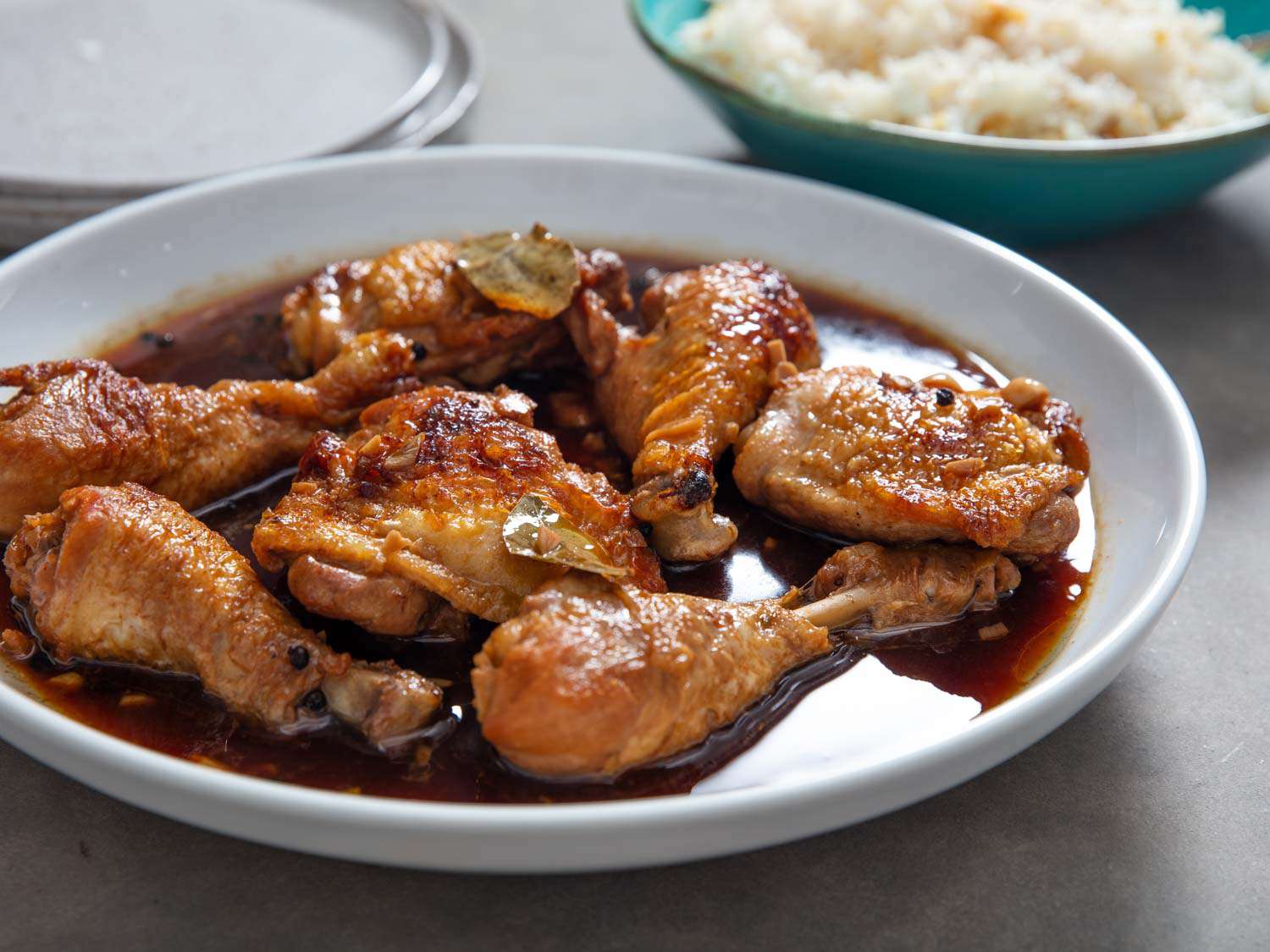
1. Chicken adobo — the entry point. Start with slow-simmered Filipino chicken adobo with vinegar and soy. Combine soy sauce, cane vinegar, whole garlic cloves, bay, and peppercorns in a pot; add bone-in chicken thighs skin-side down; simmer covered for 25 minutes, uncover and reduce for 10 more until the sauce turns glossy. That's the recipe. It gets better on day two, freezes for a month, and reheats better than any other cuisine's braise. Serve over rice with a fried egg on top.
2. Sinigang — the sour soup. Move to sinigang pork soup with tamarind and vegetables. Sinigang is a brothy, bright, sour soup built on tamarind, and it's the cold-day answer to Italian minestrone or Mexican pozole. Pork belly or spare ribs simmer with tomato, onion, and daikon; tamarind paste (or a Knorr packet) tunes the sourness; leafy greens (spinach, water spinach, mustard greens) go in at the end. Ready in 45 minutes, serves four with rice.
3. Pancit canton — the stir-fry. Stir-fried pancit canton with cabbage and pork is the fastest Filipino weeknight dinner: 20 minutes, one wok. Wheat egg noodles hydrated in warm water, then stir-fried with garlic, pork or chicken, cabbage, carrot, and a soy-oyster-fish-sauce trio. A squeeze of calamansi (or lime) at the end lifts everything.
4. Sisig — the party dinner. Sautéed pork sisig with onion and chili is the Filipino answer to Korean bulgogi or Chinese salt-and-pepper pork — crispy chopped pork with lime, chili, and onion, served sizzling. Serve with rice and a fried egg. It's the recipe that turns anyone into a Filipino food believer.
5. Tinola — the ginger chicken soup. Tinola chicken soup with ginger and green papaya is the gentler alternative to sinigang — clear ginger-forward broth, bone-in chicken thigh, green papaya (or chayote), and moringa leaves at the end. Twenty-five minutes on the stovetop, thirty in a rice cooker with a sauté function.
Common mistake on every one of these: under-caramelizing the aromatics. Filipino braises need the garlic and onion to hit real color before liquid goes in, because the sauce reduces around those flavors. Don't rush the first five minutes.
Rice Cooker Dinners: 6 One-Pot Filipino Recipes
The rice cooker is a Filipino kitchen's second burner, and six of the recipes here are designed to finish in it (Instant Pot works too — pressure-cook 35 minutes plus natural release). The trick is layering: aromatics at the bottom, protein next, liquid last, rice on top in a steamer basket or fully absorbed at the end.
Anchor the rice-cooker rotation with the chicken adobo recipe above — dump all seven ingredients into a 6-quart rice cooker on the "brown rice" cycle, walk away for 35 minutes. Sinigang works the same way: aromatics first, pork, water, Knorr packet, run the "porridge" or "soup" cycle.
Add kare-kare style Filipino peanut beef curry for a Sunday-project rice-cooker dinner: beef shank, peanut butter, achuete oil, and vegetables (eggplant, long beans, bok choy) reduce into a nutty, savory stew served with bagoong on the side. Traditionally a weekend recipe, but the rice cooker collapses it into 45 minutes.
For a stir-fry-adjacent one-pot: longganisa fried rice with garlic and scallions turns Sunday's leftover rice and one link of Filipino sausage into Monday's dinner. Fry the longganisa first, render the fat, then hit day-old rice with garlic, scallions, and a soft egg on top.
Two more rice-cooker-friendly options: the tinola already recommended above finishes in 25 minutes on a rice cooker's soup mode, and pancit bihon stir-fried rice noodles with vegetables and pork works if your rice cooker has a sauté function — but honestly, pancit is better in a wok.
Rice-cooker gotcha: don't overfill. Half-capacity is the rule for braises and soups — the boil-over on a full rice cooker is a mess. Filipino grandmothers keep a second smaller rice cooker just for adobo Sundays.
Filipino Noodles and Stir-Fries: 5 Pancit and Lumpia-Adjacent Recipes
Pancit ("noodles" in Tagalog) covers about a dozen distinct dishes in Filipino cooking — wheat egg noodles (canton), rice vermicelli (bihon), thick rice noodles (palabok), and a handful of regional variants. These are the five to know.
Return to stir-fried pancit canton with cabbage and pork — the definitive weeknight noodle. Twenty minutes, one wok, half a head of cabbage.
Move next to pancit bihon stir-fried rice noodles with vegetables and pork. Bihon (thin rice vermicelli) requires only a five-minute warm-water soak before it goes into the wok; it absorbs sauce more than canton and comes out lighter and slightly sweeter. Bihon is what shows up at every Filipino birthday party — the noodles symbolize long life, and a full sheet-tray-sized batch feeds twenty.
Add lumpia Shanghai pan-fried pork spring rolls for the party version: thin lumpia wrappers around a filling of ground pork, water chestnut, and scallion; pan-fried until golden and served with sweet chili sauce. Freeze uncooked; cook straight from frozen for weeknight dinners in 10 minutes.
Fourth, grilled longganisa skewers with garlic vinegar dipping sauce. Longganisa is a sweet-garlicky Filipino sausage; grilled or broiled on skewers with pickled papaya or garlic rice, it's the fastest way to get a Filipino weeknight dinner on the table. Fifteen minutes.
Fifth, pan-grilled chicken inasal with lemongrass marinade. Chicken thigh cubes marinated in calamansi (or lime-lemon), lemongrass, ginger, and annatto oil; grilled or broiled over high heat until charred. The rice traditionally served alongside is called "sinangag" — garlic fried rice — and the pairing is unbeatable.
Stir-fry gotcha: dry the noodles well before they hit the wok. Wet canton or bihon dumps water into hot oil and steams instead of frying; the noodles turn gummy and everything sticks. Blot with paper towels, or shake in a colander over the sink for a full minute.
Modern Filipino-American Weeknight Dinners: 4 Sheet-Pan and Skillet Adaptations
Filipino-American cooks (Marvin Gapultos, Nicole Ponseca, Angela Dimayuga) have been quietly building a modern weeknight canon that combines Filipino flavors with American convenience — sheet pans, skillets, and 30-minute timelines. These four are the ones I return to when the rice cooker isn't out.
1. Bicol Express with coconut milk. Bicol express-style spicy pork stew with coconut milk is a coconut-cream braise from the Bicol region — long green chilies, pork belly, shrimp paste, and one can of coconut milk simmer for 35 minutes. Spicy, rich, deeply savory. Serve over rice.
2. Sisig skillet dinner. Sautéed pork sisig with onion and chili works as a weeknight dinner if you use ground pork instead of the traditional (much longer) pork face and cheek prep. 20 minutes, one skillet, dinner on the table.
3. Longganisa fried rice. Already covered — longganisa fried rice with garlic and scallions is the Filipino answer to Chinese fried rice. If you've never had it, buy one link of frozen longganisa and change your weeknight rotation forever.
4. Lumpia party dinner. Same lumpia Shanghai pan-fried pork spring rolls work as a dinner if you serve them over cabbage-slaw with sweet chili and a fried egg — deep-fried protein-and-veg all-in-one plate.
Modern Filipino-American cooking anchors the tradition to weeknight reality. The pantry stays the same; the technique gets faster. And the results still taste unmistakably Filipino — soy-vinegar-garlic-lime, in every direction.
Common Mistakes: Under-Caramelizing Adobo, Over-Souring Sinigang
Three failure modes account for 80% of disappointing Filipino weeknight dinners. Fix these and you're already cooking better adobo than most American restaurants serve.
Under-caramelizing adobo. The mistake is dumping vinegar in before the aromatics have colored. Sear the chicken skin-side down for six minutes, brown the garlic and onion for another three, THEN add the vinegar and soy. If you skip the sear, the sauce tastes flat — vinegar-forward and one-note — and no amount of reduction fixes it. The Bon Appétit primer on chicken adobo technique walks through the sear-first move in detail, and it's the single highest-leverage tip for a home cook new to Filipino food.
Over-souring sinigang. The mistake is dumping the whole tamarind or Knorr packet in at the start. Taste as you go: half the packet plus a squeeze of lime is often plenty for four servings. Sinigang should be bright and puckery but still drinkable by the spoonful — over-souring turns it into a face-scrunching mistake that even a splash of coconut milk can't quite rescue. The rule Filipino grandmothers use: sour to just past what tastes right, because rice cuts the sour when you eat.
Wet noodles in pancit. Already covered above — dry the noodles before they hit the wok. This is the most common home-cook mistake with pancit canton and pancit bihon, and it's the difference between glossy, chewy noodles and gummy, sticky ones.
A fourth quiet mistake: buying pre-ground pork for sisig. Grind your own from pork shoulder in the food processor for 20 seconds (pulse, not run) — the texture is night-and-day better than the mush-fine pre-ground stuff from the meat counter.
FAQ
What is the difference between adobo and sinigang?
Adobo is a braise — protein simmered slowly in soy sauce, vinegar, garlic, bay, and peppercorns until the sauce reduces to a glossy glaze; the flavor is savory, tangy, and slightly sweet. Sinigang is a sour soup, brothy and bright, built on tamarind (or calamansi, guava, or green mango) with vegetables and pork or shrimp. Different techniques, different meals — most Filipino homes cook both in the same week.
Where do I buy calamansi and tamarind in the US?
Filipino and pan-Asian grocery stores carry fresh calamansi and frozen tamarind pulp; Amazon and H Mart stock bottled calamansi concentrate and Knorr sinigang mix that work fine for weeknight cooking. If none are available, substitute a 50/50 mix of lime and lemon juice for calamansi, or lemon plus a spoon of tomato paste for tamarind — both are close enough that no one will complain.
Can these Filipino recipes be made with a rice cooker?
Yes — six of the 20 recipes in this roundup are designed for a rice cooker or Instant Pot, and Filipino home cooking leans heavily on the rice cooker as a second burner. Chicken adobo, pork sinigang, and tinola all finish in a 6-quart pressure cooker in under 35 minutes including pressurize and release, and free the stovetop for a stir-fried vegetable side.
Is Filipino food spicy?
Most classic Filipino dishes are savory-sour-sweet rather than spicy — adobo, tinola, and pancit have little to no chili. Bicol Express and Bicolano dishes are the exception and lean heavily on coconut milk plus long green chilies. If you're cooking for kids or heat-averse eaters, 17 of the 20 recipes here are naturally mild, and the three spicy ones scale down cleanly.
How do I plan a Filipino week with AislePrompt?
Pick two braises (adobo, caldereta-style), one soup (sinigang or tinola), and one noodle stir-fry (pancit). Add them all to the meal planner at /meal-plan, and AislePrompt consolidates the pantry list — one bottle of soy, one of vinegar, one bag of rice — so a full Filipino week shops in about 20 minutes at any Asian grocery or well-stocked supermarket.
Sources and Related Guides
For deeper reading, Serious Eats' Filipino recipe collection is the best English-language technique library online — Marvin Gapultos and Angela Dimayuga wrote most of the modern canon there, and every recipe includes the "why this step matters" writing that turns a recipe into a lesson. Pair it with Bon Appétit's chicken adobo primer for the archetypal weeknight braise, and with the USDA's food and nutrition guidance for a cross-check on the protein-and-vegetable balance that makes Filipino weeknight cooking so sustainable.
On AislePrompt, every recipe surfaces related Filipino recipes below the ingredient list, so the rotation builds itself as you cook. The chat at /chat can rebuild any of these dinners around a dietary restriction, a smaller family, or leftover ingredients from Sunday's braise. And the AI meal planner at /meal-plan can pull five Filipino recipes into a full week, size the servings, and turn the whole thing into a single Instacart cart in one tap.
Frequently asked questions
What is the difference between adobo and sinigang?
Where do I buy calamansi and tamarind in the US?
Can these Filipino recipes be made with a rice cooker?
Is Filipino food spicy?
How do I plan a Filipino week with AislePrompt?
Sources
Recipes to start your week with
Save any of these to My Recipes — no account needed — and send the ingredients to Instacart in one tap.


Cook Filipino at home this week.
Ask our AI for a week of Filipino dinners — it writes the recipes, builds the shopping list, and sends the cart to Instacart. No account needed.
Plan my Filipino week →