20 Fresh Sage Recipes: Brown Butter, Pork & Autumn Sides
The bunch you buy for stuffing has 40 leaves in it — here's how to burn through every one before it turns black.
Fresh sage is the herb most home cooks buy for one recipe — usually Thanksgiving stuffing — and then watch turn black in the crisper drawer. That's a waste, because a $2.99 clamshell holds enough leaves for six or seven dinners, and sage is one of the few herbs that gets better when you cook it hard in fat. Below are 20 recipes that use a whole bunch, organized by how you'll actually cook through it: brown-butter pastas first (they burn through the most leaves), then pork, poultry, autumn sides, and crispy-leaf finishers.
Get a free week of easy dinners
Seven weeknight dinners with the shopping list already totalled, sent Sunday. No account needed, unsubscribe in one click.
No spam, unsubscribe in one click. Recipes, shopping lists and Instacart carts all work without an account either way.
How to buy, store, and prep fresh sage
Buy sage by the leaf, not the package. You want firm, dry, gray-green leaves with that distinctive pebbled surface — the same texture the University of Illinois Extension describes on the garden plant. Skip any bunch with black-edged or slimy leaves; sage bruises from the cut end inward, so a single dark stem usually means the whole clamshell is a few days past.
Sage is a woody-stemmed evergreen subshrub in the mint family (Lamiaceae), native to the Mediterranean — botanically it's Salvia officinalis, and that Mediterranean parentage is why it shrugs off high heat where basil and cilantro collapse.
Storage. Don't wash it. Wrap the bunch loosely in a barely damp paper towel, seal it in a zip-top bag, and put it in the crisper. Illinois Extension puts the realistic ceiling at about two weeks for leaves stored loosely packed and refrigerated, and that matches what we see: 10–14 days before the leaves go limp. Washing first cuts that in half — surface moisture on the pebbled leaf surface is what starts the rot.
Freezing. Sage comes out of the freezer more useful than almost any other herb, and freezing is the single highest-value thing to do with the back half of a bunch. The three methods worth using (whole leaves, oil or butter cubes, and a compound-butter log) are laid out in the freezing section further down.
Three prep cuts, three different results:
| Prep | How | Best for | Cook time in fat |
|---|---|---|---|
| Whole leaves | Pull from stem, leave intact | Crispy garnish, brown butter | 30–45 sec |
| Chiffonade | Stack 6–8 leaves, roll, slice thin | Pasta sauce, risotto, dressing | 1–2 min |
| Fine chop | Chiffonade, then rock-chop | Rubs, sausage, stuffing, compound butter | Blooms over 5+ min |
| Bruised sprig | Whole stem, smacked once | Braises, brines, stocks (pull before serving) | 30+ min |
A note on quantity: sage is assertive. About 1 tablespoon of chopped leaves per four servings is the ceiling for raw or lightly-cooked applications. Frying takes that ceiling away — crisped leaves lose most of their bitterness and read as nutty rather than medicinal.
Brown butter and sage pastas (5 recipes)
This is the pairing sage exists for. When butter's milk solids toast, they throw off nutty, almost hazelnut aromatics — the French call the result beurre noisette, a deep-yellow-to-brown sauce whose flavor comes entirely from the heating process. Sage leaves dropped into that fat at 350°F crisp in under a minute and perfume the whole pan.
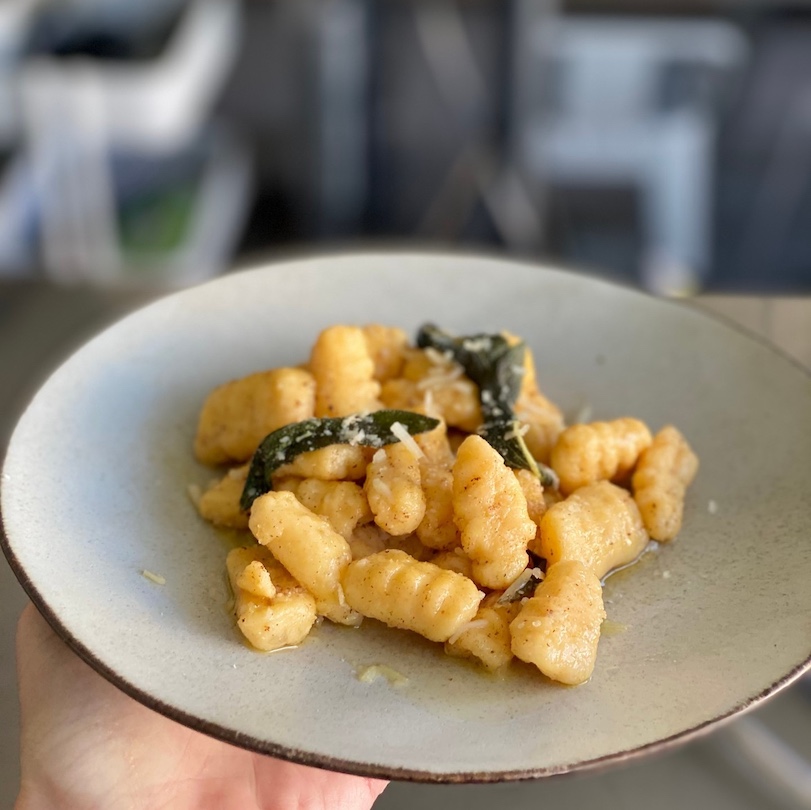
1. Herb-Infused Gnocchi with Sage Brown Butter and Roasted Asparagus — The reference version of the dish. Gnocchi get pan-crisped rather than just boiled, so they hold up under the sauce instead of going gummy.
2. Pan-Fried Gnocchi with Sage Brown Butter and Aged Parmesan — Shelf-stable gnocchi straight into a dry skillet, no boiling step. About 12 minutes start to finish, which makes it the weeknight version.
3. Authentic Hand-Rolled Tagliatelle with Brown Butter Sage — The long-pasta version. Reserve a half cup of pasta water; the starch is what turns brown butter into a sauce that clings instead of pooling.
4. Crispy Sage Butter Pasta with Parmesan Crisps — Uses the leaves twice: fried whole as a topper, chopped into the butter as a base. Good template for using up a bunch that's on day 10.
5. Maple-Glazed Butternut Squash & Sage Risotto — Not brown butter, but the same flavor axis. Sweet squash needs sage's bitterness as a counterweight or the whole bowl reads like dessert.
Brown butter timing, by pan:
| Pan | Butter to foam | Foam to nut-brown | Sage window |
|---|---|---|---|
| Stainless, 10" | 90 sec | 60–90 sec | Add at first brown fleck |
| Cast iron, 10" | 2 min | 45 sec (retains heat) | Add 15 sec early |
| Nonstick, 10" | 2 min | 2+ min (hard to read color) | Watch smell, not color |
Cast iron is the trap here: it holds so much heat that butter keeps browning after you pull it off the burner. If you're working in cast iron, get the leaves in slightly early and have your pasta ready to go in. Our cast iron skillet buying guide covers which pans hold heat evenly enough to make this predictable.
Sage with pork (4 recipes)
Pork and sage is the oldest pairing in the herb's culinary record — sage is the dominant herb in almost every traditional breakfast-sausage formula for a reason. It cuts through fat better than any other soft herb, which is why it works on shoulder and chops equally.
6. Pan-Seared Sage Pork Chops with Roasted Garlic — Bone-in chops, sage in the basting butter. Pull at 140°F internal and rest 5 minutes; carryover brings you to the 145°F the USDA calls for on whole cuts.
7. Pan-Fried Pork Chops with Sage and Apple Cider Reduction — Cider reduction is where the sage goes in, off-heat, so the acid keeps the herb bright instead of muddy.
8. Maple-Glazed Pork Tenderloin with Apple and Sage — Tenderloin is lean enough that it needs the maple; sage keeps the glaze from reading candied.
9. Herb-Roasted Pork Shoulder with Apple and Sage — The long-cook option. Sage in a rub behaves completely differently than sage in butter: over three hours it mellows into a savory background note rather than a top note.
Sage with chicken and turkey (4 recipes)
10. Sage and Garlic Roasted Chicken with Root Vegetables — Slide whole leaves under the breast skin before roasting. They fry in the rendering fat and flavor the meat from the inside.
11. Pan-Seared Chicken with Garlic-Sage Brown Butter — Weeknight-scale, 20 minutes, one skillet.
12. Maple-Glazed Roasted Turkey Breast with Sage Butter — A turkey-breast-only roast is the right way to practice your Thanksgiving sage butter in September without committing to a 16-pound bird.
13. Pan-Roasted Midwest Turkey Breast with Sage and Apple — Sage, apple, and turkey is a three-ingredient chord that carries an entire autumn menu.
If you've seen sage-and-prosciutto-wrapped cutlets called saltimbocca, note that the traditional dish is made with veal, wrapped in prosciutto with sage and marinated in wine, oil, or brine. Chicken and turkey versions are common adaptations, not the original — worth knowing if you're following an Italian recipe and wondering why the cook time seems short.
Autumn sides and stuffing (4 recipes)
14. Virginia-Style Chicken and Cornbread Casserole with Sage — The cornbread-and-sage axis, in a form you can eat in September without it feeling like a holiday.
15. Caramelized Onion & Sage Stuffed Acorn Squash — A vegetarian main that eats like a side. The onions take 35 minutes; don't rush them, because their sweetness is what sage is playing against.
16. Maple-Glazed Roasted Sweet Potatoes with Crispy Sage — Crisp the leaves separately and scatter them at the table. Roasting them on the sheet pan for 30 minutes turns them to ash.
17. Roasted Colorado Root Vegetable Salad with Sage Vinaigrette — Raw sage in a vinaigrette needs 20 minutes of sitting time to soften; whisk it in early, not at the last second.
For the Thanksgiving table: Cornbread and Sausage Stuffing with Apples and Sage is the sage-and-sausage stuffing most people are searching for in November. You sauté 1 lb Italian sausage with onion, celery, a Granny Smith apple and 2 tablespoons of chopped sage, fold it into toasted cornbread cubes with broth and two eggs, and bake it uncovered in a 9×13 for 40 minutes. It serves 8 at about 350 calories and 15 g protein per serving. Bake it in the dish rather than inside the bird, and make sure the center reaches 165°F.
Crispy sage finishers (3 recipes)
18. Crispy Sage & Balsamic Brussels Sprouts with Toasted Walnuts — Sprouts, sage, and walnuts all want the same amount of browning, so they cook together cleanly.
19. Authentic Comfort Potato Soup with Crispy Sage — Fried leaves floated on a purée are the highest-return use of five minutes in this entire list.
20. Pan-Seared Trout with Idaho Potato and Sage Butter — Sage works with firm, fatty fish; it flattens scallops and shrimp. Trout is the safe end of that spectrum.
How to fry sage leaves without burning them: heat ¼ inch of neutral oil or butter to 350°F in an 8-inch skillet. Drop leaves in a single layer — crowding drops the oil temperature and you get soggy leaves. They're done 5–10 seconds after they stop sizzling audibly, usually 30–45 seconds total. Lift to paper towels and salt immediately, while the surface oil is still hot enough to dissolve the salt. They stay crisp about two hours at room temperature; refrigeration ruins them.
Don't throw out the frying fat. If you fried in butter, you now have sage brown butter — dress pasta, spoon over roasted squash, or fold it into mashed potatoes.
Sage-forward drinks: 4 gin, whiskey and apple builds
Sage behaves in a glass the way it behaves in a pan: a little goes a long way, and it needs something to push against. In a drink that's citrus and sugar instead of butter. Every build below uses two or three leaves per drink. Past about four, the menthol note that reads as "herbal" starts reading as "cough drop." Muddle gently (press and twist two or three times; shredding the leaf releases the bitter, grassy compounds), then double-strain so no green flecks land in the glass.
Grapefruit Sage Gin Martini — 2 oz gin, ½ oz dry vermouth, ½ oz fresh grapefruit juice, 2 lightly muddled sage leaves. Stirred rather than shaken, so it stays clear. Gin's juniper is already piney, so the sage reads as part of the spirit rather than a garnish floating on top.
Blackberry Sage Gin Sour — 2 oz gin, 1 oz lemon, ¾ oz blackberry syrup, 1 egg white, 2 sage leaves. The leaves go into the 20-second dry shake (no ice) with the egg white, and that step is what infuses them; the second shake over ice only chills and dilutes.
Lemon-Sage Whiskey Sour — 2 oz bourbon, ¾ oz lemon, ¾ oz rich (2:1) simple syrup, 3 muddled sage leaves, optional egg white. This is the classic whiskey sour (bourbon, fresh lemon juice and simple syrup) with sage muddled in first. Add the egg white and you have what bartenders call a Boston sour. Bourbon's caramel sweetness is the best foil sage has behind the bar.
Honeyed Apple Fizz with Sage and Lemon — 1½ oz apple brandy, ¾ oz lemon, ¾ oz honey syrup with 3 sage leaves muddled into it, topped with 2 oz sparkling water. This is the apple build: apple brandy carries the orchard flavor with more backbone than cider, and honey rounds off sage's bitter edge. For a lower-proof version, top it with dry hard cider instead of sparkling water.
| Drink | Base spirit | Sage leaves | Method | Calories | Time |
|---|---|---|---|---|---|
| Grapefruit Sage Gin Martini | Gin + dry vermouth | 2 | Muddle, stir | 140 | 7 min |
| Blackberry Sage Gin Sour | Gin | 2 | Dry shake, then shake on ice | 180 | 8 min |
| Lemon-Sage Whiskey Sour | Bourbon | 3 | Muddle, dry shake, shake on ice | 210 | 7 min |
| Honeyed Apple Fizz | Apple brandy | 3 | Muddle into honey, shake, top | 170 | 6 min |
Sage simple syrup is the batch shortcut, and several catalog drinks, including the Mountain Sage Whiskey Sour, call for exactly this. Simmer 1 cup sugar with 1 cup water until the sugar dissolves, take it off the heat, drop in 10–12 sage leaves, steep 15 minutes, then strain. It also makes the only nonalcoholic build worth making: ¾ oz stirred into lemonade or sparkling water over ice. Keep it in a clean jar in the fridge and use it within two weeks.
About the egg whites. Both sours use raw egg white. The FDA's egg-safety guidance for any dish where the egg stays raw is to use shell eggs treated to destroy Salmonella (pasteurized in the shell) or pasteurized egg products. A carton of pasteurized egg whites covers both sours.
Gear. You need a shaker, a strainer, a muddler and a jigger. The Mixology & Craft 10-piece bar set has all four in one box. If you already own a shaker, an OXO double jigger is the one piece worth adding, because the ¾ oz pours are where eyeballing goes wrong. For more apple-and-bourbon builds, the fall cocktails roundup covers the rest of the season.
Real-world numbers: how far one bunch goes
A standard supermarket clamshell holds roughly 0.75 oz of sage — about 30–40 usable leaves depending on size. Here's the actual math on burning through one before it turns:
| Application | Leaves used | Servings |
|---|---|---|
| Brown butter pasta sauce | 8–12 whole | 4 |
| Crispy garnish for soup | 6–8 whole | 4 |
| Compound butter (½ cup) | 10–12 chopped | 8–10 uses |
| Pork chop basting butter | 4–6 whole | 2–4 |
| Stuffing (9×13 pan) | 12–15 chopped | 8–10 |
| Vinaigrette (½ cup) | 4–5 chopped | 6 |
Two dinners and a compound butter clears a bunch with room to spare. If you're only making one sage dish this week, buy the smaller package or plan to freeze the remainder in oil on day three — not day ten, when it's already soft.
How to freeze sage for winter
Sage survives the freezer better than most herbs because you were going to cook it in fat anyway. The one rule, from the National Center for Home Food Preservation, is that frozen herbs turn limp when they thaw. Use them in cooked dishes (brown butter, stuffing, braises, pan sauces), not as a garnish. Anything that has to crisp needs a fresh bunch.
| Method | How | Best for | How to use it |
|---|---|---|---|
| Whole leaves | Pat dry, wrap a few sprigs in freezer wrap, seal in a freezer bag | Stuffing, braises, brines, soup | Chop or crumble while still frozen |
| Oil or butter cubes | Chopped leaves in ice-cube wells, topped with olive oil or melted butter | Brown butter, pan sauces, roasted vegetables | Straight from frozen into a hot pan |
| Compound-butter log | ½ cup softened butter + 10–12 chopped leaves, rolled in parchment | Pork chops, turkey breast, gnocchi | Slice coins off the frozen log |
Whole leaves. This is the NCHFP method: wash, drain, and pat the leaves completely dry, wrap a few sprigs in freezer wrap, and seal them in a quart freezer bag with the air pressed out. Surface water turns into ice crystals and freezer burn, so don't skip the drying. Write the date on the bag.
Oil or butter cubes. Pack chopped leaves into an ice cube tray, cover them with olive oil or melted butter, freeze until solid, then pop the cubes into a bag so the tray is free again. Keep them frozen and cook them straight from the freezer. Herbs sitting in oil should never be thawed and left out at room temperature.
Compound-butter log. Mash the chopped leaves into softened butter with a pinch of salt (lemon zest is a good addition), roll it into a log in parchment, twist the ends, and freeze. It's the fastest route from freezer to plate: slice a coin onto a resting pork chop or tuck it under turkey skin before roasting.
How long it keeps. For the best aroma, use frozen sage within about three months. It stays safe longer at 0°F, but the flavor fades.
Don't fry frozen leaves. Ice on the leaf spatters violently in 350°F oil, and a thawed leaf is too limp to crisp anyway. Crispy-sage garnishes need fresh sage.
Or dry it. Sage is sturdy enough to air-dry. Illinois Extension suggests cutting 6–8 inch stems for drying, then stripping the leaves into a sealed container. Dried sage belongs in stuffing, rubs and sausage, not in a 45-second brown-butter fry (see Common pitfalls below).
Common pitfalls
Adding sage to a cold pan. Sage's aromatics are fat-soluble and volatile. Dropped into cold butter that then heats slowly, the good compounds evaporate before the leaf crisps. Get the fat hot first.
Using it raw in quantity. Raw sage over about a tablespoon per four servings tastes medicinal — that light menthol note that reads as pleasant at low doses becomes soapy at high ones. Fry, bloom, or braise it.
Swapping dried into a brown-butter recipe. Dried sage has no leaf structure to crisp and no fresh oils to release; it just scorches into black flecks. Dried sage is fine in stuffings, brines, and braises where it has liquid and time — use 1 teaspoon dried per 1 tablespoon fresh, since drying concentrates the flavor. It is not fine in a 45-second fry.
Confusing rubbed and ground sage. Rubbed sage is dried leaf crumbled to a fluffy texture and is noticeably milder by volume; ground sage is a fine powder and much more concentrated. A recipe calling for 1 teaspoon rubbed will be aggressive if you use 1 teaspoon ground.
Pairing it with delicate seafood. Sage overwhelms scallops, shrimp, and lean white fish like sole. Stick to trout, halibut, and cod, or skip it.
Chopping it hours ahead. Cut surfaces oxidize and go bitter. Chiffonade sage within about 15 minutes of when it hits the pan.
When not to reach for sage
If the dish is built on bright acid and fresh green flavor — a summer tomato salad, a cilantro-lime slaw, a basil pesto — sage will fight it and win, badly. Sage belongs to the same family as those herbs but behaves like a spice: it wants fat, heat, and time. When you want an herb that stays fresh and raw, use parsley, basil, or cilantro instead. When you want a woody herb for roasting and braising but sage feels too assertive, rosemary is the more forgiving substitute.
What you'll need
You don't need much, but two things matter:
- A heavy skillet. Brown butter is a color-and-smell judgment call, and thin pans develop hot spots that scorch the milk solids in one place while the rest is still pale. Cast iron or heavy stainless — see cookware for pans that hold heat evenly, and bakeware for the sheet pans the roasted-squash recipes want.
- A genuinely sharp knife. Sage bruises. A dull blade crushes the leaf and releases bitter compounds before it ever reaches the pan. Chiffonade in one clean pass — knives has the 8-inch chef's knives that make that possible.
A slotted spoon or small spider (utensils) makes pulling crisp leaves out of 350°F butter much less nerve-wracking than tongs, and a small airtight container (storage) keeps a batch of fried leaves usable through dinner.
Related reading
- 20 Fresh Herb Recipes: Basil, Cilantro & Parsley
- 20 Rosemary Recipes: Roasts, Breads & Braises
- 20 Fresh Dill Recipes: Salmon, Cucumber Salad & Scandinavian Classics
- 20 Pumpkin & Butternut Squash Dinners for Fall
Frequently asked questions
How long does fresh sage last in the fridge and what's the best way to store it?
Can I substitute dried sage for fresh in any of these recipes?
What does sage actually taste like and when is it overwhelming?
What proteins pair best with fresh sage?
How do I make crispy sage leaves without burning them?
Can you freeze fresh sage, and how do you use it once it's frozen?
How much sage should I put in a cocktail?
Sources
- extension.illinois.edu
- en.wikipedia.org
- en.wikipedia.org
- en.wikipedia.org
- nchfp.uga.edu
- en.wikipedia.org
- fda.gov
Plan a week of meals in two minutes.
Tell our AI what you have and what you like — it builds your plan, shopping list, and Instacart cart. No account needed.
Plan my week →