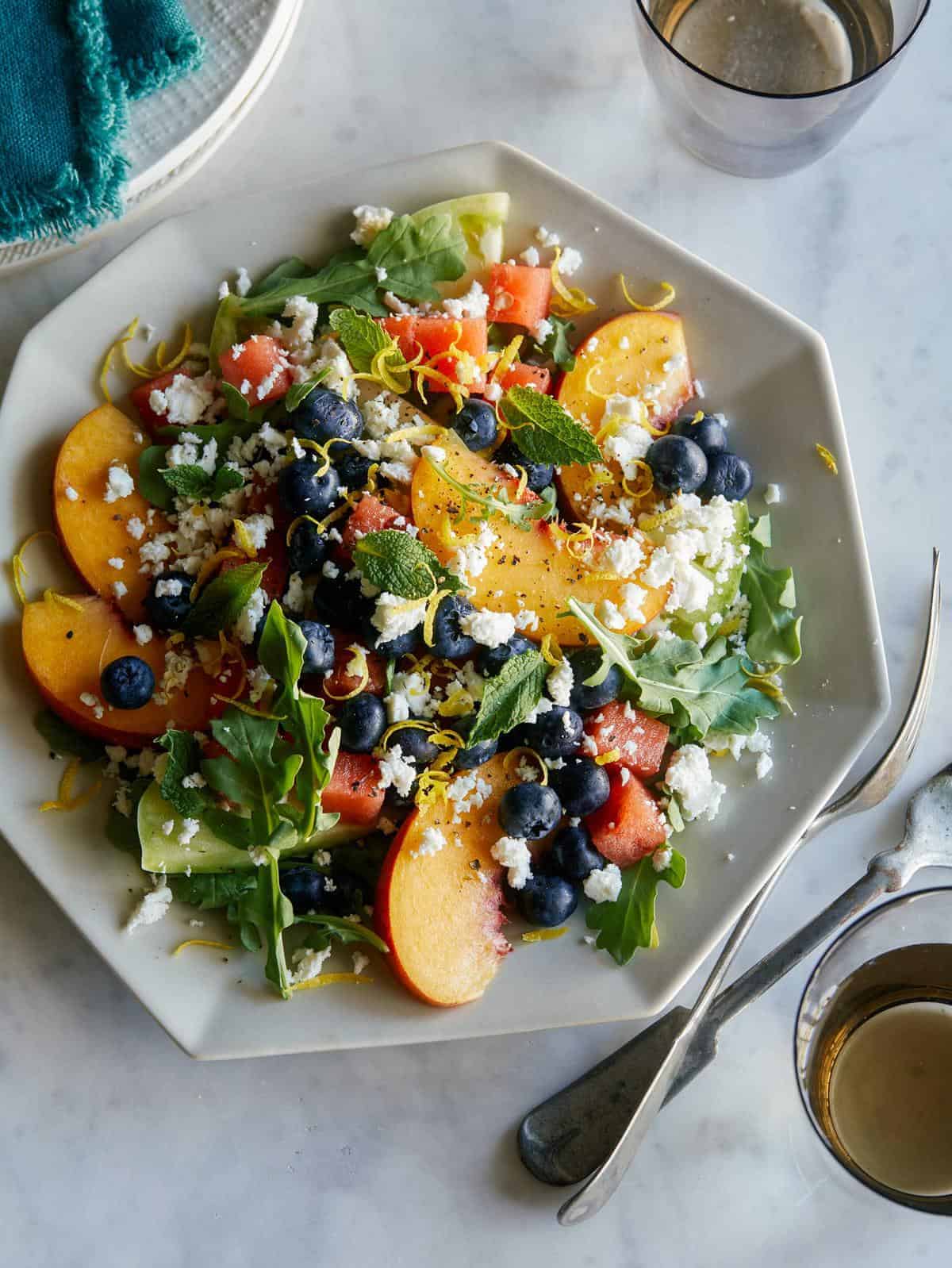
20 Refreshing End-of-Summer Salads: Corn, Tomato & Peach Combos for Labor Day Weekend
Corn is still milky, tomatoes still smell like the vine, and freestone peaches have about a week left — 20 salads for the last honest weekend of summer produce.
End-of-summer salads are the corn, tomato, and stone-fruit dishes that need almost no cooking and land at their absolute peak the first week of September. The 20 below are built for Labor Day weekend: five corn salads off the grill, five raw tomato plates, five peach-and-cheese combinations, and five grain or pasta bowls that scale to feed twelve.
Get a free week of easy dinners
Seven weeknight dinners with the shopping list already totalled, sent Sunday. No account needed, unsubscribe in one click.
No spam, unsubscribe in one click. Recipes, shopping lists and Instacart carts all work without an account either way.
Introduction — the last weekend of peak produce
Labor Day weekend 2026 falls on September 5–7, and it is the last honest week of the summer produce calendar. Sweet corn sugars start converting to starch within hours of picking and the field harvest in most of the northern half of the country winds down by mid-September. Field tomatoes stop ripening on the vine once night temperatures drop below about 55°F. Freestone peaches — the ones whose pits pull cleanly away — finish their season in most growing regions between the first and third week of September, after which you are buying clingstone or cold-storage fruit.
That timing is the entire argument for a salad-forward cookout menu. In late June a tomato salad is a compromise; in the first week of September it is the best thing on the table, and it costs you fifteen minutes and no oven time on a day when the grill is already occupied by ribs and burgers. Every recipe here leans on produce that is currently at its cheapest and sweetest, and every one of them can be staged partially ahead so you are not standing at the cutting board while guests arrive.
If you want the rest of the menu, we already covered the Labor Day BBQ mains and the full side-dish spread. This piece is the salad chapter — the part of the table that does the most work for the least effort.
How to pick corn, tomatoes, and peaches at the market this week
Three shopping rules, one per ingredient, and each one takes about four seconds at the bin.
Corn. Pull back a two-inch strip of husk at the top. You want tight, damp, bright-green husks, silk that is pale gold and slightly sticky at the base with browning only at the very tip, and kernels that are plump and fill the cob all the way to the point. A dry, papery husk or a rounded-off tip means the ear has been sitting. Press a kernel with your thumbnail: it should squirt milky liquid, not clear water and not nothing at all. The University of Minnesota Extension's sweet corn guide puts peak eating quality at 18–24 days after silking, which is a very short window — buy the same day you cook when you can.
Tomatoes. Buy by smell and weight, never by color alone. A ripe tomato smells green and grassy at the stem scar and feels heavier than it looks. It should yield to gentle palm pressure without denting. Never refrigerate a tomato you plan to eat raw — below about 55°F the flavor volatiles shut down permanently and the texture goes mealy. Store them stem-side down on the counter and use within three days.
Peaches. Press near the stem, not on the shoulder. A peach ready for salad tonight gives slightly at the stem end and smells sweet from a foot away. If it is rock hard, it will ripen on the counter in a paper bag in 24–48 hours but will never develop full sugar — cold-stored fruit shipped hard stays flat-tasting. For salads you want freestone, which you can confirm by asking, or by the fact that a halved fruit twists cleanly apart.
| Ingredient | What to look for | What to avoid | Counter life |
|---|---|---|---|
| Sweet corn | Tight damp husk, sticky pale silk, kernels to the tip | Dry papery husk, rounded tip, clear kernel liquid | 2 days in husk, refrigerated |
| Heirloom tomato | Heavy for size, grassy stem smell, slight give | Uniform hard flesh, no aroma, refrigerated bin | 3 days at room temp |
| Freestone peach | Gives at the stem, fragrant at arm's length | Green ground color, hard shoulders, bruised tips | 2 days ripe, 4 days firm |
| Watermelon | Yellow field spot, hollow thump, heavy | White field spot, dull hollow sound | 1 week whole |
| Basil | Firm dark leaves, no black edges | Wilted or blackened tips | 4 days, stems in water |
Wash everything under running water right before you cut it — the FDA's produce handling guidance is explicit that you should not use soap or produce washes, and that you should wash even items you plan to peel, because the knife drags surface bacteria into the flesh.
5 corn salads for the grill spread
Corn is the one salad ingredient here that genuinely improves with fire. Char four to six ears while the grill is already hot for the mains, let them cool ten minutes, then stand each ear in a wide bowl and run a knife down the cob. One large ear yields roughly ¾ cup of kernels.
1. Tex-Mex Grilled Corn Salad with Cotija and Cilantro-Lime Dressing — the elote-in-a-bowl version. Char the corn hard until roughly a third of the kernels are blackened, then dress warm so the cotija clings. This is the salad that disappears first at every cookout I have run it at, and it holds at room temperature for two hours without weeping.
2. Grilled Corn and Peach Salad with Honey Thyme Dressing — the bridge dish between the corn and peach sections. Grill the peach halves cut-side down for 3 minutes at the same time as the corn; the sugars caramelize and the fruit firms up enough to hold its shape when tossed.
3. Cilantro-Lime Black Bean and Corn Salad — the make-ahead workhorse. Because the beans and dressing are shelf-stable, this one can be built 24 hours in advance and finished with fresh cilantro at service. It also happens to be the only vegan option in the corn group.
4. Riverfront Herb and Corn Salad — raw corn, cut straight off the cob, no cooking at all. This only works with genuinely fresh corn, which is exactly what you have this weekend. Big handfuls of parsley, dill, and chive; a lemon vinaigrette; done in eight minutes.
5. Native American-Inspired Corn & Wild Rice Salad — the heartiest of the five and the one that doubles as a vegetarian main. Wild rice takes 45 minutes, so cook it the day before; the salad is actually better on day two once the grains absorb the dressing.
5 heirloom tomato salads that need almost no cooking
The rule for every tomato salad on this list: salt the tomatoes 15–20 minutes before serving, not earlier. Salt pulls juice out through osmosis, and that juice plus a splash of olive oil is your vinaigrette. Salt an hour ahead and you get a soupy plate; salt at the table and you get an underseasoned one.
6. Summer's Best Heirloom Tomato & Burrata Salad — four ingredients and nothing to hide behind, which is why it only belongs on a September menu. Take the burrata out of the fridge 30 minutes ahead; cold burrata is rubbery and its cream will not run.
7. Rustic Italian Panzanella Bread Salad with Cherry Tomatoes — the best possible use of the day-old ciabatta from the burger buns. Panzanella was invented as a stale-bread dish in Tuscany, and it needs 20 minutes of rest after dressing so the bread softens without dissolving. That rest time makes it a perfect thing to assemble right before guests arrive.
8. Tomato, Cucumber, and Fresh Basil Salad — the no-cheese, no-bread, no-fuss plate. Salt the cucumbers separately for ten minutes and pour off the water before combining, or the whole bowl floods.
9. Classic Picnic Caprese Salad with Basil and Balsamic Glaze — the version that travels. Layer it on a rimmed platter rather than tossing it in a bowl so the mozzarella stays put in the car.
10. Cucumber-Avocado Tomato Salad with Lemon-Herb Dressing — add the avocado last and toss with lemon immediately. Cut avocado browns visibly in about 20 minutes uncoated; with acid you get closer to 90 minutes, which covers a normal serving window.
5 peach and stone fruit salads with cheese, greens, or grains
Peaches want three things in a salad: fat (goat cheese, burrata, pecans), acid (lemon, lime, balsamic), and something bitter (arugula, radicchio). Get all three and the fruit reads as a savory ingredient rather than dessert on a plate.
11. Loveland-Inspired Grilled Peach and Arugula Salad — grill the halves 3 minutes cut-side down over direct heat, no oil on the cut face or it will flare. Dress the arugula separately and lay the peaches on top so the greens do not wilt under warm fruit.
12. Outdoor Patio Grilled Peach and Burrata Salad with Balsamic Reduction — the showpiece. One large platter, torn burrata, warm peaches, a thick balsamic reduction, and cracked black pepper. It photographs well, which matters more at a party than anyone admits.
13. Savory Peach and Pecan Salad with Goat Cheese Vinaigrette — the goat cheese goes into the dressing rather than on top, which means every bite is seasoned instead of just the ones that catch a crumble. Toast the pecans in a dry skillet for 4 minutes; untoasted nuts in a wet salad go soft.
14. Honey-Lime Roasted Watermelon Salad with Feta and Mint — the most refreshing thing you can put on a hot table. Roasting concentrates the watermelon rather than diluting it, which solves the usual problem of a watermelon salad turning into pink water after 30 minutes.
15. Grilled Zucchini and Peach Salad with Whipped Goat Cheese — the late-summer glut solver. Zucchini is the other thing nobody knows what to do with in September, and grilled planks under sweet fruit is the most convincing answer.
5 grain and pasta salads that scale for a crowd
These are the volume dishes. A grain or pasta salad costs about $1.10 per serving against roughly $2.80 for a composed tomato-and-cheese plate, it survives four hours on a buffet table, and it does not require a knife at the point of service.
16. Lemon-Basil Orzo Salad with Cherry Tomatoes and Mozzarella — rinse the orzo under cold water the moment it drains or it welds into a block. Dress it while barely warm so it absorbs the lemon.
17. Outdoor Picnic Pasta Salad with Cherry Tomatoes and Basil Vinaigrette — cook the pasta 90 seconds past al dente. Cold pasta firms up considerably, and a salad made from perfectly al dente pasta eats like erasers straight from the cooler.
18. Heirloom Tomato and Heritage Wheat Salad with Lemon-Herb Vinaigrette — chewy wheat berries or farro against soft tomato is the best texture contrast in this entire roundup. Cook the grain a day ahead and refrigerate it undressed.
19. Best-Crafted Mediterranean Quinoa Salad — the gluten-free, high-protein option that covers most dietary requests at a mixed table without a separate dish. Roughly 8g of protein per cup of cooked quinoa.
20. Summer Picnic Caprese Pasta Salad — caprese in a form that feeds sixteen out of one bowl. Use pearl mozzarella rather than sliced; it distributes and it does not shed water the way torn fresh mozzarella does.
Building the Labor Day salad spread — timing and quantities
For a cookout with mains, plan on four to five ounces of salad per guest per dish, and choose three salads rather than six. Three well-executed bowls beat six half-finished ones, and the leftovers of three are actually eaten.
| Guests | Salads to make | Corn (ears) | Tomatoes (lb) | Peaches | Grain/pasta (dry lb) |
|---|---|---|---|---|---|
| 6 | 2 | 4 | 2 | 4 | 0.5 |
| 12 | 3 | 8 | 4 | 8 | 1.0 |
| 20 | 3–4 | 12 | 6 | 12 | 1.5 |
| 30 | 4 | 18 | 9 | 18 | 2.5 |
A working schedule for a 3:00 p.m. Labor Day cookout:
| When | Task |
|---|---|
| Day before, evening | Cook grains and pasta, make all dressings, wash and dry greens, toast nuts |
| Morning of | Shuck and grill corn, cut kernels, build the bean and grain salads undressed |
| 1:00 p.m. | Slice tomatoes onto platters, cover, leave at room temperature unsalted |
| 2:00 p.m. | Grill peaches, cool, refrigerate on a sheet pan in a single layer |
| 2:40 p.m. | Salt the tomatoes, dress the grain salads, pull cheese out of the fridge |
| 2:55 p.m. | Assemble the peach platters, tear the burrata, finish with herbs and oil |
Common pitfalls
- Dressing everything at once. Greens dressed more than ten minutes ahead collapse. Dress grain salads early, leafy salads at the table.
- Refrigerating the tomatoes. Below 55°F the aroma compounds are destroyed and do not come back on rewarming. This is the single most common way a good tomato salad is ruined before it is made.
- Cold cheese. Burrata, mozzarella, and goat cheese all need 30 minutes out of the fridge. Cold fat is flavorless and squeaky.
- Under-salting the grain salads. Cooked grains absorb salt and acid as they cool; a farro salad that tastes right at assembly tastes flat two hours later. Season it, chill it, then taste and re-season before serving.
- Leaving mayonnaise-based or dairy-heavy salads in the sun. Two hours is the outdoor limit above 90°F — one hour, per standard food-safety guidance. Nest the bowl in a larger bowl of ice on the buffet table.
When NOT to make these
If you are shopping at a supermarket in a cold-climate region after the third week of September, skip the raw tomato and peach salads entirely. Cold-storage fruit will not carry a four-ingredient dish, and you will spend $18 on ingredients to produce something worse than a $6 slaw. At that point switch to roasted vegetable salads, or move to the mason jar meal-prep format where the dressing does more of the work. The same applies to any raw-produce menu you are cooking more than 24 hours after shopping — these dishes are a freshness bet, and out of season the odds are against you.
The gear that actually matters
You need five things and no more: a sharp 8-inch chef's knife, a serrated tomato knife, a rimmed half-sheet pan, a 12-quart mixing bowl, and a citrus reamer. Our knives category covers the first two — the serrated tomato knife is the upgrade most home cooks feel immediately, because a dull straight edge crushes ripe tomatoes instead of cutting them. The utensils shop has the tongs and spiders you need for pulling corn off a hot grate, dining covers the wide, shallow platters that composed salads need in order to not turn into a pile, and storage has the lidded containers for staging everything the night before. If you are grilling corn and peaches for twenty, a second set of long tongs from gadgets saves you a genuine amount of running around.
For a broader technique reference on building summer salads, Serious Eats' summer salad collection is the best free resource, and the USDA's Seasonal Produce Guide is the authoritative answer for what is actually in season in your region on any given week.
Once you have picked your three, drop them into an AislePrompt shopping list and it will consolidate the corn, tomatoes, peaches, cheese, and pantry items into a single aisle-ordered order — which matters when four recipes each want "2 tablespoons olive oil" and you need to know whether you have a bottle.
Frequently asked questions
The five questions below cover what people actually ask before a late-summer cookout. If yours is not here, the corn and tomato guide and the peach recipe roundup go deeper on each ingredient individually.
Frequently asked questions
When is peak corn season and how do I pick the sweetest ears at the store?
Do I really need to peel my tomatoes for a summer salad?
How do I keep sliced peaches from browning before guests arrive?
Can I prep these salads for a Labor Day crowd the day before?
What kitchen tools do I actually need for these late summer salads?
Sources
Plan a week of meals in two minutes.
Tell our AI what you have and what you like — it builds your plan, shopping list, and Instacart cart. No account needed.
Plan my week →