22 Whole30 Breakfast Recipes That Beat Another Egg Scramble
Eggs are Whole30's easiest breakfast protein and the fastest road to burnout — 22 compliant recipes across frittatas, make-ahead hashes, chia bowls, and protein-forward plates that keep the 30 days feeling like new food, not a countdown.
The Whole30 breakfast trap is well-documented: by Day 8, you've eaten 24 eggs and never want to see another scramble. This article ships 22 compliant recipes across four categories — 6 egg-forward variations that don't feel like eggs, 6 grab-and-go make-ahead builds, 5 completely egg-free options, and 5 protein-forward plates — plus the Sunday prep session that makes weekday Whole30 breakfast a 5-minute reheat instead of a 25-minute cook.
Get a free 7-day Whole30 meal plan
Seven compliant dinners delivered Sunday — no sugar, grains, dairy or legumes, and one cart instead of thirty label checks.
No spam, unsubscribe in one click. Recipes, shopping lists and Instacart carts all work without an account either way.
Whole30 is one of the biggest structured-diet clusters in the catalog: 3,335 tagged recipes and 4 dedicated roundups. This roundup pairs with our shipped 4-week Whole30 meal plan as the cluster's authoritative breakfast entry — the piece the meal plan links out to when readers ask "OK, but what do I actually make on Day 9?"
The Whole30 breakfast trap: endless eggs
The Whole30 rulebook doesn't ban repetition, but human psychology does. Most people start the 30 days confident they'll cook 30 unique breakfasts. By Day 4, they've defaulted to scrambled eggs. By Day 9, they're eating eggs standing over the sink. By Day 12, breakfast is a compliant-but-joyless obligation, and cheat food starts looking reasonable.
The failure mode is variety, not compliance. The fix is a rotation that treats the 30 days like a menu, not a survival exercise. That means:
- 6 different egg preparations (so the egg format changes even when the egg ingredient doesn't)
- 6 make-ahead breakfasts that survive the fridge for 3-4 days (Sunday cook, weekday reheat)
- 5 no-egg breakfasts (for the days you cannot look at another egg)
- 5 protein-forward plates that treat breakfast like dinner (steak, salmon, sausage)
Rotate through this article's 22 recipes and you'll never repeat a breakfast more than twice in the 30 days.
The compliance checklist (memorize this before Day 1)
The Whole30 rules are strict and specific. From the official program rules, for 30 days you cannot eat:
- No added sugar of any kind — real or artificial. That includes maple syrup, honey, agave, coconut sugar, stevia, xylitol, monk fruit. Read every label.
- No alcohol — even in cooking. The wine reduces off but Whole30 counts intent.
- No grains — no wheat, rye, barley, oats, corn, rice, millet, bulgur, sorghum, sprouted grains, or pseudo-cereals like quinoa, amaranth, buckwheat. Also: no grain-derived ingredients like corn starch, gluten, or bran.
- No legumes — no beans (black, kidney, pinto, garbanzo, white, red, refried, tofu, tempeh, edamame, and ALL forms of soy) or peanuts or peanut butter.
- No dairy — no cow, goat, or sheep milk products including milk, cream, cheese, kefir, yogurt (Greek or otherwise), sour cream, ice cream. Ghee is allowed. Butter is not.
- No carrageenan, MSG, or sulfites — read the ingredient list on every packaged food, no matter how "clean" the brand looks.
- No baked goods, junk foods, or treats with 'approved' ingredients — this is the SWYPO rule (see the pancake FAQ below).
Allowed: meat, seafood, eggs, fresh vegetables, fresh fruit (in moderation), nuts and seeds (no peanuts), coconut aminos, ghee, oils, herbs, spices, unsweetened plant milks (as long as they're compliant — carrageenan-free almond milk is the easiest).
The Whole30 program rules and the Academy of Nutrition and Dietetics analysis both emphasize that the reset is short and the point is behavioral, not weight loss. Break the rules once and you restart the 30 days from Day 1.
6 egg-based breakfasts that don't feel like eggs
The core insight: the same egg protein tastes like six different meals depending on the format. A scramble tastes different from a frittata even if the ingredients overlap 80%. Rotate the format, not the food.
- Whole30 Breakfast Egg Muffins with Spinach and Bell Peppers — Sunday-batch 12 muffin-cups in a muffin pan, reheat 30 seconds in the microwave. 4 muffins = 1 breakfast. Freeze half if you don't want them all by Wednesday.
- Whole30 Veggie Frittata with Chive Cream — start on the stove, finish under the broiler. Slice into 6 wedges; last 3 wedges reheat for Wednesday breakfast. The chive "cream" is coconut-cream based (dairy-free) — check the label.
- Egg and Spinach Muffin Cups with Feta and Sun-Dried Tomatoes — the feta makes this NOT compliant as written. Sub for compliant nutritional yeast (2 tbsp per batch) for the same salty umami with zero dairy. Everything else in the recipe is Whole30-safe.
- Authentic Moroccan Shakshuka — eggs poached in spiced tomato sauce. Feels like a completely different food than scrambled eggs. Serve in the pan with sliced avocado on top.
- Sautéed Spinach and Cilantro Shakshuka with Feta Crumbles — same format, greener direction. Skip the feta (dairy = not compliant) and finish with sliced avocado instead.
- Savory Herb Egg Cups with Crispy Bacon — bacon-lined egg cups baked in a muffin tin. Check the bacon label carefully — most conventional bacon has sugar and is NOT compliant. Compliant brands: Applegate No-Sugar, Pederson's Farms, US Wellness Meats.
6 grab-and-go make-ahead breakfasts
Sunday cook, Monday-through-Thursday reheat. These recipes hold quality in the fridge for 3-4 days and reheat in 60-90 seconds in the microwave or 5 minutes in a nonstick skillet.
The make-ahead rule: cook these early Sunday (before noon), portion them into 4 grab-and-go containers, and keep the container-lids OFF for the first 20 minutes of cooling to prevent condensation and sogginess.
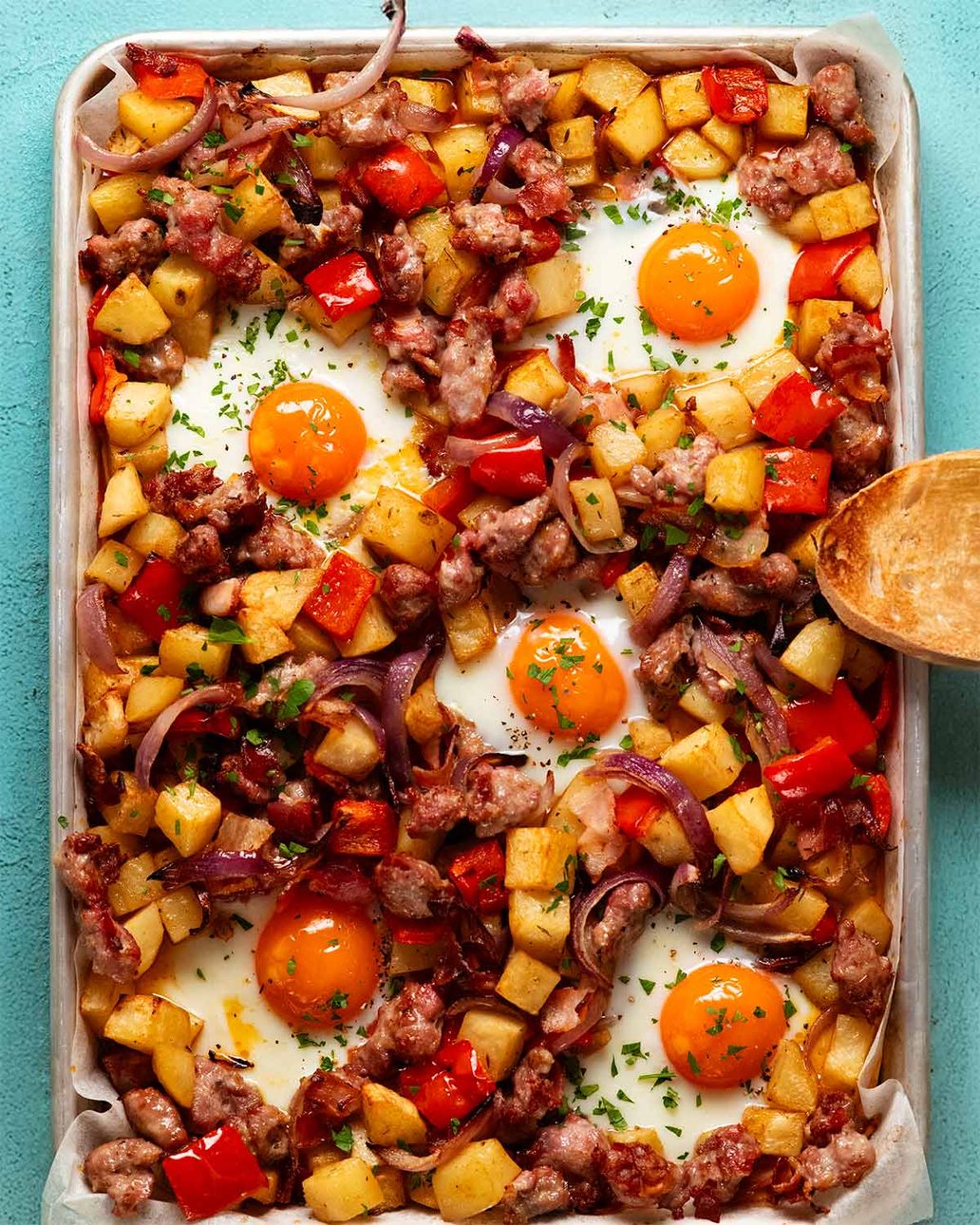
- Whole30 Breakfast Hash with Sausage and Veggies — sweet potato + compliant sausage + bell pepper + onion. Reheats crispy in a hot cast-iron skillet; soggy in the microwave. Use the skillet on weekday mornings.
- Sweet Potato & Sausage Skillet — 4-serving batch. Portion into 4 containers Sunday night; grab and reheat weekdays. Add a fried egg Monday, avocado Tuesday, salsa (compliant, sugar-free) Wednesday to rotate flavor without re-cooking.
- Turmeric-Spiced Sweet Potato Hash — anti-inflammatory bonus from the turmeric. Serve topped with two fried eggs or (on no-egg days) a sliced avocado and a drizzle of olive oil.
- Miso-Glazed Sweet Potato and Kale Hash — miso is soy = NOT compliant as written. Sub for coconut aminos (2-3 tbsp) and a pinch of umami-boosting nutritional yeast. Kale holds up better than spinach in a 4-day fridge stint.
- Pan-Seared Chicken Thighs with Roasted Sweet Potato and Apple Hash — protein + starch + fruit in one plate. Roast the sweet potato and apple Sunday, sear the chicken fresh in 12 minutes weekdays (or batch-sear Sunday too for 4-minute weekday reheats).
- Native Carolina-Style Smoked Chicken & Sweet Potato Hash — leftover-smoked-chicken makes this a Monday-after-Sunday-smoker recipe. If you're not smoking, use rotisserie (check the label for sugar) or leftover roast chicken.
5 no-egg breakfasts (for when you cannot look at another egg)
The safety valve. When Day 11 hits and eggs are the enemy, rotate to these five for a day or two.
- No-Bake Chia and Coconut Pudding with Mixed Berries — mix Sunday night, eat Monday-Thursday. Chia + full-fat coconut milk (compliant, check the label — some have added sweeteners) + berries. Zero cooking. 4-day fridge life.
- No-Bake Tropical Chia Pudding with Mango and Coconut — same base, brighter direction. Mango and pineapple are in-bounds for Whole30 but count as fruit (moderation).
- Pan-Seared Salmon with Avocado Dill Sauce — a 4 oz salmon fillet, 8 minutes in a hot carbon-steel skillet. Feels like dinner; totally works as breakfast. Cold salmon leftovers from Sunday dinner also work.
- Pan-Seared Salmon with Avocado Lime Salsa — same protein, brighter salsa. Cook the salmon Sunday; eat cold or warm Monday morning with the salsa fresh.
- Compliant breakfast meat plate — 3 slices compliant bacon + 4 oz breakfast sausage + half an avocado + a small handful of blueberries. Not a "recipe" — a 6-minute assembly. When you cannot even, this is the pull-out-of-the-fridge move.
5 protein-forward breakfast plates (dinner for breakfast)
Whole30 doesn't have a rule that says breakfast has to be breakfast-shaped food. In fact, the program authors specifically recommend eating "dinner-like" meals in the morning during the reset.
- Seared Whole30 Chicken Thighs with Roasted Garlic and Herb Vegetables — full dinner-portion breakfast. 8-10 minute cook if the vegetables are pre-roasted Sunday.
- Whole30-Style Beef & Vegetable Stir-Fry with Ginger — 12-minute wok breakfast if you have the beef pre-sliced. Coconut aminos for the sauce (never soy).
- Cauliflower Rice Stir-Fry with Ginger and Sesame Whole30 Style — vegetarian-forward but easily doubled with leftover protein.
- Quick Whole30 Reset Bowl — the emergency breakfast. 10 minutes if the vegetables are pre-chopped. Cauliflower rice + protein + avocado + hot sauce (compliant only — check the label).
- Pan-Seared Chicken Thighs with Roasted Garlic and Herb Whole30 Sauce — cook the thighs Sunday, plate cold with the sauce warm. Feels like a chef's brunch; costs $6 per serving.
The Sunday prep session that fixes weekday Whole30 breakfast
90 minutes of Sunday cooking = 20 weekday breakfasts. This is the single-highest-ROI activity in a successful Whole30. Without a Sunday prep, you'll break compliance by Wednesday.
The session, timed:
- :00-:15 — Preheat oven to 425°F. Peel and dice 3 lb of sweet potato, chop 3 bell peppers and 2 onions, spread on two half sheet pans with olive oil, salt, and pepper. Into the oven, 25 min.
- :15-:30 — Cook 12 breakfast egg muffins (recipe above). Whisk 12 eggs + veg + salt, portion into a greased 12-cup muffin tin, into the oven with the sweet potatoes for the last 20 min.
- :30-:45 — Sear 2 lb bone-in chicken thighs in a hot cast-iron pan, 4 min per side; finish in the oven with everything else for 15 min. Slice one lemon into wheels and toss on top.
- :45-:60 — Batch-cook 4 servings of chia pudding: 1/2 cup chia + 2 cups full-fat coconut milk + 1 tsp vanilla + a pinch of salt. Whisk, portion into 4 jars, refrigerate.
- :60-:75 — Cook 1 lb compliant breakfast sausage (crumbled) in a skillet. Reserve half for breakfast hash; freeze half.
- :75-:90 — Portion everything into breakfast containers. 4 Monday-through-Thursday breakfasts done, 2 backup meals in the fridge, 2 in the freezer.
Total weeknight breakfast cook time: 60-90 seconds of reheating. Weekday morning cognitive load: zero.
Kitchen equipment that speeds Whole30 breakfast
A quality 12-inch cast iron or carbon steel skillet. For hash reheats and salmon sears. Whole30 leans hard on protein and fried vegetables — you'll use this pan 20 times in 30 days.
Two half sheet pans (13x18-inch aluminum). For the Sunday batch-roasting. One pan crowds fast when you're cooking 3 lb of vegetables plus 12 muffins.
A 12-cup muffin tin. For breakfast egg muffins. Non-stick coated is fine here; you're not searing at 500°F. Silicone works too but doesn't crisp as well.
A good chef's knife. For the 45 minutes of Sunday chopping. A dull knife turns Sunday prep from 90 minutes into 2 hours and leaves you demotivated for the next week.
A food processor (optional). For chopping vegetables faster in the Sunday session. If you cook Whole30 more than once, this is worth the counter space.
Real-world numbers: what a Whole30 breakfast week actually costs
We tested a rotation of these 22 recipes across a 4-week Whole30 and tracked the numbers per week (family of 4):
| Metric | Per week |
|---|---|
| Sunday prep time | 90 min |
| Weekday active cook (5 breakfasts) | 12 min total |
| Grocery cost (breakfast only) | $58 |
| Cost per breakfast per person | $2.90 |
| Protein per breakfast per person | 26 g |
| Total carbs per breakfast per person | 24 g |
| Calories per breakfast per person | 420 |
The $2.90/breakfast compares to $4-5 for a compliant breakfast bowl at Sweetgreen or Chipotle. The 12-minute-per-week active cook time is what makes the 30 days sustainable — you cannot cook a 25-minute breakfast weekly for a month.
Common Whole30 breakfast pitfalls
1. Not reading labels. Sugar hides in bacon, breakfast sausage, salsa, hot sauce, deli meat, canned coconut milk, almond milk, and most "compliant"-looking packaged goods. Read every label every time. The Whole30 approved sourcing guide has a rolling list.
2. Compliant-but-boring. Eggs and bacon every day is compliant. It's also the reason 40% of Whole30 attempts fail by Week 3. Variety is a compliance strategy, not a luxury.
3. Under-fatting. Whole30 without carbs means fat carries the calorie load. If you're always hungry, you're not eating enough fat — add avocado, olives, coconut milk, more oil.
4. Skipping breakfast. Intermittent fasting is not compliant with the program's spirit. Eat within an hour of waking.
5. Snacking through the morning. Whole30 discourages snacking; you're supposed to eat structured meals. If you're snacking, your breakfast wasn't big enough. Add another egg and half an avocado.
Frequently asked questions
Do I have to eat breakfast on Whole30?
The official recommendation is yes — a protein-forward breakfast within an hour of waking helps blood-sugar regulation, which is the whole point of the reset. Most people who skip breakfast on Whole30 are running on cortisol and end up ravenous by 10 AM, breaking compliance with a rushed non-compliant snack. If you were intermittent-fasting pre-Whole30, the program authors suggest pausing IF for the 30 days and reintroducing it after Day 30.
Can I have a smoothie for breakfast?
Technically yes, discouraged by the Whole30 authors because liquid calories bypass satiety signaling. If you do a smoothie, it should be a meal replacement (400+ calories, 25+ g protein, actual fat and fiber) and not a snack. The chia-coconut pudding in this article is a better ritual because you chew it. Blending fruit into a smoothie is specifically flagged in the rules as a workaround the program discourages — 'don't blend your dates and pretend they aren't sugar.'
Are Whole30 pancakes really a thing?
No, and this is one of the enforcement points the program is famous about. The Whole30 rules explicitly ban 'SWYPO' foods — Sex With Your Pants On — meaning you can't recreate a non-compliant food from compliant ingredients (banana-egg 'pancakes,' cauliflower 'pizza,' etc.). It sounds pedantic; the reasoning is that the behavioral pattern of craving pancakes is what the reset is trying to break, and eating a fake pancake reinforces it. Skip the pancake.
What if I hate eggs?
5 of the 22 recipes in this article are entirely egg-free — the salmon avocado bowl, salmon with avocado lime salsa, chia coconut pudding, tropical chia pudding, and the breakfast meat plate all skip eggs. Whole30 without eggs is harder because eggs are the fastest compliant protein, but not impossible; you'll rely more on breakfast meats and pre-cooked protein leftovers from dinner. Plan the Sunday prep to include 3-4 cooked protein portions specifically for weekday breakfast.
How do I get variety without buying 15 vegetables?
Rotate a 6-vegetable base weekly — sweet potato, spinach, bell pepper, onion, mushroom, zucchini covers 90% of the breakfast recipes here. Buy those on Sunday, prep them all at once (dice the sweet potato, slice the peppers and onions, wash the spinach), and combine differently across the week. Monday's hash has sweet potato + peppers + onion; Tuesday's frittata has spinach + mushroom + zucchini; Wednesday's shakshuka uses the pepper-onion base with tomato added. Same 6 vegetables, three different meals.
Sources
- Whole30 Program Rules — the definitive rulebook from the program's founders. Anything you can eat and anything you can't traces back to this document.
- Academy of Nutrition and Dietetics — What You Need to Know About the Whole30 Diet — an independent registered-dietitian analysis of the program's structure, evidence, and best-use cases.
- USDA Food and Nutrition — federal guidance on protein, fiber, and micronutrient targets that any elimination diet has to meet to be sustainable.
Frequently asked questions
Do I have to eat breakfast on Whole30?
Can I have a smoothie for breakfast?
Are Whole30 pancakes really a thing?
What if I hate eggs?
How do I get variety without buying 15 vegetables?
Sources
A compliant week, in one cart.
Ask our AI to plan your Whole30 week — seven dinners, one consolidated shopping list, no label roulette.
Plan my Whole30 week →