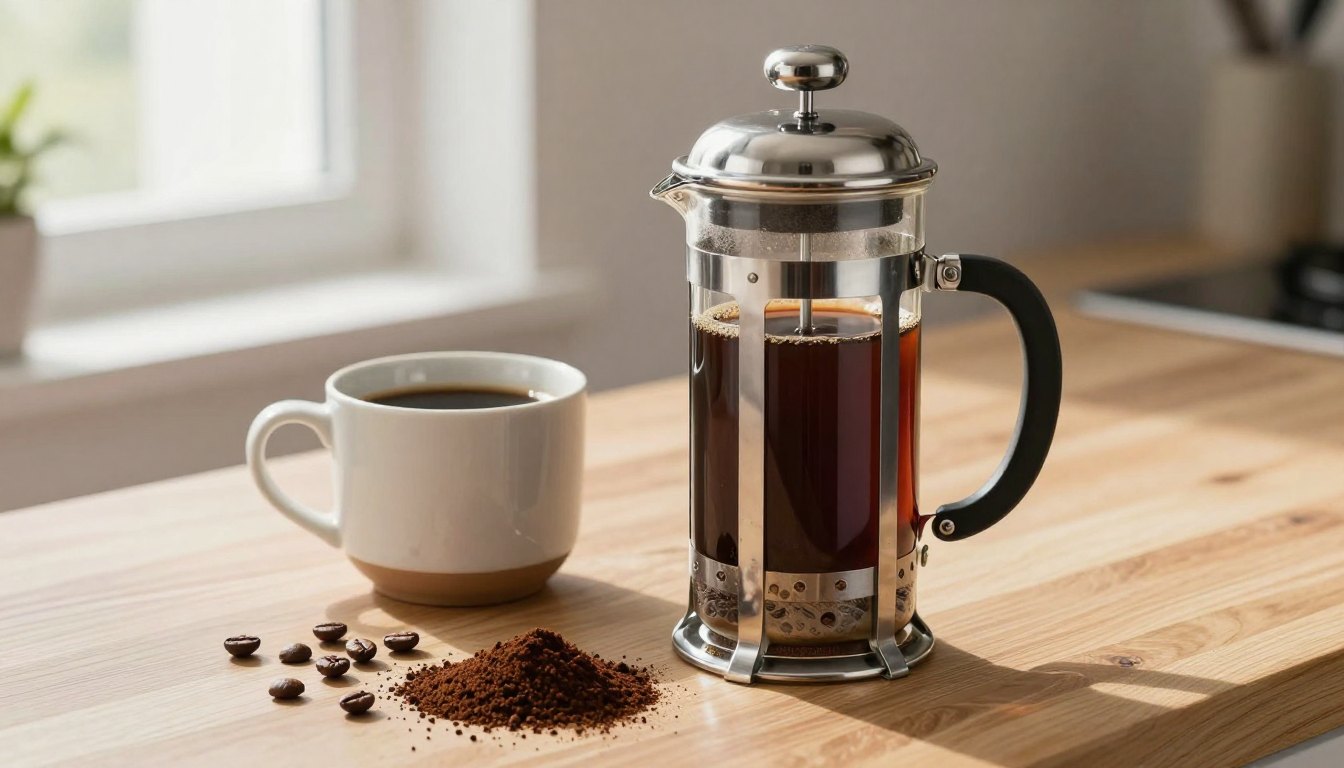
Best French Presses for 2026: Top Picks + Buying Guide
Five French presses, from a budget glass starter to a buy-once steel heirloom, plus the ratio and grind that make any of them sing.
Where to buy these picks
Affiliate links: we may earn a commission on qualifying Amazon purchases. Policy. Prices show only when checked in the last 24 hours.
- Best Overall: Secura 34 oz Double-Wall Stainless Steel French PressCheck price on Amazon →
- Best Value: Bodum Chambord Classic 34 oz $39.95 at AmazonCheck price on Amazon →
- Best for Beginners: Bodum Brazil 34 oz $19.99 at AmazonCheck price on Amazon →
- Best Premium: Frieling Double-Walled Stainless 36 ozCheck price on Amazon →
- Best Compact: Espro P0 Ultralight (16 oz single-serve)Check price on Amazon →
Direct answer: What is the best French press coffee maker for 2026?
Get a free week of easy dinners
Seven weeknight dinners with the shopping list already totalled, sent Sunday. No account needed, unsubscribe in one click.
No spam, unsubscribe in one click. Recipes, shopping lists and Instacart carts all work without an account either way.
The best French press for most people in 2026 is the Secura 34 oz double-wall stainless steel press. It costs about $35, won't shatter, keeps coffee hot through a slow breakfast, and uses a 3-layer steel filter that lets less sludge through than a basic single screen. If you want the classic glass look, get the Bodum Chambord 34 oz. If you're spending under $20, get the Bodum Brazil.
Here's the full shortlist, with prices from our catalog as of September 2026:
| Pick | Press | Price | Capacity | Body |
|---|---|---|---|---|
| Best Overall | Secura 34 oz stainless | Check current price | 34 oz / 1 L | Double-wall 18/8 steel |
| Best Value | Bodum Chambord 34 oz | Check current price | 34 oz / 1 L | Borosilicate glass, steel frame |
| Best for Beginners | Bodum Brazil 34 oz | Check current price | 34 oz / 1 L | Borosilicate glass, BPA-free plastic frame |
| Best Premium | Frieling 36 oz polished | Check current price | 36 oz | Double-wall 18/10 steel |
| Best Compact | Espro P0 Ultralight | Check current price | 16 oz (brews ~12 oz) | Vacuum-insulated steel |
Where to buy the picks in this guide
Prices are shown only when checked in the last 24 hours; otherwise check the current price on Amazon.
Why the French press remains the cleanest-tasting home brew method for full-bodied coffee
"Clean" means something specific here. A French press has no paper filter to soak up the coffee's natural oils, and no hot plate cooking the pot for an hour. Nothing gets between the grounds and your cup except a metal mesh. The ground coffee steeps fully in water just off the boil for about four minutes, then you push a screen down and pour. That's the whole method. The National Coffee Association's French press guide says it's known for "bold flavor and a full body," and that comes straight from the oils and fine particles a paper filter would catch.
That's why French press coffee has more body than drip. The oils coat your tongue, and the cup tastes rounder and heavier, closer to espresso than to a thin diner pour. The tradeoff is a little sediment at the bottom of the cup. Most of this guide is about keeping that sediment small.
The French press is also the most forgiving manual brewer there is. A pour-over punishes a sloppy pour, and espresso punishes a grind that's a few microns off. A French press only asks for three things: a coarse grind, a sensible coffee-to-water ratio, and a timer. There's no electricity, no pods and no paper, and a good press lasts for decades. Per cup, it's one of the cheapest ways to drink good coffee at home.
It's also the best entry point to our homemade coffee drinks guide. A press makes strong hot coffee for an Irish coffee with honey and cinnamon, and overnight concentrate for iced drinks, all with the same carafe.
How we picked (metal vs glass, single-wall vs double-wall, filter mesh microns, replacement-part availability)
We started with the 178 French presses in the AislePrompt kitchen catalog and ruled out anything that failed one of these five tests:
1. In stock at a real US price. A pick has to have a current, in-stock US listing. That ruled out a few well-loved presses whose listings were out of stock when we checked in September 2026, including the Stanley Classic Stay-Hot 48 oz and Le Creuset's stoneware press. Two presses that top a lot of other lists, the Espro P7 and the Fellow Clara, aren't in our tracked catalog right now, so we can't show you a verified price for them. If you find either one in stock, it's a strong alternative to our premium pick.
2. A big, consistent review base. Near-duplicate listings of the same press (color variants, bundle SKUs) were counted once.
3. Body material and wall construction. We compared single-wall glass, double-wall stainless and vacuum-insulated steel. Glass is cheapest, lets you see the brew, and stays neutral in taste. Double-wall steel holds heat far longer and survives drops. The NCA guide says double-walled presses "maintain a more consistent temperature throughout the brewing," which helps extraction as well as keeping the coffee warm.
4. Filter design. A single coarse mesh screen lets the most fines through. Stacked screens (Secura's 3-layer design, Frieling's dual screen) and Espro's double micro-filter catch more. Few makers publish a micron rating, so we compared layer count and design rather than a number.
5. Replacement parts. In a glass press, the part that breaks is almost always the carafe. The one that wears out is the mesh screen and its spring seal. Bodum sells replacement beakers for its common sizes, and Secura ships two spare screens in the box. We favored presses where a $10 part fixes the problem instead of a $40 replacement press.
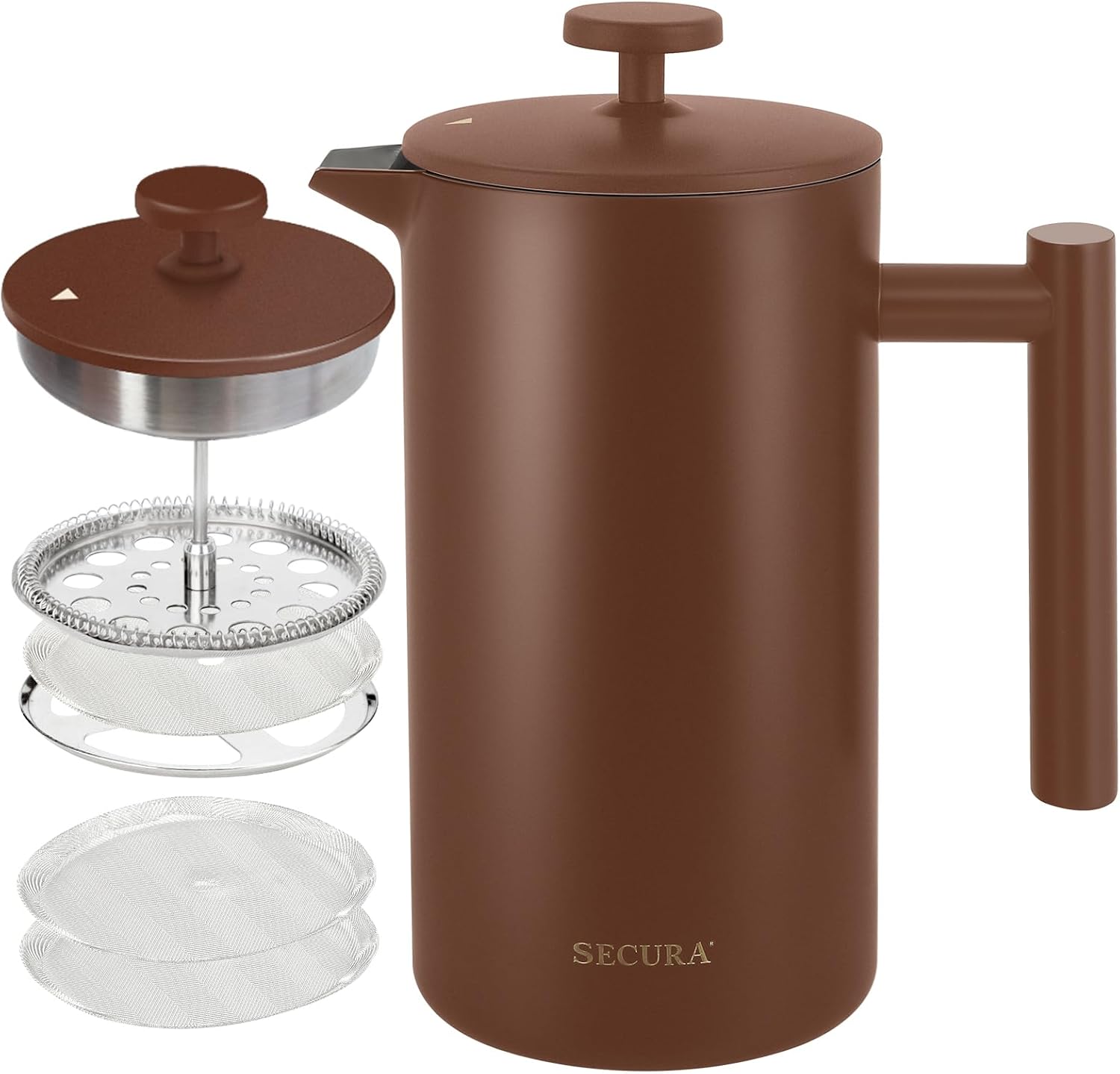
Best Overall: Secura 34 oz Double-Wall Stainless Steel French Press
Secura French Press, 34 oz, 304 stainless. About $35.
The Secura is the press we'd buy for a household that drinks coffee every morning. The inside and outside walls are both 18/8 (304) stainless steel, so there's no glass to crack when the carafe hits the sink edge. The double wall holds heat well: Secura claims 60 extra minutes compared with other steel and glass models. That matters if the pot sits on the table through a slow breakfast.
The filter sets it apart at this price. It's a 3-layer stack of stainless screens, and two extra screens come in the box. A stock single-screen Bodum lets noticeably more sludge into the last half-inch of the cup. The Secura doesn't eliminate sediment, but it cuts it enough that most people stop noticing.
What to know before you buy:
- Hand wash. The listing says hand wash, so don't put the double-wall body in the dishwasher. The plunger assembly comes apart for cleaning.
- The lid has a heat-retention position. Turn the ▲ mark on the lid away from the spout while the coffee sits, and toward the spout to pour.
- You can't see the brew. With an opaque steel body you judge the bloom by lifting the lid, not by looking through the side.
Verdict: It's unbreakable, holds heat and filters better than any glass press at the same price. For a 34-ounce household press, nothing else in our catalog beats it for the money.
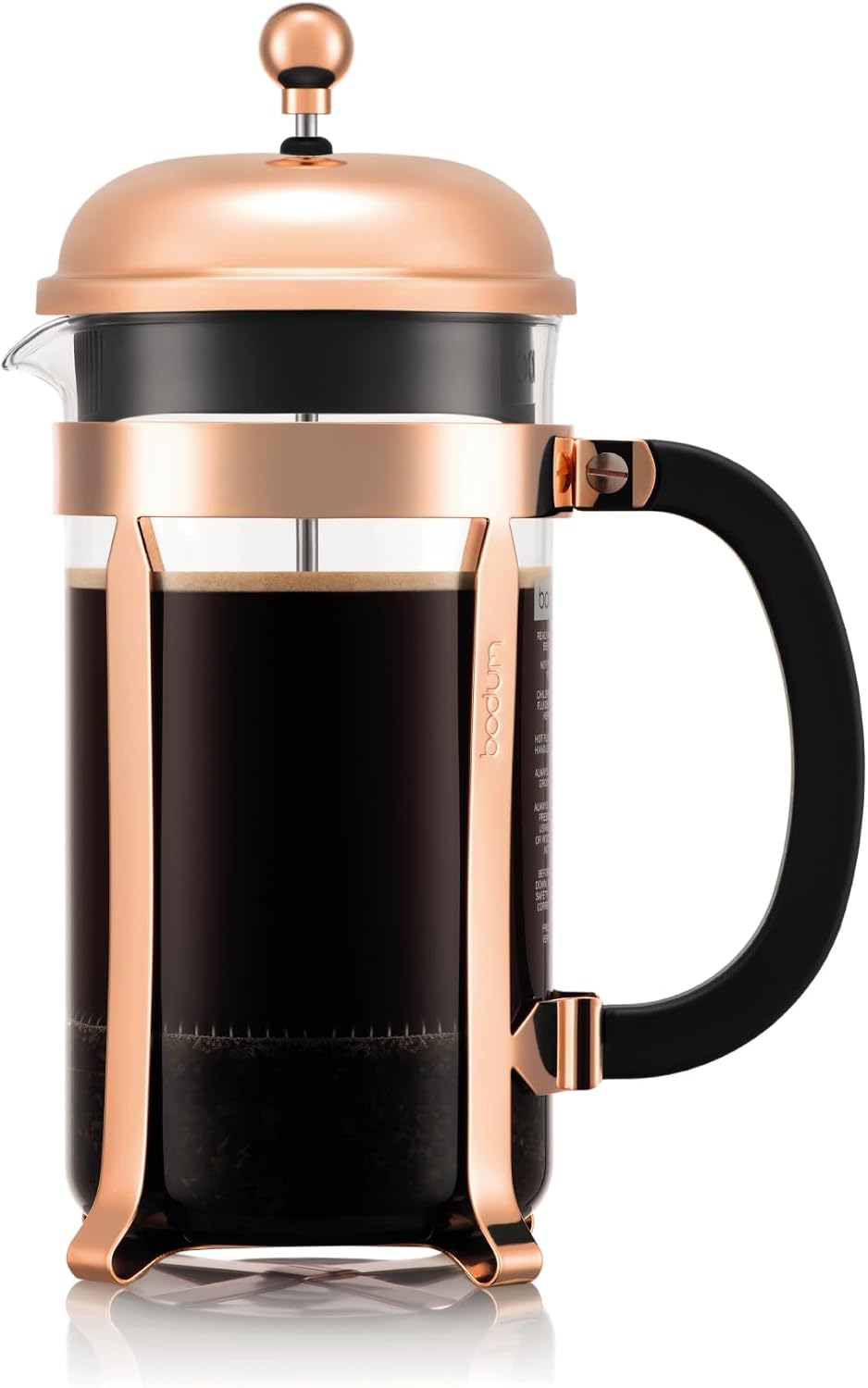
Best Value: Bodum Chambord Classic 34 oz
Bodum Chambord 34 oz. About $40.
The Chambord is the press most people picture when they hear "French press." It's the design Bodum built after buying Melior-Martin in 1991, and it's still made in Portugal. The carafe is non-staining borosilicate glass that won't carry flavors from one batch to the next. The frame and lid are chrome-plated stainless steel, and the plunger is all steel.
Why it's our value pick over the cheaper Brazil: the metal frame and lid last longer than plastic, the glass carafe is replaceable, and it looks good enough to bring to the table. It holds 1 liter, which Bodum rates as "8 cups," meaning 4-ounce cups. In real mugs that's about three.
What to know before you buy:
- It loses heat fast. A single glass wall cools quickly. Pour everything within a few minutes of plunging, or decant into a thermal carafe.
- The screen is basic. One mesh layer means more fines than the Secura. Grind coarser to compensate, and leave the last sip in the carafe.
- The glass is the weak point. Borosilicate handles heat, but not a drop onto tile. Replacement beakers are cheap, so buy one if you're clumsy before 7 a.m.
Verdict: It's the classic for a reason. If you want to watch the coffee brew and you pour right away, the Chambord is the best glass press you can buy.
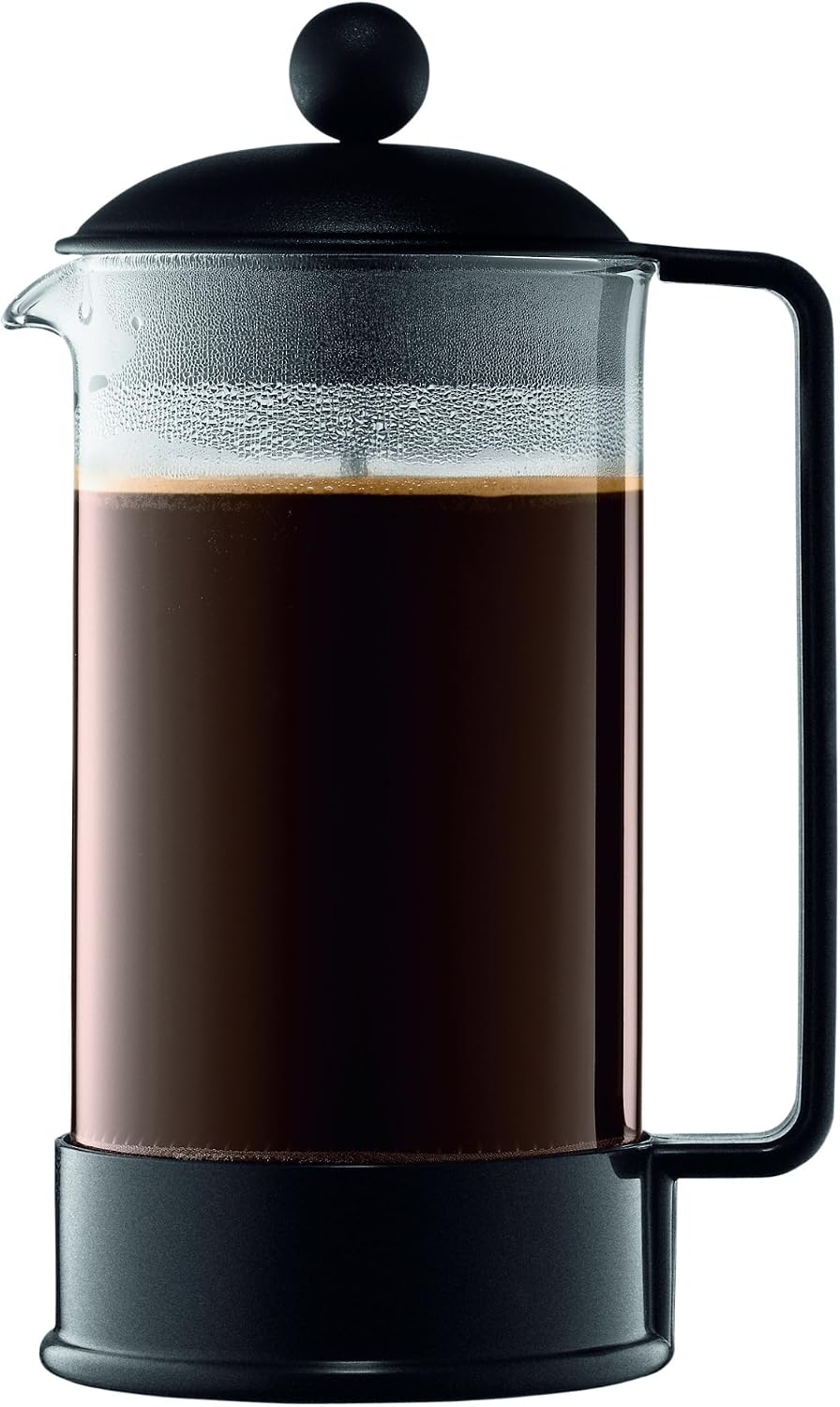
Best for Beginners: Bodum Brazil 34 oz
Bodum Brazil 34 oz. About $20.
If you've never owned a French press and don't know yet whether you'll use one daily, start with the Brazil. It has the same borosilicate glass carafe and stainless steel plunger and filter as the Chambord. The difference is a lightweight BPA-free plastic frame, handle and lid instead of steel. It brews the same coffee as the Chambord for half the price.
Beginners get two useful things from it. The whole press is dishwasher safe according to Bodum's listing, so there's no fussy cleanup. And at about $20, a cracked carafe in month three isn't a disaster.
What to know before you buy:
- The plastic frame yellows and loosens over the years. It's a starter press, not an heirloom.
- Same single-screen filter as the Chambord, with the same fines.
- Consider the 12 oz size if you live alone. The NCA points out that you lose quality brewing a small batch in a big press. Matching the press size to your usual batch matters more than extra capacity.
Verdict: This is the cheapest way to find out if you're a French press person. If you use it every day for a year, upgrade to the Secura or Chambord.
Best Premium: Frieling Double-Walled Stainless 36 oz
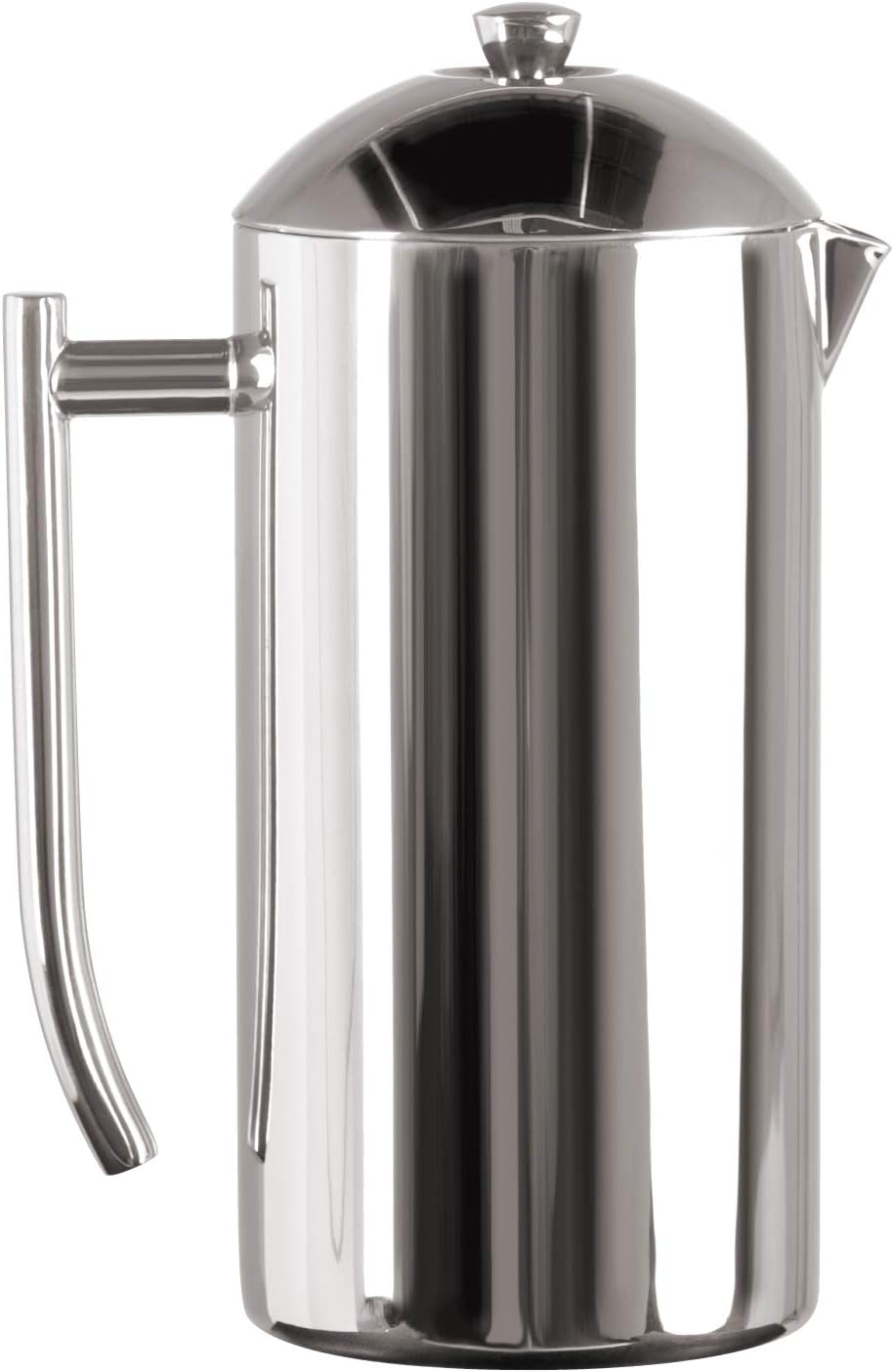
Frieling Double-Walled Stainless Steel French Press, 36 oz, polished. About $140.
The Frieling is the press you buy once. It's double-wall 18/10 stainless inside and out, polished outside and brushed inside, and there's no plastic in the brewing path. Frieling says it holds heat four times longer than glass, and the carafe works as an insulated serving pitcher. It comes apart fully and is dishwasher safe according to the listing.
The plunger is all steel, and the dual-screen filter pushes down cleanly through coarse grounds or loose-leaf tea. You're paying for build quality and heat retention more than for a better filter. Brewed side by side, a well-dialed Frieling and a well-dialed Secura taste close. The Frieling feels better in the hand, pours more cleanly and should outlast the cheaper press by decades.
What to know before you buy:
- It costs about four times as much as the Secura. The coffee isn't four times better. The build is what you're paying for.
- The listings are confusing. Frieling sells 17, 23, 36 and 44 oz versions, and some listings mix up capacities in their bullet points. Check the size in the product title before you check out.
- It's heavy. At about 2.8 lb empty, it's a countertop press, not a camping press.
Verdict: It's the best-built press in our catalog. Buy it if you'd rather pay once than replace a cheaper press every few years.
Best Compact: Espro P0 Ultralight (16 oz single-serve)
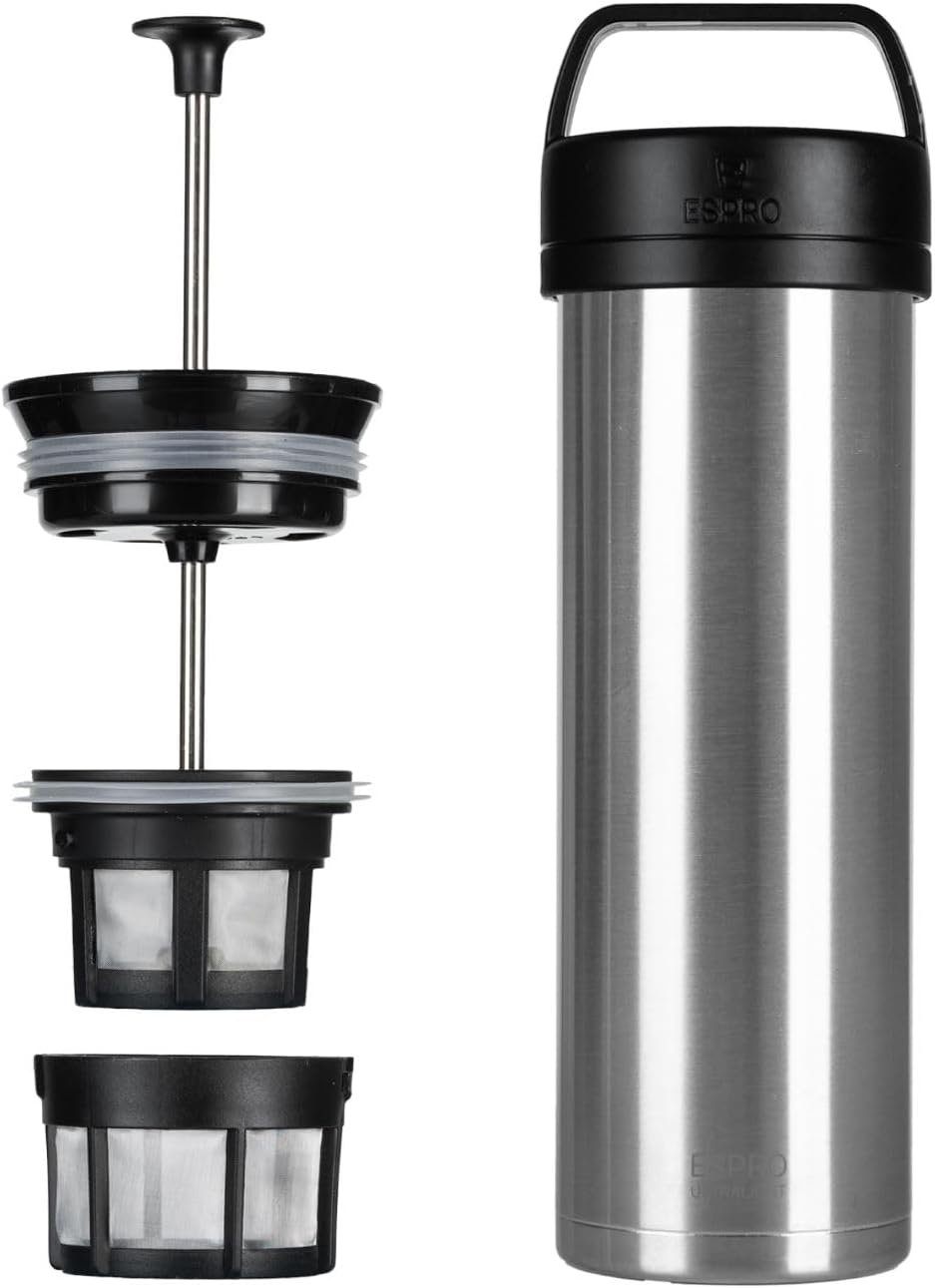
Espro P0 Ultralight Travel Press, 16 oz. About $40.
For one person, a desk, or a trip, you want a press that brews and holds a single mug. The Espro P0 is 16 oz and designed to brew up to about 12 oz of coffee. It's vacuum-insulated stainless steel and weighs about 9.6 oz, per Espro's P0 product page. It uses Espro's patented double micro-filter, the feature that made the brand's bigger presses famous: two fine screens with a seal against the wall, so almost no grit reaches the cup.
The P0 also solves the biggest problem with small presses, which is over-extraction. After you plunge, the filter holds the grounds back from the coffee, so the last sip isn't bitter sludge.
What to know before you buy:
- It's a single-cup press. You can't share a pot from it.
- Paper filters and a tea micro-filter are sold separately if you want an even cleaner cup or plan to brew tea.
- Grind a notch finer than for a big press. The micro-filter can handle it, and a smaller brew benefits from a bit more extraction.
Verdict: It's the cleanest small cup in our catalog. It's great for commuting, hotel rooms and one-person kitchens.
What to Look For (double-wall insulation, mesh micron count, gasket replaceability, dishwasher safety, capacity fit)
Double-wall insulation. This makes the biggest difference in daily use. A single-wall glass press is at its best for about 10–15 minutes. After that the coffee is lukewarm, and it keeps extracting if the grounds are still in contact with it. Double-wall steel keeps coffee drinkable for an hour or more. If you pour everything right away, glass is fine. If the pot sits, buy steel.
Mesh micron count. Fewer fines in the cup mean a cleaner, less bitter finish. Most makers don't publish a micron rating, so use construction as the proxy: one screen gives the most sediment, a 2–3 layer stack is noticeably cleaner, and Espro's double micro-filter is the cleanest. Any filter works better with a consistent coarse grind, so the grinder matters as much as the press.
Gasket and screen replaceability. The spring-edged screen seals the plunger against the wall. When it wears or bends, grounds slip around the edges. Buy a press whose screens you can replace. Secura includes spares, and Bodum and Frieling sell them.
Dishwasher safety. The Bodum Brazil and the Frieling are dishwasher safe per their listings. The Secura is hand wash. Whatever you buy, disassemble the plunger every few weeks, because oils build up between the screen layers and turn rancid.
Capacity fit. Match the press to how much you actually brew. A 34-oz press makes about three real mugs, a 12–17 oz press makes one or two, and a 16-oz travel press makes one. A half-full big press loses heat faster and brews less evenly.
How French press compares to pour over, drip, and espresso
| Method | Brew time | Body | Clarity | Hands-on effort | Typical gear cost |
|---|---|---|---|---|---|
| French press | ~4 min steep + 1 min | Full, oily | Low (some sediment) | Low | $20–$140 |
| Pour over | 3–4 min of active pouring | Light | High | High | $20–$60 + gooseneck kettle |
| Automatic drip | 5–8 min, hands-off | Medium | Medium-high | Very low | $50–$300 |
| Espresso | 25–30 sec shot | Very heavy, concentrated | Medium | Medium-high | $120–$1,800 + grinder |
French press vs pour over. Pour over sends water through a paper filter, which catches oils and fines. The result is brighter and cleaner, but it has less body. It also asks for more attention: a gooseneck kettle, a slow spiral pour, and a timer. If you like that ritual, our electric kettle guide covers the gear. If you want a heavy, rich cup with less fuss, choose the press.
French press vs drip. A drip machine is hands-off and makes a full pot on a schedule. For households that want coffee ready at 6:30 a.m. with no effort, drip wins. See our best coffee makers of 2026. A French press makes a heavier cup and never cooks the coffee on a hot plate.
French press vs espresso. Espresso is a separate drink, a 1.5-oz concentrate pulled at about 9 bars. It needs a $400+ machine and a good grinder to do properly. See our best espresso machines of 2026. A French press can't make espresso, but its full body is the closest a $35 brewer gets to that mouthfeel. It also makes a strong stand-in for recipes that call for "strong brewed coffee."
How to brew the perfect French press (grind, ratio, time, plunge technique)
The National Coffee Association gives these numbers: a coffee-to-water ratio of 1:10 to 1:16 by weight, water at 93 ± 3 °C (about 195–205 °F), and about 4 minutes of contact time. The Specialty Coffee Association's brewing standards are the industry reference behind those numbers. We start at 1:15 and adjust.
| Press size | Coffee | Water | Ratio | Yield (approx.) |
|---|---|---|---|---|
| 12 oz single-serve | 22 g (~3 tbsp) | 330 g | 1:15 | 1 mug |
| 17 oz | 32 g (~4.5 tbsp) | 480 g | 1:15 | 1–2 mugs |
| 34 oz | 57 g (~8 tbsp) | 850 g | 1:15 | 3 mugs |
| 36 oz (Frieling) | 60 g | 900 g | 1:15 | 3 mugs |
| 34 oz, strong | 65 g | 850 g | 1:13 | 3 strong mugs |
Step by step:
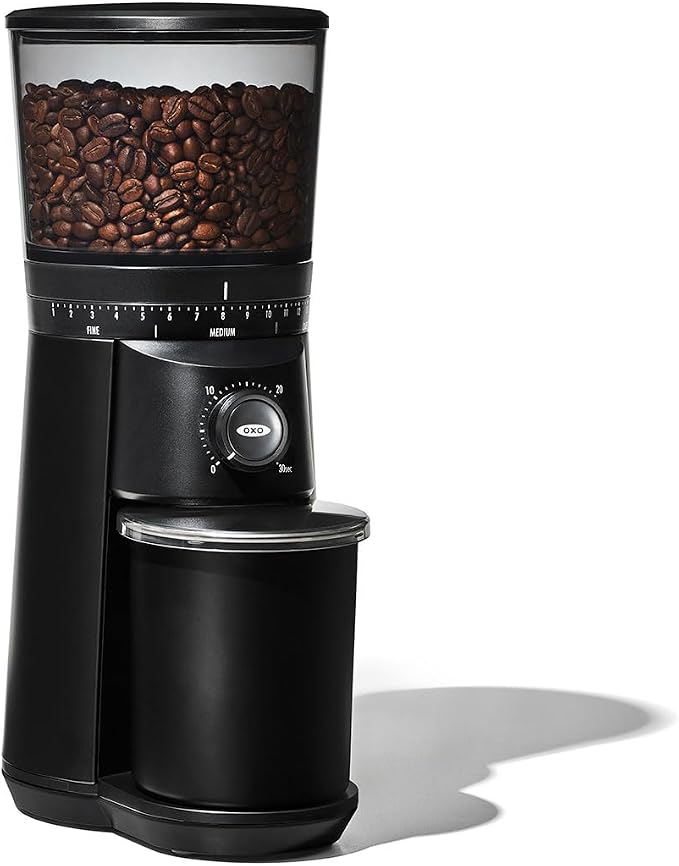
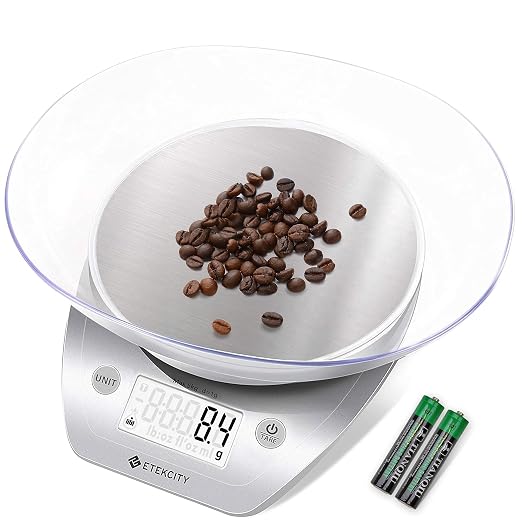
1. Weigh and grind. Grind coarse, "like rock salt" in the NCA's words. A burr grinder such as the OXO Brew Conical Burr Grinder makes even particles. A blade grinder makes a mix of boulders and dust, and the dust goes straight through the screen. A 0.1 g digital kitchen scale is more consistent than scoops. Our kitchen scale guide has more options.
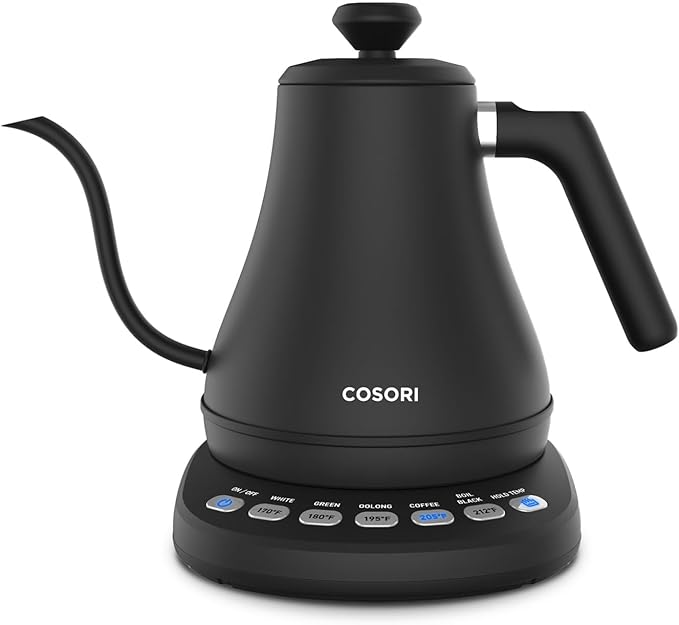
2. Heat the water. Bring it to a boil, then let it rest about 30 seconds. A variable-temperature kettle like the COSORI gooseneck lets you set it exactly.
3. Preheat the press. Swirl some hot water in the empty carafe and dump it. With glass, this matters more than you'd expect.
4. Bloom. Add the grounds, then all the water, and start a 4-minute timer. After about a minute a crust forms on top. Break it with a gentle stir using a wooden spoon, not metal, near glass.
5. Steep. Put the lid on with the plunger fully up and wait until the timer hits 4:00.
6. Plunge slowly. Take 15–20 seconds and use steady, light pressure. If it fights you, the grind is too fine. If it drops with no resistance, it's too coarse.
7. Pour everything right away. Decant into mugs or a thermal carafe. Coffee left on the grounds keeps extracting, even in a steel press.
Adjusting by taste: if the coffee is bitter or harsh, grind coarser or cut the steep to 3:30. If it's flat or sour, grind a bit finer or go to 1:13. Change one thing at a time.
Worked example: a weekend pot for three. Weigh 57 g of medium-dark beans and grind them coarse. Heat 850 g of water to 200 °F in a 34-oz Secura. Stir at 1:00, plunge at 4:00 and pour three 9-oz mugs. Pair it with our drip coffee French toast bake, which uses a cup of the same brew in the custard.
Worked example: French press cold brew. Put 100 g of very coarse grounds and 800 g of cold filtered water in the press. Stir, lid it and refrigerate for 14–18 hours, then plunge and decant. That makes about 1:8 concentrate, which you dilute 1:1 with water or milk. Use it in a spiced coffee tonic with cardamom and citrus or a cold brew maple rum flip.
Worked example: strong coffee for cooking. Brew at 1:12 for a concentrated pot. It's right for a Vietnamese-style iced coffee with condensed milk (robusta beans suit the press well) or the soak for a Guatemalan coffee-infused tres leches cake. Leftover coarse grounds are too spent for a rub, but fresh coarse coffee makes a great crust on coffee-rubbed grilled pork chops.
Common pitfalls
- Grinding too fine. This causes most bad French press coffee. Fine grounds clog the screen, make the plunge hard, and push sludge and bitterness into the cup. Pre-ground supermarket coffee is usually ground for drip, which is too fine for a press.
- Leaving coffee on the grounds. The "second cup" from a press that's been sitting for 20 minutes is over-extracted. Decant everything.
- Pressing hard and fast. Forcing the plunger pushes fines around the screen and can crack a glass carafe. Slow and steady works better.
- Washing grounds down the drain. Grounds collect in pipes and clog them. Knock them into the compost or trash first.
- Ignoring a bent screen. A warped spring edge lets grounds bypass the filter completely. Replace the screen, which costs a few dollars, before you blame the beans.
When NOT to buy a French press
- You want coffee ready when you wake up. A programmable drip machine is the right tool.
- You like bright, tea-like, very clean coffee. Pour over or a paper-filtered brewer will make you happier than any metal mesh.
- You're watching LDL cholesterol. Unfiltered brews like the French press keep more cafestol, a coffee oil that paper filters mostly remove. If your doctor has flagged cholesterol, a paper-filtered method is the cautious choice. You can also add a paper filter insert to the Espro P0.
- You want lattes and cappuccinos. You need espresso and steamed milk. A press can't make either.
FAQ
How is a French press different from a pour over or drip coffee maker?
A French press immerses the grounds in hot water for about 4 minutes. That makes a fuller-bodied, oilier cup with some fine sediment. Pour over sends water through a paper filter for a cleaner, brighter cup with no oils, and drip machines automate that pour-over process. If you like a heavy, espresso-like mouthfeel and hate paper filters, the French press wins. If you want clarity and don't mind paper, choose pour over.
Do I need a double-walled French press?
You do if you drink coffee slowly. A single-wall glass press like the Bodum Chambord drops toward lukewarm within about 15 minutes. A double-wall stainless press like the Secura or Frieling keeps coffee hot for an hour or more. Glass costs about the same as budget stainless and lets you watch the brew, but it can shatter. Steel is nearly indestructible and worth it if the pot stays on the table through breakfast.
What grind size should I use for French press?
Use a coarse grind, about the texture of rock salt or coarse breadcrumbs. Anything finer slips through the mesh, leaves muddy sediment in every cup, and over-extracts into bitterness. A burr grinder makes the consistent coarse grounds you need. Blade grinders make uneven particles, and the fines end up in your cup. Pre-ground "French press" coffee works, but it goes stale within days, so grind fresh if you can.
How long does a French press take to make coffee?
It takes about 6–7 minutes in total: roughly 2 minutes to boil the water, 4 minutes of steeping, and under a minute to plunge and pour. That's a little longer than a drip machine's hands-off cycle and about the same as a careful pour over. You can walk away during the steep, though. Set a timer, because going much past 4:30 pushes the cup toward bitter, especially with a fine grind.
How do I clean a French press without wasting time?
Pour some water into the empty press, swirl it, and dump the slurry into the compost or trash, never down the drain, where grounds clog pipes. Rinse, then take the plunger apart every few weeks to deep-clean the mesh layers, where coffee oils collect and go rancid. The Bodum Brazil and Frieling are dishwasher safe per their listings. The Secura is hand wash. Glass carafes break most often, so check that replacements are available before you buy.
What is the best coffee-to-water ratio for French press?
The National Coffee Association recommends 1 gram of coffee to 10–16 grams of water. For most people, 1:15 is a good starting point. In a 34-ounce press, that's about 57 grams of coarse coffee to 850 grams of water at about 200 °F, steeped for 4 minutes. If you want it stronger, go to 1:13 rather than steeping longer, because extra time adds bitterness faster than it adds strength.
Can you make cold brew in a French press?
Yes, and it's one of the easiest ways to make it. Combine very coarse grounds and cold filtered water at about 1:8 by weight. Stir, put the lid on, and refrigerate for 14–18 hours. Then plunge slowly and pour the concentrate into a jar right away, so it doesn't keep extracting. Dilute it about 1:1 with water or milk. The press filter catches most of the grounds, and a paper filter pass afterward removes the rest if you want it very clean.
Sources
- National Coffee Association — French press coffee: brew ratio (1:10–1:16), water temperature (93 ± 3 °C), 4-minute contact time, grind size, and single- vs double-wall construction.
- Specialty Coffee Association — Coffee Standards: the industry brewing and water standards the ratio guidance is based on.
- Wikipedia — French press: history and design of the plunger pot.
- ESPRO — P0 Ultralight Travel Press: capacity, weight and double micro-filter design of our compact pick.
The history in brief: two Frenchmen, Mayer and Delforge, patented a forerunner in 1852 that had no seal around the filter. Milanese designers Attilio Calimani and Giulio Moneta added the spring-sealed screen and patented it in the US in 1929, as covered on Wikipedia's French press page. The design has barely changed since, because it didn't need to.
Shopping for the rest of your coffee corner? Browse coffee and espresso gear, barware, small appliances and kitchen gadgets.
Frequently asked questions
How is a French press different from a pour over or drip coffee maker?
Do I need a double-walled French press?
What grind size should I use for French press?
How long does a French press take to make coffee?
How do I clean a French press without wasting time?
What is the best coffee-to-water ratio for French press?
Can you make cold brew in a French press?
How we picked
This guide is researched, not bench-tested. We shortlisted products from the AislePrompt kitchen catalog and compared them on published manufacturer specifications (materials, size, capacity, warranty), on what owners report in published reviews, and on any third-party sources linked in this guide. The guide was drafted with AI assistance. We did not run lab or hands-on tests of these products, so any measurement quoted here comes from the manufacturer or a cited source. Prices change often: use the “Check price on Amazon” buttons for today’s price.
Sources
Recipes to try with your coffee setup
Put your gear to work — save any recipe to My Recipes (no account needed) and send its ingredients to Instacart in one tap.
Shop bar & coffee gear on AislePrompt →Browse the full kitchen shop →
The coffee is sorted. What goes next to it?
Ask our AI for breakfasts and bakes that suit a proper morning cup — it builds the shopping list and sends the cart to Instacart.
Get breakfast ideas →