Diwali Recipes: 20 Sweets, Snacks and Festive Dinners (Gulab Jamun, Ladoo, Samosas, Dal)
Mithai, party snacks and a vegetarian festive dinner, with a make-ahead calendar for Lakshmi Puja on Sunday, November 8, 2026.
Affiliate disclosure: AislePrompt may earn a commission on qualifying purchases made through Amazon and Instacart links in this article, at no additional cost to you. See our affiliate policy →
What do you cook for Diwali? Plan three groups of food. The first is mithai: gulab jamun, ladoo, barfi, kheer and halwa. The second is snacks for guests: samosa, pakora, chakli and namak para. The third is a vegetarian-leaning festive dinner of dal, chana masala, paneer and biryani. Most mithai keeps 3-5 days, so make the sweets the week before Lakshmi Puja on Sunday, November 8, 2026.
That's the short answer. The rest of this guide turns it into a plan you can shop and cook from. It covers 20 recipes from the AislePrompt catalog, a day-by-day make-ahead order, the mistake that ruins each sweet, oil temperatures for the fried snacks, and a shopping list grouped by aisle.
Diwali is a five-day festival of lights, and the main night of worship to the goddess Lakshmi falls on the new-moon day of the Hindu month of Kartika (Britannica — Divali). Food sits at the center of all five days. Households trade boxes of sweets with neighbors, keep a snack tray out for visitors, and serve a large vegetarian dinner after the puja. You don't need to cook all of it. Pick two or three sweets, two snacks and a four-dish dinner, and you've covered the whole tradition.
Plan by how much time you have
The calendar matters more than any single recipe. Mithai is a make-ahead food: many of these sweets taste better a day after they set. Fried snacks and the dinner are not. Here is the order for a Lakshmi Puja on Sunday, November 8, 2026.
| Date | What to make | Why then |
|---|---|---|
| Sunday, November 1 | Shopping trip for ghee, besan, khoya or milk powder, cardamom, saffron, basmati, nuts | Specialty items at Indian grocers sell down in the final week |
| Wednesday, November 4 | Besan ladoo or chikki, coconut ladoo, barfi | Dry sweets keep 4-5 days airtight |
| Thursday, November 5 | Gulab jamun (stored in syrup), shrikhand base (strain the yogurt overnight) | Jamun soak up syrup and improve by day two |
| Friday, November 6 | Samosa filling, kachori filling, murukku dough or the finished murukku | Fillings chill well; murukku stays crisp in a tin for days |
| Saturday, November 7 | Rice kheer, gajar halwa, dal makhani (it improves overnight), chana masala | Milk sweets and slow dals want a night in the fridge |
| Sunday, November 8 (morning) | Fold and fry samosas, fry pakoras, cook jeera rice and biryani | Fried food goes soft within hours; rice is best fresh |
| Sunday, November 8 (evening) | Sooji halwa (as prasad), warm the dals, set out the sweets | Sooji halwa takes about 20 minutes and is traditionally made fresh |
If you only have the weekend: make coconut ladoo and kheer on Saturday, November 7. On Sunday, November 8, make sooji halwa, one fried snack and a dal-plus-rice dinner. That is five dishes and still a full festive table.
If you only have Sunday: buy one box of mithai, make sooji halwa from scratch (it's the sweet most often offered at the puja itself), and cook chana masala with jeera rice. Nobody will feel short-changed.
Mithai: seven sweets and how long each keeps
Mithai) is the umbrella word for South Asian confectionery. Most of it is built on three bases: reduced milk (khoya or mawa), roasted flour (besan or semolina), or sugar syrup cooked to a set "thread" stage. Each base has one classic failure. Learn those three and most of the risk is gone.
1. Gulab jamun
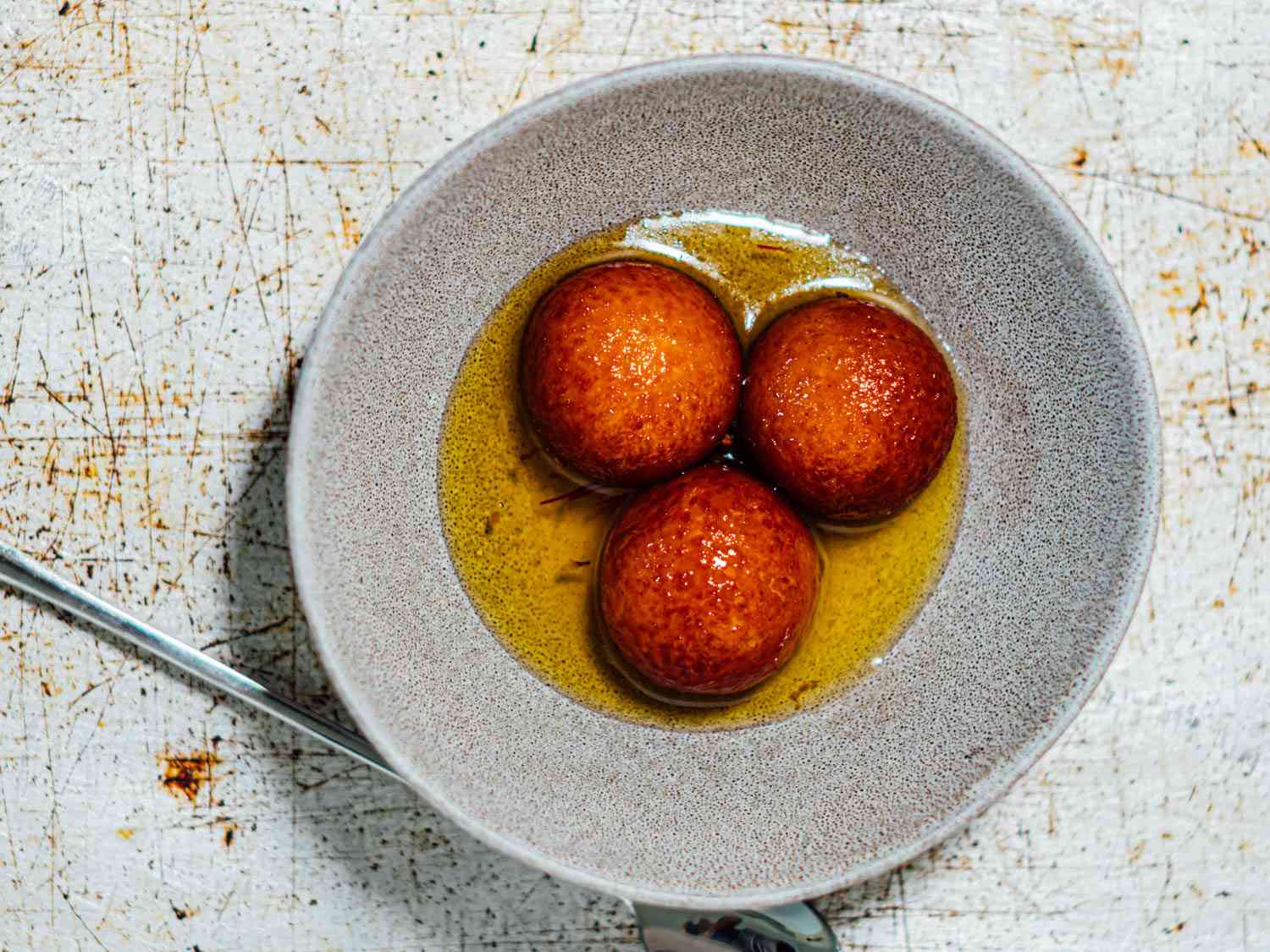
Delhi-Style Gulab Jamun with Cardamom Syrup are fried milk-powder dumplings soaked in cardamom syrup. Keeps: 4-5 days refrigerated, stored submerged in their syrup. The common mistake: oil that's too hot. The outside browns in under a minute while the center stays raw, and the jamun later collapse or crack. Fry them slowly over low-to-moderate heat, roughly 275-300°F, rolling them around so they color evenly over 6-8 minutes. Second mistake: syrup too thick. A heavy syrup coats the outside and never soaks in. The syrup should be thin and sticky between your fingers, not stringy.
2. Besan ladoo (or besan chikki)
Classic besan ladoo is chickpea flour roasted slowly in ghee, then sweetened and rolled. For a crunchier jaggery-sweetened version from the same roast, make Dry-Roasted Besan Chikki with Cardamom. Keeps: 7 days or more airtight at room temperature. The common mistake: ghee too hot, or impatience. Besan burns on the outside and stays raw and pasty inside if you rush it. Keep the heat low and stir for 15-20 minutes until it smells nutty and darkens a shade or two.
3. Coconut ladoo
Sweet Farsan-Style Mawa and Coconut Ladoo combines khoya with fresh coconut. Prefer something lighter? Pan-Fried Indian Semolina Coconut Ladoo uses toasted semolina and no milk solids. Keeps: 3-4 days refrigerated for the mawa version, about a week airtight for the semolina version. The common mistake: shaping too hot or too cold. Too hot and the balls slump; too cold and they crumble. Shape them while the mix is warm enough to press but cool enough to hold in your palm.
4. Kaju or nut barfi
Kaju katli, the diamond-cut cashew fudge, is the most-gifted Diwali sweet. It's also the least forgiving: the cashew paste turns grainy if the sugar syrup goes past one-thread stage. A softer route is Date and Nut Barfi with Cardamom Essence, which uses dates and mixed nuts and needs no syrup at all. Keeps: 7-10 days airtight. The common mistake (kaju katli): over-grinding the cashews into butter. Pulse them dry and stop as soon as they're powder.
5. Rice kheer
Sweet Rice Kheer with Cardamom and Saffron is basmati simmered slowly in whole milk until it thickens. For a richer version, try White Marble Kheer with Saffron and Cardamom. Keeps: 2-3 days refrigerated. The common mistake: scorching. Milk catches on the bottom of a thin pot within minutes. Use a heavy pot, stir the bottom often, and add the sugar only once the rice is fully soft. Sugar added early stalls the rice.
6. Gajar halwa
Cardamom-Scented Gajar Halwa is grated carrot cooked down in milk, then finished in ghee with sugar and cardamom. Keeps: 3-4 days refrigerated, and it reheats well. The common mistake: adding the sugar too early. Sugar draws water out of the carrots and the halwa turns runny. Cook the milk off first, then add the sugar and fry in ghee until glossy.
7. Sooji halwa
Sooji Halwa with Cardamom and Saffron Infusion is the fastest sweet on this list and the one most often made as prasad, the offering at the puja itself. Keeps: 1-2 days, but it's best within the hour. The common mistake: adding cold water to the roasted semolina. Boil the water-sugar syrup separately and pour it in hot, at arm's length, because it spits.
Bonus no-cook sweet: Sweet Gujarati Shrikhand with Cardamom and Saffron is strained yogurt with sugar, cardamom and saffron. Strain it overnight and it takes about five minutes of active work.
| Sweet | Base | Keeps | Make by (for November 8) | Difficulty |
|---|---|---|---|---|
| Gulab jamun | Milk powder + syrup | 4-5 days, fridge | November 5 | Medium |
| Besan ladoo / chikki | Roasted chickpea flour | 7+ days, airtight | November 4 | Easy-medium |
| Coconut ladoo | Coconut + khoya or semolina | 3-7 days | November 4-6 | Easy |
| Kaju or nut barfi | Cashew or dates + nuts | 7-10 days, airtight | November 4 | Medium-hard |
| Rice kheer | Milk + basmati | 2-3 days, fridge | November 7 | Easy |
| Gajar halwa | Carrot + milk + ghee | 3-4 days, fridge | November 7 | Easy-medium |
| Sooji halwa | Semolina + ghee + syrup | 1-2 days | November 8 | Easy |
Storage windows above follow general home-cooking practice. For anything milk-based you're holding past two days, the USDA FSIS guidance on leftovers is the conservative reference: refrigerate within two hours and use within 3-4 days.
Snacks for guests: five fried and baked options
Diwali visitors drop in all evening, so snacks need to hold at room temperature. The fried ones are best within a few hours, which is why the filling and dough work happens the day before.
Samosa
Spiced Potato and Pea Samosas with Coriander-Mint Chutney are the crowd favorite, and the potato-pea filling can be made two days ahead. If you'd rather skip the deep-fry, Pan-Fried Spiced Vegetable Samosas with Tamarind Chutney are shallow-fried. Oil temperature: start samosas at about 300-325°F and fry them slowly for 10-12 minutes. Too-hot oil blisters the pastry and leaves the inner layers raw. Batching: fold all the samosas in the morning, keep them under a damp towel, and fry them in batches of five or six so the oil temperature doesn't crash.
Onion pakora
The Best Caramelized Onion Bhaji (bhaji and pakora are the same idea) and Cumin-Spiced Gram Flour Pakoras with Yogurt Dip both use a gram-flour batter. Oil temperature: hotter than samosas, around 350-360°F, so the batter seals fast and doesn't soak up oil. Batching: slice the onions and mix the dry batter in advance, but add the water only just before frying. Wet batter left standing goes gluey.
Chakli or murukku
Chakli (Maharashtra) and murukku (Tamil Nadu) are both spiral rice-flour snacks piped through a press. Crunchy Manapparai Murukku with Roasted Peanut Candy is the closest catalog match. Oil temperature: medium, around 325-340°F, for an even, pale-gold crunch. Batching: this is the one fried snack that keeps. Fry it on November 6 and it stays crisp in a sealed tin for a week or more.
Kachori
Spiced Gujarati Kachori with Moong Dal Filling is a flaky fried pastry filled with spiced moong dal. Like samosas, it wants a low starting temperature (around 300°F) so the pastry puffs and layers instead of browning fast.
Namak para and baked mathri
Namak para are diamond-cut fried crackers made from salted, ajwain-flavored dough. Mathri is the round, flaky cousin. If frying for a crowd sounds like too much, mathri bakes well at 350°F for about 25 minutes, turning once. Both keep 1-2 weeks airtight. Neither is in the catalog yet, so plan them from any trusted family recipe.
A frying note for all five: a clip-on or instant-read thermometer is the single most useful tool here. Oil temperature drifts every time a batch goes in, and these temperature bands are the difference between crisp and greasy.
The festive dinner: eight mains and sides
The traditional Diwali dinner is vegetarian. Build it like a thali: one creamy dal, one legume curry, one paneer dish, one rice, a bread and something cooling.
1. Slow-Cooked Dal Makhani with Black Lentils and Cream. Black lentils and kidney beans simmered with butter and cream. Right when you can start it the day before; it improves overnight. Not right when you're cooking same-day only, because it needs hours. Make the dal tadka instead.
2. Classic Indian Dal Tadka with Slow-Simmered Lentils. Masoor dal finished with a cumin-garlic tempering. Right when time is short: red lentils cook in 20-25 minutes without soaking. Not right when it's the only dal on a showpiece table, since it's everyday food. Pair it with a richer main.
3. Classic Chana Masala with Cumin. Chickpeas in a tangy tomato-onion gravy. Right when you need a vegan, nut-free dish that pleases everyone. Not right when you're already serving chole bhature or chickpea snacks. Don't double up on chana.
4. Authentic Indian Palak Paneer. Paneer in a spiced spinach purée. Right when you want color on the table; the green reads as festive. Not right when you're cooking for a vegan guest. Swap in firm tofu, or make the chana masala the centerpiece. For the richer, cream-and-nut shahi paneer style, start from Spiced Tomato and Paneer Curry with Fresh Cilantro and finish it with cream.
5. Authentic Vegetable Biryani with Saffron. Layered basmati, vegetables and saffron. Right when you want one showpiece dish that feeds 8-10 people. Not right when you're already serving pulao or several rice dishes. It's heavy, so pair it with raita and skip the jeera rice.
6. Punjabi-Style Jeera Rice with Toasted Cumin and Coriander. Basmati with toasted cumin. Right when you're serving two or three gravies that need a plain base. Not right when biryani is on the table.
7. Puri. Puffed fried wheat bread, traditional for festival meals. Right when you have a second set of hands at the stove, because puri are fried to order. Not right when you're also frying snacks all evening. Use store-bought rotis, or bake Spicy No-Knead Garlic Naan Flatbread instead.
8. Cucumber and Yogurt Raita. Yogurt, cucumber and roasted cumin. Right when there's any chili heat on the table, so always. Not right when you're cooking fully vegan; use unsweetened coconut yogurt.
Serving math: for 8 adults, one batch each of dal makhani, chana masala and palak paneer, plus 3 cups of uncooked basmati, covers dinner with leftovers for Monday.
Curated recipe cards: the full 20
Every link below goes to an active AislePrompt recipe. Open any card to scale servings and add the ingredients to your shopping list in one tap.
Mithai
- Delhi-Style Gulab Jamun with Cardamom Syrup
- Dry-Roasted Besan Chikki with Cardamom
- Sweet Farsan-Style Mawa and Coconut Ladoo
- Pan-Fried Indian Semolina Coconut Ladoo
- Date and Nut Barfi with Cardamom Essence
- Sweet Rice Kheer with Cardamom and Saffron
- Cardamom-Scented Gajar Halwa
- Sooji Halwa with Cardamom and Saffron Infusion
- Sweet Gujarati Shrikhand with Cardamom and Saffron
Snacks
- Spiced Potato and Pea Samosas with Coriander-Mint Chutney
- The Best Caramelized Onion Bhaji
- Cumin-Spiced Gram Flour Pakoras with Yogurt Dip
- Crunchy Manapparai Murukku with Roasted Peanut Candy
- Spiced Gujarati Kachori with Moong Dal Filling
Dinner
- Slow-Cooked Dal Makhani with Black Lentils and Cream
- Classic Indian Dal Tadka with Slow-Simmered Lentils
- Classic Chana Masala with Cumin
- Authentic Indian Palak Paneer
- Authentic Vegetable Biryani with Saffron
- Punjabi-Style Jeera Rice with Toasted Cumin and Coriander
Plus Cucumber and Yogurt Raita to cool things down.
Gear for these dishes
You don't need new equipment for Diwali. A heavy-bottomed pot, a kadai or deep skillet for frying and a thermometer cover everything. Two appliances save real time, though. An electric pressure cooker turns dal makhani, chana masala and kheer into hands-off dishes. Our Instant Pot and electric pressure cooker guide covers which size to buy, and you can browse the full small appliances aisle. A rice cooker frees a burner for basmati and biryani rice; see the rice cooker guide. For frying and slow milk reductions, a heavy pot from the cookware aisle prevents the scorching that ruins kheer and halwa.
Common pitfalls
1. Making everything on the day. The single biggest cause of a stressful Diwali. Sweets and dals are better made ahead, so use the calendar above.
2. One oil temperature for everything. Gulab jamun want low oil, pakoras want it hot. Check the temperature between batches.
3. Thin-bottomed pots for milk. Kheer, halwa and khoya scorch in thin aluminum. A scorched batch can't be saved; the burnt taste goes all the way through.
4. Storing crisp and soft snacks together. Murukku stored next to moist ladoo goes soft overnight. Use separate tins.
5. Over-sweetening everything. With five sweets on the table, guests sample small pieces. Halving the sugar in the kheer or halwa is fine; the mithai already covers sweetness.
When not to cook it all from scratch
If you're hosting for the first time, working the week of Diwali, or feeding more than 20 people, buy the kaju katli and the gulab jamun from a good sweet shop. Spend your effort on the dinner and one homemade sweet, such as sooji halwa for the puja. Store-bought mithai is completely normal at Diwali, and gift boxes of it are part of the tradition.
Shopping list by aisle
Indian grocers get busy the week before Diwali. Shop by Sunday, November 1 for the specialty items.
| Aisle | Items |
|---|---|
| Dairy | Ghee (2 jars if frying), whole milk (1 gallon for kheer + halwa), full-fat yogurt, paneer, heavy cream, khoya/mawa (or milk powder as a substitute) |
| Flours and grains | Besan (chickpea flour), sooji (fine semolina), rice flour, all-purpose flour, basmati rice |
| Legumes | Whole black urad dal, red kidney beans, masoor dal, chickpeas (dried or canned), moong dal |
| Spices | Green cardamom, saffron, cumin seeds, garam masala, turmeric, Kashmiri chili, ajwain, asafoetida (hing) |
| Nuts and dried fruit | Cashews, almonds, pistachios, raisins, dates, desiccated or fresh coconut |
| Produce | Carrots (2 lb for halwa), onions, potatoes, peas, spinach, ginger, garlic, green chilies, cilantro, mint, cucumber |
| Pantry | Sugar, jaggery, neutral frying oil (a large bottle), tamarind |
Find these on the grocery aisle. The faster route is to open each recipe card above and add it to your AislePrompt shopping list. Duplicate ingredients like ghee and cardamom merge into one line, and the list sends straight to Instacart for delivery. If you plan the whole week in meal plan, the list builds itself from every recipe on the calendar.
Related
- 20 Pakistani Recipes: Biryani, Karahi, Haleem & Kebabs covers the overlapping sweets: kheer, gajar halwa and zarda.
- 25 Indian Weeknight Curries has 30-minute dal and curry options for the busy days around Diwali.
- 22 South Indian Recipes if your Diwali table leans Tamil or Kannadiga.