How to Plan a Week of Family Dinners with AI: A Back-to-School Meal Planning Guide
Four questions, fifteen minutes, and a rotation built against your real calendar — including the five-night back-to-school plan and the Sunday prep that shortens it.
Planning a week of family dinners takes about fifteen minutes once you stop starting from a blank page. Answer four questions — who's eating, how much time each night, what budget, how much variety — then let an AI chat assemble the rotation, generate the shopping list, and send it to the store. Here's the exact process, plus a five-night back-to-school plan you can copy.
Get a free 7-day kid-approved dinner plan
Seven school-night dinners picky eaters actually finish, delivered Sunday, with one shopping list for the week.
No spam, unsubscribe in one click. Recipes, shopping lists and Instacart carts all work without an account either way.
Introduction: Why Meal Planning Fails and What Fixes It
Almost everyone who has tried meal planning has abandoned it, and the failure modes are remarkably consistent.
Failure one: the blank page. Sunday afternoon, a notebook, and the question "what should we eat this week?" That's an open-ended creative task at the moment of the week when you have the least energy for one. The fix isn't discipline — it's constraint. A plan built by answering four narrow questions is dramatically easier than a plan built by free recall.
Failure two: planning for an idealized family. The plan assumes Tuesday has 45 minutes for dinner. Tuesday actually has soccer until 6:15 and a spelling test to study for. By Wednesday the plan is broken and abandoned, and the entire week reverts to takeout. A plan has to be built against the actual calendar, with a 15-minute night where the calendar says 15 minutes.
Failure three: no repeat wins. Beginners plan seven distinct new dinners, which means seven new shopping lists, seven unfamiliar recipes, and seven chances to fail. Households that sustain meal planning repeat. Roughly 60% of dinners in a stable rotation are things the family has eaten before and reliably likes.
Failure four: the plan doesn't produce a shopping list. A menu written on a whiteboard is not a plan; it's a wish. The plan only works when it ends in a list, and the list ends in a store.
Failure five: no leftovers strategy. Cooking five distinct dinners for a family of four generates leftovers nobody planned for, which rot in the fridge and quietly convince you that cooking is wasteful. A working rotation designs the leftovers in.
Every one of these is a structural problem, and each has a fix. That's what the rest of this guide is. If you want the conceptual background first, our complete guide to AI meal planning covers the reasoning; this guide is the mechanics and the back-to-school application.
The 4-Question Meal Planning Framework
Answer these four before you look at a single recipe. Written down, they take three minutes and they eliminate about 90% of the decision space.
1. Who's actually eating, and on which nights? Not the household roster — the real attendance. If one kid has practice until 7 on Tuesdays and Thursdays and eats separately, that's two nights that need a hold-well dinner rather than a fresh one. If Friday is usually a solo parent night, that's a low-effort night. Write the actual pattern out.
2. How much time does each night realistically have? Assign each weeknight a number: 15, 30 or 45 minutes. Be pessimistic. Most families discover they have exactly one 45-minute night, two 30s, and two 15s — which immediately tells you what kind of recipe each slot needs.
3. What's the budget, per week and per meal? A family of four eating five home dinners at 2026 US grocery prices runs roughly $75–120 depending heavily on protein choice. Naming the number changes the plan: it moves you toward ground beef, chicken thighs, eggs and beans, and toward one big protein that stretches across two nights.
4. How much variety does this household actually want? This is the question people get wrong most often. Ask the family. Many kids want the same six dinners forever; many adults want novelty. The sustainable answer is usually three known dinners, one variation on a known dinner, and one genuinely new recipe per week. One new thing a week is 52 new dinners a year, which is far more than most households ever adopt.
Write the answers as a single block of text. That block is the prompt. It looks something like: "Family of four, two adults and kids aged 7 and 11. Monday 30 min, Tuesday 15 min (soccer), Wednesday 45 min, Thursday 15 min, Friday 30 min. Budget about $100 for the week. Kids won't eat mushrooms or anything spicy. One person avoids pork. We like Mexican, Italian and sheet-pan dinners. Want four repeats and one new recipe."
That paragraph is worth more than any recipe search, because it converts an open question into a constrained one.
Step-by-Step: Using AislePrompt's AI Chat to Build the Week
Step 1 — open the chat and paste your block. The AislePrompt chat reads the constraints and proposes a full week rather than a single recipe. The difference from a general-purpose chatbot is that every dish it proposes maps to a real recipe in the catalog with a real ingredient list, so the plan can become a shopping list without you retyping anything.
Step 2 — read the proposal for calendar fit first, not appetite. Check the 15-minute nights actually got 15-minute recipes. This is where most auto-generated plans fall down, and it's the easiest thing to correct: "Tuesday needs to be genuinely 15 minutes, swap it."
Step 3 — swap by constraint, not by vibe. Useful follow-ups sound like: "Replace Thursday with something that uses the leftover chicken from Wednesday." "Make Monday cheaper." "The 11-year-old won't eat fish, give me an alternative for Friday." Each one is a narrow instruction, and narrow instructions produce good swaps.
Step 4 — lock the plan and send it to a meal plan. Now it's a saved week rather than a chat transcript, and it's there on Wednesday when you've forgotten what you decided.
Step 5 — generate the shopping list. Ingredients from all five dinners get merged and de-duplicated — three recipes calling for onion produce one line item, not three — and grouped by supermarket aisle.
Step 6 — check the list against your pantry before you shop. The single biggest source of grocery waste is buying the cumin you already have. Two minutes with the cupboard door open reliably takes 10–15% off the bill.
Step 7 — send it to Instacart in one tap. The green button at the top of the shopping list pushes the whole list to a local store. From "what's for dinner this week" to a scheduled delivery is genuinely about fifteen minutes.
What to do when a night goes sideways. It will. The plan's job is to make the fallback cheap: because the shopping is already done, a collapsed Wednesday means swapping Wednesday and Friday, not ordering takeout. Almost every "failed" meal-planning week is really a rigidity problem, not a planning problem.
A Sample 5-Night Back-to-School Dinner Rotation
Built for the constraint block above — two 15-minute nights, two 30s, one 45.
| Night | Dinner | Time | Why it's here |
|---|---|---|---|
| Monday | Quick 30-Minute Beef Stir Fry with Broccoli and Ginger | 25 min | One pan, kids eat it, cheap cut |
| Tuesday | One-Pot Cheesy Taco Pasta | 30 min | Holds warm for the late eater |
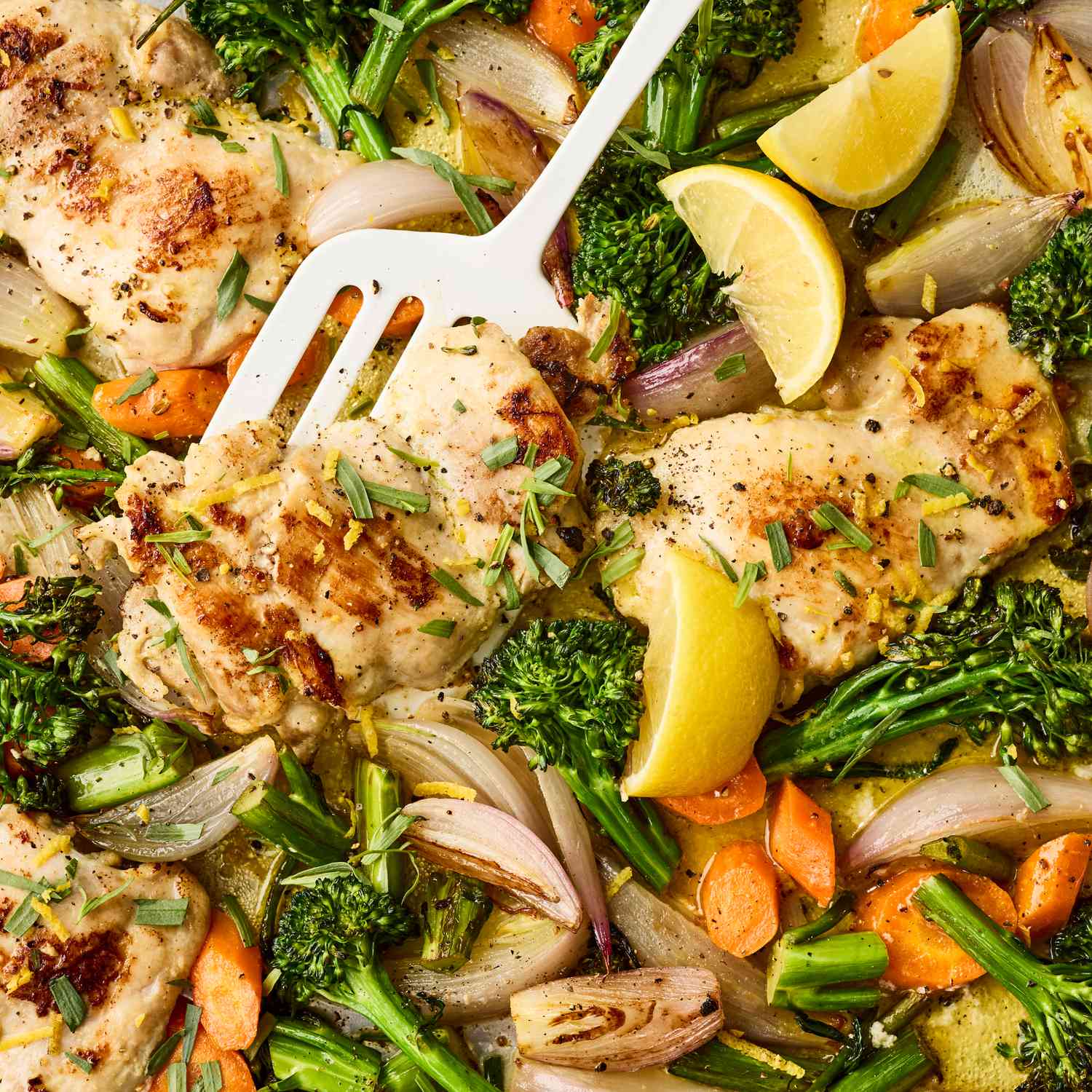
| Wednesday | Sheet Pan Lemon-Herb Chicken with Roasted Vegetables | 40 min | The 45-min night; extra chicken for Thursday |
| Thursday | Soft Baked Chicken and Veggie Quesadillas | 30 min | Uses Wednesday's chicken |
| Friday | Baked Honey-Soy Glazed Salmon with Sesame Broccoli | 25 min | The one new recipe this week |
Why this rotation works. Wednesday deliberately roasts a full extra chicken breast's worth of protein, which becomes Thursday's quesadillas — that's the leftovers strategy built in rather than hoped for. Tuesday's one-pot pasta reheats without degrading, which is what the 7 p.m. soccer arrival needs. Monday and Friday are both single-pan, and the shopping list shares broccoli, garlic, lemon and onion across four of the five nights.
Swap options by constraint. Need it cheaper? Replace the salmon with Sheet Pan Sloppy Joe Sandwiches with Ground Beef — about a third of the cost. Need it faster? Honey-Glazed Chicken Thighs with Garlic and Thyme is 35 minutes with 5 minutes of active work. Need vegetarian? Creamy Roasted Cauliflower & Sun-Dried Tomato Pasta slots straight into Tuesday. Need a slow-cooker night? Start Frozen Herb-Rubbed Pork Tenderloin with Roasted Root Vegetables in the morning.
Two more for the rotation bench. Creamy Tuscan Chicken and Pasta Skillet at 30 minutes and Instant Pot Teriyaki Chicken with Steamed Rice at 35 are the two most-repeated dinners in most families that use this system — keep them as the default when a week goes unplanned.
Building the Shopping List in One Tap
Merging is the part that saves real time. Five recipes generate somewhere between 45 and 60 ingredient lines. Merged and de-duplicated they collapse to about 30, and grouped by aisle they become a route through the store rather than a scavenger hunt. Doing that by hand takes twenty minutes; it's the single most tedious part of manual meal planning and the part software genuinely does better.
Check quantities, not just items. The merge gets "onion" right; it can't know you already have half a bag. This is why the pantry check matters.
The Instacart handoff. One tap sends the merged list to a local store. In practice you'll still want to eyeball the substitution settings — most services will swap a brand or a size, and the defaults are usually fine for pantry staples and worth checking for produce.
Budget in advance, not at checkout. If the estimate comes in over your number, the highest-leverage swaps are always protein: chicken thighs instead of breasts, ground beef instead of steak, frozen fish instead of fresh, and one bean- or egg-based dinner in place of a meat one. Two of those four swaps typically move a week by $20–25.
On shopping frequency. One trip a week is the goal, but a mid-week produce top-up is normal and not a failure. Plan the sturdiest vegetables for Thursday and Friday — cabbage, carrots, broccoli, root vegetables — and the delicate ones early.
The USDA's guidance on meal planning for a budget covers the cost side well, and the Academy of Nutrition and Dietetics' meal-planning primer is a solid neutral reference for the nutrition balance across a week.
Adapting for Allergies, Picky Eaters and Dietary Preferences
State restrictions as hard constraints in the prompt, not as an afterthought. "No peanuts" belongs in the original block, not in a correction after the plan is built. Rebuilding is more work than constraining.
Allergies need ingredient-level checking, not recipe-level. An AI plan can reliably avoid a recipe titled "peanut noodles"; it is less reliable about the fish sauce in a stir-fry or the tahini in a dressing. For a genuine allergy, read the merged ingredient list — that's the layer where a hidden ingredient shows up, and it's one screen.
Picky eating: deconstruct rather than substitute. The most effective structural trick for kids is serving components separately and letting them assemble. Taco pasta becomes pasta, meat, cheese and toppings in four bowls. Quesadillas get filled at the table. The same dinner satisfies an adult who wants everything and a seven-year-old who wants three plain things, and nobody cooks twice.
One rule that changes household dynamics: the safe side. Every dinner includes one component the picky eater reliably eats — bread, plain rice, raw carrots, fruit. They're not permitted to demand a separate meal, but they will not go hungry. That removes the negotiation from the table entirely.
Mixed diets in one household. Build the plan around a shared base and let people add. A grain bowl works for a vegetarian and a meat-eater from the same pot. So does taco night, a sheet-pan dinner where one tray section is chickpeas, and pasta with the sauce separate. This is far more sustainable than cooking two dinners, and every recipe in the rotation above adapts this way.
Cooking for one or two. Halving recipes is fiddly and produces awkward ingredient leftovers. Better: cook full recipes and plan two dinners plus two lunches from each, which is exactly the strategy in our meal planning for two guide.
Batch-Prep Strategies That Save 30 Minutes on Weeknights
The goal isn't Sunday-cooking five dinners. It's doing the shared work once.
Prep the ingredients that appear repeatedly. Look at your merged list for what shows up three or more times — usually onion, garlic, bell pepper, carrot. Dice all of it Sunday. Twelve minutes of knife work removes four to six minutes from every weeknight, which is the difference between a 30-minute recipe and a 24-minute one.
Cook the base starch once. Rice, pasta or roasted potatoes for two nights, cooled fast and stored flat. Rice in particular reheats better than its reputation suggests if you spread it thin to cool rather than leaving it in a hot lump.
Batch one protein. A tray of roasted chicken thighs, a pound of browned ground beef, or a batch of shredded chicken covers two dinners. This is the biggest single time saver on the list — most of a weeknight recipe's clock is the protein.
Make one sauce. A jar of vinaigrette, a batch of taco seasoning, a garlic-herb butter. Sauces are the flavor layer that makes repeated ingredients feel like different dinners.
What not to batch. Anything fried, anything with a crisp texture you care about, salads with dressing already on, and avocado. Batch-prepping these is how people conclude meal prep produces sad food.
| Sunday task | Time | Weeknight minutes saved |
|---|---|---|
| Dice shared aromatics | 12 min | ~20 across the week |
| Cook rice or pasta for 2 nights | 20 min | ~25 |
| Roast or brown one protein | 30 min | ~40 |
| Make one sauce or dressing | 8 min | ~10 |
| Wash and dry greens | 6 min | ~10 |
The four things that make Sunday prep worth doing. A large cutting board and a knife you actually keep sharp — twelve minutes of dicing on a small warped board is twenty minutes on a good one. A set of glass storage containers with real gasket seals, because prepped aromatics that dry out by Wednesday train you to stop prepping. A couple of half-sheet baking pans so the batched protein and the roasted vegetables go in together. And one large skillet or Dutch oven big enough to brown two pounds of ground beef in a single layer, since browning in two batches is where the "quick" one-pot dinner quietly loses ten minutes.
That's about 75 minutes on Sunday for roughly 105 minutes back across the week — and, more importantly, the recovered time is the minutes you least want to spend, at 6 p.m. with everyone hungry. For a deeper treatment, back-to-school meal prep covers the full Sunday playbook.
Common Meal-Planning Mistakes
Over-planning. Seven dinners, seven new recipes, a snack schedule and a breakfast plan. It collapses by Wednesday. Plan five dinners. Leave two nights genuinely open.
No leftovers plan. Design one dinner to feed the next. The rotation above does this on Wednesday-into-Thursday, and it's the difference between leftovers as an asset and leftovers as guilt.
No repeat wins. If every dinner is new, every dinner is a risk. Three known dinners a week is not a failure of imagination — it's what makes the system survive a bad week.
Ignoring the actual calendar. A 45-minute recipe on a soccer night is a plan that breaks itself. Match effort to the night.
Not writing it down where the family can see it. A plan that lives only in one person's head requires that person to be available and cheerful at 5:30 every day. On the fridge or on a shared screen, and the answer to "what's for dinner" stops being a question.
Buying for the plan you wish you'd made. Aspirational produce — the kale, the fennel, the thing you saw in a photo — is the most reliably wasted category in any grocery basket. Buy what the plan calls for.
Treating a broken night as a broken week. Swap the nights. The shopping is already done; that's the whole point.
When Not to Plan the Whole Week
Skip planning during the first week of school itself. Nobody knows the real schedule yet — practices move, pickup times shift, the 11-year-old joins a club on Thursday. Plan three dinners that week, keep two nights flexible, and build the real rotation once the calendar has settled.
Skip planning around a holiday week. The plan competes with travel, guests and irregular meal times, and the failure gets attributed to meal planning rather than to the week. Use the Wirecutter meal-planning guide's suggestion of a "pantry week" instead: cook from what's already in the house and shop for almost nothing.
And skip a rigid plan if the household genuinely eats on wildly different schedules most nights. A rotation assumes people eat together at least three times a week. If that's not true, the better system is a batch-cooked component menu — proteins, grains and sauces in the fridge that anyone assembles when they get in — which our freezer-friendly meal prep guide covers in depth.
Related Guides
- How to Plan Meals with AI: A Complete Guide to Smart Weekly Meal Planning — the conceptual version of this workflow
- Back-to-School Meal Prep: 5-Day Family Menu + Sunday Prep Playbook — the Sunday half in detail
- The 5-Day Family Dinner Rotation: Plan Once, Cook All Week — rotation-building without the AI step
- Meal Planning for Two: 4-Week Dinner Rotation + Shopping List — the smaller-household version
FAQ
The questions below cover the four-question framework, allergies, picky eaters, budget and how long planning actually takes.
Sources
- Meal planning — Academy of Nutrition and Dietetics
- How to meal plan — NYT Wirecutter
- Planning your meals is key to eating well on a budget — USDA
Frequently asked questions
How long does it actually take to plan a week of dinners?
What are the four questions I should answer before planning?
How do I handle food allergies in an AI-generated meal plan?
What's the best strategy for picky eaters?
How much should a week of family dinners cost?
What happens when a planned night falls apart?
Sources
Dinners the kids will actually eat.
Ask our AI to plan the week around your picky eater — one shopping list, one Instacart cart.
Plan the kids’ week →