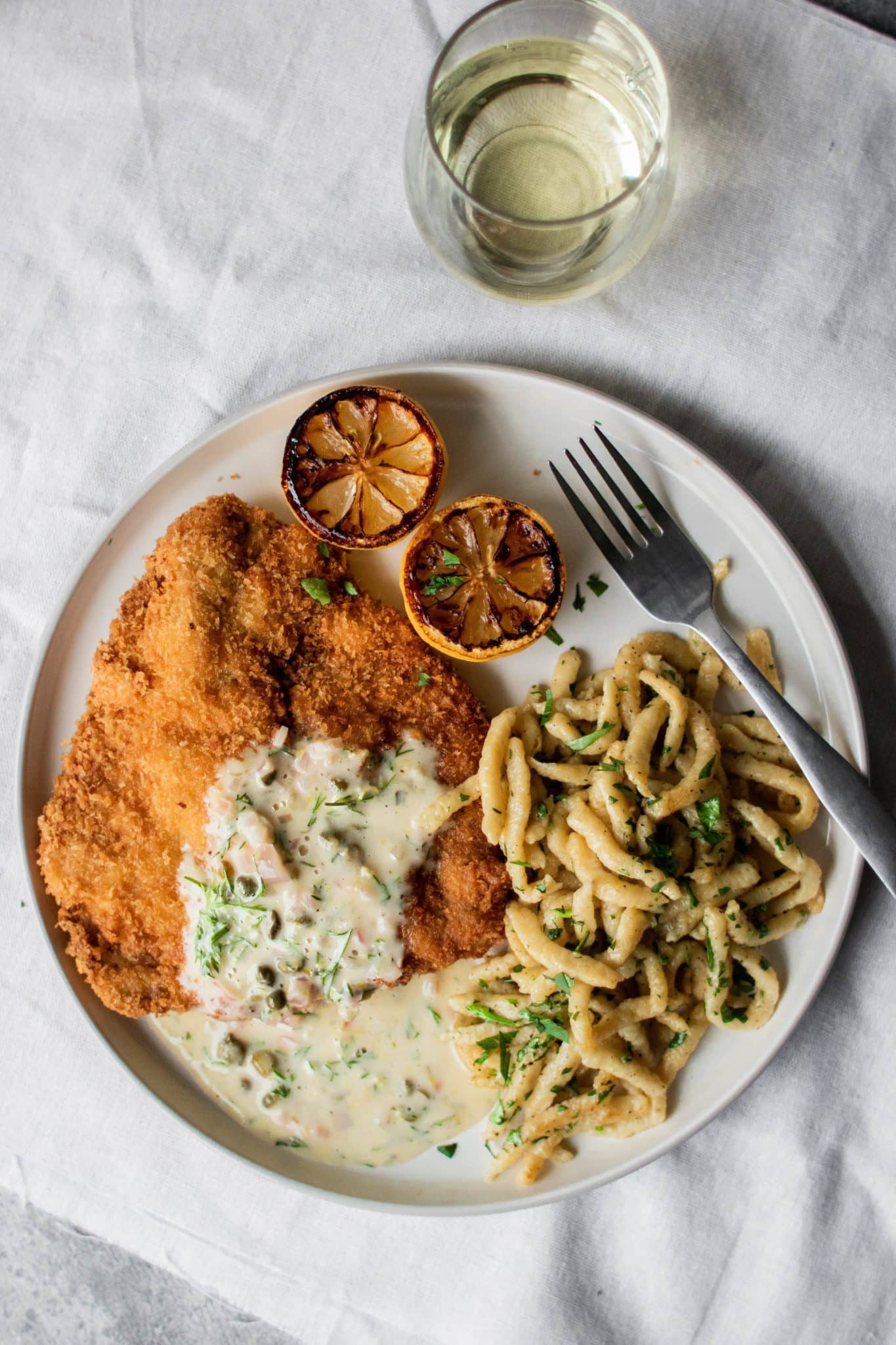
18 German Dinner Recipes: Schnitzel, Spaetzle & Cozy Weeknights
A weeknight-ready tour of schnitzel, three long-braise stews, sausage-and-kraut sheet pans, and the spaetzle and potato pancakes that make German dinners feel like a real cold-night meal.
German dinner recipes are the answer to the four coldest months of the year: heavy on braises, generous with mustard and vinegar, and built around root vegetables you probably already have. This guide walks you through 18 dinner recipes — schnitzel, spaetzle, three long-braise stews, and five sausage-and-kraut plates — with the ingredient math and technique cues you need to cook them on a weeknight.
Get a free week of easy dinners
Seven weeknight dinners with the shopping list already totalled, sent Sunday. No account needed, unsubscribe in one click.
No spam, unsubscribe in one click. Recipes, shopping lists and Instacart carts all work without an account either way.
German home cooking is comfort food with better technique
German food's reputation for being "heavy" is mostly a lost-in-translation problem. What English-language menus call heavy is actually deeply seasoned braising, careful bread-crumb frying, and the specific brand of umami you get from browned butter, mustard, capers, and long-cooked cabbage. The technique bar is low; the seasoning discipline is high. Dry the meat, salt it early, sear hard, deglaze with vinegar or wine, and let time do the rest. Almost every recipe below runs on that same rhythm.
The other thing that surprises new cooks is how weeknight-ready most of it is once you understand the meal shape: a fried or braised protein, a starchy side (spaetzle, potato pancakes, dumplings, or good rye bread), and a sharp acidic thing on the plate to cut through it (mustard, quick-pickled cucumbers, red cabbage, or a spoon of sauerkraut). Get those three components on the table and it reads unmistakably German, even if you've simplified everywhere else.
The German pantry: mustards, vinegars, and root vegetables
Six ingredients do most of the heavy lifting across the recipes below. Stock them once and you can cook German food for a week without another store run.
| Ingredient | What it does | Good weekly buy |
|---|---|---|
| Coarse Dijon or Düsseldorf mustard | Braising liquid, sauce base, table condiment | 12 oz jar; keeps 6 months refrigerated |
| Apple cider or white wine vinegar | Deglazes pans, balances stews | 500 mL bottle |
| Caraway seed | Cabbage, rye bread, sausage rubs | 2 oz jar; whole beats ground |
| Sweet paprika (edelsüss) | Goulash, schnitzel breading, potato dishes | 4 oz tin; Hungarian is fine |
| Bay leaves + juniper berries | Braises, cabbage, cured meats | Small tin each, lasts a year |
| Dark rye or pumpernickel flour | Bread crumbs, dumplings, thickener | 2 lb bag from the international aisle |
Beyond those, keep decent lard or clarified butter for schnitzel (both fry cleaner than neutral oil at the temperatures we need), plus a small bottle of Riesling that's just barely dry — it deglazes better than red for most German applications, and any half-glass you don't cook off is a fine reward for cooking dinner. Round vegetables (parsnips, turnips, celeriac, carrots, potatoes) go into every braise; buy them by the two-pound bag rather than one at a time.
If you're new to the cuisine, the German-style pork schnitzel with mustard cream sauce and Sheet Pan German-Style Beer Bratwurst with Sauerkraut and Mustard are the two easiest first cooks. Both are a full plate, both take under 40 minutes, and both use the same six pantry items.
Schnitzel four ways (Wiener, Jäger, Zigeuner, chicken)
Schnitzel is the gateway. It's chicken tenders' technique-obsessed older sibling: pound thin, three-way bread (flour, egg, crumbs), shallow-fry in enough hot fat that the crust puffs up in waves rather than sticking flat to the meat. Once you have the base cook, four variations cover 90% of the German-Austrian schnitzel canon.
Wiener — the classic, traditionally veal, pounded to a quarter-inch and shallow-fried in clarified butter or lard at 340°F. The signature is the "soufflé" — the way the breading puffs and separates from the meat. It happens because dry meat + hot fat + gentle pan-swirling let the fat wash over the top of the schnitzel, lifting the crust as it steams underneath. Try this technique first with the Sautéed Wiener Schnitzel with Lemon-Parsley Butter — pounded veal, brown butter finish, no sauce beyond the lemon.
Jäger — pork schnitzel with a mushroom cream sauce ("hunter's style"). Sear the pork first, hold it warm, then build the sauce in the same pan with butter, bacon or lardons, sliced cremini, a splash of white wine, a big spoon of Dijon, and a splash of cream. Reduce until it coats a spoon, plate the schnitzel, ladle over. If you're skipping the pork loin, the Spiced German-Style Pork Schnitzel with Mustard Cream Sauce walks through the exact deglaze sequence.
Zigeuner — schnitzel with a bell pepper and tomato pan sauce, spicier than Jäger. Same pork base; the sauce swaps in sweet peppers, red onion, sweet paprika, and a spoon of tomato paste. It's the punchiest of the four and the best pairing for spaetzle.
Chicken schnitzel — the weeknight version. Two chicken breasts butterflied and pounded to a half-inch give you four thin cutlets that cook in 3 minutes per side. See Pan-Fried Chicken Schnitzel with Lemon and Parsley for the exact bread-and-fry sequence. Serve with a mound of buttered egg noodles and a wedge of lemon; it's on the table in 25 minutes.
For any schnitzel you plan to cook: buy a real meat thermometer. Pork wants 145°F pulled with a five-minute rest, veal 145°F, chicken 165°F. Every over-fried schnitzel you've had came from someone eyeballing doneness through the crust; a thermometer solves it in one meal.
The fifth schnitzel: Holsteiner, and three more worth cooking
Four variations cover the canon, but the one that turns schnitzel night into
dinner-party food is Schnitzel Holstein — a Wiener-style cutlet topped with
a fried egg, anchovies, and capers, named for the 19th-century Prussian diplomat
Friedrich von Holstein, who reportedly wanted his whole meal on one plate so he
could keep working through lunch. It sounds like a dare and eats like a perfect
brunch: the runny yolk becomes the sauce, the capers and anchovy supply the salt
and acid that a plain lemon wedge only hints at. Build it on any pork or veal
cutlet, fry the egg in the same pan right after the schnitzel comes out, and lay
two anchovy fillets in an X across the top with a tablespoon of capers scattered
over. No cream sauce, no gravy — the yolk is the sauce.
Three more cutlets earn a place in the rotation once you have the base technique:
- Traditional German Schnitzel with Lemon-Parsley Butter — the plainest expression of the method and the one to cook first if your breading keeps falling off. Nothing on the plate but browned butter, parsley, and lemon, so every flaw in the fry shows.
- Stuttgart-Inspired Pork Schnitzel with Mushroom Cream Sauce — a Swabian jäger, built on cremini and a heavier reduction than the northern version. Serve it over spätzle, never over potatoes.
- Bavarian Mustard-Glazed Pork Schnitzel with Sauerkraut — the sweet-mustard glaze is the Bavarian move, and pairing schnitzel with kraut rather than potato salad puts the acid directly against the crust.
If you want the beer flavor in the meat rather than the glass, the Authentic German Steins Beer-Braised Pork Schnitzel breaks the fry rule on purpose: sear the breaded cutlet, then finish it in a shallow pool of dark lager. The crust softens — that is the trade — and what you get back is a cutlet that tastes seasoned all the way through. The pairing that closes the loop is Pan-Seared Schnitzel with Warm German Potato Salad, which is what most German households actually put on the table on a Friday. For the full history of how one Milanese cutlet became an Austrian national dish, Wikipedia's schnitzel entry traces the (disputed) route.
| Schnitzel | Protein | Sauce | Classic side | Active time |
|---|---|---|---|---|
| Wiener | Veal | None — lemon only | Potato salad, lingonberry | 25 min |
| Jäger | Pork | Mushroom cream | Spätzle | 35 min |
| Zigeuner | Pork | Pepper-tomato-paprika | Spätzle or fries | 35 min |
| Holstein | Veal or pork | Fried egg, capers, anchovy | Buttered potatoes | 30 min |
| Chicken | Chicken breast | None — lemon only | Egg noodles, cucumber salad | 25 min |
One-pot stews: goulash, sauerbraten, rouladen
These are Sunday cooks that repay you for four days. All three build on the same braise chassis — hard sear, mirepoix, wine-and-stock, low and slow, finish with mustard or sour cream. Once you have the rhythm, the differences are just seasoning trades.
Goulash — the Austrian-Hungarian intersection. Beef chuck cut into two-inch cubes, browned hard in lard, buried in a mountain of yellow onions cooked until they're brown and jammy, then bloomed with sweet paprika (a lot of it — half a cup per two pounds of beef), tomato paste, marjoram, caraway, and beef stock. Simmer three hours. The Austrian Braised Beef Goulash with Kaiser Roll Croutons is a canonical version — no potatoes in the pot (they get served alongside as buttered wedges), and the finish is one big spoon of sour cream stirred in off-heat right before serving.
Sauerbraten — sour-marinated pot roast. Beef bottom round marinates 3-5 days in a vinegar/wine/spice bath (juniper, cloves, allspice, bay), then braises 3 hours in the strained marinade. The signature is the finishing thickener: crushed gingersnap cookies stirred into the sauce, which sweetens, thickens, and adds spice all at once. If a four-day marinade is more commitment than you can plan, the Slow Cooker German-Style Sauerbraten with Red Cabbage compresses the marinade into six hours in the fridge, then eight hours in the crockpot.
Rouladen — thin-sliced beef, spread with mustard, layered with bacon, dill pickle, and slivered onion, rolled, tied, browned, and braised in red wine and beef stock until fork-tender. The prep looks fussy but it's actually less active work than a schnitzel line: fifteen minutes rolling, then a 90-minute simmer while you do anything else. Follow Braised Beef Rouladen with Mustard and Pickles exactly the first time; once you've done it once the pattern is memorized. Serve over egg noodles or spaetzle with the pan sauce spooned generously over.
For all three braises, a Le Creuset Enameled Cast Iron Signature Deep Round Oven, 6.5 qt is worth the money — the heavy enameled cast iron holds sear temperature when you dump in three pounds of cold beef, and the tight-fitting lid controls evaporation better than any lighter pot. If you don't want to spend the money, any 6-quart heavy cast-iron Dutch oven works; skip anything aluminum.
Braise math you can rely on
| Cut | Weight | Braise liquid | Time at low simmer | Internal temp when done |
|---|---|---|---|---|
| Beef chuck for goulash | 2 lb cubed | 3 cups stock + 1 cup wine | 2.5–3 hr | Fork slides in and out clean |
| Bottom round for sauerbraten | 3–4 lb roast | Marinade strained + 1 cup stock | 3–3.5 hr | 195°F internal |
| Rouladen | 1.5 lb rolled | 2 cups red wine + 2 cups stock | 90 min | 190°F internal |
| Pork belly for kraut supper | 2 lb slab | 3 cups pilsner + 1 cup stock | 2 hr | Fork-tender, cap crisp |
Braises reheat better than they cook fresh. Sunday's goulash is Tuesday's masterpiece. All three of the stews above hold in the fridge for four days and reheat with a splash of stock in a covered pan over low.
Sunday roasts: schweinshaxe, krustenbraten, and the beer-braised shoulder
The braises above are pot food. The other half of the German Sunday table is a
roast with a crackling exterior, and it runs on a rule that sounds wrong the
first time you hear it: wet first, dry second. You simmer or steam the pork
until the collagen has surrendered, and only then do you blast it dry with high
heat to shatter the skin. Trying to do both at once with a single oven
temperature is why home schweinshaxe comes out either leathery or pale.
Schweinshaxe (roasted pork knuckle) is the beer-hall centerpiece — a whole
hind hock, skin scored in a diamond crosshatch, simmered or slow-roasted for
about two hours with dark lager, caraway, and onion, then finished at 450°F for
20 to 25 minutes until the skin blisters into glass. One hock is 1.5 to 2 lb and
feeds one very hungry adult or two normal ones; budget about $4 to $6 per hock at
a German butcher or a Latin market, where they are sold as fresh pork hocks. The
Crispy Deep-Fried Pork Knuckle with Lemon and Thyme takes the shortcut that Bavarian restaurants use on a busy night: par-cook the hock ahead, then drop it in hot fat to order. That is a Saturday project, but it is the most reliable crackling you will get at home.
Krustenbraten is the same idea on a cheaper cut — a skin-on pork shoulder or
belly roast, scored, salted hard the night before, and roasted low until the meat
gives, then finished hot. The Slow-Roasted Pork Shoulder with German Caraway Rye Bread is the version to learn, and the rye-and-caraway crust it builds is the flavor most people mean when they say something tastes German. If you would rather the whole thing happen in a braise, the Oktoberfest Beer-Braised Pork Shoulder with Savory Potatoes puts the potatoes in the same pan and skips the crackling step entirely — a fair trade on a weeknight.
For a smaller roast that still eats like an occasion, the Maple-Glazed Roasted Pork Belly with Pickled Red Cabbage is the belly cut with the classic acid partner already on the plate.
The crackling checklist, in the order that matters:
1. Dry the skin uncovered in the fridge overnight. Twelve hours minimum. Wet skin steams; it cannot blister.
2. Score to the fat, not the meat. Quarter-inch diamonds, a sharp box cutter or a clean razor, angled shallow. Cutting into the meat lets juice up through the skin and kills the crackle in that spot.
3. Salt the skin only, and only at the end of the low phase. Salt early and it draws moisture back to the surface during the long cook.
4. Low phase: 300°F to an internal 190°F. For a 2-lb hock that is roughly two hours; for a 4-lb shoulder, closer to three and a half.
5. High phase: 450°F, 15 to 25 minutes, no lid, no basting. Watch it — the window between glass and carbon is about four minutes.
6. Rest 15 minutes, skin up, uncovered. Tenting with foil steams the crackling you just made.
Serve any of the three with red cabbage, a dumpling, and the pan juices skimmed
and reduced. This is where the Cookware shelf earns its keep: a
roast that goes from 300°F to 450°F needs a pan that will not warp, which means
enameled cast iron or heavy carbon steel, not a thin sheet tray.
Sausage & kraut dinners (5 recipes)
Sausage-and-kraut is the meal you can put on a weeknight table in 30 minutes without pretending to be anything you're not. The formula is: pick a sausage, pick a kraut treatment, add potatoes, done. Five that work every time:
1. Sheet-pan bratwurst. Brats, quartered russets tossed in oil, sliced red onion, thinly sliced apple, drained sauerkraut on top, splashed with pilsner, 400°F for 35 minutes. Everything caramelizes together. The Sheet Pan German-Style Beer Bratwurst with Sauerkraut and Mustard is the one recipe on this list I make every winter month; the version at the link is the tested one.
2. Grilled bratwurst with onions. Simmer brats in beer with sliced onions for 20 minutes to plump them and cook through, then grill hard for 3 minutes a side to blister the casing. Pile onto a bun with the beer-braised onions and coarse mustard. Try the Old Market-Inspired Grilled Bratwurst with Caramelized Onions for the exact beer-braise ratios.
3. Kielbasa and cabbage skillet. Sliced smoked kielbasa browned first, removed, then a whole shredded green cabbage cooked down in the same pan with caraway, butter, salt, and a splash of vinegar. Kielbasa back in for the last five minutes. Serves four in one pan in 25 minutes.
4. Weisswurst with sweet mustard. The white-veal Bavarian sausage is traditionally boiled (never fried), peeled, and eaten with sweet mustard, a pretzel, and a wheat beer. It's the fastest dinner in the guide — pot of water, twelve minutes, done.
5. Currywurst. Bratwurst sliced into rounds, seared in a hot pan, sauced with a mixture of ketchup, tomato paste, mild curry powder, sweet paprika, and a splash of Worcestershire. Serve over fries. This is Berlin street food translated to a weeknight; kids uniformly love it.
Buy one good coarse-grain mustard and one sharp Dijon. Between them, they season every recipe in this section.
Spaetzle, kartoffelpuffer, and side dishes
Two starches carry the German dinner: spaetzle and potato pancakes. Both are cheaper than pasta, faster than you'd expect, and forgive amateur hands.
Spaetzle. A wet dough of eggs, flour, milk, salt, and a grating of nutmeg, dropped in irregular strands into boiling salted water, cooked in 90 seconds, then finished in brown butter. You don't need a spaetzle press, but a Zoie + Chloe Spaetzle Maker Lid is the cleanest tool and takes up no drawer space. A colander with quarter-inch holes and a rubber spatula works nearly as well. Käsespätzle — cheese spaetzle — is the same dough finished with grated Emmentaler, Gruyère, and fried onions layered like mac and cheese; it's the German answer to a cold night.
Kartoffelpuffer. Grated russet potatoes squeezed absolutely dry, mixed with a beaten egg, grated onion, salt, and a spoon of flour, pan-fried in generous butter or oil until deep gold on both sides. Serve with applesauce (sweet) and sour cream (savory) on the same plate. The Berlin-Style Potato Pancakes with Applesauce and Sour Cream is the version worth memorizing — it addresses the number-one failure mode (soggy pancakes) with a specific squeezing-and-resting step. A PriorityChef 15oz Potato Ricer doubles as a moisture squeezer for the grated potato: line it with cheesecloth, load, press, catch the potato water.
Other sides worth learning: rotkohl (red cabbage braised with apple, red wine, cloves, and a splash of vinegar for two hours), knödel (bread or potato dumplings — the potato version uses the same ricer as your kartoffelpuffer), roasted parsnips with caraway, and the ubiquitous cucumber salad (thin-sliced English cucumber, salted 20 minutes to draw water, dressed with sour cream, dill, and white vinegar).
The sides that finish the plate: spätzle recipes, potato salad, rotkohl, knödel
The section above covers spätzle and kartoffelpuffer technique. Here are the
actual recipes, because in German cooking the side is frequently the reason you
cooked the main.
Spätzle, four ways. The dough is always the same — eggs, flour, milk, salt,
nutmeg — and the finish is what changes. Swabian Spätzle with Caramelized Onions is the baseline from the region that invented them; the onions go in slow, 25 minutes over medium-low, until they are jammy rather than crisp. Spätzle with Caramelized Onions and Emmental Cheese is käsespätzle, the Alpine mac-and-cheese that is a full dinner with a green salad and nothing else. When the spätzle is a side rather than the meal, Spätzle with Creamy Mushroom and Onion Sauce and the lighter Spätzle with Mushroom and Onion Gravy are the two gravies that belong under a jäger schnitzel or a rouladen. Spätzle's entry is worth two minutes if you want the regional map of what counts as a spätzle versus a knöpfle.
German potato salad — and the North/South split nobody warns you about. There
are two entirely different dishes wearing this name. Southern (Swabian, Bavarian)
potato salad is served warm and dressed with hot stock, vinegar, mustard, and
bacon fat — no mayonnaise at all. Northern potato salad is cold and mayonnaise-
bound, closer to what an American picnic serves. If you have only had the second
one and did not like it, try the first:
- Warm German Potato Salad with Bacon and Vinegar — the Swabian original. Waxy potatoes, sliced while still hot so they drink the dressing, bacon rendered and the fat poured over.
- Classic German Potato Salad with Bacon and Mustard Vinaigrette — the same idea with a sharper mustard ratio; the best one to serve alongside sausage.
- Spiced German-Style Potato Salad with Bacon and Mustard Vinaigrette — caraway and a little paprika in the dressing, which stands up to a strongly flavored main.
Three rules that separate a good German potato salad from a bowl of dressed
potatoes: use waxy potatoes (Yukon Gold or red — a russet disintegrates),
dress them hot (a cold potato is a closed potato), and **let the finished
bowl sit 30 minutes** before serving so the vinegar softens. It should be warm,
not hot, when it hits the table.
Rotkohl. Red cabbage braised with apple, vinegar, cloves, and a little sugar
is the acid that makes a rich plate work, and it is the single most improvable
side in the German repertoire — the jarred stuff is fine, and 90 minutes of your
own is dramatically better. Vinegar-Braised Cabbage with Apples and Caraway is the template. Add the vinegar at the start, not the end: the acid keeps the anthocyanins red, and cabbage braised without it turns an unappetizing blue-gray.
Knödel. Dumplings are the third starch, and the two that matter are bread
dumplings (semmelknödel) and potato dumplings (kartoffelknödel). The
Spiced German-Style Pretzel Dumplings with Mustard Cream Sauce use stale pretzels instead of stale rolls, which is both a better use for day-old pretzels and a noticeably better dumpling. For the potato version with the classic sour partner, Pan-Fried Potato Dumplings with Sauteed Sauerkraut also solves the leftovers problem: a day-old knödel sliced and fried in butter is better than it was fresh.
| Side | Serve | Make-ahead | Cost for 6 | Goes with |
|---|---|---|---|---|
| Spätzle | Hot, buttered | Par-boil 2 days ahead | $3 | Anything with gravy |
| Käsespätzle | Hot, from the pan | No — cheese breaks | $7 | It is the main |
| Warm potato salad | Warm, 30 min rested | Best 2 hours ahead | $5 | Schnitzel, sausage |
| Rotkohl | Hot | 4 days, improves | $4 | Roasts, sauerbraten |
| Knödel | Hot | Shape 1 day ahead | $4 | Braises, gravy |
The tools that make all five easier live on the Utensils & Tools
and Kitchen Gadgets shelves — a spätzle press, a ricer, and a
wide-mouth colander cover the whole section.
Modern German weeknight bowls
If you want the flavors without the four-course sit-down, three bowl formats cover most weeknights:
The schnitzel bowl. Chopped chicken schnitzel over buttered spaetzle with a fried egg on top, jäger mushroom sauce ladled over, and quick-pickled cucumbers on the side. On the table in 30 minutes if you shortcut with pre-cooked spaetzle.
The rouladen leftovers bowl. Sunday's shredded rouladen over mashed potatoes with the pan gravy poured over, a spoon of red cabbage, and coarse mustard on the side. Tuesday and Wednesday's dinner already exist.
The kraut and potato bowl. Roasted potato wedges, drained sauerkraut warmed with butter and caraway, a soft-boiled egg, a hunk of hot smoked kielbasa, and a spoon of grainy mustard. Meatless if you skip the sausage; still filling.
Four warming German soups: gulaschsuppe, linsensuppe, kartoffelsuppe, erbsensuppe
Soup in Germany is dinner, not a starter. Each of these four is a full meal in a
bowl with bread, all four freeze well, and all four cost under $12 to make for a
family of four.
1. Gulaschsuppe. The soup form of goulash — same paprika-and-onion base, cut
looser with more stock and diced smaller so it eats with a spoon. Where the stew
version wants two-inch cubes, the soup wants half-inch. Slow-Braised Czech Beef Goulash with Caraway is the caraway-forward Bohemian line, Braised Viennese Beef Goulash with Paprika and Onions is the Austrian version with a near-1:1 onion-to-beef ratio, and Sauerkraut and Beef Goulash with Paprika folds kraut into the pot — the Szegediner treatment, and the best of the three the next day. The one non-negotiable: buy fresh sweet paprika and use an absurd amount of it. Paprika older than a year is red dust with no flavor, and it is the entire backbone of this soup.
2. Linsensuppe. German lentil soup is brown or green lentils simmered with
root vegetables, smoked pork or sausage, and — the step that makes it German
rather than generic — a splash of vinegar stirred in at the end. Without the
acid it is a heavy brown bowl; with a tablespoon of red wine vinegar per quart it
snaps into focus. Lentil and Cabbage Soup is the vegetable-forward version; drop in sliced smoked sausage for the last ten minutes and you have the classic. Do not salt lentils until they are tender, and skip the soak — brown lentils cook in 30 minutes from dry.
3. Kartoffelsuppe. Potato soup, and specifically not the American creamy
kind. The German version is thickened by the potatoes themselves — half of them
mashed against the side of the pot, half left in chunks — with marjoram as the
signature herb and a sliced frankfurter or two dropped in at the end.
Hearty Cabbage and Potato Soup with Caraway is the closest catalog match and its caraway is exactly right. Use waxy potatoes for the chunks and one russet for the body; marjoram, not thyme, is the herb that makes it read as German.
4. Erbsensuppe. Split-pea soup with smoked ham hock, the workhorse of German
canteens and Christmas markets, and the cheapest good soup in this guide.
Smoky Ham Hock and Root Vegetable Split Pea Soup is the full-strength version. One 1.5-lb smoked hock and a bag of split peas runs about $8 and yields six generous bowls. Simmer the hock two hours before the peas go in, pull the meat off the bone, and skim the fat cap after the whole thing has chilled overnight.
Two more bowls worth knowing, both German-American rather than German: Milwaukee-Style Beer Cheese Soup with Pretzel Croutons — the Wisconsin descendant of the Bavarian beer-and-cheese tradition, and the right first course for an Oktoberfest table — and Authentic German Beer Stein Beef Stew, which sits between goulash and a French daube.
| Soup | Base | Simmer time | Cost for 4 | Freezes? |
|---|---|---|---|---|
| Gulaschsuppe | Beef chuck + paprika | 2 hr | $14 | Yes, 3 months |
| Linsensuppe | Brown lentils + smoked sausage | 45 min | $8 | Yes, 3 months |
| Kartoffelsuppe | Potato + marjoram | 35 min | $6 | Poorly — potatoes go grainy |
| Erbsensuppe | Split peas + ham hock | 2.5 hr | $8 | Yes, 4 months |
| Beer cheese | Lager + cheddar | 30 min | $11 | No — dairy breaks |
If you want the wider seasonal context for this kind of cooking, the
covers 22 more soups and stews built for September weeknights, several of which
share this pantry exactly. German cuisine's regional map
is also a useful orientation if you are wondering why a Bavarian bowl and a
Hamburg bowl look nothing alike.
Equipment: cast iron, spaetzle press, potato ricer
If you're building the kit for German cooking specifically, the short list is:
- Heavy cast-iron Dutch oven, 6 qt or larger — for every braise on this page. The Le Creuset Enameled Cast Iron Signature Deep Round Oven, 6.5 qt is the one to buy if you want it to outlive you; the Amazon Basics Enameled Cast Iron Dutch Oven, 7.3 qt does the same job for about a fifth of the price. Compare the field on the Cookware shelf.
- Heavy skillet — cast iron or a good stainless triply. Anything nonstick will fail the schnitzel because it won't hold enough fat at the edge to promote the crust puff.
- Meat mallet or the flat side of a heavy knife. Whatever you use, the goal is even quarter-inch pounding without tearing.
- Spaetzle press or wide-hole colander. The Zoie + Chloe Spaetzle Maker is the cleanest option.
- Potato ricer. Kartoffelknödel, kartoffelpuffer prep, and lump-free mashed potatoes all need it.
- Instant-read thermometer. For pork and veal doneness. The one-second read models are worth the extra $20 for schnitzel work.
- 8-inch chef's knife. A cheap one is fine; German cooking is heavy on cabbage and onions so keep it sharpened — the Knives & Cutting shelf tracks the 8-inch workhorses worth owning.
A sample Oktoberfest dinner party menu for eight
Munich's 2026 Wiesn runs September 19 through October 4 — it always starts the
Saturday after September 15 and ends the first Sunday in October, which is why
"Oktoberfest" is mostly a September event (official festival dates).
You do not need a tent, a band, or a dirndl to cook the menu. Here is a version
that eight people can actually eat, costing roughly $75 to $95 including beer,
with all but two items finished the day before.
This is the compact version. If you want the full beer-hall canon — six wursts, four mustards, obatzda, sauerbraten, rouladen, spätzle and strudel, with a Tuesday-to-Saturday prep schedule — the 22 German Recipes for Oktoberfest guide is the party-scale companion to this weeknight roundup.
The menu
| Course | Dish | Make-ahead | Active time |
|---|---|---|---|
| Snack | Soft pretzel bites with beer cheese dip | Dough day before, bake day-of | 40 min |
| Starter | Milwaukee-style beer cheese soup | 2 days | 30 min |
| Main | Oktoberfest bratwurst with creamy sauerkraut and Dijon | Kraut 3 days | 35 min |
| Main | Oktoberfest-style beef bratwurst with red cabbage | Cabbage 4 days | 25 min |
| Side | Warm German potato salad | 2 hours | 30 min |
| Side | Vinegar-braised cabbage with apples and caraway | 4 days | 20 min |
| Dessert | Honey-glazed Austrian apple strudel | Assemble day before, bake day-of | 45 min |
Swap in Milwaukee-Style Bratwurst with Caraway Sauerkraut
if you want one kraut treatment instead of two, add
Grilled Currywurst with Spiced Tomato Sauce
if kids are coming (it is the one every child at the table eats), and use
Musikfest-Inspired Soft Pretzels with Beer Cheese Dip
if you would rather make six big pretzels than forty bites. For a dessert that
needs no last-minute oven, Rustic Black Forest Cherry Clafoutis
gets you the Schwarzwälder flavor with about a fifth of the work of the layer cake.
The three-day plan
- Two days out. Make the beer cheese soup and the red cabbage. Both improve. Buy the brats — count 1.5 per person, not one; they disappear.
- One day out. Mix and refrigerate the pretzel dough. Assemble the strudel and keep it wrapped on a sheet tray. Braise the sauerkraut. Chill the beer — a 5-liter mini-keg is about $28 and pours better than bottles at a party.
- Day of. Bake pretzels (they are only good for two hours — do not make them early). Make the potato salad two hours before and leave it out. Simmer the brats in beer and onion 20 minutes, then grill or sear to order. Bake the strudel while everyone eats.
The beer. Serve two: a Festbier / Märzen (Paulaner, Hacker-Pschorr,
Ayinger — amber, malty, around 6% ABV) and a Hefeweizen (Weihenstephaner,
Schneider Weisse) for anyone who wants something lighter. Both are brewed under
the 1516 Reinheitsgebot purity
tradition that the six Munich breweries still cite. Budget one liter per adult
across the evening; a case of six-packs for eight people is far more than you need.
Non-alcoholic German wheat beers (Erdinger Alkoholfrei) are genuinely good and
worth having two of. For a fuller history of what the festival actually is,
Wikipedia's Oktoberfest entry covers
the 1810 royal wedding it started as.
The table. Blue-and-white check runner, mustard in three ramekins (sweet,
grainy, sharp), rye bread sliced and out, radishes and pickles in a bowl, and
pretzels in a basket. That is the entire decoration budget. The Dining & Serving
shelf covers the boards and steins if you want them, and the Grocery & Pantry
shelf tracks the sweet mustard and jarred kraut worth ordering ahead.
Common pitfalls
Five failures we see over and over in reader questions:
1. Wet meat before breading. The number-one reason schnitzel breading falls off in the pan. Pat every cutlet with paper towels for 30 seconds before flouring; the egg has nothing to grip if the surface is damp.
2. Not enough fat in the skillet. Schnitzel wants a quarter-inch of hot fat, not a light film. That's what makes the crust puff instead of stick flat.
3. Undersalting the pasta water for spaetzle. Salt like the ocean. Under-salted spaetzle water is the fastest way to make the finished dumplings taste flat no matter how much brown butter you finish with.
4. Squeezing shredded potatoes with your hands. For kartoffelpuffer, wrap in a clean towel and twist hard, or use the potato ricer. Hand-squeezing leaves them too wet and they become pancake glue in the pan.
5. Cooking down cabbage on high heat. Cabbage wants low and slow with enough liquid (wine, vinegar, apple juice) that it braises rather than sears. Blackened cabbage tastes acrid, not sweet.
Sunday cook, weekly payoff
The rhythm I've settled into: one Sunday braise (any of goulash, sauerbraten, or rouladen) that feeds four dinners across the week, plus one weeknight schnitzel and one sheet-pan sausage night. That's five German dinners a week from about three hours of active cooking. If you cook alongside the recipe pages linked above, you'll internalize the pattern by the second week and start improvising your own combinations by the third.
Related guides
German cooking sits inside a larger cluster of cold-weather, one-pot, and
European cooking on this site. If this guide worked for you, these four are the
natural next reads:
- 20 Dutch Oven Dinners: One-Pot Braises, Stews and Weeknight Roasts — the same pot, the same braise chassis, applied across a dozen cuisines. Read this if the sauerbraten and rouladen sections were the parts you liked.
- Early Fall Soup Season: 22 Comforting Soups and Stews — the direct extension of the four German soups above, sized for September weeknights.
- Apple Season Recipes: 22 Sweet and Savory Ways to Cook Fall Apples — apples do enormous work in German cooking (rotkohl, strudel, kartoffelpuffer with applesauce). This is the deep dive.
- 25 Game Day Recipes: Football Tailgate and Watch Party Menu — brats, pretzels, and beer cheese carry straight over to a tailgate, and the Oktoberfest menu above doubles as a fall party menu.
For a neighboring European cuisine with the same braise-and-acid logic and a
lighter hand, the 20 French Bistro Dinners guide
is the closest cousin. And if the equipment section convinced you it is time to
buy the pot, Best Dutch Ovens for 2026 compares
the options at every price point.
FAQ
What's the difference between Wiener Schnitzel and regular schnitzel?
True Wiener Schnitzel is legally defined in Austria as pounded veal breaded in flour, egg, and fresh breadcrumbs then shallow-fried in clarified butter or lard. Schnitzel made from pork, chicken or turkey is delicious but must legally be called Schnitzel Wiener Art ("Vienna style") on Austrian menus. At home the technique is identical across proteins — pound thin, dry the meat, bread three ways, and fry until golden with the pan gently swirling so the crust puffs and separates from the meat.
Do I need a spaetzle press to make spaetzle?
No — you have three options at home. A spaetzle press or lidded grater is cleanest. A colander with holes at least a quarter-inch wide, pressed with a rubber spatula over boiling water, works nearly as well. In a pinch, drop small dollops from a wet spoon straight into the pot. The dough should be thick enough to hold shape briefly but loose enough to drip; adjust with a tablespoon of water or flour until it slowly ribbons off the spatula.
How do I get schnitzel breading to puff instead of stick flat?
Two things drive the wave-like puff. First, dry the meat completely before flouring so the egg has something to grip; wet meat steams and the crust bonds too tightly. Second, use enough hot fat — about a quarter inch of butter or oil at 340°F — and swirl the pan gently as the schnitzel fries so the fat washes over the top and lifts the coating. Don't press the meat down or crowd the pan; both flatten the puff.
Are these German dinners kid-friendly?
Overwhelmingly yes — schnitzel is essentially a chicken tender's older sibling, spaetzle is buttered pasta with more texture, and mild sausage with kartoffelpuffer (potato pancakes) reads as breakfast-for-dinner to most kids. Skip the strong mustards and pickled sides at first; keep the sauerkraut on the adults' plates. Rouladen and sauerbraten win over reluctant eaters once the beef is sliced and served with buttered noodles.
Can I make German food ahead of time?
Braises are the German meal-prepper's dream — sauerbraten, rouladen and goulash all improve after 24 hours in the fridge as the sauce reabsorbs and rounds. Cook Sunday, reheat gently through the week. Schnitzel is best fresh but leftovers reheat in a 375°F air fryer for four minutes with the crust intact. Spaetzle can be par-boiled, tossed with a little oil, chilled up to two days, then finished in butter à la minute.
What's the best beer to cook with for beer brats and beer-braised dishes?
Use whatever pilsner, lager, or wheat beer you would actually drink — Beck's, Warsteiner, Weihenstephaner, or a domestic pale lager all work. Avoid hop-forward IPAs, which turn bitter as they reduce, and heavy stouts, which overpower everything else in the pot. For richer dishes like sauerbraten, goulash, or a beer-braised pork shoulder, a dark Munich lager or dunkel adds malty depth that a pale lager cannot. The rule of thumb: cook with a beer one shade lighter than the one you plan to drink alongside it.
Is German food always meat-heavy, or are there real vegetarian options?
Roughly half of traditional German home cooking is vegetarian, and it is the restaurant menus rather than the home kitchens that created the meat-and-potatoes reputation. Kaesespaetzle with caramelized onions and Emmental is a full dinner. So are kartoffelpuffer with applesauce, potato and bread dumplings with mushroom gravy, rotkohl, lentil soup built on vegetable stock, and mushroom jaeger sauce over spaetzle instead of a cutlet. Skip the bacon in the potato salad and add a spoon of mustard and a little extra vinegar to keep the punch.
How do I host a small Oktoberfest dinner without cooking for three days?
Cook two mains and two sides, not seven dishes. The winning eight-person menu is beer brats with sauerkraut and grainy mustard, warm German potato salad, red cabbage with apples, soft pretzels with beer cheese, and apple strudel for dessert. Everything except the pretzels and the strudel bake can be finished a day or two ahead, and both cabbage dishes are better on day three. Total cost runs $75 to $95 including a five-liter mini-keg of Festbier. Serve one amber Maerzen and one wheat beer and skip the rest of the bar.
Sources
- Serious Eats — German recipes archive
- German cuisine — regional overview
- Schnitzel — origin and regional variations
- Spätzle — regional forms and technique
- Oktoberfest — history and the six Munich breweries
- Oktoberfest.de — official 2026 festival dates
- Reinheitsgebot — the 1516 German beer purity law
Frequently asked questions
What's the difference between Wiener Schnitzel and regular schnitzel?
Do I need a spaetzle press to make spaetzle?
How do I get schnitzel breading to puff instead of stick flat?
Are these German dinners kid-friendly?
Can I make German food ahead of time?
What's the best beer to cook with for beer brats and beer-braised dishes?
Is German food always meat-heavy, or are there real vegetarian options?
How do I host a small Oktoberfest dinner without cooking for three days?
Sources
- seriouseats.com
- en.wikipedia.org
- en.wikipedia.org
- en.wikipedia.org
- en.wikipedia.org
- oktoberfest.de
- en.wikipedia.org
Recipes to start your week with
Save any of these to My Recipes — no account needed — and send the ingredients to Instacart in one tap.

Cook German at home this week.
Ask our AI for a week of German dinners — it writes the recipes, builds the shopping list, and sends the cart to Instacart. No account needed.
Plan my German week →