18 Portuguese Recipes: Bacalhau, Piri Piri Chicken & Pastel de Nata
A home cook's map of Portugal's table: the salt cod canon, the piri piri grill, and what actually works on a Tuesday.
Affiliate disclosure: AislePrompt may earn a commission on qualifying purchases made through Amazon and Instacart links in this article, at no additional cost to you. See our affiliate policy →
Traditional Portuguese recipes lean on four things: salt cod, pork and chouriço, short-grain rice, and good olive oil. Start with bacalhau à brás, piri piri chicken, caldo verde, and arroz de marisco — those four cover the seafood, grill, soup, and one-pot corners of the cuisine, and every one of them is a weeknight-length cook. The desserts are a separate project entirely.
What you'll use with it
Half these recipes turn on a temperature rather than a clock: 145°F for cod, 175°F for a piri piri thigh. The thermometer guide has five instant-reads under $100 and safe temps by protein. Read the instant-read thermometer guide →
Instant-read thermometer guide’s top pick: ThermoMaven Professional Digital Meat Thermometer $19.99 at Amazon, Check price on Amazon →Instant-read thermometer guide’s Best Value pick: Alpha Grillers Digital Instant Read $14.97 at Amazon, Check price on Amazon →Instant-read thermometer guide’s Best for Beginners pick: TempPro TP19 Waterproof Thermocouple $27.99 at Amazon, Check price on Amazon →The braises and rice here want a heavy pot with a tight lid, which also does the job of a $120–200 copper cataplana. The Dutch oven guide picks that pot, from Le Creuset down to budget enameled cast iron from Tramontina. Read the Dutch oven guide →
Dutch oven guide’s top pick: Le Creuset Signature Round Dutch Oven, 5.5 qt $363.95 at Amazon, Check price on Amazon →
Introduction — Portugal's overlooked place at the European table
Spain gets the tapas books. Italy gets the pasta empire. Portugal gets treated as a footnote, despite 1,115 miles of coast and eight centuries of trade. Those routes ran through Africa, India, and Brazil, and the food still shows it. That is a mistake you can fix in a single grocery run.
Portuguese cuisine is built on cheaper protein than its neighbors: salt cod instead of fresh turbot, pork shoulder instead of veal, rice and potatoes in the same dish because both were cheap. That frugality is exactly what makes it good weeknight food. A piri piri chicken costs under $12 for four servings. A pot of Caldo verde is potatoes, kale, a link of sausage, and 30 minutes.
The other thing to know: Portuguese cooking is not spicy the way Thai or Sichuan food is spicy. Even the piri piri dishes sit around a medium heat, built on aromatics — garlic, bay, paprika, lemon — with chili as an accent. If your household has one person who "can't do heat," this cuisine still works.
Below are 18 recipes organized the way you'd actually cook them: the salt cod canon, the piri piri grill, the rice pots, the small plates, a weeknight rotation, a Sunday lunch menu, and dessert. Every recipe links to a full page with quantities and steps.
The Portuguese Pantry: olive oil, pimenton, bay leaves, dry chourico
Six ingredients get you 80% of the way. Buy these once and the rest of this article becomes a shopping list of proteins.
Olive oil. Portugal produces roughly 150,000 tonnes a year, and the domestic style runs greener and more peppery than Spanish or Italian oil. You will use it in volumes that feel wrong if you're used to French cooking — a quarter cup to start a rice, another quarter poured over the finished plate. Buy the 1-liter tin, not the 500ml bottle.
Smoked paprika (pimentão / pimentón). Sweet, not hot. This is the color and backbone of chouriço, of the marinades, of the pork rubs. A 3-oz tin runs $6 and lasts a year if you keep it dark and sealed.
Bay leaves. Portuguese cooking uses bay far more aggressively than American recipes suggest — two or three leaves in a braise, not one. Fresh or recently-dried; the gray dust in the back of your spice drawer contributes nothing.
Dry-cured Chouriço. Not Mexican chorizo (raw, crumbly) and not quite Spanish chorizo (usually sweeter). Portuguese chouriço is garlic-and-paprika heavy and firm enough to slice into coins. Spanish chorizo is the accepted substitute in every recipe here — it's what most US grocery stores stock. Try Portuguese-Inspired Sautéed Chorizo with Peppers as your first use of the link.
Salt cod (bacalhau). The one that requires planning. See the next section.
Garlic, lemons, and coarse sea salt. In quantities that would alarm your cardiologist. A head of garlic per braise is normal.
Two tools earn their space: a heavy pot for the braises and rice — a Le Creuset Signature Round Dutch Oven, 7.25 qt at about $330 if you're buying once and forever, or the Lodge Cast Iron Combo Cooker at $60, roughly a fifth the price and functionally identical for everything in this article — and a granite mortar and pestle for piri piri paste. A blender works; a mortar gives you a paste that clings to chicken skin instead of sliding off. You will also spend real time cutting potatoes into matchsticks and slicing sausage into coins, so a sharp 8-inch blade like the Victorinox Fibrox Pro Chef's Knife earns its $44 here. Half this article turns on hitting a temperature rather than a clock — 145°F for cod, 175°F for a piri piri thigh, 220°F for nata syrup — so a $14 instant-read thermometer does more for your results here than any pan upgrade. Browse the rest of the cookware category if you're building from nothing.
Bacalhau: 5 ways to cook Portugal's national ingredient
Bacalhau — salt-dried cod — is the ingredient Portugal built an empire around. The country still consumes roughly 20% of the world's salt cod supply despite having no cod fishery of its own. There are famously "365 ways" to cook it; here are five that work in an American kitchen.
The soak is non-negotiable. Thick center-cut loin needs 24 to 48 hours in cold water in the refrigerator, with the water changed three times. Thin tail pieces need 12. Skipping the soak produces something closer to a salt lick than dinner. Taste a flake before you cook — it should read as seasoned fish, not brine.
| Recipe | Total time | Servings | Calories | Protein (g) |
|---|---|---|---|---|
| Bacalhau à Brás | 50 min | 4 | 420 | 35 |
| Portuguese-Style Cod with Tomato & Olive Ragout | 30 min | 4 | 280 | 35 |
| Baked Cod with Garlic-Parsley Crust | 25 min | 4 | 280 | 35 |
| Oven-Baked Cod with Seasoned Potato Wedges | 40 min | 4 | 320 | 30 |
| Salted Cod Fritters | 30 min | 4 | 320 | 22 |
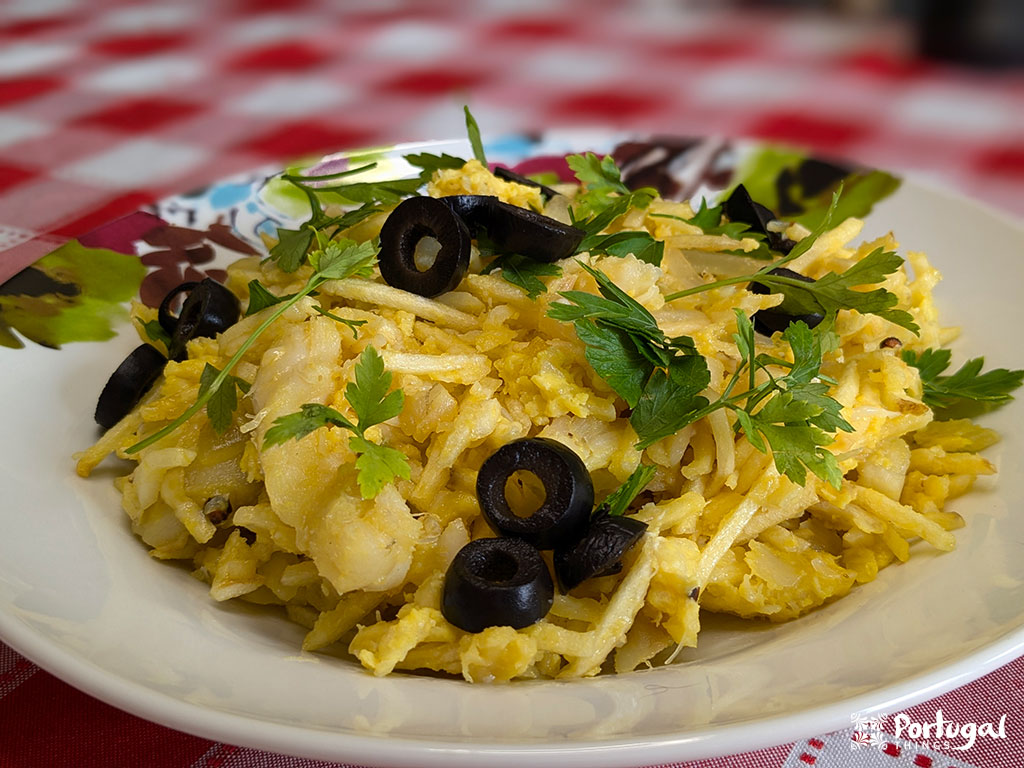
1. Bacalhau à Brás with Sautéed Onions and Parsley — the one to learn first. Shredded cod, matchstick potatoes, onions, and eggs folded together off the heat so the egg stays creamy rather than scrambling. The failure mode is heat: pull the pan before the eggs look done, because carryover finishes them in about 20 seconds.
2. Spiced Portuguese-Style Cod with Tomato and Olive Ragout — a 30-minute weeknight version built on fresh cod loin rather than salted. This is the recipe to make when you want the flavor profile tonight and forgot to start a soak on Tuesday.
3. Baked Cod with Garlic-Parsley Crust — 25 minutes start to finish, 280 calories and 35g protein per serving. The Portuguese move here is the volume of garlic and the olive oil poured over at the table.
4. Oven-Baked Cod with Seasoned Potato Wedges — the structural cousin of bacalhau à Gomes de Sá, the Porto casserole of cod, potato, onion, and egg. Same components, sheet-pan execution.
5. Pan-Fried Salted Cod Fritters — these are pastéis de bacalhau in everything but name. Swap the scotch bonnet aioli for plain lemon and garlic mayo and you have the Lisbon bar snack exactly. Cook to an internal 145°F per the FDA's seafood guidance.
Piri Piri: the sauce and the chicken
Piri piri is a Portuguese-African hybrid: the bird's-eye chili came back from Angola and Mozambique on Portuguese ships, met garlic, lemon, and paprika in Lisbon, and became the national grill sauce. Nando's built a global chain on one regional recipe.
The base sauce, in five minutes: 8–12 bird's-eye chilies (or 4 red serranos plus a teaspoon of cayenne), 6 garlic cloves, the juice of 2 lemons, 2 tablespoons smoked paprika, 1 tablespoon red wine vinegar, ½ cup olive oil, 2 teaspoons salt. Blend or pound. It keeps three weeks refrigerated and improves for the first four days.
The chicken technique that matters: spatchcock the bird, marinate at least 4 hours (12 is better), grill skin-down over medium — not high — for 20 minutes, then flip and baste every 5 minutes until the thigh hits 175°F. High heat burns the paprika and sugars before the thigh cooks. Medium and patience is the whole trick.
| Recipe | Total time | Servings | Calories | Protein (g) | Difficulty |
|---|---|---|---|---|---|
| Grilled Piri-Piri Chicken with Alfama Citrus Marinade | 30 min | 6 | 350 | 40 | medium |
| Piri-Piri Chicken with Lemon and Olives | 60 min | 4 | 420 | 38 | easy |
| One-Pan Piri Piri Chicken with Roasted Vegetables | 60 min | 4 | 450 | 42 | easy |
| Slow-Roasted Pork Shoulder with Piri-Piri Sauce | 5 hr 20 min | 6 | 450 | 45 | medium |
| Slow Cooker Portuguese Chicken with Piri Piri | 6 hr 15 min | 4 | 350 | 35 | easy |
6. Grilled Piri-Piri Chicken with Alfama Citrus Marinade — 15 minutes of prep, 15 on the grill, feeds six at 350 calories and 40g protein per portion. This is the benchmark version.
7. Piri-Piri Chicken with Lemon and Olives — oven route, no grill required, and the olives add the salt-and-brine note that lemon alone misses.
8. One-Pan Piri Piri Chicken with Roasted Vegetables — the whole dinner on one sheet, 450 calories and 42g protein. For a smaller portion, Pan-Seared Chicken with Portuguese Piri-Piri Sauce serves two in 25 minutes.
9. Slow-Roasted Pork Shoulder with Portuguese Piri-Piri Sauce — five hours unattended, 45g protein per serving, and the leftovers become sandwiches for three days. If you'd rather it run while you're at work, the slow-cooker chicken version does six hours hands-off, and Bom Jesus-Inspired Piri-Piri Shrimp cooks in six minutes when you need dinner immediately.
Five more piri piri routes, depending on what your Tuesday looks like:
| Recipe | Total time | Servings | Calories | Protein (g) |
|---|---|---|---|---|
| Piri-Piri Chicken with Lemon and Garlic | 45 min | 4 | 280 | 22 |
| Spiced Portuguese Chicken with Piri-Piri Sauce | 60 min | 4 | 420 | 38 |
| Sheet Pan Portuguese-Style Roasted Chicken with Piri-Piri Sauce | 55 min | 4 | 420 | 35 |
| Sheet Pan Portuguese-Inspired Chicken with Piri Piri Marinade | 80 min | 4 | 420 | 35 |
| Spiced Portuguese-Style Shrimp with Garlic and Piri Piri | 13 min | 4 | 210 | 30 |
Piri-Piri Chicken with Lemon and Garlic is the leanest of the group at 280 calories and 18g fat — skin-off thighs, no grill. Spiced Portuguese Chicken with Piri-Piri Sauce is the opposite: bone-in, skin-on, 28g fat, and the one that tastes most like a Lisbon churrasqueira. The two sheet-pan versions — Sheet Pan Portuguese-Style Roasted Chicken and Sheet Pan Portuguese-Inspired Chicken with Piri Piri Marinade — differ only in marinade time: 15 minutes of prep versus 40, and the longer marinade is genuinely worth it if you start it at lunch. When you have 13 minutes and nothing else, Spiced Portuguese-Style Shrimp with Garlic and Piri Piri delivers 30g of protein for 210 calories.
Rice & One-Pot Dishes: arroz de pato, arroz de marisco
Portuguese rice dishes are wetter than paella — closer to a risotto's looseness, deliberately. Arroz de marisco, the seafood rice of the Alentejo coast, is served soupy enough to eat with a spoon. If your rice looks like pilaf, you've reduced too far.
Use short or medium grain (Arborio and Calrose both work; long-grain basmati does not). The ratio is roughly 3.5 parts liquid to 1 part rice for the soupy style, versus 2:1 for a dry pilaf.
10. One-Pan Spicy Shrimp and Tomato Rice Skillet — 35 minutes, 350 calories, 32g protein and 40g carbs across four servings. This is the weeknight arroz de marisco: the same tomato-and-garlic rice base, shrimp instead of a mixed shellfish haul. Add a pound of scrubbed clams in the last 6 minutes and you have the real thing; their liquor becomes the seasoning, so don't salt until the shells have opened. For a richer, oilier take, Sautéed Shrimp and Garlic Rice with Roasted Red Pepper Sauce runs 35 minutes and 450 calories for three.
11. Bom Jesus-Inspired Portuguese Shrimp Rice Pilaf — the drier northern treatment, 35 minutes, and the one that reheats best for lunch the next day.
12. Portuguese-Style Feijoada with Mixed Pork Cuts and Chorizo — the Portuguese ancestor of Brazil's national dish. Feijoada in Portugal uses white beans as often as black, and the Trás-os-Montes version leans on the whole pig. 600 calories and 50g protein per serving over two hours, feeding five. If you want to taste the divergence, cook it back to back with Feijoada Carioca Black Bean and Pork Stew — the Rio version, black beans, 2.5 hours, 520 calories and 45g protein for six. Same architecture, different bean and a much heavier hand with the smoked cuts.
Serve any of these with Saffron-Scented Rice with Peas and Almonds if you want a second starch on the table, which is very Portuguese and completely unnecessary nutritionally.
A note on the Cataplana: the hinged copper clam-shell pot from the Algarve is beautiful and costs $120–200. A Dutch oven with a tight lid produces the same result. Buy the cataplana when you love the cuisine, not to start cooking it.
Petiscos (Portuguese small plates)
Petiscos are Portugal's answer to tapas — smaller, less formal, usually eaten standing at a tiled counter with a beer. Three or four of these plus bread is dinner for four people.
13. Portuguese-Inspired Sautéed Chorizo with Peppers — 25 minutes, serves three, 350 calories. In Portugal this often arrives flaming on a ceramic dish of aguardente; the skillet version tastes identical.
14. Portuguese-Style Shrimp Pil Pil with Garlic and Chili — 15 minutes total, 220 calories, 25g protein. The garlic oil left in the dish is the point; have bread. The near-identical Spiced Portuguese-Style Shrimp with Garlic and Chili and Sautéed Portuguese Shrimp with Garlic and White Wine give you two more angles on the same 10-minute idea.
15. Oyster Bar Style Steamed Clams with Garlic and White Wine — 20 minutes, 180 calories, 20g protein. Add a fistful of chopped cilantro at the end and you have ameijoas à Bulhão Pato, the Lisbon classic, almost exactly. Mussels are the cheaper swap and cook the same way — Oyster Bar-Style Steamed Mussels with Garlic and White Wine is 27 minutes, 220 calories, and 30g of protein for four, which is the best protein-per-dollar on this entire page.
Worth knowing for a shopping list even though they're hard to source in the US: Presunto, the dry-cured Portuguese ham, and Alheira, the bread-and-poultry sausage invented by Portuguese Jews to imitate pork. Both show up on any real petiscos board.
Weeknight Portuguese Dinners (8 recipes)
Everything in this section is on the table in 45 minutes or less, or runs unattended while you do something else.
| Recipe | Total time | Servings | Calories | Protein (g) |
|---|---|---|---|---|
| Spiced Portuguese-Style Shrimp with Garlic and Chili | 15 min | 4 | 210 | 32 |
| Portuguese-Style Shrimp Pil Pil | 15 min | 4 | 220 | 25 |
| Baked Cod with Garlic-Parsley Crust | 25 min | 4 | 280 | 35 |
| Portuguese-Style Chorizo and Potato Skillet | 35 min | 4 | 400 | 18 |
| Caldo Verde Soup with Kale and Chorizo | 45 min | 6 | 280 | 18 |
| Smoky Chouriço Potato Kale Soup | 50 min | 4 | 320 | 10 |
| Braised Portuguese Chorizo and Potato Stew | 50 min | 4 | 380 | 22 |
| Spicy Portuguese Chorizo and Chickpea Stew | 35 min | 4 | 380 | 22 |
16. Spiced Portuguese-Style Caldo Verde Soup with Kale and Chorizo — the national soup, 45 minutes, feeds six at 280 calories. The technique detail everyone misses: shred the kale into ribbons no wider than 1/8 inch, and add it in the last 5 minutes so it stays green. The Smoky Chouriço Potato Kale Soup is a chunkier variation with a heavier sausage hand.
Round out the rotation with the Portuguese-Style Chorizo and Potato Skillet (35 minutes, one pan), the Braised Portuguese Chorizo and Potato Stew, the Spicy Portuguese Chorizo and Chickpea Stew for a meatless-adjacent night, and the Sheet Pan Portuguese-Spiced Chicken with Roasted Potatoes at 480 calories and 40g protein for the highest-protein option in the group. A 12-inch sauté pan with a lid handles six of these eight without a second dish.
Three more that stretch the rotation past a week: Spiced Bom Jesus-Inspired Portuguese Chicken Stew is 65 minutes for six at 420 calories and 40g protein — the highest-yield pot in this section and the best leftovers. Smoked Sausage Bean Stew with Paprika is the weeknight-scale answer to feijoada: 80 minutes, 420 calories, 55g of carbs, and it costs under $10 to feed four. And Baked Portuguese Palm Fruit and Chickpea Stew is the one fully vegan main in the Portuguese section of our catalog — 80 minutes, 280 calories, 12g plant protein for six.
Weekend Sunday Lunch Menu
Portuguese Sunday lunch runs long — 1pm to 4pm is normal, three courses, wine throughout. Here's a menu that scales to eight people and requires about 40 minutes of active work.
To start (12:30): the chorizo with peppers and the clams in white wine, with bread and olives. Pour Vinho Verde — the slightly fizzy young white from the Minho, usually 9–11% ABV, $9–14 a bottle, and the correct answer for the entire first half of this meal.
Main (1:30): 17. Portuguese-Inspired Braised Pork with White Wine and Bay Leaves — 2 hours 45 minutes, mostly unattended, 380 calories and 35g protein for six. This is the structural template of Carne de porco à alentejana, the pork-and-clams dish that sounds wrong and tastes inevitable; add a pound of clams in the last 10 minutes to make it literal.
Two alternates if pork shoulder isn't in the cards: Slow Cooker Portuguese-Style Pork with Orange and Bay Leaves (6 hours hands-off, 320 calories) or Spiced Portuguese-Style Pork Tenderloin with Garlic and Paprika (65 minutes, leaner at 38g protein and 18g fat).
With it: the shrimp and tomato rice if you want to go full coastal, or just potatoes roasted in the braising fat.
Dessert (3:00): below. Then Port wine — a 10-year tawny, served in a small glass at cellar temperature, roughly 60°F. The IVDP is the regulator that certifies every bottle's age statement, so the number on the label is meaningful rather than marketing.
A 3-Day Portuguese Menu with Wine Pairings
Sunday lunch is the showpiece. This is the part that actually changes how you eat: three consecutive weeknights, one shopping trip, roughly 35 minutes of active cooking a night, and a bottle that carries all three.
Buy once for all three nights: 2 lb shrimp (frozen 16/20 is fine), 1.5 lb bone-in chicken thighs, a link of dry-cured chorizo, 2 lb Yukon Gold potatoes, a bunch of kale, a head of garlic, 2 lemons, a 28-oz can of tomatoes, a cup of short-grain rice, smoked paprika, bay leaves, and a liter of olive oil. About $55 at a US supermarket as of August 2026, and it feeds two people for three dinners with lunch leftovers on day two.
| Night | Main | Active time | Calories | Protein (g) | Pour |
|---|---|---|---|---|---|
| Monday | Spiced Portuguese-Style Shrimp with Garlic and Piri Piri | 13 min | 210 | 30 | Vinho Verde |
| Tuesday | One-Pan Spicy Shrimp and Tomato Rice Skillet | 35 min | 350 | 32 | Vinho Verde |
| Wednesday | Caldo Verde with Kale and Chorizo | 45 min | 280 | 18 | Dão red |
Monday — Spiced Portuguese-Style Shrimp with Garlic and Piri Piri. Thirteen minutes, one skillet, 30g of protein for 210 calories. Bread on the table to mop the garlic oil is not optional; it's the dish. Pour Vinho Verde — 9–11% ABV, $9–14, slightly spritzy, and the carbonation is what resets your palate between bites of chili oil. Open the bottle Monday and it will still be good Tuesday.
Tuesday — One-Pan Spicy Shrimp and Tomato Rice Skillet. Same bottle, same skillet, 35 minutes. Use the shrimp shells from Monday if you saved them: 10 minutes simmered in water makes a stock that turns this from good to restaurant-grade. Rice ratio is 3:1 liquid to grain here — you want it loose enough to spoon.
Wednesday — Spiced Portuguese-Style Caldo Verde Soup with Kale and Chorizo. Forty-five minutes, feeds six at 280 calories, so Thursday's lunch is already handled. This is where you switch to red: a Dão at $12–18 is the classic pairing — high-acid, medium-bodied, grippy enough for the chorizo fat without steamrolling the potato. A Douro red is the bigger, darker alternative if the sausage is heavy-handed, and an Alentejo red is the softer, fruitier one if your table doesn't like tannin.
If you'd rather not open wine at all, the Portuguese non-alcoholic move is citrus and honey: Portuguese Honey Lemonade Fizz is 7 minutes and 140 calories, and it cuts piri piri heat better than beer does. For a proper aperitif, Portuguese Pomegranate Gin Fizz (140 calories) before the shrimp, or a Portuguese Orange and Cinnamon Old Fashioned (180 calories) after the soup, both track the cuisine's citrus-and-warm-spice register without a trip to a specialty store.
Scaling to a full week: add Spiced Bom Jesus-Inspired Portuguese Chicken Stew on Thursday (65 minutes, feeds six) and Sheet Pan Portuguese-Spiced Chicken with Roasted Potatoes on Friday, and the same chorizo, potatoes, garlic and paprika carry all five nights without a second shop.
Pastel de Nata & Portuguese Desserts
Pastel de nata is the one Portuguese dish that has genuinely conquered the world — Lisbon's Pastéis de Belém has been making them from an 1837 monastery recipe and sells over 20,000 a day.
The three things that separate a real one from a sad grocery-store egg tart:
1. Oven temperature. 500–550°F. The custard must set and the top must blister black in 12–14 minutes. A 375°F oven gives you a pale, rubbery tart. If your home oven caps at 500°F, preheat for a full 45 minutes and bake on the top rack.
2. Sugar syrup, not raw sugar. The custard is thickened milk plus a 220°F sugar syrup poured in while whisking. Dumping sugar into the milk gives a grainier set.
3. Laminated dough rolled into a spiral. The pastry is rolled, spiraled, sliced into pucks, and pressed up the sides of the mold with a wet thumb — not cut as flat rounds. Store-bought puff pastry is a legitimate shortcut used widely in Lisbon.
You do not need the traditional shallow tart molds. A standard 12-cup muffin pan produces a deeper tart with the same custard-to-pastry balance; browse the rest of the bakeware selection if you're outfitting for baking generally.
18. Bom Jesus-Inspired Portuguese Almond and Orange Cake — 60 minutes, serves eight at 320 calories. Almond-and-egg-yolk cakes like this are the convent-dessert tradition, born from monasteries using egg whites to starch habits and finding a use for the leftover yolks.
Two more to round out the table: Arroz doce, Portuguese cinnamon rice pudding, is closely tracked by this Classic Vanilla Rice Pudding with Cinnamon — dust the top with cinnamon in a lattice pattern and it's the real thing. And for the custard technique itself, the Half & Half Custard Tart with Vanilla and Nutmeg is the closest base in our catalog to a nata filling; swap the nutmeg for a lemon peel and a cinnamon stick steeped in the milk.
The convent-dessert tradition travelled, too. Quindim is what Portuguese egg-yolk sweets became in Brazil once coconut entered the recipe — this version makes 12 at 185 calories each in an hour, and the technique (yolks, sugar, a water bath, no flour at all) is the same one behind every doce conventual on a Lisbon pastry counter.
Where to Source Salt Cod, Chouriço, and Piri Piri Chilies
Three ingredients decide whether this cuisine works in an American kitchen. None of them are hard to get; all three are easy to get wrong.
Salt cod (bacalhau). Buy thick center-cut loin, not the shredded flakes or the thin tail pieces — loin rehydrates into meaty flakes, tail turns to string. In order of how likely you are to find it: Portuguese and Brazilian markets stock it year-round in wooden boxes or vacuum packs; Italian and Caribbean grocers carry it as baccalà and saltfish respectively, which is the same product; Whole Foods and larger supermarkets put it near the fish counter from roughly early December through Easter and rarely otherwise; and shelf-stable boneless packs ship nationwide from Amazon and Portuguese online grocers. Expect $12–22 a pound. Norwegian and Icelandic cod is the standard, and the box will say so. It keeps a year in a cool, dry cupboard — it is a preserved food, not a refrigerated one — and one pound rehydrates to roughly 1.6 pounds, feeding four. Budget the soak before you budget the cooking: 24–48 hours refrigerated for loin, three water changes, and taste a raw flake before you commit it to a dish.
Chouriço. Portuguese chouriço is dry-cured, firm enough to slice into coins, and built on garlic and sweet smoked paprika. It is not Mexican chorizo, which is raw and loose and will render into orange grease. Spanish dry-cured chorizo is stocked by nearly every US supermarket and is the accepted substitute in every recipe on this page — check that the label says "cured" or "dry," and prefer dulce over picante since you're adding heat separately. If you want the real thing, Gaspar's and Amaral's are the two Portuguese-American brands (both out of southeastern Massachusetts, where the diaspora concentrated) that ship nationally and turn up in New England supermarkets. $8–14 per link. Presunto and alheira are much harder — special-order or a trip.
Piri piri chilies. Fresh African bird's-eye is uncommon outside Indian, African, and Southeast Asian grocers, where it's sold as bird's eye or Thai chili — close enough that no one at your table will know. Dried whole is the easy year-round option and lives in the Latin or Indian aisle. The workable supermarket substitute is 4 red serranos plus a teaspoon of cayenne per 8–12 bird's-eyes. Skip the pre-made "piri piri sauce" bottles: most are 60% vinegar and go sour on the grill where the homemade blend caramelizes. A batch takes five minutes and keeps three weeks.
One thing worth mail-ordering: pimentão paste (massa de pimentão), the red-pepper-and-salt paste that Portuguese cooks rub on pork before it ever sees heat. There is no clean supermarket substitute, a jar runs $6–9, and it lasts months refrigerated. It's the single ingredient most likely to make a home-cooked Portuguese dish taste like the restaurant version.
Common Pitfalls
Five failures we see repeatedly, and the fix for each.
Under-soaking the salt cod. 12 hours is not 24 hours. Thick loin pieces need a full day with three water changes, refrigerated. Taste before you commit the fish to a dish — a raw flake should taste like seasoned fish, not seawater.
Grilling piri piri chicken over high heat. The paprika and lemon sugars burn at around 400°F while the thigh is still at 130°F. Medium heat, skin-down first, 20 minutes before the first flip.
Buying Mexican chorizo for a Portuguese recipe. It's raw, loose, and vinegar-forward — it will render into orange grease rather than hold its shape as coins. Spanish dry-cured chorizo is the correct substitute for chouriço; check that the label says "cured" or "dry."
Cooking seafood rice to pilaf dryness. Portuguese seafood rice is meant to be spoonable. Pull it while there is still visible liquid; it tightens by a third in the two minutes between stove and table.
Salting a clam dish early. Clam liquor is already at roughly 2% salinity. Season at the end, after the shells have opened and released, or you'll overshoot every time.
When This Cuisine Isn't the Right Call
Be honest about the fit. Portuguese food is heavy on pork, shellfish, and salt cod, which makes it a poor match for a strictly vegetarian household. Baked Portuguese Palm Fruit and Chickpea Stew is the one genuinely vegan Portuguese main we carry, and the chickpea-and-chorizo stew works meat-free if you drop the sausage and add smoked paprika to compensate — but that is two options against fifteen that lean on pork or shellfish, and pretending otherwise wastes your time. It's also a sodium-forward cuisine by construction: cured sausage, salt-preserved fish, and olives in the same dish. If someone at your table is on a restricted-sodium plan, the piri piri chicken and fresh-cod recipes work but the bacalhau canon largely does not.
And if you want fast: the small plates and shrimp dishes hit 15 minutes, but the cuisine's best work — the braises, the feijoada, the slow-roasted shoulder — is Sunday cooking. Don't start a Portuguese pork shoulder at 6pm on a Tuesday.
For adjacent cuisines that solve some of these constraints, see our 22 Spanish Tapas Dinner Recipes, the 25 Mediterranean Weeknight Dinners, and 20 One-Pan Seafood Dinners Ready in 30 Minutes or Less.
One last dish that deserves mention and that nobody should attempt casually: the Francesinha of Porto — a sandwich of steak, ham, sausage, and cheese drowned in beer-and-tomato sauce, topped with a fried egg, and served with fries. It is roughly 1,200 calories. It is also the single best hangover food in Europe, and worth a trip. Visit Portugal maintains a regional food guide if you're planning one.
Prices and availability noted here are as of August 2026.
Frequently asked questions
Where do I buy salt cod (bacalhau) in the US?
What's the difference between piri piri sauce and hot sauce?
Can I make pastel de nata without special egg tart pans?
Is Portuguese food similar to Spanish food?
What wines pair with these Portuguese dishes?
Do I need special equipment to cook Portuguese food?
Can these Portuguese recipes work on a weeknight?
Sources
- en.wikipedia.org: Portuguese cuisine
- en.wikipedia.org: Caldo verde
- en.wikipedia.org: Chouriço
- en.wikipedia.org: Bacalhau
- en.wikipedia.org: Pastel de bacalhau
- fda.gov
- en.wikipedia.org: Piri piri
- en.wikipedia.org: Bird's eye chili
- en.wikipedia.org: Arroz de marisco
- en.wikipedia.org: Feijoada
- en.wikipedia.org: Cataplana
- en.wikipedia.org: Presunto
- en.wikipedia.org: Alheira
- en.wikipedia.org: Vinho Verde
- en.wikipedia.org: Carne de porco à alentejana
- en.wikipedia.org: Port wine
- ivdp.pt
- en.wikipedia.org: Dão DOC
- en.wikipedia.org: Douro DOC
- en.wikipedia.org: Alentejo DOC
- en.wikipedia.org: Pastel de nata
- en.wikipedia.org: Arroz doce
- en.wikipedia.org: Quindim
- en.wikipedia.org: Francesinha
- visitportugal.com