18 Smoked Seafood Recipes: Salmon, Trout & Oyster Weekend Dinners
Fish takes smoke in 90 minutes instead of 12 hours — the only hard part is a five-degree window most people blow straight past.
Smoked seafood is the fastest high-value cook on any smoker: hot-smoked salmon is done in 90 minutes at 180°F, trout in about an hour, oysters in five minutes. These 18 recipes cover salmon, trout, shellfish and big-format fish, plus the brine ratios, wood pairings and temperature chart that keep fish moist instead of chalky.
Get a free week of easy dinners
Seven weeknight dinners with the shopping list already totalled, sent Sunday. No account needed, unsubscribe in one click.
No spam, unsubscribe in one click. Recipes, shopping lists and Instacart carts all work without an account either way.
Introduction: Why seafood on the smoker deserves as much love as brisket (and takes 1/8 the time)
A packer brisket is a 12-hour commitment. A side of salmon is 90 minutes. That ratio — roughly 1/8 the cook time for a protein that costs about the same per pound — is the whole argument for putting fish on your smoker, and almost nobody makes it.
The reason is fear. Brisket is forgiving: connective tissue means you can overshoot by an hour and still serve it. Fish has almost no collagen, so the window between "silky" and "dry chalk" is roughly 8°F of internal temperature. Miss it and there's no rescue. That single failure mode has kept most backyard smokers cooking pork and beef exclusively while the seafood counter goes untouched.
The window is manageable once you know two numbers: pull hot-smoked fish at 135–140°F internal, and run the smoker at 175–200°F, not the 225–250°F you use for pork. Low chamber temperature widens the window because the fish climbs slowly through the last 20 degrees instead of blowing past them. That's it. Everything else in this guide is flavor.
The payoff compounds in a way brisket's doesn't. Twelve hours of brisket gets you brisket. Ninety minutes of hot-smoked salmon gets you Alexandria Applewood Smoked Salmon on Saturday, then pasta, chowder, salad and bagels off the same fillet through Wednesday — because smoked fish is already cooked and cured enough to eat cold, straight from the fridge, with zero reheating. One cook, five dinners.
As of 2026, a pellet smoker capable of holding 180°F cleanly runs $400–700, and a $25 bag of alder pellets covers a full season of fish. If you already own a charcoal kettle, your equipment cost is a $6 chunk of alder.
Cold smoke vs hot smoke: which method for which fish (with temp + time chart)
These are two entirely different processes that share a word. Confusing them is the #1 cause of both bad texture and actual food-safety risk.
Hot smoking cooks the fish while it smokes: 175–200°F chamber, pulled at 135–140°F internal. The flesh turns opaque and flaky, like a very good baked salmon with smoke through it. This is what 90% of home smoking should be, and everything in this guide except the gravlax uses it.
Cold smoking never cooks the fish. The chamber stays under 90°F so smoke deposits flavor without denaturing protein — the fish stays translucent and silky, lox-style. Because nothing gets hot enough to kill pathogens, cold smoking requires a full salt cure first, and the USDA's guidance on smoking meat and poultry applies here in full: the cure, not the smoke, is what makes it safe. Oregon State Extension's Smoking Fish at Home Safely is the definitive home-scale reference and is worth reading before your first cold smoke.
If you want the silky lox texture without a cold smoker, cure instead of smoke. Gin-Cured Citrus Gravlax with Dill delivers the same result with nothing but salt, sugar, and 48 hours of fridge space — no equipment at all.
| Fish | Method | Chamber temp | Pull temp | Time | Wood |
|---|---|---|---|---|---|
| Salmon side (2–3 lb) | Hot | 180°F | 140°F | 90–120 min | Alder |
| Salmon fillets (6 oz) | Hot | 180°F | 140°F | 45–60 min | Alder, apple |
| Whole trout (12 oz) | Hot | 180°F | 140°F | 60–75 min | Cedar, cherry |
| Trout fillets | Hot | 175°F | 140°F | 40–50 min | Cherry |
| Whitefish / cod | Hot | 180°F | 140°F | 50–60 min | Cherry, apple |
| Mackerel / bluefish | Hot | 200°F | 145°F | 45–60 min | Hickory, oak |
| Oysters (shucked, on shell) | Hot | 225°F | opaque | 5–8 min | Any |
| Mussels | Hot | 225°F | shells open | 10–15 min | Apple |
| Shrimp (16/20) | Hot | 225°F | 120°F | 12–18 min | Apple, pecan |
| Salmon (lox-style) | Cold | under 90°F | n/a — cured | 8–12 hr after 24 hr cure | Alder |
Two notes on that chart. Shellfish run hotter (225°F) because they cook so fast that a low chamber just dries them out before smoke lands — you want speed and a hard smoke hit. And mackerel and bluefish tolerate both a higher chamber and an aggressive wood because their fat content is roughly double salmon's, which buffers everything.
6 Smoked Salmon Dinners: hot-smoked salmon plates, smoked salmon pasta, salmon rillettes, brunch bagels
Smoke one large side on Saturday and these six carry you to Wednesday.
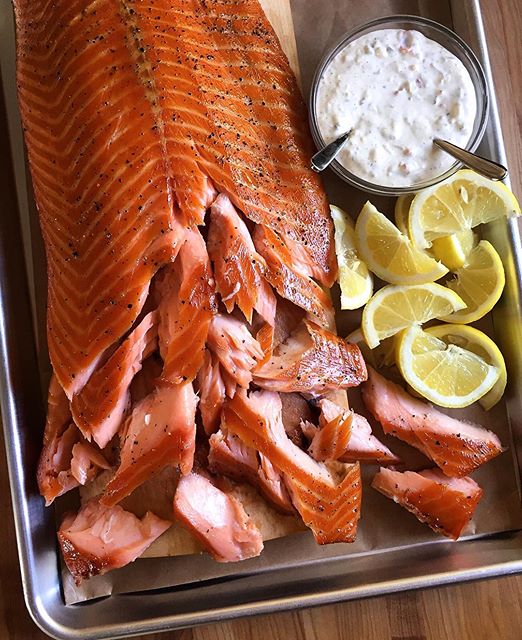
1. Alexandria Applewood Smoked Salmon — 30 minutes prep, 25 minutes cook, 4 servings, 320 calories and 28g protein per plate. Applewood over a brined fillet, served with dill cream and pickled vegetables. This is the reference plate: if you only make one thing here, make this and taste what a proper pellicle does for smoke adhesion.
2. Cedar-Planked Smoked Salmon with Lemon and Dill — 15 minutes prep, 90 minutes on the plank, 4 servings at 350 calories and 40g protein. The plank is not decoration; a soaked cedar board holds the fillet off the grate, buffers direct heat, and steams cedar aromatics up through the flesh. Soak the plank 2 hours minimum or it scorches through.
3. Wild Alaskan Smoked Salmon with Huckleberry Glaze — 35 minutes prep, 25 minutes cook, 420 calories, 34g protein. Wild sockeye is leaner than farmed Atlantic, which means a tighter temperature window — pull this one at 135°F, not 140°F. The huckleberry glaze goes on in the last 10 minutes so the sugar doesn't burn.
4. Mango-Curry Smoked Salmon Pasta with Lime-Cilantro Dressing — 20 minutes, 4 servings, 452 calories. The Monday dinner. Flake cold smoked salmon into the pasta off-heat; if you cook it again you'll turn silky flesh into gravel.
5. New York-Style Bagel Sandwich with Smoked Salmon and Cream Cheese — the brunch endpoint, and the reason to keep a portion of your side sliced thin rather than flaked. Also excellent on rye: Open-Faced Rye Sandwich with Gravlax and Horseradish Cream.
6. Baltimore-Style Smoked Salmon Chowder — 15 minutes prep, 25 minutes cook, 320 calories. Where the tail end and the belly trim go. Potatoes, leeks, cream, and the last of the fillet stirred in at the very end.
On rillettes: there's no separate recipe for this because it isn't one — it's a ratio. Flake 8 oz of leftover hot-smoked salmon, fold in 3 oz softened butter and 2 oz crème fraîche, add lemon zest, minced shallot, and a lot of black pepper, then pack into a jar and chill 4 hours. It keeps a week and turns the driest overcooked corner of your fillet into the best thing you'll eat all week. A food processor or sturdy mixing bowl is all the equipment involved.
4 Smoked Trout Dinners: whole smoked trout, trout salad, trout-and-egg breakfast, trout pâté
Trout is the smoker fish for people who think they don't like fish. It's mild, it's cheap, it comes in single-serving whole fish, and it takes smoke faster than salmon because the fillets are thin.
1. Smoked Cedar-Planked Whole Trout with Herb Butter — 20 minutes prep, 120 minutes on the smoker, 4 servings at 320 calories and 40g protein. Whole fish, head on, cavity stuffed with herb butter and lemon. Cooking on the bone is the single biggest moisture insurance policy available to you.
2. Farmstead Smoked Trout with Herb Butter — 15 minutes prep, 120 minutes cook, 40g protein per serving. The low-and-slow version: a long, cool smoke that pushes flavor deeper than the 45-minute fillet cook does.
3. Smoked Trout Salad with Dill Mustard Vinaigrette — 15 minutes, no cooking, 280 calories, 20g protein. Built entirely from Saturday's leftovers. Also see Parkersburg-Style Smoked Trout Salad with Lemon Vinaigrette for a lighter 210-calorie version.
4. Grilled Cherrywood-Smoked Trout with Traverse City Cherry Glaze — 15 minutes prep, 15 minutes cook, 320 calories, 35g protein. Cherry wood plus a cherry glaze is not redundant; the wood is savory and tannic, the glaze is sweet and acidic, and the combination is the best argument in this guide for matching wood to sauce.
Trout-and-egg breakfast: flake cold smoked trout over soft-scrambled eggs in the last 20 seconds of cooking, off heat. Chives, black pepper, done. No recipe needed and no reheating — the residual egg heat is exactly enough.
Trout pâté: same ratio as the salmon rillettes above, but swap the crème fraîche for cream cheese and add a teaspoon of horseradish. Trout's milder flesh needs the extra bite. Store it in a wide-mouth glass container rather than plastic; smoked fish odor permanently stains plastic lids.
4 Smoked Shellfish: oysters, mussels, shrimp, scallops (fastest smoker cook of any protein)
Nothing else on your smoker finishes in five minutes. Shellfish is what you cook while the salmon is still climbing to temperature — appetizers that cost you no additional fuel and no additional time.
1. Char-Grilled Smoked Oysters with Heirloom Corn Butter — 20 minutes prep, 5 minutes cook, 4 servings at 320 calories and 18g protein. Shuck, top with compound butter, set on the grate over the fire, close the lid. When the butter bubbles and the edges of the oyster ruffle, they're done. A hinged oyster knife is genuinely non-optional here; a paring knife will send you to the emergency room.
2. Smoked Mussels in White Wine Herb Broth — 15 minutes prep, 20 minutes cook, 320 calories, 22g protein. Smoke the mussels in a perforated pan until they open (10–15 minutes), then finish them in the wine broth so the smoke ends up in the liquid, not just on the shells.
3. Smoked Shrimp and Heirloom Grits — 15 minutes prep, 30 minutes cook, 4 servings, 320 calories, 28g protein. Use 16/20 count or larger; anything smaller overcooks before the smoke lands. Also worth your time: Smoked Shrimp and Potatoes with Herb Butter at 35g protein per serving.
4. Creamy Smoked Oyster Stew with Lemon Thyme — 10 minutes prep, 20 minutes cook, 430 calories, 30g protein. What to do with the oysters nobody ate. Smoked oysters hold in the fridge four days and improve in a cream base.
On scallops: our catalog doesn't carry a dedicated smoked-scallop recipe yet, and honestly, most people shouldn't attempt one first. Sea scallops are 75% water and go rubbery at 130°F, so the technique is a 20-minute dry brine (salt only, uncovered in the fridge) followed by 12–15 minutes at 225°F, pulled at 115°F and finished in a screaming-hot cast-iron pan for 45 seconds a side. Smoke for flavor, sear for texture. Skip the smoker entirely if your scallops are "wet-packed" — the added phosphate solution steams instead of browning.
4 Big-Format Smoked Fish: mackerel, bluefish, whole snapper, smoked-fish tacos
Oily fish is the smoker's natural constituency. Fat carries smoke compounds, buffers the temperature window, and keeps flesh moist well past the point where a lean cod would have surrendered.
1. Smoked Mackerel and Leek Hash with Horseradish Cream — 15 minutes prep, 20 minutes cook, 420 calories and 35g protein. Mackerel is the single most underrated smoking fish in North America and costs a third of what salmon does. The horseradish exists to cut through the fat, and it is not optional.
2. Smoked Mackerel and Pickled Onion Tart — 40 minutes prep, 27 minutes bake, 480 calories, 22g protein. The dinner-party version. Pastry, smoked mackerel, sharp pickled onion.
3. Smoked Cedar-Planked Whitefish with Juniper Berry Rub — 15 minutes prep, 50 minutes cook, 280 calories and 32g protein. Great Lakes whitefish on cedar with juniper is the closest thing North America has to a regional smoked-fish tradition, and it's the template for whole snapper too: whole fish, scored to the bone, plank, 50–60 minutes at 180°F.
4. Smoked Fish Sandwich with Tropical Pineapple Salsa — 15 minutes prep, 5 minutes assembly, 450 calories and 30g protein. Florida smokehouse logic: acidic fruit salsa against smoked oily fish. Convert it to tacos by swapping the roll for charred corn tortillas — same filling, same salsa.
Two more worth knowing: Cherry Wood Smoked Cod Fillets with Lemon-Dill Butter for a lean-fish counterpoint, and Smoked Sardines with Lemon-Garlic Vinaigrette, which is the cheapest genuinely great thing you can make on a smoker.
On bluefish: if you can get it fresh — East Coast, roughly June through October — it is the best smoking fish on this list and the worst refrigerator fish. Bluefish oil goes rancid within about 36 hours of the catch. Smoke it the day you buy it, at 200°F, over hickory, pulled at 145°F. Treat it like mackerel with a stopwatch.
Wood pairings: alder, apple, cherry, hickory — which for which fish
Wood choice matters more for fish than for any other protein, because there's no fat cap and no bark to mediate between smoke and flesh. What you burn is what you taste.
| Wood | Intensity | Best with | Avoid with |
|---|---|---|---|
| Alder | Mild, slightly sweet | Salmon, trout, all lean fish | Nothing — it's the safe default |
| Apple | Mild, fruity | Shrimp, mussels, whitefish, cod | Nothing |
| Cherry | Mild-medium, fruity, darkens skin | Trout, salmon, cod | Very delicate sole/flounder |
| Cedar (plank only) | Aromatic, resinous | Salmon, trout, whitefish | Never burn cedar directly |
| Pecan | Medium, nutty | Shrimp, mackerel | Delicate white fish |
| Oak | Medium, neutral | Mackerel, bluefish, tuna | Salmon (overwhelms) |
| Hickory | Strong, bacon-like | Bluefish, mackerel only | Salmon, trout, all shellfish |
| Mesquite | Very strong, harsh | Nothing on this list | All fish |
Alder is the Pacific Northwest standard for salmon for a reason: it's mild enough that a 90-minute cook doesn't turn acrid, and it's what the fish has been smoked over for several thousand years in that region. Start there. Makoti Lake Cedar-Smoked Trout with Lemon-Dill Butter shows what a resinous wood does when it's used as a plank rather than a fuel.
Two format rules. On charcoal, use chunks, not chips — chips burn out in 12 minutes and produce a dirty white smoke as they flare. On a pellet grill, use the manufacturer's pellets and add a smoke tube if you want more; pellet grills run clean and often under-smoke fish at low temperatures.
And the thing nobody tells you: thin blue smoke, never white. White billowing smoke means incomplete combustion and deposits creosote, which tastes like an ashtray and is the actual reason most people's first smoked fish is inedible. Wait for the smoke to go nearly invisible before the fish goes on.
The brine + smoker sequence for weekend meal prep (Sat morning to Mon lunch)
The wet brine is the step people skip and the step that matters most. Its job is threefold: season through the fillet, firm the flesh via salt-driven protein denaturation, and — critically — build the pellicle, the tacky protein film that forms on the surface during air-drying. Smoke particles bond to the pellicle. Without one, smoke rolls off and you've made baked fish that smells like a campfire.
The base brine: 1 cup kosher salt + ½ cup brown sugar per gallon of cold water. That's it. Everything else is optional.
| Cut | Brine time | Air-dry (pellicle) | Smoke time |
|---|---|---|---|
| Salmon side, 2–3 lb | 8 hours | 2 hours | 90–120 min |
| Salmon fillets, 6 oz | 4 hours | 1 hour | 45–60 min |
| Whole trout | 4 hours | 1 hour | 60–75 min |
| Trout fillets | 2 hours | 45 min | 40–50 min |
| Mackerel fillets | 3 hours | 1 hour | 45–60 min |
| Shrimp, peeled | 30 min | 15 min | 12–18 min |
| Oysters, shucked | none | none | 5–8 min |
Friday 8pm — Mix the brine, submerge the salmon side and the trout, refrigerate. Use a non-reactive container; a large glass or stainless vessel rather than aluminum, which pits and puts metal into the brine.
Saturday 8am — Pull everything, rinse under cold water, pat completely dry. Set on a wire rack in front of a fan for 2 hours. The surface should go from wet to tacky-matte; you'll be able to feel it with a fingertip.
Saturday 10am — Smoker to 180°F with alder. Salmon side goes on first. Trout follows at 10:30. Instant-read probe thermometer in the thickest part of the salmon — the single most valuable $30 in this entire process.
Saturday 11:30am — Salmon hits 140°F, comes off, rests 15 minutes. Now bump the smoker to 225°F, throw on oysters and shrimp, and eat those standing up in the yard while the salmon rests. That's lunch.
Saturday dinner — The hot-smoked salmon plate or the cedar-planked trout, served immediately at peak texture.
Sunday — Chowder from the trim and the belly. Trout salad for lunch. Rillettes packed and chilled.
Monday — Pasta with flaked salmon, cold, folded in off-heat. Bagels or rye toast for breakfast.
Total active time across the weekend: about 2 hours. Total meals: seven or eight, depending on how many oysters survive Saturday lunch.
Five ways smoked fish goes wrong
Chamber too hot. Running 225°F because that's your brisket setting is the most common error. Fish albumin (the white curd that weeps out of salmon) starts expressing above roughly 200°F flesh temperature. If your fillet looks like it's leaking cottage cheese, drop the chamber 40 degrees.
No pellicle. Fish goes straight from brine to smoker, wet. Smoke won't stick to a wet surface. You get pale fish with a faint campfire smell and no smoke ring of flavor. The 1–2 hour air-dry is not optional.
Chips instead of chunks, or too many of either. More wood is not more flavor past a point; it's creosote. One fist-sized chunk for a 90-minute salmon cook is plenty.
Cooking to time instead of temperature. Fillet thickness varies by a factor of three across a single salmon side. The tail end hits 140°F 25 minutes before the shoulder does. Either probe the thick part and accept a slightly firmer tail, or cut the side in two and pull them separately.
Storing warm fish in a sealed container. Trapped steam turns a good pellicle back into mush overnight. Cool smoked fish uncovered on a rack in the fridge for an hour, then wrap.
Real numbers: cost, yield, and shelf life
| Fish | Typical US price/lb (2026) | Yield after smoke | Fridge life, cooked | Freezer |
|---|---|---|---|---|
| Atlantic salmon side | $9–14 | ~75% | 5–7 days | 3 months |
| Wild sockeye | $16–22 | ~72% | 5–7 days | 3 months |
| Rainbow trout, whole | $6–9 | ~55% (bone-in) | 4–5 days | 2 months |
| Mackerel | $4–7 | ~70% | 3–4 days | 2 months |
| Whitefish | $8–12 | ~70% | 4–5 days | 2 months |
| Shrimp, 16/20 | $10–15 | ~85% | 3 days | 2 months |
| Oysters, shucked | $14–20 | ~80% | 3–4 days | not recommended |
A 3-pound salmon side at $11/lb is $33 and yields roughly 2¼ pounds of finished smoked salmon — call it eight servings at about $4 each, against $9–12 per 4-ounce package of retail cold-smoked salmon. The smoker pays for itself in about a dozen cooks.
On safety: hot-smoked fish held above 140°F internal is fully cooked, and the FDA's guidance on selecting and serving fresh and frozen seafood safely covers sourcing and cold-chain handling before the fish reaches your smoker. If you're curing rather than cooking — gravlax, lox-style cold smoke — freeze the fillet at −4°F for seven days first to address parasites, which is standard practice and the reason commercial smoked fish is safe to eat raw.
FAQ
Do I need a dedicated smoker or can I use my grill?
A charcoal kettle grill with a two-zone setup handles hot-smoked seafood well — light coals on one side, wood chunks over them, fish on the cool side, lid down with the vent over the fish. For cold-smoked salmon or bacon-style curing you want a dedicated cold smoker or a pellet smoker with a smoke-tube attachment because temps must stay under 90°F. A pellet grill is the easiest entry point.
How long does smoked salmon last in the fridge?
Hot-smoked salmon lasts 5–7 days sealed in the fridge and freezes for 3 months without quality loss. Cold-smoked salmon (the lox-style silky version) lasts 2 weeks unopened and 5 days after opening. Both are cooked or cured enough to eat directly, which is the payoff — one Saturday cook gives you salmon for weeknight bagels, pasta, salads, and rillettes all week. Store on the coldest fridge shelf, not the door.
Which wood should I use for smoking seafood?
Alder is the traditional Pacific-Northwest wood for salmon and the safest starting point — mild, sweet, forgiving. Apple and cherry add fruity notes that work with all fish. Skip mesquite and hickory for most seafood; both are too aggressive and turn delicate fish bitter. The exception is oily fish like mackerel or bluefish, which can take a light hickory hit. Chunks give a cleaner burn than chips on charcoal.
Do I need to brine fish before smoking?
Yes for hot-smoking — a wet brine (1 cup salt + ½ cup brown sugar per gallon water, 4–8 hours depending on fillet thickness) firms the flesh, seasons through the fillet, and produces the pellicle that smoke bonds to. Skip the brine and you get gray, dry, under-seasoned fish. For cold-smoked salmon the cure is dry (equal parts salt and sugar, 24–48 hours).
Can I get the ingredients delivered from Instacart?
Fresh fish availability varies more than any other Instacart category — most zips get salmon and trout via Whole Foods or a local grocer, but mackerel, bluefish, and whole snapper often need a fishmonger. The shopping list flags each fish with retailer coverage in your area and suggests substitutions (Arctic char for salmon, sea bream for snapper) that match the recipe technique. Wood chunks, brine ingredients, and smoker accessories route to your default retailer without issue.
Related reading
- 18 Smoker Recipes for Beginners: Brisket, Ribs & Pulled Pork Low-and-Slow at Home — the low-and-slow fundamentals, if fish is your entry point rather than your fifth cook.
- 18 Smoked Vegetable Recipes: Sides That Steal the BBQ Show — what to put on the grate alongside the salmon.
- 22 Smoked Chicken Recipes: Wings, Thighs & Whole-Bird Low-and-Slow Cookouts — the other fast protein for the smoker.
- Best Grilling Tools and BBQ Gadgets for 2026: Top Picks + Buying Guide — thermometers, planks, and perforated pans worth owning.
- How to Cook Salmon: 20 Recipes + Complete Guide to Buying, Storing & Preparing — everything about salmon that isn't smoke.
- The Complete Pescatarian Meal Plan: 40+ Seafood Recipes + Shopping List — where smoked fish fits into a full week.
Browse more kitchen gadgets and cookware for the smoker, or start with the Scottish Cullen Skink Smoked Haddock Chowder if you want the flavor tonight without owning a smoker at all.
Frequently asked questions
Do I need a dedicated smoker or can I use my grill?
How long does smoked salmon last in the fridge?
Which wood should I use for smoking seafood?
Do I need to brine fish before smoking?
Can I get the ingredients delivered from Instacart?
Sources
Plan a week of meals in two minutes.
Tell our AI what you have and what you like — it builds your plan, shopping list, and Instacart cart. No account needed.
Plan my week →