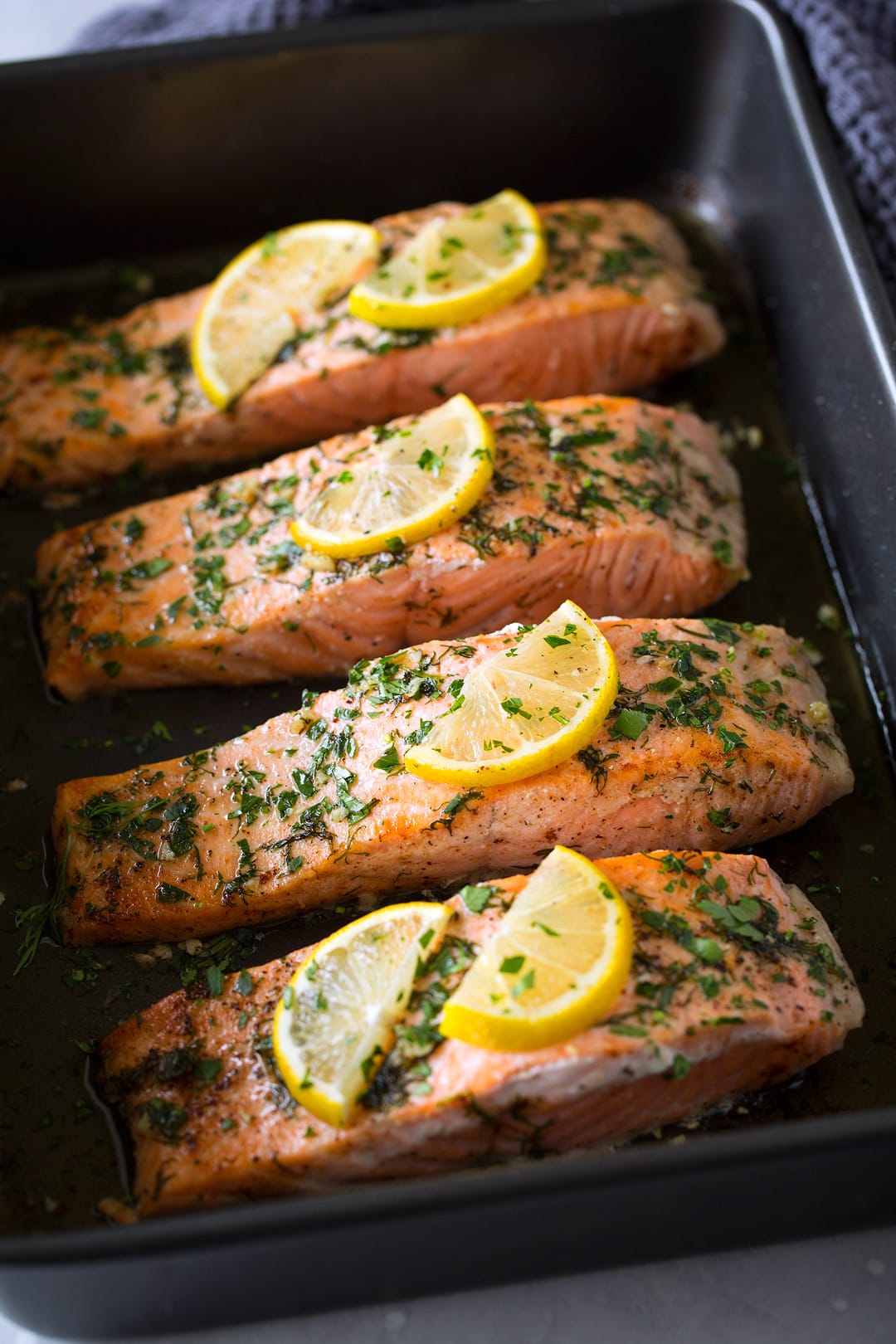
How to Cook Salmon: 20 Recipes + Complete Buying & Searing Guide
Pull it at 125°F, not 145°F — plus what to look for at the fish counter, how to store it, the four core techniques, and 20 tested recipes.
Affiliate disclosure: AislePrompt may earn a commission on qualifying purchases made through Amazon and Instacart links in this article, at no additional cost to you. See our affiliate policy →
Cook salmon to an internal temperature of 125°F for medium-rare, 130°F for medium, and 145°F only if you want it well-done — pull it 2–3°F early because it keeps cooking off the heat. A 6-ounce fillet takes 12–14 minutes in a 400°F oven, 6 minutes in a hot pan (4 minutes skin-down, 2 minutes flesh-down), or 8–10 minutes in a 160–170°F poaching liquid. Everything else in this guide is detail on top of those four numbers.
What you'll use with it
Salmon goes from silky to dry in a few degrees. The thermometer guide has five picks under $100 and a doneness table that puts salmon at 125–130°F against the USDA’s 145°F for fish. Read the instant-read thermometer guide →
Instant-read thermometer guide’s top pick: ThermoMaven Professional Digital Meat Thermometer $19.99 at Amazon, Check price on Amazon →Instant-read thermometer guide’s Best Value pick: Alpha Grillers Digital Instant Read $14.97 at Amazon, Check price on Amazon →Instant-read thermometer guide’s Best for Beginners pick: TempPro TP19 Waterproof Thermocouple $27.99 at Amazon, Check price on Amazon →The crispy-skin pan-sear here is done in cast iron over medium-high heat, because a thin pan drops 100°F when the cold fillet goes in. The cast iron guide picks pans that hold heat and explains how to preheat one. Read the cast iron skillet guide →
Cast iron skillet guide’s top pick: Lodge 10.25" Seasoned Cast Iron Skillet $29.90 at Amazon, Check price on Amazon →
Introduction: Salmon is the #1 protein Americans overcook (and how to stop)
Salmon is the most-cooked fish in American home kitchens and, by a wide margin, the most-ruined. The failure is almost never seasoning or technique — it is temperature. Salmon goes from silky to chalky across about a 15°F window, and most people cook it until it "looks done," which by definition means they cooked it past the point where it was good. Chicken breast forgives you by 10°F. Salmon does not.
The fix is unglamorous: an instant-read thermometer and the willingness to pull the fish while the center still looks slightly translucent. Do those two things and salmon becomes one of the easiest proteins on the weeknight roster. It cooks in 10–12 minutes by almost any method, it takes on flavor readily, and it delivers restaurant-quality results from a $30 skillet.
This guide covers the whole chain: what to buy at the counter and why the labels matter, how to store it so it is still good on day two, the four core techniques with specific temperatures and timing, a doneness chart you can screenshot, and 20 tested recipes from the AislePrompt catalog spanning every technique and flavor direction. As of 2026, farmed Atlantic runs roughly $10–14/lb and wild sockeye $20–30/lb at most US grocery counters, so the buying section is also a budget section.
Buying salmon: wild vs farmed, King vs Sockeye vs Coho vs Atlantic, fresh vs frozen
The fish counter is confusing because the differences are real, not marketing — and the right answer changes depending on what you are cooking.
The four species you will actually see
| Species | Typical price/lb (2026) | Fat content | Flavor | Best for |
|---|---|---|---|---|
| King (Chinook), wild | $28–40 | Highest | Rich, buttery, pronounced | Special occasion, simple sear, sashimi-grade |
| Sockeye, wild | $20–30 | Medium-low | Deep, assertive, "salmony" | Grilling, blackening, bold glazes |
| Coho, wild | $16–24 | Medium | Balanced, milder than sockeye | Roasting, poaching, all-purpose |
| Atlantic, farmed | $10–14 | High | Mild, buttery, forgiving | Weeknight anything, sheet pans, feeding a crowd |
Wild Pacific salmon has a deeper reddish-orange color, a firmer and leaner texture, and a more pronounced flavor. Sockeye is the most widely available and most affordable wild option; King is the richest and priciest, with the highest fat content of any Pacific variety. Counterintuitively, farmed Atlantic often carries more total EPA+DHA per serving than wild sockeye simply because it is fattier overall — wild wins on the omega-3 to omega-6 ratio, not on absolute omega-3 grams.
Farmed Atlantic is milder, fattier, and 30–50% cheaper. That fat is a buffer: it is materially harder to dry out, which makes it the honest choice for everyday cooking and for anyone still learning to read doneness. Save the King for the night you are paying attention.
For sourcing, look for ASC certification (Aquaculture Stewardship Council) on farmed and MSC certification (Marine Stewardship Council) on wild. Monterey Bay Aquarium's Seafood Watch salmon ratings grade specific fisheries and farms rather than the species as a whole, which is the level of detail that actually matters — "farmed salmon" spans both Best Choice and Avoid depending on the operation. NOAA's Atlantic salmon species profile explains why every Atlantic salmon you can buy in the US is farmed: the wild Gulf of Maine population is listed as endangered, and commercial fishing for it has been closed since 1948.
The FDA's advice on eating fish puts salmon in its "Best Choices" category — the lowest-mercury tier — for both farmed and wild, at 2–3 servings per week even during pregnancy.
Fresh vs frozen
"Fresh" at a fish counter means only that the fish has not been frozen since processing. It does not mean it was caught today; 3–5 days post-harvest is normal by the time it reaches the case. High-quality flash-frozen salmon — frozen at sea within hours of harvest — is often genuinely fresher in cell integrity and flavor than the "fresh" fillet three feet away.
Frozen is also the better economic decision. You thaw exactly the portions you want, and you lose the 48-hour countdown that turns fresh fish into a chore. Every recipe in this guide works from frozen; the only adjustment is time.
Sourcing: what to look for at the fish counter
Five checks, about fifteen seconds:
1. Color consistency. Deep orange-red for sockeye, lighter pink-orange for Atlantic, with no grey edges, no brown spots, and no chalky white bands running through the flesh.
2. Surface. Moist and slightly glossy. Slimy, tacky, or weeping into the tray means it has been sitting.
3. Smell. Clean and faintly oceanic. A pronounced "fishy" smell is trimethylamine from bacterial breakdown — the fish is past its prime, and no marinade rescues it.
4. Springback. Press the thickest part gently. Fresh flesh rebounds; if your fingerprint stays, the protein structure has already started to break down.
5. The gap test. Look at the muscle segments from the side. If they are separating from each other (gaping), the fillet was frozen and thawed badly or handled roughly. It will fall apart in the pan.
Skip pre-marinated fillets. The marinade is usually there to cover an aging fish, and the sugar in it burns before the center comes to temperature. Also skip anything labeled "previously frozen — do not refreeze" if you plan to portion and freeze at home.
The FDA's guide to selecting and serving fresh and frozen seafood safely adds one worth following: buy fish last on your shopping trip, and ask for a bag of ice if you are more than 30 minutes from home.
A flexible boning or fillet knife makes home portioning and pin-bone removal dramatically easier — see AislePrompt's knives and cutting tools guide.
Storage: fridge (2 days), freezer (3 months), how to thaw safely
Refrigerator. Fresh salmon keeps 1–2 days. Store it on the coldest shelf — usually the bottom rear, or the dedicated meat drawer — in its original packaging or wrapped tight in plastic, set on a plate to catch drips. Do not bed it directly on ice in the fridge; prolonged ice contact ruptures cells and accelerates spoilage. If you bought it today and are not cooking until day three, freeze it now and thaw overnight instead.
Freezer. Wrap individual portions tightly in plastic, then seal in a freezer bag with the air pressed out. Label the date. Quality holds for 2–3 months at 0°F; beyond that it stays safe but turns noticeably drier and flatter after cooking. Vacuum sealing roughly doubles that window. Purpose-built freezer containers and bags are covered in the storage and containers category.
Thawing. Overnight in the refrigerator is the best method — a 6-oz fillet needs 8–10 hours at 38°F. For same-day, seal the fish in a zip-top bag and submerge in cold tap water, changing the water every 30 minutes; a 6-oz fillet thaws in 30–45 minutes. Never thaw on the counter or in warm water: the surface climbs into the 40–140°F bacterial growth range while the center is still frozen solid.
Cooked salmon keeps 3–4 days in an airtight container and is excellent cold — flake it into the Avocado-Cucumber Salmon Salad with Lime Dressing rather than reheating it, which almost always overshoots and dries it out.
The 4 core techniques: pan-sear, oven-roast, sheet-pan, poach
| Method | Best for | Temp | Time (6 oz fillet) | Pull at |
|---|---|---|---|---|
| Pan-sear | Crispy skin, restaurant texture, 1–2 servings | Medium-high, cast iron | 4 min skin-down + 2 min flesh-down | 125–128°F |
| Oven-roast | Hands-off, 2–6 servings, glazes | 400°F | 12–14 min | 125–130°F |
| Sheet-pan | A whole dinner on one tray | 425°F | 15–18 min with vegetables | 125–130°F |
| Poach | Silky texture, cold prep, meal prep | 160–170°F liquid | 8–10 min | 125–130°F |
| Grill (bonus) | Smoke, summer, crowds | 400–425°F surface | 4–5 min per side | 125–130°F |
Pan-sear
The highest-texture result: a genuinely crunchy skin over a moist interior.
1. Pat the fillet bone-dry with paper towels. This matters more here than anywhere else — wet salmon steams and will not brown.
2. Salt the skin 15–30 minutes ahead and leave it uncovered in the fridge. The salt pulls out surface moisture, which is the single biggest lever on skin crispness.
3. Heat a cast-iron or heavy stainless pan over medium-high for 2–3 minutes, then add a tablespoon of high-smoke-point oil — avocado, canola, or grapeseed, not olive oil, which smokes at searing temperature. Wait for the oil to shimmer and move like water.
4. Lay the fillet in skin-side down, away from you. Press it flat with a spatula for the first 10–15 seconds or the skin contracts and curls, and the center of the skin never touches the pan.
5. Cook 4 minutes without touching it. Do not peek. Sustained contact is the whole mechanism.
6. Flip and give it 1.5–2 minutes flesh-side down for a 1-inch fillet.
7. Optional finish: in the last 30 seconds add a tablespoon of butter, a smashed garlic clove, and thyme, tilt the pan, and baste continuously.
A heavy-bottomed pan is not optional here — thin pans drop 100°F the moment cold fish hits them and you get a grey, steamed exterior. See the cookware guide for cast iron and tri-ply options, and pick up a thin, flexible fish spatula from utensils and tools; a standard spatula tears the fillet on the flip.
Recipes that use this method: Crispy Skin Pan-Seared Salmon with Lemon-Dill Butter and Pan-Seared Salmon with Crispy Capers and Dill.
Oven-roast
The most forgiving method and the right one for more than two people.
1. Heat the oven to 400°F. Line a pan with foil or parchment.
2. Dry the fillets, brush with oil or melted butter, season.
3. Place skin-side down and roast 12–14 minutes for a 6-oz fillet.
4. Rest 2 minutes on the pan — carryover finishes the thin spots.
Foil packets work at the same temperature: add vegetables, herbs, and a splash of white wine, seal tightly, and the fish steams in its own moisture. Glazes go on in the last 4–5 minutes so the sugar caramelizes without scorching — the same timing rule that runs through all 20 glazed recipes, as in Oven-Roasted Salmon with Miso-Maple Glaze.
Sheet-pan
Same as oven-roasting but hotter and with the sides cooking alongside. Run the oven at 425°F and stagger the timing: dense vegetables (potatoes, carrots, Brussels sprouts) get a 15–20 minute head start, quick ones (asparagus, cherry tomatoes, zucchini) go on with the fish. Do not crowd the tray — a crowded pan steams, and you lose the browning that justified the higher temperature. Use two pans instead. Sheet pans and half-sheets live in the bakeware category.
Poach
The gentlest method, the one most people skip, and the best for meal prep because poached salmon is as good cold on day three as it was hot.
1. In a wide skillet, combine 2 cups water, white wine, or a mix with a sliced lemon, a few peppercorns, a bay leaf, and dill or parsley. Bring to a bare simmer.
2. Hold at 160–170°F — the surface should barely shiver. A real boil shreds the fillet.
3. Lower the fish in; liquid should come at least halfway up the sides.
4. Cook 8–10 minutes for a 6-oz fillet, until just opaque.
5. Lift out with a slotted spatula. Serve warm, or chill for salads, grain bowls, and cold pasta.
Grill
Grilling adds smoke nothing indoors replicates; the only real problem is sticking. Clean the grates, preheat to 400–425°F, and oil the grates with a folded oil-soaked paper towel held in tongs, three passes, immediately before the fish goes on. Oil the flesh side, lay it down at 45° to the bars, and leave it 4–5 minutes — it releases when it is ready, and forcing it early is what tears fillets. Flip once, 3–4 minutes skin-side down.
For a cedar plank: soak 1 hour, put the plank on a medium grill until it smokes, add the fillet skin-side down, close the lid, and leave it 15–20 minutes. No flipping.
Doneness: internal temp guide (medium-rare 125°F, medium 130°F, well 140°F)
| Target | Pull from heat at | Final after rest | What it looks like | Who it is for |
|---|---|---|---|---|
| Medium-rare | 122–125°F | 125–128°F | Translucent center, deep color, silky | The restaurant standard; wild King and sockeye |
| Medium | 127–130°F | 130–133°F | Just opaque, still visibly moist | The default for most home cooks; farmed Atlantic |
| Medium-well | 135°F | 138–140°F | Opaque throughout, firm, flakes readily | Kids, cold leftovers, salmon cakes |
| Well-done | 142°F | 145°F | Fully firm, drier, white albumin on surface | The USDA safe-minimum recommendation |
Three practical notes. First, carryover is real: a 6-oz fillet gains 3–5°F after it leaves the heat, so the pull temperature and the eating temperature are not the same number. Second, probe the thickest part horizontally, entering from the side rather than the top — top-down probing usually reads the middle of the pan-facing surface, which runs hot. Third, that white stuff that seeps out is albumin, a harmless protein, but a lot of it means you cooked past 140°F.
The USDA's safe-minimum for finfish is 145°F. Medium-rare salmon at 125°F is a widely practiced restaurant standard and a personal risk decision; the FDA advises the 145°F minimum for anyone pregnant, immunocompromised, very young, or elderly. An instant-read thermometer is the entire ballgame here — our instant-read thermometer guide compares picks under $100; a $15 model reads in 2–3 seconds and pays for itself the first time it saves a $28 piece of King.
20 salmon recipes from the AislePrompt catalog (with prep times)
Every recipe below is tested, with per-serving nutrition drawn from the recipe's own data. Times are total (prep + cook).
Oven-roasted
| # | Recipe | Total time | Calories | Protein |
|---|---|---|---|---|
| 1 | Baked Lemon-Herb Salmon | 25 min | 360 | 35 g |
| 2 | Oven-Roasted Salmon with Miso-Maple Glaze | 22 min | 380 | 34 g |
| 3 | Miso-Glazed Salmon with Sautéed Spinach and Shiitake Mushrooms | 27 min | 380 | 42 g |
The lemon-herb version is the one to start with — olive oil, lemon, garlic, fresh herbs, nothing that can go wrong. The two miso glazes are the highest-flavor-per-effort dishes in this entire list; miso paste keeps for a year in the fridge and turns a plain fillet into something that tastes worked-on.
Pan-seared
| # | Recipe | Total time | Calories | Protein |
|---|---|---|---|---|
| 4 | Crispy Skin Pan-Seared Salmon with Lemon-Dill Butter | 20 min | 450 | 40 g |
| 5 | Pan-Seared Salmon with Crispy Capers and Dill | 20 min | 380 | 32 g |
| 6 | Pan-Seared Salmon with Garlic Herb Butter and Roasted Vegetables | 45 min | 420 | 35 g |
Number 5 is worth calling out for technique: the capers go into the hot oil first and fry until they burst open and crisp, which takes about 90 seconds and gives you a briny, crunchy garnish that costs nothing.
Sheet-pan
| # | Recipe | Total time | Calories | Protein |
|---|---|---|---|---|
| 7 | Sheet-Pan Baked Salmon with Lemon-Dill and Root Vegetables | 40 min | 480 | 38 g |
| 8 | Sheet Pan Citrus-Garlic Salmon with Roasted Asparagus | 25 min | 350 | 40 g |
The root-vegetable version runs longer because the potatoes and carrots need their head start; the asparagus version is the 25-minute weeknight one.
Grilled
| # | Recipe | Total time | Calories | Protein |
|---|---|---|---|---|
| 9 | Teriyaki-Glazed Grilled Salmon with Mango Salsa | 28 min | 350 | 35 g |
| 10 | Grilled Miso-Glazed Salmon with Sesame-Soy Dressing | 30 min | 350 | 40 g |
| 11 | Maple-Mustard Glazed Grilled Salmon Steaks | 20 min | 320 | 34 g |
Steaks — cross-cut through the fish rather than filleted along it — are the underrated grilling format: the bone and the skin ring hold the portion together, so it will not fall through the grates.
Poached
| # | Recipe | Total time | Calories | Protein |
|---|---|---|---|---|
| 12 | Flemish Herb-Poached Salmon with Lemon-Dill Sauce | 30 min | 320 | 28 g |
| 13 | Lemon-Dill Poached Salmon with Asparagus | 25 min | 320 | 34 g |
Both are excellent cold the next day, which makes them the best meal-prep entries on the list.
Bowls and grains
| # | Recipe | Total time | Calories | Protein |
|---|---|---|---|---|
| 14 | Genuine Japanese Teriyaki Salmon Bowls | 40 min | 380 | 32 g |
| 15 | Pan-Seared Lemon Garlic Salmon with Herb Quinoa | 35 min | 420 | 38 g |
| 16 | Avocado-Cucumber Salmon Salad with Lime Dressing | 10 min | 380 | 28 g |
Number 16 is a no-cook assembly built for leftovers — poach or roast on Sunday, eat this on Tuesday in ten minutes.
Handhelds, pasta, and patties
| # | Recipe | Total time | Calories | Protein |
|---|---|---|---|---|
| 17 | Salmon Tacos with Mango-Avocado Salsa and Cilantro-Lime Crema | 35 min | 500 | 30 g |
| 18 | Salmon and Lemon Pasta with Fresh Herbs | 22 min | 485 | 38 g |
| 19 | Quinoa & Dill Salmon Burgers with Cucumber Yogurt Sauce | 37 min | 380 | 30 g |
The burgers are the best use for a fillet that got slightly overcooked, or for the tail end that always finishes first — texture stops mattering once it is chopped and bound.
Blackened and glazed
| # | Recipe | Total time | Calories | Protein |
|---|---|---|---|---|
| 20 | Baltimore Blackened Salmon with Herb Couscous | 35 min | 420 | 35 g |
Blackening needs a hot cast-iron pan, an open window, and the acceptance that the spice crust will smoke. Sockeye handles it better than Atlantic — the assertive flavor stands up to the spice instead of disappearing under it.
Browse the full catalog and filter by cook time, method, or diet on the recipes index.
Quick salmon dinners under 25 minutes
Every dish here is on the table in 25 minutes or less, start to finish, including prep.
| Recipe | Total time | Method | Protein |
|---|---|---|---|
| Avocado-Cucumber Salmon Salad with Lime Dressing | 10 min | No-cook (uses leftovers) | 28 g |
| Crisp-Skinned Lemon-Dill Salmon with Capers | 17 min | Pan-sear | 28 g |
| Honey-Soy Glazed Salmon with Sesame Seeds | 20 min | Pan-sear + glaze | 28 g |
| Crispy Skin Pan-Seared Salmon with Lemon-Dill Butter | 20 min | Pan-sear | 40 g |
| Maple-Mustard Glazed Grilled Salmon Steaks | 20 min | Grill | 34 g |
| Air Fryer Crispy Lemon-Garlic Salmon Fillets | 22 min | Air fryer | 28 g |
| Oven-Roasted Salmon with Miso-Maple Glaze | 22 min | Oven | 34 g |
| Salmon and Lemon Pasta with Fresh Herbs | 22 min | Stovetop | 38 g |
| Lemon-Dill Salmon Bowl | 24 min | Oven + assembly | 25 g |
| Sheet Pan Citrus-Garlic Salmon with Roasted Asparagus | 25 min | Sheet-pan | 40 g |
The Honey-Soy Glazed Salmon with Sesame Seeds is the easiest glazed salmon to fit into a weeknight: it is a four-ingredient glaze — honey, soy, garlic, sesame — brushed on in the last 60 seconds of the sear.
Two structural tricks buy back most of the time. Preheat the pan or oven before you touch the fish, since 3 of those 25 minutes are otherwise dead time. And buy skin-on fillets already portioned at the counter; the fishmonger's 20 seconds with a real knife is faster than yours, and you get even thicknesses that finish together.
If the air fryer is your default appliance, the Air Fryer Crispy Lemon-Dill Salmon with Asparagus runs 32 minutes with the vegetables but needs almost no attention. Air fryers and countertop ovens are in small appliances.
The salmon marinade formula (acid + oil + salt + aromatic)
Nearly every salmon marinade worth making is the same four-part ratio. Learn it and you can stop looking up recipes:
2 parts oil : 1 part acid : 1 part salty-sweet : aromatics to taste
- Oil (2 parts) — olive, avocado, or toasted sesame. Carries fat-soluble flavor into the surface and prevents sticking.
- Acid (1 part) — lemon, lime, orange, rice vinegar, or dry white wine. Brightens and cuts richness.
- Salty-sweet (1 part) — soy sauce, miso paste, honey, maple syrup, or a mix. This is the browning engine: sugars caramelize, and the amino acids in soy and miso drive the Maillard reaction that makes glazed salmon look glossy instead of grey.
- Aromatics — grated garlic, grated ginger, mustard, chili flake, citrus zest, chopped herbs.
For a 1.5 lb piece of salmon: 3 tablespoons oil, 1.5 tablespoons acid, 1.5 tablespoons soy or honey, plus 2 grated garlic cloves and a thumb of ginger.
The timing rule that actually matters: 15 to 30 minutes, never more than 60. Salmon is not chicken. Acid denatures the surface proteins quickly, and an hour-plus marinade produces a mushy, ceviche-textured outer quarter-inch that never firms up. If you need to prep ahead, mix the marinade and keep it separate; combine it with the fish when you turn the oven on.
Sugar goes on late. Anything with honey, maple, or mirin burns before a fillet reaches 125°F at 400°F+. Marinate in the base, then brush the sweet component on for the final 3–5 minutes of oven time or the last 60 seconds in the pan.
Four working ratios from the catalog:
| Profile | Oil | Acid | Salty-sweet | Aromatic | Recipe |
|---|---|---|---|---|---|
| Japanese miso | Sesame | Rice vinegar | White miso + mirin | Ginger, scallion | Grilled Miso-Glazed Salmon with Sesame-Soy Dressing |
| Honey-ginger | Avocado | Lemon | Honey + soy | Ginger, garlic | Honey-Ginger Glazed Salmon with Spring Herb Quinoa |
| Maple-mustard | Olive | Cider vinegar | Maple + Dijon | Black pepper, thyme | Maple-Mustard Glazed Grilled Salmon Steaks |
| Honey-soy | Sesame | Rice vinegar | Honey + soy | Garlic, sesame seed | Honey-Soy Glazed Salmon with Sesame Seeds |
Dry brining is the alternative and often the better one for pan-searing: salt the fillet, leave it uncovered in the fridge 30 minutes, pat dry, cook. You give up marinade flavor and get significantly better skin.
Common mistakes that ruin salmon
1. Cooking it cold from the fridge. A 38°F fillet needs longer in the pan, and by the time the center hits 125°F the outer half is at 150°F. Let it sit out 15 minutes first. This is the single largest source of the dry-outside/raw-inside result.
2. A pan that is not hot enough. Fish added to a warm pan sticks, then steams. Preheat 2–3 minutes and wait for the oil to shimmer.
3. Moving it. Salmon releases from the pan or grate when the crust has formed. If it resists, it is not ready — give it 30 more seconds rather than forcing the spatula.
4. Guessing at doneness by time. Fillet thickness varies from 0.5 to 1.5 inches across a single side of salmon, which is a 2× swing in cook time. Thickness, not weight or minutes, determines timing. Use the thermometer.
5. Sugary glaze on too early. Honey and maple burn at roughly 320°F, well below a 400°F oven. Last 3–5 minutes only.
6. Reheating leftovers hot. Microwaving cooked salmon overshoots to 165°F+ and turns it chalky and strong-smelling. Eat it cold in a salad or bowl, or warm it gently at 275°F for 8 minutes.
Salmon nutrition: omega-3s, protein, and why the guidance says twice a week
A 3.5-oz (100 g) serving of cooked Atlantic salmon provides roughly:
- Calories: 206
- Protein: 20 g
- Total fat: 13 g, mostly unsaturated
- Omega-3 (EPA + DHA): 2,200–2,500 mg
- Vitamin D: 526 IU (66% DV)
- Vitamin B12: 3.2 mcg (133% DV)
- Selenium: 36.5 mcg (66% DV)
The omega-3 content is what separates salmon from every other protein most households buy. EPA and DHA are the forms your body uses directly for cardiovascular and cognitive function. You can synthesize them from plant-based ALA in walnuts and flaxseed, but the NIH Office of Dietary Supplements omega-3 fact sheet puts that conversion below 10% for EPA and lower still for DHA — which is why eating the fish is not interchangeable with eating the seeds.
Harvard T.H. Chan School of Public Health's fish guidance puts the effect size at roughly a 36% lower risk of death from heart disease for 1–2 servings of fatty fish per week versus none. That finding sits on decades of prospective cohort data across hundreds of thousands of participants — it is one of the more consistent results in nutritional epidemiology. Two 3.5-oz servings of salmon per week delivers about 4,000–5,000 mg of EPA+DHA, comfortably inside the range used in cardiovascular intervention studies.
| Protein (per 3.5 oz cooked) | Calories | Protein (g) | Omega-3 EPA+DHA (mg) |
|---|---|---|---|
| Atlantic salmon, farmed | 206 | 20 | 2,200 |
| Sockeye salmon, wild | 168 | 23 | 1,300 |
| Canned tuna, in water | 128 | 28 | 270 |
| Shrimp | 99 | 21 | 295 |
| Chicken breast | 165 | 31 | 30 |
| Ground beef, 85% lean | 215 | 22 | 80 |
Salmon's omega-3 density is an order of magnitude above anything else on that list. Combined with a 12-minute cook time, that is the practical argument for putting it on the table twice a week.
Flavor pairing guide: sauces, herbs, citrus, and sides
Salmon is fatty and strongly flavored. It stands up to soy, miso, blackening spice, and chipotle without disappearing, and it also carries delicate herb-and-citrus treatments well. The fat acts as a solvent for aromatics, which is exactly why butter-basting and oil-based marinades work as well as they do.
Acids — lemon (universal), lime (Asian and Mexican profiles), orange (glazes with soy or miso), capers (briny European), pickled red onion or cucumber (textural acid for bowls and tacos).
Herbs — dill (the traditional European partner), parsley (neutral brightener), cilantro (Mexican and Southeast Asian), thyme and rosemary (roasted and grilled, with garlic), chives (cream sauces and butter finishes).
Sauces — garlic butter (works with every method), honey-soy glaze (four ingredients, caramelizes hard), teriyaki (mirin + soy + sugar + sake), miso glaze (miso + mirin + sake, broiled 3–4 minutes), yogurt-dill or tzatziki (cool contrast), mango salsa (grilled salmon specifically), creamy Dijon (mustard + cream + shallot + white wine).
Sides — grains (white or brown rice, farro, quinoa, couscous), roasted vegetables (asparagus, broccolini, green beans, snap peas, zucchini, cherry tomatoes), fresh salads (arugula with lemon vinaigrette, cucumber-dill, avocado-lime), starches (roasted baby potatoes, crusty bread, creamy polenta).
| Profile | Recipe | Key flavors |
|---|---|---|
| Classic European | Baked Lemon-Herb Salmon | Lemon, dill, garlic, butter |
| Caramelized glaze | Honey-Soy Glazed Salmon with Sesame Seeds | Honey, soy, garlic, sesame |
| Japanese | Genuine Japanese Teriyaki Salmon Bowls | Teriyaki, sesame, rice |
| Umami-forward | Miso-Glazed Salmon with Sautéed Spinach and Shiitake Mushrooms | Miso, mirin, shiitake |
| Spiced / blackened | Baltimore Blackened Salmon with Herb Couscous | Cajun spice, herbs, couscous |
| Italian | Salmon and Lemon Pasta with Fresh Herbs | Lemon, parsley, olive oil |
| Tropical | Teriyaki-Glazed Grilled Salmon with Mango Salsa | Mango, chili, cilantro |
| Light / cold | Avocado-Cucumber Salmon Salad with Lime Dressing | Lime vinaigrette, avocado, cucumber |
What to avoid. Over-sweetened barbecue and teriyaki sauces bury the fish. Very heavy cream sauces work but are usually redundant — salmon's own fat is doing that job. And skip aggressive cheeses; aged Parmesan and blue cheese fight salmon rather than complement it.
What to cook tonight
If you have never cooked salmon before, start with Baked Lemon-Herb Salmon — 25 minutes, one pan, nothing to time precisely. If you own a cast-iron skillet and want the thing restaurants charge $34 for, make Crispy Skin Pan-Seared Salmon with Lemon-Dill Butter and pull it at 125°F. If dinner is in half an hour and the oven is already on, Sheet Pan Citrus-Garlic Salmon with Roasted Asparagus puts an entire meal on one tray.
For a full week of fast dinners built around this and other 30-minute proteins, see the 30-Minute Weeknight Dinners 4-Week Meal Plan.