18 Smoked Vegetable Recipes: Sides That Steal the BBQ Show
Vegetables take smoke four times faster than a brisket — which is why most people ruin them on the first try.
Vegetables absorb smoke roughly four times faster than a brisket does, because they have no fat cap and no collagen to work through — smoke lands on wet surface and stays there. That's why the same 8-hour hickory session that makes a pork shoulder perfect turns a head of cauliflower into an ashtray. Smoked vegetables need a shorter clock, a lighter wood, and a slightly higher temperature than the meat sitting next to them. Below are 18 recipes and the framework that makes them work.
Get a free cookout plan for a crowd
Mains, sides and quantities scaled to your headcount, with one Instacart cart instead of a spreadsheet.
No spam, unsubscribe in one click. Recipes, shopping lists and Instacart carts all work without an account either way.
The practical opportunity: your smoker is already at temperature for 6–10 hours whenever you cook a brisket or a pork butt. The bottom rack is empty. Everything in this guide can ride along in the last 60–90 minutes, which means the side dishes cost you nothing but the vegetables.
The smoking framework: wood, temp, and time by vegetable
Three variables, and only three. Get them right and the rest is seasoning.
Temperature. Run vegetables at 225–275°F. Below 225°F they dehydrate before they cook and go leathery. Above 300°F you're roasting with a smoky note rather than smoking. 250°F is the number that works for nearly everything on this list.
Wood. Match wood intensity to vegetable density. Delicate and sweet vegetables want fruit wood; dense, starchy, or strongly flavored vegetables can take hickory or a touch of mesquite.
| Vegetable | Temp | Time | Wood | Doneness cue |
|---|---|---|---|---|
| Whole cabbage (cored, buttered) | 250°F | 2–2.5 h | Apple, cherry | Knife slides to center |
| Corn on the cob (husk on) | 250°F | 60–75 min | Apple, pecan | Kernels dent under thumb |
| Sweet potatoes (whole) | 250°F | 2.5–3 h | Pecan, cherry | 205°F internal, skin loose |
| Cauliflower steaks (1.5") | 275°F | 45–60 min | Apple, oak | Stem tender, edges browned |
| Russet potatoes (whole) | 250°F | 2–2.5 h | Hickory, oak | 205°F internal |
| Portobello caps | 225°F | 45 min | Cherry, apple | Gills darkened, caps floppy |
| Bell peppers (halved) | 250°F | 45–60 min | Apple, pecan | Skins blistered, walls slack |
| Roma tomatoes (halved) | 225°F | 90 min | Cherry, apple | Collapsed, edges jammy |
| Eggplant (whole, pierced) | 275°F | 60–75 min | Oak, pecan | Skin collapses on itself |
| Butternut squash (halved) | 275°F | 75–90 min | Pecan, maple | Fork goes through with no push |
| Onions (whole, in foil) | 250°F | 2 h | Hickory, oak | Squeezable end to end |
| Carrots (whole, large) | 250°F | 75 min | Apple, cherry | Bendable, not snapping |
Time. These ranges are shorter than they look because smoke penetration on vegetables front-loads. Most of the flavor lands in the first 30 minutes; everything after that is cooking, not smoking. ThermoWorks' temperature guide to cooking potatoes is worth reading on the internal-temperature side, since the doneness cues for starchy vegetables track internal temp far more reliably than clock time — a smoked potato is done at 205-210°F, the same window as an oven-baked one.
6 headliner smoked sides
1. Whole smoked cabbage. Core a head, pack the cavity with 3 tbsp butter, salt, garlic powder and smoked paprika, wrap the bottom in foil, and run it at 250°F for about 2 hours. It comes out sweet and silky and it costs $2. This is the highest impression-to-effort ratio on the entire list.
2. Smoked corn on the cob. Leave the husk on, soak 20 minutes, smoke at 250°F for 60–75 minutes. The husk steams the kernels while the smoke works through. Pull the husk, roll in butter and lime, and it beats grilled corn without the char-management. Use the smoked kernels in Baked Sweetcorn Fritters with Smoked Paprika Aioli the next day.
3. Smoked sweet potatoes. Whole, pierced, 250°F, 2.5–3 hours to an internal 205°F. The long hold converts starch to sugar and the skins pull away clean. If you want the fast weeknight version instead, Crispy Air Fryer Sweet Potato Fries with Smoked Paprika gets you 80% of the flavor in 20 minutes.
4. Cauliflower steaks. Cut 1.5-inch slabs through the core so they hold together, oil both faces, 275°F for 45–60 minutes. Two steaks per head; the loose florets go into the Avocado-Cauliflower Puree with Smoked Paprika or a batch of Cauliflower 'Mac' with Smoked Gouda.
5. Smoked stuffed portobellos. Smoked Stuffed Portobello Mushrooms with Goat Cheese and Spinach — mushrooms are the fastest thing on the smoker at 45 minutes, and their high glutamate content means smoke reads as savory rather than acrid.
6. Smoked potato and mushroom hash. Juniper-Smoked Potato and Mushroom Hash smokes the potatoes whole, then dices and crisps them in a skillet — the two-stage approach that keeps a smoked potato from going mealy.
5 smoked salsas, dips and spreads
Smoke and blend is the most forgiving category here, because a food processor evens out any inconsistency in how the vegetables took smoke.
7. Smoked salsa roja. Smoke 6 Romas, half an onion, 2 jalapeños and 4 garlic cloves at 225°F for 90 minutes, then blend with lime and salt. Nothing you buy tastes like this.
8. Smoked baba ganoush. Whole eggplant at 275°F until it collapses, roughly 60–75 minutes. Scoop the flesh, drain 15 minutes in a sieve — this is the step people skip and it's why homemade baba ganoush is watery — then build it out per Spiced Baba Ganoush with Toasted Pine Nuts and Smoked Paprika or the classic Roasted Eggplant Baba Ganoush with Tahini and Pomegranate. The Oven-Roasted Eggplant Baba Ganoush with Lemon and Tahini is the no-smoker fallback.
9. Smoked tomato jam. Smoked Romas, brown sugar, sherry vinegar, reduced 40 minutes on the stove. Keeps two weeks; goes on burgers, eggs and cheese boards.
10. Smoked corn guacamole. Smoked Turkey Guacamole with Grilled Corn Salsa is the loaded version; drop the turkey and you have a vegetarian dip that still tastes like it came off a smoker.
11. Smoked queso. Cubed cheese, evaporated milk, smoked peppers and onion in a foil pan on the smoker for 45 minutes, stirred every 15. The Slow-Smoked Brisket Nachos with Queso and Pickled Jalapeños build shows the assembly if you want to go all in.
4 vegetable mains from the smoker
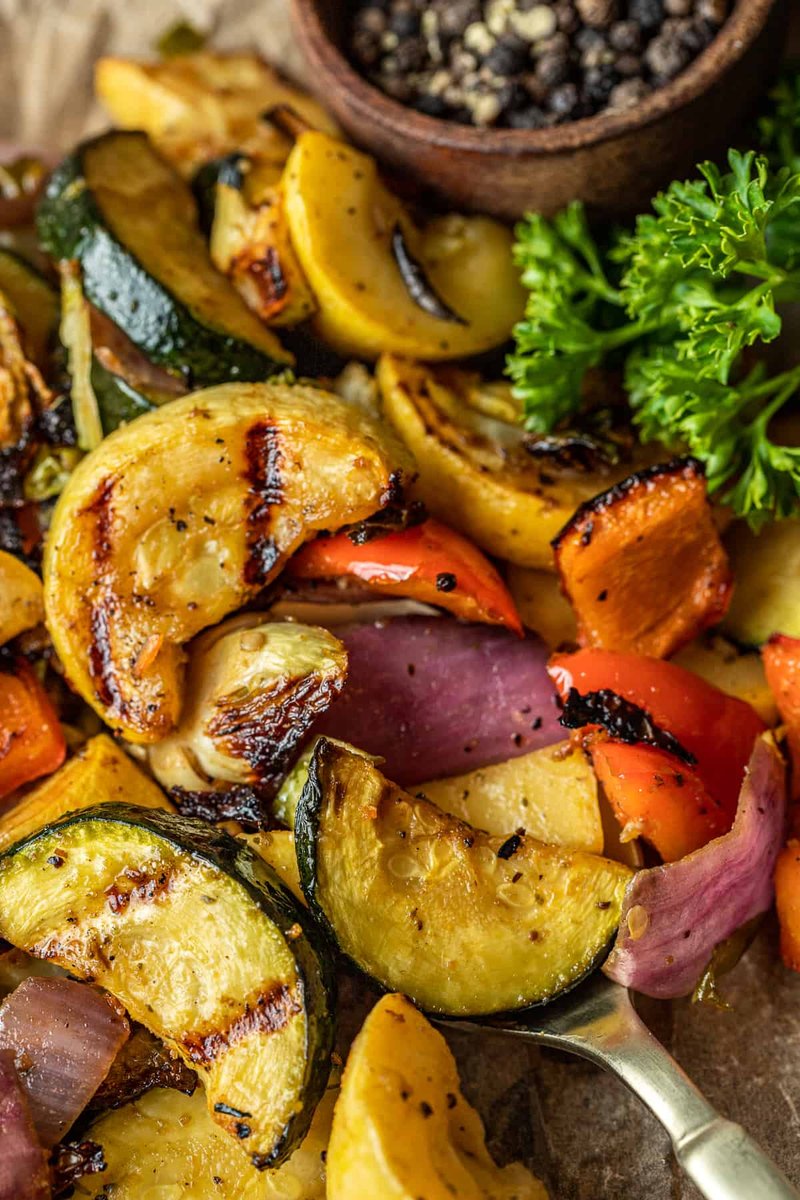
12. Texas-Style Smoked Vegetable Medley. The straightforward mixed-pan approach — cut everything to the same 1.5-inch dimension so it finishes together, which is the single biggest failure point in medleys.
13. Smoked Vegetable Medley with Beer Reduction. The reduction rehydrates the surface after 90 minutes of smoke and adds enough malt sweetness to balance the bitterness that longer sessions can introduce.
14. Smoked Tomato and Sweet Pepper Stew with Cornmeal Dumplings. A full dinner off smoked vegetables alone. Smoke the tomatoes and peppers the day before and the stew is a 40-minute weeknight.
15. Smoked Vegetable & Corn Chowder with Smoked Gouda. The best use for leftover smoked corn and potatoes, and the reason to smoke more than you need.
Two more worth knowing: Best-Smoked Vegetable Samosas turns the medley into a filling, and Sautéed Sauerkraut and Mushroom Stew with Smoked Paprika is the indoor version for when it's raining.
3 wood-and-vegetable pairings that always work
16. Fruit woods with sweet vegetables. Apple and cherry on corn, carrots, sweet potatoes, squash. The wood sugars complement rather than compete. Smoked Pecan & Honey Roasted Butternut Squash and Smithfield Smoked Paprika & Butternut Squash Risotto both live in this lane.
17. Oak and pecan with dense, earthy vegetables. Potatoes, eggplant, mushrooms, onions, cabbage. Enough backbone to be noticed without turning acrid over a 2-hour session. Wood-Fired Flatbread Pizza with Smoked Mozzarella and Wild Mushrooms is the showcase.
18. Mesquite, sparingly, with peppers and chilies. Mesquite is the most aggressive common wood and it burns hot and fast. Use it for 20–30 minutes on peppers and chilies destined for chili or salsa, then switch to oak. Northwoods-Inspired Venison Chili with Smoked Peppers and the meat-free Pan-Roasted Texas Chili with Smoked Paprika and Black Beans both benefit. Also worth having in the rotation: Lentil and Butternut Squash Stew with Smoked Paprika and Roasted Heirloom Tomatoes with Smoked Squash & Herb Oil.
The step people skip: dry the vegetables before you oil them
Smoke particulate binds to moisture on the surface. That sounds like an argument for wet vegetables, and it's exactly backwards. A wet surface holds a film of water that keeps evaporating, and evaporative cooling stalls the surface below the temperature where browning and flavor development happen — you get a damp, gray, faintly sooty exterior instead of a burnished one.
Pat everything completely dry. Then oil lightly — a teaspoon per pound, not a coating — and season. The oil is there to conduct heat and hold seasoning, not to fry. Vegetables that arrive at the smoker dry and barely oiled come off with color; vegetables that arrive dripping come off drab.
The corollary: don't spritz vegetables the way you'd spritz a brisket. Spritzing exists to manage bark formation on a long meat cook. On a 60-minute cauliflower it just resets the surface temperature every time you open the lid.
The tool kit: pellet vs offset, chips, thermometer, racks
Pellet vs offset for vegetables. Pellet smokers are the better vegetable tool, and it isn't close. Vegetables live and die on stable low temperature, and a pellet grill holds 250°F ±10°F unattended while an offset needs a fire tended every 30–45 minutes. The tradeoff is smoke volume — pellets produce a lighter smoke, which for vegetables is a feature, not a bug. If you have an offset, run the vegetables on the cool end of the chamber.
A dual-probe thermometer is the one non-negotiable purchase. Starchy vegetables are done at internal 205°F, the same number as a pork butt, and there's no visual cue that's as reliable. A basic instant-read runs $14–17 and a dual-probe leave-in about $27; a wireless probe is around $80. Browse kitchen gadgets for the current picks, and our best grilling tools and BBQ gadgets guide has the full rundown.
A wire cooling rack or grill basket keeps corn, peppers and cut vegetables from falling through the grates and lets you move an entire batch in one motion. Anything from the cookware or utensils sections that's oven-safe to 500°F will do.
Wood chips vs chunks. Chunks for offsets and charcoal, chips for electric and gas boxes, pellets for pellet grills. For a 90-minute vegetable session you need far less than you think — two fist-sized chunks, or about a cup of chips. Store them dry; soaked chips produce steam and creosote, not smoke.
Foil pans and containers. Half-size foil pans for queso and medleys, plus storage containers for the leftovers, because smoked vegetables are better on day two than day one.
Real numbers: what a ride-along vegetable session actually costs
The economic argument for smoked vegetables is that the marginal cost is close to zero. Here is what one 90-minute ride-along on the bottom rack of a pellet smoker actually produces, priced at typical late-2026 US supermarket rates:
| Item | Raw cost | Yield | Smoker time | Cost per serving |
|---|---|---|---|---|
| Whole cabbage, buttered | $2.20 | 6 servings | 2 h | $0.37 |
| 6 ears corn, husk on | $3.00 | 6 servings | 70 min | $0.50 |
| 3 lb sweet potatoes | $3.60 | 6 servings | 2.5 h | $0.60 |
| 2 heads cauliflower | $5.00 | 4 steaks + florets | 55 min | $1.25 |
| 8 Romas + onion + jalapeños (salsa) | $4.50 | 3 cups | 90 min | $0.38 |
| 2 lb portobellos | $7.00 | 6 caps | 45 min | $1.17 |
Total: about $25 of produce and roughly 30 servings of side dish, on fuel you were already burning. A bag of pellets is $18–22 and lasts 15–20 hours of cooking, so the fuel share of the vegetables above is well under a dollar.
The other number worth knowing is the smoke-uptake curve. In practice, a vegetable picks up roughly 60–70% of its total smoke character in the first 30 minutes and effectively all of it by 90 minutes. Past that point you are cooking, not flavoring — which is precisely why the ride-along timing works and why a 6-hour vegetable is a mistake rather than an upgrade.
Batch aggressively. Smoked corn, potatoes and peppers all hold 4–5 days refrigerated and get better, so a single session on Sunday feeds chowder, hash, salsa and a grain bowl through Wednesday without touching the smoker again.
Common pitfalls
Smoking vegetables for the full length of the meat cook. Six hours of smoke on a bell pepper is bitter, not smoky. Add vegetables in the last 60–90 minutes.
Cutting pieces to different sizes. A medley with 1-inch potatoes and 2-inch onion wedges gives you burnt potatoes and raw onion. Uniform dimension matters more than shape.
Using a rub built for meat. Barbecue rubs are heavy on sugar and salt calibrated to a 12-pound pork shoulder. On a zucchini, the sugar burns in 40 minutes and the salt draws out water. Cut the rub with oil, or just use salt, pepper and garlic powder.
Assuming everything benefits. Delicate greens, snap peas, asparagus and anything with high surface-area-to-mass go bitter fast. Asparagus is a 12-minute grill item, not a smoker item.
Forgetting that smoke keeps working after the cook. Smoked vegetables intensify in the fridge overnight. Season a little under where you want it and correct the next day.
When not to smoke vegetables
If you want caramelization — deep browning, crisp edges, sweetness from Maillard and sugar breakdown — a 425°F oven beats a 250°F smoker every time. Smoke adds aroma; it does not add browning. For that, roasted vegetable dinners are the right technique, and for a fast weeknight char, the grill is. Smoking is for when you already have the smoker running for something else, or when the smoke flavor itself is the point.
You also shouldn't smoke vegetables you intend to serve cold and plain. Smoke reads best warm or blended into fat — butter, cheese, tahini, mayonnaise. A cold smoked carrot on a crudité platter is an odd, ashy thing.
If you're new to the smoker generally, start with smoker recipes for beginners and add vegetables to the second cook. Once the vegetables are dialed in, smoked chicken is the natural pairing — a whole bird and a rack of vegetables share the same 250°F chamber perfectly. And for the rest of the table, our BBQ side dishes guide covers the cold sides that balance a smoke-heavy plate.
AmazingRibs' grill-roasted honey butter cabbage and Serious Eats' grilled vegetable recipe collection are both worth reading for the technique arguments behind the numbers above, and Traeger's own smoked vegetables primer is the closest thing to a manufacturer spec for pellet-smoker timings.
FAQ
Details on wood choice, timing and equipment are in the questions below.
Sources
- ThermoWorks — Temperature Tips for Cooking Potatoes
- AmazingRibs — Grill-Roasted Honey Butter Cabbage
- Serious Eats — Grilled Vegetable Recipes
- Traeger — Best Smoked Vegetables
Frequently asked questions
How long does it take to smoke vegetables?
What wood works best for smoking vegetables?
Do I need a smoker or can I do this on a grill?
Can I smoke frozen vegetables?
What sides pair with smoked vegetables in a BBQ menu?
Sources
Plan the whole cookout in one go.
Ask our AI for mains, sides and quantities for your headcount — one Instacart cart, no spreadsheet.
Plan my cookout →