25 Roasted Vegetable Dinner Recipes: Hearty One-Pan Meals for 2026
425°F, a hot pan, and room to breathe -- the three variables that separate caramelized from soggy.
Affiliate disclosure: AislePrompt may earn a commission on qualifying purchases made through Amazon and Instacart links in this article, at no additional cost to you. See our affiliate policy →
Roast vegetables at 425°F on a preheated heavy sheet pan, dried thoroughly, spread in a single layer with visible gaps between pieces. That combination -- hot oven, hot pan, dry surface, no crowding -- is what produces browned, caramelized edges instead of the pale, limp trays most people end up with. Everything else is seasoning.
Twenty-five vegetable-forward dinners follow, grouped by vegetable family, plus the four sauces that turn a sheet pan of roasted produce into an actual meal.
Introduction -- the 425°F rule that makes any vegetable delicious
Browning is the whole point. Two reactions do the work: the Maillard reaction between amino acids and sugars (starts meaningfully around 300°F, accelerates past 350°F) and caramelization of the vegetable's own sugars (starts at 320-360°F depending on the sugar). Below about 400°F oven temperature, the surface of a wet vegetable never gets there -- it sits at 212°F evaporating water, which is the technical definition of steaming.
So the failure mode is always the same: moisture. Three things create it.
1. Wet vegetables. Washed produce carries surface water. Dry every piece with a towel or a salad spinner. This is the single highest-return 60 seconds in the process.
2. A crowded pan. Vegetables release steam as they cook. With gaps, it escapes; without, it pools and the tray steams itself. Use two pans rather than one crowded one -- this is what restaurant kitchens do and it's why their vegetables always look better than yours.
3. A cold pan. Preheat the empty sheet pan with the oven for 10 minutes and the first side of contact starts browning instantly instead of ten minutes in.
Salt timing matters too. Salting draws moisture to the surface, so for high-moisture vegetables (zucchini, eggplant, mushrooms) salt after they hit the pan or at the end, not 20 minutes ahead. For dense roots, salting early is fine and helps seasoning penetrate. Serious Eats' roasting guide tests this across vegetable types and lands in the same place.
Oil quantity: about 1 tablespoon per pound of vegetables. Less and the surface dries out before it browns; more and you're shallow-frying, which produces greasy rather than crisp.
Roasted root vegetables (carrots, beets, parsnips, sweet potato)
Dense roots are the most forgiving category -- they hold structure and their sugar content is high, so they brown readily.
1. Roasted Root Vegetables -- the base recipe. Cut everything to a uniform 1-inch, 425°F, 35-40 minutes, flip once at 20.
2. Maple-Roasted Root Vegetables -- add the maple in the last 10 minutes only; sugar added at the start burns before the interior is done.
3. Honey-Thyme Roasted Carrots -- 25 minutes. Halve thick carrots lengthwise so you get a flat face against the pan.
4. Miso-Tahini Roasted Carrots -- miso adds glutamates, which is what makes a plate of vegetables read as savory rather than sweet.
5. Rosemary-Roasted Sweet Potatoes -- sweet potatoes have the highest sugar content of the common roots, so they burn fastest. 400°F is safer than 425°F for these.
6. Miso-Roasted Sweet Potato Tacos -- a full dinner off one pan in about 30 minutes.
7. Cumin-Roasted Carrots and Beets -- roast the beets separately unless you want everything pink.
8. Best-Ever Roasted Beetroot Salad -- beets take 50-60 minutes whole in foil, or 35 minutes cut. The foil method is easier to peel.
| Root vegetable | Cut size | Temp | Time | Doneness cue |
|---|---|---|---|---|
| Carrots | 1-inch diagonal | 425°F | 25-30 min | Browned edges, knife slides in |
| Beets | 1-inch cubes | 425°F | 35-45 min | Tender center, dry surface |
| Parsnips | 1-inch batons | 425°F | 25-30 min | Deep gold, slightly shrunken |
| Sweet potato | 1-inch cubes | 400°F | 30-35 min | Dark caramel edges |
| Potatoes (waxy) | 1.5-inch | 450°F | 35-40 min | Crisp shell, fluffy inside |
Cruciferous stars (Brussels sprouts, cauliflower steaks, broccoli)
The cabbage family contains glucosinolates, which turn sulfurous and unpleasant when cooked slowly at low heat -- exactly the reason these vegetables have a bad reputation. Roasting hot and fast converts them into nutty, browned flavor instead.
9. Maple-Glazed Roasted Brussels Sprouts -- halve them and lay every one cut-side down. The flat face is where the browning happens.
10. Crispy Parmesan Brussels Sprouts -- the cheese goes on in the last 5 minutes.
11. Four-Spice Roasted Cauliflower Steaks -- a head yields two or three real steaks; the rest becomes florets, so plan on cooking both.
12. Miso-Tahini Roasted Cauliflower Steaks -- roast plain first, glaze at the end. Miso scorches.
13. Garlic-Parmesan Roasted Broccoli -- 425°F, 18-20 minutes. Add minced garlic at the 12-minute mark or it burns bitter.
The other cruciferous fix worth knowing: high heat plus a squeeze of lemon at the end. Acid neutralizes the sulfur perception directly.
Mediterranean vegetable mains (eggplant, tomato, fennel, zucchini)
These are the high-moisture vegetables, which means they need either more heat, more time, or a salting-and-draining step first.
14. Roasted Eggplant Parmigiana -- roasting the eggplant instead of frying it cuts the oil by roughly two-thirds with no real loss.
15. Miso-Glazed Roasted Eggplant -- score the cut face in a diamond pattern so the glaze penetrates rather than sitting on top.
16. Smoky Tomato & Fennel Roast -- fennel becomes sweet and almost nutty when roasted; the anise note nearly disappears.
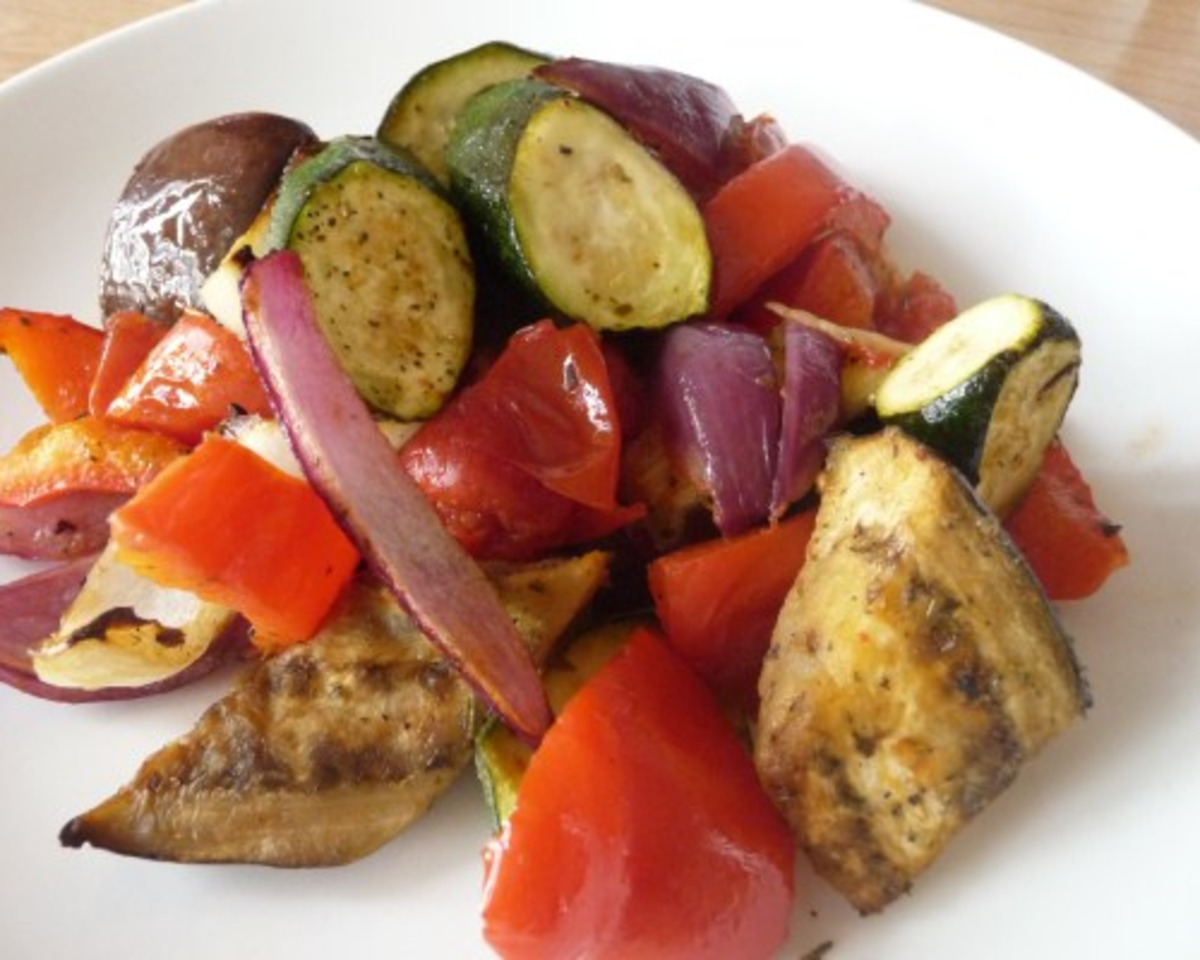
17. Herb-Roasted Zucchini and Bell Peppers -- zucchini is about 94% water. Cut it thick (3/4-inch), salt it after it hits the pan, and roast at 450°F.
18. Garlic-Parmesan Roasted Zucchini -- the cheese forms a crust that protects the surface while the interior cooks.
19. Herb-Roasted Sheet Pan Vegetables and 20. Sheet Pan Rainbow Vegetables -- both mixed-tray recipes with the cut sizes already staggered for even cooking.
21. Roasted Vegetable Medley -- the weeknight default.
Roasted squash + winter vegetable bowls
22. Creamy Roasted Butternut Squash Soup -- roasting before blending is the entire difference between a good squash soup and a bland one.
23. Best-Served-Now Roasted Butternut Squash -- 425°F, 30 minutes, cut-side down for the first 20.
24. Miso-Glazed Butternut Squash and Edamame Bowl -- about 22g of protein per bowl with the edamame.
25. Roasted Quinoa & Chickpea Bowl, with Za'atar-Spiced Roasted Chickpeas on top -- roasted chickpeas are the cheapest crunch in the kitchen at about $0.40 a serving, and they add 7g of protein.
The protein question is what separates a side dish from dinner. A tray of roasted vegetables runs 4-8g of protein per serving; a plate needs 25-30g to be satisfying. Chickpeas, edamame, halloumi, a fried egg, or white beans stirred in at the end all close the gap without another pan.
Sauces + finishers that turn a tray into a dinner (tahini, chimichurri, romesco)
This is the section that matters most and gets skipped most. A finishing sauce is the difference between "roasted vegetables again" and a meal people ask for.
| Sauce | Base | Time | Pairs with |
|---|---|---|---|
| Lemon tahini | Tahini, lemon, garlic, water | 3 min | Cauliflower, sweet potato, chickpeas |
| Chimichurri | Parsley, oregano, garlic, vinegar, oil | 5 min | Roots, potatoes, anything charred |
| Romesco | Roasted red pepper, almond, garlic, vinegar | 8 min | Broccoli, fennel, eggplant |
| Yogurt-herb | Greek yogurt, dill, lemon, salt | 2 min | Beets, carrots, squash |
| Brown butter + sage | Butter, sage leaves | 4 min | Butternut, Brussels sprouts |
Lemon tahini, the workhorse: 1/4 cup tahini, juice of one lemon, one grated garlic clove, salt, then whisk in ice water a tablespoon at a time. It will seize and look broken -- keep going, it comes back glossy. About 3 minutes and it keeps a week refrigerated.
Chimichurri wants to sit at least 20 minutes before serving so the garlic mellows and the herbs release into the oil.
Romesco freezes well in an ice cube tray, which makes it the best make-ahead of the group. The Kitchn's roasting primer has a useful vegetable-by-vegetable timing chart worth printing for the fridge.
Real-world numbers: cost and yield per tray
| Tray | Raw weight | Cost (2026) | Servings | Cost/serving |
|---|---|---|---|---|
| Mixed roots | 2.5 lb | $4.80 | 4 | $1.20 |
| Brussels sprouts | 2 lb | $5.50 | 4 | $1.38 |
| Cauliflower steaks | 1 head (2 lb) | $3.60 | 3 | $1.20 |
| Butternut squash | 3 lb | $4.20 | 5 | $0.84 |
| Chickpeas (2 cans) | 30 oz | $2.40 | 5 | $0.48 |
Vegetables shrink 25-35% by weight during roasting as water evaporates. Buy accordingly -- a pound of raw Brussels sprouts is about two side servings, not four.
Cut sizes and staggering: the mixed-tray problem
Most people want one tray, not four, which means putting vegetables with different densities on the same pan. Two techniques solve it.
Equalize by cut size. Dense vegetables get cut smaller, soft vegetables get cut larger, so everything finishes together. A 3/4-inch carrot cube and a 1.5-inch zucchini chunk both take about 28 minutes at 425°F.
Stagger by time. Start the hard vegetables, then add the soft ones partway through. This works better for large batches where the size difference gets awkward.
| Group | Vegetables | Add at |
|---|---|---|
| Hardest | Beets, potatoes, winter squash | 0 min |
| Hard | Carrots, parsnips, cauliflower | 10 min |
| Medium | Brussels sprouts, broccoli, fennel | 15 min |
| Soft | Zucchini, peppers, onion wedges | 20 min |
| Softest | Cherry tomatoes, asparagus, mushrooms | 25 min |
Total tray time 35-40 minutes at 425°F. Set a timer for each add rather than trying to eyeball it; the whole point of the staggering is that you can't tell by looking until it's too late.
A worked example: one tray, three dinners
Roast 4 pounds of mixed vegetables on Sunday -- two trays, 40 minutes, one flip. That's roughly $9 of produce as of 2026 and it becomes three completely different meals.
Monday, grain bowl. Half the tray over farro or quinoa, chickpeas, lemon tahini, a handful of arugula. About 32g protein with the chickpeas and a spoon of yogurt.
Wednesday, tacos. Reheat a quarter of the tray in a dry skillet for 5 minutes to bring back the crisp edges, load into charred corn tortillas with black beans, crumbled cotija and lime.
Friday, soup. The last quarter, blended with hot stock and a splash of cream, finished with brown butter. Fifteen minutes from fridge to bowl.
The reheating rule is the important part: roasted vegetables reheat well in a hot dry skillet or a 400°F oven for six minutes, and badly in a microwave, which drives water back to the surface and turns crisp edges limp. Store them uncovered until fully cool -- trapping steam in a sealed container is what makes day-two vegetables soggy before you even reheat them.
Common pitfalls
- Parchment on a preheated pan. It insulates and blocks contact browning. Oil the pan directly.
- Tossing in a bowl and dumping. Excess oil pools at one end. Toss on the pan itself.
- Opening the oven repeatedly. Every look drops the temperature 25-50°F. Flip once, at the halfway mark.
- Convection at the same temperature. Convection roasts faster -- drop the set temperature by 25°F or cut 15% off the time.
- Thin nonstick sheet pans. They warp above 400°F and dump oil into the bend. See our bakeware picks for heavy half-sheets that don't.
When not to roast
Skip roasting for delicate leafy greens (they go to paper), for anything you want to keep bright green as a garnish, and for very watery vegetables you plan to blend anyway -- a cucumber or a lettuce has nothing to caramelize. Also skip it in July if you don't have air conditioning; a 425°F oven for 40 minutes adds real heat to a small kitchen, and a grill basket does the same job outside.
Equipment
Two heavy half-sheet pans (13 x 18 inches, aluminum or clad steel) from our bakeware picks (the ranked ones are in Best Sheet Pans in 2026), a fish spatula or a stiff metal turner from utensils & tools for scraping browned pieces off without tearing them, and a large mixing bowl. A cast-iron skillet from cookware is the best single-pan alternative for small batches, and glass containers from storage keep leftovers from sweating.
What to cook next
Add a protein to the same tray and you have the sheet pan dinners guide. For autumn squash specifically, see the pumpkin and butternut dinners roundup; for turning a tray into lunches, the grain bowl guide and the soup season roundup both start from roasted vegetables.
Sources
- Serious Eats -- How to Roast Vegetables -- tested temperature and crowding data.
- Cook's Illustrated -- How to Roast Vegetables -- cut-size and preheated-pan testing.
- The Kitchn -- How to Roast Any Vegetable -- vegetable-by-vegetable timing chart.