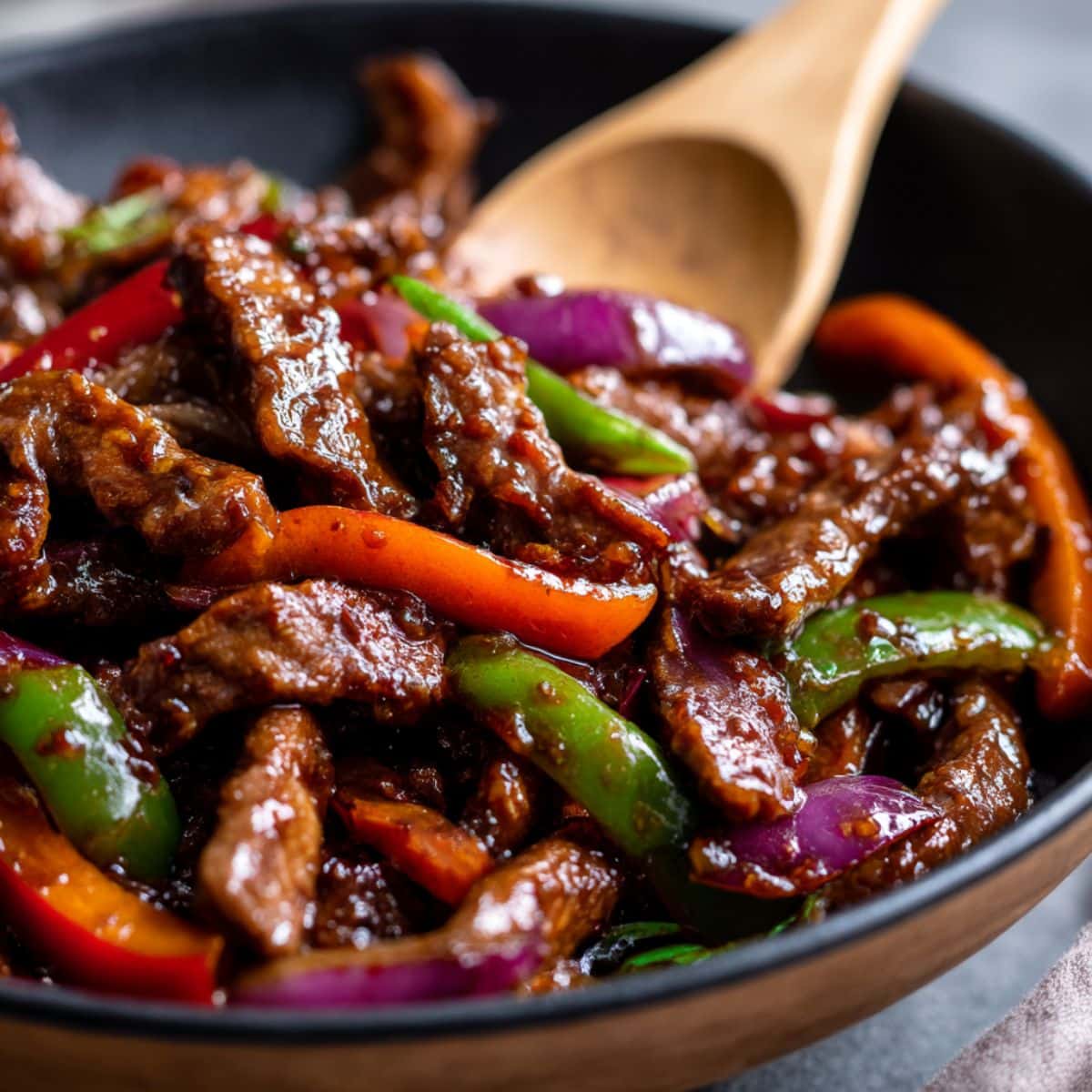
20 One-Pan Stir Fry Recipes: Beef, Chicken, Shrimp & Vegetable Weeknight Dinners
One pan, 10 minutes of cooking, and a sauce ratio you can memorize in an afternoon.
A stir fry is a weeknight dinner because the actual cooking takes 8-10 minutes: get the pan ripping hot, sear a dry protein in one layer, add hard vegetables, then soft ones, then a cold-mixed cornstarch sauce in the last 30 seconds. All 20 recipes below run on that same sequence — only the protein and the sauce change.
Get a free week of easy dinners
Seven weeknight dinners with the shopping list already totalled, sent Sunday. No account needed, unsubscribe in one click.
No spam, unsubscribe in one click. Recipes, shopping lists and Instacart carts all work without an account either way.
Why the stir fry is the ultimate weeknight one-pan dinner
Three things make stir fry the highest-leverage technique in a home kitchen. It cooks in one pan, so cleanup is a single wash. It uses roughly 1 tablespoon of oil per two servings instead of the 2-3 cups a deep-fry needs. And it front-loads all the work into knife time, which you can do on Sunday.
The time math is the real argument. A sheet-pan dinner needs 25-40 minutes of oven time you cannot compress. A braise needs 90 minutes. A stir fry with pre-cut ingredients is on the table in 12 minutes from cold pan to plate — faster than the rice, which is why you start the rice first.
The catch is heat. A restaurant wok range puts out 100,000-200,000 BTU. A residential gas burner delivers 9,000-12,000 BTU; an induction hob delivers the equivalent of roughly 12,000-18,000. That gap is why home stir fries go grey and watery, and it is what the next section is about.
The wok hei framework: heat, oil, mise en place and dry proteins
Wok hei — literally "breath of the wok" — is the faintly smoky, slightly charred aroma that separates a restaurant stir fry from a home one. It comes from oil and food droplets aerosolizing above roughly 200°C and combusting briefly. Wikipedia's entry on wok hei is a good short primer on the chemistry, and The Woks of Life's wok-seasoning guide covers the patina that makes a carbon-steel pan release food properly.
You cannot fully replicate a wok range at home. You can get 80% of the way there with four rules:
1. Preheat 3-4 minutes, empty. Not 60 seconds. The pan should be hot enough that a bead of water skitters and vanishes in under two seconds. Cold pan is the single most common failure.
2. Dry the protein. Pat it with paper towel until it stops darkening the towel. Surface water has to boil off before searing starts, and boiling drops the pan temperature 40-60°C.
3. Cook in batches, one layer deep. Two servings max per round in a 12-inch pan. Crowding is the second most common failure.
4. High-smoke-point oil. Peanut (450°F), refined avocado (520°F), grapeseed (420°F). Not extra-virgin olive oil at 375°F, which will smoke bitter before the pan is hot enough.
Velveting is the fifth trick and the one most home cooks skip. Toss sliced protein with 1 tsp cornstarch, 1 tsp soy and 1 tsp Shaoxing wine per 8 oz, rest 15 minutes, and the starch layer keeps the meat tender through high heat. It is the reason takeout chicken is silkier than yours. The general stir-frying overview covers the chao and bao technique split if you want the vocabulary.
Six beef stir fry recipes
Beef wants a hot pan and a short cook. Slice against the grain at 1/4 inch, and use flank, skirt, sirloin tip or flat iron — cuts that are lean enough not to render but tough enough to reward the thin slice.
1. Stir-Fried Noodles with Beef and Broccoli — the whole meal in one pan; no separate rice pot.
2. Stir-Fried Mongolian Beef with Scallions and Garlic — brown-sugar-and-soy glaze, six ingredients.
3. Garlic-Black Pepper Beef and Broccoli Stir-Fry — coarse-cracked pepper does the heavy lifting; no chili needed.
4. Stir-Fried Chinese Pepper Steak with Sesame Oil — bell pepper and onion; the American-Chinese standard done right.
5. Sesame-Glazed Beef Stir-Fry — a 15-minute weeknight version with pantry ingredients only.
6. Korean-Inspired Beef and Broccoli Stir-Fry — gochujang in the sauce base; a good bridge from our Korean weeknight dinners roundup.
Six chicken stir fry recipes
Chicken thigh beats breast in a stir fry by a wide margin — it holds 15-20% more moisture at the same internal temperature and forgives an extra 30 seconds in the pan. Use breast only if you velvet it.
7. Traditional Chinese Kung Pao Chicken — peanuts, dried chilies, Sichuan peppercorn.
8. Authentic Sichuan Kung Pao Chicken — the numbing version, with more peppercorn and less sugar.
9. Spicy Chicken and Cashew Stir-Fry — the mildest entry here; good for a mixed-age table.
10. Stir-Fried Thai Basil Chicken — pad krapow; fish sauce and holy basil, five minutes of cooking.
11. Teriyaki Chicken Stir-Fry with Vegetables — the kid-safe pick; sweet, glossy, no chili.
12. Wok-Seared Chicken Stir-Fry with Snow Peas and Water Chestnuts — the crunchiest of the set.
Four shrimp and seafood stir fry recipes
Shrimp is the fastest protein here and the easiest to ruin: 90 seconds per side at high heat, then out of the pan. Overcooked shrimp goes from snappy to rubbery in about 45 seconds.
13. Spicy Shrimp Stir-Fry with Garlic and Snow Peas — the reference build for shrimp.
14. Cantonese Shrimp and Snow Pea Stir-Fry with Garlic Sauce — a lighter, less sweet white sauce.
15. Stir-Fried Garlic Shrimp with Snow Peas and Ginger — heavy on aromatics, no sugar at all.
16. Szechuan Kung Pao Shrimp — the kung pao template with shellfish.
Four vegetarian and tofu stir fry recipes
Extra-firm tofu, pressed 20 minutes and patted bone-dry, sears properly. Silken and soft tofu do not — they will disintegrate the moment you toss the pan.
17. Tofu and Vegetable Stir-Fry — the baseline; learn this before the others.
18. Miso-Glazed Tofu and Vegetable Stir-Fry — miso adds the umami that soy alone misses in a meatless build.
19. Rainbow Vegetable and Tofu Stir-Fry — the one to make when the crisper drawer needs clearing.
20. Vegetable Stir Fry with Garlic and Ginger — no protein at all; a 10-minute side that scales to a main over rice.
Two extras worth bookmarking: Sweet and Sour Tofu with Rice and Chili-Garlic Egg Noodles Stir Fry with Vegetables for a noodle night.
Sauce master formulas
Memorize one ratio and you never need a recipe's sauce section again. All quantities are parts by volume; whisk cold, pour in during the final 30 seconds, and let it thicken for 20-30 seconds before plating.
| Sauce | Soy | Stock/water | Acid | Sugar | Cornstarch | Finish |
|---|---|---|---|---|---|---|
| All-purpose brown | 3 | 2 | 1 rice vinegar | 1 | 1 tsp | 1 tsp sesame oil |
| Garlic white | 1 | 4 | 0.5 rice wine | 0.5 | 1 tsp | white pepper |
| Sweet and sour | 1 | 2 | 2 rice vinegar | 3 | 1.5 tsp | ketchup 1 |
| Kung pao | 2 | 1 | 1 black vinegar | 1.5 | 1 tsp | chili oil, Sichuan pepper |
| Teriyaki | 3 | 1 | 1 mirin | 2 | 1 tsp | grated ginger |
| Black bean | 2 | 3 | 0.5 rice wine | 0.5 | 1 tsp | 1 fermented black bean |
Real-world numbers. A batch of all-purpose brown sauce at 3 tbsp soy / 2 tbsp stock / 1 tbsp vinegar / 1 tbsp sugar / 1 tsp cornstarch dresses two servings and adds about 55 calories and 900mg sodium per serving. Cut the soy to 2 tbsp and add 1 tbsp of water if you are watching sodium — the cornstarch keeps the coating glossy either way.
Wok vs carbon-steel skillet vs nonstick
| Pan | Price | Best for | Weakness |
|---|---|---|---|
| 14" flat-bottom carbon steel wok | $40-60 | 4+ servings, real tossing, high heat | Needs seasoning; will rust if left wet |
| 12" carbon-steel skillet | $35-55 | 2 servings, sears well, oven-safe | Small surface; no walls to push food up |
| 12" cast iron | $25-45 | Heat retention on weak burners | Slow to respond; heavy to toss |
| 12" nonstick | $30-60 | Tofu, eggs, low-fat cooking | Coating degrades above ~500°F — no wok hei |
| Round-bottom wok + ring | $30-50 | Gas only; the closest to restaurant technique | Unusable on induction and most electric |
If you have gas, buy the 14-inch flat-bottom carbon steel. If you have induction, buy the carbon-steel skillet — a round-bottom wok has almost no contact patch on an induction hob and will heat only a 4-inch circle. Our Best Woks for 2026 guide breaks down specific models by burner type; browse the pans themselves in Cookware, and pick up a wok spatula and a spider strainer from Utensils & Tools — a regular spoon will not move food fast enough at these temperatures. A sharp blade matters here too, because uniform 1/4-inch slices cook evenly; see Knives & Cutting.
Shopping list and pantry sauce staples
Eight bottles cover every sauce in the table above, and all of them keep 12+ months.
| Item | Approx cost | Keeps |
|---|---|---|
| Light soy sauce | $4-7 | 2 years unopened, 1 year open |
| Shaoxing wine | $5-9 | Indefinitely |
| Toasted sesame oil | $6-10 | 6-12 months (refrigerate) |
| Rice vinegar | $3-5 | 2 years |
| Oyster sauce | $4-7 | 6 months refrigerated |
| Chinkiang black vinegar | $5-8 | 2 years |
| Cornstarch | $2-3 | Indefinitely |
| Chili crisp or chili oil | $7-12 | 6 months |
Common pitfalls
- Cold pan. Three to four minutes of preheat, every time. This fixes more stir fries than any other single change.
- Wet protein. Pat dry until the towel stays clean. Marinade left clinging to the meat boils instead of sears.
- Crowding. One layer, two servings max. Cook in rounds and combine at the end.
- Sauce added too early. Cornstarch sauce added at the start scorches and turns bitter. Last 30 seconds only.
- Pre-cut frozen vegetable blends. They carry ice crystals that flood the pan. If you use them, thaw and drain first, then pat dry.
A 30-minute Sunday prep session
Cut once, eat four times. Slice 1 lb chicken thigh and 1 lb flank steak, portion into four deli containers with aromatics on top, wash and cut 2 lbs of mixed vegetables, and premix four sauce jars from the ratio table. Total: about 30 minutes. Weeknight cook time then drops to 8-10 minutes per dinner. Store proteins 2 days refrigerated or 3 months frozen; cut vegetables hold 4-5 days.
When NOT to stir fry
Skip it when the protein is a thick cut that wants a slow render — pork belly, short rib, brisket. Skip it when you are cooking for more than six people, because batching in a 12-inch pan takes longer than a braise. And skip it if your only heat source is a low-output portable electric coil; you will end up steaming, and a sheet-pan dinner will taste better for the same effort. The tell is simple: if you cannot get a drop of water to skitter and vanish off the dry pan within two seconds, the burner is not going to deliver a stir fry, and no amount of technique will compensate for missing energy.
FAQ
Do I need a wok? A 12-inch carbon-steel skillet handles two servings. For four or more, a 14-inch flat-bottom carbon-steel wok is worth $40-60.
Why is my stir fry watery? Pan not hot enough, or too crowded. Preheat 3-4 minutes and cook one layer at a time.
Beginner sauce ratio? 3 soy : 2 stock : 1 rice vinegar : 1 sugar, plus 1 tsp cornstarch and 1 tsp sesame oil.
Can these be gluten-free? Yes — tamari or coconut aminos 1:1 for soy, rice noodles for wheat, and check the oyster sauce label.
How do I prep ahead? See the Sunday session above: 30 minutes of knife work sets up four weeknight stir fries.
Related reading and sources
- 25 Better-Than-Takeout Chinese Recipes
- 22 Cantonese Recipes: Char Siu, Wonton & Stir-Fry Dinners
- 25 Thai Dinners: Pad Thai, Green Curry & Basil Chicken
- Best Woks for 2026
Sources: Wikipedia — Wok hei, The Woks of Life — How to Season a Wok, Wikipedia — Stir frying.
Frequently asked questions
Do I really need a wok, or will a regular skillet work?
Why does my stir fry always turn out watery?
What is a good beginner stir fry sauce ratio?
Can I make these gluten-free?
How do I prep everything in advance so the cook is fast?
Sources
Recipes to start your week with
Save any of these to My Recipes — no account needed — and send the ingredients to Instacart in one tap.

Plan a week of meals in two minutes.
Tell our AI what you have and what you like — it builds your plan, shopping list, and Instacart cart. No account needed.
Plan my week →