18 Argentine Asado Recipes: Grilled Meats, Chimichurri & Steakhouse Sides at Home
The four-hour order of service, the cuts to actually ask a US butcher for, and why the chimichurri belongs on the table instead of the grill.
Affiliate disclosure: AislePrompt may earn a commission on qualifying purchases made through Amazon and Instacart links in this article, at no additional cost to you. See our affiliate policy →
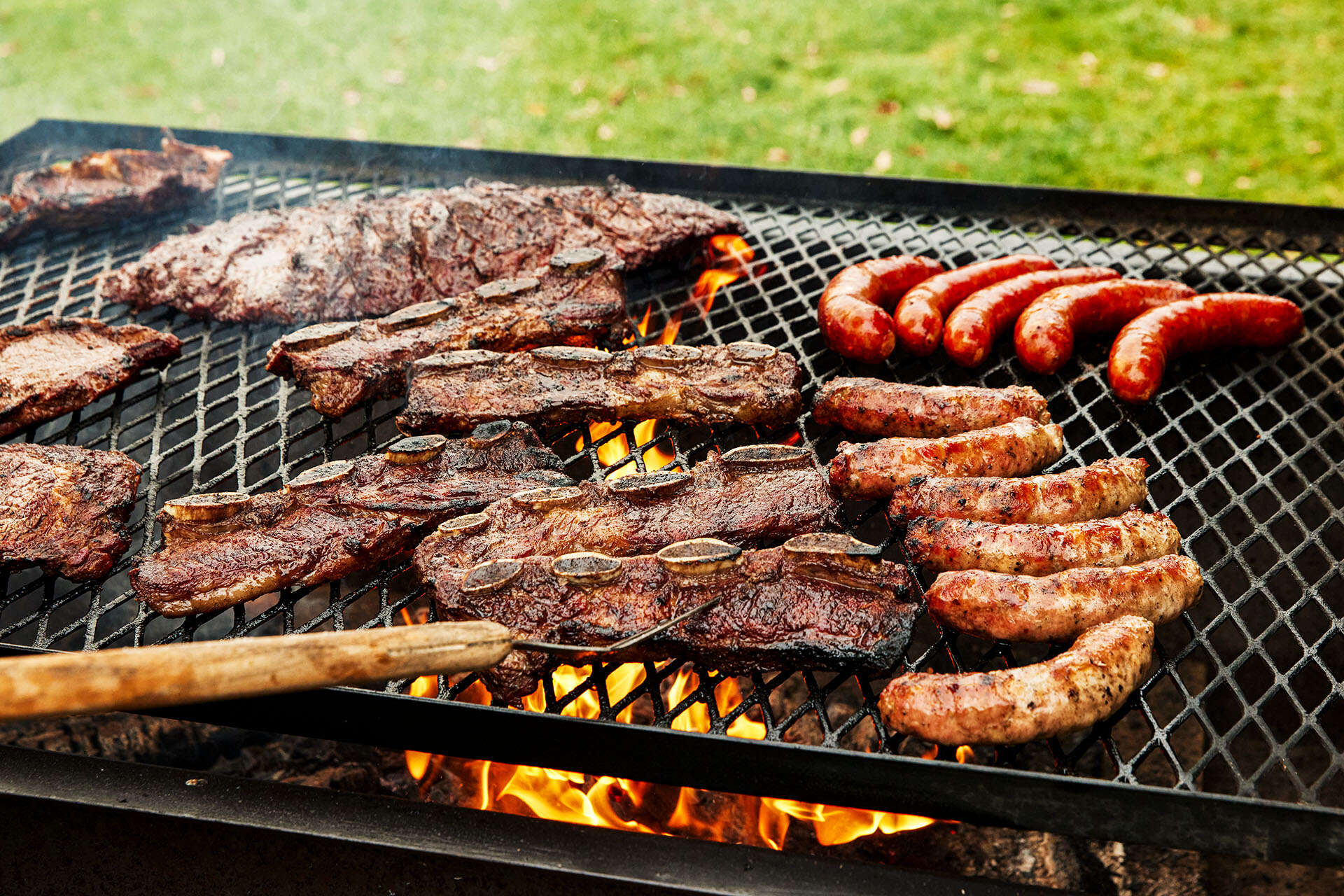
An Argentine asado is a four-hour fire ritual, not a dinner. You light hardwood or charcoal, wait 45 minutes for embers, and cook in a fixed order — sausage, then cheese, then offal, then ribs, then the main cuts — over low, indirect heat with almost no seasoning beyond coarse salt. Chimichurri goes on at the table, never on the grill.
What asado actually is
American backyard grilling is a cooking method. Asado is a social event that happens to involve meat. The distinction matters because it changes every decision you'll make.
There is one person in charge — the asador — and they do not leave the fire. Guests arrive over the first two hours and eat in waves as things come off. Nothing is rushed and nothing is cooked hot. The fire is built to one side or in a separate box and embers are shovelled under the grill as needed, so the grate temperature stays somewhere around 250–300°F for hours. That's the whole trick, and it's the opposite of what most people do with a bag of briquettes.
The seasoning philosophy is equally spare. Coarse salt on the meat. That's it. No rubs, no marinades, no sauce during cooking. Everything you'd want from a rub arrives at the table as chimichurri or salsa criolla, applied by the person eating. Argentine cuisine is built on the assumption that the beef is good enough to carry itself, and Argentine beef mostly is.
This is eighteen recipes structured the way a real asado runs. If you want the broader survey of the cuisine — pastas, milanesas, the Italian-immigrant half of Argentine cooking — that's in 20 Argentine Recipes: Chimichurri, Empanadas and Asado Classics. This article is about the fire.
The order of service
Food comes off the grill in a sequence, roughly one course an hour. Don't put everything on at once.
| Hour | Course | What's cooking |
|---|---|---|
| 0:00 | Fire lit | Nothing yet — 45 min to embers |
| 0:45 | Picada | Sausage, cheese, empanadas from the oven |
| 1:15 | Achuras | Offal — sweetbreads, blood sausage |
| 1:45 | Costillas | Short ribs, low and slow |
| 2:45 | Cortes principales | Picanha, skirt, flank, tri-tip |
| 3:30 | Rest and carve | 15–20 minutes off the heat |
| 3:45 | Sides and salad | Assembled while the meat rests |
| 4:15 | Dessert and coffee | Flan, churros, dulce de leche |
The pacing is the point. Guests eat a sausage sandwich at 45 minutes, cheese and empanadas at an hour, ribs at two hours, and the main event at three and a half. Nobody stands around hungry, and nobody is full before the good part.
The meats: what to ask a US butcher for
This is where most American attempts go wrong, because the cuts don't translate. Bring photos.
1 & 2. Picanha (colita de cuadril). The top sirloin cap with the fat cap left on — the single most important cut in South American grilling. Charcoal Pit-Grilled Picanha with Chimichurri Sauce runs 480 calories and 48g protein for 4, about 65 minutes. The faster version is Fire-Roasted Picanha with Garlic Chimichurri at 480 calories and 52g protein in 30 minutes. Most US butchers call it "top sirloin cap" or "coulotte" and will trim the fat off unless you stop them. Don't let them.
3. Entraña (skirt steak). Grilled Beef Skirt Steak with Smoky Chipotle Salsa — 350 calories, 40g protein, 35 minutes. Skirt steak is a diaphragm muscle with coarse, distinctly directional grain; cook it hot and fast to medium-rare, then slice hard across the grain or it eats like rope.
4. Vacío (flank). Grilled Citrus-Marinated Flank Steak at 320 calories and 40g protein, 27 minutes. In Argentina this is cooked far longer than an American would — closer to an hour over low embers, until the outside is genuinely crusted.
5. Tri-tip. Grilled Santa Maria Tri-Tip with Charred Salsa Verde — 350 calories, 40g protein, 35 minutes. Not traditionally Argentine, but it's the closest thing a US supermarket reliably stocks to a whole-muscle asado cut at a sane price.
6 & 7. Skewers. Grilled Argentine Beef Skewers with Chimichurri Sauce at 320 calories and 35g protein, and Churrasco-Style Fire-Roasted Beef Skewers with Chimichurri at 350 calories and 38g protein. Both are 30 minutes and both are the right call when you can't get a whole-muscle cut.
8. The pub-crossover steak. Argentine-British Fusion Steak — 520 calories, 42g protein, 4 servings. Chimichurri technique on a cut an American butcher will hand you without a conversation.
9 & 10. Chorizo, for the choripán. Barbecue Grilled Sausage with Onion Jam at 380 calories, or Grilled Sausage and Jalapeño Skewers with Smoky BBQ Glaze at 280 calories for 8. Split the sausage lengthwise (mariposa, butterflied), grill both cut faces, and serve on crusty bread with chimichurri. This is the first thing off the fire and the thing everyone remembers.
On short ribs: ask for asado de tira — short ribs cut flanken-style, across the bone, about half an inch thick. Do not accept English-cut short ribs; they're the same animal but the wrong geometry and they will chew like a tire on a grill.
The sauces
Chimichurri is not a marinade. It goes on cooked meat at the table. Real chimichurri is fresh flat-leaf parsley (never dried), red wine vinegar (never white), a full head of raw garlic finely minced, dried oregano, red pepper flakes, and enough neutral oil to loosen it — and then it rests, uncovered, at room temperature for at least two hours. Overnight is better. That rest is the entire difference between a jar of green oil and an actual sauce; grocery-store bottles use dried herbs and stabilizers and taste like a different product. The best versions in our catalog are built into the picanha and skewer recipes above — Sautéed Picanha Steak with Chimichurri Sauce is the fastest way to make the sauce and eat it the same night, and it keeps two weeks in the fridge.
Salsa criolla is the other table sauce and it's barely a recipe: finely diced red onion, red and green bell pepper, tomato, red wine vinegar, oil, salt, rested an hour. Salsa Criolla Chicken with Roasted Garlic — recipe 11, at 350 calories and 30g protein — builds it around chicken, and Pan-Fried Salmon with Fresh Salsa Criolla is the version to make when half the table doesn't eat red meat.
Provoleta is a thick disc of provolone grilled in a small cast-iron pan until the bottom crusts and the middle goes molten, dressed with oregano and chili flakes and eaten with bread. Our catalog's closest analogue is recipe 12, Grilled Vegetable and Halloumi Skewers with Herb Yogurt Sauce at 280 calories and 16g protein — the same grilled-firm-cheese idea, and the technique transfers directly if you buy a whole provolone and cut a one-inch round.
The sides
Argentines keep sides deliberately minimal so the meat stays the subject.
13. Grilled vegetables. Herb-Infused Grilled Vegetable Platter with Balsamic Glaze — 120 calories, serves 6, 35 minutes. Peppers, eggplant, zucchini, onion, cooked on the cool side of the fire while the meat rests.
14. Potatoes. Pan-Roasted Herb Potatoes with Garlic and Rosemary at 220 calories, 30 minutes. Stand-in for papas fritas if you don't want a pot of frying oil going outdoors alongside a live fire.
15. The vegetarian centerpiece. Charcoal-Grilled Portobello Mushrooms with Balsamic Glaze — 180 calories, 30 minutes. Grill these on a clean part of the grate and dress them with the same chimichurri.
A ensalada mixta — lettuce, tomato, raw onion, oil, vinegar, salt, nothing else — belongs on the table too. It doesn't need a recipe and it shouldn't have one. Skip American BBQ sides entirely; coleslaw and baked beans fight the meat instead of cutting it.
The empanadas
Empanadas come out before the meat, with a drink, while the fire is still coming up. The empanada travelled to Argentina from Galicia and every province now claims its own version — Salta's are cumin-heavy with potato, Tucumán's are juicier and knife-cut rather than ground.
16. Beef. Argentine Beef Empanadas with Spiced Tomato Sauce — 320 calories, 22g protein, 8 empanadas, 80 minutes. Baked, not fried, which is the Argentine default.
17. Chicken. Pan-Fried Empanadas with Spiced Chicken Filling at 320 calories and 22g protein for 8. The fried version, for when you want the blistered shell.
The beef alternative. Pan-Fried Empanadas with Spiced Beef Filling, 320 calories, 8 servings — the same dough, a simpler filling, and a good one to make ahead and freeze raw.
Two rules: chill the filling completely before you fill anything (warm filling melts the dough and it tears), and freeze them raw rather than cooked if you're making them in advance.
The dessert
Everything Argentine ends in caramel.
18. Flan. Flan de Huevo con Caramelo — 250 calories, 8 servings, 80 minutes. Serve it the Argentine way, flan mixto, with a spoonful of dulce de leche and whipped cream on the side.
The richer flan. Baked Quesillo Flan with Caramel Sauce at 320 calories for 8.
Dulce de leche, two ways. Grilled Churro Skewers with Whipped Dulce de Leche Cream — 300 calories, 6 servings, 30 minutes, and they finish on the dying fire, which is a nice piece of theatre. Dulce de Leche Filled Sopapillas with Honey Drizzle at 350 calories is the fried alternative.
The drink. Shaken Fernet and Malbec Argentine Cocktail, 180 calories. Fernet is genuinely Argentina's national drink — the country consumes the overwhelming majority of the world's supply — and it is an acquired taste that pays off next to four hours of beef.
Grill setup: embers, not flames
| Setup | Works? | Notes |
|---|---|---|
| Hardwood fire, embers shovelled under | Best | Oak or quebracho; 45 min to embers |
| Lump charcoal, banked to one side | Very good | The realistic home version |
| Briquettes | Acceptable | More ash, more even, less flavour |
| Gas grill | Compromised | Use a smoker box; keep the lid shut |
| Pellet grill | Decent | Set 250°F, no flame contact |
Never cook over flames. Meat goes on when the coals are covered in grey ash and you can hold a hand six inches above the grate for about five seconds. If you can only manage two seconds, it's too hot — wait, or raise the grate. Argentine grills have a crank precisely so the asador can move the grate up and down instead of changing the fire.
Salt the meat generously with coarse salt fifteen to forty minutes before it goes on, not hours before. And put the fat cap toward the fire first on the picanha; the rendered fat bastes everything below it.
The chimichurri debate
There is no single recipe and Argentines will argue about it at length. Broadly:
| Style | Herb base | Character |
|---|---|---|
| Buenos Aires / porteño | Parsley-forward, little oregano | Bright, garlicky, vinegar-sharp |
| Rural / provincial | Heavy dried oregano | Earthier, more medicinal |
| Rojo | Parsley plus paprika and chili | Redder, warmer, slightly sweet |
| Uruguayan | More oil, less vinegar | Softer, closer to a dressing |
The one thing everyone agrees on: no blender. Chimichurri is chopped, not puréed. A food processor bruises the parsley and turns the sauce into green sludge that tastes of nothing but garlic within a day.
Shopping list
Butcher — 3 lb picanha / top sirloin cap with fat cap, 2 lb skirt steak, 2 lb flank, 2 lb tri-tip, 3 lb flanken-cut short ribs, 2 lb fresh chorizo or bratwurst, 1 lb chicken thighs, 1 lb ground beef (empanadas).
Produce — 3 bunches flat-leaf parsley, 4 heads garlic, 6 red onions, 4 bell peppers (mixed colours), 6 tomatoes, 2 lemons, 2 limes, 3 lb potatoes, 2 zucchini, 2 eggplant, 4 portobello caps, 2 heads lettuce, 1 bunch cilantro.
Dairy and eggs — 1 lb whole provolone (for provoleta), 8 oz halloumi, 1 dozen eggs, heavy cream, butter.
Center aisles — red wine vinegar, good neutral oil (1 quart), olive oil, dried oregano, red pepper flakes, sweet paprika, cumin, coarse/kosher salt, whole black pepper, all-purpose flour, empanada discs (frozen, if your store carries them), 14 oz sweetened condensed milk, dulce de leche, sugar, vanilla, crusty rolls for choripán, Malbec, Fernet, 20 lb lump charcoal, hardwood chunks.
Send it all to your store in one pass from the shopping list tool, or ask AislePrompt's chat to scale the meat quantities to your actual headcount — asado math is unforgiving and running short is the one failure that can't be fixed mid-event.
Common pitfalls
Cooking over flames. The single most common mistake. Flames deposit soot, not flavour, and they burn the outside before the inside moves. Wait for grey ash.
Marinating in chimichurri. The vinegar denatures the surface protein and you lose the crust. Sauce on the plate, salt on the grill.
Buying English-cut short ribs. Wrong geometry entirely. You want them cut across the bones, half an inch thick.
Blending the chimichurri. Chopped, always. A processor turns it bitter and muddy inside a day.
Everything on the grill at once. The order of service exists so that food arrives in waves over four hours. Loading the grate at 2pm means everything is ready at 2:40 and cold at 3.
Slicing straight off the fire. Skirt and flank need 10–15 minutes of rest, and picanha needs 20. The general guidance on cooking steak is the same everywhere: resting is not optional, and it's also what gives you time to plate the sides.
When not to do this
An asado is a four-hour commitment with roughly 90 minutes of active work spread across it, and it needs a live fire you can adjust. If you have two hours, or a small balcony, or a gas grill you can't run at 250°F, cook one skirt steak hot and fast and make the chimichurri properly — that's 90% of the pleasure for 20% of the effort. And if you're feeding four people, skip the whole order-of-service structure; it's built for a dozen guests arriving over two hours.
Sources
- Wikipedia — Asado — the ritual, the order of service and regional variations
- Wikipedia — Chimichurri — composition and the parsley-versus-oregano regional split
- Wikipedia — Argentine cuisine — the beef tradition and Italian-immigrant influence
- Wikipedia — Skirt steak — the muscle, the grain direction and why slicing matters
- Wikipedia — Empanada — the Galician origin and provincial Argentine styles
- BBC Good Food — How to cook the perfect steak — resting times and doneness
Calorie, protein and timing figures come from the linked AislePrompt recipe pages, as of 2026.
Related guides
For the rest of South America, see 18 Brazilian Recipes: Feijoada, Pão de Queijo and Churrasco at Home, 20 Brazilian Dinner Recipes, and 22 Peruvian Recipes: Ceviche, Lomo Saltado and Ají Classics.
Grill gear is covered in Best Grilling Tools and BBQ Gadgets 2026, and the indoor version of these cuts is in 20 Cast Iron Skillet Dinners. Our vetted picks live in Cookware for the cast-iron provoleta pan, Knives & Cutting for a slicing knife that handles a whole picanha, and Utensils & Tools for long tongs and an instant-read thermometer.
Beyond the parrilla, 22 Latin American Dinners covers the everyday home cooking of Argentina's neighbors — Chile, Uruguay, Paraguay, Bolivia and Ecuador.