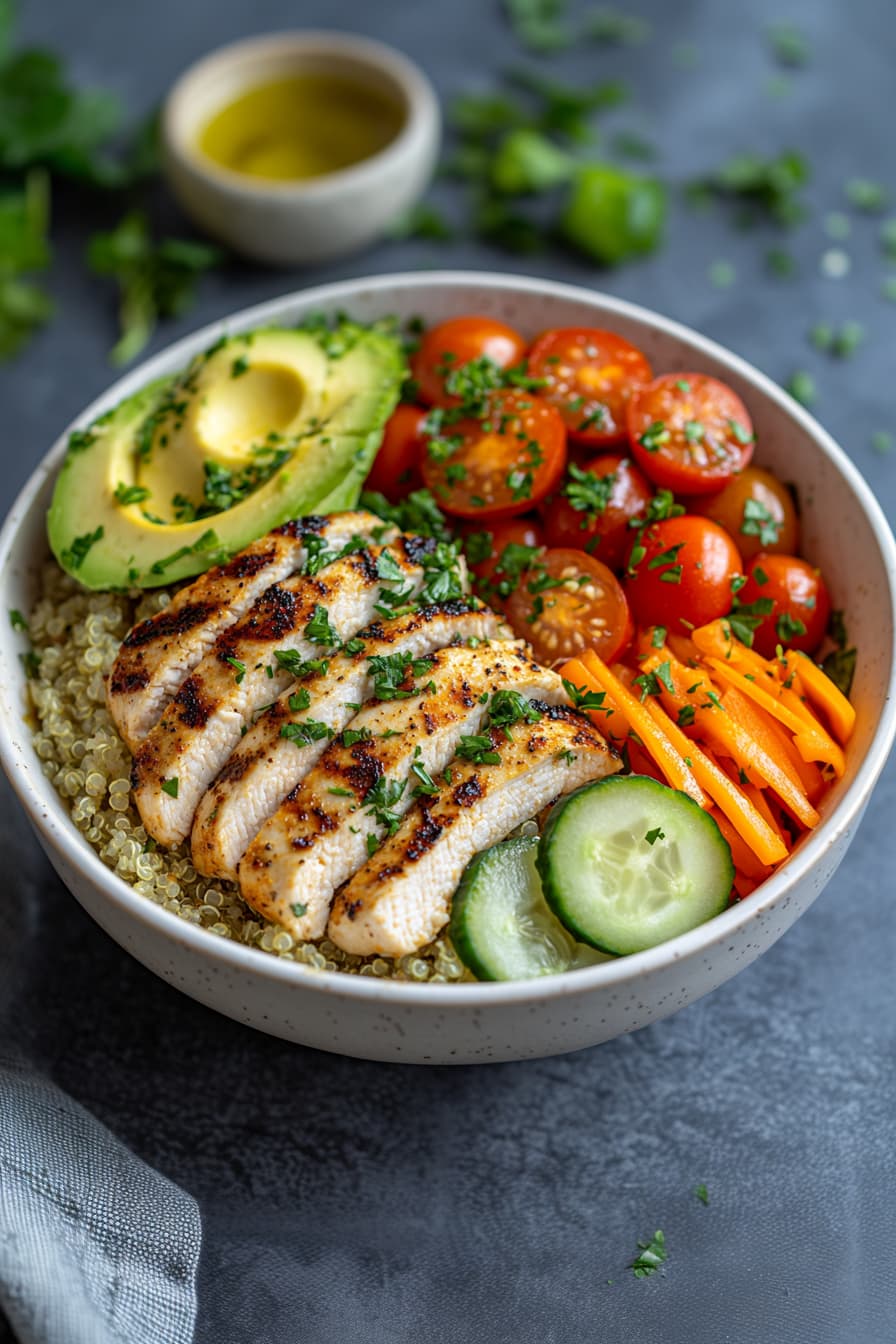
High-Protein Meal Prep: 5-Day Muscle-Building Plan + 40g-Protein Batch Recipes
One protein, one carb, one vegetable, three sauces — the batch-cooking framework that gets you to four 35g protein doses a day without eating the same bowl five times.
High-protein meal prep for the week means cooking 3–4 lb of protein, two carbohydrate bases and two vegetables in one 90-minute session, then assembling 10–15 containers that each land between 35 and 45 g of protein. One protein, one carb, one vegetable, three sauces — that framework produces a week of meals that do not taste identical by Thursday.
Get a free Sunday meal-prep plan
One batch cook, five lunches that still hold on Thursday, and a single consolidated Instacart cart. Sent Saturday.
No spam, unsubscribe in one click. Recipes, shopping lists and Instacart carts all work without an account either way.
Introduction — why high-protein meal prep is the most-searched fitness eating pattern for a reason
High-protein meal prep survives contact with real life better than any other eating pattern, and the reason is mechanical rather than metabolic. Protein is the macronutrient with the highest satiety per calorie, the highest thermic effect (20–30% of its calories are burned in digestion versus 5–10% for carbohydrate), and the only one with a hard floor for preserving lean mass in a deficit. Batch cooking then solves the compliance problem: the failure mode of every eating plan is a hungry Tuesday at 7pm with nothing cooked.
There is also a plain cost argument. Chicken thighs at $2.60/lb, eggs at $0.28 each, and canned lentils at $1.20 per can put a 40 g-protein meal at roughly $2.90 as of 2026. The equivalent prepared-meal delivery service runs $11–$14. Ninety minutes on Sunday saves about $60 a week for a single person and considerably more for a household.
This guide is the top-of-funnel for the site's high-protein meal prep hub — the hub is the browsable recipe surface, and the meal prep planner builds a shopping list from whatever you pick.
How much protein you actually need (per body weight, activity level, and goal)
The RDA is 0.8 g per kg of body weight, and that number is a minimum to prevent deficiency in sedentary adults — not an optimum. Every serious review of resistance-training populations lands substantially higher.
| Goal / population | g per kg body weight | g per lb | 175 lb person |
|---|---|---|---|
| RDA floor (sedentary) | 0.8 | 0.36 | 64 g |
| General health, active | 1.2–1.4 | 0.55–0.64 | 96–112 g |
| Building muscle | 1.6–2.2 | 0.73–1.0 | 128–175 g |
| Cutting (preserving lean mass) | 2.0–2.4 | 0.9–1.1 | 158–192 g |
| Adults over 65 | 1.2–1.6 | 0.55–0.73 | 96–128 g |
The meta-analytic consensus is that benefits for muscle protein synthesis plateau around 1.6 g/kg, with diminishing but non-zero returns to about 2.2 g/kg — Schoenfeld and Aragon's per-meal dose-response review (JISSN, 2018) covers the dose-response data in detail. Harvard Health notes the same plateau and cautions that going far above it displaces other nutrients rather than adding benefit. The International Society of Sports Nutrition position stand on protein and exercise puts the athlete range at 1.4–2.0 g/kg, and 2.3–3.1 g/kg when you are cutting and need to protect lean mass.
Distribution matters more than most people think. Muscle protein synthesis responds to a per-meal dose of roughly 0.4 g/kg — about 30–40 g for most adults — and eating 120 g as one enormous dinner is measurably less effective than eating four 30 g meals. That is the real argument for meal prep: it is the only reliable way to hit four separate 35 g doses on a workday.
Age raises the threshold. Older adults show anabolic resistance — the same 20 g dose that maximally stimulates synthesis at 25 does not at 70. Target 35–40 g per meal after 65.
The Batch Cooking Framework — one protein × one carb × one vegetable × 3 sauces
The reason most meal prep fails is not effort, it is monotony. Five identical containers is a plan you abandon on Wednesday. The framework that survives:
Cook once:
- One protein, 3–4 lb, cooked plainly and seasoned only with salt (chicken thighs, ground turkey, or a pork loin)
- One carbohydrate base, ~6 cups cooked (rice, quinoa, potatoes, or pasta)
- Two vegetables, roasted on separate sheet pans so they cook to their own timing
Vary at assembly: three sauces, made in five minutes each, transform the same three components into three distinct cuisines.
| Sauce | Ingredients | Reads as | Keeps |
|---|---|---|---|
| Lemon-tahini | Tahini, lemon, garlic, water, salt | Mediterranean | 7 days |
| Chipotle-lime yogurt | Greek yogurt, chipotle in adobo, lime | Tex-Mex | 5 days |
| Ginger-soy-sesame | Soy, rice vinegar, sesame oil, ginger, honey | East Asian | 10 days |
Store sauces separately in 2 oz containers and add at reheat. Sauce mixed in on Sunday makes everything soggy by Wednesday — this is the single highest-impact change to make.
The mid-week reset. Cook Sunday for Monday–Wednesday and Wednesday evening for Thursday–Friday. Five days of refrigerated cooked chicken is at the edge of both food safety and palatability; three days is comfortable. A 25-minute Wednesday session doubles the perceived freshness of the week.
5-Day Plan (breakfast, lunch, dinner, snack — each 30–45g protein)
| Day | Breakfast (g) | Lunch (g) | Dinner (g) | Snack (g) | Total |
|---|---|---|---|---|---|
| Mon | Egg bites ×3 (32) | Chicken quinoa bowl (44) | Sheet-pan honey-sesame chicken (41) | Greek yogurt parfait (24) | 141 g |
| Tue | Overnight oats + whey (35) | Turkey quinoa power bowl (42) | Miso salmon quinoa bowl (40) | Protein smoothie (30) | 147 g |
| Wed | Breakfast burrito (30) | Leftover salmon bowl (40) | Chipotle chicken + lime rice (43) | Cottage cheese + berries (25) | 138 g |
| Thu | High-protein pancakes (34) | Tex-Mex chicken burrito bowl (41) | Souvlaki skewers + rice (45) | Greek yogurt parfait (24) | 144 g |
| Fri | Egg bites ×3 (32) | Salmon avocado salad (38) | Beef and onion rice bowl (40) | Protein smoothie (30) | 140 g |
That averages 142 g/day, which lands a 175 lb person at roughly 1.8 g/kg — the muscle-building range without supplements beyond one scoop of whey.
The Protein Cheat Sheet — grams per serving
| Food | Serving | Protein | Calories | Protein per 100 cal |
|---|---|---|---|---|
| Chicken breast | 6 oz cooked | 54 g | 280 | 19.3 g |
| Chicken thigh, skinless | 6 oz cooked | 44 g | 340 | 12.9 g |
| Sirloin steak | 6 oz cooked | 48 g | 380 | 12.6 g |
| 93% lean ground turkey | 6 oz cooked | 44 g | 300 | 14.7 g |
| Salmon | 6 oz cooked | 40 g | 350 | 11.4 g |
| Shrimp | 6 oz cooked | 36 g | 170 | 21.2 g |
| Canned tuna in water | 1 can (5 oz) | 27 g | 120 | 22.5 g |
| Greek yogurt, 0% | 1 cup (227 g) | 23 g | 130 | 17.7 g |
| Cottage cheese, 2% | 1 cup | 24 g | 180 | 13.3 g |
| Whole eggs | 3 large | 19 g | 215 | 8.8 g |
| Egg whites | 1 cup | 26 g | 125 | 20.8 g |
| Whey isolate | 1 scoop (30 g) | 25 g | 110 | 22.7 g |
| Firm tofu | 6 oz | 20 g | 180 | 11.1 g |
| Tempeh | 4 oz | 21 g | 220 | 9.5 g |
| Lentils, cooked | 1 cup | 18 g | 230 | 7.8 g |
| Black beans, cooked | 1 cup | 15 g | 227 | 6.6 g |
| Edamame, shelled | 1 cup | 18 g | 190 | 9.5 g |
| Quinoa, cooked | 1 cup | 8 g | 222 | 3.6 g |
How to read this table. The right-hand column is what matters when you are in a calorie deficit — shrimp, whey, canned tuna, egg whites and chicken breast give you the most protein per calorie. When you are eating at maintenance or a surplus, the middle column matters more and thighs, salmon and steak are perfectly efficient choices that taste substantially better after three days in a container.
Plant-based note: legume and grain proteins are less bioavailable and lower in leucine, so plant-forward eaters should target the upper end of the ranges above — roughly 1.8–2.2 g/kg — and combine sources across the day rather than within a single meal.
8 Batch-Cook Recipes at 40g+ Protein Each (from the AislePrompt catalog)
These eight are the backbone. All reheat cleanly, all scale to a 4× batch, and all hold 3–4 days refrigerated.
1. High-Protein Chicken and Quinoa Bowl — the reference build. Chicken, quinoa, roasted vegetables; swap the sauce daily.
2. High-Protein Turkey and Quinoa Power Bowl — ground turkey is the cheapest route to 40 g and browns in one pan.
3. Miso-Glazed Salmon and Quinoa Bowl with Steamed Broccoli — the omega-3 entry; cook salmon slightly under, since it finishes on reheat.
4. Sheet Pan Honey-Sesame Chicken with Broccoli — one pan, 35 minutes, quadruples without a second tray of effort.
5. Baked Chipotle Chicken Thighs with Cilantro Lime Rice — thighs stay moist through day 4 where breast does not.
6. Tex-Mex Chicken Burrito Bowl with Avocado Crema — keep the crema separate; add avocado fresh at eating time.
7. Lemon-Oregano Greek Chicken Souvlaki Skewers — the marinade doubles as brine, which is why these survive reheating.
8. Tender Beef and Onion Rice Bowl with Ginger Glaze — the one to cook when the week needs to not taste like chicken.
Breakfast and snacks that carry real protein: Savory Egg and Cheese Bites with Chives (a muffin tin makes 12 in 25 minutes), Sheet Pan High-Protein Pancakes with Berries, Hidden Forest Berry and Almond Overnight Oats with a scoop of whey stirred in, Quick Breakfast Breakfast Burrito with Scrambled Eggs and Avocado, Honey-Infused Greek Yogurt and Strawberry Parfait, No-Bake Greek Yogurt and Berry Parfait and Magic and Muscles Power Protein Smoothie.
More lunches for the rotation: Fit & Fueled Quinoa Power Bowl, Turkish-Spiced Sweet Potato & Ground Turkey, Meal-Prep Salmon Avocado Salad with Lemon Vinaigrette, Authentically Prepared Herb-Crusted Chicken Breasts, Air Fryer Harissa Chicken Breasts with Roasted Vegetables and Sweet Soy-Glazed Chicken Thighs with Steamed Rice.
Plant-forward builds at 25–35 g: Harissa-Roasted Sweet Potato & Chickpea Power Bowl, High-Protein Lentil and Spinach Soup with Turmeric and Garlic, Stir-Fried Teriyaki Tofu with Broccoli and Carrots, Teriyaki Tofu & Broccoli One-Pot Wonder, Stovetop Poor Man's Burrito Bowl with Black Beans and Rice and Spicy Raul's Burrito-Inspired Black Bean and Rice Bowl. Add a scoop of whey to a smoothie or a cup of Greek yogurt alongside to close the gap to 40 g.
Meal Prep Container Guide — glass vs plastic, portion sizes, freezer rules
| Type | Pros | Cons | Best for |
|---|---|---|---|
| Borosilicate glass, locking lid | Oven and microwave safe, no staining, no odor | Heavy (~1.4 lb each), breakable | Desk lunches, reheating in an oven |
| Polypropylene (PP #5) | Light, cheap, stackable | Stains with curry and tomato, warps over time | Gym bags, travel, freezing |
| Tritan / BPA-free copolyester | Clear, durable, odor-resistant | Not oven safe, pricier | Salads and cold prep |
| Silicone collapsible | Packs flat, freezer-safe | Floppy when full, can retain odor | Small kitchens, freezer stacks |
Sizing that actually works: 3-cup (700 ml) for a lunch bowl, 2-compartment 4-cup for protein-plus-sides, and 2 oz cups for sauces. Buy one size and buy 12 of them — mismatched sets are why containers end up unstacked in a cupboard and unused. The storage and containers category covers glass, polypropylene and compartment sets, plus the 2 oz sauce cups that make the separate-sauce rule practical.
The other four items that carry a prep session. A digital kitchen scale ($15–$25) is the only way to know a portion is actually 6 oz rather than "about a chicken breast," and portion drift is the most common reason a tracked plan stops working — see kitchen gadgets for scales that read to the gram and zero out a container. Two half-sheet pans ($25–$35 a pair) let one protein and one vegetable roast simultaneously without steaming each other; the bakeware category also has the wire racks that keep chicken skin crisp instead of sitting in its own liquid. A heavy 12-inch skillet and a 5-quart pot handle the browning and the grain in one pass — the cookware category covers both, and cast iron holds the 450°F sear that plain protein needs to taste like something on day three. Total outlay is about $120 and every piece is used every single week.
Freezer rules that matter:
1. Cool to room temperature before sealing. Sealing hot food condenses water onto the lid, which drips back down and produces freezer burn and soggy grain.
2. Freeze flat, then stack. Flat-frozen containers thaw in half the time and store in a third of the space.
3. Grains and proteins freeze well; raw vegetables and dairy sauces do not. Freeze the base, add fresh vegetables and sauce at eating time.
4. Label with the date. Cooked protein holds 3 months frozen and 3–4 days refrigerated. Rice specifically should be cooled within an hour and eaten within 3 days refrigerated — reheated rice held warm is a genuine food-safety risk (Bacillus cereus), not an urban legend.
5. Reheat rice and chicken with a splash of water and a lid. Dry microwaving is what produces the rubbery day-4 chicken everyone complains about.
Common Mistakes — under-seasoning, mushy vegetables, dry chicken, and why day-5 lunch tastes worse
Under-seasoning. Cold blunts flavor perception by roughly 20–30%, and refrigeration mutes it further overnight. Meal-prep food needs to taste slightly over-seasoned when hot on Sunday to taste correct when reheated on Wednesday. Salt at every stage, and finish with acid — a squeeze of lemon at reheat does more than any amount of extra salt.
Mushy vegetables. Broccoli, zucchini and asparagus have already been fully cooked once; reheating cooks them a second time. Roast them 20% under, or better, keep them raw and separate — sliced peppers, cucumber and cherry tomatoes cost nothing in prep time and add texture the reheated components cannot.
Dry chicken. Breast at 6% fat has essentially no margin. Three fixes, in order of effectiveness: use thighs (12% fat, and they cost less), brine breasts for 30 minutes in 5% salt water before cooking, or pull them at 155°F and let carryover finish the job. Slicing chicken before refrigerating also accelerates drying — store portions whole and slice at eating time.
Why day-5 lunch tastes worse. Three separate things are happening: starch retrogradation (cooked rice and pasta recrystallize and go firm and chalky), lipid oxidation in cooked fats (the stale, cardboard note in reheated meat, strongest in fish and poultry), and moisture migration from protein into grain. None are reversible. The mid-week cook is the fix, not better containers.
Over-prepping. Fifteen identical containers is the ambitious plan that gets abandoned. Start with 6 — three lunches and three dinners — and scale up once you have run two successful weeks.
When NOT to meal prep
Skip the Sunday session on a week you already know is chaotic — travel, a house full of guests, three nights out. Cooking 12 containers that you eat four of is $40 of waste and a reason to give up on the habit entirely. Prep three lunches instead and buy the rest.
Also skip it if you genuinely dislike leftovers. Some people have a strong texture aversion to reheated protein, and that does not change with better technique. The alternative that works for those people is component prep rather than meal prep: cook the rice, roast the vegetables and portion the raw marinated protein, then cook the protein fresh in 8 minutes each night. You keep 80% of the time saving and none of the reheated texture.
Where to go next
The high-protein meal prep hub is the browsable version of everything above — filter by protein target and cook time. The meal prep planner turns whatever you select into a single consolidated shopping list, which is the step that actually saves the second grocery trip.
FAQ
How much protein do I actually need per day to build muscle?
Research consensus puts the muscle-building range at 1.6–2.2 g per kg of body weight — roughly 0.73–1.0 g per pound. For a 175 lb person that is 128–175 g per day. Benefits plateau near 1.6 g/kg, so most people are better served hitting that number consistently than chasing 2.2. If you are in a calorie deficit and trying to preserve lean mass, push toward the top of the range at 2.0–2.4 g/kg.
Is it better to eat protein in a few large meals or spread across the day?
Spread it out. Muscle protein synthesis responds to a per-meal dose of about 0.4 g/kg — around 30–40 g for most adults — and the response saturates above that. Eating 120 g as one large dinner produces measurably less total synthesis than four 30 g meals across the day. This is the strongest practical argument for meal prep: pre-portioned containers are the only reliable way to hit four separate protein doses on a workday.
How long does meal-prepped chicken actually stay good in the fridge?
Cooked poultry is safe for 3–4 days refrigerated at or below 40°F, and 3 months frozen. Quality degrades faster than safety — by day 4 lipid oxidation gives a noticeably stale flavor and moisture has migrated out into the grain. Cook Sunday for Monday through Wednesday, then do a 25-minute Wednesday-evening reset for Thursday and Friday rather than pushing a single batch across five days.
Why does my meal prep taste bland by Wednesday?
Cold and reheating both mute flavor perception by roughly 20–30%, and refrigeration flattens aromatics overnight. Season more aggressively than tastes right on Sunday, store sauces in separate 2 oz containers and add them at reheat rather than mixing them in, and finish every reheated bowl with acid — lemon, lime or a splash of vinegar. Keeping one component raw and crunchy also restores contrast that reheating destroys.
Are glass or plastic containers better for meal prep?
Borosilicate glass is better for anything you will reheat: it goes from fridge to oven or microwave, does not stain from tomato or curry, and holds no odor. The trade-off is weight (about 1.4 lb each) and breakage. Polypropylene is the right pick for gym bags, travel and freezer stacking where weight matters and staining does not. Whichever you choose, buy twelve of one size rather than a mixed set — mismatched containers are the main reason prep systems get abandoned.
Related reading
- 20 Grain Bowl Dinners: Meal-Prep-Friendly Buddha Bowls With 30g+ Protein
- Freezer-Friendly Meal Prep: 20 Recipes You Can Batch-Cook and Freeze for a Month
- 20 High-Protein Vegetarian Recipes with 25g+ Protein Per Serving
- Best Meal Prep Containers in 2026: Top Picks + Buying Guide
- Budget Meal Prep Under $5 Per Portion: 20 Cheap Bulk Recipes
Frequently asked questions
How much protein do I actually need each day for muscle-building or weight loss?
What are the highest-protein foods per calorie for meal prep?
How do I keep meal-prep chicken from getting dry by day 4?
What meal prep containers are best for high-protein bulk cooking?
Can I meal-prep for the whole week or should I split into two batches?
Sources
One Sunday, one week of lunches.
Ask our AI to plan the batch-cook — components, quantities, and a single Instacart cart.
Plan my prep day →