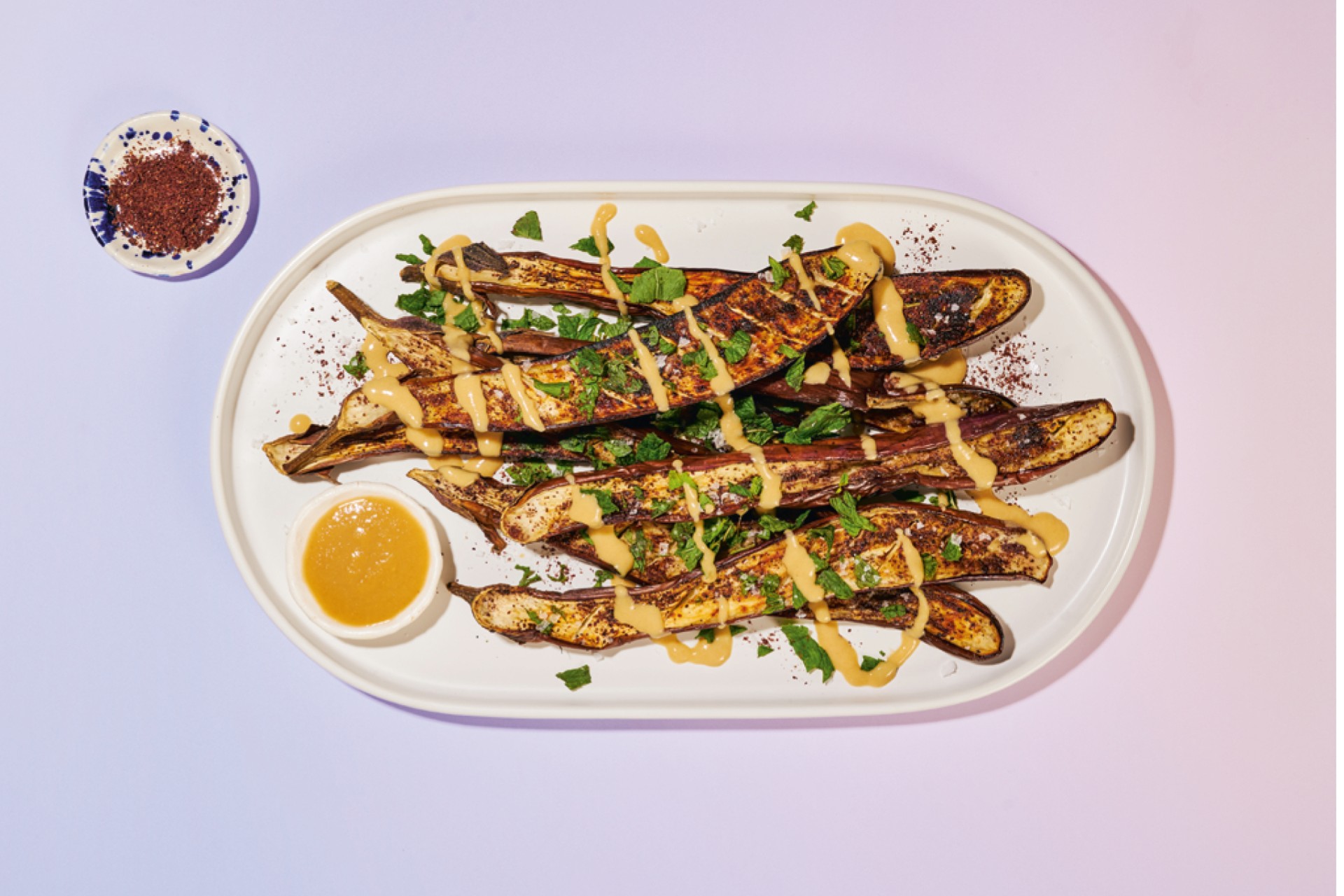
How to Cook Eggplant: 25 Recipes + Roast, Grill, Fry & Braise Guide
Roast it at 425°F until it collapses, then work through 25 tested roasted, grilled, fried, braised, and dip recipes.
The most reliable way to cook eggplant is to roast it. Heat the oven to 425°F, cut the eggplant into 1-inch cubes, and toss about 1 1/2 pounds of cubes with roughly 3 tablespoons of olive oil, salt, and pepper. Spread the cubes in a single layer on a rimmed sheet pan and roast for 25 to 30 minutes, stirring once halfway. Eggplant is done when the cubes have collapsed, the edges are deep golden brown, and a knife slides through the center with no resistance; pale, firm, or squeaky eggplant is undercooked, not overcooked. Cubes much smaller than an inch tend to dry out, while larger chunks can stay spongy in the middle. Salting first is optional for roasting, but it is worth 30 minutes of your time before frying or when a large eggplant tastes bitter.
Get a free week of easy dinners
Seven weeknight dinners with the shopping list already totalled, sent Sunday. No account needed, unsubscribe in one click.
No spam, unsubscribe in one click. Recipes, shopping lists and Instacart carts all work without an account either way.
| Method | Heat | Time | Best for |
|---|---|---|---|
| Roast | 425°F oven | 25-30 min (1-inch cubes), 20-25 min (1/2-inch rounds) | Sheet-pan sides, pasta, grain salads |
| Grill | Medium-high grill or grill pan | 4-5 min per side (1/2-inch slices) | Slices with yogurt sauces, salads, wraps |
| Pan-fry | Medium heat, shallow oil | 3-4 min per side (1/2-inch rounds) | Breaded rounds, tapas, pasta alla Norma |
| Stir-fry | Medium-high wok | 5-6 min, then 1-2 min in sauce | Chinese eggplant in garlic or chili sauce |
| Braise / stew | Brown, then covered simmer | About 20 min after browning | Caponata, stews, tomato-braised eggplant |
| Char whole | Broiler on high or 425°F oven | 20-25 min broiled, 35-50 min roasted | Baba ghanoush, mutabal, bharta |
Every time in that table comes from a recipe in the AislePrompt catalog, so you can check each one against a full ingredient list below.
Why eggplant goes wrong (and the two mistakes to stop making)
Eggplant has a reputation for turning out either spongy and squeaky or greasy and gray. Both failures have simple causes.
Mistake one: pulling it too early. Raw eggplant is firm and slightly astringent, and it only turns silky once it is cooked all the way through. Wikipedia's eggplant entry notes that raw eggplant can taste bitter and astringent but becomes tender and develops a richer flavor once cooked. Browned edges don't prove it's done. Press a cube with a spoon: if it doesn't give easily, keep cooking. A roasted cube should look shrunken and wrinkled, not plump.
Mistake two: too little oil, added the wrong way. Eggplant flesh is full of tiny air pockets. The University of Illinois Extension explains that as air escapes from those cells during cooking, oil rushes in to take its place. That is why a few tablespoons can vanish into a skillet of raw slices in seconds. If you respond by adding splash after splash, you end up with greasy eggplant. If you skimp, it scorches before it softens. The fix is to toss or brush the oil on before the eggplant hits the heat so it coats evenly, then leave it alone. For roasting, about 2 to 3 tablespoons per pound is the range most of the recipes below use.
There is a third, smaller mistake: crowding. Eggplant is mostly water (raw eggplant is about 92% water, per the nutrition data summarized on Wikipedia), and cubes packed shoulder to shoulder steam in that water instead of browning. Use two pans before you pile one high.
How to buy eggplant
Good eggplant is mostly decided at the store. The University of Maine Cooperative Extension tells shoppers to look for eggplants that are firm, heavy for their size, and free of scars, with glossy skin. Avoid any with brown or blue streaks, or that look shriveled or flabby.
A few practical checks:
- Press gently with your thumb. Fresh eggplant springs back. A dent that stays means it is past its best.
- Weigh two of the same size in your hands. Pick the heavier one; a light eggplant has usually lost moisture and turned pithy.
- Look at the cap. A green, fresh-looking calyx is a good sign. A dry, brown one means it has been sitting.
- Size matters for texture. The Maine extension notes that smaller, slender eggplants usually have smaller seeds and are more tender. SNAP-Ed Connection at USDA adds that small to medium eggplants may have softer skin and taste less bitter.
Which kind to buy. The large, dark purple globe eggplant most U.S. stores sell is the all-rounder for parmigiana, moussaka, and dips. Long, slender Chinese and Japanese eggplants have thinner skin (Wikipedia notes Korean and Japanese varieties are typically thin-skinned) and cook faster, which is why stir-fries like the Sichuan recipe below call for them. You can swap by weight, but cut thin varieties into slightly larger pieces or shorten the cook time so they don't turn to mush.
Eggplant is a summer crop, and September is still a good month to buy it at farmers' markets before the season closes.
The salting question
For decades, recipes told you to salt every eggplant before cooking. The honest answer in 2026 is: salt when it helps, skip it when it doesn't.
What salting actually does. Salt draws water out of the cut surfaces. According to the University of Illinois Extension, many cooks salt and press eggplant to push air and water out, which means it absorbs less oil and leaks less water into the dish. SNAP-Ed notes the same step can reduce bitterness, and Wikipedia says rinsing, draining, and salting slices may remove bitterness.
When to salt:
- You are pan-frying slices or cubes (less oil absorption matters most here).
- You are layering a baked casserole such as parmigiana, where extra water can make the dish soupy.
- The eggplant is large, seedy, or tastes bitter when you nibble a raw sliver.
When to skip it:
- You are roasting cubes at high heat with oil already on them.
- You are making a dip from whole charred eggplant, where you'll drain the flesh in a colander anyway.
- You are using slender Chinese or Japanese eggplant in a quick stir-fry.
How to salt correctly. Cut the eggplant, sprinkle both sides with kosher salt (about 1 teaspoon per medium eggplant), and set the pieces on a rack or in a colander for 20 to 30 minutes. SNAP-Ed suggests about 30 minutes. Beads of liquid will form. The Illinois extension recommends rinsing and patting dry so the finished dish isn't too salty, then cutting back on salt later in the recipe. Pat the pieces truly dry; wet eggplant will not brown.
Three recipes below build the step in: Grilled Eggplant Slices with Tzatziki and Mint salts for 20 minutes, Pan-Fried Eggplant with Garlic Yogurt and Pimentón salts for 20 minutes on a wire rack, and Oven-Baked Eggplant Parmigiana salts for 30 minutes and rinses.
Roasted eggplant recipes
Roasting is the lowest-effort method and the one to learn first. It needs one sheet pan, no babysitting, and gives you caramelized edges without the oil a skillet demands. A heavy rimmed half-sheet pan such as the USA Pan Half Sheet Pan (set of 2) gives the cubes room to brown. For a whole week of vegetable-forward sheet-pan ideas, see our roasted vegetable dinner roundup.
1. Italian Roasted Eggplant and Tomato Pasta — The textbook version of the method above: one 1-pound eggplant in 1-inch cubes, 2 tablespoons of oil, 425°F for 25 minutes, then folded into a garlic and crushed-tomato sauce with spaghetti and Parmesan. About 45 minutes total and 420 calories with 15 g protein per serving.
2. Roasted Eggplant and Bulgur Salad with Pomegranate Molasses — A large eggplant in 1-inch cubes roasts at 425°F for 25 to 30 minutes while fine bulgur soaks in boiling water. Parsley, mint, pine nuts, and a pomegranate-molasses dressing turn it into a make-ahead lunch that holds at room temperature. About 45 minutes, 320 calories.
3. Sumac-Spiced Roasted Eggplant with Yogurt Drizzle — Half-inch rounds with sumac and dried mint, roasted 20 to 25 minutes at 425°F and finished with a lemon-zest and dill yogurt. The ingredient list calls for 2 tablespoons of oil; use all of it on the rounds rather than just the 1 tablespoon the method mentions, or the slices can dry out. About 35 minutes, 180 calories.
4. Sheet Pan Zucchini and Eggplant with Garlic and Thyme — Two medium eggplants and two zucchini in half-inch rounds, 3 tablespoons of oil, garlic, and thyme at 425°F for about 20 minutes, finished with goat cheese and parsley. A good side for roast chicken. About 40 minutes, 250 calories.
5. Oven-Roasted Eggplant with Garlic and Basil — The simplest recipe on this list: one pound of rounds, 3 tablespoons of oil, sliced garlic, and 400°F for 20 to 25 minutes, flipped halfway. Basil and optional Parmesan go on at the end. About 35 minutes and 140 calories.
6. Sicilian Pasta alla Norma — Half-inch cubes roasted at 400°F for 25 minutes and simmered with tomatoes, then tossed with pasta, ricotta salata, and basil. Wikipedia's Pasta alla Norma entry describes the Catania original with fried eggplant; roasting is the lighter weeknight route. About 55 minutes, 300 calories.
Grilled eggplant recipes
Grilling gives eggplant a smoky char that no oven can match. Cut slices at least 1/2 inch thick so they don't fall apart, brush both sides with oil, and cook over medium-high heat until the grill marks are dark and the center is soft, usually 4 to 5 minutes per side. Indoors, a ridged cast-iron pan such as the Lodge Square Cast Iron Grill Pan (10.5-inch) does the job; let it preheat for several minutes before the first slice goes on. If you like cooking over fire, our smoked vegetable sides guide covers the rest of the grill.
7. Grilled Eggplant with Garlic Yogurt — A Turkish-style plate: two large eggplants sliced lengthwise into 1/2-inch planks, brushed with oil, grilled 4 to 5 minutes per side, and topped with a cucumber, dill, and garlic yogurt. About 25 minutes and 180 calories. See more mezze ideas in our Turkish recipe roundup.
8. Grilled Eggplant Slices with Tzatziki and Mint — Rounds are salted for 20 minutes, patted dry, brushed with 4 tablespoons of oil, and grilled on a grill pan for 4 to 5 minutes per side. Serve warm or at room temperature with a mint tzatziki. About 45 minutes including salting, 150 calories.
9. Grilled Eggplant and Halloumi Salad with Mint and Lemon Dressing — Eggplant rounds grilled 4 minutes per side, then slices of halloumi for 2 minutes per side, dressed with lemon, garlic, and mint. The halloumi makes this the most filling of the grilled recipes at 18 g protein and 320 calories per serving. About 30 minutes.
10. Ginger-Soy Marinated Grilled Eggplant with Toasted Sesame — Half-inch rounds soak in soy, ginger, garlic, honey, and oil for 20 minutes, then grill 4 to 5 minutes per side. The marinade doubles as the oil, so the rounds don't need brushing. About 35 minutes, 140 calories.
Fried and stir-fried eggplant recipes
Frying is where eggplant's sponge-like flesh either rewards you or punishes you. Keep the oil hot enough that the surface sizzles on contact, cook in batches so the pan doesn't cool, and drain on paper towels. A 10-inch cast-iron skillet holds heat well for shallow-frying; the Lodge 10.25-inch Cast Iron Skillet with silicone handle holder was listed at about $25 at the time of writing.
11. Sichuan-Style Stir-Fried Eggplant with Garlic Sauce — Two Chinese eggplants cut into 2-inch strips stir-fry for 5 to 6 minutes in 3 tablespoons of oil, then pick up garlic, ginger, doubanjiang, soy, black vinegar, and a cornstarch slurry. Wikipedia's eggplant entry notes that Chinese cooks often deep-fry eggplant for dishes such as yuxiang qiezi ("fish-fragrant eggplant"); this is a quicker, shallow-fried take. About 22 minutes and 180 calories, the fastest recipe in this guide.
12. True Sicilian Pasta alla Norma — The fried version: 1-inch cubes are salted for 20 minutes, patted dry, and fried in 3 tablespoons of oil for 8 to 10 minutes before being tossed with a passata sauce, pasta, and ricotta. Written for 2 servings, about 40 minutes, 350 calories each. Our Sicilian recipe roundup has more from the island.
13. Pan-Fried Eggplant with Garlic Yogurt and Pimentón — A Spanish-style tapa: 1/2-inch rounds salted for 20 minutes, pan-fried over medium heat 3 to 4 minutes per side, then topped with garlic yogurt, smoked paprika, and parsley. About 40 minutes, 180 calories.
14. Fried Eggplant Rings with Basil Oil — Rings dredged in flour, egg, and panko and shallow-fried in 1/4 cup of olive oil for 3 to 4 minutes per side, served with a blitzed basil oil. At 340 calories per serving it is the richest recipe in this section, and it is best eaten right away while the crust is crisp. About 45 minutes.
Baked and braised eggplant recipes
Long, gentle cooking in sauce is the most forgiving way to handle eggplant: it has plenty of time to soften fully and it soaks up whatever it simmers in. Most of these recipes brown the eggplant first (in the oven or a skillet), then finish it in tomato sauce, béchamel, or a soy glaze. A sharp 8-inch chef's knife makes the prep much faster; the Victorinox Fibrox Pro 8-inch Chef's Knife was about $47 at the time of writing.
15. Oven-Baked Eggplant Parmigiana — Two medium eggplants in 1/2-inch rounds, salted 30 minutes, rinsed, brushed with oil and roasted at 375°F for 20 minutes, then layered with a garlic-oregano tomato sauce, mozzarella, and Parmesan and baked 25 minutes more. Roasting the slices instead of breading and frying them keeps it at 310 calories per serving. About 90 minutes total.
16. Classic Greek Vegetarian Moussaka — Roasted eggplant rounds layered with a tomato-chickpea sauce under a nutmeg béchamel, baked covered 30 minutes then uncovered 15. About 100 minutes, 420 calories and 18 g protein.
17. Oven-Baked Greek Moussaka with Eggplant and Ground Lamb — The meat version, with lamb simmered in red wine, cinnamon, and allspice and an egg-yolk-enriched béchamel. Wikipedia's moussaka entry credits the modern layered Greek version to chef Nikolaos Tselementes in the 1920s. About 110 minutes, 480 calories with 32 g protein. For more Greek weeknight dishes, see our Greek recipe roundup.
18. Authentic Provençal Ratatouille with Herbs de Provence — Diced eggplant browned in olive oil with zucchini, bell pepper, and onion, then covered with tomatoes and herbs on low heat for 15 minutes and finished in a 375°F oven for 25 to 30 minutes. About 65 minutes and 140 calories.
19. Sicilian-Style Eggplant Caponata with Pine Nuts and Golden Raisins — Half-inch cubes sautéed in 1/4 cup of olive oil, then simmered 15 minutes with onion, celery, capers, olives, raisins, tomato paste, vinegar, and sugar. Wikipedia's caponata entry describes the dish as fried eggplant with celery, olives, and capers in a sweet-and-sour sauce, which is exactly this recipe. It tastes better the next day. About 45 minutes, 210 calories.
20. Turkish Spiced Chickpea and Eggplant Stew — Cumin, smoked paprika, and cinnamon bloom in oil before 1-inch eggplant cubes brown for 8 to 10 minutes; chickpeas, crushed tomatoes, and broth then simmer covered for 20 minutes. A one-pot vegan dinner at 280 calories and 10 g protein. About 55 minutes.
21. Iraqi-Inspired Stuffed Eggplant with Spiced Ground Beef and Pine Nuts — Halved eggplants are hollowed, roasted cut side down at 400°F for 20 minutes, filled with beef, tomato, the chopped eggplant flesh, cinnamon, and allspice, then baked 15 minutes more. About 75 minutes, 410 calories with 32 g protein.
22. Shanghai-Style Red-Braised Eggplant with Garlic and Soy — Chinese eggplant strips are lightly fried for 3 to 4 minutes, then braised uncovered in light and dark soy sauce, sugar, and water for 8 to 10 minutes until the sauce reduces to a glaze. About 30 minutes, 180 calories.
Baba ghanoush and eggplant dip recipes
For dips, you cook the eggplant whole until it collapses, then peel it and mash the flesh. The skin should be blackened and blistered and the eggplant should slump when you lift it by the stem. Always drain the flesh in a colander for about 10 minutes; every recipe below does, and it is what keeps a dip creamy instead of watery. Wikipedia's baba ghanoush entry notes the eggplant is traditionally roasted, baked, or broiled over an open flame before peeling so the pulp is soft and smoky, and that the close cousin mutabbal is defined by its tahini. More mezze to serve alongside are in our Lebanese recipe roundup.
23. Charred Eggplant Baba Ghanoush with Tahini and Pomegranate — Two eggplants go under a high broiler for 20 to 25 minutes, turned every 5, then get mashed with tahini, lemon, garlic, and olive oil and topped with pomegranate seeds. About 45 minutes, 160 calories per serving.
24. Baked Eggplant Mutabal with Garlic and Lemon — The oven route for anyone without a gas flame or reliable broiler: whole pricked eggplants roast at 425°F for 35 to 40 minutes, turned halfway, then get mashed with tahini, lemon, garlic, and cumin. About 55 minutes, 120 calories.
25. Charred Eggplant and Yogurt Dip with Garlic and Sumac — Charred on a grill or under the broiler for 15 to 20 minutes, then mixed with Greek yogurt in place of tahini. Tangier and lighter than baba ghanoush, with 6 g protein per serving. About 35 minutes, 150 calories.
Bonus for the charred-eggplant method: Bengali Eggplant and Potato Bharta roasts three small eggplants whole at 425°F for 40 minutes beside foil-wrapped potatoes, then mashes both with mustard oil, green chili, lemon, and coriander. It is closer to a rustic side than a dip; serve it with rice or flatbread. About 55 minutes, 220 calories.
Storage: how long eggplant keeps
Fresh, whole eggplant. Store it unwashed in the refrigerator crisper and plan to use it within about 5 to 7 days, the window Have A Plant from the Produce for Better Health Foundation gives. The University of Maine Cooperative Extension puts premium eggplant at about a week in the refrigerator and adds two useful details: the ideal storage range is 46 to 55°F, and storage below 46°F damages eggplant. Because most home refrigerators run colder, buy eggplant close to when you plan to cook it, and don't jam it into a crowded drawer, since pressure bruises the skin.
Cut eggplant. The flesh browns quickly once cut, so slice it right before cooking.
Cooked eggplant. Treat it like any other leftover. Nebraska Extension (UNL Food) advises refrigerating leftovers within 2 hours of cooking and using them within 3 to 4 days, or freezing them. Casseroles like moussaka and parmigiana reheat well; fried or breaded eggplant loses its crunch.
Freezing raw eggplant. The University of Illinois Extension recommends blanching slices for 4 minutes in boiling water with lemon juice before freezing. Frozen eggplant is best in stews, sauces, and dips rather than dishes that need a crisp texture.
Equipment that makes eggplant easier
You don't need special tools, but four pieces help:
- A rimmed half-sheet pan. Big enough to roast 1 1/2 pounds of cubes in a single layer. The USA Pan Half Sheet Pan set comes as a pair (about $45 at the time of writing), which helps because two pans are better than one crowded pan. Browse more in bakeware.
- A cast-iron skillet. Holds its heat when a batch of eggplant goes in, so slices sear instead of soaking. The Lodge 10.25-inch Cast Iron Skillet handles frying, caponata, and stuffed-eggplant filling.
- A grill pan. For char marks on a rainy day, the Lodge Square Cast Iron Grill Pan (about $25 at the time of writing).
- A sharp chef's knife. Eggplant skin can make a dull blade skid. An 8-inch knife such as the Victorinox Fibrox Pro cuts even 1/2-inch rounds and 1-inch cubes, which matters because pieces of even size cook at the same rate. More options are in cookware.
Common pitfalls, fixed
- Eggplant is greasy. You fried it in oil that wasn't hot enough, or added oil halfway through. Next time, salt and dry the pieces first, heat the oil until it shimmers, and cook in batches. Or switch to roasting.
- Eggplant is rubbery or squeaky. It is undercooked. Give roasted cubes another 5 minutes and check again; pierce grilled slices at the thickest point.
- Eggplant is bitter. Usually an oversized, seedy eggplant. Salt it for 30 minutes, rinse, and dry, or choose smaller eggplants next time.
- The casserole is watery. The eggplant went in raw or wet. Roast or fry the slices first, and salt them if you have time, as in the parmigiana recipe above.
- The dip is thin. You skipped draining the charred flesh. Let it sit in a colander for 10 minutes before mashing.
- Cubes burned before softening. The pieces were too small or too thin for the oven temperature. Keep cubes at about 1 inch, or drop the oven to 400°F for rounds.
Real-world numbers from the recipes above
A quick way to choose by the clock or the calorie count:
| Goal | Pick | Total time | Calories per serving |
|---|---|---|---|
| Fastest dinner | Sichuan-Style Stir-Fried Eggplant | 22 min | 180 |
| Lightest side | Baked Eggplant Mutabal | 55 min | 120 |
| Most protein | Stuffed Eggplant with Beef, or Lamb Moussaka | 75-110 min | 410-480 (32 g protein) |
| Best vegan one-pot | Turkish Chickpea and Eggplant Stew | 55 min | 280 |
| Best make-ahead | Caponata or Bulgur Salad | 45 min | 210-320 |
When not to cook eggplant a particular way
- Don't grill tiny cubes directly on the grates. They fall through; use planks or skewers.
- Don't deep-fry for a crowd on a weeknight. Oven-roasted slices layered into parmigiana give you most of the flavor with far less oil and mess.
- Don't boil eggplant plain. It turns waterlogged and gray. If you want it soft, braise it in a flavorful sauce so the sponge soaks up something good.
For more meatless Italian dinners that lean on eggplant, see our Italian vegetarian recipes.
FAQ
The most common questions are answered in the FAQ below.
Related reading
- 20 Sicilian recipes: pasta alla Norma, arancini, caponata
- 22 Greek recipes: moussaka, souvlaki, spanakopita
- 20 Turkish recipes: kebabs, pilaf, and mezze
- 20 Lebanese recipes: hummus, tabbouleh, kibbeh, and mezze
- 25 roasted vegetable dinner recipes
Sources
- University of Illinois Extension: Preparing Eggplant
- University of Maine Cooperative Extension: Vegetables and Fruits for Health: Eggplant
- SNAP-Ed Connection (USDA): Eggplant
- Have A Plant (Produce for Better Health Foundation): Eggplant
- Nebraska Extension (UNL Food): Leftover Food Safety
- Wikipedia: Eggplant
- Wikipedia: Baba ghanoush
- Wikipedia: Caponata
- Wikipedia: Pasta alla Norma
- Wikipedia: Moussaka
Frequently asked questions
Do I really need to salt eggplant before cooking?
Why does my eggplant turn out spongy or rubbery?
Why does eggplant soak up so much oil, and how do I stop it?
What's the difference between globe, Italian, Japanese, and Chinese eggplant?
Does eggplant fit a low-carb, keto, or vegan diet?
Sources
- extension.illinois.edu
- extension.umaine.edu
- snaped.fns.usda.gov
- fruitsandveggies.org
- food.unl.edu
- en.wikipedia.org
- en.wikipedia.org
- en.wikipedia.org
- en.wikipedia.org
- en.wikipedia.org
You know how to cook eggplant. Now what do you make with it?
Ask our AI what to make with eggplant tonight — it writes the recipe, the shopping list, and sends the cart to Instacart. No account needed.
Get eggplant dinner ideas →