18 Australian Recipes: Meat Pies, Pavlova & BBQ Classics for Home Cooks
A muffin tin, a sheet of puff pastry, and a 250°F oven get you most of the Australian canon.
Affiliate disclosure: AislePrompt may earn a commission on qualifying purchases made through Amazon and Instacart links in this article, at no additional cost to you. See our affiliate policy →
Australian home cooking runs on three things an American kitchen already has: puff pastry, a hot grill, and an oven that can hold a low temperature. A muffin tin turns store-bought pastry into proper meat pies, a 250°F oven turns six egg whites into a pavlova, and the "barbie" is a fifteen-minute high-heat grill, not an all-day smoke.
Eighteen recipes below, from the pub canon to the bakery case, with the specific techniques that separate the real versions from approximations.
Introduction -- what makes Australian food its own thing
Australian cuisine is usually described as British food with better weather, which undersells it badly. Three forces shaped what's on the table as of 2026:
British colonial roots gave the meat pie, the sausage roll, the pavlova argument, and the deep national commitment to a properly baked biscuit.
Post-war immigration brought Italian, Greek, Lebanese and Vietnamese cooking into the mainstream to a degree that has no American equivalent. The chicken parma is an Italian-Australian pub invention. Banh mi is standard lunchtime food in Sydney and Melbourne.
Native ingredients -- macadamias, wattleseed, lemon myrtle, finger lime, Davidson's plum, Tasmanian pepperberry -- moved from novelty to genuine pantry items over the last two decades.
Three ingredient notes worth having before you start:
| Ingredient | What it is | US substitute |
|---|---|---|
| Vegemite | Yeast-extract spread, intensely savory | Marmite (sweeter) or 1 tsp miso + dash soy |
| Golden syrup | Inverted cane sugar syrup | Light corn syrup + 1 tbsp molasses per cup |
| Caster sugar | Superfine sugar | Blitz granulated sugar 20 seconds |
| Barramundi | Asian sea bass, firm white flesh | Branzino, black sea bass, striped bass |
| Wattleseed | Roasted acacia seed, coffee-cocoa notes | Espresso powder (approximation only) |
Golden syrup and caster sugar are the two that actually matter -- Anzac biscuits and pavlova both fail without the right sugar chemistry. SBS Food's Australian collection is a good reference for the regional versions of anything here.
The savory canon: meat pies, sausage rolls, chicken parma
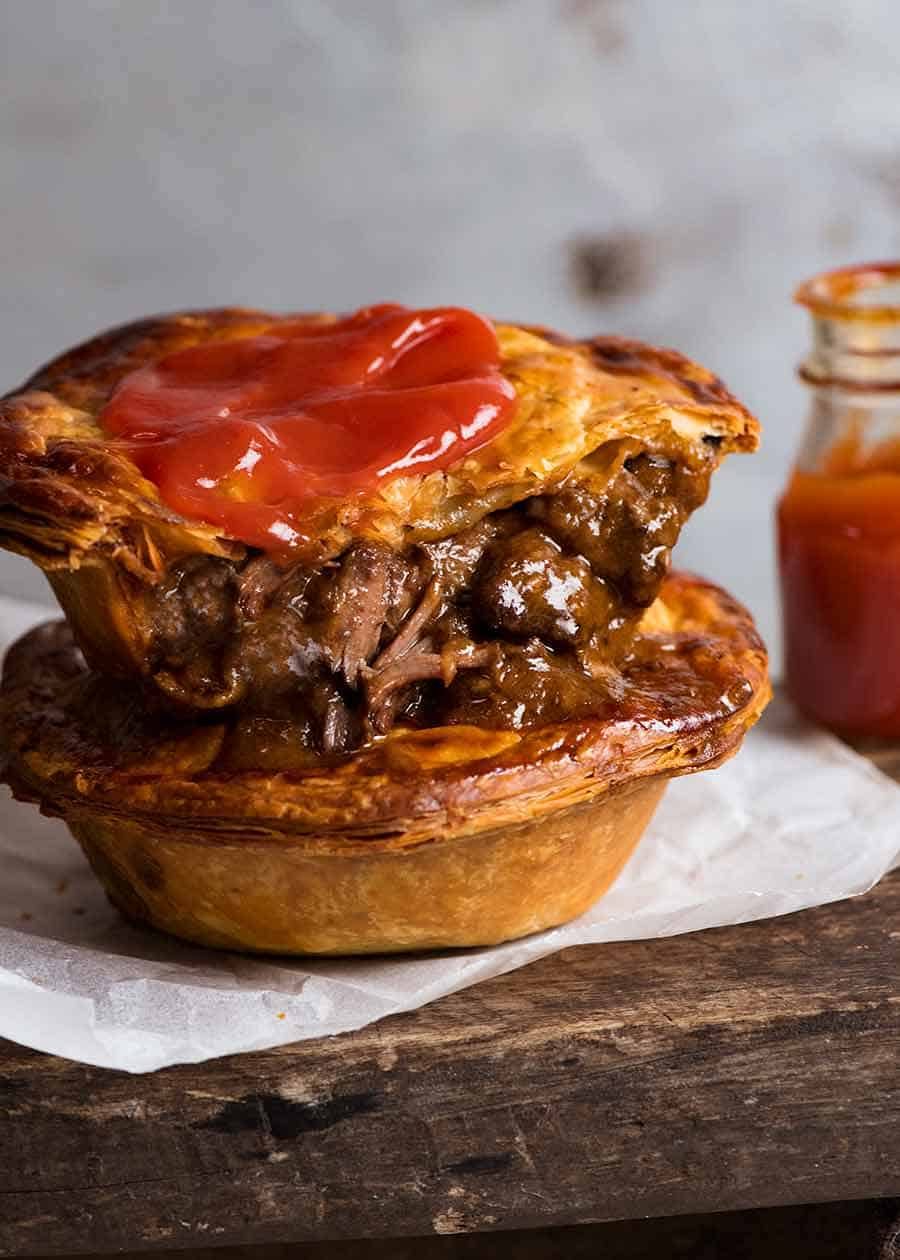
The meat pie is the national dish, sold at every bakery, service station and football ground. The homemade version is better than almost any of them and it takes one bowl and a muffin tin.
1. Beef and Mushroom Aussie Meat Pie -- the filling should be thick enough to hold a spoon upright. If it's saucy, the bottom pastry goes to mush. Cook the filling the day before and chill it; cold filling into cold pastry is the professional trick.
2. Slow-Baked Australian Beef Meat Pies -- beef chuck, three hours, no shortcuts. This is the Sunday version.
3. Baked Lamb and Vegemite Meat Pies -- one teaspoon of Vegemite in the gravy adds glutamates and reads as depth, not as Vegemite. Even people who hate the spread can't identify it here.
4. Classic Aussie Bacon and Egg Pie -- eggs cracked whole into the pastry case, not beaten. That's the whole difference from a quiche.
5. Homemade Sausage Rolls with Puff Pastry -- grate a raw onion and squeeze it dry before it goes into the mince; that moisture is why most homemade sausage rolls leak.
6. Oven-Baked Pork and Fennel Sausage Rolls -- the bakery-counter upgrade. 400°F for 25 minutes, egg-washed twice.
7. Baked Chicken Parma with Parmesan and Tomato Relish -- Australia's most-ordered pub meal, on effectively every counter menu in the country.
8. Sheet Pan Chicken Parma -- the weeknight version, one pan, about 35 minutes.
The pastry rule for all of these: puff pastry on top, shortcrust on the bottom. Puff underneath goes soggy from the filling. If you only have puff, blind-bake the base for 10 minutes with weights first.
The barbie: sausages, prawns, lamb chops, marinated barramundi
An Australian barbecue is a flat-top or grill running hot for fifteen minutes, not a smoker running for eight hours. Sausages ("snags") go on first, everything else follows, and it's served with white bread and onions rather than buns.
9. Barbecue Grilled Sausage with Onion Jam -- the sausage sandwich in its proper form. Onions grilled soft on the flat top, one slice of white bread folded, not a bun.
10. Herb-Crusted Lamb Chops -- lamb is the national protein and Australians eat roughly three times as much of it per head as Americans. Cook to 130-135°F internal for medium-rare; lamb chops are thin and go from perfect to grey in about ninety seconds.
11. Shrimp and Avocado Aussie BBQ Salad -- for the record, nobody in Australia says "shrimp on the barbie." They're prawns, and they take about 90 seconds a side over high heat.
12. Tasmanian Pepperberry Baked Barramundi -- barramundi has a firm, meaty flesh that holds together on a grill better than snapper or cod.
13. One-Pot Barramundi and Lemon Myrtle Rice -- lemon myrtle is more intensely lemony than lemon zest; use half what you'd expect.
| Barbie item | Heat | Time per side | Internal temp |
|---|---|---|---|
| Thick sausages | Medium | 6-8 min | 160°F |
| Lamb chops | High | 2-3 min | 130-135°F |
| Prawns (shell on) | High | 90 sec | Opaque throughout |
| Barramundi fillet | Medium-high | 3-4 min | 135°F |
| Onions (flat top) | Medium-low | 12 min total | Soft and browned |
Bakery classics: lamingtons, Anzac biscuits, vanilla slice
14. No-Bake Lamington Cake Bites -- lamingtons are sponge squares dipped in thin chocolate icing and rolled in desiccated coconut. The traditional method requires day-old sponge; fresh cake disintegrates in the icing. This no-bake version sidesteps the problem entirely.
15. No-Bake Anzac Biscuit Slice with Coconut -- Anzac biscuits are oats, coconut, flour, butter and golden syrup, with bicarbonate of soda dissolved in boiling water as the leavener. They were designed to survive a sea voyage, which is why there's no egg. Australian law actually restricts commercial use of the name and prohibits selling them as "Anzac cookies."
16. Vanilla Slice with Passionfruit Glaze -- known nationally, and unaffectionately, as the "snot block." Custard between two sheets of puff pastry, passionfruit icing on top. Chill at least four hours before cutting or the custard runs.
Also worth making: No-Knead Australian Damper Bread, the campfire soda bread that predates all of the above, and No-Bake Aussie Chocolate Caramel Slice, which is in every bakery case in the country.
The pavlova debate + how to nail the meringue
Australia and New Zealand have argued about the pavlova's origin since the 1930s. The Oxford English Dictionary sided with New Zealand in 2010 on the basis of a 1927 recipe. Australians have not accepted this and will not.
What actually matters is the chemistry. A pavlova is not a plain meringue -- it contains cornstarch and an acid (white vinegar or cream of tartar), which is what produces the crisp shell and the soft marshmallow interior. Leave them out and you get a French meringue: crisp all the way through, and not a pavlova.
17. Berry Pavlova with Whipped Mascarpone and 18. Kakadu Plum and Coconut Pavlova -- the classic and the native-ingredient version.
The technique, in order:
1. Room-temperature egg whites, no yolk at all. A speck of fat prevents the foam from forming. Separate cold (cleaner break), then let the whites warm for 30 minutes.
2. Caster sugar, added a tablespoon at a time once soft peaks form. Rub a little between your fingers -- if it's gritty, keep beating. Undissolved sugar is what makes pavlovas weep amber syrup.
3. Fold in cornstarch and vinegar at the very end, by hand. Roughly 2 teaspoons cornstarch and 1 teaspoon white vinegar per 4 egg whites.
4. Bake at 250°F for 90 minutes. This is drying, not baking.
5. Cool in the turned-off oven with the door ajar, at least two hours or overnight. Cracking is almost always a thermal-shock problem, not a mixing problem.
6. Top immediately before serving. Whipped cream on a pavlova starts dissolving the shell within an hour.
Humidity is the uncontrollable variable. Meringue is hygroscopic -- on a rainy day it will pull moisture from the air and go tacky no matter what you do. Bake pavlova on a dry day.
Sweet finishes: sticky date pudding, Tim Tam slam, fairy bread
Sticky date pudding -- dates simmered with bicarbonate of soda until they collapse, folded into a light batter, drowned in butterscotch sauce. The Macadamia and Wattleseed Sticky Date Pudding is the version with native ingredients. Serve warm; it's inedible cold and excellent reheated.
Fairy bread -- white bread, butter, hundreds and thousands (rainbow nonpareils). It is served at every Australian child's birthday party and it is not negotiable. The Fairy Bread Roll-Ups are the party-tray version. The butter must go all the way to the edges or the sprinkles fall off.
The Tim Tam Slam -- bite off both ends of a Tim Tam biscuit, use it as a straw for hot coffee or tea until the chocolate collapses, then eat the whole thing immediately. There is a two-second window. This is a national technique, not a recipe.
Real-world numbers: a full Aussie menu, costed
Australia Day (26 January) and Anzac Day (25 April) are the two days this menu gets cooked in full. Here's what feeding eight people actually costs and takes, at 2026 US supermarket prices:
| Dish | Ingredient cost | Active time | Total time | Make-ahead? |
|---|---|---|---|---|
| Beef meat pies (8) | $14.50 | 40 min | 3 hr 30 min | Filling: 2 days |
| Sausage rolls (16) | $9.00 | 25 min | 55 min | Freeze raw |
| Chicken parma (4) | $12.00 | 30 min | 45 min | No |
| Grilled snags + onions | $11.00 | 20 min | 20 min | No |
| Pavlova (serves 8) | $6.50 | 20 min | 4 hr (mostly passive) | Shell: 1 day |
| Lamingtons (16) | $7.50 | 45 min | 2 hr | 3 days |
| Anzac biscuits (24) | $5.00 | 15 min | 30 min | 2 weeks |
Total: about $65 for eight people across a full spread, with roughly three hours of hands-on work spread over two days. The pies and the pavlova shell both want to be made the day before, which leaves the barbecue and the parma as the only things happening while guests are there.
One planning note that catches people out: the pavlova shell and the lamingtons compete for oven time at very different temperatures (250°F versus 350°F). Bake the sponge first, then drop the oven and dry the pavlova overnight.
Common pitfalls
- Puff pastry on the bottom of a pie. Use shortcrust, or blind-bake.
- Wet pie filling. Chill it first; a hot, loose filling melts the pastry before it sets.
- Beating pavlova sugar in too fast. Gritty meringue weeps. A tablespoon at a time, minimum.
- Opening the oven during pavlova baking. The temperature drop cracks the shell.
- Substituting brown sugar for golden syrup. Different chemistry -- Anzac biscuits will spread flat.
- Overcooking lamb chops. They are thin. 130-135°F, then rest.
When not to bother
Skip the from-scratch puff pastry. Australian home cooks overwhelmingly use frozen sheets, and a good all-butter store-bought puff outperforms a rushed homemade one. Save the effort for the filling. Likewise, if you can't get real Vegemite, leave it out rather than substituting Marmite in a pie -- Marmite is noticeably sweeter and it shows.
Equipment
A standard 12-cup muffin tin for pies, two heavy sheet pans, a hand mixer or stand mixer for pavlova, and a Dutch oven for slow-cooked filling. Our bakeware picks cover the sheet pans and tins; cookware has the 12-inch skillet a chicken parma needs; small appliances covers the mixers; and utensils & tools has the offset spatula that makes icing a lamington bearable.
What to cook next
For more national-canon cooking in the same format, see the Portuguese recipes roundup, the Turkish home cooking guide, the German dinner classics, and the Brazilian dinner recipes.
Sources
- taste.com.au -- Best Aussie Recipes -- the mainstream Australian recipe canon.
- ABC Everyday -- Food -- regional technique and ingredient background.
- SBS Food -- Australian Cuisine -- immigrant-influenced and native-ingredient cooking.