18 Filipino Recipes: Adobo, Sinigang, Pancit & Silog Breakfasts
Four flavors, nine pantry items, and almost no chili: the least-cooked major Asian cuisine in America is also the most weeknight-friendly.
Filipino cooking runs on four flavors — sour, salty, sweet, and deep browned-garlic umami — and almost none of it is spicy. Start with adobo (meat braised in vinegar, soy, garlic, bay, and black pepper), add sinigang (a tamarind-sour soup), and add pancit (stir-fried noodles), and you can cook Filipino food on a Tuesday with a supermarket run and one pan.
Get a free week of easy dinners
Seven weeknight dinners with the shopping list already totalled, sent Sunday. No account needed, unsubscribe in one click.
No spam, unsubscribe in one click. Recipes, shopping lists and Instacart carts all work without an account either way.
That is the whole pitch. Below are 18 core recipes with cook times, the pantry list that makes them possible, and a 90-minute Sunday spread that feeds eight.
Why Filipino food is the underrepresented giant of Asian cuisine
The Philippines has roughly 115 million people and one of the largest diaspora populations in the United States — over 4 million by Census estimates — and yet Filipino food remains the least-represented major Asian cuisine on American home-cooking sites. Thai, Vietnamese, Korean, and Japanese cooking all crossed into the US mainstream in the 1990s and 2000s. Filipino cooking mostly stayed inside Filipino homes.
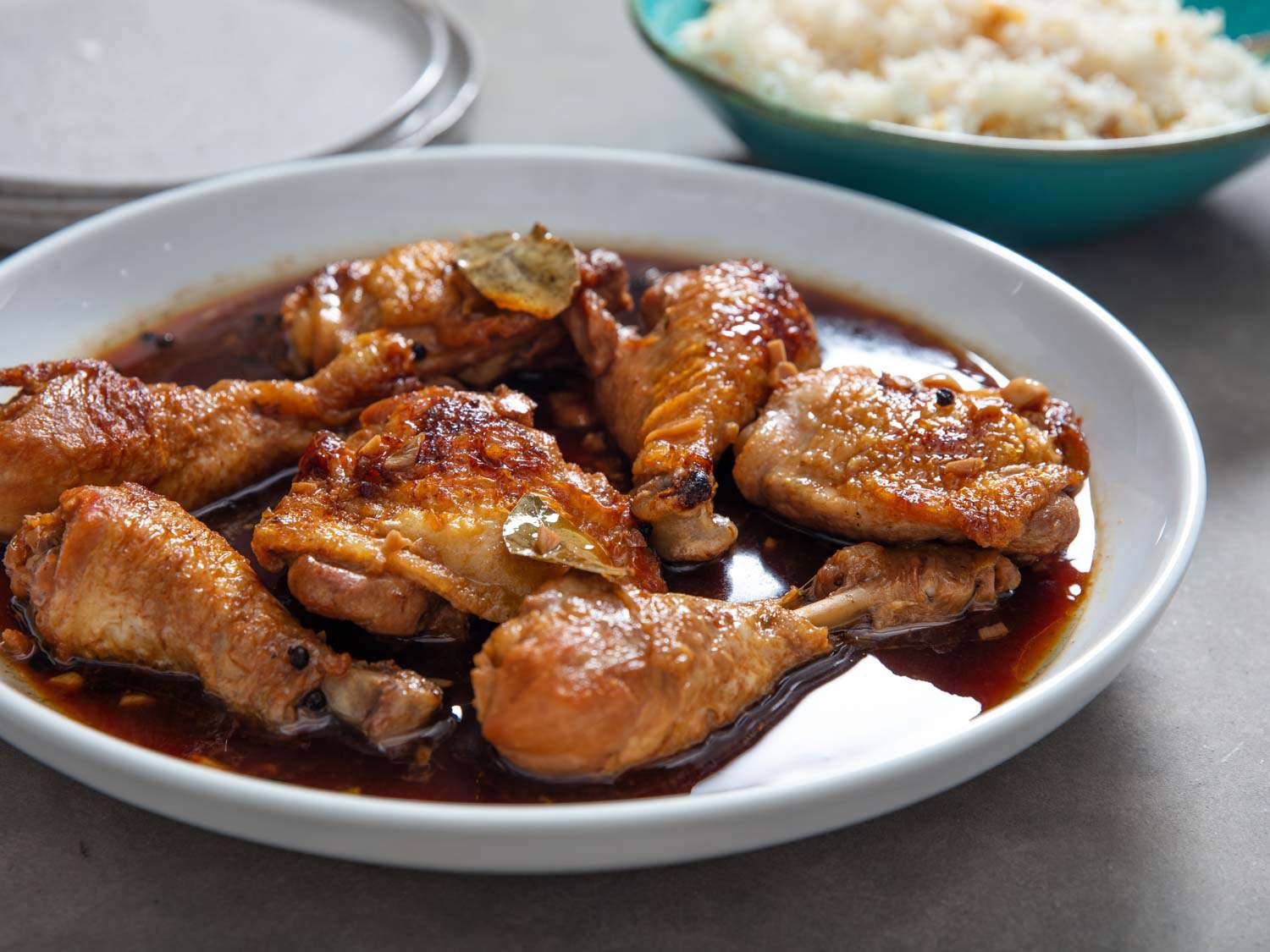
Part of that is structural. Filipino food does not photograph like Thai curries or Vietnamese pho. A bowl of adobo is brown. Sinigang is a cloudy gray-brown broth. Dinuguan is black. These are dishes built for flavor density, not for a camera, and food media selects hard for color.
The other part is that Filipino cuisine resists the one-line summary that sells a cuisine to newcomers. It is genuinely a mongrel — Filipino cuisine carries Austronesian and Indigenous foundations (coconut milk, fish sauce, sour fruit, rice), a heavy Chinese trading layer (noodles, spring rolls, congee, soy sauce), more than 300 years of Spanish colonial rule (caldereta, menudo, embutido, leche flan, the Spanish words for half the dishes), and a 20th-century American layer (canned meat, condensed milk, banana ketchup). "Chinese technique, Spanish naming, Malay pantry, cooked sour" is closer to accurate than anything shorter.
What it gives you as a home cook is a cuisine that is unusually forgiving. Braises reheat better than they serve fresh. Vinegar is a preservative, so leftovers keep. Almost every recipe here scales from four to ten without changing technique — only pot size.
Heat level, for planning purposes: essentially zero. Outside the Bicol region's coconut-and-chili dishes, Filipino home cooking has no capsaicin heat built in. Chili arrives at the table as a condiment. If you have been avoiding Asian cuisines because of spice tolerance in the house, this is the one to cook.
The Filipino pantry starter kit
Nine items. Under $45 at any Asian grocery, and about $60 if you order online. Once you own them, every recipe in this article is a grocery run away.
| Item | Filipino name | What it does | Substitute |
|---|---|---|---|
| Cane vinegar | sukang maasim | The backbone acid in adobo, paksiw, kinilaw | Distilled white vinegar (sharper), rice vinegar (weaker) |
| Soy sauce | toyo | Salt + color; Filipino brands are thinner than Japanese | Any Chinese light soy; avoid dark/thick soy |
| Fish sauce | patis | Savory salt in soups and stir-fries | Thai fish sauce (saltier, use 20% less) |
| Dried bay leaves | dahon ng laurel | Adobo aromatic; 3-4 per pot, not 1 | None — buy them |
| Whole black peppercorns | paminta | Cracked, not ground; adobo needs the texture | Coarse-cracked pepper |
| Garlic | bawang | Used by the head, not the clove | None |
| Calamansi | calamansi | Sour-citrus finish; frozen juice is fine | 50/50 lime + orange juice |
| Tamarind | sampalok | Souring agent for sinigang | Tamarind paste, or a Knorr sinigang mix |
| Coconut milk | gata | Richness in Bicol, laing, ginataan | Full-fat canned coconut milk (not "coconut beverage") |
Two notes that matter more than they look. First, buy cane vinegar, not white. Datu Puti and Silver Swan are the standard brands and cost about $3 for a large bottle. Cane vinegar is rounder and less aggressive, which is why Filipino braises can carry a cup of it without tasting like a pickle.
Second, buy whole peppercorns and a real grinder or mortar rather than pre-ground pepper. Adobo wants cracked peppercorns that stay whole in the sauce and pop when you bite one. Pre-ground pepper dissolves into the braise and just makes it dusty.
For calamansi, the frozen juice bottles sold at Seafood City, Island Pacific, and most large Asian groceries are the practical answer in the US — fresh calamansi is seasonal and rarely stocked outside Filipino markets. Calamansi is a hybrid citrus somewhere between a lime and a mandarin; that is why the lime-plus-orange substitution actually works.
Adobo — the national dish and its variations
Adobo is not one recipe. It is a method: protein simmered in vinegar and something salty, with garlic, bay, and peppercorns, until the liquid reduces to a glaze. The Spanish gave it the name (adobar, to marinate), but the technique — cooking in vinegar to preserve meat in a tropical climate — predates contact by centuries. Adobo (Filipino dish) is a preservation method that turned into a national identity.
The one rule that separates good adobo from harsh adobo: once the vinegar goes in and the pot comes to a boil, do not stir for the first 5-6 minutes. Raw vinegar agitated into hot fat tastes thin and volatile. Left alone to boil off, it mellows into something round. Then stir all you want.
Here are the six variations worth knowing, in rough order of how often they get cooked:
1. Classic chicken adobo (adobong manok). Bone-in thighs, soy, cane vinegar, garlic, bay, peppercorn. The reference version is Simple Filipino Chicken Adobo with Vinegar and Soy Sauce — 40 minutes of simmering, 320 calories a serving, and 35g of protein. If you have a slower evening, Slow-Simmered Filipino Chicken Adobo with Vinegar and Soy runs 55 minutes and reduces further.
2. Peppercorn-forward adobo. Some households push the black pepper hard enough that it reads as the primary flavor. Vinegar-Braised Chicken Adobo with Black Peppercorns is the 10-minute-prep weeknight version — this is the one to make on a Tuesday.
3. Pork belly adobo (adobong baboy). Fattier, richer, and it holds up better as leftovers than chicken does. Vinegar-Simmered Pork Belly Adobo with Garlic and Bay Leaves takes 50 minutes and lands at 450 calories a serving.
4. Sweet/anise adobo. Chinese-influenced households add star anise and more sugar, which produces something closer to a red-braise. Glazed Filipino Pork Belly Adobo with Star Anise is the version to cook if you have people at the table who find straight adobo too sour.
5. Oven adobo. Braising in the oven means no stovetop babysitting and a better crust on the meat. Baked Filipino-Inspired Pork Adobo with Garlic and Bay Leaves runs two hours mostly unattended, which makes it a Sunday dish.
6. Sauteed / dry adobo (adobong tuyo). Cook it down past the sauce stage until the meat fries in its own rendered fat. Sautéed Chicken Adobo with Garlic and Bay Leaves is the closest to that style here.
There is a seventh — adobo sa gata, finished with coconut milk — which is really adobo crossed with Bicolano cooking. If you want that flavor profile, Bicol Express-Style Spicy Coconut Pork Stir-Fry gets you to the same place in 20 minutes of cook time.
Every one of these reheats better on day two. Adobo is arguably the single best make-ahead braise in any cuisine — the vinegar keeps it, and the flavor tightens overnight.
Sinigang and the sour soups: souring agents explained
If adobo is sour-by-vinegar, sinigang is sour-by-fruit. It is a clear-ish broth soured with tamarind, loaded with vegetables, and served scalding hot with rice. It is the dish most Filipinos name when asked for comfort food, and it is the one most likely to convert a skeptic — a sour, savory, vegetable-heavy soup reads as familiar even to someone who has never eaten Filipino food.
The souring agent is the variable, and it changes the dish substantially:
| Souring agent | Filipino name | Character | Where to find it |
|---|---|---|---|
| Tamarind | sampalok | Deep, fruity-sour, slightly sweet | Paste, pods, or bouillon mix |
| Green mango | manggang hilaw | Sharp, bright, fast | Any grocery |
| Bilimbi | kamias | Extremely sour, grassy | Filipino markets, frozen |
| Calamansi | calamansi | Citrus-sour, floral | Frozen juice |
| Guava | bayabas | Sweet-sour, cloudy broth | Frozen or fresh |
| Tomato + tamarind | — | Mildest; the training-wheels version | Any grocery |
The workhorse recipe is Sinigang Pork Soup with Tamarind and Vegetables — 75 minutes, serves six, 280 calories a bowl. Pork belly or ribs, simmered until tender, then daikon, long beans, eggplant, and water spinach go in at the end.
For a weeknight, skip pork entirely and use shrimp: Pineapple and Shrimp Sinigang with Tamarind Broth is done in 25 minutes of cook time at 180 calories. Pineapple as a secondary souring agent is a real regional variation, not a shortcut — Pork and Pineapple Sinigang with Tamarind Broth is the fuller-bodied version.
Sinigang has two cousins worth cooking:
Tinola — chicken, ginger, green papaya, and chili leaves in a clear broth. Not sour at all; it is the Filipino chicken soup you make for someone who is sick. Tinola Chicken Soup with Ginger and Green Papaya is 45 minutes and 230 calories. Tinolang Manok with Green Papaya and Ginger Broth serves six from the same technique. If green papaya is unavailable, chayote is the standard substitute and nobody will complain.
Arroz caldo — Filipino congee, ginger-heavy, usually finished with fried garlic, scallion, and calamansi. Ginger Chicken Arroz Caldo with Coconut Milk is a 35-minute one-pot that feeds four for 450 calories a bowl.
Merienda and silog: the snack meal and the breakfast plate
Filipino eating runs on more than three meals. Merienda is the mid-afternoon snack slot — roughly 3pm — and it is a real meal, not a handful of crackers. Silog is the breakfast construction: a protein + sinangag (garlic fried rice) + itlog (fried egg). The name is a portmanteau. Silog plates are named for whatever protein sits on them: tapsilog (beef tapa), tocilog (tocino), longsilog (longganisa).
The base of every silog is garlic fried rice, and it is worth learning on its own: Garlic Fried Rice with Scallions and Toasted Garlic takes 12 minutes and 220 calories, and it uses day-old rice, which solves the leftover-rice problem permanently.
The three canonical silog plates:
- Tapsilog — Pan-Fried Beef Tapa with Garlic Rice. Cured, sweet-savory sliced beef. 15 minutes cook, 450 calories, 35g protein. The highest-protein breakfast in this entire article.
- Tocilog — Pan-Fried Sweet Pork Tocino with Garlic Rice. Sweet cured pork that caramelizes hard in the pan. If you want it as a full skillet for four, Sweet Tocino Breakfast Skillet with Pineapple and Garlic Rice is the same idea scaled up.
- Longsilog — Longganisa Fried Rice with Garlic and Scallions. Sweet garlic sausage, 10 minutes of prep, 15 of cook. The fastest breakfast here.
For a meatless breakfast, Eggplant and Tomato Tortang Talong with Garlic Rice — grilled eggplant flattened into an omelet — is the classic.
Merienda is where pancit and lumpia live. Pancit is a Chinese import fully naturalized: Pancit Bihon Stir-Fried Rice Noodles with Vegetables and Pork is the thin rice-noodle version at 20 minutes cook time, and Pancit Canton Stir-Fry with Chinese Sausage and Vegetables is the thicker wheat-noodle version in 15. Pancit is served at every Filipino birthday because long noodles symbolize long life — cutting them is considered bad form.
Two more noodle plates worth knowing: Palabok-Style Rice Noodles with Shrimp and Pork Sauce, which is pancit under an annatto-orange shrimp gravy, and Sautéed Pancit Bihon with Shrimp and Vegetables for a lighter 320-calorie plate.
Vegetarians are well served here: Stir-Fried Tofu Vegetable Pancit with Bihon Noodles and Vegetarian Pancit Palabok with Mushroom Gravy and Annatto are both full-flavor versions, not compromises.
And lumpia. Pan-Fried Pork Lumpia with Ground Pork and Vegetables makes six servings for 280 calories each; if you would rather not deal with a pan of oil, Baked Lumpia Rolls with Ground Pork and Vegetables gets to 220 calories and cleans up in one tray. Ukoy Shrimp and Sweet Potato Fritters with Garlic Vinegar Dip is the fritter side of merienda.
The 18-recipe roundup
Filipino name, English translation, and total time — prep plus cook, as the recipes are written.
| # | Dish | Filipino name / meaning | Total time | Serves |
|---|---|---|---|---|
| 1 | Simple Filipino Chicken Adobo | adobong manok — "marinated chicken" | 80 min | 4 |
| 2 | Vinegar-Simmered Pork Belly Adobo | adobong baboy — "marinated pork" | 65 min | 4 |
| 3 | Sinigang Pork Soup with Tamarind | sinigang na baboy — "sour pork stew" | 90 min | 6 |
| 4 | Pineapple and Shrimp Sinigang | sinigang na hipon — "sour shrimp stew" | 40 min | 4 |
| 5 | Tinola Chicken Soup | tinolang manok — "ginger-stewed chicken" | 60 min | 4 |
| 6 | Pancit Bihon with Pork | pancit bihon — "thin rice noodles" | 35 min | 4 |
| 7 | Pancit Canton with Chinese Sausage | pancit canton — "Cantonese noodles" | 30 min | 4 |
| 8 | Pan-Fried Pork Lumpia | lumpiang shanghai — "Shanghai rolls" | 40 min | 6 |
| 9 | Sautéed Pork Sisig | sisig — "to snack on something sour" | 30 min | 4 |
| 10 | Beef Kaldereta with Tomato and Potato | kaldereta — from Spanish caldera, "cauldron" | 80 min | 4 |
| 11 | Pan-Grilled Chicken Inasal | inasal — "char-grilled" (Ilonggo) | 30 min | 4 |
| 12 | Pan-Seared Beef Bistek | bistek tagalog — from "beefsteak" | 45 min | 4 |
| 13 | Pan-Fried Beef Tapa with Garlic Rice | tapsilog — tapa + sinangag + itlog | 30 min | 4 |
| 14 | Chicken Kare-Kare Peanut Curry | kare-kare — peanut stew | 50 min | 4 |
| 15 | Bicol Express Spicy Coconut Pork | Bicol Express — named for a train line | 30 min | 4 |
| 16 | Pinakbet Vegetable Stew | pinakbet — "shrunken," from pinakebbet | 45 min | 4 |
| 17 | Sautéed Laing with Coconut Milk | laing — dried taro leaves in gata | 45 min | 4 |
| 18 | Leche Flan Baked Caramel Custard | leche flan — Spanish milk custard | 75 min | 8 |
A few more that did not fit the eighteen but belong in the rotation: Pork Menudo Stew with Tomato and Potatoes (a Spanish-lineage tomato braise, nothing like Mexican menudo), Hearty Beef Giniling with Potatoes and Carrots (Filipino picadillo, the cheapest dish here), Slow-Cooked Pork Kaldereta with Tomato and Liver Spread, Slow-Simmered Filipino Chicken Curry with Coconut and Vegetables, and Pan-Seared Tilapia with Tomato and Onion Escabeche for a 30-minute fish night.
On the vegetable side: Creamy Coconut Ginataang Gulay with Squash and String Beans at 220 calories, Sautéed Ginisang Munggo with Spinach and Garlic at 180, and Sautéed Ginisang Ampalaya with Eggs and Tomatoes at 120 — bitter melon, and yes, it is genuinely bitter.
Desserts beyond flan: Pan-Fried Turon with Brown Sugar and Banana in 25 minutes total, Brown Sugar and Coconut Milk Biko with Latik Topping, Chilled Halo-Halo with Mixed Fruits and Sweetened Beans, and Buko Pandan Fruit Salad with Coconut Cream.
A Filipino Sunday spread: 3 mains + 2 sides + rice in 90 minutes
This feeds eight, costs roughly $35-45 in ingredients as of 2026, and the timing works on a standard four-burner stove plus an oven.
The menu: chicken adobo, pancit bihon, lumpia, laing, ginisang munggo, and a rice cooker running the whole time.
| Time | Action | Burner / appliance |
|---|---|---|
| 0:00 | Rice on. Marinate chicken for adobo | Rice cooker |
| 0:10 | Adobo into the pot, bring to boil, then leave it alone 6 min | Burner 1 |
| 0:15 | Start ginisang munggo — mung beans need 40 min | Burner 2 |
| 0:25 | Roll lumpia, oven to 400°F | Counter |
| 0:35 | Lumpia into the oven, 25 min | Oven |
| 0:40 | Start laing — coconut milk, taro leaves, low | Burner 3 |
| 0:55 | Adobo is done; pull it off, let it sit. Start pancit | Burner 1 |
| 1:15 | Everything lands within 10 minutes of each other | — |
| 1:30 | Table | — |
Two logistics notes. Rice quantity: plan one cup of uncooked rice per two people, minimum, and expect to be wrong on the low side. Filipino meals are rice-anchored — the dishes are seasoned to be eaten with a lot of plain rice, which is exactly why adobo tastes aggressively salty-sour on its own.
Second: put out a small bowl of cane vinegar with crushed garlic and a sliced chili. That is sawsawan, the table dipping sauce, and it does more for lumpia than anything you can buy. If anyone at the table wants heat, that bowl is where it goes.
Common pitfalls
Five failure modes, all of which produce edible-but-wrong food:
1. Stirring adobo while the vinegar is raw. Covered above; it is the single most common mistake. Boil 5-6 minutes untouched, then stir.
2. Adding water to adobo. The braise is supposed to reduce to a glossy, concentrated sauce. Every splash of water you add is flavor you have to cook back off. If it looks dry, that is the finish line, not a problem.
3. Using chicken breast. Filipino braises run 40-90 minutes. Breast meat is chalk by minute 25. Use bone-in thighs everywhere a recipe here says chicken, unless it explicitly says otherwise.
4. Under-souring sinigang. Home cooks routinely use half the tamarind they should because the raw broth tastes aggressive. It should make you wince slightly on its own — remember it is eaten with plain rice, which flattens the acid.
5. Buying "coconut beverage" instead of coconut milk. Laing, Bicol express, and ginataan need full-fat canned coconut milk with a solid cream layer on top. Carton coconut drink will not thicken and will break.
A sixth, for the noodle dishes: soak dried bihon noodles in warm water rather than boiling them. Boiled bihon turns to paste in the wok. Warm-soak for 8-10 minutes until pliable, drain, then stir-fry.
When not to cook Filipino this week
Three honest no-fit cases.
If you need it plated and photogenic. Adobo, kaldereta, and sinigang are brown, brown, and gray-brown. They taste extraordinary and they look like leftovers. For a dinner party where the food is part of the show, Vietnamese or Korean spreads carry more visual variety.
If you are cooking low-sodium. Soy sauce plus patis plus a reduced braise stacks sodium fast, and the recipes are calibrated to be eaten with unsalted rice. You can dial it down — use low-sodium soy, cut patis by half, add calamansi at the end to compensate — but you are fighting the cuisine's structure. A Mediterranean rotation is an easier fit.
If you have under 20 minutes and no pantry. The fast dishes here — pancit, sisig, tapsilog, ginataang sitaw — assume you already own cane vinegar, patis, and soy. Cold-starting from a regular supermarket means a shopping trip first. Build the pantry on a weekend, then the weeknight speed shows up.
Otherwise: adobo on Sunday, sinigang on Monday from the same aromatics, pancit on Wednesday for the fastest dinner in this article. That is a workable week.
What to buy
Filipino cooking needs less equipment than most cuisines because so much of it is one-pot braising. Four things earn their place.
A heavy 5-6 quart pot. Adobo, kaldereta, sinigang, and menudo are all long simmers, and a thin pot scorches the sugar in soy and tomato. Enameled cast iron or a heavy stainless Dutch oven both work; browse Cookware for the size range. The traditional vessel is a palayok, an unglazed clay pot, and it genuinely changes sinigang — clay holds heat more evenly and does not react with the acid. It is a nice-to-have, not a requirement, and it needs seasoning and careful heating before first use.
A rice cooker. This is the one appliance that is not optional. Filipino meals are built around a large volume of plain rice arriving hot at the same moment as three other dishes, and a rice cooker removes a burner and a timer from the equation. A 5-6 cup model handles a family; 10-cup if you host. See Small Appliances.
A garlic press or a heavy knife you are willing to smash with. Filipino recipes use garlic by the head. Adobo alone can take 8-12 cloves, laing wants a similar amount, and every fried rice starts with garlic toasted to deep gold. A press pays for itself in a month, and a solid chef's knife handles the pork belly and the vegetable prep — see Knives & Cutting and Kitchen Gadgets.
A wide wok or 14-inch skillet. Pancit needs surface area more than it needs depth; noodles steaming in a crowded pan turn gummy instead of getting the dry-edged texture you want. A long-handled wok spatula belongs with it — Utensils & Tools. And because half of Filipino cooking is better on day two, a set of stackable containers is not an afterthought: Storage & Containers.
What you do not need: a mortar and pestle (nothing here requires a paste), a pressure cooker (the braises are 40-90 minutes, which is fine), or a dedicated steamer.
FAQ
What makes Filipino food different from other Southeast Asian cuisines? Filipino food is defined by four flavor pillars — sour (vinegar, calamansi, tamarind), salty (patis fish sauce, soy), sweet (cane sugar, banana ketchup), and umami (garlic and onions cooked until dark). Where Thai leans on lemongrass and chilies and Vietnamese on herbs and lime, Filipino cooking is heavier on vinegar and long braises. It also carries more than 300 years of Spanish colonial influence — dishes like caldereta and menudo are the Iberian side of the family tree.
What's the trick to chicken adobo? Two things: use bone-in, skin-on thighs (never breasts — they dry out), and do not stir once the soy-vinegar liquid comes to a boil. Stirring while the vinegar is raw produces a harsh, thin, volatile bite; letting it simmer uncovered for 5-6 minutes first cooks that off. Once it mellows, then stir. Also, resist the urge to add water — the marinade reduces to a glossy sauce as the chicken renders, and diluting kills the flavor concentration.
Where do I get calamansi and Filipino ingredients in the US? Frozen calamansi juice bottles are stocked at Seafood City, Island Pacific, and most Asian groceries; some H-Mart locations carry them refrigerated. Online grocery delivery reaches most US metros for the frozen bottles and the shelf-stable pantry items. If nothing local, a 50/50 mix of fresh lime and orange juice is the closest home substitute. For patis (fish sauce), Rufina and Datu Puti are the canonical brands; Thai fish sauce works but is slightly saltier and less funky.
Is Filipino food spicy? Almost none of it — Filipino home cooking is a sweet-salty-sour flavor profile, not a heat-forward one. The Bicol region uses chili and coconut milk (bicol express, laing) and is the exception. Most everything else — adobo, sinigang, kaldereta, sisig, pancit — has zero heat unless a diner adds siling labuyo (bird's eye chili) as a condiment at the table. Kids eat Filipino food readily for this reason.
Can I make Filipino recipes gluten-free? Yes — most Filipino savory recipes use soy sauce (which contains wheat) but coconut aminos or a certified gluten-free tamari substitute 1:1 with no flavor loss. Skip lumpia wrappers made with wheat flour and use rice paper instead; pancit bihon (rice noodles) is naturally gluten-free while pancit canton (wheat noodles) isn't. AislePrompt's chat at /chat will rebuild any recipe gluten-free — just note the restriction.
Sources
- Wikipedia — Filipino cuisine — the Austronesian, Chinese, Spanish, and American layers described above
- Wikipedia — Adobo (Filipino dish) — the etymology and the pre-colonial vinegar-preservation origin
- Wikipedia — Sinigang — the regional souring agents (sampalok, kamias, bayabas, calamansi)
- Wikipedia — Calamansi — the citrus hybrid and its substitutions
- DOST-FNRI Philippine Food Composition Tables — the Philippine government's primary nutrient reference for Filipino ingredients and dishes
Frequently asked questions
What makes Filipino food different from other Southeast Asian cuisines?
What's the trick to chicken adobo?
Where do I get calamansi and Filipino ingredients in the US?
Is Filipino food spicy?
Can I make Filipino recipes gluten-free?
Sources
- en.wikipedia.org
- en.wikipedia.org
- en.wikipedia.org
- en.wikipedia.org
- en.wikipedia.org
- en.wikipedia.org
- i.fnri.dost.gov.ph
Plan a week of meals in two minutes.
Tell our AI what you have and what you like — it builds your plan, shopping list, and Instacart cart. No account needed.
Try free →