20 Cozy Casseroles: One-Dish Dinners for Weeknight Comfort
Base, protein, binder, topping — get that ratio right and you can build a casserole without a recipe.
Every dinner casserole is the same four parts: a starch or vegetable base, a protein, a binding sauce, and a topping that browns. Get the ratio right and you can build one from whatever is in the fridge without a recipe. Get it wrong — usually too much liquid, or a topping added too early — and you get soup with a soggy lid.
Get a free week of easy dinners
Seven weeknight dinners with the shopping list already totalled, sent Sunday. No account needed, unsubscribe in one click.
No spam, unsubscribe in one click. Recipes, shopping lists and Instacart carts all work without an account either way.
What makes a casserole work: the four-part formula
A casserole is a composed dish baked and served in one vessel. That is the entire definition, which is why the category runs from lasagna to tater tot bakes with nothing obvious in common. The structure underneath, though, is consistent.
| Part | Share of volume | Job | Examples |
|---|---|---|---|
| Base | 40-50% | Bulk, texture, absorbs sauce | Pasta, rice, potato, tortilla, bread, vegetables |
| Protein | 20-30% | Substance | Chicken, ground beef, sausage, beans, tuna, eggs |
| Binder | 20-30% | Moisture and cohesion | Béchamel, condensed soup, cream, egg custard, tomato sauce |
| Topping | 5-10% | Browning and contrast | Cheese, breadcrumbs, crushed crackers, tots, mash, pastry |
The binder ratio is where nearly every failure lives. Too little and the dish is dry and crumbly; too much and it never sets. The reliable starting point is 1 cup of binder per 4 cups of base-plus-protein for a dish with cooked, drained components, dropping to about 3/4 cup if the base is raw rice or dry pasta cooking in the dish — those absorb liquid on their own schedule.
The second structural rule: the topping goes on for the last third of the bake, not the start, unless it is cheese under foil. Breadcrumbs, crackers, and tots added at minute zero are dark and bitter by the time the middle is hot.
Choosing the right dish: 9x13, 8x8, oval, cast iron
The pan changes the cook time more than most people expect, because depth drives how long heat takes to reach the center.
| Dish | Volume | Serves | Typical bake at 350°F | Best for |
|---|---|---|---|---|
| 9x13 rectangular | 3-3.5 qt | 8-10 | 45-55 min | Lasagna, baked ziti, most family bakes |
| 8x8 square | 1.5-2 qt | 4 | 35-45 min | Two people, or half batches |
| 2 qt oval | 2 qt | 4-6 | 40-50 min | Pot pies, gratins |
| 10 in cast iron | 2.5 qt | 6 | 35-45 min | Anything that starts on the burner |
| 4 qt deep roaster | 4 qt | 12 | 70-90 min | Crowds; expect a long bake |
Material matters too, and it is a genuine 10-15 minute difference. Borosilicate and tempered soda-lime glass heat slowly and hold heat, so glass dishes run longer to reach temperature and keep cooking after they come out. Ceramic behaves similarly. Metal pans heat fast and brown edges harder. If a recipe was written for metal and you are using glass, add roughly 10 minutes and check the center with a thermometer — 165°F is done for anything with poultry or egg.
Depth is the variable people miss. A 9x13 filled 2 inches deep bakes in 45 minutes; the same volume packed into an 8x8 at 3.5 inches deep needs closer to 70 and will brown the top long before the middle is hot. Spread out when you can.
The bakeware category covers glass, ceramic and metal in the standard sizes, and our best bakeware buying guide compares the specific pans.
Chicken casseroles: king ranch, chicken and rice, chicken pot pie
Chicken is the default casserole protein because it stays tender through a long bake and because a rotisserie bird makes the whole dish a 15-minute assembly job.
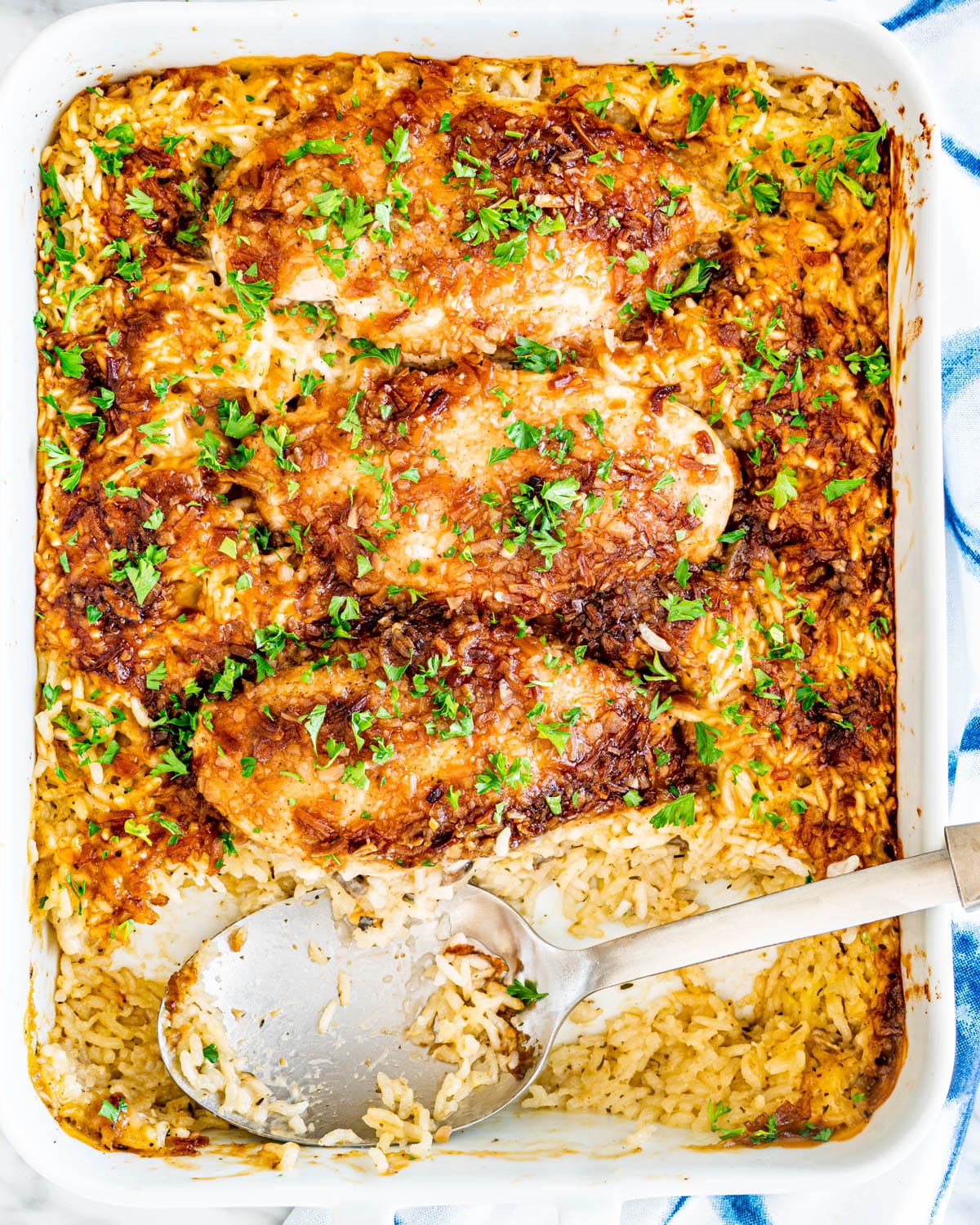
Simple No-Peek Chicken and Rice Casserole is the archetype — raw rice, liquid, chicken, sealed tightly with foil, and genuinely no peeking, because every lid lift vents the steam that is cooking the rice. 350°F for 90 minutes. The liquid ratio here is the whole recipe: 2 cups liquid per 1 cup long-grain white rice, no more.
Homemade Chicken Potpie with Flaky Pastry — the filling must be thick enough to mound on a spoon before the crust goes on. A loose filling boils, lifts the pastry, and steams it from below into a pale raft.
Creamy Chicken & Broccoli Casserole and Cheese-Topped Chicken and Broccoli Casserole are the weeknight versions. Blanch the broccoli 90 seconds and shock it; raw broccoli releases water into the binder and overcooked broccoli turns grey and sulfurous over 40 minutes.
Creamy Crockpot Chicken Enchilada Casserole and Slow-Simmered Chicken Enchilada Verde Casserole cover the tortilla-base end, where corn tortillas play the role pasta plays elsewhere. King Ranch-style casseroles belong to this family: chicken, corn tortillas, peppers, and a cream binder, layered like lasagna.
Beef casseroles: shepherd's pie, tater tot, taco casserole
Beef and Potato Shepherd's Pie is the reference. Two rules: reduce the filling until a spoon leaves a track, and pipe or fork the mashed potato into ridges — the ridges are what brown under the broiler and give the dish its texture contrast. Vegetarian versions work identically: Root Vegetable Shepherd's Pie and Vegetable Lentil Shepherd's Pie.
Tater tot casseroles are the same architecture with a frozen potato topping instead of mash, and the tots must go on frozen, in a single layer, uncovered, for the last 30 minutes. Southern-Inspired Pulled Pork with Creamy Macaroni and Tater Tot Casserole runs the pork variant.
Taco and chile casseroles layer tortillas, seasoned beef, and cheese: Ground Beef and Poblano Chile Relleno Casserole and Baked Poblano Casserole with Monterey Jack and Chorizo.
Pasta bakes: baked ziti, lasagna, mac and cheese variations
The pasta bake is the most-cooked casserole in America and the one most often ruined by a single mistake: fully cooking the pasta before it goes in the dish.
Pasta continues absorbing liquid in the oven. Boil it to 2-3 minutes short of al dente — genuinely underdone, chalky at the center — and it finishes to exactly right in a 45-minute bake. Boiled to package time, it comes out of the oven soft and swollen.
Lasagne — Best Homemade Lasagna and Real Italian Lasagna. The classic build is five layers: sauce, noodles, ricotta or béchamel, meat, cheese, repeated. Rest it 20 minutes out of the oven before cutting or the layers slide. Vegetarian: Best Vegetable Lasagna and Herb-Roasted Vegetable Lasagna — roast the vegetables first to drive off water, or the whole dish weeps.
Baked ziti is lasagna without the layering discipline: Low-Profile Baked Ziti, Oven-Baked Ziti with Sausage and Ricotta, and the shortcut One-Pot Baked Ziti with Italian Sausage.
Baked mac and cheese — Wellesley-Inspired Baked Macaroni and Cheese with Smoked Cheddar. The sauce should look alarmingly loose going into the oven; the pasta drinks the difference. Grate your own cheese, because the anti-caking starch on pre-shredded cheese makes a grainy sauce.
Tuna noodle deserves its place: One-Pot Tuna Noodle Casserole with Homemade Béchamel and Temple Hills Tuna Noodle Casserole.
Vegetarian casseroles: enchilada casserole, veggie lasagna, potato gratin
Vegetables carry far more water than meat, and every vegetarian casserole failure traces back to that fact. The fix is always the same: cook the water out first.
| Vegetable | Water content | Pre-treatment | Time |
|---|---|---|---|
| Zucchini, summer squash | ~94% | Salt 20 min, squeeze | 20 min |
| Mushrooms | ~92% | Sauté hard until re-absorbed | 8 min |
| Spinach | ~91% | Wilt and squeeze bone dry | 5 min |
| Eggplant | ~92% | Roast or salt and press | 25 min |
| Broccoli, cauliflower | ~90% | Blanch 90 s, shock, drain | 5 min |
| Frozen vegetables | varies | Thaw completely and drain | 30 min |
Herb-Roasted Potato Gratin with Gruyère is the exception that proves the rule — potato starch is the thickener, so you deliberately do not rinse the slices. Béchamel-Enriched Green Bean Casserole with Crispy Shallots upgrades the holiday standard by replacing condensed soup with an actual béchamel.
Breakfast-for-dinner: strata, egg bakes, hash brown casserole
A strata is bread and custard: cubed stale bread, eggs, milk, cheese, and whatever else, soaked overnight and baked in the morning — or at 6 p.m., which is when it is actually best.
The custard ratio is the recipe: 1 large egg per 1/2 cup dairy, and enough total custard to just submerge the bread. Six eggs and 3 cups of milk fills a 9x13. Soak at least 4 hours, ideally overnight; unsoaked bread floats and bakes into a dry crouton layer over a wet bottom.
Overnight Sausage and Cheese Breakfast Casserole is the make-ahead version — assembled the night before, straight from fridge to oven. Sausage, Egg, and Chive Breakfast Casserole is the same-day one, and Cheesy Sausage and Spinach Egg Bake drops the bread entirely for a lower-carb crustless bake. Cheesy Cauliflower Breakfast Casserole with Bacon and Spinach swaps cauliflower for the starch, and Sausage & Potato Bake with Herbed Eggs uses potato as the base.
Bake egg-based casseroles at 325-350°F, lower than pasta bakes, and pull at 160-165°F in the center. Egg custard sets around 160°F and turns rubbery and weeping above about 180°F, so this is one dish where a thermometer genuinely outperforms a visual check.
Make-ahead, freeze, and reheat strategy
This is what casseroles are actually for. Nearly every dish above can be assembled days ahead or frozen for months.
| Dish type | Fridge, assembled | Freezer | Bake from frozen | Notes |
|---|---|---|---|---|
| Pasta bake (ziti, lasagna) | 2 days | 3 months | 375°F, 75-90 min covered | Undercook pasta more if freezing |
| Chicken and rice | Do not | 3 months cooked only | Thaw first | Raw rice does not freeze well pre-bake |
| Shepherd's / cottage pie | 2 days | 3 months | 375°F, 75 min | Best frozen unbaked |
| Pot pie | 1 day | 2 months | 400°F, 60 min | Add crust just before baking |
| Strata / egg bake | Overnight (required) | 1 month | Thaw first | Custard separates if frozen long |
| Mac and cheese | 2 days | 2 months | 350°F, 60 min | Add extra milk on reheat |
| Green bean casserole | 2 days | Not recommended | — | Beans go mushy |
| Enchilada / tortilla | 1 day | 3 months | 375°F, 70 min | Tortillas soften in the fridge |
Practical mechanics. Freeze unbaked, not baked, wherever the table allows — you get one cooking cycle instead of two, and the texture is markedly better. Use disposable foil pans for anything going in the freezer so your good dish is not out of commission for three months. Cover with plastic wrap and then foil; the plastic stops freezer burn, the foil stops the plastic tearing. Label with the dish, the date, and the bake instruction, because in February you will not remember whether it needs 60 minutes or 90.
On reheating leftovers: cover with foil, add a splash of milk or stock to anything with a cream binder, and reheat at 325°F until the center reaches 165°F — roughly 25 minutes for a portion, 45 for a half pan. Refrigerated leftovers are good for three to four days; see the FDA's cold-storage guidance for the underlying rules.
Store leftovers in portions rather than in the baking dish — it cools faster, which matters for safety, and it makes lunches automatic. The storage and containers category covers oven-to-fridge sets, and kitchen utensils has the offset spatulas and serving pieces that get a square out of a 9x13 intact.
Common pitfalls
- Fully cooking the pasta first. Two to three minutes short of al dente. Every time.
- Too much binder. One cup per four cups of base and protein. Casseroles that never set are almost always over-sauced.
- Topping on from minute zero. Breadcrumbs and crackers go on for the last third; tots go on frozen for the last 30 minutes.
- Wet vegetables. Salt, squeeze, sauté, or roast first. Frozen vegetables must be thawed and drained.
- Pre-shredded cheese in a sauce. The anti-caking starch makes it grainy. Grate your own.
- Peeking at a rice casserole. Every lid lift releases the steam doing the cooking.
- Cutting lasagna hot. Twenty minutes of rest is the difference between slices and slop.
- Glass pan, metal-pan timing. Add about 10 minutes and verify 165°F in the center.
- Freezing a baked casserole. Freeze unbaked when you can — one cooking cycle, better texture.
When a casserole is the wrong answer
Skip the format when the meal needs to be fast — nothing here beats 35 minutes, and a skillet dinner will be on the table in 20. Skip it for two people unless you actively want four days of leftovers, or halve it into an 8x8 and accept a shorter bake. Skip it for delicate proteins: shrimp, scallops, and thin white fish all overcook badly in the 40-plus minutes a casserole needs, and no amount of sauce hides it. And skip the freezer route for anything built on cream cheese, sour cream, or a heavy dairy binder without a starch — those break on thawing and reheat grainy.
FAQ
How do I stop my casserole from turning out watery?
Water comes from three places: undercooked vegetables releasing moisture during the bake, too much binder relative to the base, and frozen ingredients added without thawing and draining. Fix all three in advance. Salt and squeeze zucchini and spinach, sauté mushrooms until they reabsorb their liquid, blanch and shock broccoli, and hold to roughly one cup of sauce per four cups of base and protein combined.
Can I assemble a casserole the night before and bake it the next day?
Most of them, yes, and strata actually requires it. The exceptions are dishes with raw rice, which will absorb liquid overnight and bake unevenly, and anything with a pastry crust, which goes soggy sitting on wet filling. Take a refrigerated casserole out about thirty minutes before baking and add roughly ten to fifteen minutes to the cook time, since it starts far colder than a freshly assembled one.
What temperature is a casserole actually done at?
Anything containing poultry, eggs, or previously cooked meat should reach 165F at the center, measured with an instant-read thermometer rather than judged by the surface. Egg-custard dishes such as strata are the exception in the other direction: pull them at 160 to 165F, because egg sets around 160F and turns rubbery and weeping above roughly 180F. A browned top means nothing about the center.
Should I bake covered or uncovered?
Covered for the majority of the bake, uncovered for the last fifteen to twenty minutes. Foil traps steam, which is what heats the interior evenly and stops the edges drying before the middle is hot; removing it at the end lets the surface brown and any excess moisture evaporate. Rice casseroles are the exception and stay sealed the whole time, and dishes topped with frozen tots or pastry stay uncovered throughout.
Can I substitute homemade sauce for condensed soup?
Yes, and it is a straight upgrade. One can of condensed cream soup is roughly one and a quarter cups of thick bechamel, which you make from two tablespoons of butter, two tablespoons of flour, and one cup of milk, seasoned with salt, pepper and whatever the soup was flavoured with. It takes about six minutes, costs less, and lets you control the salt, which in canned versions is usually the dominant note.
How long do casserole leftovers keep?
Three to four days refrigerated, and they should be cooled and moved into shallow covered containers within two hours of coming out of the oven rather than left in the hot baking dish. Reheat covered at 325F with a splash of milk or stock added to anything with a cream binder, until the center reaches 165F. Frozen cooked portions keep two to three months with acceptable texture, and pasta bakes reheat best of all.
Where to go next
For the fast end of the same comfort-food territory, 22 weeknight casserole recipes sticks to bakes under an hour. 22 Dutch oven dinners covers the stovetop-to-oven equivalent, and freezer-friendly meal prep turns the make-ahead section above into a month-long system.
Frequently asked questions
How do I stop my casserole from turning out watery?
Can I assemble a casserole the night before and bake it the next day?
What temperature is a casserole actually done at?
Should I bake a casserole covered or uncovered?
Can I substitute homemade sauce for condensed soup?
How long do casserole leftovers keep?
Sources
Plan a week of meals in two minutes.
Tell our AI what you have and what you like — it builds your plan, shopping list, and Instacart cart. No account needed.
Try free →