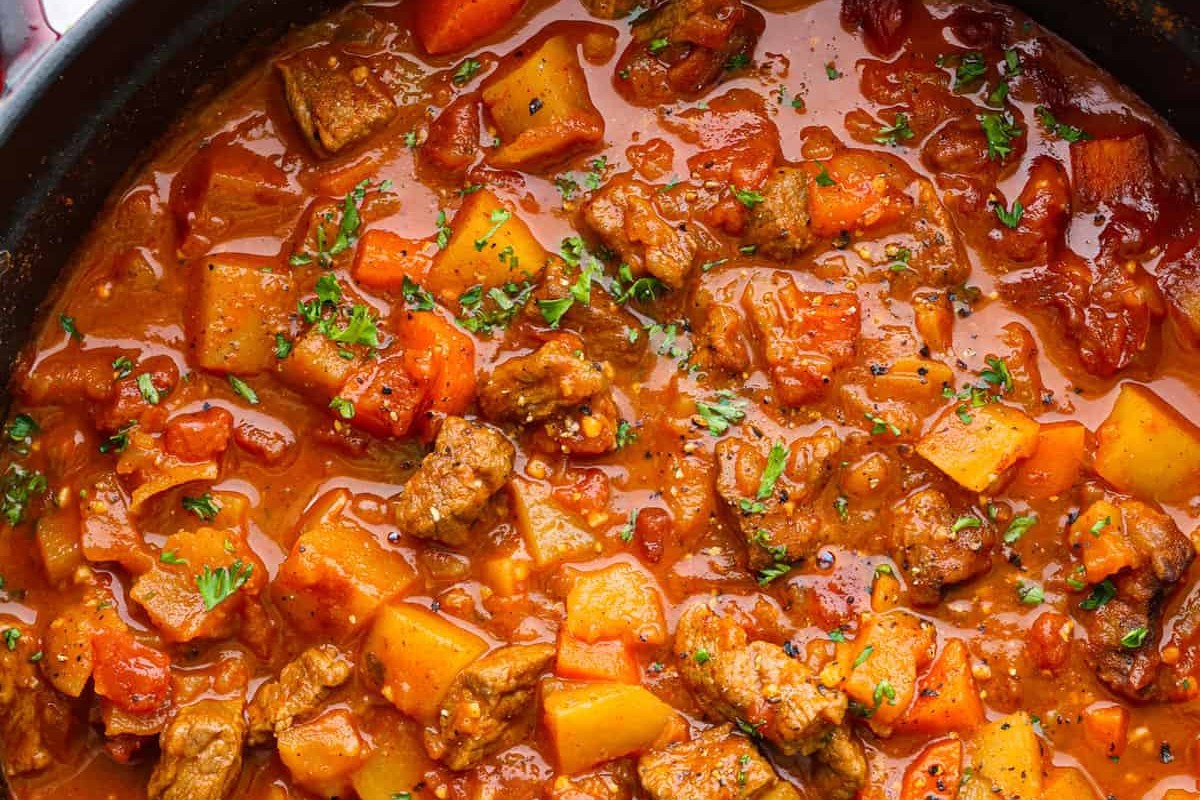
20 Hungarian Recipes: Goulash, Chicken Paprikash & Stuffed Peppers
Real imported paprika, a slow-sweated onion base, and one off-heat step that separates goulash from red beef stew.
Authentic Hungarian cooking at home comes down to three moves: buy real imported paprika, build every braise on a slow-sweated onion base, and stir the paprika into warm fat off the heat so it never scorches. Get those right and goulash, chicken paprikash, and stuffed peppers all fall out of the same technique — no specialty equipment, no hard-to-source ingredients.
Get a free week of easy dinners
Seven weeknight dinners with the shopping list already totalled, sent Sunday. No account needed, unsubscribe in one click.
No spam, unsubscribe in one click. Recipes, shopping lists and Instacart carts all work without an account either way.
Introduction — paprika is the whole culture in a jar
Hungarian food has a reputation for being heavy. It isn't. It's concentrated. A pot of gulyás has maybe eight ingredients — beef, onion, paprika, tomato, potato, carrot, caraway, fat — and it tastes like far more than the sum of them because two of those ingredients are doing enormous work. The onion, cooked down until it stops being onion and starts being sauce. And the paprika, which is not a garnish and not a color agent but the actual backbone of the dish.
That distinction matters more than almost anything else you'll read about this cuisine. In most Western cooking, paprika is the dusty red jar you shake over deviled eggs. In Hungary it's a primary flavor, measured in tablespoons rather than pinches, and the quality gap between a $2 supermarket tin and a $6 imported one is the gap between "reddish beef stew" and "goulash." Hungarian cuisine built its identity around the pepper after it arrived from the New World in the 16th century, and by the 1800s Szeged and Kalocsa were milling it commercially at a scale nowhere else matched.
The other thing to know: Hungarian braises are cheap. Chuck roast, chicken thighs, cabbage, potatoes, onions, sour cream. A pot of pörkölt that feeds six costs less than two fast-food meals and improves for three days in the fridge. If you already cook from our Polish recipe cluster or the German dinner lineup, the pantry overlap is close to total — you're maybe two spice tins away from being able to cook Hungarian tonight.
This guide covers the paprika you should buy, the one technique that makes or breaks every braise, the real difference between goulash and pörkölt and paprikás (Hungarians are firm about this and Americans get it wrong constantly), and 20 recipes from our catalog that let you cook the whole repertoire.
Pick your paprika: sweet, hot, smoked (édesnemes, csípős, füstölt)
Start with one tin and add from there. Paprika is graded in Hungary along two axes — heat and grind fineness — and the labels on an imported tin tell you exactly what you're getting.
| Hungarian label | English | Heat | Use it for |
|---|---|---|---|
| Édesnemes | Sweet noble | None | Default. Goulash, pörkölt, paprikash, everything |
| Csemege | Delicate | Very mild | Sauces where you want color plus subtlety |
| Csípős | Hot | Moderate | Halászlé, table condiment, blending into sweet |
| Különleges | Special / finest grind | None | Finishing, sprinkled on lángos or eggs |
| Füstölt | Smoked | None to mild | Sausage-forward dishes, vegetarian stews |
Buy this first: a 4-oz tin of imported Hungarian édesnemes. It runs about $6, which sounds steep next to the $2 domestic jar until you notice you're using a full tablespoon per pot instead of a quarter teaspoon. One tin covers roughly eight braises. Szeged and Kalocsa are the two protected-origin regions; both are widely stocked in US grocery import aisles and online. Our pantry and grocery section tracks the imported tins alongside the caraway, marjoram, and bay you'll want next to them.
Buy this second: a small tin of csípős (hot). You will use it in teaspoons, not tablespoons, and it lasts a year. Blending one part hot into three parts sweet gives you the warmth of a Hungarian country kitchen without turning the dish into chili.
Skip, mostly: smoked paprika for classic Hungarian braises. Smoked is Spanish (pimentón) in spirit, and while a pinch is great in a vegetarian lecsó where you're replacing the smokiness of missing sausage, it's wrong in goulash. Hungarian sweet paprika is fruity and faintly sweet; smoked paprika is campfire. They are not substitutes.
Storage — this is where most home cooks lose the flavor
Ground paprika is a fresh spice pretending to be a shelf-stable one. It's mostly dried pepper flesh and pepper oil, and both go stale fast. Keep the tin sealed, dark, and cool; six months is the honest window before it flattens into dust. If your paprika smells like nothing when you open it, it is nothing — buy a new tin rather than compensating with a bigger spoonful, which just adds bitterness. A drawer or a closed cabinet beats a spice rack over the stove by a wide margin. Our storage and container picks include the small opaque tins worth decanting into if your kitchen runs warm.
Building a Hungarian braise: onion, lard, paprika off-heat
Nearly every savory dish in this article is the same three-step base. Learn it once and you can cook two-thirds of the Hungarian canon without a recipe.
Step 1 — Onions, more than feels right, cooked longer than feels right. The classic ratio is roughly equal weights of onion and meat. Two pounds of chuck gets two large onions, finely diced. Sweat them in fat over medium-low for 12 to 18 minutes until they're translucent, slumped, and just starting to take color at the edges. You are not browning them into French-onion-soup territory; you are dissolving them. In a finished pörkölt there should be no visible onion at all — it has become the sauce body. Rushing this step is the single most common reason a home goulash tastes thin.
Step 2 — Kill the heat, then add the paprika. This is the whole technique. Pull the pot off the burner, wait 20 to 30 seconds, then stir the paprika into the warm onion-and-fat mixture and keep it moving for about 30 seconds until it blooms into a deep brick-red paste. Paprika's sugars scorch above roughly 300°F and scorched paprika is acrid in a way nothing downstream can fix — no amount of tomato, sour cream, or simmering will pull it back. If you have ever made a goulash that tasted faintly of burnt tomato and you couldn't figure out why, this was it.
Step 3 — Add liquid immediately, then braise low. The moment the paprika is bloomed, deglaze with a splash of water, stock, or tomato, which drops the pan temperature and locks the paprika in suspension. From there it's a normal low braise: 90 minutes to 2.5 hours for beef chuck, 35 to 45 minutes for chicken thighs. Barely-there bubbles, lid ajar. A slow-simmered beef paprika stew takes about 135 minutes of unattended time and rewards every one of them.
On the fat. Traditionally this is lard, and lard genuinely tastes better here — it's neutral-savory and carries paprika beautifully. But sunflower oil is the everyday Hungarian default now, and butter or duck fat both work. The fat choice changes the dish by maybe 5%; the off-heat paprika step changes it by 50%.
A note on flour. Real pörkölt and gulyás are not thickened with flour or roux. The body comes from collagen in the meat, the dissolved onion, and reduction. Paprikás is finished with sour cream stabilized with a spoonful of flour so it doesn't split, and that's the only place flour belongs.
Goulash vs. pörkölt vs. paprikás — the three sisters
Americans use "goulash" for all three and Hungarians find this funny at best. Here's the actual taxonomy.
| Dish | What it is | Liquid level | Served with | Typical cook time |
|---|---|---|---|---|
| Gulyás (goulash) | A soup | Brothy, spoonable | Bowl, bread, sometimes csipetke pinched pasta | 100–150 min |
| Pörkölt | A thick braise | Almost none — glossy sauce clings | Nokedli, egg noodles, boiled potatoes | 120–150 min |
| Paprikás | Pörkölt finished with sour cream | Creamy, pale brick | Nokedli, always | 45–135 min |
Gulyás is soup. It comes in a bowl, it has potatoes and carrots swimming in it, and in Hungary you'd eat it as a first course or a whole lunch out of a cauldron over a fire. Our Hungarian beef goulash with potatoes and tomatoes is the reference version — 20 minutes of prep, 100 minutes of simmer, about 420 calories a serving across four bowls.
Pörkölt is what most Americans are picturing when they say goulash: chunks of beef in a thick, deep-red paprika sauce with essentially no free liquid, spooned over noodles. Same base, less water, longer reduction. The slow-simmered beef paprika stew and the paprika-spiced beef stew with root vegetables are both in this family.
Paprikás is pörkölt plus sour cream, and it's almost always chicken. That's the next section.
The regional cousins are worth cooking too
Goulash traveled. Every country that shared a border with the Austro-Hungarian Empire has a version, and each one tells you what that kitchen cares about:
- Braised Viennese beef goulash with paprika and onions — the Austrian Saftgulasch. Even more onion, almost no vegetables, sauce reduced until it's nearly a gravy. Two hours, 450 calories a serving.
- Slow-braised Czech beef goulash with caraway — caraway forward, served with bread dumplings, 130 minutes.
- Slow-cooked Ukrainian beef goulash with paprika and onions — the longest braise of the group at 150 minutes, and the most forgiving if you walk away from the stove.
- Sauerkraut and beef goulash with paprika — this is székelykáposzta in spirit: goulash plus sauerkraut plus sour cream, a genuinely Hungarian dish that reads as Central European comfort food to anyone.
Cook two of these back to back and you'll learn more about braising than from any single recipe.
Chicken paprikash, done right
Paprikás csirke is the dish to start with if you've never cooked Hungarian food. It's 15 minutes of prep and 45 minutes of cooking, it uses one pot, and it's hard to ruin as long as you respect two rules.
Use bone-in, skin-on thighs. Breast meat goes chalky in a paprika sauce and contributes no gelatin. Thighs hold up through 40 minutes of simmering and their rendered fat becomes part of the sauce. Our chicken paprikash with sour cream runs about 380 calories per serving for four — modest for how rich it eats.
Temper the sour cream, or it will break. This is the second rule and the one people fail. Full-fat sour cream, whisked with a tablespoon of flour, then thinned with a ladle of the hot cooking liquid before it goes into the pot. Then kill the heat entirely and stir it in. Sour cream added cold and straight to a boiling pot curdles into grainy white specks in about four seconds. Low-fat sour cream splits even when you do everything right — this is not the dish for it.
The five-minute troubleshooting table
| Symptom | Cause | Fix |
|---|---|---|
| Bitter, acrid aftertaste | Paprika scorched in a hot pan | Start over; bloom off the heat next time |
| Sauce is thin and watery | Under-cooked onions, too much liquid | Reduce uncovered 10–15 min |
| Sour cream broke into curds | Added cold, or pot was boiling | Temper next time; blend the current pot smooth |
| Tastes flat and dusty | Stale paprika | Buy a new tin — more of the old one won't help |
| Chicken is dry and stringy | Used breast, or boiled instead of simmered | Switch to thighs; keep it at a bare tremble |
Serve it over nokedli. Not rice. This is covered below, but it matters enough to repeat: the sauce is designed to catch in the crannies of an irregular egg dumpling, and rice grains just sit under it.
Töltött káposzta and töltött paprika (stuffed cabbage / peppers)
Stuffed things are the other half of Hungarian home cooking, and they're the dishes most worth making on a Sunday for a Wednesday payoff — both improve substantially overnight.
Töltött káposzta — stuffed cabbage — is ground pork and rice rolled in blanched or brined cabbage leaves, layered with sauerkraut and smoked meat, and braised for an hour or more. Our Hungarian-style stuffed cabbage rolls with tomato sauce runs 25 minutes of prep and 70 of oven time for six servings at roughly 380 calories each. Two practical notes: freeze the whole head of cabbage overnight and thaw it instead of blanching — the leaves peel off limp and tear-free with zero boiling — and always tuck a few handfuls of sauerkraut between the layers, because the acid is what keeps an hour-long pork braise from tasting flat.
For a slightly different treatment, the cabbage rolls with beef and mushroom sauce swap the tomato for a savory mushroom gravy — closer to the Polish and Ukrainian end of the family, and excellent in its own right.
Töltött paprika — stuffed peppers — is the weeknight version. Hungarian wax peppers (pale yellow-green, thin-walled, mildly sweet) are the traditional vessel, stuffed with the same pork-and-rice mixture and simmered in a light tomato sauce rather than baked dry. If you can't find wax peppers, bell peppers work; just simmer rather than roast, because the point is the peppers giving up their sweetness into the sauce.
Make-ahead math: both dishes take about 90 minutes of mostly-passive work and yield six servings. Portioned into containers they hold five days refrigerated and three months frozen, and the flavor peaks on day two. This is the single highest-leverage Sunday cook in the cuisine — see our meal plan tool if you want to slot it into a week.
Lángos, dumplings, and side starches
The starches are not an afterthought in Hungarian cooking. They're engineered to carry sauce.
Nokedli are small, irregular egg dumplings — flour, egg, water, salt, scraped or dripped off a board into boiling water. They're the same idea as German spätzle, and functionally interchangeable. They exist because their ragged surface traps paprika sauce in a way smooth noodles can't. Our Swabian spätzle with caramelized onions is the plain version to serve under paprikash, and the spätzle noodles with creamy mushroom and onion ragout turns them into a meal on their own. Both take about 35 minutes start to finish.
Lángos is deep-fried yeasted flatbread, rubbed with raw garlic while it's still hot, then loaded with sour cream and grated cheese. It's Hungary's great street food and it's genuinely easy — the fried Hungarian lángos flatbread with garlic and sour cream needs 90 minutes of dough rise but only 20 minutes of active work, and one batch makes six. Fry at 350–360°F; hotter and the outside darkens before the inside sets.
Potato dumplings (krumplis nudli, krumpligombóc) are the third starch. The pan-fried potato dumplings with sautéed sauerkraut show the technique — riced potato, flour, egg, boiled then browned in fat.
The starch you should skip is rice. Paprika sauce is fat-and-pepper based; it slides off rice grains and pools at the bottom of the plate. Egg noodles, nokedli, or plain boiled potatoes all catch it.
The salad you should not skip is uborkasaláta — thinly sliced cucumber, salted and squeezed, dressed with vinegar, sugar, and a shower of sweet paprika, sometimes loosened with sour cream. It takes ten minutes, adds 150 calories, and its acidity is the reason a plate of pörkölt and dumplings doesn't feel like a brick. The cucumber and chive salad with lemon-dill vinaigrette is a lighter riff on the same job.
20 Hungarian recipes to cook this season
Every recipe below is live in our catalog with full ingredients, timings, and nutrition. Where the closest catalog match comes from a neighboring Central European kitchen — Austrian, Czech, Swabian — we've said so, because those dishes share the same technique and the same table.
The braises
1. Gulyás — Slow-simmered Hungarian beef goulash with potatoes and tomatoes. 20 min prep, 100 min simmer, 4 servings, 420 cal. The reference soup.
2. Pörkölt — Slow-simmered beef paprika stew. 135 min, 6 servings, 420 cal. Thick, glossy, over noodles.
3. Marhapörkölt with roots — Paprika-spiced beef stew with root vegetables. 90 min, 4 servings, 400 cal. Faster weeknight version.
4. Paprikás csirke — Chicken paprikash with sour cream. 45 min, 4 servings, 380 cal. Start here.
5. Székelykáposzta — Sauerkraut and beef goulash with paprika. 90 min, 6 servings, 430 cal. Goulash plus sauerkraut plus sour cream.
6. Bécsi tokány — Braised Viennese beef goulash with paprika and onions. 120 min, 4 servings, 450 cal. Austrian, onion-heavy.
7. Cseh gulyás — Slow-braised Czech beef goulash with caraway. 130 min, 4 servings, 450 cal. Caraway-forward cousin.
8. Hosszú gulyás — Slow-cooked Ukrainian beef goulash with paprika and onions. 150 min, 6 servings, 420 cal. The set-and-forget one.
Stuffed and layered
9. Töltött káposzta — Hungarian-style stuffed cabbage rolls with tomato sauce. 95 min total, 6 servings, 380 cal.
10. Töltött káposzta, mushroom style — Cabbage rolls with beef and mushroom sauce. 90 min, 6 servings, 350 cal.
11. Rakott krumpli — Layered Austrian-inspired potato gratin. 85 min, 6 servings, 350 cal. Add sliced hard-boiled egg and kolbász between the layers for the true Hungarian version.
Vegetable-forward
12. Lecsó — Smoky vegetable paprika stew. 55 min, 4 servings, 220 cal. Peppers, onion, tomato, paprika — the summer-into-fall staple.
13. Lecsó, lighter — Vegetarian paprika vegetable stew. 45 min, 4 servings, 180 cal. Weeknight speed.
14. Lencsefőzelék — Hungarian-inspired lentil stew with root vegetables. 55 min, 4 servings, 320 cal. Traditionally eaten at New Year for luck.
15. Gombaleves — Creamy mushroom soup. 45 min, 6 servings, 180 cal. Finish with sweet paprika and dill to bring it home.
Breads, starches, and sides
16. Lángos — Fried Hungarian lángos flatbread with garlic and sour cream. 90 min rise + 20 min fry, 6 servings, 360 cal.
17. Nokedli — Swabian spätzle with caramelized onions. 40 min, 4 servings, 350 cal. The correct bed for paprikash.
18. Krumpligombóc — Pan-fried potato dumplings with sautéed sauerkraut. 45 min, 4 servings, 320 cal.
19. Uborkasaláta — Quick cucumber and dill salad. 10 min, 2 servings, 150 cal. Non-negotiable alongside a braise.
20. Kolbász — Pan-seared kielbasa with caramelized onions and mustard sauce. 40 min, 4 servings, 400 cal. The 20-minute answer on a Tuesday.
Two more worth the oven time
- Rántott hús — Pan-fried pork schnitzel with lemon parsley butter. 30 min, 4 servings, 420 cal. Hungary's Sunday cutlet, near-identical to the Austrian one.
- Almás rétes — Honey-glazed Austrian apple strudel with cinnamon and raisins. 65 min, 8 servings, 320 cal. And for a coffee-house finish, the Viennese-inspired coffee and walnut cake stands in nicely for a dobos torta.
Add any of these to your week from the shopping list — the braises share an ingredient base, so cooking three of them in a week barely widens the cart.
What to buy: authentic Hungarian paprika + Dutch oven
The equipment list for this entire cuisine is short. You almost certainly own most of it.
| Item | Why it matters | Rough spend |
|---|---|---|
| Imported édesnemes paprika, 4 oz | The flavor backbone; domestic tins taste flat | $6 |
| Csípős (hot) paprika, small tin | Blend into sweet for warmth; lasts a year | $5 |
| 5–7 qt enameled Dutch oven | Even low heat, tight lid, oven-safe for long braises | $60–$380 |
| Heavy wooden spoon | Scraping fond without gouging enamel | $10 |
| Spätzle board or colander | Nokedli in 5 minutes instead of 20 | $12–$25 |
| Sharp 8" chef's knife | Two pounds of onion, diced fine, every time | $40–$150 |
The Dutch oven is the one real purchase. A heavy enameled pot holds a bare simmer without scorching, which is exactly what a 2.5-hour pörkölt needs, and it goes straight from stovetop onion-sweating to a 300°F oven. Our cookware section carries the current lineup, and the 2026 Dutch oven buying guide breaks down where the price jumps actually buy you something. If you'd rather cook these braises unattended, most of them adapt directly to a slow cooker — see the cozy slow-cooker fall recipes for timing conversions.
A spätzle board is a $15 upgrade that pays off immediately. You can drip nokedli batter off a wet cutting board with a knife, and generations of Hungarian cooks did exactly that, but a perforated board or a wide-holed colander cuts the job from twenty fiddly minutes to five. Our utensils and tools and kitchen gadgets sections both stock them.
What you don't need: a bogrács (the traditional outdoor goulash kettle), a meat grinder, or a pressure cooker. Everything here is a pot, a knife, and time. A good chef's knife does more for the finished dish than any gadget, because dicing two large onions finely and evenly is what makes them dissolve in step one.
Common pitfalls
Five failure modes account for almost every disappointing pot of Hungarian food:
1. Scorched paprika. Added to a hot pan instead of off the heat. Bitter, unrecoverable, and the #1 cause of "my goulash tastes wrong."
2. Not enough onion, not cooked long enough. Half a diced onion softened for four minutes is not a base. Go one-to-one with the meat by weight and give it fifteen minutes.
3. Stale paprika. If the open tin has been in a warm cabinet for two years, it contributes color and nothing else.
4. Broken sour cream. Cold dairy into a boiling pot. Temper it with hot liquid and a spoonful of flour, then take the pot off the heat.
5. Rushing the braise. Chuck at a hard boil for 45 minutes is tough; chuck at a bare tremble for two hours is spoonable. There is no shortcut, though the Dutch oven dinners collection has plenty of one-pot options for nights you don't have the time.
When Hungarian food isn't the right call
Be honest about the fit. These are slow, rich, dairy-and-pork-leaning dishes.
- On a strict low-fat plan, the classic braises are hard to adapt. The fat carries the paprika — cut it and the dish goes hollow. Cook the vegetarian paprika vegetable stew at 180 calories a serving instead.
- Dairy-free works for gulyás, pörkölt, lecsó, and stuffed cabbage, but paprikás is defined by the sour cream. Cashew cream is a real substitute, not a great one.
- Under 30 minutes on a weeknight, skip the braises entirely. The kielbasa with caramelized onions and the lighter lecsó are the only two things here that fit, or pull from our early-fall soup and stew lineup instead.
- Cooking for a crowd of picky eaters, chicken paprikash over noodles is the safest entry point. Stuffed cabbage and sauerkraut-forward dishes are an acquired taste for many American palates.
A worked week: one Sunday, four dinners
This is how the cuisine actually runs in a household, and it's the strongest argument for cooking it.
Sunday, about 2.5 hours mostly unattended. Start a double batch of pörkölt (135 min). While it braises, assemble stuffed cabbage rolls and get them in the oven (95 min). Make a big bowl of uborkasaláta (10 min). Total active work: maybe 50 minutes.
Monday — pörkölt over fresh nokedli, cucumber salad on the side. 15 minutes of work.
Tuesday — stuffed cabbage, reheated, better than it was Sunday. 10 minutes.
Wednesday — remaining pörkölt thinned with stock into a gulyás-style soup, plus bread. 10 minutes.
Thursday — kielbasa with onions and the last of the salad, 20 minutes start to finish.
Four dinners for six, from one afternoon, at roughly $4 a serving. That's the actual Hungarian domestic tradition — cook heavy once, eat well all week — and it's why the recipes are built to hold and improve. Our Polish and German clusters follow the same rhythm if you want to rotate cuisines week to week.
Sources
- Hungarian cuisine — Wikipedia
- Paprika — Wikipedia
- Goulash (gulyás) — Wikipedia
- Pörkölt — Wikipedia
- Chicken paprikash — Wikipedia
- Töltött káposzta (stuffed cabbage) — Wikipedia
- Lángos — Wikipedia
- Nokedli — Wikipedia
- Lecsó — Wikipedia
Frequently asked questions
What kind of paprika should I buy for Hungarian cooking?
What's the difference between goulash and pörkölt?
Can I make Hungarian dishes without lard?
What do I serve with Hungarian braises?
How spicy is Hungarian food, really?
Sources
- en.wikipedia.org
- en.wikipedia.org
- en.wikipedia.org
- en.wikipedia.org
- en.wikipedia.org
- en.wikipedia.org
- en.wikipedia.org
- en.wikipedia.org
- en.wikipedia.org
Plan a week of meals in two minutes.
Tell our AI what you have and what you like — it builds your plan, shopping list, and Instacart cart. No account needed.
Try free →