18 Tropical Recipes: Mango, Pineapple & Coconut Dinners for Endless Summer
Mango brings acid with the sweetness, pineapple brings an enzyme that tenderizes, coconut fat carries chili heat — 18 dinners built on what each one actually does.
Affiliate disclosure: AislePrompt may earn a commission on qualifying purchases made through Amazon and Instacart links in this article, at no additional cost to you. See our affiliate policy →
Tropical cooking is three ingredients doing three different jobs: mango brings sweetness with acid behind it, pineapple brings acid with an enzyme that tenderizes meat, and coconut milk brings fat that carries chili heat without dulling it. Get those roles straight and the 18 recipes below stop being "summer food" and start being a year-round rotation.
Most of these are 25 to 50 minutes. The ingredient primer up front matters more than usual here, because the single biggest failure in tropical cooking is buying the wrong form of coconut milk.
Introduction: The tropical flavor palette — sweet, tangy, coconut-rich
Every dish in this guide balances the same four axes: sweet, sour, salty, and fat. What makes it read as tropical rather than generic is where the sweetness comes from — fruit, not sugar — and what the fat is — coconut, not butter or olive oil.
That has practical consequences. Fruit sweetness comes with acid and water attached, so a mango-glazed chicken browns differently than a honey-glazed one: it scorches faster and steams more. And coconut fat is about 90% saturated, which means it is solid at room temperature and splits under a hard boil. Both of those are handled below.
The nutritional shape is worth knowing too. A cup of full-fat canned coconut milk runs roughly 445 calories and 48 g of fat; light coconut milk is about 150 calories and 15 g. They are not interchangeable in a curry — light coconut milk will not carry chili or emulsify a sauce — but they are interchangeable in a soup, which is where most of the savings are available.
Ingredient primer: fresh vs canned coconut milk, ripe vs green mango, cutting a pineapple
Coconut milk. Buy canned, full-fat, with two ingredients on the label: coconut and water. The cartons in the refrigerated dairy aisle are a different product — diluted, gum-stabilized, roughly 45 calories a cup — and they will not thicken a curry. Do not shake the can: the solid cream at the top is what you want to fry the curry paste in first, and the thin liquid underneath goes in later.
Mango. Ripe mango gives to gentle pressure at the stem end and smells sweet there; color is unreliable across varieties. Green (unripe) mango is a different ingredient entirely — firm, sour, closer to a tart apple — and it is what Thai and Vietnamese salads use. Ataulfo/honey mangoes are less fibrous than Tommy Atkins and worth the extra dollar for salsas.
Pineapple. Pull a leaf from the center: if it releases with light resistance, it's ripe. Cut the top and bottom flat, stand it up, and cut the skin off in strips following the curve, then cut around the core. One medium pineapple yields about 4 cups. Fresh pineapple contains bromelain, a protease that breaks down protein — excellent as a 30-minute marinade for pork, ruinous over several hours (the meat turns to mush), and the reason fresh pineapple will not set in gelatin. Canned pineapple is heat-treated and has no active bromelain.
| Ingredient | Ripe indicator | Yield | Key caution |
|---|---|---|---|
| Coconut milk, canned full-fat | 2 ingredients on the label | 1 can ≈ 1.5 cups | Splits above a simmer |
| Mango, ripe | Gives at the stem, smells sweet | 1 mango ≈ 1 cup diced | Fibrous varieties need straining |
| Mango, green | Rock-hard, no aroma | 1 mango ≈ 2 cups shredded | Not a substitute for ripe |
| Pineapple, fresh | Center leaf pulls free | 1 medium ≈ 4 cups | Bromelain: marinate ≤30 min |
| Coconut cream | Separate can, thicker | 1 can ≈ 1 cup | 2× the fat of coconut milk |
5 Mango-Forward Recipes (chicken, shrimp, salads)
Mango pairs with chili and lime by default. All five of these use that triangle.
1. Mango and Chicken Stir-Fry with Cashew Sauce — 35 minutes, serves 4, 350 calories and 25 g protein per serving. Add the mango in the last 60 seconds; any longer and it collapses into the sauce.
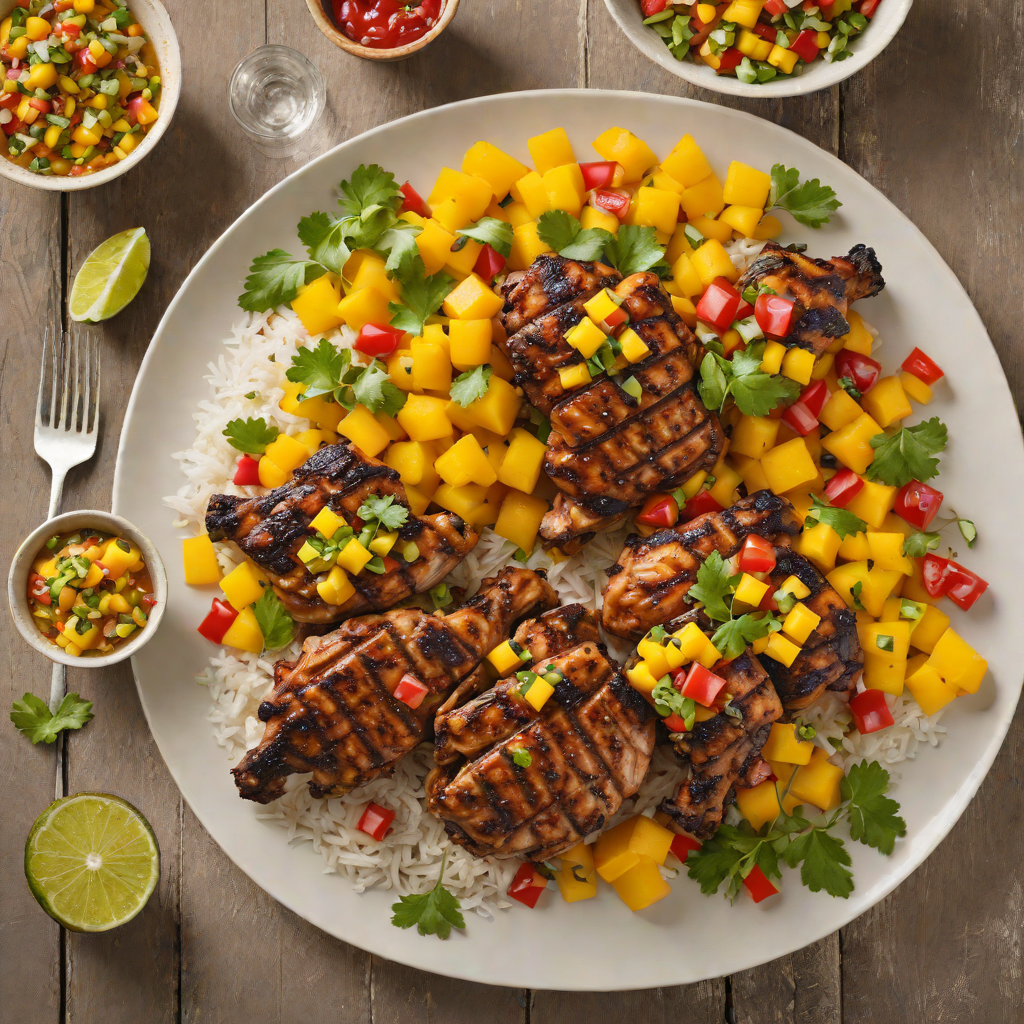
2. Jerk Chicken with Mango Salsa — 45 minutes, serves 4, 400 calories, 35 g protein, 10 g carbs. Scotch bonnet is the authentic chili at 100,000–350,000 Scoville; a habanero is the closest common substitute, and a jalapeño is not one.
3. Spicy Mango Salsa with Grilled Shrimp — 30 minutes, serves 4, 300 calories, 25 g protein, 20 g carbs. Dice the mango small — 1/4 inch — so it distributes rather than clumps.
4. Mango-Lime Glazed Grilled Chicken Skewers — 45 minutes, serves 4, 280 calories, 30 g protein. Brush the glaze on in the last 3 minutes only; fruit sugar burns at grill temperature.
5. Coconut-Crusted Grilled Fish with Mango Salsa — 40 minutes, serves 4, 300 calories, 25 g protein. Unsweetened shredded coconut, not the sweetened baking kind, or the crust caramelizes into candy.
4 Pineapple Mains (grilled, stir-fried, curried)
Pineapple's acid and enzyme make it a natural partner for pork and for anything grilled.
6. Grilled Pineapple and Chicken Skewers with Coconut Glaze — 25 minutes, serves 4, 320 calories, 25 g protein, 20 g carbs. The fastest tropical dinner here.
7. Hawaiian-Style Pineapple Pork Chops — 55 minutes, serves 4, 320 calories, 35 g protein, 18 g carbs. The bromelain marinade genuinely tenderizes — keep it to 30 minutes.
8. Pineapple Pork Stir-Fry — 30 minutes, serves 4, 400 calories, 25 g protein, 45 g carbs. The weeknight version of the same idea.
9. Tiki-Style Pineapple Fried Rice with Cashews — 25 minutes, serves 4, 350 calories, 50 g carbs. Cold day-old rice only; fresh rice steams and clumps.
5 Coconut Milk Dinners (curries, soups, rice dishes)
The technique that matters: fry the curry paste in the thick coconut cream from the top of the can until the oil separates and beads on the surface — about 3 minutes — then add the thin liquid. That single step is the difference between a curry that tastes cooked and one that tastes like paste stirred into milk.
10. Coconut Curry Soup — 35 minutes, serves 4, 440 calories, 28 g protein, 32 g carbs. Keep it at a bare simmer; a rolling boil splits coconut milk into oil and grainy solids.
11. Coconut Curry Fish — 50 minutes, serves 4, 450 calories, 30 g protein, 45 g carbs. Firm white fish only — cod, halibut, snapper. Flaky fish disintegrates.
12. Best-Selling Thai Green Curry with Coconut Rice — 65 minutes, serves 4, 500 calories, 30 g protein, 45 g carbs. Green curry is the hottest of the three standard Thai pastes; red is milder, yellow mildest.
13. Hidden Coconut Curry Shrimp with Jasmine Rice — 33 minutes, serves 4, 450 calories, 35 g protein, 40 g carbs. Shrimp go in for the last 3 minutes.
14. Coconut Fish Stew with Callaloo — 50 minutes, serves 4, 350 calories, 30 g protein, 15 g carbs. The Caribbean expression; spinach substitutes for callaloo one-for-one if you can't find it.
4 Tropical Salads & Sides
15. Best-Caribbean Coconut Rice — 50 minutes, serves 4, 280 calories, 56 g carbs. The default side for everything above. Rinse the rice until the water runs clear or the coconut fat makes it gluey.
16. Tropical Fruit Salad with Coconut Lime Dressing — 15 minutes, serves 4, 120 calories. Dress it within 20 minutes of serving; the salt in the dressing pulls water out of the fruit.
17. Green Mango Salad with Feta and Chili-Lime Dressing — 15 minutes, serves 4, 220 calories, 30 g carbs. Green mango, shredded on the large holes of a box grater.
18. Coconut Shrimp and Mango Salad — 25 minutes, serves 4, 320 calories, 24 g protein, 28 g carbs. Substantial enough to be dinner on its own.
Pairing suggestions: fresh salads, rice, plantains
The plate architecture for tropical food is almost always: something rich (a curry or a glazed protein), something starchy and neutral (rice, plantain, flatbread), and something sharp and cold (a slaw, a salad, a squeeze of lime at the table).
- With curries — coconut rice or plain jasmine, plus the green mango salad above for acid. Skip a second rich dish.
- With grilled skewers — fried sweet plantain (maduros) or the tropical fruit salad, and something with vinegar in it.
- With jerk chicken — rice and peas, and a cabbage slaw dressed only with lime and salt. The heat needs a cold, plain counterweight, not a creamy one.
- Drinks — anything carbonated and unsweetened. Sweet drinks alongside sweet glazes flatten both.
Equipment
You need a wide, heavy pan that holds a simmer without scorching, a sharp knife for the pineapple, and a box grater for green mango. Shop the Dutch oven, skillet and saucepan in cookware, the chef's knife and a serrated pineapple knife in knives and cutting, and the box grater, microplane, citrus juicer and skewers in utensils and tools. Airtight containers for cut fruit — which oxidizes fast — are in storage and containers.
Real-world numbers: coconut milk, cost, and calories
Two comparisons worth having in front of you before you shop. First, the coconut products, per cup:
| Product | Calories | Fat (g) | Thickens a curry? | Typical price |
|---|---|---|---|---|
| Full-fat canned coconut milk | 445 | 48 | Yes | $2.00 / can |
| Light canned coconut milk | 150 | 15 | Weakly | $1.80 / can |
| Coconut cream, canned | 790 | 83 | Yes, heavily | $3.00 / can |
| Refrigerated coconut beverage | 45 | 4 | No | $4.00 / half gal |
| Coconut milk powder, reconstituted | 300 | 30 | Yes | $8.00 / bag |
The refrigerated carton is the trap: it is the cheapest per cup and the only one on the list that cannot make a curry.
Second, what a week of this costs. Building the pantry — two cans of coconut milk, a jar of green curry paste, fish sauce, limes, a knob of ginger, jasmine rice, and one bag of frozen mango — runs about $28 and produces four of the dinners above for roughly $7 a night for a family of four. Fresh mango and pineapple in season add $4–$6 per dish; out of season, frozen mango is both cheaper and better than what the produce aisle is selling.
Calorie-wise the range is wide and mostly under your control. The lightest dinner here is the coconut-crusted fish at 300 calories a serving; the heaviest is the green curry with coconut rice at 500. The rice, not the coconut milk, is usually the bigger number.
Common pitfalls
1. Boiling coconut milk. Above a bare simmer it breaks. If it splits, whisk in a tablespoon of cold coconut milk off the heat; sometimes it comes back.
2. Carton coconut milk in a curry. It is diluted and gum-stabilized and it will not thicken. Cans only.
3. Over-marinating in fresh pineapple. Thirty minutes tenderizes; three hours turns pork into paste. Canned pineapple has no active enzyme, so it is safe for long marinades and useless for tenderizing.
4. Sweetened shredded coconut for crusts. It burns before the fish is cooked. Buy unsweetened.
5. Adding fruit too early. Mango and pineapple collapse in about 90 seconds of high heat. They go in at the end, or they go on the grill separately and get added at the plate.
6. Under-salting. Sweet-forward food needs more salt than savory food to taste balanced, not less. Taste at the end and expect to add more than feels right.
When NOT to cook tropical
If your crowd doesn't like heat, most of this list loses its point — the coconut fat exists partly to carry chili, and a coconut curry with no chili is just a rich sauce. Cook the pineapple pork and the salads instead. And skip the fresh-fruit recipes entirely in deep winter: a February supermarket mango is a fibrous, starchy object, and frozen mango chunks make a better salsa than a bad fresh one does.
Related Caribbean and Southeast Asian roundups
- 20 Hawaiian Recipes — poke, kalua pig and the Pacific end of this palette.
- Caribbean Recipes by Island — where jerk, callaloo and coconut rice actually come from.
- 25 Thai Recipes — the curry-paste technique in depth.
- 18 Sri Lankan Recipes — coconut milk used as a daily staple rather than an accent.
- 18 Trinidadian Recipes — doubles, roti and the callaloo tradition.
- 18 Jamaican Recipes — jerk chicken with real Scotch bonnet heat, curry goat and rice and peas.
- 18 Cuban Recipes — mojo pork and ropa vieja, where sour orange does the job lime does here.
- 18 Puerto Rican Recipes — pernil, mofongo and the green-plantain side of the island table.
- 22 Malaysian Recipes — rendang and nasi lemak, coconut cooked down until it turns rich and dark.
- 20 Filipino Dinner Recipes — adobo and sinigang for when you want sour and savory more than sweet.
Further reading: Wikipedia — Bromelain for why fresh pineapple tenderizes meat and stops gelatin setting while canned does not, Bon Appétit — Coconut for the ingredient in depth, and Wikipedia — Coconut milk for how coconut cream, coconut milk and skim coconut milk differ by fat content.