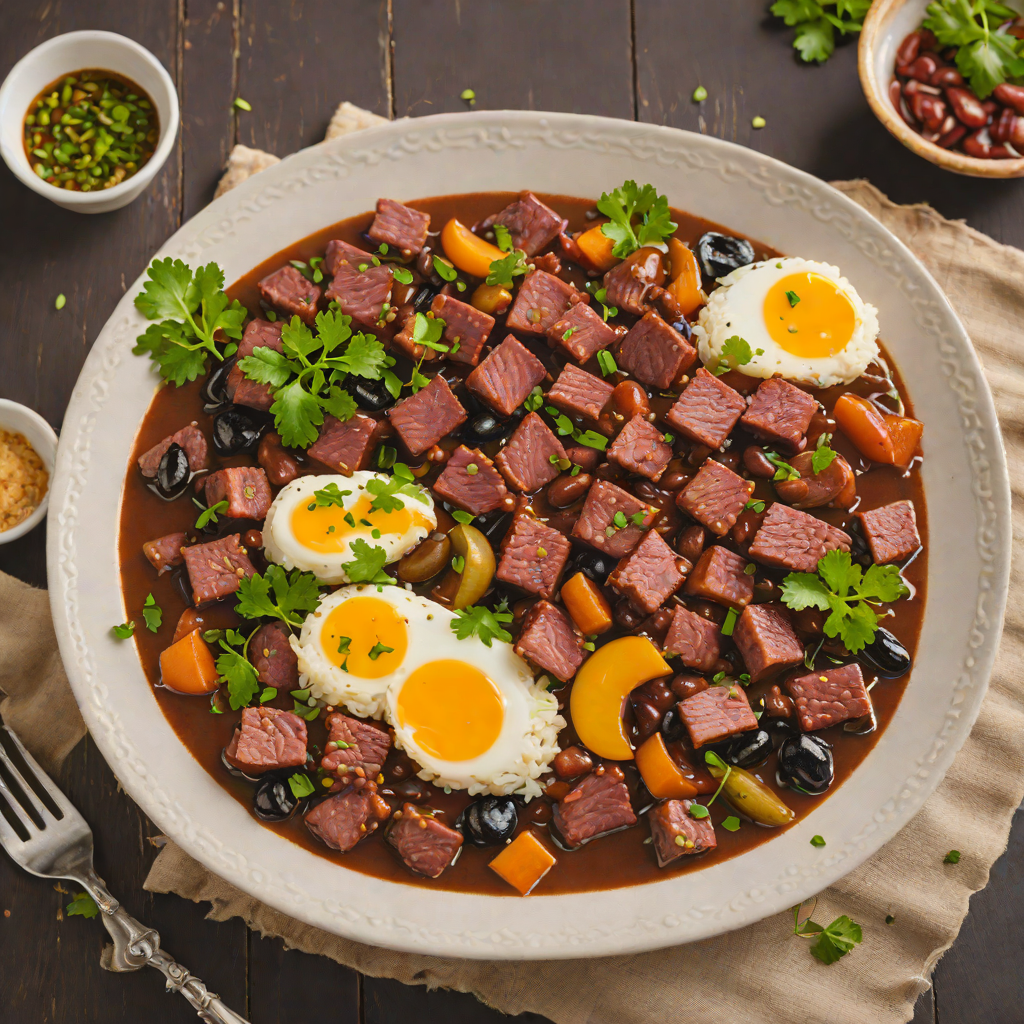
18 Brazilian Recipes: Feijoada, Pão de Queijo & Churrasco At Home
Feijoada, moqueca, picanha and pao de queijo - with honest substitutes for the five pantry items US stores rarely stock.
Brazilian home cooking is simpler than its restaurant reputation suggests: rice and beans on the plate every day, meat cooked over hard heat with almost no marinade, and a short list of ingredients — cassava flour, tapioca starch, coconut milk, dendê oil — doing the heavy lifting. These 18 Brazilian recipes cover feijoada, moqueca, churrasco, pão de queijo, and the sweets, with honest notes on what to substitute when your grocery store comes up short.
Get a free week of easy dinners
Seven weeknight dinners with the shopping list already totalled, sent Sunday. No account needed, unsubscribe in one click.
No spam, unsubscribe in one click. Recipes, shopping lists and Instacart carts all work without an account either way.
A quick tour: the Amazonian north, the Bahian coast, the gaúcho south
Brazil is the size of the continental United States, and its food splits along the same lines its history does. The north (Amazonas, Pará) cooks with river fish, cassava in every form, and ingredients — jambu, tucupi, açaí — that mostly stay in the region. The northeast, especially Bahia, carries the strongest West African influence: palm oil (dendê), coconut milk, dried shrimp, and the moqueca and vatapá family of stews. The southeast (São Paulo, Rio) gave the country feijoada and most of its street snacks. The south is cattle and immigrant country — the gaúcho churrasco tradition, plus heavy German and Italian influence.
Brazilian cuisine is best understood through that regional lens rather than as one national menu. What every region shares is arroz e feijão — white rice and beans, eaten daily, at lunch, by most of the country.
The everyday plate looks like this: rice, beans, a protein, a simple salad, and farofa (toasted cassava flour) sprinkled over the top for texture. That's it. Once you can make those four things, everything below is a variation.
The Brazilian pantry: five items worth sourcing
| Item | What it's for | Substitute | Where to find it |
|---|---|---|---|
| Tapioca starch (polvilho azedo/doce) | Pão de queijo — non-negotiable | None | Latin market, online, Bob's Red Mill |
| Cassava flour (farinha de mandioca) | Farofa, thickening moqueca | Panko (texture only) | Latin market, online |
| Dendê (red palm) oil | Bahian stews — color and aroma | Annatto oil + a little sesame | Latin/African market |
| Cachaça | Caipirinhas, marinades | White rum (different, still good) | Most liquor stores |
| Dulce de leite / doce de leite | Desserts and fillings | Sweetened condensed milk, simmered | Latin aisle |
Only two of these are truly irreplaceable. Tapioca starch is what makes pão de queijo chewy and hollow; wheat flour produces a dense roll that is not the same food. Dendê oil carries the specific aroma of Bahian cooking — annatto gets you the color but not the scent. Everything else has a workable substitute.
Coarse salt for churrasco is the sleeper item. Brazilian grill cooks use sal grosso, a rock salt that draws surface moisture and forms a crust rather than dissolving into the meat. Kosher salt is close; fine table salt is not, and will over-salt the meat.
Feijoada and moqueca: the two heavyweight one-pots
Feijoada is Brazil's national dish — black beans slow-cooked with salted and smoked pork, served with rice, orange slices, sautéed collards, and farofa. It's a Saturday project in Brazil, traditionally eaten at lunch with the afternoon deliberately left free afterward.
- Slow-cooked Brazilian feijoada with smoked sausage — the approachable version using grocery-store smoked meats.
- Feijoada carioca black bean and pork stew — the Rio style, closest to the traditional recipe.
- Slow-simmered black bean feijoada with pork and beef — a mixed-meat version.
- Instant Pot Brazilian feijoada-style black bean stew — the weeknight route; pressure cooking takes it from four hours to about one.
- Baked feijoada-style black bean casserole with pork — an oven-baked adaptation.
The orange slices are not a garnish. Feijoada is rich and salty, and the citrus is a functional palate reset between bites; so are the collards. Skip them and the dish is heavy in a way that reads as a flaw. Feijoada exists across the Portuguese-speaking world, but the black-bean Brazilian version is the one that became a national symbol.
Moqueca is the Bahian coast's answer — fish or shrimp stewed with coconut milk, dendê, tomato, onion, and cilantro, usually in a clay pot.
- Moqueca de camarão with coconut milk and dendê oil — shrimp moqueca, 30 minutes start to finish.
- Clay pot moqueca baiana with coconut and dendê oil — the traditional vessel and method.
- Baked moqueca-style fish with coconut milk and dendê oil — an oven version that's hard to overcook.
- Bobó de camarão with coconut and cassava — moqueca's thicker cousin, bound with puréed cassava.
Moqueca has no roux, no butter, and no stock. The liquid is coconut milk plus whatever the fish and tomatoes release. Add the seafood in the last 6-8 minutes only — Bahian cooks build the vegetable base first, then drop the fish in to poach.
Churrasco at home: cuts, salt, and heat
Brazilian churrasco is a technique of near-total simplicity: coarse salt, hard heat, no marinade, no sauce until it hits the plate. Picanha (top sirloin cap) is the signature cut — a thick fat cap that bastes the meat as it renders.
- Brazilian-style grilled picanha with garlic butter — the whole-cap method, scored fat side up.
- Fire-roasted Brazilian picanha with chimichurri — a herb-sauce finish.
- Charcoal pit-grilled picanha with chimichurri — full charcoal treatment.
- Sautéed picanha steak with chimichurri — the stovetop version for anyone without a grill.
- Traditional Brazilian churrasco with garlic chimichurri — the mixed-skewer approach.
- Churrasco-style fire-roasted beef skewers with chimichurri — skewers sized for a home grill.
- Skewered garlic-lime Brazilian chicken churrasco — chicken thighs on the same setup.
- Brazilian pork and beef sausage with cilantro chimichurri — linguiça, the churrascaria opener.
Picanha method, exactly: buy a 2-3 pound whole cap with the fat left on, score the fat in a diamond pattern without cutting into the meat, salt it heavily with coarse salt 40 minutes ahead, and cook fat side down first over high heat until the fat renders and crisps. Then flip and finish to 130-135°F internal for medium-rare, rest 10 minutes, and slice against the grain. A cast-iron pan or grill grate that holds real heat matters more than the fuel source — see the cookware picks for pans that do.
Molho à campanha — diced tomato, onion, bell pepper, vinegar, and oil — is the traditional table sauce, closer to a chunky vinaigrette than chimichurri. Both work. Churrasco in the gaúcho tradition uses long swords over an open pit, but a covered kettle grill reproduces it well enough.
Snacks and breads: pão de queijo, coxinha, and friends
This is the category most likely to make you a repeat Brazilian cook, because pão de queijo takes 10 minutes to mix in a blender.
- Traditional Brazilian cheese and cassava bread (pão de queijo) — the canonical recipe.
- Pão de queijo baked Brazilian cheese buns — a slightly larger, dinner-roll format.
- Cheese-filled Brazilian pão de queijo bites — bite-sized, good for a party.
- Grilled pão de queijo Brazilian cheese buns — finished on the grill alongside churrasco.
- Fried coxinha chicken croquettes — the teardrop-shaped shredded-chicken snack.
- Coxinha-shaped chicken croquettes with creamy catupiry filling — with the traditional cream-cheese-like filling.
- Grilled coxinha with spiced chicken filling — a lighter, non-fried adaptation.
Pão de queijo works because tapioca starch is gelatinized by hot liquid and then puffed by steam — that's the source of the hollow, chewy interior. It is also naturally gluten-free, which makes it one of the most useful recipes on this site for a gluten-free household. Use the blender method: hot milk-and-oil mixture, tapioca starch, eggs, cheese, blend, scoop, bake at 400°F for 20 minutes.
Minas cheese is traditional; a 50/50 mix of parmesan and low-moisture mozzarella is the standard US substitute and is genuinely close.
Everyday dinners: rice, beans, and the plate Brazilians actually eat
- Brazilian-style black bean and rice bowl with grilled chicken — the daily plate, assembled as a bowl.
- Galinhada with saffron-infused Brazilian chicken and rice — the one-pot chicken-and-rice of the interior.
- Feijão tropeiro with collard greens and farofa — beans, bacon, egg, and cassava flour in one pan.
- Pan-fried farofa with toasted cassava flour and bacon — the essential table condiment.
- Grilled farofa-stuffed chicken with garlic and herbs — farofa used as a stuffing.
- Brazilian-style grilled chicken with chimichurri sauce — a weeknight grill dinner.
- Pan-seared chicken with spiced Brazilian coconut sauce — northeastern flavors, 25 minutes.
- Slow-cooked beef picadinho with Brazilian spices — diced beef stew, the everyday braise.
Farofa deserves its own paragraph, because North American cooks routinely skip it and then wonder why the plate feels one-note. It is cassava flour toasted in butter or bacon fat until sandy and golden, often with onion, egg, or banana added. It goes on top of the wet food — beans, stew, braised meat — where it soaks up sauce and adds crunch. It takes eight minutes and transforms the meal.
Sweets and drinks
- Brigadeiro truffle balls with cocoa and condensed milk — three ingredients, the birthday-party standard.
- Moist Brazilian brigadeiro chocolate fudge — the pan-set version, eaten with a spoon.
- Coconut and mango brigadeiro truffles — the beijinho-adjacent variation.
- Toasted coconut and guava brigadeiros — a tropical-fruit take.
- Caipirinha cocktail with fresh lime and cachaça — the national drink, two ingredients plus sugar.
- Muddled mint cachaça caipirinha — a mint variant that sits between caipirinha and mojito.
- Tropical lychee caipirinha — a fruit-forward version for a crowd.
Brigadeiro is condensed milk, cocoa powder, and butter cooked until it pulls away from the pan, then rolled in sprinkles. The only technique note is knowing when to stop: drag a spatula across the bottom, and when the trail holds for a full second before closing, it's done. Undercooked brigadeiro won't hold a ball; overcooked turns grainy.
A caipirinha is muddled lime, sugar, cachaça, and ice — that's the whole drink. The difference from a mojito is real: no mint, no rum, no soda water, and cachaça is distilled from fresh sugarcane juice rather than molasses, which gives it a grassier, more vegetal edge.
How to run a mini-churrasco at home
You need less equipment than a churrascaria suggests. A kettle charcoal grill, a few long metal skewers, coarse salt, and three cuts: picanha for the centerpiece, linguiça sausage to serve first while everything else cooks, and chicken thighs or hearts for volume. Budget about ½ pound of meat per person, which sounds like a lot and isn't once the fat renders off.
Run the grill hot and direct. Salt the meat 30-40 minutes before it goes on, brush off the excess, and cook fat side down first. Serve in rounds as each skewer finishes rather than plating everything at once — that continuous service is the actual structure of a churrasco. Rice, farofa, molho à campanha, and pão de queijo round out the table, and everything except the meat can be made in advance.
If you enjoy this kind of grill-forward cooking, our 20 Argentine recipes collection covers the neighboring asado tradition, which shares the salt-and-fire philosophy but diverges sharply on cuts and sauces. A few decent utensils — long tongs and a sturdy carving fork — are the only purchase either tradition really requires.
Common pitfalls
1. Wheat flour in pão de queijo. It doesn't puff and it isn't the same bread. Tapioca starch or don't bother.
2. Marinating churrasco. Coarse salt only. Marinades burn over the high heat this cooking uses.
3. Skipping farofa. The plate needs the texture contrast; it's an eight-minute side.
4. Boiling moqueca after the fish goes in. Gentle poach for 6-8 minutes; a hard boil makes the fish rubbery and splits the coconut milk.
5. Slicing picanha with the grain. Cut the cap into thick steaks with the grain first, then slice each portion against it after cooking.
Make-ahead and storage
Nearly every dish here is better on day two, which makes Brazilian cooking unusually friendly to cooking once and eating three times.
| Dish | Fridge | Freezer | How to reheat |
|---|---|---|---|
| Feijoada | 5 days | 3 months | Low heat, splash of water, 20 min |
| Moqueca | 2 days | Not recommended | Below a simmer, uncovered |
| Pao de queijo dough | 3 days | 3 months, raw balls | Bake from frozen, add 5 min |
| Farofa | 2 weeks, sealed jar | No | Dry pan, 3 min |
| Brigadeiro | 1 week | 1 month | Serve at room temperature |
Feijoada is the clearest win: the beans keep absorbing pork fat and smoke overnight, and a batch that tasted merely good on Saturday tastes finished on Sunday. Portion it into pint containers before it cools so it chills fast, and freeze in single dinners rather than one brick — a set of straight-sided storage containers pays for itself on this recipe alone.
Moqueca is the exception. Coconut milk separates when frozen and never fully re-emulsifies, and the fish goes cottony on the second reheat, so cook it at the size you plan to eat. If you have leftovers, warm them below a simmer and stir gently; boiling is what splits the sauce.
Pao de queijo freezes better raw than baked. Scoop the batter onto a sheet pan, freeze until firm, bag the balls, and bake straight from frozen with about five extra minutes — mini-muffin tins from the bakeware shelf give the most consistent puff because the batter is loose enough to spread on a flat pan. Baked and refrozen, the interior goes dense.
Farofa keeps for two weeks in a sealed jar at room temperature and re-crisps in a dry pan in three minutes, so it is worth making double. Brigadeiro dough holds a week in the fridge and is easier to roll cold.
Where to start: a three-recipe on-ramp
Do not open with feijoada. It is the flagship, but it is also a four-hour cook with five kinds of pork, and a first attempt usually ends with beans that are either chalky or blown apart. Build up in this order instead.
First: traditional pao de queijo. Thirty minutes, one blender, no technique to speak of, and the payoff is the single most persuasive thing in Brazilian cooking. It also teaches you what tapioca starch does, which is the piece of knowledge that unlocks the rest of the snack chapter.
Second: moqueca de camarao. A 30-minute stew that looks like a two-hour one. Building the vegetable base and then poaching the shrimp at the end is the same move behind half the dishes on the Bahian coast, and getting the heat right here is the only skill it requires.
Third: Instant Pot feijoada. The pressure cooker collapses the timeline to about an hour and, more usefully, takes the bean texture out of your hands — a decent multicooker from the small appliances range is the one purchase that makes this an ordinary weeknight dish rather than a project. Once you have made it under pressure twice, the traditional stovetop version stops being intimidating.
Pour a caipirinha while you cook any of the three; a wooden muddler off the barware shelf crushes the lime peel without shredding it, which is the difference between fragrant and bitter.
Full ingredient lists, method, and one-tap shopping for every recipe above are on AislePrompt. Last reviewed August 2026.
Frequently asked questions
Do I need tapioca flour for pão de queijo?
What cut is picanha and how do I cook it without a Brazilian grill?
Is feijoada a weekend project or can I make it on a weeknight?
Where do I buy Brazilian ingredients in the US?
What's the difference between a caipirinha and a mojito?
Sources
Plan a week of meals in two minutes.
Tell our AI what you have and what you like — it builds your plan, shopping list, and Instacart cart. No account needed.
Try free →