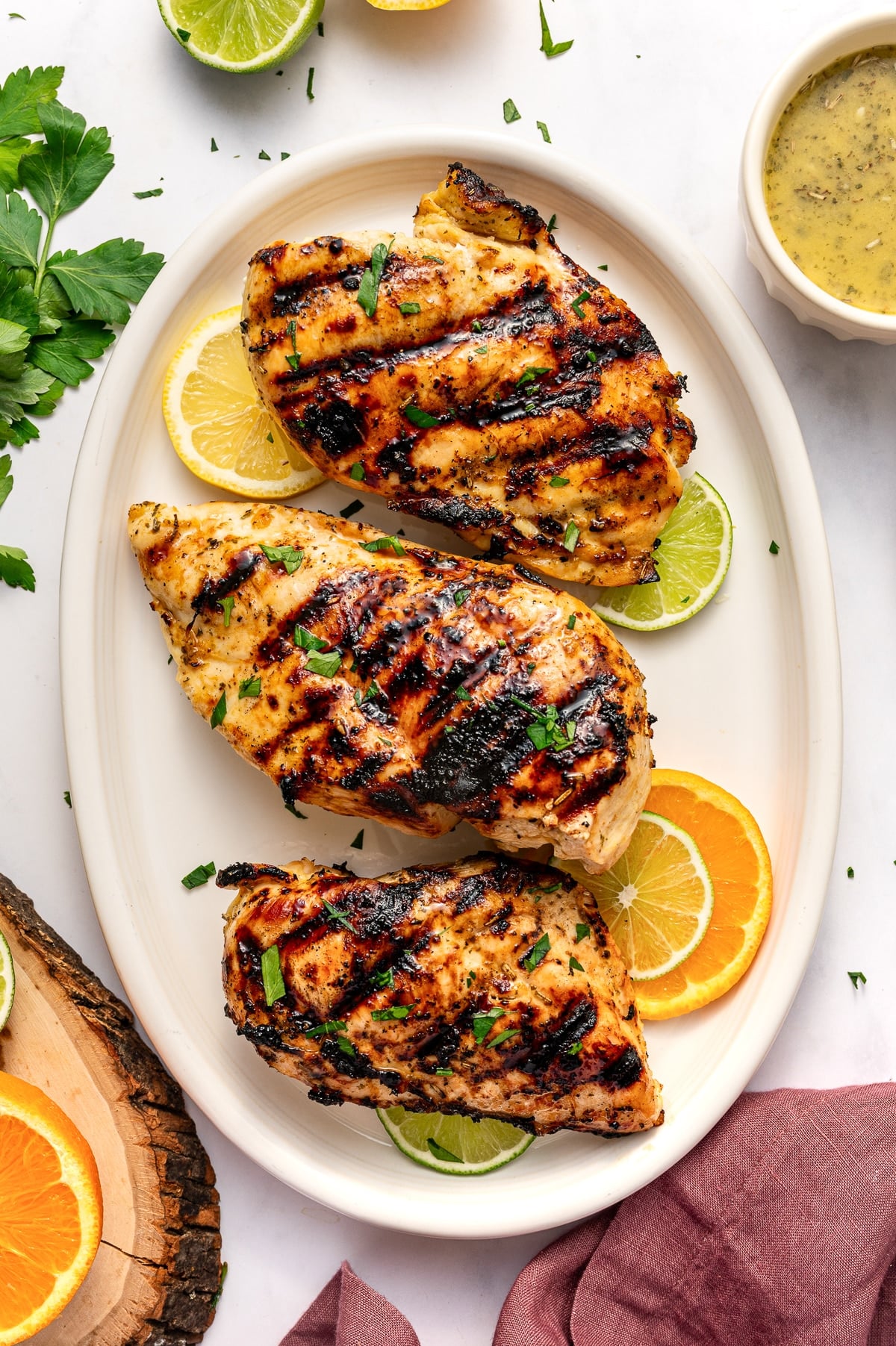
18 Citrus Marinades: Lemon, Lime & Orange Chicken, Fish & Beef Recipes
The acid ratios, marinating ceilings, and pantry math behind 18 lemon, lime, and orange marinades, plus the catalog recipes already built on them.
Affiliate disclosure: AislePrompt may earn a commission on qualifying purchases made through Amazon and Instacart links in this article, at no additional cost to you. See our affiliate policy →
A citrus marinade is acid plus fat plus salt plus aromatics — roughly one part fresh juice to two parts oil, salted to about 1.5% of the meat's weight. Lemon suits chicken, fish, and lamb; lime suits pork, shrimp, and skirt steak; orange suits duck, pork shoulder, and beef stir-fries. Below are 18 reliable ratios and the catalog recipes built on them.
Introduction — the science of how citrus tenderizes protein
Citrus does not tenderize the way a papaya or pineapple enzyme does. Bromelain and papain cut peptide bonds and turn meat to mush from the inside out. Citric acid works differently: it lowers surface pH, which unwinds the coiled proteins in the outer millimetre or two of the meat and lets them trap a little more water. That is protein denaturation, not digestion, and it is why a citrus marinade improves texture for a few hours and then starts wrecking it.
The numbers are worth internalising because they explain every rule further down this page. Lemon juice sits at roughly pH 2.0–2.6 and lime at pH 2.0–2.4; both carry about 45–50 grams of citric acid per litre. Orange juice is a different animal entirely — pH 3.3–4.2, and only about 9–10 grams of citric acid per litre. Orange is roughly five times weaker as an acid than lemon or lime. That single fact is why you can leave pork shoulder in a sour-orange mojo overnight and why you cannot leave shrimp in lime juice for more than twenty minutes.
Push lime far enough and you get ceviche: raw fish held in lime juice until the flesh turns opaque and firm. Nothing was heated. The acid alone did it. Ceviche is delicious on purpose; the same transformation happening accidentally to the outer layer of a chicken breast you meant to grill is not. It goes chalky, it refuses to brown properly, and no amount of grill time fixes it.
The other thing to understand is penetration depth. A marinade does not soak through a steak. Salt migrates reasonably far — call it half an inch over several hours — but acid, oil, and most aromatic compounds stay within about 1–3 mm of the surface. This is not a flaw. It means a citrus marinade is a surface treatment: a seasoned, slightly acidified, aromatic crust that browns hard and tastes bright. Stop trying to make it penetrate. Make the surface excellent instead, and salt the interior separately.
Three components do the actual work:
- Acid (the juice) — surface denaturation, brightness, and a pH low enough to slow surface bacteria.
- Fat (olive oil, neutral oil, coconut milk, yogurt) — carries the fat-soluble aromatics out of the zest and into contact with the meat, and buffers the acid so it acts more slowly.
- Salt — the only ingredient that meaningfully travels inward. Aim for 1.25–1.5% of the protein's weight, which for a 2 lb (907 g) piece of chicken is about 11–14 g of table salt, or roughly 2¼–2¾ teaspoons.
Everything else — garlic, oregano, cumin, chile, ginger, achiote, fish sauce — is flavour direction, not chemistry.
Marinating time rules by protein — how long is too long
The table below is the single most useful thing on this page. "Minimum" is the point at which the marinade has done anything at all. "Sweet spot" is where most cooks land for the best balance of flavour and texture. "Hard ceiling" is where texture starts to degrade visibly — chalky surface, mushy exterior, poor browning.
Times assume a full-strength lemon or lime marinade (one part juice to two parts oil). Because orange is about five times weaker as an acid, you can multiply every ceiling below by roughly three when orange juice is the only acid — and by more when the marinade is buffered with yogurt, coconut milk, or a large volume of oil.
| Protein | Minimum | Sweet spot | Hard ceiling (lemon/lime) | Ceiling (orange only) |
|---|---|---|---|---|
| Shrimp, scallops | 10 min | 15–20 min | 30 min | 90 min |
| Thin white fish (tilapia, sole) | 10 min | 15 min | 30 min | 90 min |
| Firm fish (salmon, mahi-mahi, swordfish) | 15 min | 20–30 min | 45 min | 2 hr |
| Boneless chicken breast | 30 min | 2 hr | 4 hr | 12 hr |
| Boneless chicken thigh | 30 min | 2–4 hr | 6 hr | 12 hr |
| Bone-in chicken pieces | 1 hr | 4 hr | 8 hr | 24 hr |
| Pork tenderloin | 1 hr | 2–4 hr | 8 hr | 24 hr |
| Pork chops | 1 hr | 3–4 hr | 8 hr | 24 hr |
| Pork shoulder (whole) | 4 hr | 12 hr | 24 hr | 36 hr |
| Skirt / flank steak | 30 min | 2–4 hr | 8 hr | 24 hr |
| Lamb chops | 1 hr | 3–4 hr | 8 hr | 24 hr |
| Lamb shoulder (whole) | 4 hr | 12 hr | 24 hr | 36 hr |
| Duck breast | 30 min | 1–2 hr | 4 hr | 12 hr |
| Firm tofu (pressed) | 20 min | 1 hr | overnight | overnight |
Two structural exceptions to the whole table:
Yogurt marinades ignore it. Dairy is buffered — its lactic acid works far more slowly than free citric acid, and the calcium and casein moderate the effect. A lemon-yogurt marinade holds chicken safely for 24 hours where a lemon-oil marinade would ruin it in six. This is the mechanism behind tandoori-style birds, and it is why Baked Lemon-Ginger Chicken with Yogurt Marinade can sit overnight without penalty.
Preserved lemon has no free juice at all. It is lemon fermented in salt; the acid is largely bound up and the flavour is aromatic rather than sharp. There is effectively no ceiling. Slow-Roasted Lamb Shoulder with Preserved Lemon and Cumin runs 4h20m in the oven with preserved lemon in contact the whole time and comes out better for it.
If you need to prep more than a day ahead, do not extend the marinade. Salt the protein now, hold it dry in the fridge, and add the citrus in the last hour. You get deeper seasoning and a drier surface that browns harder.
6 lemon-based marinades and matching recipes
Lemon is the default for chicken, white fish, shrimp, lamb, and vegetables. Its acidity is sharp and clean, and it does not bring the sweetness that orange does or the resinous edge that lime does.
1. The all-purpose lemon-garlic-herb
The one to memorise. For 2 lb of chicken or vegetables:
- 3 tbsp fresh lemon juice + 1 tbsp zest
- 1/3 cup olive oil
- 4 cloves garlic, crushed not minced (minced garlic burns on a grill)
- 1 tsp dried oregano or 2 tbsp chopped fresh parsley
- 2¼ tsp kosher salt (1.5% by weight)
- ½ tsp black pepper
Marinate 2 hours; 4 hours maximum. Cook it as Sheet Pan Garlic and Lemon Chicken with Asparagus for a 40-minute weeknight version, or as Sheet Pan Lemon-Garlic Roast Chicken with Root Vegetables when you want bone-in thighs and a longer roast that renders the skin properly.
2. Greek lemon-oregano
Higher acid, less oil, dried oregano rather than fresh, and no sweetener at all. For 1 lb of protein: 1/4 cup lemon juice, 3 tbsp olive oil, 3 cloves garlic, 2 tsp dried oregano, 1 tsp salt. This is the marinade for anything on a skewer.
Four ways to use it, in ascending order of cook time: Lemon-Oregano Greek Chicken Souvlaki Skewers (12 minutes over high heat), Charcoal-Grilled Pork Souvlaki with Lemon-Oregano Marinade, Grilled Greek Lamb Chops with Lemon-Oregano Marinade, and — for a Sunday — Slow-Roasted Lemon-Oregano Lamb Shoulder at 4h15m. If you want the marinade on something less predictable, Octopus Souvlaki with Lemon-Oregano Marinade is the same formula on a 55-minute braise-then-char.
3. Lemon-dill, for fish only
- 2 tbsp lemon juice + 1 tsp zest
- 3 tbsp olive oil or melted butter
- 2 tbsp chopped fresh dill
- 1 tsp salt
Fifteen minutes. Not thirty. Salmon's surface proteins are more acid-sensitive than chicken's, and a lemon marinade left on for an hour produces that pale, slightly grainy band around the edge of the fillet that never sears. Sautéed Lemon-Dill Salmon with Asparagus is a 20-minute total cook and the easiest place to start in this section. For a zest-only version with no free acid at all — which you can assemble hours ahead — use Herb-Roasted Salmon with Asparagus and Lemon Zest.
4. Lemon-yogurt (the overnight one)
- 1 cup whole-milk yogurt
- 2 tbsp lemon juice + 1 tbsp zest
- 1 tbsp grated ginger, 3 cloves garlic
- 1 tsp each ground cumin and coriander
- 1½ tsp salt
Holds 24 hours. The yogurt buffers the acid and the milk proteins cling to the meat, so you get a crust that browns rather than steams. Baked Lemon-Ginger Chicken with Yogurt Marinade is the direct application; 35 minutes prep, 20 minutes in the oven, 320 kcal and 30 g protein per serving.
5. Sumac-lemon
Sumac is dried, ground drupe with its own malic acid — it stacks a second, slower acid on top of the lemon and adds a dusty red colour that looks excellent off a grill. For 1 lb chicken: 3 tbsp lemon juice, 3 tbsp olive oil, 1 tbsp sumac, 3 cloves garlic, 1 tsp salt. Two to four hours. See Sumac-Spiced Grilled Chicken with Lemon Garlic Marinade.
6. Preserved lemon (the no-ceiling marinade)
Rinse one preserved lemon, discard the pulp, and mince the rind fine — the rind is where the flavour lives, and the pulp is mostly salt. Two tablespoons of minced rind plus 1/4 cup olive oil, no additional salt, no additional juice. Because there is almost no free acid, this marinade will not turn anything to mush no matter how long it sits.
Four recipes built on it: Pan-Seared Chicken Thighs with Preserved Lemon and Thyme, Sheet Pan Za'atar Chicken with Preserved Lemon and Chickpeas, the lamb shoulder above, and — for a meat-free option — Miso-Infused Tofu Stir-Fry with Preserved Lemon.
6 lime-based marinades for Mexican, Thai, and Vietnamese dishes
Lime is as acidic as lemon but carries a resinous, faintly bitter aromatic profile that stands up to chile, cumin, cilantro, and fish sauce in a way lemon does not. It is the acid for pork, shrimp, skirt and flank steak, and anything going into a tortilla.
7. Cilantro-lime, for shrimp
- 3 tbsp lime juice + 2 tsp zest
- 1/4 cup olive oil
- 1/2 cup chopped cilantro (stems included — they carry more flavour than the leaves)
- 2 cloves garlic, 1 tsp salt
Twenty minutes maximum. Shrimp is the fastest-denaturing protein in a home kitchen; leave it in lime for an hour and you have made cold, rubbery ceviche by accident. Char-Grilled Shrimp Skewers with Cilantro-Lime Marinade is 25 minutes prep and 8 minutes on the grill, 180 kcal and 28 g protein per serving. For a version where the lime lives in the rice instead of on the shrimp — no timing risk at all — cook Pan-Seared Gulf Shrimp with Cilantro Lime Rice.
8. Tequila-lime
Alcohol is a solvent for aromatic compounds that neither water nor oil dissolves well, so a splash of tequila pulls more out of the lime zest and the chile. It mostly cooks off. For 1 lb chicken or shrimp: 3 tbsp lime juice, 2 tbsp tequila (blanco, not reposado — the oak fights the citrus), 3 tbsp oil, 1 tbsp honey, 1 tsp salt, 1 tsp chile powder.
Tequila-Lime Grilled Chicken Tacos with Avocado Salsa runs a 70-minute prep that is mostly hands-off marinating time. The shrimp equivalent — and the faster weeknight option at 20 minutes prep — is Honey-Lime Tequila Shrimp Tacos with Cilantro Slaw.
9. Chipotle-lime, for pork
Chipotles in adobo bring smoke, moderate heat, and a small amount of vinegar that stacks with the lime. For a 1 lb tenderloin: 3 tbsp lime juice, 2 chipotles plus 1 tbsp adobo sauce, 2 tbsp oil, 2 cloves garlic, 1 tsp cumin, 1 tsp salt. Two to four hours. Grilled Chipotle-Lime Pork Tenderloin with Avocado Cilantro Sauce delivers 38 g protein per serving in a 35-minute total cook.
10. Carne asada — lime and orange together
The classic Mexican grilling marinade is not lime alone. It is equal parts lime and orange juice, and the orange is doing real work: it adds sugar for browning and it dilutes the lime enough that flank steak can sit for four hours without the surface going grey. Equal parts is the ratio to remember — 1/4 cup each per pound of steak, plus 2 tbsp oil, 3 cloves garlic, 1 tsp cumin, 1 tsp smoked paprika, 1 tsp salt.
Citrus-Marinated Grilled Carne Asada Skewers uses exactly that ratio on sliced flank; 10 minutes on the grill, 40 g protein per serving. For the taco-and-slaw version over charcoal, use Charcoal-Grilled Carne Asada Tacos with Cilantro Lime Slaw.
11. Coconut-lime (Thai and Caribbean)
Full-fat coconut milk is the buffer here. The fat coats the protein, slows the acid, and adds enough sugar to caramelise. For 1 lb of fish or tofu: 1 cup coconut milk, 2 tbsp lime juice, 2 tbsp soy sauce, 1 tbsp grated ginger, 3 cloves garlic. An hour is fine, and firm fish tolerates two.
Grilled Mahi-Mahi with Coconut-Lime Tiki Glaze runs it on a firm fillet that holds up to a grate; Coconut-Lime Tofu Stir Fry with Bell Peppers is the vegan version at 320 kcal and 18 g protein.
12. Fish-sauce-lime, Vietnamese-style
Here is the correction most Western recipes get wrong: in Vietnamese grilling, lime is usually in the dipping sauce, not in the marinade. The marinade is lemongrass, garlic, fish sauce, sugar, and pepper — no acid — and the lime hits at the table in the nước chấm. Lemongrass is not a citrus at all; it is a grass whose citral content mimics the aroma of lemon zest without contributing any acid, which is exactly why it can sit on pork for hours.
Both Lemongrass-Grilled Pork Skewers with Pickled Daikon and Carrot and Vietnamese-Inspired Grilled Lemongrass Pork Tacos follow the authentic structure — acid-free marinade, acid at the end. If you want a genuinely lime-forward version of the same idea, Crisp Pan-Seared Tofu with Tamarind-Lime Sour Sauce puts tamarind and lime in a finishing sauce, and Skewered Garlic-Lime Brazilian Chicken Churrasco is a straight garlic-lime marinade at 280 kcal and 32 g protein per serving.
The dipping sauce, for reference: 3 tbsp lime juice, 3 tbsp fish sauce, 2 tbsp sugar, 1/4 cup water, 1 minced chile, 2 cloves garlic. Mix and let stand ten minutes.
6 orange-based marinades for pork, duck, and beef
Orange is the beginner-proof citrus. Weak acid, real sugar content, and an aroma that reads sweet-savoury rather than sharp — it pairs with fat in a way lemon does not, which is why it belongs on duck, pork shoulder, and beef stir-fries.
The sugar is the catch. Orange juice carries roughly 8–10 g of sugar per 100 ml, and sugar burns. Keep orange-marinated meat off a screaming-hot grate; sear over medium and finish indirect, or roast.
13. Orange-soy-ginger
The most useful weeknight orange marinade. For 1 lb salmon or chicken: 1/3 cup orange juice + 1 tbsp zest, 3 tbsp soy sauce, 1 tbsp grated ginger, 2 cloves garlic, 1 tbsp toasted sesame oil, 1 tbsp honey. The soy supplies the salt, so add none. Thirty minutes for fish; up to 12 hours for chicken. Grated ginger is the through-line across these citrus builds — 20 fresh ginger recipes covers the rest of the knob.
Half-Orange Soy Glazed Salmon is a 20-minute total cook at 38 g protein; Pan-Roasted Salmon with Orange-Ginger Glaze and Bok Choy adds a vegetable and runs 30 minutes.
14. Mojo — sour orange, garlic, oregano
Mojo is the Caribbean citrus marinade, built on bitter orange (naranja agria, Seville orange) rather than the sweet navel oranges most US supermarkets stock. If you cannot find sour orange, the standard substitution is 2 parts sweet orange juice to 1 part lime juice — it lands close on both acidity and aroma.
For a 3 lb pork shoulder: 1/2 cup sour orange juice (or 1/3 cup orange + 3 tbsp lime), 1/4 cup olive oil, 8 cloves garlic crushed to a paste with salt, 1 tbsp dried oregano, 1 tbsp cumin, 1 tbsp salt. Twelve hours; 24 is fine.
Mojo-Marinated Pork Shoulder with Citrus is the slow-cooker route at 4 hours; Puerto Rican-Style Mojo Pork Roast with Garlic and Sour Orange is the 3h30m oven roast. For a weeknight-scale version, Pan-Seared Pork Chops with Dominican Mojo Sauce puts the same flavours in a 20-minute pan sauce, and Baked Caribbean Mahi-Mahi with Citrus Mojo Sauce moves it onto fish.
15. Achiote–sour orange
Yucatecan cochinita pibil is mojo's brick-red cousin: achiote paste (annatto seed, plus oregano, cumin, and its own citrus) loosened with sour orange juice until it spreads like thin paint. For 3 lb pork: 3 tbsp achiote paste, 1 cup sour orange juice, 4 cloves garlic, 1 tsp cumin, 1 tsp oregano, 1 tbsp salt. Overnight, then a very long low roast. Slow-Roasted Achiote Pork with Sour Orange Marinade runs 3 hours and serves 6 at 45 g protein each.
16. Orange-balsamic, for duck
Duck breast is fatty enough that it needs an acid with some sweetness to balance, and short enough in cook time that the marinade is really a glaze. For 2 breasts: 1/4 cup orange juice + 1 tbsp zest, 2 tbsp balsamic, 1 tbsp honey, 1 sprig thyme. One to two hours on the meat side only — never on the skin, which must stay bone-dry to render and crisp.
Crisp Pan-Seared Duck Breast with Orange-Balsamic Glaze and Pan-Seared Duck Breast with Bitter Orange Glaze are both 25-minute cooks; the bitter-orange version is the more traditional à l'orange profile.
17. Orange-sesame, for stir-fries
In a stir-fry the citrus is a sauce component, not a soak. Marinate the protein in cornstarch, soy, and egg white for 20 minutes (velveting), and keep the orange in the sauce: 1/2 cup orange juice, 2 tbsp zest, 2 tbsp soy, 1 tbsp rice vinegar, 1 tbsp sugar, 1 tsp cornstarch slurry. Adding acid to the velveting step defeats it — the acid breaks the starch coating that keeps the meat juicy.
Orange-Sesame Glazed Chicken Stir Fry and Stir-Fried Beijing Beef with Crispy Orange Glaze both run 30 minutes total and follow that structure.
18. Orange-fennel dry-brine, for pork shoulder
The best long-cook citrus treatment barely uses juice. Zest of 2 oranges, 2 tbsp cracked fennel seed, 6 cloves garlic, 2 tbsp salt, 1 tbsp black pepper, rubbed dry onto pork shoulder and left uncovered in the fridge overnight. The salt penetrates, the surface dries, and the zest oils — limonene and its relatives — perfume the fat without any acid to soften the exterior. Juice goes in the roasting pan, not on the meat.
Slow-Roasted Pork Shoulder with Fennel and Orange is the 4-hour version at 60 g protein per serving; Pan-Seared Pork Chops with Bitter Orange Reduction is the 25-minute weeknight adaptation.
Building a citrus pantry — what to zest and what to juice
Zest and juice are not interchangeable and do not do the same job. Zest is the outer coloured layer of the peel, packed with volatile oils — limonene, citral, linalool — and containing zero acid. Juice is acid plus sugar plus water, with far less aroma than people assume. Almost every mediocre citrus marinade is mediocre because it used only juice.
Practical rule: zest for aroma, juice for chemistry, and use both. Add zest at the start so its oils have time to migrate into the fat; add juice closer to cook time so the acid clock starts as late as possible.
Yield per fruit
| Fruit | Juice per fruit | Zest per fruit | Approx. pH | Best for |
|---|---|---|---|---|
| Lemon (medium) | 2–3 tbsp | 1 tbsp | 2.0–2.6 | Chicken, fish, lamb, vegetables |
| Lime (Persian) | 2 tbsp | 2 tsp | 2.0–2.4 | Pork, shrimp, skirt/flank steak |
| Navel orange | 1/3–1/2 cup | 2 tbsp | 3.3–4.2 | Duck, pork shoulder, beef stir-fry |
| Sour/Seville orange | 1/4–1/3 cup | 2 tbsp | 2.8–3.2 | Mojo, cochinita pibil |
| Grapefruit | 2/3–1 cup | 3 tbsp | 3.0–3.3 | Oily fish — mackerel, salmon |
| Meyer lemon | 3 tbsp | 1 tbsp | 2.8–3.2 | Longer holds; delicate fish |
| Yuzu | 1–2 tsp | 2 tsp | 2.2–2.6 | Finishing; never a long soak |
Two of those deserve a note. Meyer lemon is a lemon–mandarin hybrid: sweeter, markedly less acidic, and thin-skinned enough that the zest carries a floral note ordinary lemons lack. Swap it in when you want to stretch a marinade past its normal ceiling. Yuzu is the opposite — intensely aromatic, barely any juice, and expensive enough that it is a finishing ingredient. Aomori-Style Grilled Salmon with Yuzu Glaze, Authentic Miso-Marinated Salmon with Yuzu, and Authentic Kobe Beef Tataki with Yuzu Zest all use it the right way: a small amount, late.
Storage, because citrus is the most-wasted item in most fridges
- Whole fruit: counter for a week, crisper drawer for three to four. Cold roughly quadruples the life.
- Zest first, always. You cannot zest a juiced lemon. Zest before you cut, even if the recipe only wants juice — freeze the surplus zest flat in a bag.
- Juice freezes perfectly in ice-cube trays. One standard cube is about 2 tbsp, which is one lemon or one lime. A dozen cubes is a month of weeknight marinades.
- Zest freezes for six months and loses very little aroma. Juice loses none.
Do not use bottled juice for a raw marinade
Bottled lemon and lime juice are typically preserved with sodium metabisulfite and/or sodium benzoate, and pasteurisation strips most of the volatile top notes. The acid is still there, so the chemistry works, but the aroma does not. In a four-hour braise nobody can tell. In a 20-minute shrimp marinade where the citrus is the flavour, everybody can. Fresh is worth the 60 seconds.
Real numbers: cost, yield, and how much marinade you actually need
A recurring waste pattern is mixing three times as much marinade as needed and pouring two-thirds down the sink. Half a cup of marinade per pound of protein is enough, provided you use a zip-top bag and press the air out rather than a bowl. In a bowl you need double.
Prices below are typical US supermarket, September 2026, and will vary by region and season.
| Marinade (per 1 lb protein) | Citrus needed | Citrus cost | Total ingredient cost | vs. bottled marinade |
|---|---|---|---|---|
| All-purpose lemon-garlic-herb | 1 lemon | $0.80 | ~$1.35 | $3.29 (12 oz bottle) |
| Greek lemon-oregano | 1½ lemons | $1.20 | ~$1.60 | $3.79 |
| Cilantro-lime | 2 limes | $1.00 | ~$1.85 | $3.49 |
| Tequila-lime | 2 limes | $1.00 | ~$2.60 | $4.29 |
| Carne asada (lime + orange) | 2 limes + 1 orange | $2.15 | ~$2.75 | $3.99 |
| Orange-soy-ginger | 1 orange | $1.15 | ~$1.90 | $4.49 |
| Mojo (sour orange substitute) | 1 orange + 1½ limes | $1.90 | ~$2.45 | $5.99 |
| Coconut-lime | 1 lime | $0.50 | ~$2.30 | $4.99 |
The homemade version is cheaper in every row, and the gap widens on the more specialised marinades — a bottled mojo costs more than double what the fruit does.
Two more numbers worth knowing. Weight gain: a properly marinated chicken breast picks up 3–5% of its weight, essentially all of it in the outer few millimetres and mostly from the salt rather than the acid. Yield loss: an over-marinated one loses more on the grill than an unmarinated one, because the denatured surface holds water poorly — a breast left in a full-strength lemon marinade for 12 hours generally cooks up drier and smaller than one marinated for 2 hours. Over-marinating does not just hurt texture; it costs you food.
Common pitfalls that ruin a citrus marinade
1. Marinating in aluminium or cast iron. Citric acid strips the oxide layer off bare aluminium and reacts with cast iron, and you will taste it — a metallic edge that no amount of seasoning covers. Use glass, ceramic, stainless steel, or a zip-top bag. This is the single most common failure and the easiest to avoid.
2. Leaving shrimp and thin fish in too long. Covered above, but it bears repeating because it is irreversible. Twenty minutes for shrimp. Set a timer.
3. Sugar plus high direct heat. Orange juice, honey, and hoisin all burn well below the temperature a good sear needs. Sear over medium, or wipe the marinade off, sear hard, and brush the marinade on in the last two minutes as a glaze.
4. Grilling straight out of the marinade. Wet meat steams; it does not brown. The Maillard reaction needs a dry surface above roughly 140 °C, and a soaking-wet chicken thigh spends its first four minutes on the grate boiling off surface water. Pat it dry with paper towels. You lose no flavour — the flavour is already in the meat, not in the liquid clinging to it.
5. Reusing the marinade as a sauce. A raw-meat marinade carries whatever was on the raw protein. If you want sauce, either reserve a portion before the meat goes in, or bring the used marinade to a full rolling boil for at least three minutes. The FDA's safe food handling guidance is unambiguous on this, and it is one of the few genuinely dangerous mistakes in this article.
6. Marinating on the counter. Always in the fridge. Citrus lowers surface pH but does not sterilise anything, and the interior of the meat sits at whatever the ambient temperature is.
7. Salting separately and forgetting. If your marinade is a soy- or fish-sauce build, it already carries the salt. If it is juice and oil, it does not — and unsalted marinated chicken tastes flat no matter how good the aromatics were.
When NOT to use a citrus marinade
Citrus is not a universal solvent for boring meat. Skip it entirely when:
- You are cooking a high-grade steak. A ribeye or strip does not want its surface denatured; it wants salt, time, and heat. Save the citrus for the finishing butter.
- You want deep interior seasoning. Marinades stay in the top 1–3 mm. A dry brine — salt on the surface, uncovered in the fridge, 12 to 24 hours — seasons all the way through and dries the exterior for a better sear. For pork shoulder and whole birds this beats a wet marinade almost every time.
- The protein is already delicate and expensive. Scallops, sushi-grade tuna, and Dover sole are better with citrus applied after cooking. A squeeze at the table does more than a soak.
- You are cooking sous-vide. Extended low-temperature contact with acid produces exactly the mushy texture the time table is designed to avoid. Season, cook, then add citrus in the sear or the sauce.
- You need to prep more than 24 hours ahead. Use zest, preserved lemon, or a dry rub. Do not extend the juice contact and hope.
Equipment that actually matters
Four items, and only four:
- A microplane rasp. The single highest-value tool on this page. It takes the coloured zest and leaves the bitter white pith, which a box grater cannot do. Browse the kitchen utensils category for current picks.
- A hand juicer or reamer. A hinged press extracts roughly 30% more juice from a lemon than squeezing by hand, which is the difference between one fruit and two per batch. See the kitchen gadgets category.
- A non-reactive dish or zip-top bags. Glass or ceramic. Bags use half the marinade for the same coverage; see the storage and containers category.
- A heavy skillet that browns. Carbon steel or stainless — see the cookware category. Most of these marinades finish in a pan, and a thin nonstick will not build fond.
A sharp knife matters for the prep, not the marinade; the knives category covers that separately.
What to cook next
If you want the same flavours without the marinating step, 20 Bright Citrus Dinner Recipes: Lemon, Lime & Orange Mains covers citrus as a finishing and pan-sauce ingredient across twenty weeknight dinners.
For grill-specific technique — heat zones, rubs, brines, and marinades organised by protein rather than by citrus — go to Summer Grilling Marinades: 15 Recipes for Chicken, Steak, Shrimp & Vegetables. It is the companion piece to this one: that article organises by what you are cooking, this one by what you are cooking it with.
Three more that pick up specific threads here: 20 Glazed Recipes: Sweet-Savory Sauces for Salmon, Chicken & Pork for the reduce-and-brush technique the orange section keeps referring to; 25 Easy Thai Dinners for more lime-and-fish-sauce balance; and 22 Vietnamese Recipes: Pho, Banh Mi, Bun Cha for the nước chấm structure in context.
For a broader citrus workout, the all-citrus-blend recipes are worth a look on their own: Grilled Citrus-Marinated Chicken with Florida Orange Glaze, Grilled Citrus-Marinated Pork Skewers with Cilantro-Lime Rice, Grilled Citrus-Marinated Mahi Mahi with Pineapple Salsa, Grilled Citrus-Marinated Shrimp with Avocado Salsa, Grilled Citrus-Marinated Lamb Skewers, and Grilled Citrus-Marinated Chicken with Roasted Vegetables.
And citrus is not only for protein. Pan-Seared Brussels Sprouts with Bitter Orange Glaze, Honey-Glazed Roasted Carrots with Toasted Pistachios and Orange, and Carrot and Orange Salad with Saffron Vinaigrette put the same acid-and-zest logic on vegetables.
Build any of these into a week with the meal plan, and the shopping list will group your lemons, limes, and oranges into a single produce stop.
Sources
- Marination — Wikipedia
- Protein denaturation — Wikipedia
- Citric acid — Wikipedia
- Ceviche — Wikipedia
- Zest (ingredient) — Wikipedia
- Limonene — Wikipedia
- Maillard reaction — Wikipedia
- Meyer lemon — Wikipedia
- Bitter orange — Wikipedia
- Mojo (sauce) — Wikipedia
- Cochinita pibil — Wikipedia
- Yuzu — Wikipedia
- Safe Food Handling — U.S. Food and Drug Administration