20 Fresh Ginger Recipes: Warming Stir-Fries, Sweets & Cozy Bowls
Peel it with a spoon, grate it on a Microplane, and it stops being an ingredient you buy and throw away.
Affiliate disclosure: AislePrompt may earn a commission on qualifying purchases made through Amazon and Instacart links in this article, at no additional cost to you. See our affiliate policy →
Fresh ginger beats ground because the two aren't the same compound. Fresh ginger's heat comes from gingerol, which is bright, citrusy and volatile. Drying converts gingerol into shogaol, which is roughly twice as pungent but flat and one-dimensional. That's why ground ginger works in a spice cookie and fails completely in a stir-fry.
Twenty recipes below that use a whole knob well, plus the peeling, grating and storage techniques that stop ginger from being the thing you buy, use once, and find fossilized in the crisper three weeks later.
Introduction -- why fresh ginger beats ground every time
Ginger is a rhizome, not a root -- an underground stem. Its flavor lives in two places: the volatile oils near the skin, and gingerol in the flesh. Both change with heat and time.
| Form | Dominant compound | Character | Best for |
|---|---|---|---|
| Fresh, raw grated | Gingerol | Bright, hot, citrusy | Dressings, finishing, tea |
| Fresh, cooked | Gingerol -> zingerone | Sweet, mellow, warming | Stir-fries, braises, soups |
| Ground / dried | Shogaol | Pungent, flat, woody | Baking, spice blends, rubs |
| Pickled (gari) | Gingerol, acidified | Sharp, clean | Sushi, salads, garnish |
| Candied | Sugar-preserved | Sweet-hot | Baking, cheese boards |
The conversion rule if you're stuck: 1 tablespoon fresh grated ginger equals about 1/4 teaspoon ground. It works for cakes and cookies and it does not work for a stir-fry, where fresh ginger is the featured flavor rather than a background spice. Wikipedia's ginger article goes deeper on the chemistry if you want the full picture.
One practical consequence: when you add ginger changes what it does. Ginger added to hot oil at the start becomes sweet and rounded within about 45 seconds. Ginger added at the very end stays sharp and hot. Many good recipes use both -- half at the start for depth, half off the heat for brightness.
How to buy, peel, grate, and store ginger (the spoon-peel trick)
Buying. Look for firm, heavy pieces with taut, papery skin and no wrinkles. Wrinkled skin means it's dried out and will be fibrous. Snap a knob at a knuckle if the store allows -- fresh ginger breaks cleanly with a crisp snap and a strong smell. Young ginger (pale, pink-tipped, thin-skinned, spring only) doesn't need peeling at all.
Peeling. Use the edge of a metal teaspoon. Hold the ginger in one hand, scrape with the spoon in the other, and the skin lifts off in strips while the spoon rides over every knob and crevice. A vegetable peeler or a paring knife takes roughly a third of the flesh with it; the spoon loses under 5%. It takes about 20 seconds for a large knob.
Grating. A Microplane rasp is the right tool and it isn't close. It shears the fibers rather than shredding along them, producing a fluffy paste that dissolves into a sauce with no stringy bits. Grate across the grain -- look at the cut end of the knob, find the direction the fibers run, and rasp perpendicular to them. A box grater's medium holes shred rather than mince and lose most of the juice.
Storing. Three options, in order of usefulness:
| Method | How | Lasts | Notes |
|---|---|---|---|
| Crisper drawer | Unpeeled, loosely wrapped in paper towel | 3-4 weeks | Never sealed plastic -- it molds |
| Freezer, whole | Unpeeled, in a zip bag | 6 months | Grate from frozen; it grates easier |
| Freezer, portioned | Grate, freeze in 1-tbsp pucks | 6 months | Straight into a hot pan, no thaw |
The freezer method is the one that changes your cooking, because it removes the "do I have ginger?" question entirely. Frozen ginger goes into a hot pan without thawing and behaves identically to fresh.
Savory mains: ginger chicken, ginger-glazed salmon, ginger beef noodles
Ginger's savory partner is almost always garlic, and the pair goes into the oil first, for 30-45 seconds, before anything else. Longer than about 60 seconds and both burn -- ginger turns acrid faster than garlic does.
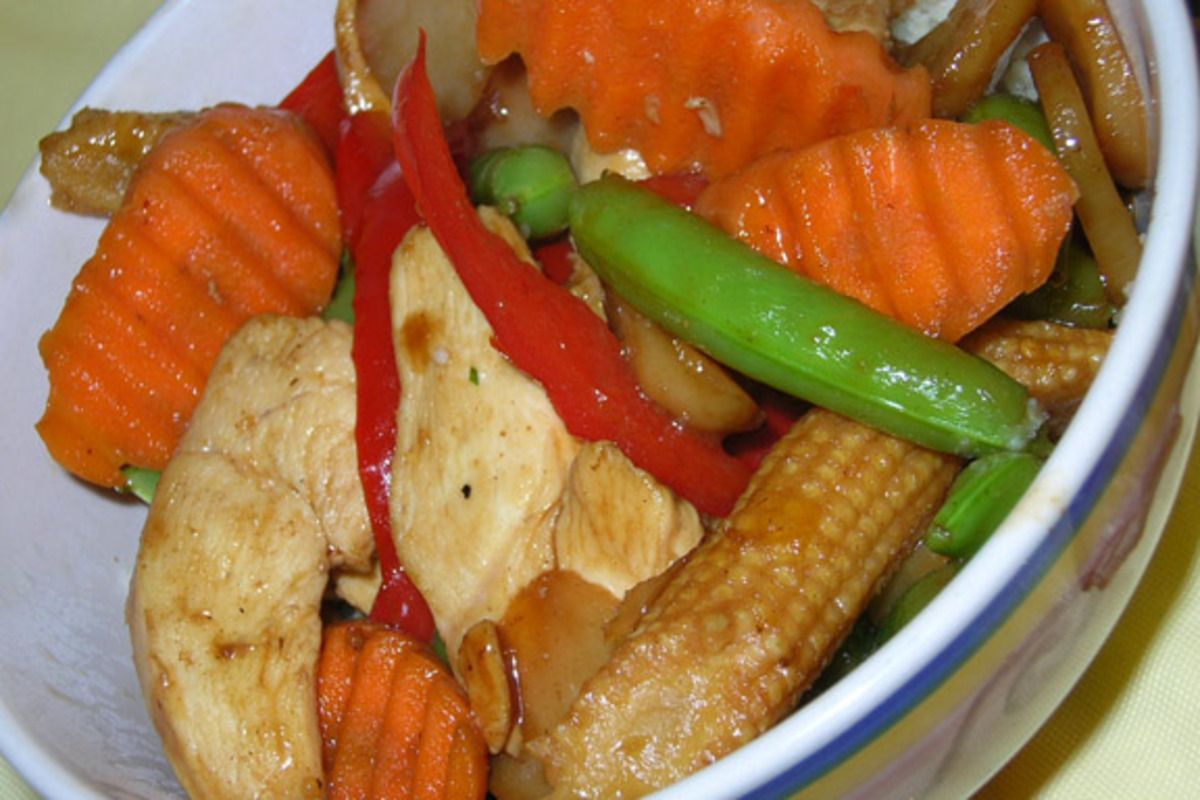
1. Honey-Ginger Chicken Stir-Fry -- 20 minutes. Honey plus ginger plus soy in a 1:1:2 ratio is a sauce that works on almost any protein.
2. Ginger Soy Chicken Stir-Fry -- the plainest version and the best one to learn the technique on.
3. Ginger-Garlic Tofu Stir-Fry -- press the tofu 20 minutes first; wet tofu will not brown.
4. Ginger-Lemongrass Shrimp Stir Fry -- ginger and lemongrass are complementary rather than redundant; lemongrass is floral and grassy, ginger is hot and sweet.
5. Miso-Glazed Salmon with Ginger -- broil 6 inches from the element for 6-8 minutes. Miso and honey both burn, so glaze late.
6. Mandarin Ginger Glazed Salmon -- citrus and ginger share terpene aromatics, which is why they read as one flavor rather than two.
7. Soy-Ginger Beef with Broccoli -- grate ginger directly into the marinade; the enzymes (zingibain) genuinely tenderize the meat over 30 minutes.
8. Honey-Ginger Glazed Pork Tenderloin -- 400°F to an internal 145°F, about 22 minutes, glazed in the last 8.
9. Ginger-Soy Braised Pork Belly -- two hours, and ginger's role here is cutting fat, not adding heat. Use large coins rather than grated.
10. Tomato-Ginger Chicken Curry -- ginger-garlic paste in a 1:1 ratio is the base of most North Indian curries. Make a batch and freeze it in tablespoons.
11. Sesame-Ginger Stir-Fried Noodles and 12. Ginger-Scallion Soba Noodles with Sesame -- the noodle pair. Ginger-scallion oil (equal volumes minced ginger and scallion, salt, hot neutral oil poured over) is the single most useful ginger preparation there is. It keeps two weeks refrigerated and improves rice, noodles, chicken, eggs and steamed fish.
13. Crisped Tofu Salad with Sesame-Ginger Dressing -- raw grated ginger in a dressing is where you taste gingerol at full strength.
Cozy soups + broths: carrot-ginger, chicken-ginger congee
Ginger in liquid behaves differently than ginger in a pan. Simmered for 20+ minutes it mellows into background warmth; added in the last five minutes it stays forward and hot.
14. Roasted Carrot and Ginger Soup -- roast the carrots first at 425°F; raw-simmered carrot soup tastes thin by comparison.
15. Ginger-Turmeric Chicken Soup -- the one to make when someone's sick. Add a strip of lemon peel at the end.
16. Ginger-Scallion Chicken Soup -- four ingredients, 40 minutes, and it tastes like it took much longer.
17. Roasted Garlic and Ginger Congee and 18. Warm Scallion and Ginger Rice Congee -- congee is a 1:8 rice-to-liquid ratio simmered 60-90 minutes until the grains collapse. It costs about $0.90 a bowl and it is the most comforting thing on this list.
Sweet ginger: molasses cookies, gingerbread, ginger cake
This is where ground ginger earns its place -- but the best versions use both.
19. Soft Molasses Ginger Cookies and Brown Butter Ginger Molasses Cookies -- chill the dough at least an hour. Warm dough spreads thin and the chew disappears.
20. Black Rum Molasses Gingerbread Cake -- gingerbread improves on day two as the molasses redistributes moisture. Bake it the day before you need it.
The baker's move worth stealing: use ground ginger for the base warmth, plus a tablespoon of fresh grated for top notes, plus chopped candied ginger for texture and bursts. Three forms, three jobs. Most commercial gingerbread uses only the first and tastes one-dimensional as a result.
| Baked good | Ground ginger | Fresh grated | Candied |
|---|---|---|---|
| Molasses cookies | 2 tsp | 1 tbsp | 1/4 cup, chopped |
| Gingerbread cake | 1 tbsp | 1 tbsp | Optional |
| Ginger scones | 2 tsp | -- | 1/3 cup |
| Ginger ice cream | -- | 3 tbsp, steeped | 1/4 cup |
Ginger drinks: fresh ginger tea, ginger switchel, ginger-lime shrub
Fresh ginger tea. Ginger-Lemon Soothing Tea -- slice a 2-inch knob thin, simmer in 3 cups water for 10-15 minutes, add honey and lemon off the heat. Simmering, not steeping, is what extracts gingerol from the flesh.
Switchel. The original American farm drink: 1/4 cup apple cider vinegar, 1/4 cup maple syrup, 2 tablespoons grated ginger, 4 cups water. Steep overnight, strain. It predates commercial sports drinks by two centuries and does roughly the same job.
Ginger-lime shrub. Equal parts sugar and lime juice with grated ginger, macerated 24 hours, strained. An ounce in soda water is a good non-alcoholic option; an ounce in a whiskey sour is better.
Ginger syrup. Equal parts sugar, water and sliced ginger, simmered 20 minutes and strained. It keeps a month refrigerated and turns any soda water into ginger ale, or any bourbon into a decent highball.
Real-world numbers: what a $3 knob actually buys
A large hand of ginger runs about $3.00 at 2026 US supermarket prices and weighs roughly 6 ounces. Peeled, that's about 5.5 ounces of usable flesh, or 11 tablespoons of grated ginger. Here's where it goes:
| Preparation | Ginger used | Feeds | Cost of ginger per serving |
|---|---|---|---|
| Stir-fry for 4 | 1 tbsp | 4 | $0.07 |
| Ginger-scallion oil (1 cup) | 3 tbsp | ~12 uses | $0.07 |
| Congee pot | 2 tbsp | 6 | $0.09 |
| Ginger tea (3 cups) | 2 tbsp | 3 | $0.18 |
| Molasses cookies (24) | 1 tbsp | 24 | $0.01 |
| Ginger syrup (1 cup) | 2 tbsp | ~16 drinks | $0.03 |
The whole hand covers a week of cooking for under $3, which is why the storage question matters more than the buying question. Nearly all the waste in a home kitchen happens between purchase and second use.
The batch-prep hour. Peel the entire hand at once with a spoon (about four minutes). Grate two-thirds on a Microplane and freeze it in one-tablespoon portions on a parchment-lined plate, then bag the pucks once solid. Slice the remaining third into coins and freeze those separately for soups and braises, where you want to pull the ginger out at the end. Total time under fifteen minutes, and it converts a perishable into a pantry staple that lasts six months.
Common pitfalls
- Burning it. Ginger scorches faster than garlic. 30-45 seconds in oil, then the next ingredient goes in.
- Grating with the grain. You get string. Look at the fibers and go across them.
- Sealed plastic in the fridge. Traps moisture, grows mold in about a week. Paper towel, loose.
- Substituting ground in a stir-fry. Never works. Skip the ginger entirely rather than substituting.
- Peeling with a knife. You lose a third of the knob to the trash.
- Old ground ginger. Ground spices lose potency in about six months. If it doesn't smell sharp, it isn't doing anything.
When not to use ginger
Ginger's enzymes (zingibain) break down proteins, which is why it tenderizes meat -- and also why fresh ginger will prevent gelatin from setting and will turn a dairy custard thin and grainy over time. For a panna cotta or a gelatin dessert, use ground ginger or steep fresh ginger in the cream and strain it out before adding gelatin. The same enzyme activity is why a fresh-ginger marinade past about four hours turns chicken breast mushy.
Equipment
One tool matters: a Microplane rasp, about $18, from our kitchen gadget picks. It handles ginger, garlic, citrus zest and hard cheese, and it makes the difference between paste and string. Add a sharp knife from knives & cutting for coins and matchsticks, a carbon-steel wok or a 12-inch skillet from cookware that can actually hold high heat, and a set of small freezer containers from storage for portioned ginger pucks.
Beyond the wok: ginger in Indian, Ethiopian and Mediterranean cooking
The twenty above lean East and Southeast Asian because that's where ginger is used most aggressively. But ginger is load-bearing in a much wider band of cooking, and the technique changes with the cuisine.
North Indian cooking uses it as a paste, not a garnish. Equal volumes of ginger and garlic, blitzed with a splash of water, fried in oil until the raw smell goes — that's the base of most curries on the subcontinent, and it goes in for two to three minutes, not forty-five seconds. The longer fry is deliberate: you want the sweetness, not the bite.
- Authentic Punjabi Chana Masala with Fresh Ginger — 110 minutes, 320 calories and 16 g protein per serving, serves 4. The long simmer is what turns the ginger from sharp to round; there's no shortcut.
- Slow-Simmered Yogurt Chicken Curry with Fresh Ginger — 50 minutes, 320 calories, 35 g protein. Temper the yogurt off the heat before it goes in, and see the enzyme warning below: fresh ginger and dairy have a time limit.
- Toor Dal Khichdi with Turmeric and Ginger — 45 minutes, 280 calories, 14 g protein. The cheapest meal in this entire guide and the one most worth learning.
- Steamed Moong Dal Poodla with Ginger and Green Chilies — 35 minutes, 150 calories, 10 g protein. Ginger raw in the batter, so the heat stays forward.
- Garam Masala Braised Lamb Shanks with Tomato and Ginger — 170 minutes, 520 calories, 45 g protein. Weekend cooking. Use coins, not grated, over a braise this long.
East Africa and the Mediterranean use it drier and lighter. Mild Ethiopian Lamb Stew with Turmeric and Ginger runs 100 minutes for 400 calories and 35 g protein, and pairs ginger with turmeric rather than garlic — a combination that reads warm rather than hot. On the lighter end, Ginger-Turmeric Quinoa Salad with Roasted Chickpeas (40 minutes, 320 calories, 12 g protein) and its stovetop sibling Steamed Ginger-Turmeric Quinoa with Roasted Chickpeas (35 minutes, same 320 calories) put raw grated ginger in the dressing, where you taste it at full strength.
The outlier worth cooking first is Burmese Ginger Salad with Toasted Chickpeas and Lime — 25 minutes, 220 calories, 9 g protein. It's the only dish here where ginger is the bulk ingredient rather than the seasoning: shredded raw, softened in lime juice, and served as a salad. If you want to know what ginger actually tastes like, this is the dish.
| Cuisine | How ginger goes in | Cook time on it | Resulting flavor |
|---|---|---|---|
| Chinese / Japanese stir-fry | Minced, into hot oil first | 30-45 seconds | Sweet, rounded |
| North Indian curry | 1:1 paste with garlic, fried | 2-3 minutes | Deep, sweet, no bite |
| Ethiopian stew | Ground or minced with turmeric | 90+ minutes | Warm background |
| Mediterranean grain bowl | Raw, grated into dressing | None | Sharp, citrusy |
| Burmese salad | Shredded raw, cured in lime | 10 minutes in acid | Hot, crunchy, forward |
Pickled and candied ginger: the two forms most cooks never make
The chart at the top lists five forms. Most home cooks only ever buy two of them. The other two are worth knowing because they do jobs fresh ginger cannot.
Pickled ginger (gari) is thin-sliced young ginger cured in rice vinegar, sugar and salt. It is not a condiment in the ketchup sense — it's a palate cleanser, and the pink color in commercial jars is usually dye rather than the natural blush young ginger takes on. See Wikipedia's entry on gari for the history and the distinction from beni shoga, the red, saltier version served with ramen and okonomiyaki.
Making it: slice young ginger paper-thin against the grain on a mandoline, salt for 30 minutes, blanch 60 seconds, then cover with 1 cup rice vinegar to 1/3 cup sugar to 1 teaspoon salt, warmed to dissolve. It's ready in 24 hours and keeps a month. Mature ginger works but stays fibrous; if the store only has knobby, thick-skinned ginger, buy the jar.
Where it earns its place:
- Vegetarian Sushi Bowl with Pickled Ginger and Sesame Dressing — 15 minutes, 320 calories, 6 g protein. The fastest real meal in this guide.
- Sushi-Style Salmon Rice Bowl with Pickled Ginger — 40 minutes, 550 calories, 30 g protein. The acid in the gari is doing the same work a squeeze of lemon does on rich fish.
Candied ginger is fresh ginger simmered in sugar syrup until translucent, then tossed in sugar. It's a different ingredient again: sweet-hot, chewy, and stable for months. Make it with the tough end of a knob you'd otherwise discard — simmer 1/4-inch coins in equal parts sugar and water for about 45 minutes, drain (keep the syrup, it's ginger syrup), and toss in granulated sugar.
- Spiced Pumpkin Molasses Cookies with Crystallized Ginger — 34 minutes, makes 24 cookies at 130 calories each. This is the three-forms principle from the baking section in practice, and it's the right cookie for September.
- Pan-Seared Chicken with Candied Ginger and Citrus Glaze — 25 minutes, 320 calories, 38 g protein, serves 2. Candied ginger in a savory pan sauce sounds wrong and isn't; the sugar is doing what a honey glaze would, with heat attached.
Ginger drinks with proof: mules, sours and punches
The syrup recipe above is the unlock for all of these — once you have a jar of ginger syrup in the fridge, the drinks take about five minutes each.
- Ginger-Honey Bourbon Sour with Candied Ginger — 8 minutes, 210 calories. Uses both candied and fresh, which is why it tastes like more work than it is.
- El Diablo Ginger Lime Margarita — 6 minutes, 210 calories. Tequila, crème de cassis, lime and ginger; the cassis is not optional.
- Cranberry Ginger Sparkler Punch — 10 minutes, serves 8 at 105 calories a glass. Batch drink, so make the ginger syrup the day before.
- Sparkling Ginger-Lime Mocktail with Mint and Cucumber — 5 minutes, 60 calories, zero proof. More in the mocktail roundup.
One note on ginger beer versus ginger ale, because the recipes above assume you know the difference: ginger beer is brewed and carries real ginger heat; ginger ale is a flavored soda and mostly doesn't. A mule made with ale tastes like a vodka soda with a lime in it.
Ginger for wellness: what the research actually says
Ginger gets health claims attached to it more freely than almost any other kitchen ingredient. Some of them hold up. Most don't. Here's the honest split, and none of this is medical advice — if you're pregnant, on blood thinners, or managing a condition, ask a clinician before treating ginger as a supplement rather than a food.
Nausea: genuinely well-supported. This is the strongest claim ginger has. A systematic review of randomized trials in Integrative Medicine Insights found ginger meaningfully reduced nausea and vomiting in pregnancy and showed benefit against chemotherapy-induced nausea, at doses around 1 to 1.5 grams per day. That's roughly a tablespoon of fresh grated ginger, or a strong cup of the ginger-lemon tea above. The effect on motion sickness is much less consistent across studies.
Inflammation and arthritis pain: modest and mixed. The National Center for Complementary and Integrative Health's ginger fact sheet summarizes the state of play: some small studies suggest a benefit for osteoarthritis pain, but the trials are short, small, and inconsistent enough that NCCIH does not describe the evidence as conclusive.
Immunity: no. There is no good clinical evidence that eating ginger prevents or shortens colds. It's a warm, aromatic thing to drink when your throat hurts, which is a real comfort and not the same as an immune effect.
The compounds doing the work are gingerol in fresh ginger and shogaol in dried — the same chemistry that drives the flavor difference described at the top of this guide. Wikipedia's ginger article has the full compound breakdown if you want the pharmacology.
Two practical caveats. First, ginger ale does not count: most commercial brands contain trace or artificial ginger flavoring and a great deal of sugar. If you want the dose, brew tea or eat crystallized ginger. Second, NCCIH notes that ginger is generally safe as a food but that high supplemental doses can cause heartburn and may interact with anticoagulants — the amounts in the recipes on this page are food amounts, well below that range.
Is candied ginger the same as pickled ginger?
No, and they aren't interchangeable in either direction. Candied ginger is fresh ginger simmered in sugar syrup until translucent then tossed in sugar — sweet, hot, chewy, and used in baking or eaten as a sweet. Pickled ginger (Japanese gari) is thin-sliced young ginger cured in rice vinegar, sugar and salt — tart, clean, and served alongside sushi to reset your palate between pieces. One adds sweetness and texture; the other adds acid.
Does ginger actually help with nausea?
This is the one health claim with real evidence behind it. Systematic reviews of randomized trials find that roughly 1 to 1.5 grams of ginger per day meaningfully reduces nausea and vomiting in pregnancy, and shows benefit against chemotherapy-induced nausea. Results for motion sickness are much weaker and inconsistent. A tablespoon of fresh grated ginger, or a strong cup of ginger tea, is in that range. Ginger ale is not — most brands contain little or no real ginger. See the wellness section above for the sources, and ask a clinician before using ginger in supplement doses.
What to cook next
Ginger is load-bearing in most of the takeout canon -- see the Chinese takeout recipes guide and the better-than-takeout stir-fry roundup. For the lemongrass-and-ginger side of Southeast Asian cooking, see the Vietnamese dinners guide, and for more warming bowls, the soup season roundup.
Sources
- NIH National Center for Complementary and Integrative Health -- Ginger -- the evidence review behind the wellness section, including safety and drug-interaction notes.
- The Effectiveness of Ginger in the Prevention of Nausea and Vomiting during Pregnancy and Chemotherapy (Integrative Medicine Insights, via PubMed Central) -- the systematic review of randomized trials behind the 1-1.5 g/day nausea figure.
- Wikipedia -- Ginger -- botany, and the gingerol/shogaol/zingerone chemistry that drives the fresh-versus-dried difference.
- Wikipedia -- Gari (pickled ginger) -- what gari is, how it differs from beni shoga, and why commercial jars are dyed pink.