Back-to-School Weeknight Dinners: A 4-Week Meal Plan for Busy Families
A 4-week weeknight dinner rotation for families with kids heading back to school — 20 unique dinners, all under 30 minutes of active cooking, with a Sunday 45-minute prep routine that saves 2 hours during the week.
Back-to-school dinner is not about cooking — it's about staging. The parents who feed a family a real dinner at 6:15pm on a Tuesday with two kids doing homework and a third at soccer practice are not better cooks than you. They just made three decisions on Sunday that pay off five times during the week. This 4-week rotation walks through those decisions: the 20 dinners on the wall, the 45-minute Sunday prep, the two-veto rule for picky kids, and the shopping list that keeps the whole thing under $180 a week for a family of four. Year-stamp: this plan was tested against the 2026 AislePrompt catalog with a real September-through-December calendar.
Get a free 7-day kid-approved dinner plan
Seven school-night dinners picky eaters actually finish, delivered Sunday, with one shopping list for the week.
No spam, unsubscribe in one click. Recipes, shopping lists and Instacart carts all work without an account either way.
The after-school reality is unforgiving. Kids melt down by 5:30. Homework starts at 6. Somebody has a game or a practice by 6:30. Weekday dinner has a 45-minute window that opens at 5:45 and closes at 6:30, and if you're not in that window with food on the table, everyone eats crackers and a granola bar and you feel like you're failing. Dietitians have been making the same case for years: the Academy of Nutrition and Dietetics' food planning and preparation resources put a written weekly plan ahead of any single recipe, because it is the plan — not the cooking — that decides whether vegetables reach the plate and whether the produce drawer gets eaten instead of thrown out. The plan is the whole trick.
The system: 20 dinners on a 4-week wall calendar
The plan runs on a simple pattern: 5 dinners a week, 4 weeks in a cycle, then repeat. Twenty unique dinners total; nothing shows up more than once every 28 days. Sunday is family-cooked or leftovers. Monday, Wednesday, and Friday are designated "easy nights" (crockpot, sheet pan, or 15-minute pasta). Tuesday and Thursday are the two "real cooking" nights when you're actually at the stove for 25-30 minutes.
Every dinner in the rotation follows three rules:
- Under 30 minutes of active time. If you're actually standing at the stove for more than 30 minutes on a Tuesday, the plan failed you. Sheet pans and slow cookers do most of the cooking while you're helping with math homework.
- 8 or fewer core ingredients. More than 8 and you'll skip the recipe on a bad day. The plan repeats the same 6-8 proteins and 6-8 pantry items across all 20 dinners so your grocery list stays short and your fridge doesn't fill with one-use ingredients.
- At least one veg per plate. Pushed hard by the rotation — sheet pans have roasted veg baked in, taco nights have a slaw, pasta nights have a green salad next to them.
The 4-week rotation at a glance
| Week | Monday | Tuesday | Wednesday | Thursday | Friday |
|---|---|---|---|---|---|
| Week 1 (Getting back into it) | Sheet-pan chicken | Taco Tuesday | Spaghetti + meatballs | Teriyaki bowls | Breakfast for dinner |
| Week 2 (Homework is back) | One-pot pasta | Sheet-pan salmon | Chicken quesadillas | Meatball subs | Chili night |
| Week 3 (Sport season) | Slow-cooker chicken tacos | Chicken parm bake | Pesto pasta | Air-fryer chicken tenders | Veggie fried rice |
| Week 4 (Kid's-pick refine) | Kid pick #1 | Kid pick #2 | Kid pick #3 | Kid pick #4 | Family pizza night |
This table alone is worth printing and stuck to the fridge. Photograph it on your phone; look at it Sunday night when you're building the shopping list. The USDA nutrition planning resources recommend exactly this kind of visible calendar — decisions made when you're not hungry are dramatically better than decisions made at 5:30pm on an empty stomach.
Week 1: getting back into it
The first week of the school year is the hardest — everybody is exhausted, the routine has vanished over summer, and you're just trying to make it to Friday. All five dinners for this week are staged so that the effort is minimal.
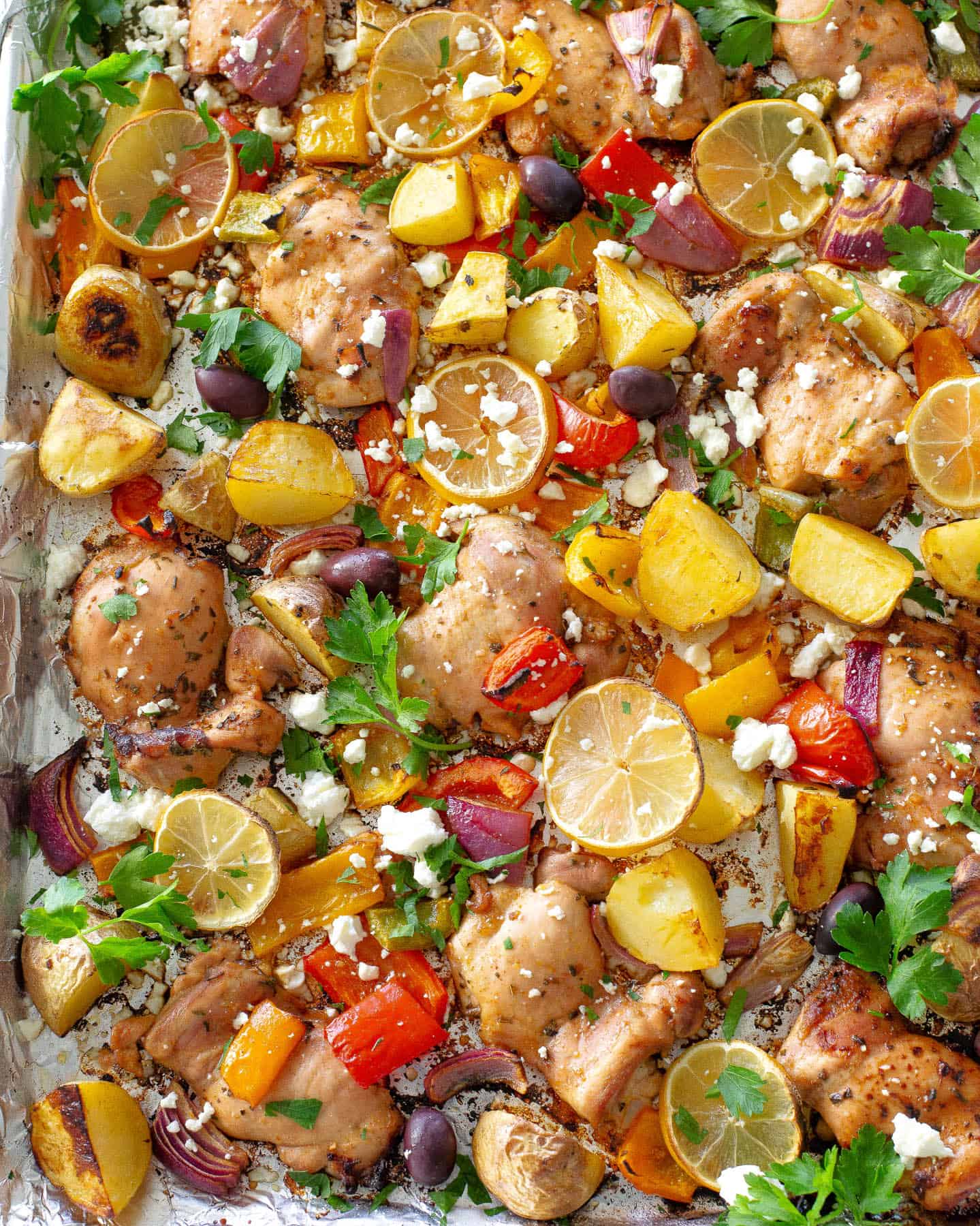
Monday — Sheet Pan Greek Marinated Chicken with Roasted Potatoes and Vegetables. This is the sheet-pan chicken that starts the whole rotation. Chicken thighs, quartered potatoes, and cut vegetables all tossed in olive oil, lemon, oregano, and garlic; onto a half-sheet pan; 425°F for 30 minutes. Active time: 10 minutes. Kids eat the chicken; adults eat everything. Enough leftover chicken to make Tuesday's tacos or a Wednesday lunch.
Tuesday — Taco Tuesday. Ground beef, taco seasoning, tortillas, shredded cheese, lettuce, salsa, sour cream — every kid on earth eats this. Try Mexican-Style Beef and Black Bean Tacos with Cilantro Lime Slaw for the version with black beans and a slaw that gets vegetables into the meal without a battle. Twenty minutes total; the assembly is what the kids look forward to.
Wednesday — Family-Style Spaghetti with Homemade Meatballs. The universal back-to-school dinner. Homemade meatballs get pan-browned on Sunday during the prep window and reheat in the sauce in 8 minutes on Wednesday. Sauce from a jar is completely acceptable here. Twenty minutes on a school night if the meatballs are already made; 45 minutes if you're making them from scratch that night.
Thursday — Honey-Glazed Teriyaki Chicken Bowls. Chicken cubes glazed with soy, honey, and ginger; served over rice with steamed broccoli or edamame. Fifteen minutes if you have rice already made in the fridge. This is the plate that makes kids feel like they got takeout without you paying takeout prices.
Friday — Breakfast for dinner. Pancakes, scrambled eggs, bacon, fruit. Everyone loves it. Twenty minutes total; requires zero brain power at the end of a long week. Great for using up any breakfast ingredients (eggs, bacon, berries) that are about to expire.
Week 2: homework is back
By week 2 the routines are back — homework is real, practices are on the calendar, and dinner has to happen inside a tight window. Week 2 leans into hands-off cooking that lets you help with math while dinner takes care of itself.
Monday — One-Pot Tomato-Basil Pasta with Sun-Dried Tomatoes. Pasta, canned tomatoes, sun-dried tomatoes, olive oil, garlic, all in one pot; water added, lid on, simmered until the pasta cooks in the sauce. Fifteen minutes and one dish to wash. The one-pot pasta trick is a game-changer for busy weeknights.
Tuesday — Sheet Pan Herb-Glazed Salmon with Asparagus. Salmon filets and asparagus on a sheet pan; herb glaze, 12 minutes at 425°F. This is the healthy-fat, high-protein Tuesday that offsets Wednesday's chicken and cheese. Kids who won't eat salmon usually eat this version because the glaze reads as sweet.
Wednesday — Stovetop Chicken Quesadillas with Roasted Red Pepper Sauce. Cooked chicken (or Sunday's leftover sheet-pan chicken), shredded cheese, tortillas, roasted red pepper sauce. Griddle for 3 minutes per side. Kids assemble their own with sides of guacamole, salsa, and sour cream. Twenty minutes.
Thursday — Classic Italian-American Meatball Subs. If Wednesday's spaghetti and meatballs left extra meatballs, this is where they land — on a hoagie roll with red sauce and melted provolone under the broiler for 3 minutes. If you don't have leftover meatballs, frozen store-bought Italian meatballs work fine. Fifteen minutes.
Friday — Chili night. Ground turkey or beef, canned beans, canned tomatoes, chili spices — 25 minutes in a Dutch oven, served with cornbread. Big pot; leftovers become Saturday lunch (over baked potatoes, or as chili dogs). Also freezes beautifully.
Week 3: sport season
Week 3 is peak scheduling chaos — every kid has a practice, at least one has a game on a weeknight, and you may or may not be home in time to cook. This week has two crockpot-style nights that cook while you're at the field.
Monday — Slow Cooker Mexican Chicken Tacos. Chicken thighs, salsa, taco spice into the crockpot in the morning; comes home to fall-apart chicken that gets shredded and served in tortillas with the same taco toppings as week 1. Total morning prep: 5 minutes. Total evening effort: warming tortillas.
Tuesday — Chicken Parmesan Meatball Bake with Mozzarella. A sheet-pan take on chicken parm — meatballs baked with mozzarella and marinara on a sheet pan, served over pasta or garlic bread. Thirty minutes total; the mozzarella-browning step is what wins kids over. Feels fancier than the effort suggests.
Wednesday — Pesto pasta. Boxed pasta, jarred pesto, cherry tomatoes, torn mozzarella. Ten minutes if you're really pressed. Kids who claim to hate pesto usually eat this version because the tomatoes and mozzarella carry it. Add a grilled chicken breast (or Monday's leftover slow-cooker chicken) if you need more protein.
Thursday — Air-fryer chicken tenders. Chicken breast strips, egg wash, breadcrumb mixture; 12 minutes in the air fryer at 400°F. Every kid eats them. Served with sweet potato fries (also air-fried) and a side of ranch. Twenty minutes; the game-night dinner.
Friday — Veggie fried rice. Cold jasmine rice from earlier in the week, scrambled egg, frozen mixed vegetables, garlic, soy sauce, sesame oil. Ten minutes; a "clean out the fridge" dinner that uses up any lingering vegetables. Add leftover teriyaki chicken from week 1 or slow-cooker chicken from Monday if you want protein.
Week 4: repeat and refine
Week 4 is where the plan pays you back. By now the kids have opinions — some real, some not. Give them the power to pick their four favorite dinners from weeks 1-3 and put those on the calendar. This is the "veto and pick" week.
The two-veto rule: each kid gets two vetoes per month, no negotiation, but they don't build the calendar. Vetoes come out of the four dinners they picked, not out of your rotation. If your third-grader vetoes salmon and quesadillas, you serve something else those nights — you don't have to argue.
The four "kid's pick" nights get filled from the winners of weeks 1-3 (usually taco Tuesday, teriyaki bowls, chicken tenders, and spaghetti and meatballs — but let the kids tell you). Friday is family pizza night — homemade or delivery, doesn't matter, but everybody agrees to it.
Week 5 loops back to week 1. Between the four-week cycle and the two-veto rule, no dinner comes around more often than every 4 weeks, and every kid feels like they're getting stuff they like.
The one-page shopping list, sorted by aisle
A plan only saves time if the list is sorted the way the store is laid out. Written recipe-by-recipe, a five-dinner list sends you back across the store four times. Grouped by aisle, it is one loop — 30 to 40 minutes in-store instead of an hour. Print the week you're cooking, or photograph it before you leave the house.
Quantities below assume a family of four and include Friday's breakfast-for-dinner night. Check the pantry line last — most weeks you already own half of it.
Week 1 list
- Produce. 1.5 lb baby potatoes; 1 large red bell pepper; 1 red onion; 2 lemons; 2 limes; 1 head garlic; 1 small green cabbage; 1 lb carrots; 1 bunch flat-leaf parsley; 1 bunch basil; 1 bunch cilantro; 1 broccoli crown; 1 thumb fresh ginger; 1 pint berries.
- Meat. 4 boneless skinless chicken breasts (6 oz each) for Monday; 2 lb ground beef, 80/20 (1 lb Tuesday, 1 lb Wednesday); 1/2 lb ground pork for the meatballs; 1 lb boneless chicken thighs for Thursday; 1 package bacon for Friday.
- Dairy and eggs. 4 oz crumbled feta; 8 oz sour cream; 1 dozen eggs; 1/2 gallon milk; 1 stick butter.
- Dry goods. 12 oz spaghetti; 1 lb short-grain rice; 8 small corn tortillas; 1 container breadcrumbs; pancake mix; 1 small jar sesame seeds.
- Canned and jarred. 1 can black beans (15 oz); 1 can diced tomatoes (28 oz); 1 small can tomato paste; 1 jar pitted kalamata olives.
- Pantry check. Olive oil, soy sauce, honey, rice vinegar, sesame oil, taco seasoning, dried oregano, salt, black pepper.
That covers Monday's sheet-pan Greek chicken, Tuesday's beef and black bean tacos, Wednesday's spaghetti and meatballs, Thursday's teriyaki bowls, and Friday's pancakes-and-eggs night.
Week 2 list
- Produce. 1 head garlic; 1 bunch basil; 1 lb asparagus; 1 lemon; 1 lime; 2 yellow onions.
- Meat. 4 salmon fillets (4 oz each); 1 lb boneless skinless chicken breasts; 1/2 lb ground beef plus 1/2 lb ground Italian sausage for the subs; 1 lb ground beef for chili night.
- Dairy and eggs. Grated Parmesan; 2 cups shredded Monterey Jack; 1.5 cups shredded mozzarella; 8 oz sour cream; small carton milk; 1 dozen eggs.
- Dry goods. 12 oz spaghetti; 4 large flour tortillas; breadcrumbs; 4 Italian rolls.
- Canned and jarred. 2 cans crushed tomatoes (28 oz and 24 oz); 1 jar oil-packed sun-dried tomatoes; 1 jar roasted red peppers; 1 can kidney beans; 1 can diced tomatoes.
- Pantry check. Olive oil, dried thyme, garlic powder, red pepper flakes, ground cumin, chili powder, dried basil, dried oregano.
Week 2 feeds the one-pot tomato-basil pasta, sheet-pan salmon with asparagus, stovetop chicken quesadillas, meatball subs, and a pot of chili.
The repeat-buy core
Weeks 3 and 4 reuse the same spine, which is the whole reason the grocery bill stays predictable: ground beef, chicken thighs, chicken breasts, pasta, rice, tortillas, canned tomatoes, onions, garlic, and a block of cheese. Buy those in the largest size your freezer and pantry tolerate and the marginal cost of each new week is produce plus one protein. The Academy of Nutrition and Dietetics' food planning and preparation resources make the same point: repetition in the ingredient list, not in the meals, is what makes a plan survivable.
If the list keeps falling apart between the store and the fridge, the fix is usually containers rather than willpower — see the AislePrompt Storage and Containers picks for the stackable sets that hold a week of washed produce, and the Knives and Cutting picks for the one chef's knife that makes Sunday's chopping 15 minutes instead of 30.
The Sunday 45-minute prep routine
This is the single highest-leverage 45 minutes of your week. Do it once and it saves you 2+ hours during the week.
- Wash and chop: All the produce for the week — onions, peppers, carrots, lettuce, herbs. Store in glass containers in the fridge. 15 min.
- Cook the base grains: A big pot of rice (4 cups), a pot of pasta (1 lb, cooked al dente, tossed in olive oil). 20 min mostly hands-off.
- Marinate the proteins: Chicken thighs in Greek marinade for Monday; salmon filets in soy-honey for Tuesday; ground beef pre-seasoned for taco Tuesday. 5 min.
- Roll and freeze the meatballs: If Wednesday is spaghetti night and you're making meatballs from scratch, roll them Sunday and freeze on a sheet pan (30 min in the freezer, then bag). Straight from freezer to sauce; adds only 3 min to Wednesday's cook time. 5 min.
Total: 45 minutes, one dishwasher run. If you can put a podcast or a football game on while you do it, it barely feels like work. And Monday-through-Friday's active cooking drops from 30 min to 15 min per night.
The kid-buy-in rule: two vetoes per month, no more
Every kid gets to veto two dinners per rotation. That's it. The vetoes are absolute — if your daughter vetoes salmon, salmon does not get served on her plate that week. But she doesn't get a third veto, and she does not get to design the rotation.
This works because it gives kids agency without giving them chaos. Most picky kids reject 3-5 things categorically (mushrooms, seafood, spicy stuff, bell peppers) and are fine with 20 other things they've never tried. The two-veto rule lets them protect the 3-5 non-negotiables and forces them to try the rest. According to Serious Eats' family-friendly recipe collection, kids exposed to a new food 8-10 times will usually accept it — the veto rule keeps the exposure happening without turning every dinner into a fight.
Allergies and dietary swaps that don't break the rotation
Most meal plans collapse the first time somebody in the house can't eat wheat or dairy, because the swap changes the shopping list and the shopping list is the whole system. This rotation was picked partly because the substitutions are one-for-one — same aisle, same quantity, same cook time. The FDA recognizes nine major food allergens — milk, eggs, fish, shellfish, tree nuts, peanuts, wheat, soybeans, and sesame — and seven of the nine show up somewhere in these four weeks. Here is where, and what to do about it.
- Dairy. Easier than it looks, because most of the dairy here is garnish rather than structure. Skip the feta on Monday's sheet pan and the Parmesan on the pasta and nothing changes. The two that matter are the quesadillas and the meatball subs, where cheese is the binder — a dairy-free shred melts acceptably in both if you cover the pan for the last two minutes.
- Egg. One egg binds Wednesday's meatballs and one binds the meatball subs. Three tablespoons of aquafaba (the liquid from a can of chickpeas) or a tablespoon of ground flax whisked into three tablespoons of water does the same job. Don't skip the binder outright — the meatballs fall apart in the sauce.
- Wheat and gluten. Gluten-free pasta drops into Wednesday and Week 2's one-pot night at a 1:1 ratio; pull it a minute shy of the box time because it goes soft fast in sauce. Tuesday's corn tortillas are already gluten-free. For the subs, gluten-free rolls work but lettuce wraps hold up better under hot sauce.
- Tree nuts. Worth flagging specifically: the chicken parmesan meatball bake in Week 3 uses almond flour as its binder, so it is gluten-free but not nut-free. Swap in gluten-free breadcrumbs at the same volume.
- Soy. Thursday's teriyaki glaze is the only soy in the rotation. Coconut aminos replace soy sauce 1:1; they run sweeter, so cut the honey from two tablespoons to one.
- Sesame. Same night, and the easiest fix in the list — leave out the sesame oil and the sesame seed garnish and use a neutral oil. Nothing else in the four weeks contains sesame.
- Fish. Week 2's sheet-pan salmon is the only fish night. Chicken thighs go on the same sheet pan with the same herb glaze at 425°F, but they need about 22 minutes rather than 14.
Two habits worth building regardless of which allergen you're managing: read the label on anything pre-mixed (taco seasoning, jarred marinara, and shredded cheese anti-caking agents are the usual culprits), and re-read it every few months, because manufacturers reformulate without announcing it. FARE's guide to common allergens is the reference worth bookmarking. In Chat you can also state the allergy once — "no dairy, no sesame" — and have the whole four-week rotation rebuilt around it rather than editing each night by hand.
How to use AislePrompt to build your rotation
Once you've read this article, open Meal Plan and ask for "a 4-week back-to-school dinner rotation for a family of 4." The planner drafts 20 dinners from your catalog, groups the ingredients into a single shopping list, and shows you the estimated grocery cost before you commit. Push the list to Instacart in one tap for Sunday delivery; the whole week is stocked before you've had breakfast.
If a kid vetoes a dinner mid-week, Chat rebuilds that night around the substitution in one prompt — "swap Wednesday's salmon for chicken quesadillas" — and updates the shopping list too. If you're cooking for a household of 2 or 6, set the servings in the plan and every recipe rescales automatically.
Store the fridge-ready staples in the right containers — see the AislePrompt Cookware picks for the Dutch ovens, sheet pans, and cast iron that all 20 dinners depend on. For the bakeware you'll lean on (half-sheet pans for the sheet-pan chicken and salmon, 9x13 for the parm bake), the Bakeware list is the tested short list. Two half-sheet pans and one 9x13 will cook 12 of the 20 dinners in this rotation.
Real weeknight numbers: the honest cost + time
Here's what the four-week plan actually costs and takes, based on running it for a family of four in a typical US metro.
| Metric | Value |
|---|---|
| Active weeknight cooking (Mon-Fri avg) | 22 min/night |
| Sunday prep window | 45 min |
| Total weekly kitchen time | ~2h 40min |
| Grocery bill for 4 (per week, average metro) | $135-175 |
| Take-out replaced (dinners not ordered) | 4-5 per week |
| Estimated take-out savings vs $18 avg delivery | $60-80/week |
| Break-even vs takeout | Week 1 |
The break-even math is decisive. Even at premium grocery prices, cooking 5 dinners a week saves a family of four about $60-80 vs the equivalent takeout, and that's without counting the delivery fees, tips, and the 40-minute wait for the driver. This is the actual reason the plan is worth doing — the health and family-time upside is real, but the money savings are what make it sustainable.
Common pitfalls: what breaks the plan
- No Sunday prep. The rotation collapses in week 2 without the 45-minute Sunday prep. It's non-negotiable; if Sunday is a lost cause, do a mini-prep Monday morning.
- Too many ingredient variations. The plan only works because the ingredients repeat. If you swap a rotation dinner for something with 15 new ingredients, the shopping list gets weird and expensive.
- Ignoring the veto rule. Kids who are told "eat what I made or nothing" will find something in the pantry to eat and you'll feel like the plan failed. Two vetoes is the right amount — enough to keep the plan honest, not so much that it collapses.
- No leftover strategy. Sunday's roast chicken becomes Tuesday's chicken tacos. Wednesday's meatballs become Thursday's subs. Every big-cook dinner should feed at least one other dinner too — the math falls apart otherwise.
- Perfectionism. Some weeks you'll serve boxed mac and cheese with hot dogs and call it dinner. That's the plan working — it's not failing. Kids do not remember individual dinners; they remember that dinner happened, that you were there, and that the kitchen felt calm.
When NOT to follow the plan
Two situations where you should step outside the rotation.
- Somebody's sick. The plan is a normal-week tool. Sick kid, sick parent, snow day — buy pizza and take the week off. Restart Sunday. There is no gold medal for cooking through a norovirus outbreak.
- You're hosting. Weekend guests, dinner parties, extended family in town — the rotation is for you, not for them. Cook something more ambitious those nights and rejoin the rotation on Monday.
For readers who want deeper cooking
Once the rotation is comfortable, you'll want to branch into more specific regional cooking. Rotate any of these once a month for variety: 22 Thai Weeknight Dinners: Pad Thai, Green Curry & 30-Minute Stir Fries, 22 Cajun and Southern Dinner Recipes: Gumbo, Jambalaya & Shrimp Boils, 22 Greek Dinner Recipes: Souvlaki, Moussaka & Sheet-Pan Chicken Bowls, or the 25 Mediterranean Weeknight Dinners: 30-Minute Bowls, Sheet Pans & Skillets collection. All four cluster nicely with the back-to-school rotation because they lean on the same sheet pans and one-pot techniques.
FAQ
How much time should I really block for weeknight dinner?
Realistically, 20-30 minutes of active cooking plus 10 minutes of shopping-list execution. This plan targets that budget by prioritizing sheet-pan and one-pot dinners with 8 or fewer ingredients. If you can add 45 minutes of Sunday prep (chopping veg, marinating proteins, cooking a batch of rice), you'll cut every weeknight down to about 20 minutes total from start to on-the-table.
My kids are picky — will this work?
Yes, if you give them the two-veto rule: each kid can veto two dinners a month, no negotiation, but you build the rotation. Most picky kids reject 3-5 things (mushrooms, seafood, spicy stuff) and love 20 more they haven't tried. AislePrompt's /chat can rebuild any week around specific dislikes ("no tomatoes for the plan") without you retyping the whole thing.
What if we have soccer practice and no time to cook?
Every week in this plan has a designated "crockpot night" (Monday or Wednesday) where dinner cooks itself while you're at practice. There's also a "leftover night" built in so week 3's chili becomes week 4's chili dogs. If practice runs late, swap in an air-fryer chicken tender night — 12 minutes basket to plate and every kid eats them.
Can I use this if I'm cooking for just 2?
Absolutely — every recipe scales in the AislePrompt meal-planner. Set servings to 2 in /meal-plan and the shopping list recalculates automatically. Most 2-person families find they can also freeze half a week of dinners on Sunday and rotate frozen portions in for a genuinely 15-minute weeknight. The rotation still works with just 4 unique recipes a week instead of 5.
How do I keep the grocery bill under control with 5 dinners a week?
This plan uses the same 6-8 proteins repeatedly across the month (chicken thighs, ground beef, salmon, pasta, eggs, canned beans) so you buy in bulk and use every ingredient in at least two meals. Expect roughly $120-180/week for a family of 4 depending on region and store. Instacart price previews on the shopping list show the actual bill before you check out — no surprises at checkout.
How long does the weekly grocery run actually take?
Budget 30 to 40 minutes in-store if you shop from the aisle-sorted list above, against the 55 to 70 minutes it takes when the list is written recipe by recipe and you cross the store four times. The ordering matters more than the store does: produce, meat, dairy, dry goods, canned, frozen is one loop with no backtracking. Instacart delivery cuts your own time to about five minutes of tapping, and the price preview shows the bill before you check out.
Can I run this rotation with food allergies in the house?
Yes, and the swaps were chosen to be one-for-one so the shopping list barely changes. Gluten-free pasta drops into Wednesday and Week 2's one-pot night; corn tortillas are already gluten-free; coconut aminos replace soy sauce at a 1:1 ratio in the teriyaki bowls. Dairy is the easiest of the nine major allergens here, because the feta and the Parmesan are garnish rather than structure. Read the label on anything pre-mixed, including taco seasoning and jarred marinara.
How do I get the week's shopping list into Instacart?
Open the plan at /meal-plan, tap Generate Shopping List, then tap the Instacart cart icon at the top of the list. Every ingredient routes to your local store with retailer-aware substitutions, so if the store is out of ground turkey it proposes ground chicken rather than silently dropping the item. Delivery usually lands within one to two hours and pickup is free at most retailers. Set servings first if you are cooking for more or fewer than four.
Sources
- Academy of Nutrition and Dietetics — Food planning and preparation
- USDA — Food and Nutrition
- Serious Eats — Family-friendly recipes
- FDA — Food allergies and the nine major allergens
- FARE — Common allergens
Frequently asked questions
How much time should I really block for weeknight dinner?
My kids are picky — will this work?
What if we have soccer practice and no time to cook?
Can I use this if I'm cooking for just 2?
How do I keep the grocery bill under control with 5 dinners a week?
How long does the weekly grocery run actually take?
Can I run this rotation with food allergies in the house?
How do I get the week's shopping list into Instacart?
Sources
Recipes to start your week with
Save any of these to My Recipes — no account needed — and send the ingredients to Instacart in one tap.




Dinners the kids will actually eat.
Ask our AI to plan the week around your picky eater — one shopping list, one Instacart cart.
Plan the kids’ week →