20 Homemade Pizza Night Recipes: Sheet Pan, Cast Iron & Grilled Pies
Three doughs, three pans, and 20 pies — the family-dinner template that costs $9 to feed six and gets better every week you run it.
Affiliate disclosure: AislePrompt may earn a commission on qualifying purchases made through Amazon and Instacart links in this article, at no additional cost to you. See our affiliate policy →
Pizza night works as a family template because it's the only dinner where everyone gets exactly what they want and you still only cook once. Below are 20 recipes from the AislePrompt catalog organized by pan — sheet pan for a crowd, cast iron for crispy-bottomed pan pies, grill for summer — plus the three doughs that feed all of them and the specific fixes for the soggy-bottom problem that ruins most home pizza.
The economics are the other reason to run it weekly. A sheet pan pizza that feeds six costs about $9 in ingredients as of August 2026 — roughly $1.50 a head, against $28-$40 for delivery. Once the dough is a routine, the active work is under 25 minutes.
If pizza night is your answer to the after-practice scramble, it pairs with the back-to-school weeknight dinners list, and it's the reliable fallback for a picky-eater table because everyone builds their own quadrant.
Introduction: why pizza night is the ultimate family template
Three reasons it beats almost any other recurring family dinner.
It's modular. One dough, six people, six different topping preferences, one bake. Nobody negotiates. A kid who eats plain cheese and an adult who wants anchovies and chili oil are served by the same 12 minutes of oven time.
It absorbs leftovers. Roast chicken, sausage from Sunday, the last of the peppers, wilting spinach — all of it becomes topping. Pizza night on Thursday is a fridge-clearing mechanism disguised as a treat.
The skill compounds. The tenth pizza is meaningfully better than the first, and it's the same 25 minutes. Very few dinners have that curve.
The one commitment is the dough, and the fix for that is scheduling rather than skill.
Three doughs: 24-hour fridge, same-day quick, no-yeast
The 24-hour cold-fermented dough is the best-tasting option and the least work per session, because it's made the day before in 8 minutes. Cold fermentation develops flavor through slow enzymatic breakdown rather than fast yeast activity — the same reason a long-risen bread tastes like something and a quick one doesn't. Mix, refrigerate, use between 24 and 72 hours later.
1. Neuchâtel-Style 48-Hour Fermented Artisan Pizza Dough — the long ferment. Make Wednesday, bake Friday.
2. Neapolitan-Style Pizza Dough with Garlic-Infused Tomato Sauce — high-hydration, soft, meant for a very hot oven. Neapolitan pizza is defined by a 60-90 second bake at 800-900°F — the AVPN's official disciplinare specifies 430-480°C for 60-90 seconds — which no home oven does. At 550°F you get something excellent but different; don't chase the leopard-spotting.
3. Sourdough Hand-Stretched Pizza Dough with Classic Toppings — if you keep a starter, this is the best use of discard you have.
4. No-Knead Overnight Whole Wheat Pizza Dough with Sun-Dried Tomato Pesto — whole wheat, no kneading. Whole grain absorbs more water; if the dough feels stiff, add 2 tablespoons of water, not flour.
Same-day dough is fine — 90 minutes from mixing to baking with a warm rise — and store-bought dough balls are genuinely acceptable. The one rule with store-bought: pull it out of the fridge 90 minutes before you stretch it. Cold dough springs back and tears, and that's what people mean when they say they "can't stretch dough."
Kitchen tools that upgrade pizza night
The single highest-return purchase for home pizza is a baking steel. A 1/4-inch steel plate stores roughly 8-10× the usable heat of a pizza stone and transfers it far faster, which is what crisps a bottom crust in a 550°F oven instead of the 900°F one the recipe assumes. Look in bakeware for a steel or, failing that, a heavy half-sheet pan from Best Sheet Pans in 2026 — a thin sheet pan warps and browns unevenly, and it's the most common reason sheet-pan pizza cooks pale in the middle.
For pan pizza, a 10- or 12-inch cast-iron skillet from cookware is the whole technique — mass plus direct contact is what produces the fried, lacy cheese edge. A peel or a rimless cookie sheet from utensils lets you launch onto a hot surface without folding the pie in half. A stand mixer from small appliances makes dough a 6-minute hands-off job if you're making it weekly, and a cheap infrared thermometer from gadgets tells you what your steel is actually at, which is usually 60-80°F cooler than the oven's readout after a 30-minute preheat.
Skip the countertop pizza oven unless you're making more than four pies a session. At 550°F with a steel and a 45-minute preheat you're within a few percent of the result for a fraction of the price and the storage space.
Sheet pan pizza — feeds 6, no stone needed
The highest-throughput format and the best one for a family. Oil the pan generously — 2-3 tablespoons — because the bottom is essentially shallow-fried, and that's the point.
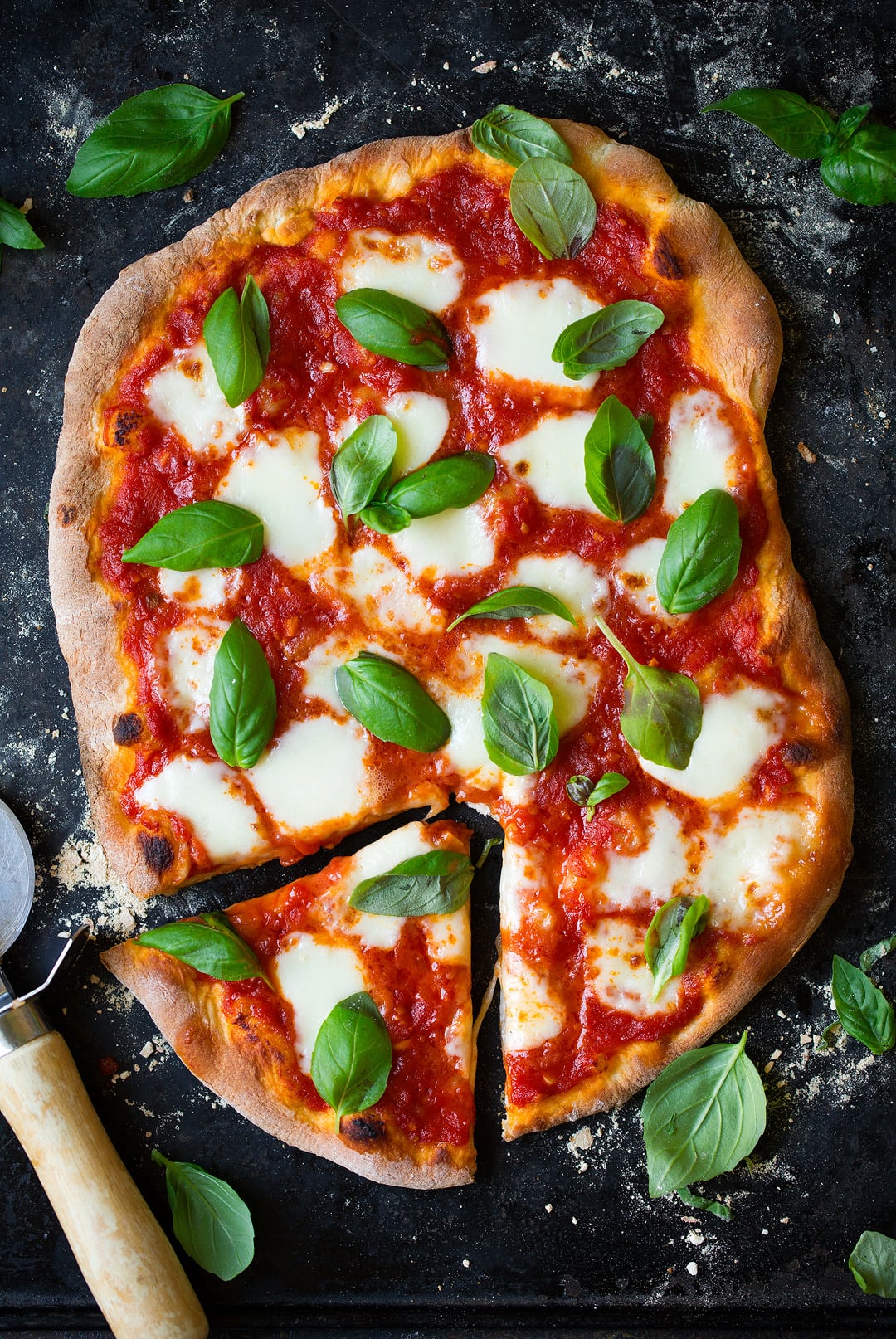
5. Sheet Pan Margherita Flatbread Pizza — the baseline. 18×13 pan, 425°F, 18-20 minutes.
6. Sheet Pan Mini Pepperoni Pizzas with Hidden Veggie Sauce — individual portions on one pan, which solves the topping negotiation entirely.
7. Sheet Pan Hawaiian Pizza with Pineapple and Bacon — pat the pineapple dry with paper towels. Canned pineapple carries enough liquid to waterlog the center.
8. Sheet Pan Whole Wheat Pita Pizzas with Spinach and Mozzarella — no dough at all, 12 minutes, and the fastest path to pizza on a Tuesday. Squeeze the spinach genuinely dry — a fistful of cooked spinach holds about 1/3 cup of water.
Cast iron pan pizza
Deep-dish-adjacent, thick, and the crispiest bottom you can get at home. Preheat the skillet empty for 10 minutes, add oil, press the dough in, top, and bake at 500°F. Finish 2 minutes on a stovetop burner if the bottom needs more color.
9. Cast Iron Pan Pizza with Honey-Balsamic Glazed Onions — the reference recipe for the format.
10. Detroit-Style Crispy Pan Pizza with Caramelized Onions — Detroit style is defined by brick cheese pushed to the walls of the pan, where it fries against the metal into a caramelized edge. Low-moisture mozzarella works; fresh mozzarella does not — too much water, no fry.
11. Detroit-Style Sicilian Pepperoni Pizza with Crispy Edges — sauce goes on after the bake in the true Detroit method, in two stripes.
12. Pan-Baked Deep Dish Sausage Pizza — Chicago style: cheese on the bottom, sauce on top, 35-40 minutes at 425°F. It's a casserole and it should be treated like one.
Grilled pizza
The best summer format because it keeps the heat outside and cooks in 6 minutes. The technique is counterintuitive: grill one side of the naked dough first, flip it, then top the cooked side and close the lid.
13. Charcoal-Grilled Sausage and Pepper Pizza — pre-cook the sausage. Six minutes on a grill will not cook raw pork through.
14. Grilled Chicken Pesto Pizza with Sun-Dried Tomatoes — the leftover-chicken pizza, and a good one.
15. Grilled Wood-Fired Pizza with Chorizo and Roasted Peppers — high fat content in the chorizo means it renders and seasons the whole pie.
10 topping combinations beyond pepperoni
16. Homemade Margherita Pizza with Fresh Basil — basil goes on after the bake, not before. Baked basil turns black and bitter.
17. Hand-Tossed Margherita Pizza with Fresh Basil and Mozzarella — the hand-stretched version.
18. Vegetarian White Pizza with Spinach and Ricotta — no tomato. Dollop the ricotta rather than spreading it; a full layer steams instead of browning.
19. Sage and Ricotta White Pizza — fry the sage leaves in oil for 20 seconds first.
20. Thin-Crust Wild Mushroom and Truffle Oil Pizza — sauté the mushrooms first and drive off the water. Raw mushrooms release about 80% of their weight as liquid onto your crust.
21. Four-Cheese Pizza with Caramelized Onions and Thyme — the onions want 40 minutes on low; do them Sunday.
22. New York-Style Foldable Pepperoni Pizza with Garlic Butter Crust — cup-and-char pepperoni (the small, natural-casing kind) is a genuinely different and better product than the flat deli slices.
23. Baked Cauliflower Pizza Crust with Mushrooms and Spinach — the gluten-free option. Squeeze the riced cauliflower in a towel until you've pulled out at least a cup of water, or it will not hold together. This step is not optional and it is the reason most cauliflower crusts fail.
How to build a DIY pizza bar for family night
Set out the dough already portioned and stretched onto oiled parchment squares. Then, in small bowls: sauce, shredded low-moisture mozzarella, three or four proteins, three or four vegetables (all pre-cooked), and a finishing shelf of basil, chili flakes, hot honey, and grated parmesan that goes on after the bake.
Rules that make it work with kids: pre-cook every vegetable and every meat, cap toppings at four per pie, and bake in the order they were built. Parchment squares mean a six-year-old can build a pie and you can move it to the hot steel without a peel and without a disaster.
| Format | Oven temp | Bake time | Feeds | Ingredient cost |
|---|---|---|---|---|
| Sheet pan (18×13) | 425°F | 18-20 min | 6 | ~$9.00 |
| Cast iron 12-in | 500°F | 14-16 min | 3 | ~$5.50 |
| Steel, 12-in round | 550°F | 6-8 min | 2 | ~$4.00 |
| Grill, 10-in round | ~600°F | 6 min | 2 | ~$4.50 |
| Pita pizzas | 425°F | 10-12 min | 4 | ~$6.00 |
Real-world numbers: what pizza night actually costs
Ingredient costs are US grocery averages as of August 2026, for a sheet pan that feeds six.
| Item | Amount | Cost |
|---|---|---|
| Bread flour | 1 lb | $0.90 |
| Yeast, salt, oil | — | $0.60 |
| Canned San Marzano tomatoes | 1/2 can | $1.60 |
| Low-moisture mozzarella | 12 oz | $3.60 |
| Pepperoni | 4 oz | $1.50 |
| Onion, peppers, basil | — | $1.20 |
| Total | feeds 6 | $9.40 |
That's $1.57 a head against $32 for a comparable delivery order with tip — a difference of about $22 per session, or roughly $1,150 a year if you run it weekly. The steel pays for itself in five weeks.
Time is the other number. Once the routine is established: 8 minutes to mix dough two days ahead, 10 minutes to prep toppings, 5 minutes to stretch and build, 20 minutes to bake. Twenty-three minutes of active work on the night.
Two worked examples
The Friday cold-ferment. Wednesday evening, 8 minutes: mix 500g bread flour, 325g water, 10g salt, 2g instant yeast. No kneading — stir until shaggy, cover, leave 30 minutes, fold four times, then into the fridge. Friday at 4:30pm, divide into four balls and leave on the counter. At 6:15 the steel goes in the oven at 550°F. At 7:00 you bake four pies in 32 minutes total. Nobody did more than 25 minutes of work and the dough tastes like it took a weekend.
The Tuesday emergency. No dough, no plan, everyone is hungry. Whole-wheat pitas, jarred sauce, shredded mozzarella, whatever protein is in the fridge. Oven at 425°F, 11 minutes, done. It is not the best pizza in this article but it is on the table 20 minutes after you decide, it costs $6, and it beats every delivery option on speed. Keep a bag of pitas in the freezer specifically for this.
The mistakes that make pizza soggy
Six causes, in order of how often they're the actual problem.
Too much sauce. A 12-inch pie takes 1/3 cup. Most home cooks use double that. Sauce is water.
Fresh mozzarella straight from the tub. It's packed in water and it releases all of it onto your crust. Tear it, drain it on paper towels for 20 minutes, then use it — or use low-moisture for anything but a very hot, very fast bake.
Raw watery vegetables. Mushrooms, zucchini, peppers, and spinach all need to be cooked and drained first.
Not enough preheat. A steel needs 45 minutes at full temperature, not the 12 minutes it takes the oven to beep. This is the single most common gap between home pizza and pizzeria pizza.
Cold dough. Stretches unevenly, springs back, and bakes into a thick raw center. Ninety minutes at room temperature.
Cutting immediately. Two minutes on a rack lets steam escape from underneath. Cutting straight out of the oven traps it and the crust goes limp under the slices.
King Arthur's pizza collection is the best free resource on dough hydration if you want to go deeper, and Serious Eats' pizza archive has the most rigorous testing on bake surfaces. Wikipedia's survey of pizza varieties by country is a good source for topping ideas once technique is settled.
Gotchas nobody warns you about
Parchment burns above 450°F. Most parchment is rated to 425-450°F. On a 550°F steel it browns and can scorch at the edges within 4 minutes. Use it to launch the pie, then pull it out from under with tongs after 90 seconds once the crust has set.
Semolina, not flour, on the peel. Flour burns and tastes acrid; semolina acts like ball bearings and toasts cleanly. A tablespoon is enough.
Pre-shredded mozzarella is coated in cellulose or potato starch to stop it caking. It melts less smoothly and browns unevenly. Shredding a block takes 90 seconds and is a visible upgrade.
Toppings under the cheese cook, toppings on top of the cheese char. Delicate things — prosciutto, arugula, fresh basil, an egg yolk — either go under the cheese or on after the bake. This is the single easiest way to make a home pie look intentional.
Your oven's convection setting helps sheet pan pizza and hurts thin crust. Moving air dries the top before a thin crust's bottom is done. Convection on for sheet pan and cast iron; off for anything on a steel.
Cast iron handles stay 500°F for a long time. Every household that does pan pizza has exactly one burn story. Leave a folded towel over the handle the moment the skillet comes out.
When NOT to do pizza night
If dinner has to be on the table 25 minutes after you walk in and you have no dough made, this isn't it — a 30-minute pasta is the honest answer. Pizza night rewards one small piece of advance work, and without it you're stretching cold dough and getting a mediocre pie.
If your oven maxes out at 425°F, skip the thin-crust Neapolitan-style recipes entirely and go straight to sheet pan and cast iron, which are designed around lower temperatures and longer bakes. You'll get a better result than fighting the equipment.
How AislePrompt runs pizza night for you
Add three or four of these to your shopping list and AislePrompt collapses the shared ingredients into one line each — the flour, the mozzarella, and the sauce base don't need to appear four times. The meal plan tool will schedule the dough mix two days before the bake so the cold ferment actually happens, which is the one piece of timing that makes or breaks the week. The AI chat will convert any pie here to gluten-free, dairy-free, or lower-sodium, and it will scale the dough to the exact number of people eating.
Sources
- Serious Eats — pizza recipes
- King Arthur Baking — pizza recipes
- Wikipedia — pizza varieties by country
- Associazione Verace Pizza Napoletana — official disciplinare
- Wikipedia — Neapolitan pizza
- Wikipedia — Detroit-style pizza
Frequently asked questions
Do I need a pizza stone to make good pizza at home?
What is the best flour for homemade pizza dough?
How far ahead can I make pizza dough?
Why does my homemade pizza always turn out soggy in the middle?
Can I make pizza in a gluten-free or dairy-free version?
Recipes to start your week with
Save any of these to My Recipes — no account needed — and send the ingredients to Instacart in one tap.