15 After-School Snacks You Can Prep Sunday for the Whole Week
Fifteen snacks in four categories, a sixty-minute Sunday sequence and a storage table — so the fastest thing in the house at 4pm is also the thing you want them eating.
Affiliate disclosure: AislePrompt may earn a commission on qualifying purchases made through Amazon and Instacart links in this article, at no additional cost to you. See our affiliate policy →
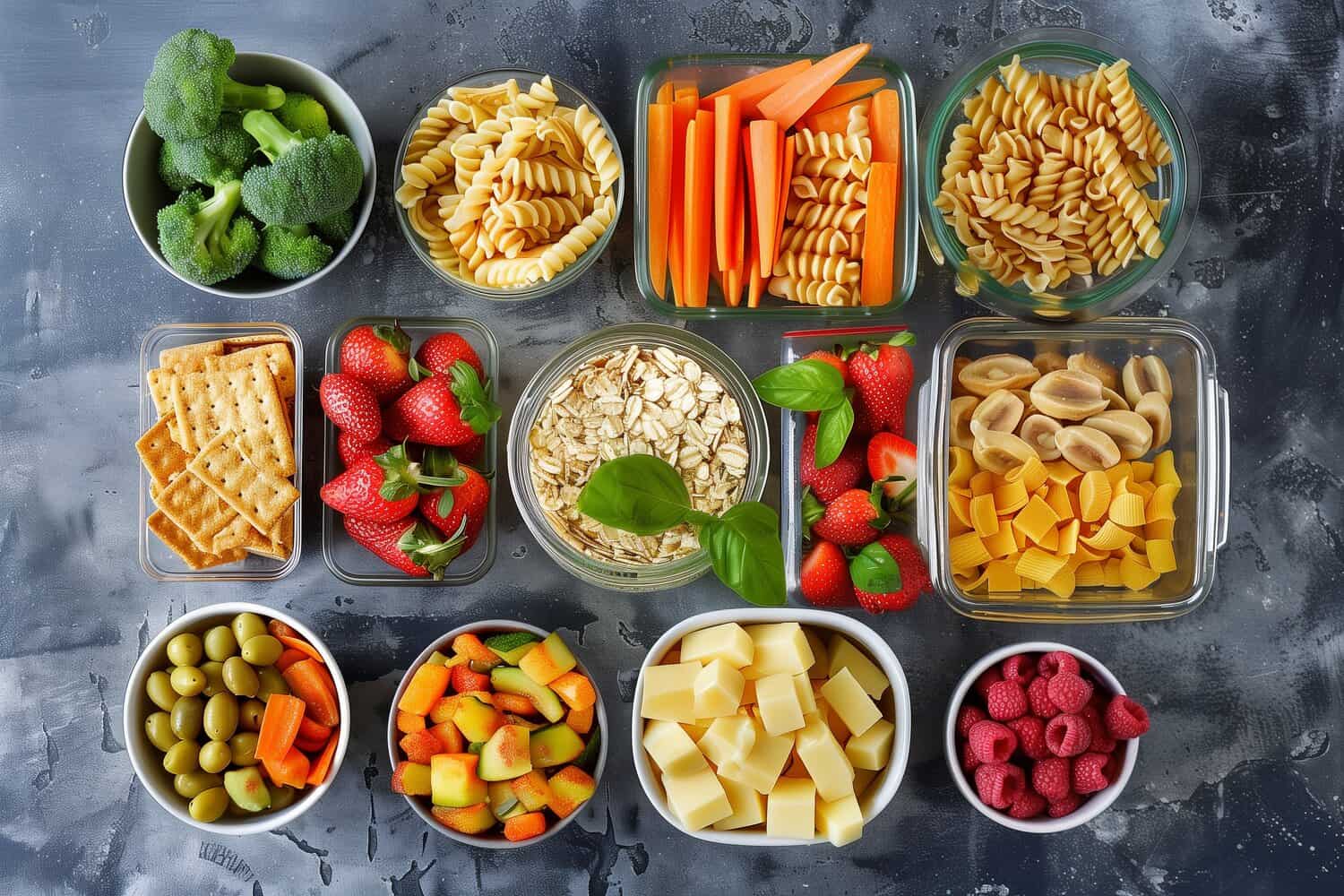
The fastest fix for the 4pm snack scramble is one hour on Sunday: wash and cut produce, bake one tray of muffins or bars, portion everything into single-serve containers, and put the whole lot on one eye-level fridge shelf. Fifteen snacks, fifteen zero-decision afternoons, and dinner stops competing with a bag of chips.
Why the 4pm snack window derails weeknight dinners
Your kid walks in at 3:45. They are ravenous, they are done making decisions for the day, and the first thing they can reach without asking is what they eat. If that's a sleeve of crackers or a granola bar with 14 grams of added sugar, two things happen: they're not hungry at 6:30, and the dinner you planned around them gets picked at and scraped into the trash.
That's not a discipline problem. It's a logistics problem. The pantry has a 10-second path to calories and the fridge has a 10-minute one, so the pantry wins every single afternoon. The MyPlate snack guidance frames snacks as small meals that fill real gaps between eating occasions — protein, fiber, and produce, not just fast carbohydrate. The only way that happens on a Tuesday is if the good option is already the fastest option.
One Sunday hour flips the path. When cut fruit is in a clear container at eye level and the muffins are on the same shelf, the 10-second path goes to the fridge. The plan below is the same fifteen snacks, prepped every Sunday, rotating four categories so nothing gets boring by October.
If you want the same-day, cook-it-now version of this problem, we have a companion piece — 20 After-School Snacks Kids Actually Eat in 15 Minutes. This article is the opposite approach: cook once, coast for five days.
The prep philosophy: 15 minutes of chopping = 15 zero-decision afternoons
Three rules make weekly snack prep survive contact with a real week.
Rule 1 — Prep to a container, not to a recipe. A batch of energy bites sitting in one big tub is a recipe. The same batch portioned into fifteen 4-ounce cups is a snack system. The portioning is the part that makes the afternoon decision-free, and it's the part everyone skips.
Rule 2 — Two shelf-stable, two fridge, one warm. Every week you want at least two things that live in the pantry (bars, trail mix), two that live in the fridge (parfaits, cut veg with dip), and one that reheats in 90 seconds. That spread survives a hot September and a cold November without re-planning.
Rule 3 — Batch by equipment, not by recipe. One oven session, one blender session, one cutting-board session. You will spend 60 minutes total instead of 60 minutes per recipe, because the setup and cleanup happen once.
The arithmetic is straightforward. Fifteen snacks × 5 minutes of ad-hoc afternoon prep is 75 minutes across the week, spread across your five worst-timed moments. Batched on Sunday it's roughly 60 minutes total, in a block you actually chose.
What you'll need: containers, labels, and a fridge shelf you'll actually see
You need less gear than you think, but the gear you need matters.
Containers. Fifteen to twenty 4-to-8-ounce containers with lids that seal. Glass survives dishwashers and doesn't stain from tomato or turmeric; plastic is lighter for a backpack. Get one size, not four — mixed sizes don't stack, and unstacked containers get pushed to the back of the shelf where they die. Our vetted picks live in Storage & Containers.
A real knife and a big board. Ninety percent of the Sunday hour is cutting. A dull 6-inch knife turns 15 minutes of prep into 30 and mangles apple slices into something no eight-year-old will eat. See Knives & Cutting for the two-knife setup that covers everything here.
A muffin tin and a half-sheet pan. Both baked categories — savory egg muffins and oat muffins — come out of one 12-cup tin, and the bars bake on the sheet. Bakeware has the non-warping picks.
Mixing bowls and a scoop. A 1.5-tablespoon cookie scoop portions energy bites in about 90 seconds instead of five minutes of rolling. Utensils & Tools and Kitchen Gadgets cover the scoop, the peeler, and the salad spinner that keeps cut veg from going limp.
Masking tape and a Sharpie. Write the food and the prep date on every lid. This is the cheapest food-safety system in existence and it settles every "is this still good?" argument in two seconds.
One dedicated shelf. Middle shelf, front, at your kid's eye level. Not the crisper. Not behind the milk. The whole system fails if the snacks are invisible.
Category 1: Protein-forward snacks
Protein is what makes a snack hold until dinner instead of spiking and crashing at 4:30. Aim for 7–12g per serving.
1. Savory cheesy egg muffins — Savory Cheesy Egg Muffins run 99 calories and 8g of protein each, bake 6 in 20 minutes, and reheat from the fridge in 25 seconds. Make a double batch; they're the single highest-value item on this list.
2. Spinach and feta egg muffins — Baked Savory Egg Muffins with Spinach and Feta at 150 calories and 12g protein. Same tin, same bake, different flavor — this is how you keep the rotation from getting stale.
3. Turkey and cheese pinwheels — Classic Turkey and Cheese Pinwheel Sandwiches, 220 calories and 15g protein for four servings, 10 minutes of assembly, no cooking. Roll them Sunday, slice them Sunday, and they hold three days wrapped tightly.
4. Berry yogurt parfaits — Honey-Infused Berry Yogurt Parfaits at 180 calories and 10g protein. Critical technique: assemble yogurt and fruit in the container, keep granola in a separate 2-ounce cup, and combine at eating time. Pre-mixed granola turns to wet sand by Tuesday.
Category 2: Fruit and veg combos that don't go brown
The whole reason cut fruit doesn't survive in most fridges is enzymatic browning — polyphenol oxidase in the fruit reacting with oxygen the moment you cut it. Acid slows the enzyme down dramatically. A 30-second dip in cold water with a tablespoon of lemon juice per cup buys cut apples and pears four good days instead of four hours.
5. Apple "ants on a log" — Apple 'Ants on a Log' with Peanut Butter, 120 calories, 5 minutes. Dip the apple slices, pack the peanut butter separately, assemble at snack time so nothing gets soggy.
6. Hummus and veggie platter — Hummus and Grilled Veggie Platter. Portion hummus into 2-ounce cups and stand carrot, cucumber, and pepper sticks upright in a taller container with an inch of cold water in the bottom. The water is the trick — celery and carrots stay snappy for five days instead of going rubbery on day two.
7. Baked cinnamon apple slices — Cinnamon-Spiced Baked Apple Slices with Almond Flour, 140 calories, 15 minutes prep and 25 in the oven. Baked apple doesn't brown at all, which makes it the reliable Thursday-and-Friday fruit when the fresh-cut stuff is fading.
8. Cinnamon apple nachos — Oven-Roasted Cinnamon Apple Nachos with Caramel Drizzle. This is the Friday treat slot. Roast Sunday, refrigerate, and drizzle the caramel on serving day.
9. Veggie and cheese pinwheel wraps — Vegetable and Cheese Pinwheel Sandwich Wraps at 150 calories for eight servings. The lowest-effort way to get an actual vegetable into a kid who has decided vegetables are over.
Category 3: Grab-and-go carbs
These are the pantry-shelf items — no refrigeration, no assembly, thrown in a backpack for the drive to practice.
10. Peanut butter banana energy bites — No-Bake Peanut Butter Banana Energy Bites for Kids, 110 calories each, 10 minutes total, no oven. A double batch takes 15 minutes and covers two weeks.
11. Peanut butter chocolate granola bars — No-Bake Peanut Butter and Chocolate Granola Bars at 190 calories, 12 bars per batch. Cut them, wrap them individually, and they are functionally identical to a store bar at about a third of the cost and none of the added-sugar load.
12. Banana oat mini muffins — Homemade Banana Oat Mini Muffins, 70 calories each and 24 to a batch. The best use of the bananas that went spotty over the weekend, and the small size means a kid eats two and feels like they got something.
13. Trail mix energy bars — Philadelphia Trail Mix Energy Bars with Nuts and Dried Fruit at 220 calories and 6g protein. The highest-calorie item here on purpose — this is the after-practice bar, not the after-homework one.
14. Overnight oats cups — No-Bake Peanut Butter Banana Overnight Oats, 350 calories and 10g protein, built Sunday night in the same jars they get eaten from. Doubles as breakfast on the mornings that get away from you.
15. Chia and berry pudding — No-Bake Chia and Coconut Pudding with Mixed Berries, 180 calories, four servings, ten minutes of work and zero cooking. Set it Sunday, eat it through Thursday.
Category 4: Warm-in-90-seconds options
Once it's dark at 5pm, cold snacks stop selling. Keep two warm options in the rotation from about mid-October.
Mini cheese quesadillas — Kid-Friendly Mini Cheese Quesadillas, 290 calories, 5 minutes prep and 12 to cook. Cook them Sunday, stack with parchment between, and reheat in a dry skillet for 90 seconds — the microwave makes them limp, the skillet brings the crust back.
Mini pita pizzas — Vegetable-Loaded Mini Pita Pizzas, 220 calories, 12 minutes. Assemble Sunday but don't bake; store assembled and unbaked, then hit them with 6 minutes at 400°F on a school afternoon.
Sweet potato fries with yogurt dip — Homemade Baked Sweet Potato Fries with Yogurt Dip, 180 calories, 10 minutes prep. Par-bake Sunday to 80% done, finish for 8 minutes at 425°F when they're wanted. Full-baked-then-reheated sweet potato fries go soft; par-baked ones crisp.
The Sunday hour: exact sequence
The order matters. Everything below assumes one oven, one cook, and 60 minutes.
| Minute | Task | Why here |
|---|---|---|
| 0:00 | Preheat 375°F; mix egg-muffin batter | Oven ramps while you mix |
| 0:08 | Egg muffins into the oven (20 min) | Longest bake goes first |
| 0:10 | Mix and pan the banana oat mini muffins | Uses the same bowl, no wash |
| 0:15 | Wash and cut all produce; lemon-dip the apples | Hands-free oven time |
| 0:28 | Egg muffins out; mini muffins in (15 min) | One tin swap |
| 0:30 | Roll energy bites with a cookie scoop | No oven needed |
| 0:38 | Press and cut the granola bars | Sheet pan, same station |
| 0:43 | Mini muffins out; build parfaits and chia cups | Cooling starts |
| 0:48 | Roll and slice both pinwheel batches | Cutting board already out |
| 0:53 | Portion everything; label with food + date | The step that makes it work |
| 1:00 | Load the shelf, front row first | Visibility is the whole point |
Two things to protect: don't portion anything warm (condensation ruins texture and shortens fridge life), and don't skip the labeling minute at 0:53 to save time. The label is what stops a Thursday judgment call from becoming a Thursday argument.
Storage rules by food type
Shelf life here is about water activity and acidity, not calendar days — the shelf-life basics are that drier and more acidic foods last longer. That's why a granola bar outlives a parfait by a factor of four.
| Snack | Where | Keeps | Notes |
|---|---|---|---|
| Egg muffins | Fridge | 5 days | Reheat 25 sec; freeze at 3 months |
| Yogurt parfaits | Fridge | 5 days | Granola stored separately |
| Cut apples (lemon-dipped) | Fridge | 4 days | Airtight; no dip = 1 day |
| Veg sticks in water | Fridge | 5 days | Change the water on day 3 |
| Hummus (portioned) | Fridge | 5 days | Discard if it weeps or smells sharp |
| Pinwheels | Fridge | 3 days | Wrap tightly; tortilla dries fast |
| Energy bites | Fridge | 14 days | Freezer: 3 months |
| Granola bars | Pantry | 7 days | Fridge: 14 days |
| Mini muffins | Pantry | 3 days | Fridge: 7 days; freezer: 3 months |
| Overnight oats | Fridge | 4 days | Add fruit on serving day |
| Chia pudding | Fridge | 5 days | Stir before serving |
| Quesadillas (cooked) | Fridge | 4 days | Reheat in a dry skillet |
| Pita pizzas (unbaked) | Fridge | 3 days | Bake from cold, 6 min at 400°F |
| Sweet potato fries (par-baked) | Fridge | 4 days | Finish 8 min at 425°F |
The single most important variable is fridge temperature. The FDA's guidance on refrigerator thermometers is that the box should sit at or below 40°F — most home fridges with a full door and a busy family run several degrees warmer than the dial claims. A $7 thermometer on the middle shelf is the difference between the numbers above and half of them.
Shopping list, aisle by aisle
Produce — 6 apples, 2 lb carrots, 2 cucumbers, 2 bell peppers, 1 bunch celery, 4 bananas (spotty is ideal), 1 pint blueberries, 1 pint strawberries, 1 lemon, 2 sweet potatoes, 1 bag baby spinach.
Dairy and eggs — 18 eggs, 32 oz plain Greek yogurt (tub, not pouches), 8 oz shredded cheddar, 4 oz feta, 8 oz cream cheese, 1 gallon milk.
Deli — 1 lb sliced turkey.
Center aisles — 32 oz rolled oats, 16 oz peanut butter, 8 oz almond butter, honey, chia seeds, mini chocolate chips, 8 oz mixed nuts, 8 oz dried fruit, 1 can coconut milk, 10 oz tortillas, 6 mini pitas, marinara, 16 oz hummus (or chickpeas and tahini to make your own), whole-wheat flour, baking powder, cinnamon, vanilla.
At national supermarket averages that's roughly $18–22 per kid per week, which is about half of what the same fifteen snacks cost as individually wrapped supermarket items. The savings concentrate in three places: yogurt in a tub instead of pouches, oats in a canister instead of instant packets, and cheese by the block instead of pre-shredded.
Send the whole list to your store in one pass from the shopping list tool, or ask AislePrompt's chat to rebuild the fifteen around an allergy — nut-free, dairy-free, or gluten-free versions of this exact rotation take about 30 seconds to generate.
Common pitfalls
Prepping thirty snacks instead of fifteen. Week one enthusiasm produces a fridge full of food that goes bad by Thursday and kills the habit. Fifteen portions covers a five-day week with three snacks a day for one kid, or one-and-a-half kids at two a day. Scale by kid, not by ambition.
Storing everything assembled. Granola in the parfait, peanut butter on the celery, sauce on the pita. Every one of those turns good food into wet food by day two. Wet components go in separate cups.
Using the crisper drawer. Out of sight is out of the rotation. Snacks live on the shelf your kid opens the door and sees.
Skipping the warm category after October. Cold snacks stop being appealing when it's dark and 45°F. Two warm options keeps the system alive through winter.
Prepping only sweet things. Sweet-only rotations burn out fast and leave the protein gap unfilled. The 2-protein / 2-produce / 2-carb / 1-warm split per week is the shape that survives.
When this isn't the right approach
If your kid eats one snack a day and it's always the same thing, don't build a fifteen-item system — make a double batch of that one thing and move on. And if afternoons are genuinely chaotic (different pickup every day, activities in three directions), the backpack-portable subset matters more than the fridge subset: bars, bites, trail mix, and muffins travel; parfaits and quesadillas don't.
Sources
- MyPlate — Snacks — what a snack should actually contain
- Wikipedia — Enzymatic browning — why cut apples go brown and how acid stops it
- FDA — Refrigerator Thermometers: Cold Facts About Food Safety — the 40°F rule behind every number in the storage table
- Wikipedia — Shelf life — water activity and acidity as the drivers of keeping time
Calorie, protein and timing figures come from the linked AislePrompt recipe pages; costs are national supermarket averages as of 2026.
Related guides
Snack prep is one shelf of a bigger back-to-school system. The lunchbox side is covered in Kid Lunchbox Meal Prep: 20 Bento-Style Ideas and Freezer-Friendly School Lunch Prep. Mornings are in 20 Quick School-Morning Breakfasts. And the dinner half — the meals this snack rotation is designed to protect — is in Back-to-School Family Dinners and the Sunday-prep playbook.
Run the whole week from the meal plan tool if you want the snacks and dinners on one shopping list.
Frequently asked questions
How long do prepped snacks actually last in the fridge?
Can I freeze these snacks for even longer storage?
What if my kid refuses to eat what I prep?
How much does a week of prepped snacks cost per kid?
How many snacks should I actually prep for one kid?
Can I get these ingredients in one grocery order?
Kid-friendly recipes from the catalog
Save any of these to My Recipes — no account needed — and send the ingredients to Instacart in one tap.