Best Spice Grinders and Mortar and Pestle Sets for 2026: Top Picks + Buying Guide
A whole spice keeps its flavor for two years and a ground one for six months — the right grinder is how you collect the difference.
Where to buy these picks
Affiliate links: we may earn a commission on qualifying Amazon purchases. Policy. Prices show only when checked in the last 24 hours.
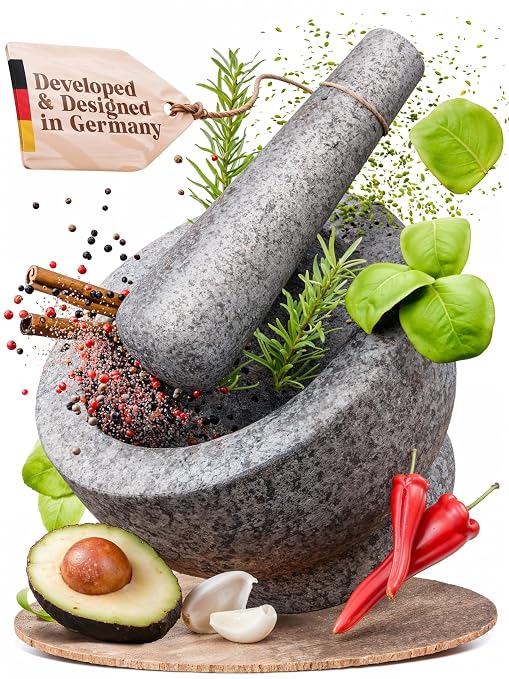
- ChefSofi 6-Inch 2-Cup Unpolished Granite Mortar and PestleCheck price on Amazon →
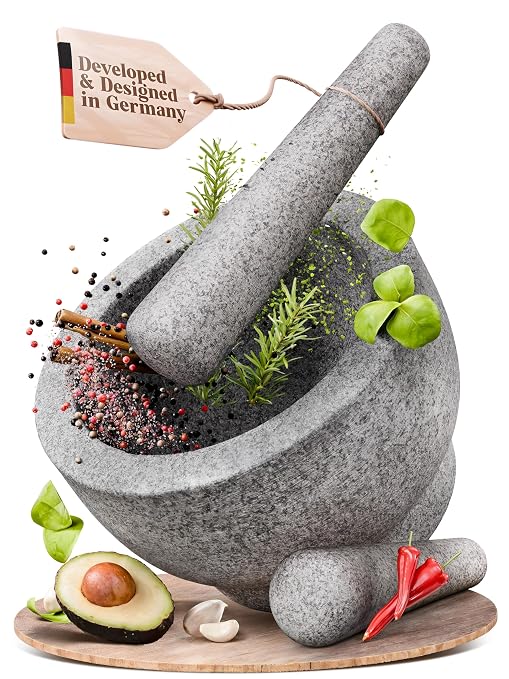
- GORILLA GRIP Natural Granite Unpolished MolcajeteCheck price on Amazon →
- Umien 8-Inch Granite Molcajete, 3.5-CupCheck price on Amazon →
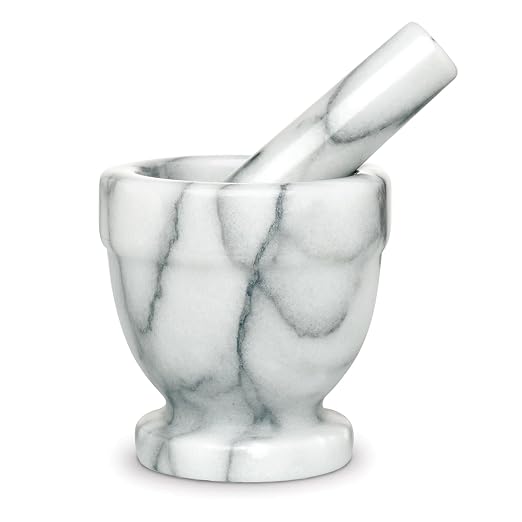
- HIC Kitchen Carrara Marble, 3.8-InchCheck price on Amazon →
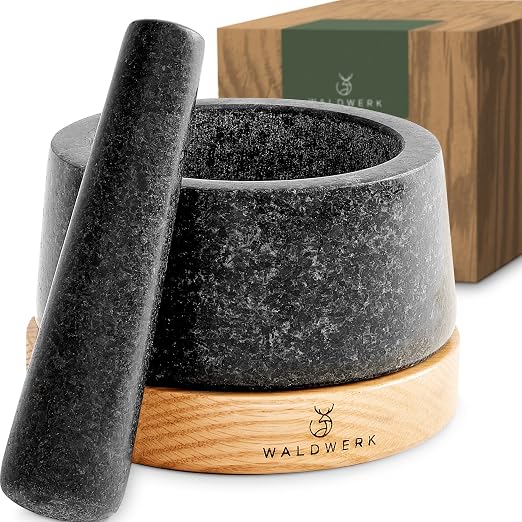
- WALDWERK Granite Mortar and Pestle with Oak BaseCheck price on Amazon →
For home cooking in 2026 the best spice grinder for most people is a heavy unpolished granite mortar and pestle, and the ChefSofi 6-Inch 2-Cup set at $29.99 is the one to buy. Granite's coarse tooth grips peppercorns and cardamom pods instead of letting them skate, it handles wet pastes no electric grinder will touch, and it never contaminates your coffee.
Get a free week of easy dinners
Seven weeknight dinners with the shopping list already totalled, sent Sunday. No account needed, unsubscribe in one click.
No spam, unsubscribe in one click. Recipes, shopping lists and Instacart carts all work without an account either way.
Why whole spices beat the pre-ground jar
The flavor of a spice lives in volatile oils that oxidise and evaporate on contact with air. Grinding shreds the seed coat that was sealing them in and multiplies the exposed surface area, so the clock starts the second the seed breaks. The numbers are not subtle: a whole dry spice keeps roughly two years, a ground one roughly six months, and its real "flavor life" is shorter still (Wikipedia — Spice).
Now count the time a jar of pre-ground cumin has already spent in the supply chain. It was ground at a processor, warehoused, trucked, shelved, and then sat in your cabinet. A jar you open in 2026 is very often past the six-month mark before its first use. That is the whole gap: not that grinding at home is magic, but that the jar has already spent its budget.
You will notice it most in the cuisines that build a dish on a blend rather than a single note — the berbere in our Ethiopian recipe roundup, the ras el hanout in the Moroccan collection, the garam masala across the Indian weeknight dinners. Those blends are 8 to 20 spices deep. When each component is at 30% strength, the result is not a weaker version of the dish; it is a muddier one, because the loud spices (cinnamon, clove) fade more slowly than the delicate ones (coriander, fennel, cardamom) and the ratio drifts.
Our top 5 picks
Every pick below is a live listing in our catalog, checked the week this guide was published.
#1: ChefSofi 6-Inch 2-Cup Unpolished Granite Mortar and Pestle
Verdict: Best overall. $29.99, 2-cup bowl, anti-scratch base protector included.
This set is the default answer because unpolished granite is the right surface for the job. Granite is built from quartz and feldspar, which sit at 7 and 6 on the Mohs hardness scale; polished marble is calcite at 3 (Wikipedia — Mohs scale). That hardness gap is why a granite bowl keeps its tooth for decades of pounding while a marble one slowly burnishes smooth.
The 6-inch/2-cup size is the sweet spot. It is big enough to grind a full tablespoon of toasted cumin and coriander for a Punjabi chana masala without spraying seeds onto the counter, and small enough to live out on the worktop instead of in a cabinet — which matters more than any spec, because a mortar in a cabinet is a mortar you do not use.
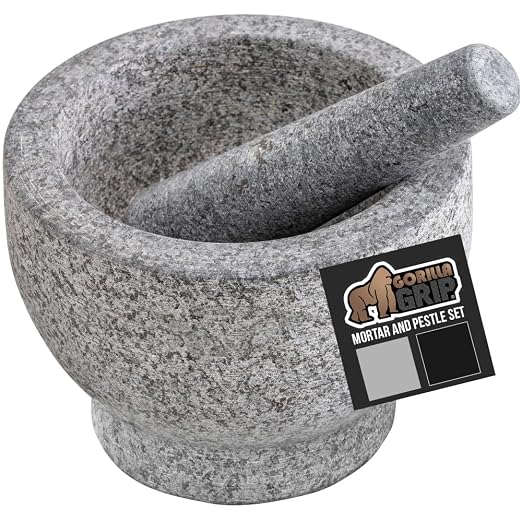
#2: GORILLA GRIP Natural Granite Unpolished Molcajete
Verdict: Best value. $23.99, 1.5-cup bowl, non-scratch base.
The Gorilla Grip gives you the same unpolished granite working surface for six dollars less, in a slightly smaller 1.5-cup bowl. If your grinding is mostly seed spices measured in teaspoons rather than pastes measured in cups, you lose nothing. The non-scratch base is not a gimmick — a 5-pound stone bowl on a stone countertop will mark one of them, and it will not be the bowl.
Where the smaller bowl costs you: wet work. Two avocados for a roasted-jalapeño guacamole will crowd 1.5 cups. Grind spices here, mash guacamole in something bigger.
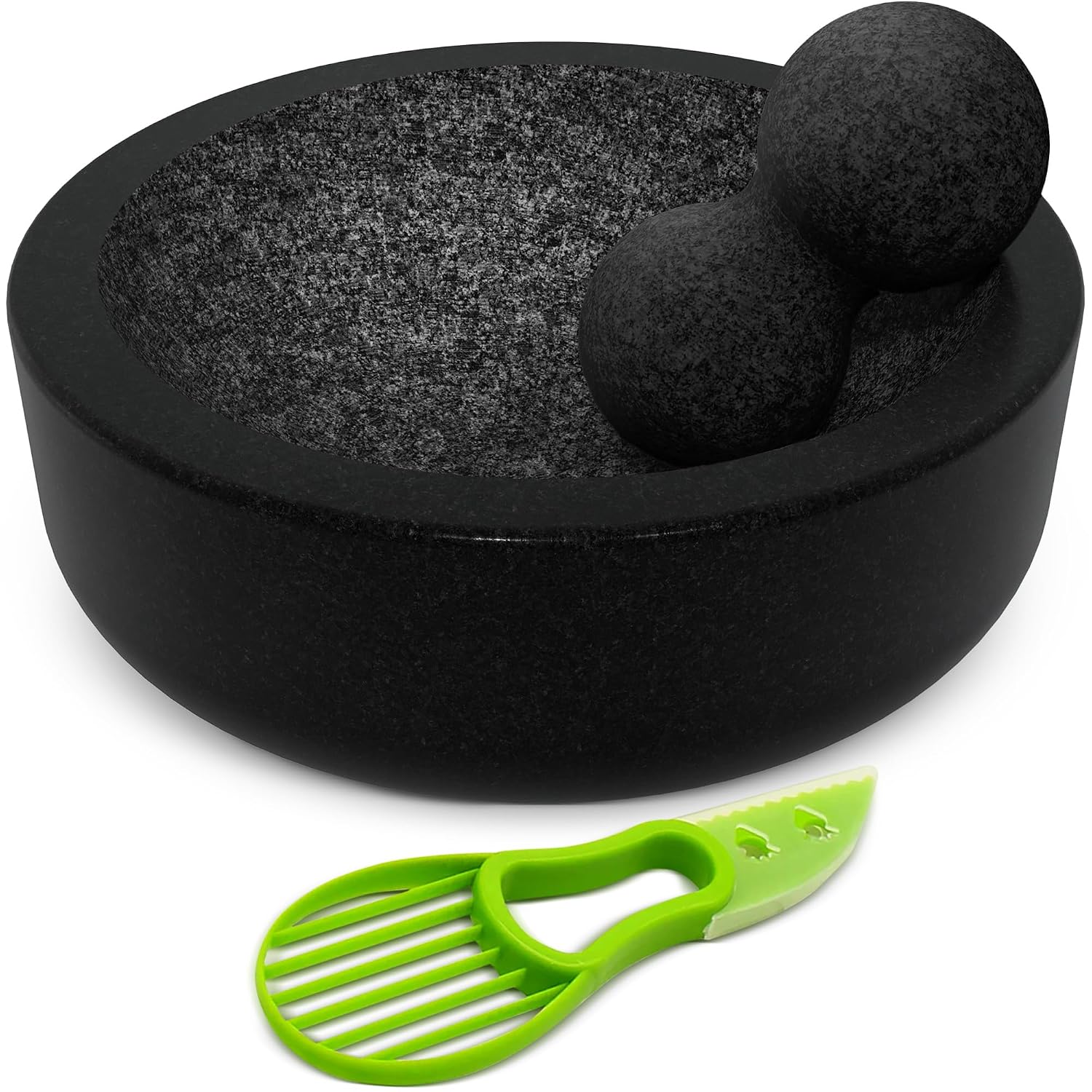
#3: Umien 8-Inch Granite Molcajete, 3.5-Cup
Verdict: Best for batch work and pastes. $25.99, 3.5-cup capacity, avocado tool included.
An 8-inch molcajete is what you want if you make paste more often than powder. Chile-garlic pastes for birria, the basil-and-garlic base behind a pesto pasta — pesto is literally named for the pestle that made it (Wikipedia — Mortar and pestle) — and a full batch of guacamole all need room to work, and at 3.5 cups you get it for a dollar more than a 1.5-cup bowl.
The trade-off is real: a wide shallow bowl is worse at small dry batches, because a teaspoon of fennel seed spreads out and the pestle cannot corner it. If you buy this as your only mortar, expect to hunt seeds around the bowl.
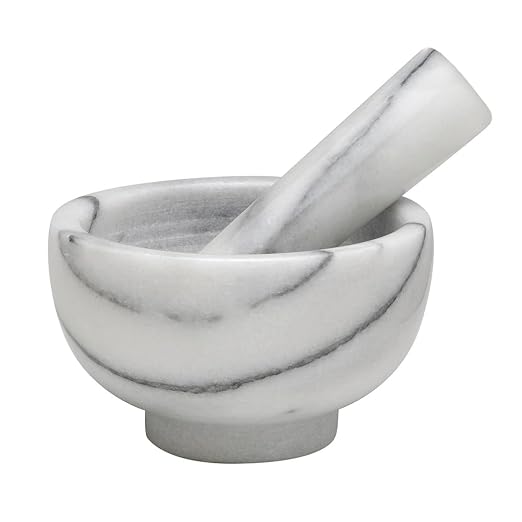
#4: HIC Kitchen Carrara Marble, 3.8-Inch
Verdict: Best small/second mortar. $14.30, solid Carrara marble.
Marble is the wrong material for hard whole spices and the right one for everything soft. This 3.8-inch HIC is where you crush garlic and salt into a paste, bruise cardamom pods before they go into a cardamom rice pudding, or grind a pinch of saffron with sugar. The narrow bowl keeps small quantities contained in a way the 8-inch molcajete cannot.
At $14.30 it is cheap enough to own alongside a granite bowl and reserve for wet and aromatic work, which is the real reason to buy it: you stop cross-flavoring. There is also a 4-inch tall version at $12.89 with a deeper well if you crush more than you grind.
#5: WALDWERK Granite Mortar and Pestle with Oak Base
Verdict: Best premium. $49.99, natural granite with an anti-scratch oak base and oversized pestle.
The WALDWERK costs roughly $20 more than the ChefSofi and spends it on two things that matter during use: an oversized pestle, which means more mass per stroke and fewer strokes, and an oak base that solves the countertop-scratch and countertop-noise problem properly rather than with a rubber ring.
Buy it if you grind several times a week and want the tool to be pleasant rather than merely effective. If you grind monthly, the ChefSofi does the same job for $30. Note the smaller review pool (823 vs 24,039) — less corroborated, though the 4.8 average is consistent.
Also worth knowing
These did not make the top five but are the right answer for a specific case.
| Product | Price | Buy it for |
|---|---|---|
| ChefSofi Extra-Large 8-Inch, 5-Cup | Check price | Two pestles, 5-cup bowl; batch-cooking households |
| PriorityChef Granite with Bamboo Base | Check price | Same size as the ChefSofi with a wood base |
| Velaze 2-Cup Unpolished Granite | Check price | Long 6.3-inch pestle, better leverage |
| Laevo White Marble, Reversible 2.1-Cup | Check price | Reversible bowl; looks good left out |
| Tera Marble Small, 4.64-Inch | Check price | Compact marble for pastes and pills |
| Fox Run Marble Mortar and Pestle | Check price | Unpolished marble interior, rare in marble |
| IMUSA Polished Granite, 3.75-Inch | Check price | Cheapest real granite in the catalog |
| LEETOYI Porcelain, 3.3-Inch | Check price | Non-porous; zero flavor carryover |
Where to buy the picks in this guide
Prices are shown only when checked in the last 24 hours; otherwise check the current price on Amazon.
One catalog note in the interest of honesty: several of these brands list near-identical variants (polished vs unpolished, two colorways) that share a single review pool.
Electric vs manual: which tool for which spice
Here is the part most buying guides get wrong. "Electric spice grinder" describes three different machines, and only one of them is a spice grinder.
Blade grinders (the cheap $20 unit sold as a coffee grinder) chop with a spinning blade and produce an uneven grind with real friction heat. For spices that is fine — you want a coarse-to-medium powder and you are using it in the next five minutes. This remains the standard workshop answer for grinding a half-cup of whole spices fast. Our catalog does not currently stock a dedicated blade spice grinder; the honest advice is to buy a bare-bones blade coffee grinder and dedicate it to spices permanently, label included.
Burr mills crush between two abrasive surfaces, heat the product far less, and give a uniform particle size set by the gap between the burrs (Wikipedia — Burr mill). That is exactly what you want for coffee and exactly what you must not use for spices: turmeric and cumin oils will coat the burrs, hard seeds like coriander will chip them, and a $110 grinder like the OXO Brew Conical Burr is too expensive to sacrifice. Keep it on coffee only.
Electric mills are the rechargeable shakers that grind at the table. The Gaivis rechargeable 2-pack at $23.99 and the ThermoMaven set at $39.99 are one-handed and genuinely useful for peppercorns and coarse salt. They are not general spice grinders — do not load cinnamon bark or cardamom pods into a ceramic pepper mechanism.
And then there is the manual mill, which is what most cooks actually reach for daily. The PepperMate Traditional 723 at $34.99 grinds into a catch cup, so you can measure a half-teaspoon of pepper instead of guessing at wrist-turns — the single most useful feature on any grinder for someone who follows recipes. The Peugeot u'Select 22cm at $43.60 is the heirloom option, with a detented coarseness selector you set rather than feel for. At the other end, the Ebaco stainless mill is a budget mill with a ceramic mechanism — the right price for something you fill with a single blend and keep next to the stove.
For the two hardest cases, buy the purpose-built tool. Cinnamon bark and whole nutmeg wreck ordinary grinders; the Microplane Manual Spice Mill at $22.99 handles both with photo-etched blades, and a plain Microplane zester does nutmeg and fresh ginger for $18.99.
Real-world numbers
| Task | Granite mortar | Blade grinder | Electric mill |
|---|---|---|---|
| 1 tsp toasted cumin | 45-60 sec | 10 sec (won't grip so little) | Not suitable |
| 2 tbsp whole garam masala | 4-6 min | 20-30 sec | Not suitable |
| Garlic + salt to a paste | 60 sec | Smears, won't emulsify | No |
| Peppercorns for a roast | 90 sec | 10 sec, uneven | 15 sec, even |
| Wet chile paste for birria | 3-4 min | Needs liquid to move | No |
| Cleanup between spices | Rice purge, 30 sec | Rice purge + wipe, 60 sec | Empty hopper |
Two honest conclusions from that table. The mortar wins on small batches, wet work, and control; the blade grinder wins on volume and speed, by a factor of roughly ten. If you grind more than about two tablespoons at a time on a weekly basis, you want both tools, and the total is still under $60.
What to look for
Material and tooth. Unpolished granite first, unpolished marble second, polished anything last, ceramic only for soft work. The interior finish matters more than the rock: a polished granite bowl grinds worse than an unpolished marble one.
Weight. 4 to 8 pounds. The stone should do the work; if the bowl skates while you pound, it is too light. This is the spec most $12 listings quietly fail.
Bowl geometry. Deep and narrow contains small dry batches; wide and shallow suits pastes. If you are buying one mortar and grind mostly seeds, go narrow.
Capacity. 1.5-2 cups covers the overwhelming majority of home use. Go to 3.5-5 cups only if you make salsas and pastes in volume.
Seasoning requirement. Real basalt molcajetes and unpolished granite need a rice break-in (below). Ceramic and porcelain do not. Factor in the 20 minutes.
Footprint and looks. A mortar you leave out gets used ten times more than one in a cabinet. This is a real purchasing criterion, not an aesthetic aside.
For mills specifically: look for a catch cup (measurability), an external coarseness setting you can index rather than feel for, and a ceramic or hardened-steel mechanism — plastic burrs round off inside a year.
Care: cleaning, seasoning, and getting the coffee out
Season a new granite or basalt mortar before first use. Grind a handful of raw white rice to powder and discard it; repeat until the flour comes out white with no grey stone grit in it. Then grind a few cloves of garlic with coarse salt and discard that too. Porous stone is impossible to fully sanitise and will always carry a little flavor forward — that is a known property of the molcajete, which "seasons" much like a cast-iron pan (Wikipedia — Molcajete).
Between spices, pulse 2 tablespoons of raw rice or a piece of stale bread, then wipe dry. Never wet-wash a stone mortar with soap: porous stone absorbs detergent and gives it back to your next paste. Warm water and a stiff brush, then air-dry completely.
Getting coffee out of a blade grinder: grind rice, wipe, repeat. Then accept that you will never fully win, and buy the second grinder. At $20 for a blade unit this is the cheapest problem in your kitchen to solve permanently.
Toast before you grind. Dry-toast whole seeds in a cast-iron skillet over medium heat for 60-90 seconds, until they smell nutty and the first seed pops, then cool before grinding — hot seeds gum up any grinder. The related South Asian technique, tempering or tadka, goes the other way and blooms whole spices directly in hot oil or ghee to liberate their essential oils into the fat (Wikipedia — Tempering (spices))). Both work; toasting is what you do before a grinder, tempering is what you do instead of one.
Four blends worth grinding from whole
Garam masala. Toast cinnamon, green cardamom, clove, cumin, coriander and black pepper, then grind. The difference is loudest in a dish where the blend is the whole point, like a garam masala beef curry with spinach or a biryani — both dishes where a stale blend reads as "brown" rather than as anything.
Ras el hanout. The North African "head of the shop" blend runs a dozen-plus spices. Grind it fresh for a Moroccan chickpea tagine, a ras el hanout vegetable tagine, or a slow-roasted lamb shank.
Berbere. Ethiopian chile-forward blend built on dried chile, fenugreek, korarima and ajwain. Whole-toasted and ground it is the entire difference between a good and a flat doro wat or a slow-simmered berbere chicken stew.
Za'atar. Not strictly a grinding job — you want texture, sesame kept whole, thyme crumbled rather than pulverised — which is precisely where a mortar beats a machine, because you can stop. Use it on a za'atar roasted chickpea salad or sumac lamb chops.
Once you have the tool out, the everyday cases follow: whole cumin for a cumin-spiced lentil soup, toasted coriander for spiced potato paratha, a coarse Sichuan peppercorn crush for stir-fried beef with garlic and chilies, a fresh tandoori mix for tandoori chicken thighs, a harissa base for harissa sheet-pan chicken, and a hand-crushed nut-and-seed dukkah for grilled prawns that no blender will give you the texture for.
Common pitfalls
Buying polished because it photographs better. A glossy interior is a worse grinding surface, full stop. Unpolished looks rougher and works better.
Buying too light. Under about 4 pounds the bowl moves when you pound and you end up steadying it with one hand, which halves your force.
Using the burr coffee grinder "just this once." Spice oils are not water-soluble and burrs are not easily cleaned. One batch of turmeric is enough to flavor coffee for weeks.
Soap-washing porous stone. Detergent soaks in and comes back out into the next paste. Rice, brush, water, air-dry.
Grinding warm spices. Toasted seeds must cool. Warm seeds release oil, oil turns powder into paste, paste cakes inside the grinder.
Grinding a whole jar's worth "to save time." You have just converted a two-year shelf life into a six-month one. Grind what the recipe needs, plus a little.
When not to buy one
If you cook from pre-made blends and are happy with the result, a mortar and pestle will sit unused; buy a $7 Ebaco mill for pepper and spend the rest elsewhere. If you have wrist or grip limitations, pounding is genuinely difficult — go straight to an electric mill or a blade grinder. If your cooking is European and herb-led rather than spice-led, a garlic press and a sharp knife cover most of what a mortar would do for you.
And if you are outfitting a kitchen from scratch, a mortar is not the first purchase. Work through the kitchen gadgets that actually earn drawer space and a cast-iron skillet first; the grinder is what you add once the cooking gets ambitious enough to need it — the point at which you start cooking from our Middle Eastern dinners rather than around them.
Sources
- Wikipedia — Spice: volatile-oil loss, surface area on grinding, and the two-year vs six-month shelf-life figures.
- Wikipedia — Mortar and pestle: materials, history, and the pestle/pesto etymology.
- Wikipedia — Molcajete: vesicular basalt, the rice seasoning procedure, and why porous stone carries flavor forward.
- Wikipedia — Mohs scale: quartz at 7, orthoclase feldspar at 6, calcite at 3 — the granite-vs-marble hardness gap.
- Wikipedia — Burr mill: burrs vs blades on friction heat and particle uniformity.
- Wikipedia — Tempering (spices)): blooming whole spices in fat to release essential oils.
Frequently asked questions
Can I use my coffee grinder for spices?
Mortar and pestle or electric grinder — which should I buy first?
How do I clean spice residue between different spices?
Why do fresh-ground spices taste so different from pre-ground?
Is a granite mortar and pestle better than marble or ceramic?
Do I need to season a new mortar and pestle before using it?
How we picked
This guide is researched, not bench-tested. We shortlisted products from the AislePrompt kitchen catalog and compared them on published manufacturer specifications (materials, size, capacity, warranty), on what owners report in published reviews, and on any third-party sources linked in this guide. The guide was drafted with AI assistance. We did not run lab or hands-on tests of these products, so any measurement quoted here comes from the manufacturer or a cited source. Prices change often: use the “Check price on Amazon” buttons for today’s price.
Sources
Recipes to try with these tools
Put your gear to work — save any recipe to My Recipes (no account needed) and send its ingredients to Instacart in one tap.



Shop kitchen tools on AislePrompt →Browse the full kitchen shop →
Plan a week of meals in two minutes.
Tell our AI what you have and what you like — it builds your plan, shopping list, and Instacart cart. No account needed.
Plan my week →