22 Greek Recipes: Moussaka, Souvlaki, Spanakopita & Weeknight Dinners
Four pantry staples — olive oil, lemon, oregano and feta — carry every dish here, from 12-minute souvlaki to a Sunday moussaka.
Greek cooking is built on four cheap ingredients — olive oil, lemon, oregano and feta — layered over grilled meat, baked vegetables or beans. Most of the canon lands on the table in under 45 minutes; only the layered bakes like moussaka and pastitsio need an oven hour. The 22 recipes below are organized by how much time you actually have.
Get a free week of easy dinners
Seven weeknight dinners with the shopping list already totalled, sent Sunday. No account needed, unsubscribe in one click.
No spam, unsubscribe in one click. Recipes, shopping lists and Instacart carts all work without an account either way.
Introduction: The Mediterranean's Under-Ranked Weeknight Cuisine
Italian and Spanish food get the weeknight credit, but Greek cooking is the faster of the three. There is no long-simmered soffritto, no saffron to bloom, no risotto to stir. A chicken souvlaki marinade is olive oil, lemon juice, garlic, oregano and salt — five things, whisked in the bowl you'll marinate in. Lemon-Infused Greek Chicken Souvlaki with Tzatziki needs 70 minutes of hands-off marinating and 12 minutes on the grill, and it costs about $3.20 per 320-calorie serving at 2026 US grocery prices.
That asymmetry — almost no active time, big flavor return — is why Greek food survives a Tuesday. It is also why the cuisine is quietly one of the best-documented Mediterranean diets in nutrition research: the base is vegetables, legumes, olive oil and yogurt, with meat used as seasoning rather than centerpiece. Wikipedia's overview of Greek cuisine traces the regional split that explains most of what follows: island cooking leans on fish, herbs and capers; mainland and northern cooking leans on lamb, phyllo and slow bakes.
This roundup pulls from both. Every recipe below is on AislePrompt with a full ingredient list and an Instacart shopping list, so you can send an entire week's worth of Greek dinners to a cart in one pass.
What you'll find here:
| Section | Recipes | Typical total time | Best for |
|---|---|---|---|
| Grilled & roasted mains | 6 | 25–60 min | Weeknight dinners, grilling season |
| Layered bakes | 4 | 60–100 min | Sunday cooking, freezer stock |
| Bean & vegetable mains | 4 | 40–135 min | Meatless nights, batch cooking |
| Meze & small plates | 4 | 10–60 min | Appetizers, mezze spreads |
| Salads beyond horiatiki | 4 | 10–25 min | Lunches, sides, potlucks |
| 20-minute pantry dinners | 5 | 15–25 min | Nights with no plan |
Greek Flavor Foundations: Olive Oil, Oregano, Lemon & Feta
Greek recipes rarely have more than eight ingredients because four of them do almost all the work. Get these right and everything else is assembly.
Olive oil is a cooking ingredient, not a finishing drizzle. Greek recipes use it in volumes that look wrong to American eyes — a quarter cup to roast four potatoes, half a cup in a pan of gigantes. That's the point: the oil emulsifies with the tomato and lemon into a sauce. Use a plain extra-virgin for heat (roasting, the béchamel roux, the sauté) and save a single-origin Koroneiki bottle for finishing. A 2026 US grocery run puts decent everyday Greek EVOO around $12–18 per liter and finishing oil at $22–30 for 500 ml.
Oregano means dried Greek oregano, not Italian. Greek oregano (Origanum vulgare subsp. hirtum) is sharper and more camphorous, and it's used dried — the volatile oils concentrate as the plant dries, which is the opposite of how basil or parsley behave. Buy it on the stem in a bunch if your grocer carries it; crumble between your palms directly over the pan.
Lemon is structural. In Avgolemono Chicken Soup with Lemon and Dill, lemon juice tempered with egg is the entire thickener — no roux, no cream, 280 calories and 30 g protein per serving. In Traditional Greek Lemon-Oregano Roasted Potatoes, the lemon-and-stock braise is what makes the potatoes creamy inside while the top edges crisp.
Feta is a PDO product with real variation. Since 2002, "feta" in the EU legally means Greek sheep's-milk (with up to 30% goat's milk) cheese brined in blocks — the feta PDO designation is why US supermarket "feta" made from cow's milk crumbles dry and tastes flat. Buy the block in brine, not the pre-crumbled tub: crumbled feta is coated in anti-caking starch that turns gummy when baked.
Round out the pantry with kalamata olives, capers, dried Greek oregano, cinnamon sticks (for stifado and moussaka's meat sauce), short-grain rice, orzo and canned gigantes or butter beans. A well-stocked pantry and grocery shelf is what makes the 20-minute section at the bottom of this guide possible.
6 Grilled & Roasted Mains: Souvlaki, Gyro, Whole Fish, Lamb Chops
These are the fastest wins in the cuisine — most are under 30 minutes of active work, and every one of them scales to a crowd on a grill.
1. Chicken souvlaki. Lemon-Infused Greek Chicken Souvlaki with Tzatziki is the benchmark: 70 minutes marinating, 12 minutes over direct heat, 320 calories and 35 g protein per serving. Cut the thigh meat into 1.5-inch cubes, not 1-inch — smaller cubes dry out before they char.
2. Pork souvlaki. Charcoal-Grilled Pork Souvlaki with Lemon-Oregano Marinade is what you'd actually get at a souvlatzidiko in Athens. Pork shoulder, 12 minutes on the coals, 320 calories a serving. Pull it at 145°F internal and rest five minutes.
3. Lamb souvlaki. Char-Grilled Lamb Souvlaki with Tzatziki Sauce runs 420 calories and 38 g protein. Lamb leg cubes take a longer marinade (the recipe budgets 70 minutes) because the connective tissue needs the acid.
4. Beef gyro. Slow-Cooked Greek Beef Gyro with Tzatziki Sauce is the home workaround for a vertical rotisserie you don't own: 8 hours in a slow cooker, then shred and crisp the edges under a broiler for 4 minutes. That broiler step is not optional — it's the only thing standing between gyro and pot roast.
5. Whole-fish style sea bass. Pan-Seared Greek Sea Bass with Lemon and Dill is 10 minutes of prep and 10 minutes of cooking for 280 calories and 34 g protein — the leanest main in this guide. Score the skin twice before it hits the pan so it doesn't curl.
6. Lamb chops. Pan-Seared Lamb Chops with Tzatziki and Fresh Dill cooks in 10 minutes flat for 370 calories and 38 g protein. For a crowd, switch to Slow-Roasted Lamb Shoulder with Greek Herbs and Garlic — 3.5 hours at low heat, six servings, 56 g protein each.
Two more worth knowing: Greek Sheet Pan Chicken with Lemon, Olives, and Potatoes puts the whole dinner on one pan in 45 minutes, and Lemon-Oregano Grilled Octopus with Roasted Potatoes is the taverna dish worth the 90-minute simmer-then-char routine once a summer.
If you're grilling for Labor Day weekend, souvlaki scales better than burgers: one marinade bowl feeds twelve, and the skewers cook in the time it takes to toast pita. A good pair of tongs and skewers matters more than the grill.
4 Layered Bakes: Moussaka, Pastitsio, Spanakopita, Tiropita
This is the Sunday-cooking half of the cuisine. Every one of these freezes well, and every one is better on day two.
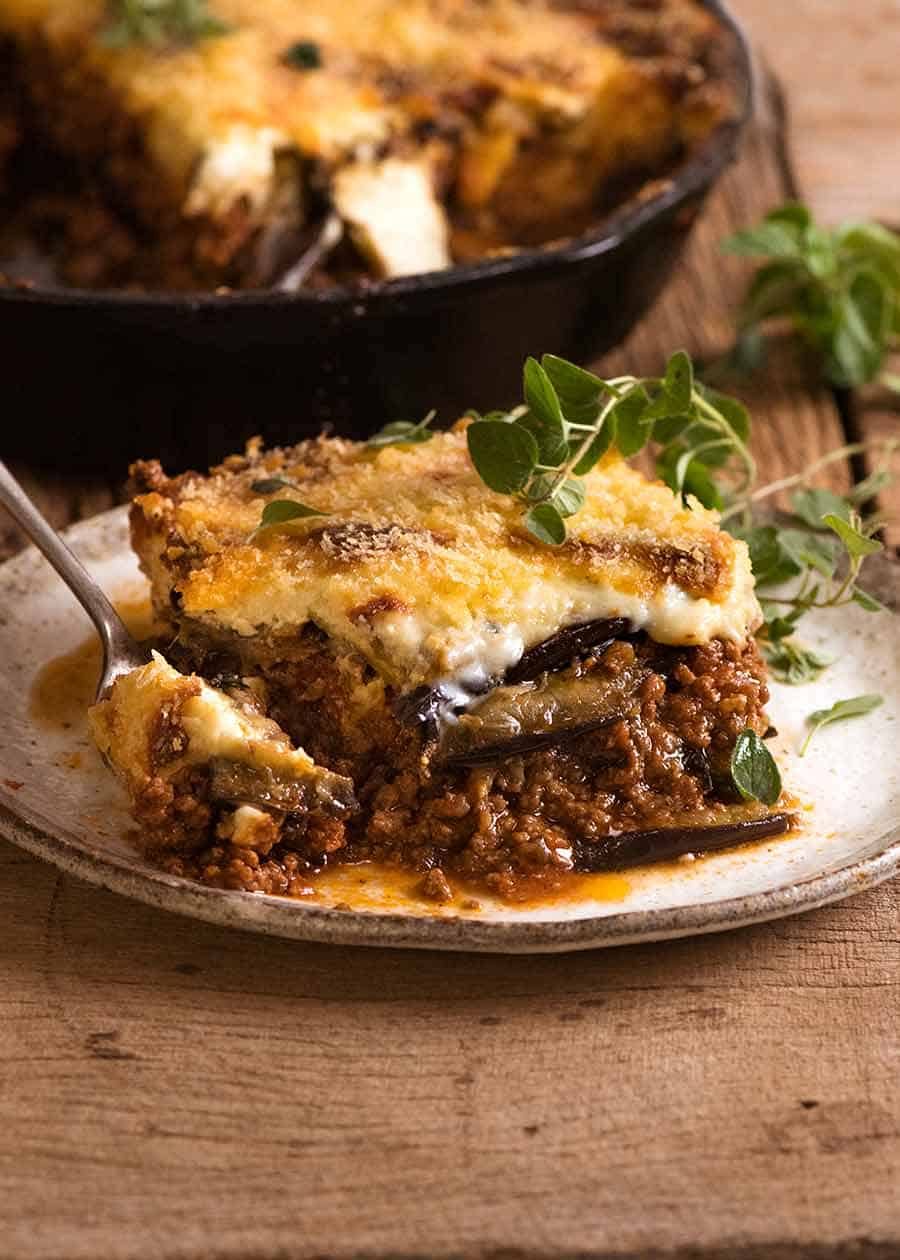
7. Moussaka with lamb. Oven-Baked Greek Eggplant Moussaka with Ground Lamb is the canonical version: 25 minutes prep, 70 minutes bake, 6 servings at 480 calories and 35 g protein. Wikipedia's moussaka entry is worth reading for the detail that the béchamel cap is a 1920s Nikolaos Tselementes addition — the Ottoman-era original had no white sauce at all.
8. Moussaka with beef. Oven-Baked Moussaka with Spiced Beef and Creamy Béchamel swaps in ground beef and lands at 450 calories with a slightly lighter sauce. Use this one if lamb is over $12/lb at your store, which it usually is outside Easter.
9. Pastitsio. Baked Pastitsio with Ground Beef and Béchamel is the weeknight-friendlier bake — 20 minutes prep against moussaka's 25, because pasta needs a 5-minute par-boil while eggplant needs salting and roasting. It's the richest dish in this guide at 570 calories and 38 g protein per serving.
10. Spanakopita. Classic Spanakopita Triangles with Spinach and Feta Filling makes 6 servings at 220 calories. If you don't want to fold 30 triangles on a Tuesday, Skillet Spanakopita-Inspired Spinach and Feta Pie gets you there in one pan in 55 minutes total, and Spanakopita-Inspired Phyllo Roll with Spinach and Feta is the coiled strifti shape that slices cleanly for a party.
| Bake | Prep | Cook | Servings | Cal/serving | Protein |
|---|---|---|---|---|---|
| Moussaka (lamb) | 25 min | 70 min | 6 | 480 | 35 g |
| Moussaka (beef) | 30 min | 70 min | 6 | 450 | 30 g |
| Pastitsio | 20 min | 70 min | 6 | 570 | 38 g |
| Spanakopita triangles | 30 min | 30 min | 6 | 220 | 8 g |
| Skillet spanakopita pie | 20 min | 35 min | 6 | 320 | 12 g |
The phyllo rule that matters: thaw it in the refrigerator overnight, never on the counter. Counter-thawed phyllo sweats, and the sheets weld into a block you can't separate. Keep the stack under a damp towel while you work, and brush every second sheet rather than every sheet — you'll use a third less oil with no loss of crunch. A pastry brush and a half-sheet pan are the only special equipment in this whole section.
4 Bean & Vegetable Mains (Gigantes, Fasolada, Briam, Gemista)
Greek cooking calls these ladera — "the oily ones" — vegetables braised in enough olive oil that the dish is a main course, not a side. They're the cheapest recipes in this guide, usually under $2 per serving.
11. Gigantes plaki. Slow-Cooked Gigantes Plaki with Tomato and Herbs is giant butter beans baked in tomato, olive oil and dill: 15 minutes prep, 2 hours in the oven, 350 calories and 18 g protein per serving. Canned gigantes cut the cook to about 45 minutes if you skip the dried-bean soak.
12. Fasolada. Slow-Simmered Greek Fasolada White Bean Soup with Tomato and Carrot is often called the Greek national dish. Six servings at 280 calories and 15 g protein, and it costs under $6 total to make.
13. Briam. Oven-Roasted Mediterranean Vegetables with Za'atar and Feta Crumble is the briam pattern — zucchini, eggplant, potato and tomato roasted together at high heat, 180 calories a serving. Cut everything to the same 1/4-inch thickness or the zucchini turns to mush before the potato softens.
14. Gemista. Greek-Style Stuffed Tomatoes with Rice, Herbs, and Feta is gemista proper: 40 minutes in the oven, 220 calories per serving. Greek-Style Stuffed Peppers with Feta and Herbs is the same filling in bell peppers at 320 calories. Traditionally you'd do a pan of both.
Two more in the same family: Slow-Cooked Greek Chickpea and Spinach Stew with Feta at 350 calories and 18 g protein, and Baked Greek-Style Eggplant with Feta and Tomato Sauce, which is essentially moussaka with the béchamel and the meat removed — 280 calories, one hour, no layering.
4 Meze & Small Plates (Tzatziki, Taramasalata, Melitzanosalata, Saganaki)
Meze is not an appetizer course; it's a way of eating a whole dinner in small plates. Four of these plus bread and a salad is a full meal for four people.
15. Tzatziki. Zesty Tzatziki Sauce with Cucumber and Dill — 10 minutes, no cooking, 90 calories a serving. The one technique that matters: grate the cucumber, salt it, and wring it in a clean towel until it stops dripping. Skip that and you get soup by hour two.
16. Melitzanosalata. Roasted Red Pepper and Eggplant Dip is the smoky eggplant spread at 70 calories per serving for 6. Char the eggplant directly on a gas burner until the skin collapses — an oven roast gives you the texture but not the smoke.
17. Saganaki-style halloumi. True saganaki uses kefalograviera fried in a small two-handled pan. Pan-Seared Halloumi Salad with Cherry Tomatoes and Kalamata Olives is the version you can actually source in a US grocery store: 6 minutes in the pan, 420 calories and 22 g protein for two.
18. Keftedes. Pan-Fried Greek Keftedes with Fresh Mint and Herbs — mint-and-oregano meatballs, 15 minutes of cooking, 380 calories and 30 g protein. Bread soaked in water and squeezed out (not breadcrumbs) is what keeps them tender.
Taramasalata — whipped cod roe — is the one classic meze this catalog doesn't carry yet, and it's hard to fake without proper tarama. In its place, Pan-Seared Octopus with Olive Oil and Citrus Dressing covers the seafood slot at 180 calories and 30 g protein. Serve meze on small plates from your dining and serving shelf so people graze instead of building one big plate.
4 Greek Salads Beyond Horiatiki
Horiatiki — the village salad — has no lettuce. If your Greek salad has romaine in it, it's an American Greek salad, which is fine but it isn't this.
19. Horiatiki. Classic Horiatiki Greek Village Salad is tomato, cucumber, green pepper, red onion, kalamata olives and a slab of feta on top — not crumbled. 15 minutes, 250 calories, 8 g protein.
20. Marinated Greek salad. Olive Oil and Lemon Marinated Greek Salad sits in dressing for 20 minutes so the onion mellows — 180 calories a serving and better an hour after you make it, which makes it a rare salad you can prep ahead.
21. Greek lentil salad. Cold Greek Lentil Salad with Feta and Red Onion is the highest-protein salad here: 310 calories, 18 g protein, and it holds four days in the fridge.
22. Chickpea salad. Greek-Style Chickpea Salad with Red Onion and Feta is a 15-minute no-cook lunch at 280 calories and 12 g protein.
Two more for the rotation: Lemon and Feta Orzo Salad with Fresh Herbs and, while tomatoes are still good in late August, Crisp Summer Watermelon and Feta Salad with Mint Vinaigrette at 150 calories.
| Salad | Time | Cal | Protein | Holds in fridge |
|---|---|---|---|---|
| Horiatiki | 15 min | 250 | 8 g | Same day |
| Marinated Greek salad | 15 min + 20 rest | 180 | 5 g | 2 days |
| Greek lentil salad | 35 min | 310 | 18 g | 4 days |
| Chickpea salad | 15 min | 280 | 12 g | 3 days |
| Lemon-feta orzo salad | 25 min | 280 | 8 g | 3 days |
The 20-Minute Greek Pantry
These are the nights with no plan. Each one is under 25 minutes start to finish, and each is built from things you can keep on hand.
- Sautéed Greek Shrimp with Tomatoes and Feta — shrimp saganaki in 18 minutes total, 280 calories and 32 g protein. Frozen shrimp thaw under cold running water in 6 minutes.
- 15-Minute Shrimp and Garlic Lemon Orzo — 420 calories, 35 g protein, one pot.
- One-Pot Greek Tomato and Chickpea Stew with Feta — 40 minutes, entirely from cans and a block of feta, 350 calories.
- Cold Lemon-Dill Orzo Salad with Feta and Cherry Tomatoes — 20 minutes, eats cold from the fridge all week.
- Baked Greek Lemon-Oregano Chicken Thighs — 10 minutes of prep, 40 hands-off, 320 calories and 34 g protein for 6.
The shopping list behind all five: canned chickpeas, canned diced tomatoes, orzo, frozen shrimp, chicken thighs, a block of feta, lemons, garlic, dried oregano, olive oil. That's it. A 12-inch skillet with a lid cooks four of the five.
Meal Plan: 5 Greek Dinners That Share a Shopping List
The efficiency here comes from one lemon-oregano marinade base, one block of feta, one container of Greek yogurt and one bunch of dill carrying five dinners. Total cost lands around $58 for four people across five nights at 2026 US grocery prices — roughly $2.90 a plate.
| Night | Dinner | Active time | Shared ingredients used |
|---|---|---|---|
| Monday | Baked Greek Lemon-Oregano Chicken Thighs + lemon potatoes | 15 min | Lemon, oregano, olive oil, potatoes |
| Tuesday | 15-Minute Shrimp and Garlic Lemon Orzo | 15 min | Lemon, garlic, orzo, parsley |
| Wednesday | Slow-Cooked Greek Chickpea and Spinach Stew with Feta | 10 min | Feta, spinach, canned tomato |
| Thursday | Lemon-Infused Greek Chicken Souvlaki with Tzatziki + tzatziki | 20 min | Yogurt, cucumber, dill, lemon, oregano |
| Friday | Skillet Spanakopita-Inspired Spinach and Feta Pie | 20 min | Feta, spinach, dill, phyllo |
Prep-ahead order that saves the most time: make a double batch of tzatziki on Sunday (it's better on day two and it's Thursday's sauce plus Monday's chicken condiment), mix the lemon-oregano marinade in a jar at the same time, and wash and dry the dill and parsley once for the week. Keep the herbs upright in a jar of water under a produce keeper or storage container and they'll last the full five days.
For a weekend addition, Slow-Cooked Greek Beef Stifado with Red Wine and Cinnamon takes 3 hours mostly unattended and yields 6 servings at 480 calories, or scale up to Slow-Simmered Greek Lemon Chicken with Orzo at 520 calories and 42 g protein.
Common Pitfalls
Wet eggplant. The single most common moussaka failure. Salt the slices for 30 minutes, blot them dry, then roast — not fry — at 425°F until the edges brown. Unsalted eggplant releases water under the béchamel and the middle layer slumps the moment you cut it.
Pre-crumbled feta in a bake. The anti-caking starch on tub feta turns rubbery and squeaks between your teeth after 20 minutes in the oven. Buy a block in brine and crumble it yourself; it costs about the same per ounce and it melts instead of seizing.
Counter-thawed phyllo. Refrigerator overnight, 2 hours at room temperature in the sealed box, then unroll. Phyllo thawed fast on a warm counter condenses moisture between the sheets and fuses into one sticky brick.
Underused olive oil. Ladera dishes need the full quarter or half cup the recipe calls for. Cutting it to two tablespoons doesn't make gigantes healthier, it makes them dry — the oil is the sauce, and it's what carries the tomato and dill onto the bean.
Cold lemon into hot egg. Avgolemono breaks if you dump the lemon-egg mixture straight into boiling broth. Temper it: whisk a full ladle of hot broth into the eggs a little at a time, then pour that back off the heat. The soup should never boil again after the egg goes in.
Skipping the gyro broiler step. Slow-cooked gyro meat is soft and pale straight out of the cooker. Four minutes under a broiler on a sheet pan is what produces the crisp edges people associate with the vertical spit.
When NOT to Cook Greek
Greek food is a poor fit for two situations. First, if you need dinner in under 15 minutes with nothing prepped, the marinades work against you — souvlaki without its acid soak is just grilled chicken. Reach for the pantry section above or a different cuisine entirely.
Second, if you're cooking dairy-free. Feta, yogurt and béchamel run through most of the canon, and the substitutions genuinely change the dish rather than approximating it. The exceptions worth knowing: gigantes plaki, fasolada, briam, gemista, most souvlaki, and grilled fish are all naturally dairy-free as written.
Low-carb eaters have an easier time — drop the pita and the orzo and the rest of the cuisine still works, since the calorie base is olive oil and protein rather than starch.
Where to Go Next
If Greek cooking clicks, the neighboring cuisines share nearly the same pantry. Turkish cooking runs on the same yogurt, lamb and phyllo triangle; Lebanese meze overlaps with Greek meze almost dish for dish; and the Moroccan tagine tradition uses the same slow-braise logic with a different spice palette. For a structured week rather than a cuisine, the 5-day Mediterranean meal-prep plan reuses most of the same shopping list, and the Sicilian guide covers the eggplant-and-tomato side of the Mediterranean from the Italian direction.
For further reading outside AislePrompt, the NYT Cooking Greek recipe collection is the best-edited English-language archive, and BBC Good Food's Greek collection is strong on the bakes with weight-based measurements if you prefer grams to cups.
Finish any of these dinners with Honey-Glazed Greek Yogurt and Walnut Baklava Cups at 280 calories, or the lighter No-Bake Greek Yogurt and Honey Fig Parfait at 220 — both are 15 minutes or less and both use the same tub of yogurt as Thursday's tzatziki.
FAQ
What's the difference between moussaka and pastitsio?
Both are layered baked casseroles with tomato-spiced meat sauce and a creamy béchamel cap, but moussaka uses roasted eggplant and potato slices as its starch layers while pastitsio uses long tubular pasta (bucatini or the Greek "pastitsio no. 2"). Moussaka is heavier and more autumnal; pastitsio is faster on a weeknight because the pasta only needs a five-minute par-boil before assembly.
Do I really need to salt and drain eggplant for moussaka?
Yes — 30 minutes of salt draws out enough water that the eggplant browns instead of steams during the roast, and the finished moussaka doesn't turn watery under the béchamel. Skip this step and the middle layer collapses when you slice it. Modern hybrid eggplants are less bitter than they used to be, so the salting is now about texture and moisture rather than removing bitterness.
Can I make spanakopita ahead and freeze it?
Absolutely — spanakopita is one of the best freezer meals in this roundup. Assemble the pan, brush the top with olive oil, wrap tightly in foil, and freeze for up to three months. Bake directly from frozen at 375°F for 55-65 minutes until deeply golden. The phyllo actually crisps better from frozen than from thawed because the moisture in the spinach filling doesn't have time to soften the bottom layers.
What's the best olive oil for Greek cooking?
A single-origin Greek extra-virgin (Koroneiki olive) delivers the grassy, peppery finish that anchors most of these recipes — brands like Kalamata Gold, Ellora Farms, and Terra Delyssa are widely available in US grocers and on Instacart. Save the good bottle for finishing salads, dips, and grilled meats; use a plain "extra-virgin" for high-heat sautéing and the béchamel roux to control cost.
Are Greek recipes usually gluten-free?
Many are naturally gluten-free: gigantes plaki, briam, gemista, most souvlaki and grilled fish dishes, tzatziki, melitzanosalata, and horiatiki (Greek salad). The main gluten sources in this roundup are pastitsio, moussaka's béchamel, spanakopita's phyllo, and pita bread — each has a straightforward GF substitution (GF pasta, cornstarch-thickened béchamel, GF phyllo from Whole Foods, or roasted vegetables in place of pita).
Sources
- Greek cuisine — Wikipedia — regional structure, ladera tradition, and the historical context behind the mainland/island split.
- Moussaka — Wikipedia — the Tselementes béchamel history and the Balkan and Levantine variants.
- Feta (PDO) — Wikipedia — the 2002 EU protected-designation ruling and the sheep/goat milk composition rules.
- NYT Cooking — Greek recipes — tested versions of most of the canonical dishes above.
- BBC Good Food — Greek recipes — metric, weight-based versions of the layered bakes.
All nutrition figures are per serving as published on each linked recipe page. Grocery costs reflect US national averages as of August 2026 and will vary by region.
Frequently asked questions
What's the difference between moussaka and pastitsio?
Do I really need to salt and drain eggplant for moussaka?
Can I make spanakopita ahead and freeze it?
What's the best olive oil for Greek cooking?
Are Greek recipes usually gluten-free?
Sources
Plan a week of meals in two minutes.
Tell our AI what you have and what you like — it builds your plan, shopping list, and Instacart cart. No account needed.
Try free →