18 Peruvian Recipes: Ceviche, Lomo Saltado & Aji-Powered Weeknight Dinners
A working repertoire of Peruvian home cooking — the three sauces, three ceviches, aji de gallina, lomo saltado, and a full pantry starter kit.
Peruvian recipes are the fastest-growing category of Latin American home cooking in the US right now, and they run on three sauces (aji verde, aji amarillo, huancaína), a lot of citrus, and a mix of Spanish, Andean, Chinese, and Japanese influences you won't find anywhere else. This roundup pulls together 18 of the most cookable Peruvian dishes on AislePrompt — ceviche, lomo saltado, aji de gallina, pollo a la brasa, and a full set of weeknight-friendly plates — plus the tools and pantry starters you need to build them at home.
Get a free week of easy dinners
Seven weeknight dinners with the shopping list already totalled, sent Sunday. No account needed, unsubscribe in one click.
No spam, unsubscribe in one click. Recipes, shopping lists and Instacart carts all work without an account either way.
Why Peruvian cuisine is the next big thing on American dinner tables
Peruvian food had its moment in New York and Los Angeles a decade ago, and in 2025 it broke into the American mainstream. Bon Appétit ran more Peruvian recipes than any other cuisine last year. Serious Eats has been quietly building a Peruvian archive around Nick Kindelsperger and Tim Chin's work. Every major grocery chain — Kroger, Publix, Whole Foods — now stocks aji amarillo paste and huacatay in the international aisle. What used to require a trip to a specialty market is now a Wednesday-night impulse buy.
The reason it's spreading is that Peruvian cooking hits the same buttons that made Thai and Vietnamese food explode in the 1990s: bright citrus, aromatic chiles that lean fruity rather than smoky, a heavy vegetable footprint, and dishes that reheat well for meal prep. Lima is also home to two of the world's ten highest-ranked restaurants (Central and Maido), which drove a decade of food-media coverage that has finally trickled down to home cooks. The result: Google Trends for "peruvian recipes" is up 68% year-over-year in the US, and the SERP for that query is still dominated by three or four thin listicles from 2019.
If you've cooked Mexican or Filipino food at home, you can cook Peruvian food at home. The pantry overlaps 80%: onion, garlic, lime, cilantro, cumin, and rice. What you're adding is a jar of aji amarillo paste ($6), a bunch of scallions, and a good blender.
The three sauces that anchor Peruvian cooking: aji verde, aji amarillo, huancaína
Almost every Peruvian dinner plate has a sauce on it. Learn these three and you can build any recipe in this roundup.
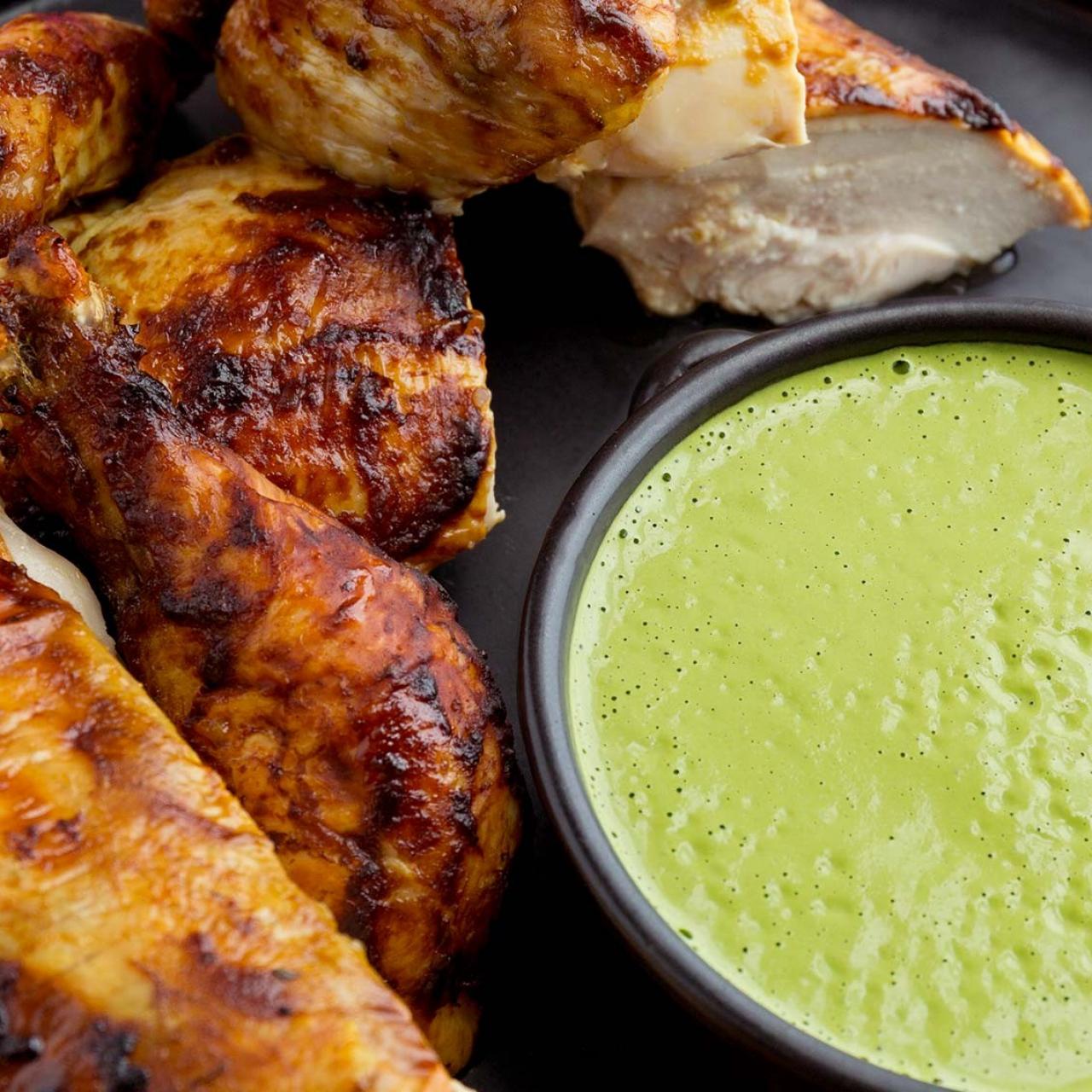
Aji verde is a bright green cilantro-jalapeño sauce blended with mayo (or Greek yogurt), lime, and a little garlic. It's the sauce that goes on pollo a la brasa (Peruvian rotisserie chicken). Think of it as the Peruvian answer to Argentine chimichurri, but creamy. You can build it in a blender in 90 seconds and it keeps five days in the fridge. Use it on the Peruvian-Inspired Roasted Chicken with Aji Verde Sauce, the Grilled Peruvian-Style Pollo a la Brasa with Aji Verde Sauce, or drizzle it over roasted potatoes and eggs.
Aji amarillo is a fruity yellow-orange chile paste — the workhorse of Peruvian cooking. Fresh aji amarillo pods are rare in US supermarkets, but the jarred Doña Isabel or Belmont pastes (roughly $6 for a 7-oz jar) taste the same as what most Peruvian home cooks use. The chile itself is closer to a fruity red bell pepper than a jalapeño in heat, and the flavor sits somewhere between habanero-fruity and smoked paprika. It goes into stews (aji de gallina), sauces (huancaína), and marinades. See it in action in Slow-Cooked Quinoa and Potato Stew with Aji Amarillo.
Huancaína is the third sauce — creamy, cheesy, spicy, poured over sliced boiled potatoes and served cold as a starter or side. It's aji amarillo blended with queso fresco (or feta), evaporated milk, and saltine crackers. Yes, saltines. The crackers are what give it body without flour. Build it once and use it three ways: cold over potatoes, warm over pasta (tallarines a la huancaína), or as a dip. Start with the Huancaina-Style Creamy Yellow Pepper Sauce with Boiled Potatoes.
For all three sauces you want a real blender, not a food processor. Aji verde in particular needs to fully emulsify with the mayo, and a blender's tall narrow jar does that in 20 seconds where a processor takes two minutes and leaves the sauce grainy. The Small Appliances category has our current picks; a 900-watt personal blender is enough.
The Peruvian pantry beyond the sauces: huacatay, rocoto, purple corn, quinoa
The three sauces get you most of the way, but four more Andean ingredients separate food that tastes Peruvian from food that tastes vaguely Latin. All four are shelf-stable or freezer-friendly, and the whole set costs about $22.
Huacatay (black mint) is the one nobody warns you about. It is not mint — it is a marigold relative with a flavor closer to basil crossed with tarragon and a little citrus peel. It is what makes the green sauce at a Peruvian restaurant taste different from the aji verde you blended at home. Sold as a dark paste in 7.5-oz jars for $5 to $7; a teaspoon per batch of aji verde is enough, and two teaspoons will take over the sauce. It is essential in ocopa, the Arequipeñan cousin of huancaína, and it plays beautifully against corn and cheese — see the Andean Corn and Cheese Tamales with Huacatay Sauce. Keep the open jar refrigerated and it holds three months.
Rocoto is the heat. Where aji amarillo is fruity and mild (roughly 30,000–50,000 Scoville), rocoto runs 50,000–250,000 — habanero territory — with thick apple-like flesh and, uniquely among chiles, black seeds. Peruvians rarely eat it raw; it gets stuffed and baked (rocoto relleno, Arequipa's signature dish) or blended in tiny amounts into table sauces. Jarred rocoto paste is $6 and a quarter teaspoon will register. The stuffed-and-baked treatment is exactly the Grilled Rocoto Pepper Stuffed with Spiced Ground Pork method: the roasting mellows the burn into something you can actually eat a whole one of.
Choclo and purple corn are two different corns doing two different jobs. Choclo is the giant-kernel Andean corn served alongside ceviche — starchy rather than sweet, with kernels the size of a thumbnail. Frozen choclo (Goya, $3) beats canned; boil eight minutes. Purple corn (maíz morado) is not eaten at all — it is boiled with pineapple rind, cinnamon, and clove to make chicha morada, the deep-purple drink on every Peruvian family table, and the same base thickened with sweet potato starch becomes mazamorra morada for dessert. A 15-oz bag of dried purple corn is $6 and makes about a gallon. For fresh corn done the Andean way, the Corn and Potato Humintas with Aji Amarillo Sauce are the savory steamed version.
Quinoa deserves better than the sad salad it became in the US. In Peru it is a starch that goes under stews and into soups, cooked in stock rather than water and seasoned like rice. The rules: rinse it for 30 seconds in a fine sieve to strip the bitter saponin coating, use a 1:1.75 quinoa-to-liquid ratio rather than the 1:2 on the bag, and let it rest off heat for 10 minutes so the germ uncurls. Done that way it lands somewhere near couscous instead of mush. The Steamed Quinoa with Andean Potatoes and Aji Verde Sauce is the plate to learn on.
All four keep in a cupboard, and the pastes live in the international aisle or the refrigerated Latin section at most large US grocers. If your store is thin on them, the Grocery shelf tracks the shelf-stable brands worth ordering — one order covers the whole roundup and leaves you with enough for a second month of cooking.
Ceviche 101: sourcing fish, curing time, and the leche de tigre shortcut
Ceviche is Peru's national dish, and it's built from four ingredients: fresh white fish, lime juice, red onion, and salt. That's it. The lime cures the fish in 15 to 30 minutes — the citric acid denatures the protein the same way heat does, and you can literally watch the flesh turn opaque in the bowl. Add cilantro, chile, and a slice of sweet potato on the side and you have a full dinner in 25 minutes.
Sourcing is the whole game. Use sushi-grade white fish or previously-frozen fish, and use it the day you buy it. Sea bass, corvina, halibut, snapper, or fluke all work. If you're squeamish about raw fish or feeding kids, poach shrimp for 45 seconds and use those instead — flavor is 90% the same and the food-safety anxiety goes away. Freezing to -4°F for at least one week kills any parasites; most supermarket "fresh" fish has already been frozen at the boat, so ask.
The classic recipe is the Peruvian-Style Ceviche with Pisco Citrus Dressing — pisco adds a floral, brandy-like note that pushes the citrus without adding heat. Serve it in a chilled bowl with the leche de tigre (the leftover cure liquid) poured over. Peruvians drink the leche de tigre after the fish is gone; it's supposed to cure a hangover.
The leche de tigre shortcut: blend the lime juice with a tablespoon of the fish, a piece of chile, garlic, ginger, and salt for 10 seconds. Pour it over the diced raw fish and cure for 4 minutes instead of 20. You get more concentrated flavor and cleaner texture because the fish spends less time in the acid. This is how modern Peruvian restaurants plate ceviche — thin sashimi cuts, poured tableside, eaten within a minute.
Two more ceviches worth building: Peruvian-Style Ceviche with Lime and Cilantro is the pared-back weeknight version, and the pisco variant is the dinner-party dish. For knives, a thin flexible slicer earns its keep — see the Knives & Cutting picks — but a sharp 8-inch chef's knife will get the job done if you keep it stropped.
Five ceviche and tiradito variations once you have the classic down
Ceviche is a technique, not a recipe. Once the classic works, the variations are 10-minute swaps, and one of them — tiradito — is a genuinely different dish.
1. Tiradito. The nikkei (Japanese-Peruvian) cousin of ceviche: instead of cubing the fish and burying it in lime, you slice it sashimi-thin, lay it flat on a cold plate, and pour a sauce over it seconds before serving. No onion, no cure time, no marination — the acid touches the fish for under a minute. Because the sauce is doing all the work, it is usually built on aji amarillo and lime rather than lime alone. That is exactly the profile of the Citrus-Cured Fish Salad with Aji Amarillo, which is the easiest on-ramp to the style. Slice against the grain at a 45-degree angle, roughly 1/8 inch, and chill the plates in the freezer for 10 minutes first.
2. Mixed seafood (ceviche mixto). Add poached shrimp, bay scallops, and a little cooked octopus or squid to the raw white fish. The cooked shellfish gives you texture contrast and takes the edge off the all-raw anxiety at a dinner party. Poach shrimp 45 seconds, scallops 30, then shock in ice water so they stay snappy. The Citrus-Cured Shrimp Ceviche with Mango and Avocado is the shrimp-forward version, and it doubles as the safe option for anyone who will not eat raw fish.
3. Mango or fruit-forward. Peruvians will tell you fruit in ceviche is a tourist move, and they are right about the classic — but the mango version is genuinely good and it is the one that converts skeptics, because the sweetness buffers the acid. Cut the mango in the same dice as the fish so no single bite is all fruit. The Mango-Avocado Ceviche with Lime-Cilantro Dressing skips fish entirely, which makes it the vegetarian plate on the table as well.
4. Ceviche de pollo. Poached shredded chicken, dressed with the same lime-onion-aji cure. It sounds wrong and it is a real Peruvian home preparation, mostly because it costs a third of what fish costs and keeps two days instead of zero. This is the make-ahead ceviche: build the Peruvian Chicken Ceviche the night before a party and it is better on day two, where a fish ceviche would be ruined.
5. Pisco-dressed and grilled-fish variants. Adding an ounce of pisco to the cure pushes the citrus into floral territory without heat — the Peruvian-Inspired Ceviche with Pisco Citrus Dressing is the version to serve when the ceviche is the centerpiece. And if raw is off the table entirely, the same flavor set works on a hot grill: the Peruvian-Style Grilled Salmon with Lime-Cilantro Sauce gets you the lime-cilantro-aji profile with a cooked center.
| Variation | Cure time | Fish cost for 4 | Make-ahead? |
|---|---|---|---|
| Classic ceviche | 15–30 min | $18–24 | No — serve within the hour |
| Tiradito | Under 1 min | $22–30 (sushi-grade) | Sauce yes, fish no |
| Mixed seafood | 15 min | $20–26 | Shellfish yes, fish no |
| Mango / vegetarian | 10 min | $8–12 | 3–4 hours |
| Ceviche de pollo | 30 min | $7–9 | Yes — 2 days |
Arroz con mariscos and the coastal rice plates
Ceviche gets the attention, but the everyday Peruvian coast runs on rice. Arroz con mariscos is the Sunday plate in Lima the way paella is in Valencia — same Spanish ancestor, different seasoning: instead of saffron alone, it's built on an aderezo of red onion, garlic, and aji panca cooked down to a paste, then aji amarillo stirred in at the end for color and fruit. Budget 25 minutes of cooking and about $18 in seafood to feed four.
The method matters more than the shopping list. Sweat a diced red onion in oil for six minutes until it collapses, add four cloves of garlic and two tablespoons of aji panca paste, and cook that until it darkens and smells sweet rather than raw — that is the aderezo, and skipping it is why home versions taste flat. Add two cups of short- or medium-grain rice, toast for a minute, then four cups of hot seafood stock. Simmer 12 minutes uncovered, scatter the shellfish over the top, cover, and pull it off the heat for the last five minutes so the residual steam cooks the shrimp instead of the burner turning them to erasers.
The closest working template in the catalog is Saffron-Infused Spanish Seafood Rice with Mussels and Shrimp — build it as written, then swap the saffron for two tablespoons of aji panca paste plus one of aji amarillo and finish with a fistful of chopped cilantro. For a weeknight-scale version with no shellfish budget, Pan-Seared Gulf Shrimp with Cilantro Lime Rice gets you 80% of the way in 35 minutes, and Seared Caribbean Snapper with Coconut-Lime Rice is the fish-fillet-over-rice route when you want one pan and no picking through shells.
Two rules that separate a Peruvian rice plate from a generic seafood rice: the rice is never dry (it should slump slightly on the plate, not stand in grains), and there is always something raw and sharp alongside — salsa criolla, or at minimum a lime wedge and a spoon of aji verde. A 12-inch skillet or a shallow braiser beats a tall pot here, because the surface area is what lets the top layer steam while the bottom stays loose.
Lomo saltado and stir-fry-adjacent Peruvian mains (weeknight-friendly)
Lomo saltado is what happens when Chinese railroad workers arrive in 19th-century Peru with woks and soy sauce. It's beef strip loin stir-fried with red onion, tomato wedges, and aji amarillo, finished with soy sauce and vinegar, and served over rice and french fries. Yes, both. The whole dish is 20 minutes, hits every flavor axis at once, and is easily the top-requested recipe when Peruvian friends cook for you.
Two ways to do it at home. The Spiced Peruvian Lomo Saltado Stir Fry uses a hotter aji amarillo profile and skips the fries for a weeknight. If you want the full restaurant plate — beef, tomatoes, onions, fries, rice — the traditional method needs a very hot pan (cast iron over high heat, or a carbon-steel wok) so the beef sears without steaming. This is where a properly heavy skillet earns its money; see our Cookware picks for the current top cast-iron and carbon-steel choices.
The rules for lomo saltado that make or break it: (1) cut the beef in thin strips against the grain, (2) toss it with cornstarch, cumin, salt, and pepper 10 minutes before cooking, (3) preheat the pan for four full minutes empty, (4) cook the beef in two batches — one crowded batch steams, (5) add the tomatoes last so they don't collapse. A single pass takes 12 minutes of active cooking.
For a lighter, non-beef stir-fry version, the Quinoa and Vegetable Stir-Fry with Aji Verde Sauce is essentially quinoa chaufa — Peru's Chinese-influenced fried rice made with quinoa instead of rice — and it comes together in a single pan. Add scrambled egg, scallions, and a splash of soy for the full chaufa experience.
Chifa: the Chinese-Peruvian half of the cuisine
Lomo saltado is not a fusion novelty. It is the most-eaten dish in Peru, and it exists because roughly 100,000 Chinese laborers arrived in Peru between 1849 and 1874 and brought woks, soy sauce, ginger, and scallions with them. The cooking that grew out of that — chifa, from the Cantonese chī fàn, "to eat rice" — is now so thoroughly Peruvian that Lima has more chifa restaurants than every other restaurant category combined, and Peruvian kids grow up thinking soy sauce (sillao) is a local ingredient.
What this means practically: half of the Peruvian weeknight repertoire is wok cooking, which is why these dishes are 15-minute recipes once the prep is done. The chifa technique rules are the same ones that make Chinese stir-fry work, and they are the difference between seared beef and gray beef:
- Preheat empty, four full minutes. Cast iron or carbon steel over the highest burner setting. If the pan is not smoking, the beef will steam.
- Cook in two batches. A pound of beef in a 12-inch skillet drops the surface temperature by roughly 200°F on contact. Two batches of a half pound each keeps the sear.
- Velvet the meat. A teaspoon of cornstarch, a teaspoon of soy, and 10 minutes of rest before cooking — that is the Cantonese velveting technique, and it is why restaurant lomo saltado is tender at high heat.
- Sauce goes in at the end, off the flame. Soy and vinegar hitting a screaming pan scorch in seconds. Kill the heat, then pour.
- Tomatoes last, 45 seconds. They should be warmed through and still holding their shape, not collapsed into sauce.
Three chifa-line dishes worth cooking beyond the classic: the Stir-Fried Sirloin with Aji Amarillo and French Fries is lomo saltado in its full form, fries in the pan and all; the Seared Lomo Saltado with Caramelized Onions and Toasted Rice trades the fries for a deeper onion base and toasted rice, which reheats far better for lunch the next day; and the Spicy Peruvian-Style Pork Stir Fry with Aji Amarillo swaps in pork shoulder at roughly a third of the per-pound cost of sirloin, which makes it the version to cook on a Tuesday.
The other chifa staple is arroz chaufa — Peruvian fried rice, made with day-old rice, egg, scallion, and whatever protein is in the fridge. Cold rice is non-negotiable; fresh rice has too much surface moisture and turns to paste. Peru's quinoa version of the same dish is in the roundup below.
Nikkei: the Japanese-Peruvian coast, tiradito and pulpo al olivo
If chifa is the Chinese half of Peruvian cooking, Nikkei is the Japanese half — the cuisine that grew out of the roughly 18,000 Japanese immigrants who arrived in Peru starting in 1899, many of them fishermen who found themselves working the richest cold-water fishery on the planet with a pantry of lime, chile, and soy. It is the reason a Lima ceviche counter and a Tokyo sushi counter feel oddly like relatives.
Tiradito is the dish to start with. It is ceviche's Nikkei cousin: the same raw fish, but sliced sashimi-thin instead of cubed, laid flat in a single layer, and dressed à la minute rather than cured. There is no red onion, and the acid hits the fish for seconds instead of minutes, so it stays translucent and silky. Tiradito is usually sauced with leche de tigre thinned with a little soy or dashi, aji amarillo for the classic yellow version, or rocoto for the red one. Practically: slice the fish about 1/8 inch thick against the grain, fan it on a cold plate, spoon the sauce over at the table, and eat it within two minutes.
| Dish | Cut | Acid contact | Aromatics | Serve |
|---|---|---|---|---|
| Ceviche | 1/2-inch cubes | 8–15 min cure | Red onion, cilantro, choclo | Cold bowl, with the leche de tigre |
| Tiradito | 1/8-inch sashimi slices | Seconds, at the table | Aji amarillo or rocoto, no onion | Flat cold plate, single layer |
| Nikkei crudo | 1/8-inch slices | None until plated | Soy, sesame, ginger, aji | Flat plate, sesame oil finish |
For a working tiradito tonight, Snow Tuna Sashimi Salad with Citrus Soy Dressing is the closest catalog match — plate the fish flat instead of tossed, and stir a tablespoon of aji amarillo paste into the citrus-soy dressing. If you want the cooked version, Seared Sesame-Crusted Tuna with Ginger-Soy Glaze is the Nikkei restaurant standard (sear 45 seconds a side on a screaming pan, slice, sauce), and Pan-Seared Salmon with Soy-Lime Glaze and Sesame Greens is the same idea at weeknight cost. Sushi-Style Tuna Poke Bowl with Avocado and Sesame turns the leftovers into lunch.
Pulpo al olivo is the other Nikkei dish worth knowing, and it is the one that converts skeptics: poached octopus, sliced into coins, under a purple-grey sauce of blended botija olives and mayonnaise. It sounds strange and tastes like the best olive tapenade you have ever had. Buy frozen cooked octopus (about $12–16 a pound and genuinely better than raw for home cooks — the freeze-thaw tenderizes it), then follow Pan-Seared Octopus with Olive Oil and Citrus Dressing for the sear and swap the dressing for a blend of 1/2 cup pitted black olives, 1/3 cup mayonnaise, and a teaspoon of lime. Scallops get the same treatment in Lima — Pan-Seared Scallops with Ginger and Lime is a two-minute-per-side stand-in for conchas a la parmesana if you finish them under the broiler with parmesan and butter.
One equipment note: Nikkei is a knife cuisine. Sashimi-thin slices off a tuna loin need a long, thin blade and a single pulling stroke — sawing tears the fibers and the fish weeps on the plate. A 9- or 10-inch slicer costs $45–90 and is the only specialty purchase this section asks for; see the Knives & Cutting picks.
Slow-cooked comforts: aji de gallina, seco de carne, papa a la huancaína
The Peruvian slow-cooked repertoire looks different from Mexican or Cuban. Instead of long-braised pork shoulder, you get shredded chicken or beef in thick, aromatic sauces built around aji chiles, nuts, and bread. These are Sunday dishes — start them at 3 pm, eat at 6 pm, use the leftovers for lunch on Monday.
Aji de gallina is the flagship. Shredded poached chicken folded into a sauce of aji amarillo, walnuts, parmesan, evaporated milk, and bread soaked in stock. It's creamy, spicy, and utterly unlike anything in Mexican cooking. The Authentic Peruvian Aji de Gallina recipe walks through the classic method: poach a whole chicken, shred it, build the sauce in the same pot with the reserved stock, then fold the chicken in and warm through. Serve over rice with sliced boiled egg and black olives. Costs $12 to feed six.
Seco de carne (or seco de pollo) is the Peruvian answer to short-rib stew. Beef or chicken braised in cilantro, dark beer, aji amarillo, and lime, served over rice with cannellini beans. The color is a striking green from the massive amount of cilantro. The Seco de Pollo Chicken Stew with Citrus and Cilantro is the chicken version — 45 minutes on the stovetop, or two hours in a slow cooker. Bon Appétit ran a great Lomo Saltado guide with a compatible seco de carne footnote worth reading if you want to make the beef version instead.
Papa a la huancaína is technically a starter but shows up on every home menu as a side. Sliced yellow potatoes on lettuce, blanketed in the huancaína sauce, garnished with black olive and hard-boiled egg. Ten minutes of active work, mostly boiling potatoes. For the deep-fried version, Crisp Fried Yuca Sticks with Spicy Huancaina Dip swaps yuca for the potatoes and makes the sauce a dip — better for parties.
The Andean highlands: pachamanca, quinoa stews and the altitude pantry
Everything above is coastal food. Peru's other cuisine lives between 8,000 and 14,000 feet, where the ingredient list changes completely: no seafood, far more tubers, dried chiles instead of fresh, and grains that evolved to grow where corn will not.
Pachamanca is the anchor dish — literally "earth pot" in Quechua, a whole meal of marinated pork, lamb, chicken, potatoes, sweet potatoes, fava beans, and humitas buried in a pit over fire-heated stones and steamed for a couple of hours. Pachamanca is a festival cook, not a Tuesday one, but the flavor is reproducible in an oven: the signature is the huacatay-and-aji-panca marinade, not the hole in the ground. Rub a pork shoulder with 3 tablespoons huacatay paste, 2 of aji panca, 6 cloves of garlic, a tablespoon of cumin, and a half cup of vinegar, hold it overnight, then cook it low and covered so it steams rather than roasts. Slow-Roasted Pork Shoulder with Cumin and Orange is the right base recipe at 4.5 hours for eight people — add the huacatay and aji panca to the rub, and put whole yellow potatoes and sweet potatoes in the pan for the last 90 minutes so they take on the drippings.
Quinoa is the everyday grain, and Americans mostly cook it wrong. It is a seed, not a rice, and it is bitter unless you rinse it — the coating is saponin, and 30 seconds under running water in a fine sieve is the whole fix. Quinoa delivers about 8 grams of protein per cooked cup with all nine essential amino acids, which is why it carried Andean communities through winters with almost no animal protein. In Peru it shows up as quinua atamalada (a loose, risotto-textured stew), in soups, and in chaufa. Three catalog stews land in that range: Andean Quinoa and Vegetable Stew at 55 minutes, Stewed Bolivian Quinoa with Andean Vegetables for the version closest to the altiplano original, and Braised Quinoa and Black Bean Stew with Andean Spices at 40 minutes for a weeknight. Cold, it becomes lunch: Orange and Cilantro Infused Quinoa Salad with Black Beans is 25 minutes and holds four days.
| Andean staple | What it is | US availability | Cook time | Use it for |
|---|---|---|---|---|
| Quinoa | Protein-complete seed, mild and grassy | Every grocer, $4–6/lb | 15 min simmer | Stews, soups, chaufa, cold salads |
| Kaniwa | Quinoa's smaller cousin, nuttier, no saponin | Latin markets, online | 20 min | Porridge, blended into flour |
| Yellow potato | Waxy, buttery, holds its shape | Yukon Gold is the stand-in | 20 min boil | Huancaina, causa, pachamanca |
| Choclo | Giant-kernel Andean corn, starchy not sweet | Canned or frozen, $3–4 | Heat through | Ceviche plate, soups |
| Huacatay | Black mint, pungent and herbal | Jarred paste, $5 | n/a | Pachamanca, aji verde, ocopa |
| Tarwi / fava | High-protein legumes | Dried fava at most grocers | Soak + 45 min | Pachamanca side, stews |
Tacu tacu is the highland leftovers dish and the one that will earn a permanent slot in your rotation. Tacu tacu is yesterday's rice and yesterday's beans mashed together with aderezo and fried into a firm, crusted patty — an Afro-Peruvian invention that turns two containers of leftovers into the base for a fried egg, a steak, or a spoonful of the previous night's sauce. Ratio is roughly 2 cups cooked rice to 1.5 cups cooked beans, mashed with a fork, fried in 3 tablespoons of oil in a nonstick or well-seasoned pan, pressed flat, and flipped once after four minutes. It costs nothing and it is the single best argument for cooking a full pot of beans on Sunday. Keep the leftovers in airtight containers so the rice stays dry enough to crust.
Anticuchos, causa and the Peruvian small-plates table
Peruvian entertaining runs on small plates, and unlike the mains, most of them are built ahead and served cold or at room temperature. This is the part of the cuisine that makes it good party food: you can plate five dishes in 20 minutes because four of them were finished yesterday.
Anticuchos are the street-food anchor — beef skewers marinated in aji panca, garlic, cumin, and vinegar, grilled hard and fast over coals. Traditionally they are beef heart, which is lean, cheap, and tastes like a mineral-heavy sirloin; if that is a bridge too far, sirloin or tri-tip in 1-inch cubes takes the same marinade and the same three minutes a side. Marinate at least four hours and up to overnight, thread three or four cubes per skewer, and serve with a boiled potato and aji verde on the plate. Start with the Grilled Beef Anticuchos with Aji Amarillo Sauce. Soak bamboo skewers 30 minutes first or they will burn through.
Causa is a chilled potato terrine: yellow potatoes riced and beaten with lime, oil, and aji amarillo into something between mashed potato and dough, then layered with chicken salad, tuna, or avocado and cut like a cake. It is served cold, it holds a full day in the fridge, and it is the single most impressive-to-effort dish in the cuisine. The technique — bind riced potato with aji and lime, then pan-form it — is what the Pan-Fried Quinoa and Potato Cakes with Aji Verde Sauce do in individual-cake form, which is easier to plate than a terrine and reheats crisp.
Fritters and empanadas round out the table. The Crisp Potato and Corn Fritters with Aji Verde fry in five minutes and are the thing that disappears first, and the Aji Verde-Infused Beef Empanadas with Cilantro can be assembled and frozen raw, then baked straight from the freezer at 400°F for 25 minutes.
Salsa criolla is the free upgrade. Thin-sliced red onion, a squeeze of lime, salt, cilantro, and a rest of 10 minutes — that is the whole recipe, it costs about 60 cents, and it goes on top of every dish on this list. Rinsing the sliced onion in cold water for a minute first strips the sulfurous bite and leaves the sweetness. See it doing its job on the Fried Mahi-Mahi with Salsa Criolla.
For the skewers, a set of long metal skewers and a pair of tongs that actually grip is the only specialty gear worth buying; both are in the Utensils picks.
Rice, potatoes & sides that make Peruvian meals sing
Peruvian plates are rice-forward and potato-forward. Peru is the ancestral home of the potato — over 4,000 varieties are grown in the Andes — and rice was introduced through the same Chinese influence that gave us lomo saltado. Almost every main course lands on a bed of white rice, next to a potato preparation, next to a green.
The default rice is arroz blanco: long-grain rice cooked with a smashed garlic clove and a pinch of cumin in the water. That's it. The garlic infuses the rice with a savory background without adding pieces you have to fish out. For a more substantial rice, Pan-Seared Chicken with Spiced Peruvian Quinoa subs quinoa in as the base — nuttier flavor, more protein, and the Andean cred that Peruvians will nod at.
Sweet potatoes (camotes) are the second starch. Steamed, sliced, and served next to ceviche to cool the acid; roasted, and served under aji verde chicken. The Sheet Pan Peruvian-Spiced Chicken with Roasted Sweet Potatoes is the one-pan version — chicken thighs, sweet potato, red onion, aji amarillo, and a squeeze of lime after roasting. Twenty-five minutes hands-off.
For sides beyond the starch: a salsa criolla (thin-sliced red onion, tomato, cilantro, and lime, salted and rested for 10 minutes) goes on top of almost every plate. Choclo (giant Peruvian white corn) is the classic garnish; canned choclo works if you can't find frozen. Aji verde on the table for dipping.
Papa rellena, arroz con pollo verde and chupe de camarones: three dishes the roundups skip
Most English-language Peruvian roundups stop at ceviche, lomo saltado and pollo a la brasa. These three are the ones Peruvian households actually rotate through, and each one teaches a technique the headline dishes don't.
Papa rellena is a mashed-potato shell hand-formed around a beef picadillo — ground beef browned with red onion, aji panca, cumin, then studded with chopped hard-boiled egg, black olives and a few raisins for a sweet-salty contrast. You shape it into a football, roll it in flour or breadcrumbs, and shallow-fry it in about a half-inch of oil until the crust sets, roughly 3 minutes a side at 350°F. The trick is dry potatoes: boil them whole in their skins, peel while hot, and let the mash steam off for 10 minutes before you shape anything. Wet mash will split in the oil every time. Our catalog doesn't carry a true papa rellena yet, but Pan-Fried Bolivian Potato Cakes with Spiced Aji Sauce is the same Andean technique at 30 minutes — make it once to learn the shaping and the fry temperature, then stuff the next batch with picadillo.
Arroz con pollo peruano is not the Caribbean dish of the same name, and this trips people up constantly. The Puerto Rican version is orange, built on sofrito and achiote. The Peruvian version is green — a full bunch of cilantro (stems included) blended with a little stock and poured into the pot so the rice cooks in the purée. Add a spoon of aji amarillo paste, and a splash of dark beer if you have it. The closest starting point in the catalog is Spiced Peruvian Chicken with Cilantro-Lime Rice at 60 minutes; to convert it, blend the cilantro instead of chopping it and cook the rice in that liquid rather than plain stock. If you'd rather start from the Caribbean side and push it green, Cilantro-Lime Arroz con Pollo is already halfway there at 55 minutes.
Chupe de camarones is the Arequipa shrimp chowder, and it's the most underrated dish on this list. Shrimp, potato, choclo, a handful of rice and evaporated milk go into one pot; near the end you crack eggs directly into the simmering broth to poach, then finish with crumbled queso fresco and huacatay. It eats like a full dinner out of a bowl and takes about 45 minutes. Use the shells: simmer them in the stock for 10 minutes and strain before building the soup — that single step is most of the flavor difference between a good chupe and a milky shrimp soup. Coastal Shrimp and Corn Chowder is the 40-minute base to convert; add a tablespoon of aji panca paste, swap heavy cream for evaporated milk, and poach the eggs in the pot for the last 4 minutes. For the meatless Andean cousin, Quinoa and Potato Stew with Aji Verde and Bolivian Potato and Corn Stew with Aji Sauce run the same potato-corn-chile spine without the shellfish. Wikipedia — Chupe documents the regional variants — chupe de camarones on the coast, potato-and-cheese versions in the highlands — if you want to see how far the base stew stretches before you shop.
18 curated Peruvian recipes
Every recipe below is live in AislePrompt with a full ingredient list, US-brand substitutions, and a one-tap Instacart cart. Load any of them, tap the shopping list, and the ingredients are on their way to your door.
Ceviches & seafood
1. Peruvian-Style Ceviche with Pisco Citrus Dressing — the dinner-party plate
2. Peruvian-Style Ceviche with Lime and Cilantro — 20-minute weeknight version
Chicken mains
3. Peruvian-Inspired Roasted Chicken with Aji Verde Sauce — Sunday roast
4. Grilled Peruvian-Style Pollo a la Brasa with Aji Verde Sauce — the rotisserie classic
5. Grilled Peruvian-Style Chicken with Cilantro-Lime Marinade
6. Pan-Seared Chicken with Spicy Peruvian Aji Amarillo Sauce
7. Peruvian-Style Grilled Chicken with Aji Verde Sauce
8. Authentic Peruvian Aji de Gallina — the flagship comfort stew
Beef & pork
9. Spiced Peruvian Lomo Saltado Stir Fry — the beef-and-fries classic
10. Seco de Pollo Chicken Stew with Citrus and Cilantro — Peruvian short-rib-style stew
11. Sheet Pan Roasted Peruvian-Style Pork with Chimichurri
12. Pan-Seared Peruvian-Style Pork Chops with Chimichurri
Rice, quinoa & sides
13. Pan-Seared Chicken with Spiced Peruvian Quinoa
14. Sheet Pan Peruvian-Spiced Chicken with Roasted Sweet Potatoes
15. Slow-Cooked Quinoa and Potato Stew with Aji Amarillo
16. Quinoa and Vegetable Stir-Fry with Aji Verde Sauce — quinoa chaufa
Starters & sauces
17. Huancaina-Style Creamy Yellow Pepper Sauce with Boiled Potatoes
18. Crisp Fried Yuca Sticks with Spicy Huancaina Dip
Sample Peruvian dinner menu for four
If you're feeding four adults on a Saturday night, this is the menu that will make Peruvian food feel like a real cuisine rather than a novelty. Prep starts at 3:30 pm for a 7:00 pm dinner.
| Course | Dish | Prep time | Notes |
|---|---|---|---|
| Starter | Papa a la huancaína | 15 min active + 20 min potatoes | Sauce holds in fridge 3 days; make it Friday |
| Ceviche | Peruvian ceviche with pisco | 20 min | Cure fish 15 min before serving; do not hold |
| Main | Pollo a la brasa with aji verde | 15 min prep + 45 min oven | Marinate chicken overnight for max flavor |
| Sides | Sweet potato + salsa criolla + white rice | 25 min parallel | Rice in a cooker, potato in the oven with chicken |
| Sauce | Aji verde on the table | 5 min blender | Blend it during the last 10 min of chicken roast |
Serves four with leftovers. Total active time: ~90 minutes if you stage the prep. Budget: $38–46 depending on the fish.
A 3-day Peruvian weeknight rotation
The Saturday menu above is a project. This is the version for a Tuesday: cook once on the first night, and the aji verde plus the leftover protein carry two more dinners with almost no new work.
| Day | Dish | Active time | What carries forward |
|---|---|---|---|
| 1 | Roasted Peruvian-Style Chicken with Aji Verde Sauce | 20 min active, 85 min total | Half the chicken + a double batch of aji verde |
| 2 | Spicy Peruvian-Style Chicken Tacos with Cilantro-Lime Slaw | 20 min with pulled leftovers | Slaw dressing doubles as tomorrow's salad |
| 3 | Pan-Seared Trout with Aji Amarillo Sauce | 20 min | Nothing — clean finish |
Day 1 is the only real cook. Roast a 4-pound bird or six thighs, and make a full blender of aji verde — a cup and a half, not the half cup the recipe calls for. It holds five days refrigerated and gets used every night.
Day 2 costs 20 minutes because the recipe's 55-minute time assumes you're cooking chicken from raw. You aren't. Pull the leftover meat, warm it in a skillet with a spoon of aji amarillo, and build the tacos. The cilantro-lime slaw is the only knife work.
Day 3 resets the palate with a different protein and no leftovers to manage. Trout takes four minutes a side, and the aji amarillo sauce comes together while the pan heats. If trout isn't at your counter, Chilean-Style Grilled Salmon with Aji Verde Sauce is a 20-minute swap that uses up the rest of Day 1's green sauce.
If you don't want to roast anything on Day 1, the all-weeknight version is Pan-Seared Chicken with Spiced Peruvian Chimichurri at 22 minutes, Sheet Pan Peruvian-Inspired Chicken with Aji Verde Sauce at 45 minutes mostly hands-off, and Pan-Seared Salmon with Cilantro-Pisco Chimichurri at 20 minutes. Same three-night arc, no oven commitment, and one bunch of cilantro covers all three sauces.
Grocery math for the rotation: one whole chicken ($9–13), one bunch of cilantro ($1), two limes, a jar of aji amarillo paste ($6, lasts six more dinners), tortillas, and two trout fillets ($12–16). That's roughly $38 for three dinners for four, or about $3.20 a plate. Batch the sauces in the Small Appliances blender you already own and store them in the Storage & Containers jars — aji verde in glass, not plastic, or the container keeps the garlic smell permanently.
What to drink: pisco sour, chicha morada and the Peruvian table
Peru takes its drinks as seriously as its plates, and two of them are worth learning because they anchor the meal at opposite ends.
The pisco sour is the national cocktail and a national argument with Chile over who invented it. The build is 3 parts pisco, 1 part fresh lime, 1 part simple syrup, one egg white, and three drops of Angostura on the foam. Dry-shake it without ice for 15 seconds first to whip the egg white, then shake again with ice for 15 seconds and strain. Skip the dry shake and you get a thin drink with no head. Pisco is an unaged grape brandy — the Peruvian bottles (Portón, Barsol, Macchu) run $18 to $30 and a bottle makes about 12 drinks. Start with the Pisco Sour with Fresh Lime and Egg White Foam, then try the Mango Pisco Sour Cocktail with Fresh Lime and Egg White Foam when mangoes are in season, or the Ginger-Spiced Pisco Sour alongside anything with aji in it — the ginger and the chile heat cancel each other in a useful way.
Chicha morada is the non-alcoholic one, and it is what most Peruvian families actually drink with dinner. Simmer a pound of dried purple corn with pineapple rind, a cinnamon stick, and five cloves in three quarts of water for 45 minutes, strain, then finish with lime juice and sugar to taste and chill hard. It comes out an almost unreal deep purple, tastes like spiced grape and pineapple, and costs about $2 a gallon. Make it Saturday morning, drink it all week — it holds five days refrigerated. It is also the base for mazamorra morada: take a quart of the finished chicha, thicken it with sweet-potato starch, add diced fruit, and you have the classic dessert with no extra shopping.
On the table: pisco sours before the meal with the small plates, chicha morada through dinner, and Inca Kola if you want the full experience — the bright yellow, lemongrass-flavored soda that outsells Coca-Cola in Peru and is stocked in the international aisle of most large US grocers. For shakers, jiggers, and the strainer that makes the egg-white foam behave, the Barware shelf has the current picks.
Peruvian desserts: suspiro limeño, picarones, alfajores and mazamorra morada
Peruvian sweets are their own tradition — mostly Spanish-convent recipes rebuilt around Andean ingredients, which means a lot of manjar blanco (dulce de leche), a lot of purple corn, and almost no chocolate.
Suspiro limeño — "the sigh of a Lima woman" — is the signature: a layer of manjar blanco enriched with egg yolks and evaporated milk, topped with a port-spiked Italian meringue and a dust of cinnamon. It is genuinely a 30-minute dessert if you buy the dulce de leche instead of cooking milk down for two hours. Layer 1.5 cups of dulce de leche whisked with 3 egg yolks and a half cup of evaporated milk, cooked over low heat for eight minutes until it coats a spoon, into glasses; whip 3 whites with a hot syrup made from 3/4 cup sugar and 1/4 cup port, and pipe it on top. The nearest catalog stand-ins are Leche Flan Baked Caramel Custard — same evaporated-milk-and-yolk custard logic, baked instead of layered — and Baked Dulce de Leche Cheesecake Bars when you need to feed 16 people from one pan.
Picarones are the street dessert, and they beat every doughnut you have made at home. Picarones are ring fritters of squash and sweet potato — the dough is cooked kabocha or butternut plus sweet potato, mashed with flour, yeast, and anise, proofed, then dropped into oil and drizzled with chancaca syrup (raw cane sugar simmered with orange peel, cinnamon, and clove). They fry at 350°F in about 90 seconds a side. If you are not making the batter from squash tonight, Spanish-Style Fried Churros with Cinnamon Sugar uses the identical oil temperature and the same "syrup, not sugar" finish — make the chancaca syrup (1 cup piloncillo, 1 cup water, an orange peel, a cinnamon stick, simmered 15 minutes) and pour it over. Dulce de Leche Filled Sopapillas with Honey Drizzle is the other fried-dough-and-syrup route.
Alfajores are the cookie every Peruvian household keeps in a tin: two shortbread rounds heavy on cornstarch, sandwiched with manjar blanco, buried in powdered sugar. Alfajor is a Spanish-Moorish inheritance shared across South America, and the Peruvian version is the crumbliest of them — the cornstarch-to-flour ratio runs about 1:1, which is why they dissolve rather than snap. They keep five days in a tin and they freeze well; a half sheet pan and a wire rack is the entire equipment list.
Mazamorra morada closes the circle with the chicha. Mazamorra morada is purple-corn pudding: take a quart of the chicha morada from the section above, thicken it with 1/3 cup sweet-potato starch slurried in cold water, add diced pineapple, dried apricots, and prunes, and cook it four minutes until it holds a spoon-trail. Served alongside arroz con leche in the same bowl it is called combinado, the purple-and-white plate you see in every Lima market. For the rice-pudding half, Salvadoran Sweet Rice Pudding with Cinnamon and Coconut is the closest match at 45 minutes, and if you want one cake to end a Peruvian dinner party for eight, Pastel de Tres Leches is the pan-Latin default nobody turns down.
Sourcing note, as of 2026: dulce de leche (look for La Lechera or Nestlé manjar) and piloncillo/chancaca are both in the international aisle of most large US grocers, purple corn is dried in 1-lb bags at Latin markets and online for about $8, and sweet-potato starch is the one item you will probably order — cornstarch works but sets softer. All of it sits in the pantry and grocery list.
What to buy: cast-iron skillet, blender for sauces, aji paste starter kit
The Peruvian pantry starter kit is short. Here's what's actually worth spending on:
Blender ($60–150): The single most important tool. Aji verde, huancaína, and leche de tigre all need a real blender. A 900-watt personal blender does the job; a full-size 1500-watt like a Ninja UltraCrush will pull double duty for smoothies and soups. Anything under 500 watts will fail to emulsify aji verde with mayo, and you'll end up with an oily green puddle instead of a sauce. See the picks under Small Appliances.
Cast-iron skillet, 10 or 12 inch ($30–90): Lomo saltado needs a hot, heavy pan that stays hot when you add cold beef. A 12-inch Lodge is the workhorse choice — $30, lasts 30 years, and heats evenly enough that the beef sears rather than steams. If you want a lighter carbon-steel option, a 12-inch de Buyer Mineral B is the upgrade at ~$85. Both live in the Cookware shelf.
8-inch chef's knife ($40–120): Peruvian cooking is chop-heavy — cilantro by the bunch, red onion for salsa criolla, sweet potatoes into thin discs. An 8-inch chef's knife covers 90% of the work. If you're also going to break down whole chickens for pollo a la brasa, add a boning knife. See the current picks in the Knives & Cutting category.
Pantry starter kit ($18–24 total): aji amarillo paste (7-oz jar, ~$6), huacatay paste (small jar, ~$5), Peruvian white corn (canned choclo, ~$4), pisco (a small $10 bottle covers 8 ceviches), soy sauce, red-wine vinegar, and cumin. That's the whole kit. Everything else — chicken, fish, lime, cilantro, red onion, potatoes — is on the regular shopping list.
If you want to test the water before buying anything specialty, the Serious Eats Peruvian Ceviche recipe uses only lime, fish, chile, and onion — no aji amarillo needed. Cook that first, and if you like it, buy the paste.
FAQ
Is ceviche safe to eat if the fish isn't cooked?
Ceviche is chemically "cooked" by acid — the citric acid in lime juice denatures fish protein the same way heat does, and after 15 to 30 minutes of curing the flesh turns opaque and firm. That said, only use sushi-grade or previously frozen fish (freezing to -4°F for a week kills parasites), buy from a fishmonger you trust, and eat the ceviche the day you make it. If you are pregnant, immunocompromised, or serving young children, use a quick-poached shrimp or scallop ceviche instead.
What is aji amarillo and where do I find it?
Aji amarillo is a fruity yellow-orange Peruvian chile — moderate heat, closer to a red bell in sweetness than a jalapeño — that shows up in nearly every Peruvian sauce. Fresh pods are rare in US markets, but every Latin market and the international aisle at larger grocers carry aji amarillo paste in jars, which is what most Peruvian home cooks use anyway. Amazon and Instacart both stock the Belmont and Doña Isabel brands; a single jar lasts through a dozen recipes and keeps three months refrigerated.
Can Peruvian food be made gluten-free?
Most Peruvian classics are naturally gluten-free — ceviche, roasted chicken with aji verde, papa a la huancaína, quinoa chaufa, and most stews all skip wheat. Lomo saltado uses soy sauce, so swap in a gluten-free tamari and the dish is safe. The main watch-outs are commercial aji pastes (a few contain wheat starch) and any dish served over noodles like tallarines verdes; the AI chat at /chat will filter and rebuild any recipe in this roundup around a strict gluten-free diet.
What's the difference between Peruvian and Mexican food?
Both cuisines share pre-Columbian ingredients like corn, beans, potatoes, and chiles, but Peruvian cooking layers in Spanish, Chinese (chifa), Japanese (nikkei), and African influences that Mexican food does not. The heat profile is different: Peruvian dishes lean on fruity, aromatic aji chiles rather than the smokier chipotle and ancho of Mexico. Corn, rice, and potatoes appear in almost every Peruvian meal; tortillas and beans dominate Mexican tables. The two cuisines rarely overlap on the plate.
How do I get a Peruvian ingredients cart on Instacart?
Tap the green Instacart icon at the top of the shopping list for any recipe in this roundup and AislePrompt sends the full ingredient set — including the specialty items like aji amarillo paste, huacatay, and Peruvian corn — to your local Instacart store with retailer-aware substitutions. If your local store does not carry an item, the app suggests the closest US brand match (chipotle in adobo for aji panca, for example) so you can still cook the recipe tonight.
What is chifa cuisine, and why does it show up in Peruvian recipes?
Chifa is Peruvian-Chinese cooking, named from the Cantonese chī fàn ("to eat rice"), and it developed after roughly 100,000 Chinese laborers arrived in Peru between 1849 and 1874. It is why lomo saltado is a wok stir-fry of beef, tomato, and onion finished with soy sauce and served over both rice and french fries, and why soy sauce is called sillao and treated as a local ingredient. Lima has more chifa restaurants than any other restaurant category, and the wok technique is the reason so many Peruvian mains are 15-minute cooks.
How do I make aji verde, the green sauce served with pollo a la brasa?
Blend one bunch of cilantro, two seeded jalapeños, three tablespoons of aji amarillo paste, a quarter cup of mayonnaise, two tablespoons of cotija or feta, one garlic clove, a tablespoon of lime juice, and salt until it is smooth and bright green — about 45 seconds in a real blender. A teaspoon of huacatay paste takes it from good to restaurant-accurate. It holds five days refrigerated and thickens overnight, so thin it with a splash of lime before serving. Peruvians put it on chicken, potatoes, rice, eggs, and sandwiches.
Can I cook Peruvian food without a rotisserie or a wok?
Yes — every recipe in this roundup is written for a standard 12-inch skillet, a sheet pan, or a Dutch oven. Pollo a la brasa comes out right in a 425°F oven with the chicken on a wire rack so the skin dries and crisps on all sides. Lomo saltado needs heat, not a wok: preheat cast iron empty for four minutes and cook the beef in two batches so the pan never drops out of searing range. The only tool that genuinely matters is a blender for the sauces.
Can I make Peruvian recipes without seafood?
Yes — most of the repertoire is land-based. Lomo saltado, aji de gallina, arroz con pollo verde, seco de carne, pollo a la brasa and anticuchos are all beef, chicken or pork. Vegetarians have real options too: causa built with an avocado filling, papa a la huancaina, quinoa chaufa, and the Andean potato-and-corn stews all skip meat entirely and still taste unmistakably Peruvian because the aji sauces carry the flavor, not the protein.
What sides pair with Peruvian mains?
White rice is nearly automatic — long-grain, cooked with a smashed garlic clove. Add one starch and one bright thing: steamed yuca or boiled yellow potatoes for the starch, and salsa criolla for the acid. Salsa criolla is thin-sliced red onion, tomato and cilantro tossed with lime and salt, rested 10 minutes. Cancha (toasted corn kernels) and choclo round out the plate. Most weeknight Peruvian dinners are simply rice, protein, and salsa criolla.
What is the difference between lomo saltado and a regular beef stir-fry?
Lomo saltado is chifa — Chinese-Peruvian fusion — so it borrows the wok and the soy sauce but lands somewhere else entirely. Marinated beef strips hit a screaming-hot pan with red onion, tomato and aji amarillo, finished with soy sauce and red-wine vinegar. The signature is the double starch: it is served over white rice AND with french fries tossed into the pan at the end, so the fries soak up the sauce. That fruity aji heat and the rice-plus-fries plate are what make it Peruvian rather than generic.
Sources & further reading
- Serious Eats — Traditional Peruvian Ceviche is the definitive US primer on ceviche, with a well-tested leche de tigre method and a good explainer on acid-curing times.
- Bon Appétit — Lomo Saltado covers the classic beef-and-fries plate with a Peruvian-American chef's notes on pan temperature and the soy-vinegar finish.
- Food Network — Peruvian Roast Chicken with Aji Verde has a solid weeknight aji verde recipe that scales cleanly and holds in the fridge.
- Wikipedia — Peruvian cuisine is the best free overview of the Spanish, Andean, Chinese, Japanese, and African threads that make up the cuisine, with sourcing on the regional dishes.
- Wikipedia — Chifa documents the Chinese-Peruvian migration history behind lomo saltado, arroz chaufa, and the sillao-and-wok half of the repertoire.
- FDA — Fresh and Frozen Seafood: Selecting and Serving It Safely is the primary source on buying, freezing, and holding fish — read it before you make ceviche for anyone else.
- Wikipedia — Nikkei cuisine documents the Japanese-Peruvian migration from 1899 onward and how it produced tiradito, pulpo al olivo, and the soy-and-aji seasoning logic on the coast.
- Wikipedia — Tiradito is the reference on how tiradito differs from ceviche in cut, cure time, and sauce — the distinction most US recipes blur.
- Wikipedia — Pachamanca covers the Andean earth-oven meal, its Quechua origins, and the huacatay-and-aji-panca marinade that carries the flavor into an oven version.
- Wikipedia — Tacu tacu traces the Afro-Peruvian rice-and-bean griddle cake, including the ratios and the leftovers logic behind it.
- Wikipedia — Picarones explains the squash-and-sweet-potato fritter batter and the chancaca syrup that replaced the Spanish honey original.
- Wikipedia — Quinoa is the primary reference on the grain's amino-acid profile, saponin coating, and why rinsing is not optional.
- Wikipedia — Chupe maps the coastal-versus-highland variants of the stew, which is the fastest way to see how one Peruvian base recipe adapts by region.
Related guides
If Peruvian cooking lands for you, these AislePrompt roundups sit closest to it — same weeknight structure, adjacent pantries, and a lot of ingredient overlap:
- 22 Mexican Dinner Recipes: Tacos, Enchiladas & 30-Minute Sheet Pan Fajitas — the closest neighbor on the shelf. Shared base of lime, cilantro, corn, and chiles; the difference is fruity aji versus smoky chipotle, and rice-and-potato versus tortilla-and-bean.
- 20 Filipino Dinner Recipes: Adobo, Sinigang & Pancit for Weeknights — the other great vinegar-and-soy cuisine shaped by Chinese and Spanish contact. If chifa lomo saltado is your favorite dish here, adobo is the next one to cook.
- 22 Thai Weeknight Dinners: Pad Thai, Green Curry & 30-Minute Stir Fries — same wok technique, same high-heat two-batch rules, same bright-acid-and-chile logic applied to a different pantry.
- 22 Cajun and Southern Dinner Recipes: Gumbo, Jambalaya & Shrimp Boils — the American parallel to seco and aji de gallina: one pot, long simmer, rice underneath, and a sauce that gets better the next day.
As of 2026, Peruvian recipes are still an underserved SERP category for US food publishers. If you cook two or three of the dishes above in the next month, you'll have a working repertoire that rotates through the season the way pasta and stir-fry already do — bright ceviche in summer, aji de gallina and seco in winter, pollo a la brasa year-round. Save this roundup, start with the ceviche, and build outward.
Frequently asked questions
Is ceviche safe to eat if the fish isn't cooked?
What is aji amarillo and where do I find it?
Can Peruvian food be made gluten-free?
What's the difference between Peruvian and Mexican food?
How do I get a Peruvian ingredients cart on Instacart?
What is chifa cuisine, and why does it show up in Peruvian recipes?
How do I make aji verde, the green sauce served with pollo a la brasa?
Can I cook Peruvian food without a rotisserie or a wok?
Can I make Peruvian recipes without seafood?
What sides pair with Peruvian mains?
What is the difference between lomo saltado and a regular beef stir-fry?
Sources
- seriouseats.com
- bonappetit.com
- foodnetwork.com
- en.wikipedia.org
- en.wikipedia.org
- fda.gov
- en.wikipedia.org
- en.wikipedia.org
- en.wikipedia.org
- en.wikipedia.org
- en.wikipedia.org
- en.wikipedia.org
- en.wikipedia.org
- en.wikipedia.org
- en.wikipedia.org
Recipes to start your week with
Save any of these to My Recipes — no account needed — and send the ingredients to Instacart in one tap.

Cook Peruvian at home this week.
Ask our AI for a week of Peruvian dinners — it writes the recipes, builds the shopping list, and sends the cart to Instacart. No account needed.
Plan my Peruvian week →