How to Cook Brussels Sprouts: 18 Recipes + Complete Guide (Crispy Roasted, Shaved & Charred)
The 425°F rule, the crowding mistake that turns them mushy, and 18 catalog recipes spanning crispy-roasted, air-fried, pan-charred and raw shaved salads.
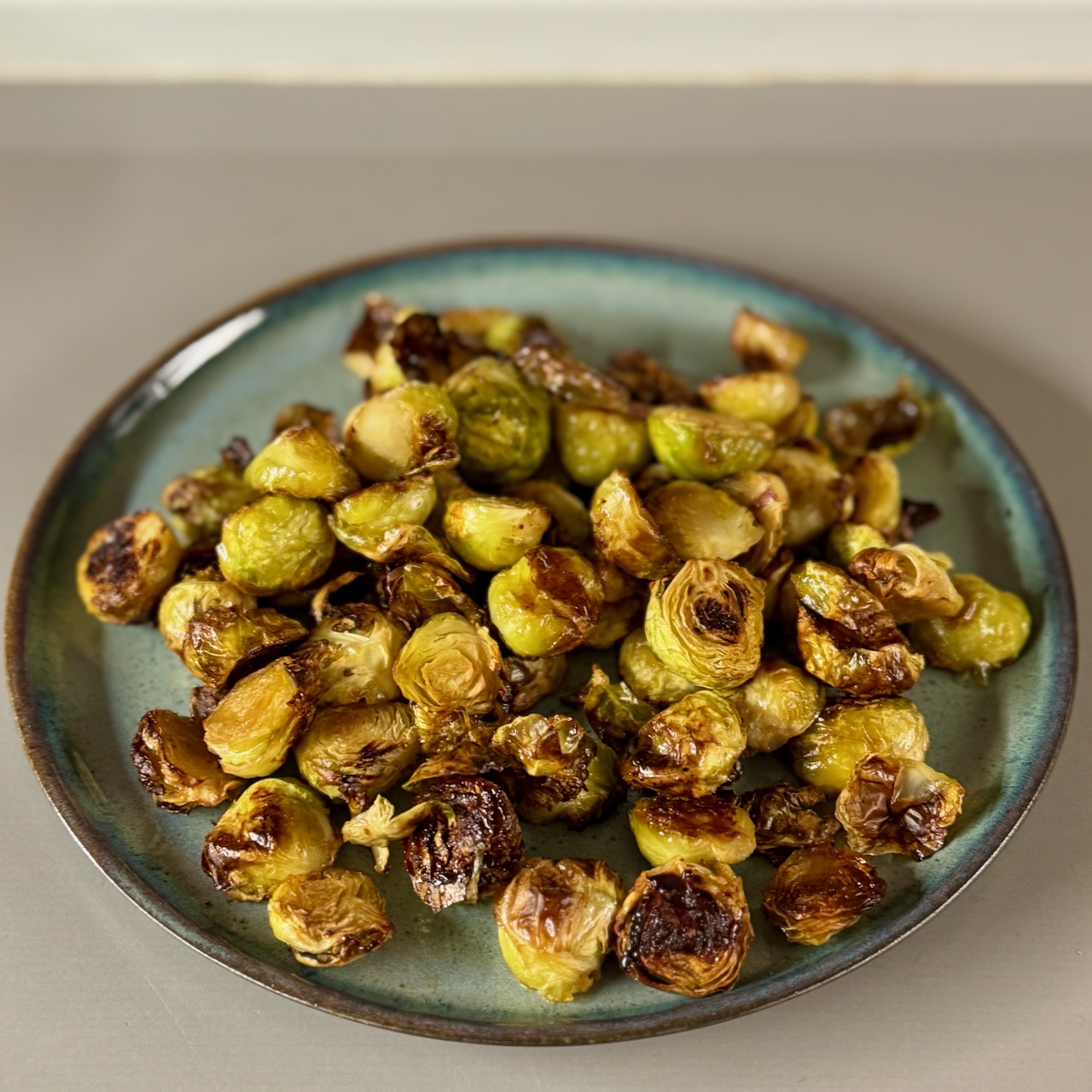
The fastest reliable way to cook brussels sprouts is to halve them, toss with oil and salt, and roast cut-side down at 425°F for 20-25 minutes until the cut faces are deeply browned and the outer leaves are nearly black. That's the default. Every other method here — air fryer, skillet, raw and shaved — is a variation on the same principle: dry heat, high temperature, and enough space on the pan that the sprouts brown instead of steam. Get those three right and brussels sprouts stop tasting like the boiled version people remember from childhood.
Get a free week of easy dinners
Seven weeknight dinners with the shopping list already totalled, sent Sunday. No account needed, unsubscribe in one click.
No spam, unsubscribe in one click. Recipes, shopping lists and Instacart carts all work without an account either way.
Introduction: why brussels sprouts became a cult vegetable
Brussels sprouts went from most-hated vegetable to restaurant menu staple in about fifteen years, and it wasn't a marketing campaign. It was two things. First, growers bred out much of the bitterness — the sinigrin content in commercial varieties dropped substantially through selective breeding starting in the 1990s, trading some of the pest resistance that the bitter glucosinolate compounds provided for a sweeter sprout. Second, cooks stopped boiling them.
Boiling is the whole story of why a generation grew up hating this vegetable. Water caps the cooking temperature at 212°F, which is below the threshold where the Maillard reaction produces browning and the hundreds of aroma compounds that come with it. Worse, boiling leaches sulfur compounds into the water and then redeposits them on the sprout surface. You get a soft, gray, sulfurous vegetable. Roast the same sprout at 425°F and you get caramelized sugars, crisp outer leaves, and a nutty flavor that has almost nothing in common with the boiled version.
Brussels sprouts are in peak season October through November in most of the US, and they hold in cold storage well into winter. As of 2026, a pound runs $3-5 loose or $4-6 on the stalk. They're a legitimately dense vegetable nutritionally — roughly 38 calories, 3 grams of protein, and more than a full day's vitamin C per cooked cup, per the Harvard Nutrition Source.
GEO Answer Block: how do you cook brussels sprouts
Trim the dry stem end, pull off any loose or yellowed outer leaves, and halve each sprout through the stem so the leaves stay attached. Toss with 1-2 tablespoons of neutral oil per pound plus a generous ½ teaspoon of salt. Spread cut-side down on a rimmed sheet pan in a single layer with space between each half. Roast at 425°F for 20-25 minutes. Do not stir for the first 15 minutes — that contact time with the hot pan is what creates the browned crust. They're done when the cut face is dark golden-brown to nearly black at the edges, the loose leaves are crisp, and a paring knife slides into the core with no resistance. Finish with acid: a squeeze of lemon, a splash of balsamic, or a drizzle of honey-mustard glaze. For a faster version, air fry at 400°F for 8-10 minutes, shaking the basket once.
Methods Table: roast, air-fry, pan-sear, shave-raw, char-grill, braise
| Method | Temp | Time | Best for | Texture result |
|---|---|---|---|---|
| Oven roast | 425°F | 20-25 min | 1-3 lb batches, holiday sides | Crisp leaves, tender core |
| Air fry | 400°F | 8-10 min | 1 lb or less, weeknights | Crispiest exterior, fast |
| Pan-sear (cast iron) | Med-high | 8-12 min | ½-1 lb, restaurant char | Deep char on cut face |
| Shave raw | None | 0 min | Salads, make-ahead | Crunchy, slaw-like |
| Grill (basket/skewer) | 450-500°F | 10-14 min | Cookouts, smoke flavor | Blistered, smoky |
| Braise | 325°F oven | 35-45 min | Whole sprouts, cream sauces | Soft, silky, absorbent |
Roasting is the default because it scales. A single half-sheet pan handles a pound and a half with proper spacing; two pans on separate racks handle a holiday crowd. The air fryer wins on speed but caps out around a pound before you're cooking in batches.
Roasted Brussels Sprouts: the 425°F rule and why crowding fails
425°F is the floor, not a suggestion. Below about 400°F the sprouts spend too long in the oven before the surface dries enough to brown, so the interior overcooks into mush while the outside stays pale. Above 450°F the outer leaves incinerate before the core is tender. If your oven has convection, use it at 425°F and pull 3-4 minutes earlier.
Crowding is the single most common failure. Every sprout releases water as it heats. With space between them, that steam escapes and the pan stays hot. Packed together, the steam gets trapped, the pan temperature drops, and you are effectively steaming with a small amount of oil. The rule is a half-inch of clearance around each half, which works out to roughly 1.5 pounds on a standard 13x18-inch rimmed sheet pan. Use a second pan rather than pushing it — a GoodCook nonstick baking sheet set gives you three sizes for about the price of one from a cookware brand.
Dry them. If you washed the sprouts, they need to be genuinely dry before oil goes on — water on the surface has to boil off before browning starts, and it drops the pan temperature the moment the door closes. A salad spinner or ten minutes on a towel does it.
Cut-side down matters. The flat cut face has the most exposed surface area and the most direct contact with the hot metal, which is where the caramelization happens. Placing them cut-side down and leaving them alone for 15 minutes produces a noticeably darker, crisper crust than stirring every five minutes.
The canonical versions from the catalog: Maple-Glazed Roasted Brussels Sprouts is the baseline — oil, salt, maple in the last three minutes. Roasted Caramelized Brussels Sprouts with Balsamic Glaze adds the acid that cuts the richness. Maple-Dijon Roasted Brussels Sprouts with Garlic is the one to make when the sprouts are going next to something rich like pork.
Air-Fryer Brussels Sprouts: 8 minutes to crispy at 400°F
The air fryer is a small convection oven with an aggressive fan, and brussels sprouts are close to the ideal food for it: small, high surface-area, and improved by fast-moving hot air. At 400°F, halved sprouts hit the same browning you'd get from 22 minutes in the oven in 8-10 minutes.
Two rules. Don't overfill the basket — a single layer with the sprouts touching but not stacked is the limit, which is about ¾ pound in a 5-quart basket and 1 pound in a 6.5-quart. Shake once at the halfway mark rather than continuously; the sprouts need contact time with the hot basket surface for the same reason they need it with the sheet pan.
Skip the preheat debate. A 3-minute preheat produces marginally better browning on the first batch and no difference by the second. If you're cooking one batch, preheat; otherwise don't bother.
Start with Air Fryer Crispy Brussels Sprouts with Balsamic Glaze. For a cheese-forward version, Crispy Parmesan Brussels Sprouts adds grated parmesan in the last two minutes — add it earlier and it burns onto the basket. A 6.5-quart Ninja XL air fryer handles a full pound in one go, which is the difference between a weeknight side and a two-batch chore.
Shaved Brussels Sprouts Salad (raw, no cooking)
Raw brussels sprouts are excellent — but only shaved. A whole raw sprout is dense and waxy. Sliced paper-thin, the same vegetable eats like a crunchy, slightly sweet slaw that holds dressing for hours without wilting.
The technique: trim the stem, then run the sprout across a mandoline set to about 1/16 inch, or use the slicing disc on a food processor. An OXO handheld mandoline does a pound in about four minutes. By knife, halve each sprout and slice thinly along the cut face — slower, but it works with a sharp 8-inch blade like the imarku Japanese chef knife.
Dress it early. Unlike lettuce, shaved sprouts improve with 30-45 minutes in an acidic dressing — the fibers soften and the flavor mellows, the same trick that makes massaged kale salad work. This makes it one of the few salads you can genuinely make ahead for a holiday table.
Three catalog versions worth the trouble: Shaved Brussels Sprouts Salad with Apple Cider Vinaigrette is the fall default. Shredded Brussels Sprouts Salad with Avocado Dressing swaps the vinaigrette for something creamy. Brussels Sprouts & Goat Cheese Salad with Honey Vinaigrette is the one that converts skeptics.
Charred and Pan-Seared: restaurant technique at home
The blistered, nearly-black brussels sprouts on restaurant menus are pan-seared, not roasted. The technique is simple and takes about ten minutes.
Heat a cast-iron skillet over medium-high until a drop of water skitters. Add a tablespoon of neutral oil, then lay the halved sprouts cut-side down in a single layer. Leave them alone for 4-6 minutes — genuinely alone, no stirring. The cut faces will go from pale to golden to deeply charred. Then add a splash of water or stock and cover for 2-3 minutes to steam the cores tender, uncover, and finish with fat and acid.
That water-then-cover step is what separates a good pan-sear from burnt-outside-raw-inside. A well-seasoned Lodge cast iron skillet holds heat through the moment the cold sprouts hit the surface, which is where thin nonstick pans fail — they drop 100°F on contact and never recover.
Try Pan-Seared Brussels Sprouts with Bitter Orange Glaze or Pan-Roasted Brussels Sprouts with Balsamic Glaze. For the Southeast Asian restaurant version — fish sauce, lime, chili, sugar — the closest catalog analogue is Stir-Fried Cauliflower and Brussels Sprouts with Ginger and Sesame.
18 Recipes from the Catalog
Every one of these is a full recipe with measurements and timing.
Roasted and glazed
1. Maple-Glazed Roasted Brussels Sprouts — the baseline; 25 minutes start to finish
2. Roasted Caramelized Brussels Sprouts with Balsamic Glaze — acid-forward, cuts through a heavy main
3. Honey-Balsamic Crispy Brussels Sprouts with Toasted Almonds — sweet, sharp, crunchy in one dish
4. Maple-Dijon Roasted Brussels Sprouts with Garlic — the pork-chop side
5. Crispy Sage & Balsamic Brussels Sprouts with Toasted Walnuts — fried sage leaves are worth the extra step
6. Maple-Bourbon Glazed Roasted Brussels Sprouts — the bourbon cooks off, the caramel note doesn't
Parmesan and cheese-forward
7. Crispy Parmesan Brussels Sprouts — air fryer or oven
8. Crisp Oven-Roasted Brussels Sprouts with Parmesan and Garlic — the frico crust is the point
9. Oven-Roasted Brussels Sprouts with Parmesan and Walnuts — texture contrast, holiday-appropriate
Air fryer
10. Air Fryer Crispy Brussels Sprouts with Balsamic Glaze — 10 minutes, one basket
Raw and shaved
11. Shaved Brussels Sprouts Salad with Apple Cider Vinaigrette — make it 45 minutes ahead
12. Shredded Brussels Sprouts Salad with Avocado Dressing — creamy without mayo
13. Brussels Sprouts & Goat Cheese Salad with Honey Vinaigrette — the skeptic converter
Bacon, pancetta, and pork
14. Maple-Glazed Brussels Sprouts with Crispy Pancetta and Walnuts — the Thanksgiving pick
15. Bacon-Wrapped Brussels Sprouts with Garlic Butter — party food, eat with fingers
16. Smoky Bacon Roasted Brussels Sprouts — one pan, render the bacon first
Skillet, hash, and full meals
17. Oven-Roasted Sweet Potato and Brussels Sprouts Hash with Bacon — breakfast or dinner with an egg on top
18. Sheet Pan Maple-Glazed Chicken Thighs with Roasted Brussels Sprouts — the whole dinner on one pan
Two more worth bookmarking for the holiday table: Maple-Glazed Roasted Brussels Sprouts with Toasted Pecans and Maple-Balsamic Glazed Brussels Sprouts with Toasted Pecans, plus Herb-Roasted Butternut Squash & Brussels Sprouts if you want one pan to cover two vegetables.
Thanksgiving & Holiday Sides: pancetta, maple, bacon, balsamic
Brussels sprouts earn their place on a holiday table because they're the one green vegetable that improves under the constraints of holiday cooking: they hold, they reheat acceptably, and they can share oven space.
The timing problem. Your oven is occupied by a turkey at 325°F and the sprouts want 425°F. Three ways out. Roast them while the turkey rests — a bird needs 30-45 minutes of rest, which is exactly enough time at 425°F. Or roast them at 325°F alongside the turkey for 35-40 minutes, accepting less browning, then blast them at 450°F for 6 minutes after the bird comes out. Or cook them entirely on the stovetop in cast iron and free the oven completely.
Real-world numbers for scaling. Plan 4 ounces raw per person as a side among many, 6 ounces if it's one of only two or three vegetables. A pound of raw sprouts yields about 12 ounces cooked. For 12 people among 5 sides: 3 pounds raw, two half-sheet pans, 25 minutes at 425°F.
Make-ahead. Trim and halve up to two days ahead and hold in a sealed container in the fridge — they'll oxidize slightly at the cut face, which is cosmetic and disappears under browning. Do not roast ahead and reheat; roasted sprouts go soft within 20 minutes of leaving the oven and never fully recover crispness. The shaved salad is the genuinely make-ahead option.
The flavor pairings that work. Pork fat plus something sweet plus acid is the reliable formula: pancetta and maple, bacon and balsamic, or honey and dijon. Toasted nuts add the textural contrast the plate usually lacks. Dried cranberries or pomegranate seeds scattered at the table handle both the sweet and the color.
What to Buy: sharp knife, sheet pan, cast-iron skillet
You need three things, and you probably own two of them.
A rimmed half-sheet pan (13x18 inches). Non-negotiable for roasting. The rim keeps sprouts from rolling off; the size fits a standard oven with airflow around the edges. Light-colored aluminum browns more evenly than dark nonstick, which can scorch the cut faces before the cores cook. The GoodCook 3-pack covers the holiday two-pan scenario.
A sharp 8-inch chef's knife. Trimming and halving a pound of sprouts is about 60 cuts. A dull knife crushes the stem end and scatters leaves; a sharp one halves cleanly and keeps the leaves attached. The imarku 8-inch is the budget pick that holds an edge through a season of prep.
A 10-12 inch cast-iron skillet. For the charred restaurant version, thermal mass is the whole game. The Lodge 10.25-inch with the silicone handle sleeve is the standard answer and goes stovetop-to-oven.
Optional but transformative: a mandoline for the shaved salad, and an air fryer if weeknight sides are the use case. Browse the full cookware and bakeware categories if you're building out a kitchen rather than filling one gap.
Common Mistakes: undersalting, boiling, cutting too small
Boiling or steaming as the primary method. Covered above, but worth repeating: it's the reason for the vegetable's reputation. Braising is different — it's a deliberate technique for a soft, silky result with a sauce, not a default.
Undersalting. Brussels sprouts need more salt than most vegetables because the bitter compounds need something to balance against. A half teaspoon of kosher salt per pound before roasting, plus flaky salt at the table. Salting only at the end tastes like salt sitting on top of a bitter vegetable.
Cutting them too small. Quartering small sprouts or shredding them for roasting produces a pan of burnt leaves and no tender interior. Halve them. If a sprout is genuinely enormous — bigger than a golf ball — quarter that one and leave the rest halved.
Not preheating the pan. Putting sprouts on a cold pan into a hot oven costs you several minutes of browning time. Preheat the sheet pan in the oven for 5 minutes, then add the sprouts cut-side down — they'll sizzle on contact.
Adding sweet glazes too early. Maple, honey, and balsamic all contain sugars that burn well before 25 minutes at 425°F. Add them in the last 3-5 minutes, or toss after the sprouts come out.
Buying them pre-halved. Pre-cut sprouts have been oxidizing since they were packed and have lost moisture at the cut face, which means less steam, more scorch, and a flatter flavor. Buy them whole; on the stalk if you can find them, since they hold longer.
FAQ
See the frequently asked questions below for the specific fixes to mushy sprouts, bitterness, raw preparation, cutting, and equipment.
Related
- 25 Sheet Pan Dinners for Busy Weeknights — the technique that makes brussels sprouts a whole dinner
- 20 Pumpkin & Butternut Squash Dinners — the other half of fall produce
- How to Cook Mushrooms: Complete Guide — same dry-heat, don't-crowd-the-pan principles
- 25 Roasted Vegetable Dinner Recipes — scale the method across the produce aisle
Sources & Last Verified
Last verified September 2026. Nutrition figures and seasonality per the Harvard T.H. Chan Nutrition Source. Cultivation, variety, and the breeding history behind the bitterness reduction per Wikipedia: Brussels sprout and the University of Minnesota Extension growing guide. Bitterness chemistry per Wikipedia: Glucosinolate and the peer-reviewed survey Profiling of Phenolic Compounds and Antioxidant Activity of 12 Cruciferous Vegetables in Molecules. Browning chemistry per Wikipedia: Maillard reaction. Prices are US retail as of September 2026 and will vary by region and season.
Frequently asked questions
Why are my roasted brussels sprouts mushy instead of crispy?
How do I take the bitterness out of brussels sprouts?
Can you eat brussels sprouts raw?
Should I cut brussels sprouts in half or leave them whole?
What kitchen equipment do I actually need?
Sources
- en.wikipedia.org
- nutritionsource.hsph.harvard.edu
- en.wikipedia.org
- ncbi.nlm.nih.gov
- en.wikipedia.org
- extension.umn.edu
You know how to cook brussels sprouts. Now what do you make with it?
Ask our AI what to make with brussels sprouts tonight — it writes the recipe, the shopping list, and sends the cart to Instacart. No account needed.
Get brussels sprouts dinner ideas →