20 Israeli & Levantine Recipes: Shakshuka, Sabich, Hummus & Malawach
Five pantry buys, one heavy skillet and a food processor: the shortcut to a mezze table that feeds six for about $39.
Israeli cooking at home is mostly a pantry problem, not a technique problem. Buy good tahini, za'atar, sumac, and silan once, and the signature dishes — shakshuka, hummus, sabich, chopped salad, roasted eggplant — come together in 20 to 40 minutes with equipment you already own. Start with shakshuka tonight; it needs one pan and 25 minutes.
Get a free week of easy dinners
Seven weeknight dinners with the shopping list already totalled, sent Sunday. No account needed, unsubscribe in one click.
No spam, unsubscribe in one click. Recipes, shopping lists and Instacart carts all work without an account either way.
A cuisine built on breakfast, brunch, and mezze
Most world cuisines organize around dinner. Israeli cuisine organizes around the morning and the middle of the table. The default meal shape is not a plate with a protein and two sides — it's six to ten small dishes arriving at once, half of them cold, most of them vegetable, with bread doing the work a fork does elsewhere.
That structure comes from the fact that this is a young cuisine assembled from old ones. Mizrahi and Yemenite cooks brought malawach, jachnun, and hawaij; Iraqi cooks brought sabich, amba, and kubbeh; North African cooks brought shakshuka and harissa; Ashkenazi cooks brought challah, schnitzel, and rugelach. Layer those over a Levantine base of hummus, tahini, za'atar, and chopped salad and you get a kitchen where a Yemenite pastry, a Romanian grilled meat, and a Palestinian salad share one table without anyone thinking it's fusion.
For a home cook the practical consequence is good news: almost nothing here is a multi-day project. The long-cooked items are a minority. Most of what you actually eat is assembled from components that keep 3–5 days in the fridge, which is why this cuisine converts to weeknight cooking better than almost anything else. If you already cook from our Lebanese mezze guide, you own most of the pantry already — skip to the shakshuka and sabich sections, which are the genuine additions.
The pantry: tahini, za'atar, sumac, preserved lemon, silan
Five purchases separate "tastes like a restaurant" from "tastes like a health-food-store approximation." Get these right and the recipes stop needing your help.
Tahini. The single highest-leverage item on this list. Buy Lebanese, Palestinian, or Israeli tahini made from Ethiopian humera sesame; it should pour like heavy cream and taste nutty and slightly bitter, never chalky or acrid. A 16 oz jar runs $8–14 and lasts a month of regular cooking. Cheap supermarket tahini is the reason most home hummus tastes flat — no amount of lemon fixes a bad jar. Store it upside down so the oil re-integrates, and stir it in the jar before every use.
Za'atar. A blend, not a single herb: wild thyme or hyssop, toasted sesame, sumac, salt. Quality varies wildly. Good za'atar is green-grey and smells like oregano and toasted seed; bad za'atar is brown, dusty, and mostly salt and wheat filler. Check the ingredient list — if salt is first, put it back.
Sumac. Dried, ground berries that deliver acidity as a dry powder. It is the reason a chopped salad tastes bright without going soupy, and it's what makes roasted cauliflower taste Levantine rather than generic. Buy it deep brick-red; if it's brown, it's old and will taste like nothing.
Preserved lemon. Salt-cured lemons, used rind-only (discard the pulp, rinse the rind, mince it). One jar lasts six months and turns a sheet-pan chicken into something that reads as intentional.
Silan. Date syrup. This is the flavor most Americans can't place in Israeli food — a dark, raisin-and-caramel sweetness that isn't sugar or honey. It goes over tahini, into dressings, and on roasted eggplant. Non-negotiable for tangy roasted eggplant with pomegranate molasses glaze-style dishes, where it does half the work.
Two more worth adding on the second shop: amba (fermented mango pickle, funky and sour, essential to sabich) and pomegranate molasses (sour-sweet syrup that makes muhammara work). Everything on this list is shelf-stable. Build the pantry once and the weekly shopping list shrinks to produce, eggs, and bread.
Shakshuka four ways: red, green, white, sabra brunch
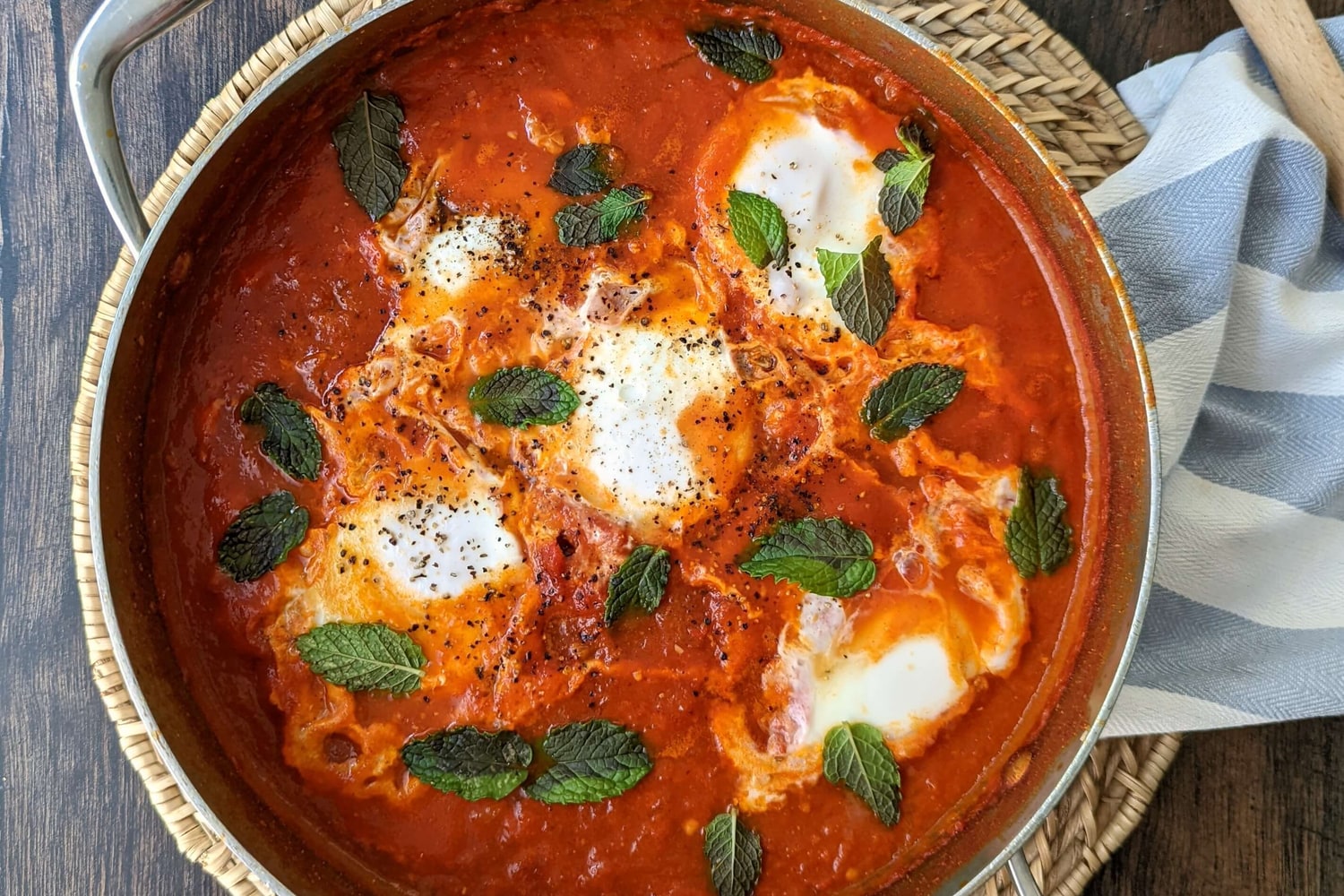
Shakshuka arrived from Tunisia and Libya and became the national breakfast. It is eggs poached in a spiced tomato-and-pepper sauce, eaten straight from the pan with bread. It is also the best entry point in this entire article: one pan, 25 minutes, pantry ingredients, and essentially impossible to ruin.
The technique that matters is sauce first, eggs last. Cook the peppers and onions until genuinely soft (8–10 minutes, not 3), add tomato and spice, and simmer until the sauce mounds behind a spoon instead of running. A watery sauce cannot hold an egg — the whites spread, thin out, and overcook before the yolk sets. Only when the sauce is thick do you make wells, crack the eggs in, cover, and cook 5–8 minutes until whites are set and yolks still run.
Red is the standard: authentic Moroccan shakshuka with cumin, paprika, and a long pepper sauté. For a heartier version that eats as dinner, one-pan spicy tomato and chickpea shakshuka adds a can of chickpeas and turns a 4-egg pan into a meal for four.
Green swaps tomato for greens and dairy — the modern café version. Sautéed spinach and cilantro shakshuka with feta crumbles is the tightest of these at about 17 minutes, and cabbage and spinach shakshuka with cilantro stretches the same idea over cheaper produce.
White is green shakshuka's richer cousin: no tomato, no greens, just a garlic-cream or labneh base with eggs and a lot of black pepper and za'atar. Build it from the labneh technique in the salatim section below.
Sabra brunch isn't a fourth recipe so much as a serving format: shakshuka in the middle, chopped salad, a bowl of hummus, olives, pickles, labneh, and a pile of bread, all at once. That is what an Israeli café means by breakfast, and it's the single best use of a Saturday morning in this article.
Sabich, malawach, jachnun — the Yemenite-Israeli trio
This is where the cuisine stops resembling anything else, and — a straight answer — where our recipe catalog is thinnest. We'll link what exists and give you the technique for the rest rather than pointing you at a card that isn't there.
Sabich is an Iraqi-Jewish Shabbat breakfast that became Israel's second-most-important street food after falafel. A pita is stuffed with fried eggplant, hard-boiled egg, chopped salad, parsley, tahini, and amba. The eggplant is the whole dish: slice it a generous ½ inch thick, salt it 30 minutes, blot it dry, and fry in enough oil that the slices float slightly. Under-fried eggplant is spongy and bitter; properly fried, it's custardy. The amba is what makes it sabich rather than a vegetable sandwich — sour, funky, mustard-yellow, and non-optional. We don't currently have a sabich card in the catalog, so build it from components: fry the eggplant, hard-boil eggs, and use the tahini sauce and pickled vegetables from the falafel recipe as your condiment base.
Malawach is a Yemenite laminated flatbread — flour, water, salt, and a great deal of softened butter or samneh, rolled and folded like a rough puff, rested, then pan-fried until it's crisp outside and pull-apart inside. It's served with crushed tomato, zhug, and a hard-boiled egg. It freezes beautifully, which is why every Israeli freezer has a stack.
Jachnun is the same dough family taken to an extreme: rolled tight, packed into a covered pot, and baked at ~225°F overnight for 8–10 hours until it turns dense, sweet, and mahogany. It is a Shabbat-morning dish precisely because it cooks while nobody is cooking. Both malawach and jachnun are Yemenite in origin — the broader Yemenite Jewish tradition is worth reading about if you want to understand why Israeli bread is so much better than it has any right to be. Neither has a catalog card yet; both are on the list.
The closest things we do have are laminated-adjacent flatbreads worth cooking tonight: za'atar flatbread with labneh and pickled vegetables and grilled eggplant and labneh flatbread with za'atar.
Salatim: the parade of chopped salads
Salatim are the small salads that arrive before the main event — often eight or twelve of them, free, in a restaurant. At home, three is a table.
The base is the Israeli salad itself: cucumber and tomato cut small — genuinely small, ¼-inch dice — with parsley, lemon, olive oil, and salt. The knife work is the recipe. Cut it coarse and it's a Greek salad; cut it fine and the flavors merge into something that eats like a relish. Salt it at the table, not in the bowl, or it floods. A sharp, thin-bladed knife is the only equipment that matters here.
From that base the variations run wide. Ceviche-style tabbouleh with tahini-lime dressing is the fastest at 15 minutes; Aleppo pepper and mint tabbouleh needs 10. For the herb-forward classic, tangy tabbouleh with fresh parsley and bulgur and bulgur wheat tabbouleh with mint and parsley are the reference builds — remember that real tabbouleh is a parsley salad with some bulgur, not a bulgur salad with some parsley.
Bread salads and roasted-vegetable salads round out the table: roasted cauliflower fattoush with sumac and pomegranate seeds, spiced chickpea and mint fattoush — see fattoush for the Levantine original — plus sumac-roasted cauliflower with tahini drizzle, tangy sumac and za'atar roasted cauliflower steaks, and roasted chickpea and za'atar cauliflower salad. Roasted cauliflower with tahini is, by volume, the most-ordered vegetable dish in modern Israeli restaurants, and it costs about $4 to make.
Add the dips and you have mezze: baba ganoush in three builds — roasted eggplant with tahini and pomegranate, spiced with toasted pine nuts and smoked paprika, and oven-roasted with lemon and tahini — plus muhammara, the red-pepper-and-walnut dip that is the best thing on most mezze tables.
Hummus that's actually creamy (baking-soda soak, warm serve)
Hummus is where home cooks accept a worse result than they need to. The gap between supermarket hummus and Abu Hassan hummus is not a secret ingredient. It's four decisions.
1. Dried chickpeas, and baking soda twice. Soak dried chickpeas overnight in water with 1 tsp baking soda per cup. Drain, then cook in fresh water with another ½ tsp baking soda until they are genuinely falling apart — about 90 minutes, well past "tender." The alkaline environment breaks down pectin and helps the skins slough off. If a chickpea doesn't smear to paste between your fingers, keep cooking. Undercooked chickpeas are the number-one cause of grainy hummus, ahead of everything else on this list.
2. More tahini than you think. Restaurant hummus runs close to 1:1 tahini to cooked chickpeas by weight. Most home recipes use a third of that, which is why they taste like bean dip. Whip the tahini with lemon juice and garlic first, until it seizes and then loosens into a pale paste, before the chickpeas go anywhere near it.
3. Ice water, and time. Add ice water a tablespoon at a time while the processor runs. Then let it run — a full four minutes, not thirty seconds. The texture change in minute three is dramatic and most people quit before it happens. This is the one step that genuinely wants a real food processor rather than a blender, which tends to pack the paste against the blade.
4. Serve it warm. Hummus in Israel is a hot dish, served within an hour of being made, pooled in a shallow bowl with olive oil, whole chickpeas, paprika, and parsley. Cold hummus from the fridge is a different, worse food — the tahini firms up and the flavors mute. If you refrigerate it, let it come to room temperature and stir in a splash of warm water before serving.
Working builds: authentically toasted chickpea hummus with za'atar is the closest to the technique above, za'atar-roasted garlic hummus adds roasted garlic sweetness, authentic vegan hummus with roasted garlic scales to 8, and beetroot and herb hummus with crispy flatbread is the color-forward party version. To serve it as a full meal, hummus and grilled veggie platter is the format.
Hummus's close relative, falafel, follows the same rule about dried chickpeas — never canned, which will disintegrate in the oil. Crispy air fryer falafel with tahini lemon sauce gets you there in 27 minutes without a quart of frying oil; oven-baked falafel with tahini lemon sauce and spiced falafel patties with tahini-lemon drizzle are the tray versions.
Sweets: malabi, halvah, rugelach
Israeli desserts are lighter than European ones and lean on rosewater, pistachio, sesame, and date.
Malabi is a cornstarch-set milk pudding — closer to panna cotta than custard, with no eggs — served cold under rose syrup, crushed pistachio, and shredded coconut. It's a 15-minute stovetop dish and the easiest impressive dessert in this article: heat milk with sugar, whisk in a cornstarch slurry, cook until it coats a spoon, chill 3 hours. No catalog card yet.
Halva is crushed sesame bound with hot sugar syrup — dense, flaky, and sold in slabs the size of car batteries in every Israeli market. Making it from scratch requires a sugar thermometer and some nerve; the practical home version is to buy a good slab and use it. Half-sweet halva parfait does exactly that, layering it into yogurt in 15 minutes.
Rugelach are the Ashkenazi contribution — cream-cheese or yeasted dough rolled around chocolate, cinnamon, or apricot. Jerusalem's version is yeasted and drenched in sugar syrup straight from the oven, which is why it's sticky rather than crumbly. Also not yet in the catalog.
What we do have covers the phyllo-and-syrup family: honey-rose pistachio baklava rolls and a baklava-inspired phyllo tart with honey and pistachios. If you want the wider tradition, baklava and knafeh are the two to read up on.
20 Israeli and Levantine recipes to cook this month
Every link below resolves to a real recipe card with ingredients, timings, and a shopping list.
Shakshuka and eggs
1. Authentic Moroccan Shakshuka — the reference red, 50 min, serves 4
2. One-Pan Spicy Tomato and Chickpea Shakshuka — dinner-weight, 35 min
3. Sautéed Spinach and Cilantro Shakshuka with Feta Crumbles — green, 17 min
4. Cabbage and Spinach Shakshuka with Cilantro — budget green, 30 min
Hummus, dips, and falafel
5. Authentically Toasted Chickpea Hummus with Za'atar — the technique build
6. Za'atar-Roasted Garlic Hummus — 35 min, serves 6
7. Roasted Eggplant Baba Ganoush with Tahini and Pomegranate
8. Spiced Baba Ganoush with Toasted Pine Nuts and Smoked Paprika
9. Roasted Eggplant Muhammara with Pomegranate Molasses
10. Crispy Air Fryer Falafel with Tahini Lemon Sauce — 27 min
11. Oven-Baked Falafel with Tahini Sauce and Pickled Vegetables — the sabich condiment base
Salatim and vegetables
12. Ceviche-Style Tabbouleh Salad with Tahini Lime Dressing — 15 min
13. Aleppo Pepper and Mint Tabbouleh Salad — 10 min, serves 6
14. Roasted Cauliflower Fattoush with Sumac and Pomegranate Seeds
15. Sumac-Roasted Cauliflower with Tahini Drizzle — 30 min, ~$4
16. Tangy Roasted Eggplant with Pomegranate Molasses Glaze — 35 min
Mains
17. Za'atar-Spiced Chicken Shawarma Wraps with Pickled Turnips — 25 min
18. Sheet Pan Za'atar Chicken Thighs with Chickpeas — one tray, 45 min
19. Oven-Baked Chicken Schnitzel with Apple Dipping Sauce — the Israeli kid-dinner
20. Phoenician Lamb Kofta with Tahini Yogurt Sauce — 30 min
Four more worth your time
21. Lebanese Lentil and Rice Pilaf with Caramelized Onions — mujaddara, the great cheap dinner
22. Slow-Roasted Lamb Shoulder with Israeli Couscous and Labne — the holiday centerpiece
23. Chilled Israeli Couscous and Three-Bean Summer Salad — ptitim, 25 min
24. Honey-Rose Pistachio Baklava Rolls — serves 8
Also worth a look when you want the heavier, slower end of the tradition: slow-simmered Iraqi lamb stew with sumac and pomegranate molasses, layered stuffed onions and tomatoes with spiced beef and rice, grilled lamb kibbeh with pine nut and herb filling, and harissa-spiced chickpea and tomato stew built on harissa.
The mangal: kebabs, shish tawook, and whole fish
The one part of Israeli cooking that never happens indoors is the mangal — the small charcoal grill that comes out on Yom Ha'atzmaut, in every park, and on most balconies between April and October. It is the counterweight to the mezze table: salads and dips are cold, communal, and endlessly extendable, and the mangal is hot, fast, and served straight off the skewer. If you have only ever cooked this food in a skillet, this is the half you're missing.
The rules are short. Burn hardwood charcoal down to a grey ash coat — you want roughly 500-600°F at the grate, hot enough to color meat in three minutes a side. Skewer flat, not round, so the meat can't spin. Salt lamb and beef 40 minutes ahead; salt chicken only at the grill, because the yogurt marinade already carries enough. Nothing here needs a sauce beyond lemon, tahini, and a pile of Israeli salad.
Skewers. Lamb is the default. Char-grilled lamb kebabs with tzatziki run about 3 minutes a side on a hot grate and are the closest thing here to a Tel Aviv street plate; the sumac-spiced lamb chops with za'atar roasted veggies and grilled za'atar-spiced lamb chops with tzatziki are the chop version when you don't want to thread skewers at all. On the chicken side, shish tawook is the workhorse — authentic Lebanese shish tawook wants a full 4 hours in the yogurt-lemon-garlic marinade and repays it with meat that stays juicy at 165°F. Berber & Q-style buttermilk chicken shish kebabs with lemon pickle swap buttermilk for yogurt and add the pickled-lemon hit that makes the modern London-Israeli grill houses worth the trip.
Whole fish. This is the piece home cooks skip and shouldn't. A whole sea bass — denis or lavraki on a Tel Aviv menu — takes 8-10 minutes a side over the same fire and costs less per serving than lamb. Whole grilled branzino with lemon and herb butter is the direct build. If you don't want to fight a grill basket, baked fish with tomato and olive ragout gets you to the same place in a 400°F oven with a tomato base that is, functionally, shakshuka with fish in it.
Serve any of these with warm flatbread, one chopped salad, and one dip. That is the entire format — the kebab is the event and everything else on the table is a condiment.
What to buy: cast iron for shakshuka, a food processor for hummus
Three purchases cover almost everything in this article. Everything else you already own.
| Item | Why it matters here | Typical spend | Skip it if |
|---|---|---|---|
| 10–12" cast-iron or heavy nonstick skillet | Shakshuka needs even, retained heat to set whites without scorching sauce; thin pans scorch the bottom | $30–60 | You own a heavy oven-safe skillet already |
| 9–14 cup food processor | The 4-minute hummus run; blenders pack the paste against the blade | $80–200 | You eat hummus twice a year |
| Sharp 8" chef's or santoku knife | Chopped salad is ¼-inch dice by hand; a dull knife makes it watery | $40–120 | Your current knife slices a tomato without pressure |
| Half-sheet pan (heavy gauge) | Roasted cauliflower, falafel trays, sheet-pan chicken | $18–30 | You have two already |
| Air fryer (optional) | Falafel in 27 min without a quart of oil | $70–150 | You'd rather use the oven |
Browse the categories: cookware for the skillet and sheet pans, small appliances for the processor and air fryer, knives for the chopped-salad knife, gadgets for a citrus press and a microplane, and grocery for tahini, za'atar, sumac, and silan.
Real-world numbers: cost and time for a full mezze table
A common objection is that mezze is expensive because it's ten dishes. It isn't — it's ten small dishes, and most are legumes and vegetables. Here's a table for six, built from the recipes above. Prices are approximate US supermarket costs as of 2026 and will swing with your region.
| Dish | Hands-on time | Total time | Approx. cost | Make-ahead |
|---|---|---|---|---|
| Hummus (dried chickpeas) | 15 min | 2 hr (mostly unattended) | $3.00 | 3 days |
| Baba ganoush | 15 min | 55 min | $5.00 | 3 days |
| Muhammara | 15 min | 60 min | $7.00 | 5 days |
| Chopped salad | 20 min | 20 min | $4.00 | Same day |
| Roasted cauliflower + tahini | 10 min | 30 min | $4.00 | 2 days |
| Falafel (air fryer) | 20 min | 27 min | $4.00 | Fry fresh |
| Shakshuka | 10 min | 35 min | $6.00 | Sauce 1 week |
| Pita and pickles | 5 min | 5 min | $6.00 | 1 week |
| Total | 1 hr 50 min | — | $39.00 | — |
That's about $6.50 per person for a table that eats like a restaurant meal, and roughly two hours of hands-on work spread across two days if you make the dips ahead. Compare that to a single entrée at a Levantine restaurant and the math is not close.
The timing that actually works, for a Saturday table at 1pm:
- Friday night: soak chickpeas. Roast eggplants for baba ganoush and let them drain overnight.
- Saturday 9am: cook chickpeas, make hummus, make baba ganoush and muhammara. Refrigerate.
- Saturday 12:15pm: roast cauliflower. Start the shakshuka sauce.
- Saturday 12:40pm: chop the salad. Take the dips out to come to room temperature.
- Saturday 12:55pm: eggs into the shakshuka, bread into the oven.
- 1pm: everything lands at once, which is the entire point.
A five-day Israeli home menu
Cook this in order and the pantry pays for itself: the tahini opened on Monday carries the whole week, Tuesday's grilled surplus becomes Wednesday's lunch, and nothing gets made twice. Hands-on time is active minutes, not total.
Two swaps worth knowing. If Monday's lentils feel thin as a standalone dinner, Palestinian mujadara with tahini drizzle and mujadara lentils and caramelized onion rice bowl both plate up heavier for the same 25 minutes. And if Thursday's fish is a hard sell at your table, spiced lamb and freekeh salad with mint and lemon or spiced bulgur wheat pilaf with pine nuts and toasted almonds hold the grain-forward slot without changing the shopping list.
Grill on Tuesday and Thursday back to back and you light charcoal once — cook Thursday's fish on Tuesday's second fire, chill it, and serve it cold with lemon. That is how it is actually done at home.
Common pitfalls
Cold hummus straight from the fridge. Covered above, but it's the single most common mistake and it undoes all the work. Room temperature minimum; warm is better.
Canned chickpeas in falafel. They hold too much water and the fritters disintegrate in the oil or steam into mush in the oven. Dried, soaked, never cooked — the mixture should look like coarse wet sand, not a purée.
Watery shakshuka. You added the eggs before the sauce reduced. Recover it by tilting the pan, spooning out excess liquid, and reducing it separately for two minutes before returning it.
Salting the chopped salad in the bowl. Cucumber and tomato will release a quarter-cup of water in ten minutes. Salt at the table, or salt and drain the cucumber separately first.
Under-fried eggplant in sabich. Pale, spongy eggplant makes the sandwich taste bitter and oily at once. It needs to go properly golden and collapse slightly — that's when the texture turns custardy.
Buying za'atar by the biggest jar. It's a ground herb blend and it dies in about four months. Buy small, buy often, and store it away from the stove.
Treating tahini as a garnish. In hummus, in falafel sauce, in the drizzle over cauliflower, tahini is a primary ingredient by volume. Doubling it is almost always the right call.
When this food is not the right call
Skip it when you need dinner on the table in fifteen minutes flat with no shopping — the pantry build is a real up-front cost, and without good tahini and fresh za'atar the results are genuinely mediocre rather than merely simpler. Our sheet-pan dinners are the better call on a Tuesday you didn't plan for.
Skip it for a table with a sesame allergy. Tahini is load-bearing across hummus, falafel sauce, baba ganoush, sabich, and the cauliflower drizzle; removing it doesn't leave a cuisine so much as a vegetable plate. Our Greek and Moroccan collections give you an overlapping flavor world with far less sesame exposure.
And skip the mezze format — not the food — if you're cooking for people who want a plated main. A table of ten small dishes reads as generous to some and as "no actual dinner" to others. Serve shakshuka, schnitzel, or kofta as a centered main with two salads instead, and everyone's happy. If you want to build a full week around this, the meal plan tool will sequence the components so the dips get used before they turn.
Sources
- Israeli cuisine and Levantine cuisine — the regional and historical frame
- Shakshouka, Sabich, Malawach, Jachnun — the signature dishes
- Yemenite Jewish cuisine and Mizrahi Jewish cuisine — the two traditions that shaped the bread and the spice
- Hummus, Falafel, Tahini — the chickpea-and-sesame core
- Za'atar, Sumac, Date honey (silan), Amba, Harissa, Pomegranate molasses — the pantry
- Israeli salad, Tabbouleh, Fattoush, Baba ghanoush, Muhammara, Strained yogurt (labneh) — the mezze table
- Malabi, Halva, Rugelach, Baklava, Knafeh — the sweets
- Challah, Schnitzel, Mujaddara, Israeli couscous — the Ashkenazi and Levantine staples
- Mangal (barbecue), Kebab, Shish taouk, Yom Ha'atzmaut, European sea bass — the grill
Frequently asked questions
What's the difference between Israeli and Lebanese food?
How do I make hummus that's actually creamy?
Is shakshuka only for breakfast?
Do I need special equipment for these recipes?
Can I make sabich and shakshuka meal-prep style?
Sources
- en.wikipedia.org
- en.wikipedia.org
- en.wikipedia.org
- en.wikipedia.org
- en.wikipedia.org
- en.wikipedia.org
- en.wikipedia.org
- en.wikipedia.org
- en.wikipedia.org
- en.wikipedia.org
- en.wikipedia.org
- en.wikipedia.org
- en.wikipedia.org
- en.wikipedia.org
- en.wikipedia.org
- en.wikipedia.org
- en.wikipedia.org
- en.wikipedia.org
- en.wikipedia.org
- en.wikipedia.org
- en.wikipedia.org
- en.wikipedia.org
- en.wikipedia.org
- en.wikipedia.org
- en.wikipedia.org
- en.wikipedia.org
- en.wikipedia.org
- en.wikipedia.org
- en.wikipedia.org
- en.wikipedia.org
- en.wikipedia.org
- en.wikipedia.org
- en.wikipedia.org
- en.wikipedia.org
- en.wikipedia.org
- en.wikipedia.org
- en.wikipedia.org
Plan a week of meals in two minutes.
Tell our AI what you have and what you like — it builds your plan, shopping list, and Instacart cart. No account needed.
Try free →