How to Cook Pork Tenderloin: 20 Recipes + Complete Method Guide
Six methods, one 145°F target, and twenty tested recipes — from a 25-minute pan-sear to a sheet-pan dinner that feeds four.
Last updated 2026-09-10
Get a free week of easy dinners
Seven weeknight dinners with the shopping list already totalled, sent Sunday. No account needed, unsubscribe in one click.
No spam, unsubscribe in one click. Recipes, shopping lists and Instacart carts all work without an account either way.
How to Cook Pork Tenderloin
Sear a 1- to 1.25-pound pork tenderloin in a screaming-hot skillet for 2 minutes per side on all four sides, then transfer the pan to a 400°F oven for 12 to 18 minutes. Pull it at 145°F internal temperature measured in the thickest part, tent it loosely with foil, and rest it 5 to 10 minutes before slicing. Total active time is under 10 minutes and total cook time lands between 20 and 28 minutes. The 145°F target is the USDA's revised whole-cut pork standard — the center will be faintly pink and that is correct, not undercooked. The single most common failure is cooking to the old 160°F guidance, which strips a lean cut of its remaining moisture.
The Cut Explained: Tenderloin vs Loin vs Pork Loin Roast
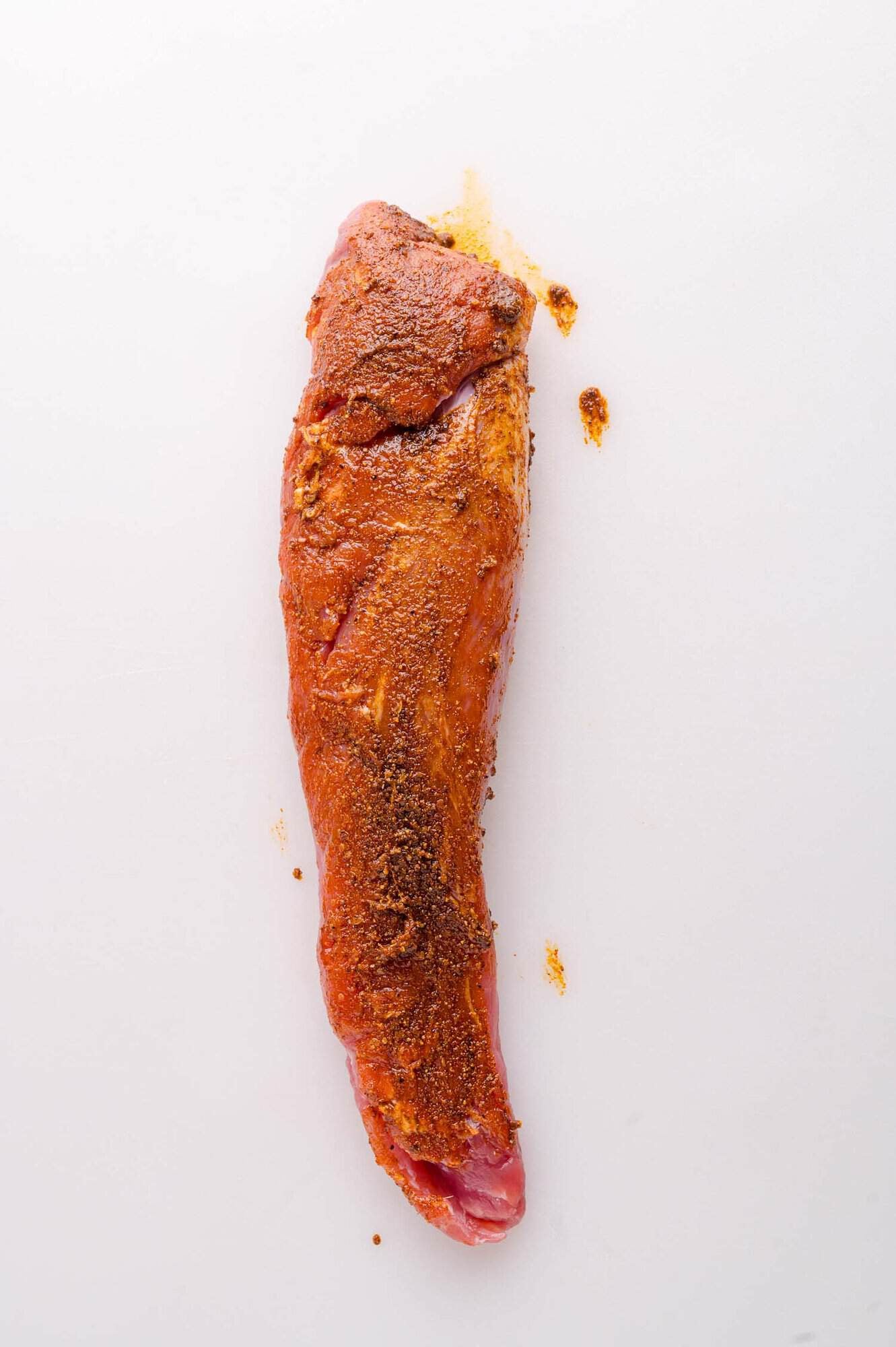
These three names get used interchangeably at the meat counter and they should not be. Pork tenderloin is the psoas major — a long, narrow muscle roughly 12 inches long, 2 to 3 inches thick, weighing 1 to 1.5 pounds. It does almost no work during the animal's life, so it is the leanest and most tender cut on the hog, at roughly 2 to 3 grams of fat per 3-ounce serving.
Pork loin (also sold as center-cut pork loin roast) is a much wider, flatter cut from the back, typically 3 to 5 pounds with a fat cap on top. It is a different muscle entirely and needs 20 to 25 minutes per pound at 350°F — roughly triple the tenderloin's cook time. Buying a loin and cooking it on a tenderloin timeline gives you raw pork; the reverse gives you shoe leather.
Pork loin chops are that same loin cut crosswise into steaks. Recipes like Pan-Seared Pork Chops with Apple and Mustard Sauce use them, and the technique transfers, but the timing does not.
At the store, check the package weight. Under 1.75 pounds and long and skinny means tenderloin. Over 2.5 pounds and wide means loin. Many tenderloins are sold two-to-a-package in a marinade-injected vacuum bag; those are pre-brined at roughly 10% solution, so skip any additional salting step or you will overshoot.
Methods Table
| Method | Temp | Active + Total Time | Best For |
|---|---|---|---|
| Pan-sear then roast | 450°F pan → 400°F oven | 8 min + 22 min | The default — best crust, most reliable |
| Grilled (two-zone) | 450°F direct / 350°F indirect | 10 min + 22 min | Marinades, char, summer cooking |
| Oven-roasted whole | 425°F | 4 min + 25 min | Hands-off, sheet-pan dinners |
| Sous vide + sear | 140°F bath, then 1 min sear | 5 min + 90 min | Zero-risk doneness, batch cooking |
| Air fryer | 380°F | 4 min + 20 min | One tenderloin, no oven preheat |
| Slow cooker | Low, 4 hr | 5 min + 4 hr | Shredded pork only — not sliceable |
Note the last row. A tenderloin has almost no collagen and no intramuscular fat, so a slow cooker cannot do for it what it does for shoulder. Four hours on low produces dry, stringy meat that only works shredded into a sauce. If a recipe tells you to slow-cook a tenderloin whole and slice it, skip that recipe.
Method 1: Pan-Seared Then Roasted
This is the default for a reason: you get a hard Maillard crust from the skillet and gentle, even finishing from the oven, and the whole thing happens in one pan.
Preheat the oven to 400°F with a rack in the center. Pat the tenderloin completely dry with paper towels — surface water costs you 30 to 60 seconds of sear time while it boils off. Trim the silverskin: slide a thin boning knife under the iridescent membrane at one end, angle the blade slightly up, and pull the membrane taut as you slide forward. Silverskin does not render and will contract in the heat, curling the tenderloin into a bow.
Season aggressively with kosher salt and coarse black pepper — about 1 teaspoon of Diamond Crystal per pound. Heat a 12-inch cast iron or carbon steel skillet over medium-high until a drop of water skitters, roughly 4 minutes. Add 1 tablespoon of a high-smoke-point oil (grapeseed, avocado, refined canola — not extra virgin olive oil, which smokes at 375°F).
Lay the tenderloin away from you and do not move it for 2 minutes. Turn a quarter rotation with tongs and repeat on all four faces — 8 minutes total, and yes, a round cut has four workable faces if you press it down lightly. Transfer the skillet straight to the oven.
Roast 12 to 18 minutes depending on thickness. Start checking at 12. Pull at 145°F. If you want a pan sauce, remove the pork to a board, put the skillet on medium heat, deglaze with 1/3 cup of stock, wine, or cider, scrape the fond, and finish with a tablespoon of cold butter off the heat. Herb-Roasted Pork Tenderloin with Mustard Pan Sauce walks the full sauce sequence, and Pan-Seared Pork Tenderloin with Honey Garlic Glaze does it in 25 minutes end to end.
Method 2: Grilled Pork Tenderloin
Build two zones: all coals banked to one side on charcoal, or two burners on high and two off on gas. You want roughly 450°F over the hot side and 350°F over the cool side.
Marinate first — this is the method where marinade pays off, because direct flame drives surface flavor in hard. Give an acidic marinade 2 to 4 hours and no more; citrus and vinegar at higher concentrations start denaturing the exterior into a mushy texture past about 6 hours. Citrus-Marinated Grilled Pork Tenderloin uses a 2-hour orange-and-lemon soak, and Grilled Caribbean Mojo Pork Tenderloin runs garlic-heavy mojo for the same window.
Wipe the marinade off before the pork hits the grate. Sugar in a marinade — honey, maple, pineapple juice — burns black at 450°F in under 90 seconds. Sear over direct heat 2 minutes per side, quarter-turning for 8 minutes total, then slide to the indirect zone, close the lid, and cook 10 to 14 minutes to 145°F.
For glazes, brush during the last 3 minutes only. Smoky Maple-Glazed Pork Tenderloin on the Grill is built around that late-glaze timing. Charcoal cooks read about 5 minutes faster than gas at the same nominal temperature because of radiant heat off the coal bed — trust the thermometer, not the clock.
Method 3: Oven-Roasted Whole
The hands-off version. Heat the oven to 425°F — higher than the sear-then-roast method, because there is no skillet stage building crust and you need the oven's dry heat to do that work.
Rub the tenderloin with oil, salt, pepper, and a dry rub, set it on a rack over a rimmed sheet pan, and roast 22 to 28 minutes to 145°F. The rack matters: sitting the pork directly on the pan steams the underside and you get a pale, wet stripe along the bottom.
This is the method that scales into a full sheet-pan dinner. Toss halved baby potatoes and thick-cut carrots in oil, spread them around the pork, and everything finishes together. Sheet Pan Herb-Roasted Pork Tenderloin with Vegetables and Smoky Sheet Pan Pork Tenderloin with Sweet Potato and Apples both run this pattern at 4 servings for about 45 minutes total. Give root vegetables a 10-minute head start; they need roughly 35 minutes to the pork's 25.
Method 4: Sous Vide Pork Tenderloin
Sous vide removes the timing problem entirely. The water bath is the target temperature, so the pork physically cannot overshoot.
Set the circulator to 140°F for a firm, traditionally sliced texture, or 135°F for noticeably more tender and slightly pinker. Season, bag with a sprig of thyme and a smashed garlic clove, and drop it in. Minimum 1 hour for a 1.25-pound tenderloin to come to temperature; you can hold it up to 4 hours without texture loss. Past 4 hours the muscle fibers begin to break down into a mealy, ham-like texture.
Pasteurization at 140°F held for 30-plus minutes exceeds the safety equivalent of an instantaneous 145°F reading, which is why 140°F is safe here but not in a skillet — the doneness standard is a time-and-temperature curve, not a single number.
The sear afterward is non-negotiable and must be fast. Dry the pork thoroughly, get the pan hotter than you would for a raw sear, and give it 45 to 60 seconds per face. Any longer and you cook a gray band into the meat you just spent 90 minutes protecting. This method is the best of the six for cooking four tenderloins for a dinner party — bag them all, bath them together, sear in two batches.
Method 5: Air Fryer Pork Tenderloin
A 1-pound tenderloin fits a 5.8-quart basket if you curve it into a horseshoe. Preheat to 380°F for 3 minutes, oil and season the pork, and cook 18 to 22 minutes, flipping once at the halfway mark.
The convection fan gives you a decent all-over crust with no skillet, and the small chamber means no oven preheat — this is a 25-minute weeknight dinner from a cold start. The trade-off is that basket contact leaves flat spots, and there is no fond, so no pan sauce. Glaze in the last 4 minutes. A Herb-Infused Honey-Glazed Pork Tenderloin adapts cleanly with that timing shift.
5 Marinade & Rub Formulas
Each of these is scaled for one 1.25-pound tenderloin. Marinades go 2 to 4 hours in the fridge; dry rubs can go on 30 minutes ahead or up to overnight.
Herb (dry rub). 1 tbsp chopped rosemary, 1 tbsp thyme, 3 minced garlic cloves, 2 tsp kosher salt, 1 tsp black pepper, 2 tbsp olive oil. The all-purpose default. Used in Garlic-Rosemary Roasted Pork Tenderloin.
Asian-style (marinade). 3 tbsp soy sauce, 2 tbsp rice vinegar, 1 tbsp honey, 1 tbsp grated ginger, 2 cloves garlic, 1 tsp toasted sesame oil. Wipe before searing — the honey will scorch.
Mustard-herb (paste). 3 tbsp Dijon, 1 tbsp whole-grain mustard, 2 tsp chopped tarragon, 1 tsp black pepper. Mustard's emulsifiers hold the crust onto the meat better than oil-based rubs. See Oven-Roasted Pork Tenderloin with Mustard Herb Crust and Creole Mustard and Herb Roasted Pork Tenderloin.
Latin mojo (marinade). 1/3 cup orange juice, 2 tbsp lime juice, 6 cloves garlic, 1 tsp cumin, 1 tsp oregano, 1/4 cup olive oil. Four hours maximum.
Sweet BBQ (rub + late glaze). 2 tbsp brown sugar, 1 tbsp smoked paprika, 2 tsp salt, 1 tsp garlic powder, 1/2 tsp cayenne, plus 1/4 cup barbecue sauce brushed on in the final 3 minutes.
20 Recipe Roundup
Every one of these is a working pork tenderloin recipe from the AislePrompt catalog with tested timings.
1. Smoky Sheet Pan Pork Tenderloin with Sweet Potato and Apples — 45 min, 4 servings, 380 cal. The best all-in-one fall version.
2. Aperol-Balsamic Glazed Pork Tenderloin — 40 min, bitter-orange glaze that cuts the sweetness.
3. Honey-Garlic Glazed Pork Tenderloin with Roasted Shallots — 35 min, 45g protein per serving.
4. Honey-Glazed Balsamic Pork Tenderloin — 38 min, the crowd-pleaser glaze.
5. Sheet Pan Harissa-Spiced Pork Tenderloin with Roasted Vegetables — 45 min, North African heat.
6. Herb-Infused Honey-Glazed Pork Tenderloin — 35 min, the air-fryer adaptation above.
7. Creole Mustard and Herb Roasted Pork Tenderloin — 40 min, 45g protein.
8. Sheet Pan Citrus-Glazed Pork Tenderloin with Sweet Potatoes — 55 min, brightest of the sheet-pan set.
9. Sheet Pan Honey-Garlic Glazed Pork Tenderloin with Roasted Vegetables — 50 min, 40g protein.
10. Herb-Roasted Pork Tenderloin with Maple Glaze — 40 min, the autumn default.
11. Herb-Roasted Pork Tenderloin with Mustard Pan Sauce — 35 min, best pan sauce in the set.
12. Pan-Seared Pork Tenderloin with Honey Garlic Glaze — 25 min, the fastest here.
13. Oven-Roasted Pork Tenderloin with Mustard Herb Crust — 35 min, 45g protein, no skillet needed.
14. Herb-Roasted Pork Tenderloin with Mustard Dijon Glaze — 40 min.
15. Maple-Sage Pork Tenderloin with Honeycrisp Apple Slices — 35 min, peak-September produce.
16. Grilled Caribbean Mojo Pork Tenderloin — 35 min, 45g protein.
17. Citrus-Glazed Grilled Pork Tenderloin with Mojo Verde — 50 min including the marinade.
18. Citrus-Marinated Grilled Pork Tenderloin — 35 min, 40g protein.
19. Smoky Maple-Glazed Pork Tenderloin on the Grill — 50 min, low-and-slow on the indirect zone.
20. Sheet Pan Herb-Roasted Pork Tenderloin with Vegetables — 45 min, 420 cal, the weeknight workhorse.
Common Mistakes
Cooking to 160°F. The USDA lowered the whole-cut pork guidance to 145°F plus a 3-minute rest in 2011, and the National Pork Board has published to that standard ever since. Fifteen degrees of overshoot on a cut with 2 grams of fat per serving is the difference between juicy and chalky. If pink pork makes you uneasy, understand that the color at 145°F comes from myoglobin, not from raw meat.
Skipping the thermometer. Tenderloins taper — the thick end and the tail end can differ by 15°F at pull time. Probe the thickest section, horizontally along the length rather than straight down, so the tip sits in the center mass.
Leaving the silverskin on. It shrinks at temperature and bows the meat, which makes the thin end cook faster still. Two minutes with a boning knife fixes it.
Not resting. Five to ten minutes under loose foil lets the pressure gradient in the muscle equalize. Cut immediately and you lose measurable juice to the board — enough to see. Loose foil, not wrapped: sealing it traps steam and softens the crust you just built.
Glazing too early. Sugar-based glazes go on in the last 3 to 5 minutes. Brush them on at the start of a 400°F roast and you get carbon.
Cold pork straight from the fridge. Thirty minutes on the counter takes the chill off and narrows the gap between surface and center doneness. It is the cheapest improvement on this list.
What to Serve with Pork Tenderloin
Pork tenderloin is lean and mildly sweet, which means it pairs with acid and starch better than it pairs with more richness. Roasted root vegetables cooked in the same pan are the obvious answer, and they are the reason the sheet-pan method is so popular.
Apples and pork is not a cliché, it is chemistry — malic acid cuts the fat and the sugars caramelize alongside the meat's own. A quick pan sauce of cider, mustard, and butter takes 4 minutes in the skillet you already dirtied.
For starch, creamy polenta, mashed potatoes with buttermilk, or a whole grain like farro all work. Green sides want sharpness: shaved brussels sprouts with lemon, a fennel and apple slaw, or blistered green beans with garlic. If you are building a full autumn menu, 20 Fresh Sage Recipes: Brown Butter, Pork & Autumn Sides covers the herb side of the same table, and 20 Glazed Recipes: Sweet-Savory Sauces for Salmon, Chicken & Pork has the sauce formulas.
Wine: an off-dry Riesling or a Pinot Noir. Beer: a Märzen or a brown ale.
Kitchen Tools
An instant-read thermometer is the one non-optional tool. Everything above resolves to a number, and a 2-second Thermapen-class reader removes the guesswork entirely. Our picks are in Best Instant-Read Thermometers for 2026, and the broader Kitchen Gadgets category carries the alternates.
A 12-inch cast iron or carbon steel skillet holds enough thermal mass that adding a pound of cold pork does not crash the pan temperature — that is why the sear works there and does not in thin nonstick. Browse Cookware for the sizes worth owning.
A heavy rimmed half-sheet pan with a wire rack covers the roasting method and every sheet-pan dinner in the roundup. Thin pans warp audibly at 425°F. See Bakeware for gauge recommendations, and Knives & Cutting for the thin boning knife that makes silverskin removal a two-minute job.
Sources & Related Reading
Primary references for this guide: the National Pork Board's cooking standards, the pork tenderloin cut anatomy, the time-and-temperature basis of doneness, the Maillard reaction chemistry behind the sear, and sous vide pasteurization curves.
Related reading on AislePrompt: 22 Pan-Seared Dinners: Restaurant-Style Crust at Home in 30 Minutes, Best Roasting Pans for 2026, and 20 Weekday BBQ Dinners Under 45 Minutes.
Frequently asked questions
What internal temperature should pork tenderloin reach?
Do I need to marinate pork tenderloin before cooking?
What's the difference between pork tenderloin and pork loin?
Can I cook pork tenderloin from frozen?
What sides pair best with roasted pork tenderloin?
Sources
You know how to cook pork tenderloin. Now what do you make with it?
Ask our AI what to make with pork tenderloin tonight — it writes the recipe, the shopping list, and sends the cart to Instacart. No account needed.
Get pork tenderloin dinner ideas →