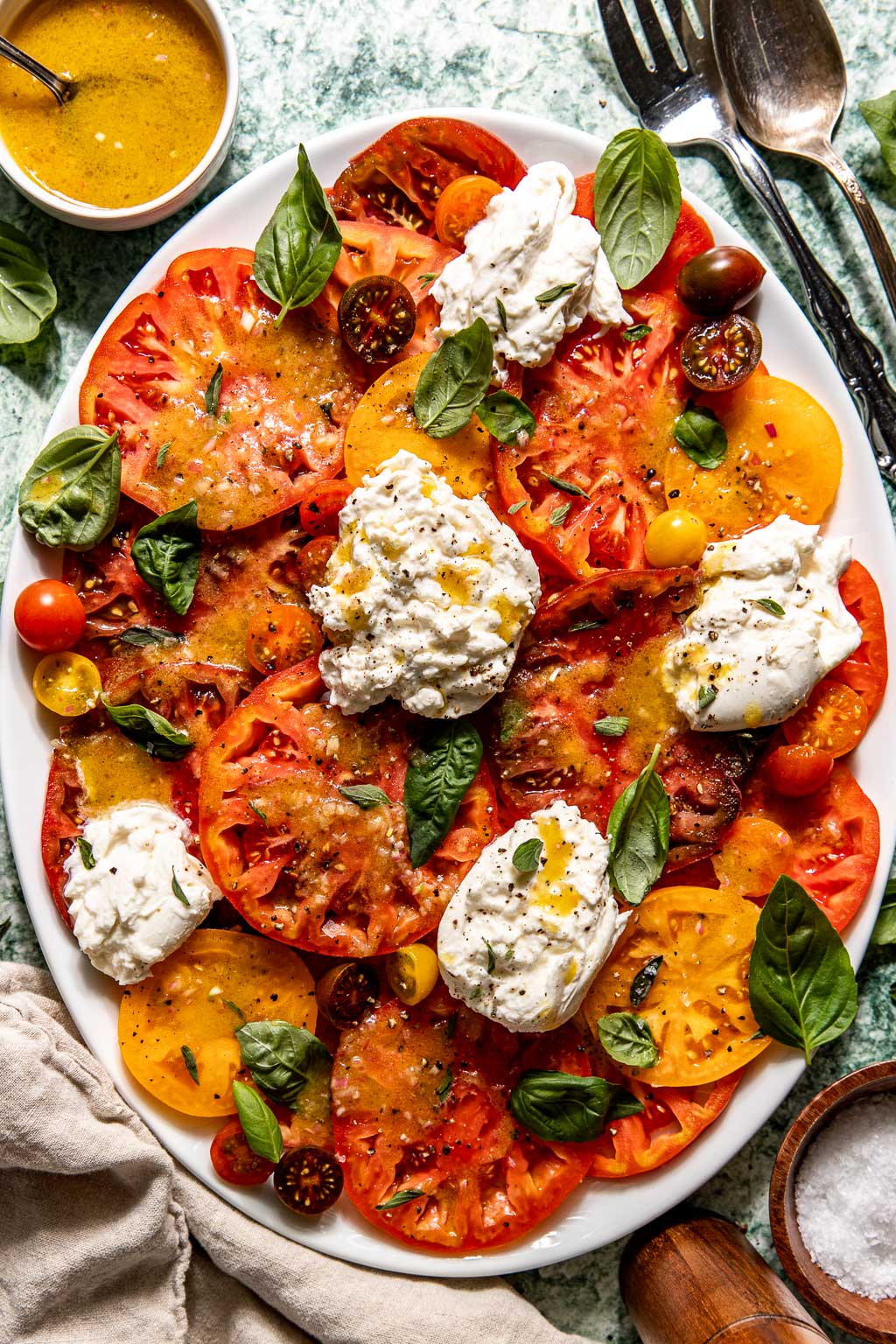
Peak Summer Produce Guide: What to Cook in July & August (30+ Recipes)
The 12 produce items worth shopping for at peak — tomatoes, corn, stone fruit, zucchini, eggplant, peppers, basil, watermelon — plus 41 tested recipes organized by ingredient and the storage rules that keep flavor from collapsing before you cook.
What to cook with summer produce
Get a free week of easy dinners
Seven weeknight dinners with the shopping list already totalled, sent Sunday. No account needed, unsubscribe in one click.
No spam, unsubscribe in one click. Recipes, shopping lists and Instacart carts all work without an account either way.
Cook what's at peak. From late June through early September, US farmers markets carry tomatoes, corn, zucchini, eggplant, bell peppers, basil, cucumbers, green beans, watermelon, and stone fruit (peaches, plums, nectarines) at flavor levels you simply cannot buy in February. The job in July and August isn't cooking technique — it's sourcing, then getting out of the way.
This guide covers the 12 summer produce items worth shopping for, how to buy and store each one, and 30+ tested recipes (Heirloom Tomato & Burrata Caprese Salad, Chilled Summer Corn and Avocado Gazpacho, Sheet Pan Rustic Peach Galette with Almond Glaze, and more) organized by ingredient. As of 2026, the US growing window has shifted later in northern states — most of these picks now hold through mid-September.
Why summer cooking is about ingredient, not technique
In January, a recipe lives or dies on what you do to the food: braise, deglaze, layer, reduce. In July, technique gets out of the way. A flat of farmers-market heirlooms (Summer's Best Heirloom Tomato & Burrata Salad) needs flaky salt, good olive oil, and a knife. That's it. Spend three hours making a tomato confit out of January romas and you'll still be eating a sad sauce; spend three minutes slicing a July heirloom and you'll have one of the best dishes you eat all year.
The shift in mindset matters because most cooks default to winter habits — long braises, heavy sauces, layered casseroles — well into August. They cook the summer out of the food. This guide treats every section the same way: source it right, store it right, then choose the lightest treatment that respects the ingredient.
A second consequence: summer is the season where home cooking is most directly competitive with restaurants. A pro kitchen pays $4 a pound for greenhouse tomatoes year-round and rarely accesses true peak-season heirlooms. You can walk into a Saturday farmers market with $25 and beat anything a 3-star restaurant puts on a plate in February. Use that advantage. Per the USDA's seasonal produce guide, this is the only stretch of the year where the entire shopping list — vegetables, fruit, herbs — peaks simultaneously.
What's at peak in July & August
These are the 12 items worth building your shopping list around. Everything else in the market is either still developing flavor or already past peak.
| Item | Peak weeks (US) | How to spot peak | Common 7-day post-buy loss |
|---|---|---|---|
| Heirloom tomato | Jul 15 – Sep 5 | Heavy for size, fragrant at stem | 30% flavor in 4 days |
| Cherry tomato | Jul 1 – Sep 20 | Firm skin, no splits | 15% in 7 days |
| Sweet corn | Jul 10 – Aug 25 | Tight husks, plump kernels to tip | 50% sugar→starch in 24h |
| Zucchini | Jun 25 – Sep 1 | 6–8 inches max, glossy skin | 20% in 7 days |
| Eggplant | Jul 1 – Sep 10 | Tight, shiny skin, light for size | 25% in 5 days |
| Bell pepper | Jul 15 – Sep 15 | Heavy, glossy, no soft spots | 15% in 7 days |
| Cucumber | Jun 20 – Sep 5 | Firm, no bulges, slim variety | 20% in 7 days |
| Green bean | Jun 25 – Aug 15 | Snaps cleanly, no string | 30% in 4 days |
| Basil | Jun 15 – Sep 15 | Bright green, no black tips | Wilts in 24h refrigerated |
| Watermelon | Jul 1 – Sep 1 | Hollow knock, yellow ground spot | 5% in 7 days uncut |
| Peach | Jul 10 – Aug 25 | Strong scent, slight stem give | Hard→ripe in 2–4 days |
| Plum / nectarine | Jul 20 – Sep 5 | Slight give at shoulder, no shrivel | 3% in 5 days |
The 24-hour sugar-to-starch conversion on sweet corn is the single highest-impact reason to shop the same day you cook. Corn picked in the morning and eaten that night tastes like dessert; the same ear three days later tastes like a vegetable. This is one rare case where what your grandparents told you — "boil the water before you pick the corn" — is technically defensible. Cornell extension data (echoed across the home-cooking press) shows roughly 30% of corn's sugar converts to starch in the first 24 hours at room temperature.
Tomatoes — buying, storing, and 6 ways to use a flat
If you buy nothing else from a farmers market this summer, buy heirloom tomatoes. The flavor delta vs. a supermarket tomato is the single largest gap in the produce aisle: farmers-market tomatoes are picked ripe and trucked the same morning; supermarket tomatoes are picked green and gassed with ethylene to turn red, which produces color but never develops the volatile compounds that taste like tomato. The flavor difference is dramatic enough that most professional kitchens only use supermarket tomatoes for cooked sauce.
Buying: weight is the single best signal. A good heirloom feels heavy for its size, smells faintly like tomato at the stem, and yields slightly to thumb pressure without going soft. Cracks at the stem are fine — they're a sign the fruit ripened on the vine. Anything labeled "vine-ripened" at a supermarket is usually still picked green; the vine is attached for visual marketing, not flavor.
Storing: counter, never fridge. Refrigeration below 55°F damages cell walls and creates the mealy texture everyone complains about. Store stem-side down on a paper towel out of direct sun. Use within 5–7 days of full ripeness. If you've cut one and need to save half, refrigerate the cut half, but bring it back to room temperature before serving — cold kills volatile aroma.
Six ways to use a flat:
| Treatment | Best variety | Time | Recipe link |
|---|---|---|---|
| Sliced with salt and oil | Brandywine, Cherokee Purple | 5 min | Summer's Best Heirloom Tomato & Burrata Salad |
| Caprese with burrata | Beefsteak heirloom | 10 min | Italian-Inspired Caprese Salad with Balsamic Reduction |
| Panzanella | Mix of cherry + heirloom | 25 min | Rustic Italian Panzanella Bread Salad with Cherry Tomatoes |
| Sandwich (the August sandwich) | Brandywine on toast | 8 min | Avocado and Tomato Sandwich with Zucchini and Basil |
| Garden salad | Sungold cherry | 15 min | Botanical Garden Herb & Heirloom Tomato Salad |
| Mixed-veg salad | Vine cherry + cucumber | 15 min | Cucumber-Avocado Tomato Salad with Lemon-Herb Dressing |
The August sandwich — white bread, mayo, salt, thick slice of heirloom — is the test case. If your tomato passes it, you bought right. If it tastes like a tomato-flavored sponge, your tomato came from a supermarket regardless of what the chalkboard claimed.
Corn — beyond the cob
Sweet corn is the summer ingredient with the steepest post-harvest decay curve, and the easiest to source poorly. The supermarket "fresh sweet corn" section is almost always 4–7 days old; by the time it hits your pot, half the sugar has converted to starch and you're boiling a vegetable that tasted like candy 96 hours ago. Buy the corn at a farm stand, drive home, and cook it that night.
Picking peak corn: husks should be tight, bright green, and slightly sticky near the silk. Kernels should be plump all the way to the tip — pull back one inch of husk and check. Yellowing husks or shriveled tip kernels mean the corn sat too long.
Cooking the cob: boil 4 minutes in unsalted water (salt toughens kernels), or grill in the husk for 12–15 minutes over direct medium heat. Skip the supposedly-old-school "throw it in the husk on the grill for 45 minutes" — modern corn varieties are sweet enough that long cooks turn them gummy. For a quick flavored treatment, try Honey-Lime Grilled Corn on the Cob with Chili Butter or Mexican Street Food-Inspired Grilled Corn with Cotija and Lime.
Off the cob is where corn shines for crowds. Cut kernels with a chef's knife from a quality 8-inch blade (a dull knife crushes the cob and loses juice). Use them in:
- A cold chowder — Chilled Summer Corn and Avocado Gazpacho is the highest-impact 20-minute starter you can make in July
- A grain-bowl salad — Summer Grilled Corn and Black Bean Salad, Grilled Corn and Peach Salad with Honey Thyme Dressing
- A panzanella variation — Tomato and Fresh Corn Panzanella with Basil and Red Wine Vinaigrette
- A summer chowder — Native Heirloom Corn Chowder or Summer Island Vegetable and Corn Chowder
Bonus move: when you cut the kernels off, save the bare cobs in a freezer bag. They make the best corn stock you'll ever have for winter soups and risottos. One ear's worth of cobs simmered 45 minutes in 4 cups of water gives you a stock so sweet you'll cut it 50/50 with chicken broth.
Stone fruit — sweet and savory
Peaches, plums, and nectarines hit peak right alongside the tomatoes, and they're the most underused summer category in home cooking. Most people default to "cobbler or eat raw," and miss that stone fruit pairs as well with prosciutto and balsamic as it does with sugar and butter.
How to tell if a peach is actually ripe: smell first — a ripe peach has a strong peach scent at the stem. Press gently near the top (not the bottom, which bruises) — it should yield slightly without going mushy. Color isn't reliable; some varieties stay greenish-orange even when ripe. If your peach was bought hard, leave it stem-down on the counter for 2–4 days; it'll soften and sweeten. Never refrigerate before fully ripe — the cold halts ripening permanently.
Savory treatments first, because they're the more interesting half:
- Burrata Peach & Prosciutto Salad with Honey-Lemon Vinaigrette — the classic three-ingredient summer salad
- Grilled Peach and Prosciutto Chicken Skewers — the same flavor on the grill, scaled for a crowd
Then desserts, which are where most people start:
- Sheet Pan Rustic Peach Galette with Almond Glaze — the highest-impact dessert for the time invested; one sheet feeds 8
- Peach-Cardamom Galette with Honey-Drizzle and Baked Peach and Ricotta Galette with Honey Drizzle for variations
- Cinnamon-Spiced Peach Cobbler with Brown Sugar Crumble and Peach Cobbler Dump Cake with Vanilla Ice Cream for the lazy-Sunday format
Plums and nectarines substitute 1:1 in any peach recipe. Italian prune plums (small, dark purple, peak in late August) hold their shape in a galette better than peaches do, so they're the move if you want clean wedges.
Zucchini, eggplant, bell peppers, basil, watermelon — quick treatments
These five items show up at every farmers market all summer and need the fewest words to handle right.
Zucchini. Buy small — 6–8 inches max. Anything larger has tough skin and watery seeds. The single best technique is high-heat blister: cut into 1-inch coins, toss with olive oil and salt, blast at 500°F for 12 minutes. The high heat caramelizes the edges instead of turning the zucchini to mush. For a more substantial treatment, Crisp-Topped Zucchini and Corn Fritters with Lemon-Dill Yogurt, Fresh Corn and Zucchini Fritters with Chives, Dill-Crusted Zucchini and Corn Fritters, or Zucchini & Corn Fritters with Dill Sauce — all batches feed 4 and freeze well. Excess zucchini freezes well shredded raw; it goes straight into bread, soups, or pasta sauce.
Eggplant. Glossy skin, light for size — heavy eggplants are seed-bound and bitter. The classic French treatment is ratatouille: Spring Garden Ratatouille with Herbed Goat Cheese, One-Pan Ratatouille with Roasted Vegetables, French C'est Bon Ratatouille with Roasted Vegetables, or Oven-Baked Ratatouille with Fresh Herbs. One technique tip: salt sliced eggplant for 20 minutes before cooking and blot with a paper towel — this pulls out moisture and prevents the spongy texture that makes people think they don't like eggplant.
Bell peppers. Red, yellow, and orange peppers are just green peppers that ripened longer on the plant — they're sweeter, more vitamin-dense, and worth the price gap. For stuffed peppers, Roasted Sweet Bell Pepper & Feta Stuffed Peppers and Colorful Bell Pepper and Hummus Stuffed Peppers are the lowest-friction templates. Shishitos — the smaller, mildly spicy Japanese pepper — blister in 90 seconds in a screaming-hot pan: Charred Shishito Peppers with Miso Soy Glaze or Charred Shishito Pepper and Sweet Corn Salad with Garlic Vinaigrette.
Basil. Buy in bunches, not packaged. Wilts in 24 hours refrigerated; store on the counter in a glass of water like cut flowers. Best uses: pesto (freezes for 6 months in ice cube trays), torn over tomatoes, or stem-and-all into pasta. Italian Oven-Roasted Vegetable Pasta with Basil Pesto, Lemon-Basil Pesto Penne with Sun-Dried Tomatoes, and Mini Caprese Sandwiches with Basil Pesto cover the main weeknight angles.
Watermelon. Hollow knock + a yellow ground spot where it sat on the ground = ripe. Beyond eating it cold by the slice, watermelon takes salt, lime, and feta the way tomato takes mozzarella: Crisp Summer Watermelon and Feta Salad with Mint Vinaigrette, Charlotte Watermelon and Feta Summer Salad, Watermelon and Feta Skewers with Chili Lime Drizzle.
30+ recipes organized by ingredient
The full list. Bookmark any of these for the next farmers-market haul.
Tomatoes (9): Summer's Best Heirloom Tomato & Burrata Salad, Heirloom Tomato & Burrata Caprese Salad, Italian-Inspired Caprese Salad with Balsamic Reduction, Rustic Italian Panzanella Bread Salad with Cherry Tomatoes, Authentic Tuscan Panzanella Salad, Tomato and Fresh Corn Panzanella with Basil and Red Wine Vinaigrette, Avocado and Tomato Sandwich with Zucchini and Basil, Botanical Garden Herb & Heirloom Tomato Salad, Cucumber-Avocado Tomato Salad with Lemon-Herb Dressing.
Corn (7): Honey-Lime Grilled Corn on the Cob with Chili Butter, Mexican Street Food-Inspired Grilled Corn with Cotija and Lime, Grilled Corn and Peach Salad with Honey Thyme Dressing, Summer Grilled Corn and Black Bean Salad, Chilled Summer Corn and Avocado Gazpacho, Summer Island Vegetable and Corn Chowder, Native Heirloom Corn Chowder.
Stone fruit (7): Burrata Peach & Prosciutto Salad with Honey-Lemon Vinaigrette, Grilled Peach and Prosciutto Chicken Skewers, Sheet Pan Rustic Peach Galette with Almond Glaze, Peach-Cardamom Galette with Honey-Drizzle, Baked Peach and Ricotta Galette with Honey Drizzle, Cinnamon-Spiced Peach Cobbler with Brown Sugar Crumble, Peach Cobbler Dump Cake with Vanilla Ice Cream.
Zucchini (4): Crisp-Topped Zucchini and Corn Fritters with Lemon-Dill Yogurt, Fresh Corn and Zucchini Fritters with Chives, Dill-Crusted Zucchini and Corn Fritters, Zucchini & Corn Fritters with Dill Sauce.
Eggplant (4): Spring Garden Ratatouille with Herbed Goat Cheese, One-Pan Ratatouille with Roasted Vegetables, French C'est Bon Ratatouille with Roasted Vegetables, Oven-Baked Ratatouille with Fresh Herbs.
Peppers (4): Roasted Sweet Bell Pepper & Feta Stuffed Peppers, Colorful Bell Pepper and Hummus Stuffed Peppers, Charred Shishito Peppers with Miso Soy Glaze, Charred Shishito Pepper and Sweet Corn Salad with Garlic Vinaigrette.
Basil + pasta (3): Italian Oven-Roasted Vegetable Pasta with Basil Pesto, Lemon-Basil Pesto Penne with Sun-Dried Tomatoes, Mini Caprese Sandwiches with Basil Pesto.
Watermelon (3): Crisp Summer Watermelon and Feta Salad with Mint Vinaigrette, Charlotte Watermelon and Feta Summer Salad, Watermelon and Feta Skewers with Chili Lime Drizzle.
That's 41 distinct recipes — pick any one and you're cooking with something at peak this week.
Real-world numbers — how peak-season produce actually performs
Specifics for cooks who want to plan a week around farmers-market hauls.
| Metric | Peak | Off-peak | Source / measurement |
|---|---|---|---|
| Sweet corn sugar content | 6.0 g/100g | 3.5 g/100g | 24h post-harvest at room temp |
| Heirloom tomato Brix | 6–9° | 3.5–4.5° | refractometer reading; supermarket tomato ~4° |
| Basil volatile aroma compounds | 100% (baseline) | 38% | 5 days refrigerated vs same day |
| Peach softening rate | hard→ripe in 2–4 days | indefinite | 65–72°F counter, stem-down |
| Zucchini water content | 94% | 96% | larger gourds carry more water, weaker flavor |
| Watermelon Brix at peak | 10–12° | 6–8° | seedless varieties cap ~11°, heirloom seeded ~12° |
| Farmers-market vs supermarket tomato price | $4–6/lb | $2/lb | typical July spread for heirloom |
| Average shelf life from market | 5–7 days | 3–4 days at home | shop weekly, not biweekly |
The Brix number — degrees Brix, a refractometer reading of dissolved solids, mostly sugar — is the single most useful metric to know. Above 6° on a tomato is "good." Above 8° is "excellent." Below 5° and you should leave it on the table. A $15 handheld refractometer pays for itself within two market trips if you cook seriously.
Common pitfalls — five things that ruin a haul
These are the failure modes we see most often when people are new to seasonal cooking.
1. Refrigerating tomatoes. Single most common destruction of flavor. Below 55°F the volatile aroma compounds collapse and the cell walls break down — the tomato turns mealy and tastes like a vegetable. Counter only, stem-side down, use within 7 days.
2. Buying corn at the supermarket. Sweet corn at the average chain supermarket has been in transit 4–7 days. The 24-hour sugar-to-starch conversion means you're already eating a tougher, more vegetal product. Farmers market or farm stand, picked the same day, cooked that night.
3. Choosing peaches by color. Color is variety-specific, not ripeness-specific. White peaches stay greenish-pink even when ripe; donut peaches go pale yellow. Use scent and gentle pressure near the stem. A peach with no aroma at the stem will never develop flavor no matter how long you wait.
4. Buying baseball-bat zucchini. Anything over 8 inches has tough skin, watery flesh, and bitter seeds. The 4–6 inch "baby zucchini" is best; 6–8 inches is fine. Past that, ask the farmer if they have any smaller — they almost always do, they just put the bigger ones out first.
5. Skipping the herb bunch. Most people buy basil only when a recipe demands it. In July, buy a bunch every week regardless — chop it onto pasta, tomatoes, salads, sandwiches, watermelon. Fresh basil in season is the cheapest flavor upgrade in the kitchen, full stop.
When NOT to buy farmers-market produce
There are cases where the supermarket wins. Knowing them keeps the farmers market budget targeted.
- Tomatoes you're going to cook into sauce for hours. Flavor compounds develop with heat anyway; supermarket Romas at $2/lb beat heirlooms at $5/lb when you're reducing for 4 hours.
- Corn you're freezing on the same day. Once you cut and freeze the kernels, you've stopped the sugar→starch conversion. Bulk supermarket corn sometimes works here if you process it within 12 hours of buying.
- Anything for a baking recipe where you're masking the produce with sugar and butter. A peach cobbler can carry slightly off-peak fruit; a tomato salad cannot.
- Out-of-season cravings. A January Mediterranean salad with sad supermarket tomatoes will always disappoint. Save the recipe for July; substitute roasted winter squash now. This is the entire premise of seasonal cooking.
Your summer farmers-market shopping list
A weekly 3-person target. Adjust up for entertaining.
- 2 lbs heirloom tomatoes (mixed varieties)
- 1 pint cherry / sungold tomatoes
- 6 ears sweet corn
- 4 small zucchini (or 2 zucchini + 2 yellow squash)
- 1 medium eggplant
- 2 bell peppers (one red, one yellow)
- 2 cucumbers
- 1/2 lb green beans
- 1 large bunch basil
- 1 watermelon (1/4 if pre-cut)
- 6 peaches (3 firm to ripen, 3 already ripe)
- 4 plums or nectarines
Budget: $35–55 depending on region and market. That feeds three people for a week of summer-forward cooking with leftovers — substantially cheaper than the equivalent restaurant or meal-kit week, and the ingredient quality is better than any restaurant outside Per Se's tomato tasting menu.
What you'll need — gear
You don't need much. Three pieces of kitchen gear handle every recipe above.
- A sharp 8-inch chef's knife. For corn off the cob, slicing tomatoes thin, dicing peppers and eggplant. A dull knife crushes tomato cell walls and makes corn juice run everywhere. Browse our knife picks for blade recommendations under $100 — a decent forged carbon-steel knife is one of the highest-leverage kitchen investments you can make.
- A mandoline. For paper-thin tomato, cucumber, and zucchini slices. The mandoline is non-negotiable for panzanella and for any salad where you're stacking thin layers. Always use the guard. See our cookware and utensils guides for current picks.
- A 12-inch cast-iron skillet. For high-heat blistering of zucchini, shishitos, and corn. Nothing else gets hot enough to caramelize without overcooking the inside. Cookware picks in our cookware hub.
Optional but high-impact: an instant-read digital thermometer ($25), a refractometer ($15) for serious tomato sourcing, and a large cutting board — 18×24 inches is minimum for processing a full week's haul.
That's the full kit. Most of this — knife, skillet, board, mandoline — also handles the off-season; the only summer-specific add is the refractometer.
FAQ
Which summer vegetables are at their peak in July and August?
Tomatoes, corn, zucchini, eggplant, bell peppers, summer squash, cucumbers, green beans, basil, and stone fruit (peaches, plums, nectarines) all hit peak ripeness in this window. Shop the farmers market the same week you'll cook — most peak-season produce loses 30% of its flavor within 4 days even refrigerated. Cherry tomatoes and zucchini are the most forgiving; heirloom tomatoes and basil are the most perishable.
How do I store summer tomatoes so they don't go mealy?
Counter, not fridge. Refrigeration below 55°F damages the cell walls and creates the mealy texture everyone complains about. Store stem-side down on a paper towel on the counter, out of direct sun, and use within 5-7 days of full ripeness. If you've cut a tomato and need to save half, then yes, refrigerate the cut half — but bring it back to room temp before serving for full flavor.
What's the easiest way to use up a glut of zucchini?
Shred and freeze (raw shredded zucchini holds in the freezer 8 months and goes straight into bread, soups, or pasta sauce). Or blister: cut into 1-inch coins, toss with olive oil and salt, blast in a 500°F oven 12 minutes — the high heat caramelizes the edges instead of turning the zucchini to mush. Zucchini fritters with corn (recipe linked) are the highest-impact use; one big batch feeds 4 and freezes well.
How do I tell if a peach is actually ripe?
Smell first — a ripe peach has a strong peach scent at the stem. Press gently near the top (not the bottom, which bruises) — it should yield slightly without going mushy. Color isn't reliable; some varieties stay greenish-orange even when ripe. If your peach was bought hard, leave it stem-down on the counter for 2-4 days; it'll soften and sweeten. Never refrigerate before fully ripe — the cold halts ripening permanently.
What's the difference between a farmers market tomato and a supermarket one?
Farmers market tomatoes are picked ripe and trucked the same morning; supermarket tomatoes are picked green and gassed with ethylene to turn red in transit, which gives color but never develops the volatile compounds responsible for flavor. The flavor difference is dramatic enough that most chefs only buy supermarket tomatoes when they're cooking the tomato into sauce (where flavor compounds develop with heat). For salads and panzanella, source from a farmers market or grow your own.
Sources
- USDA Seasonal Produce Guide — month-by-month peak windows for every common US crop.
- Bon Appétit summer recipes — editorial reference for late-season produce technique.
- Serious Eats summer vegetable recipes — deep-dive technique pieces on the high-leverage items (tomato, corn, zucchini, eggplant).
Cook the season. The window is short — 8–10 weeks in most of the US — and the flavor payoff is the largest single jump available in home cooking. Bookmark this guide for the next market trip.
Frequently asked questions
Which summer vegetables are at their peak in July and August?
How do I store summer tomatoes so they don't go mealy?
What's the easiest way to use up a glut of zucchini?
How do I tell if a peach is actually ripe?
What's the difference between a farmers market tomato and a supermarket one?
Sources
Plan a week of meals in two minutes.
Tell our AI what you have and what you like — it builds your plan, shopping list, and Instacart cart. No account needed.
Try free →